Category: Business/Economy

  • Buhari to inaugurate Dangote fertiliser plant, inspect new seaport in Lagos

    Buhari to inaugurate Dangote fertiliser plant, inspect new seaport in Lagos

    President Muhammadu Buhari will on Tuesday make an official visit to Lagos to inaugurate the Dangote fertilizer plant, event schedule of his Lagos’ itinerary sighted by Peoples Gazette on Sunday reveals.

    Mr Buhari is expected to take a factory tour of the Dangote TPA Fertilizer facility, an inspection trip of the 650,000 BPO oil refinery and 900,000 TPA Polypropylene Plant, as well as a tour of the newly established Lekki Deep Sea Port, according to the schedule.

    The president’s scheduled visit to Lagos is coming after he arrived in the country on Friday, following a medical trip to London on March 6.

    Owned by Africa’s richest man Aliko Dangote, the Dangote fertilizer plant, situated in the Lekki area of Nigeria’s commercial hub, has a capacity to produce three million tons a year of urea and ammonia.

    The deep seaport project, to be inspected by Mr Buhari during the visit, is expected to contribute more than $200 billion to the federal government’s coffers and create close to 170,000 new jobs.

    The deep seaport will have a 600-metre turning circle and a 16.5-metre draught, with a projected annual capacity of 2.7 million TEUs.

    It will also have three container berths, a dry bulk berth, three liquid berths, and marine facility berthing facilities.

    (Peoples Gazette)

  • Inflation: MAN calls for FG’s intervention as diesel price hit N720


    The Manufacturers Association of Nigeria (MAN), has called for Federal Government’s urgent intervention to support the production of goods, as cost of diesel hits N720 per litre.

    Mr Lanre Popoola, the Chairman, Manufacturers Association of Nigeria (MAN), Oyo, Osun, Ekiti and Ondo branches, stated this in Ibadan on Sunday, while speaking on the increase of prices of petroleum products and lack of power supply.

    “It is a difficult thing ensuring production at this time, as diesel has gone up to N720 and N730 per litre.

    “It is getting extremely difficult to produce and I don’t know how we are going to cope because 70 per cent of industries are running on diesel, there is no light.

    “There is no power supply, we are having 30 per cent of what it used to be, whereas the disposable income of people is not increasing and the cost of products is going up.

    “Even in my factory now, we are only running one shift instead of three shifts of eight hours each.

    “Other businesses are also running limited hours on diesel as they cannot afford to use generators all day,” Popoola added.

    The chairman noted that, if the situation persisted, it could lead to bigger issues that would further affect the nation’s economy and increase the hardship of Nigerians.

    “The worst part is that diesel suppliers cannot agree for organizations to make a flexible payment plan such as instalments, while they deliver the products in trust.

    “They cannot again supply you with diesel and allow you to pay in two weeks. It is either you do cash and carry, or pay ahead, because they too cannot predict the cost of the product.

    “And I don’t blame them, imagine you bought diesel last week at N630 per litre and the next day it is sold for N730 per litre, how will you replace your stock,” he said.

    Popoola stated that the way forward was for the government to come in and assist manufacturers, by giving some rebate on diesel, adding that, that was the only lifeline.

    “Aside manufacturers, for transporters that are bringing food from the North or taking products to the East or Lagos, now the cost of their logistics would have doubled by 100 per cent if not 200 per cent. “May be the government can come in and do a kind of palliative for us, it is either we have light 24 hours per week, to run our factories or do a palliative on diesel.

    “But unfortunately, we don’t produce diesel in this country, if the refineries are working, it is a different ball game, the country would have had it better now, if the refineries are working.

    “So the more the international prices of Petroleum products go up, the higher the prices of what we are going to get from them,” Popoola said.


    (Sun)

  • Adulterated fuel: Buhari approves sanctions against culprits


    As the Federal Government makes effort to clear the long queues occasioned by petrol scarcity brought about as a result of supply of adulterated petrol, President Muhammadu Buhari has approved the sanctioning of those responsible .

    Last month, the government had said methanol, a substance that is usually present in petrol, found in the product exceeded Nigeria’s specification, led to the affected fuel being kept off the supply chain, resulting in long fuel queues in the nation’s capital and other cities across the nation.

    Oil marketers had reportedly estimated that about 100 million litres of contaminated petrol were imported .Minister of State for Petroleum Resources, Timipre Sylva, had after briefing President Buhari last Tuesday said investigation was on to get to the bottom of the matter. But a top source who was present at last week’s Federal Executive Council (FEC) presided over by Vice President Yemi Osinbajo said a plan to end fuel scarcity and ensure a repeat does not happen again has been approved.

    “The plan is designed to do everything necessary to end the scarcity quickly and hold those responsible for it in the first instance responsible so as to avoid a repeat. The plan which was presented to FEC last week had been signed off previously by President Buhari before he left the country last Sunday with clear goals that included a conclusive determination on the initial cause of the scarcity with attendant consequences imposed.

    “Indeed, under the Buhari administration what used to be an incessant and recurring decimal of fuel scarcity had been reduced to it barest minimum until the recent case of adulterated PMS, an incident that incurred the president’s wrath.

    “But the plan drawn up by the NNPC executives had won the endorsement of the president and the praise of the vice president, especially because of the 24-hour round the clock operations, including 24-hour sales in major supply centres in the country and the 24-hour continuous loading at all depots…”


    (Sun)

  • Scarcity of aviation fuel: domestic airlines complain


    Domestic airlines are currently groaning under acute scarcity of aviation fuel, popularly called Jet A1, with only few operators getting supplies from marketers.

    This is just as the Chief Executive Officer of Cleanserve Energy, a major marketer of Jet A1, Mr Chris Ndulle, told Vanguard that the current price of crude oil in the international market and the raging Ukraine-Russia war have affected price and supply.

    Vanguard investigation revealed that the price of Jet A1 has been oscillating between N580 and N600 per litre in the last few days, compared to the N450 it was previously sold.

    An official of one of the domestic airlines, who does not want to be named, told Vanguard, yesterday, that “the price of jet A1 touched N600 yesterday, reason those who have been keeping quiet shouted.”

    The high cost of aviation fuel, which accounts for almost 40 per cent of airline’s cost of operations, is one of the reasons advanced recently by airline operators for increasing the cost of tickets. The least ticket for an hour flight currently goes for N50,000.

    A statement from Ibom Air on the current state of the scarcity, read: “We have encountered a situation today where aviation fuel is scarce and, therefore, unavailable at almost all our flight destinations. This has significantly impacted our flight schedule today and may do the same tomorrow.

    “We sincerely apologize to all our passengers affected by the current situation. At this time, we have no indication when the issue will be resolved. However, we are working with our fellow airlines and fuel suppliers to find a solution.”

    Arik Air also, yesterday, said: “Nigeria airlines are currently experiencing acute scarcity of Jet A1 and this situation is having serious impact on our operations.

    “The commodity is not readily available across the country and where available goes for between N590 and N625 per litre.

    “We are appealing to our esteemed customers to please bear with us as we engage the oil marketers and other stakeholders on ways of resolving the current jet fuel situation.”

    Dana Air had also cried out about the crippling effect of the Jet A1 scarcity on their operations. The airline management said the “aviation fuel crisis is taking a new turn and has continued to have effect on our operations in the last few weeks.”

    Crude oil price, Ukraine/Russia war affecting price, supply —Marketer

    Speaking with Vanguard on the cause of the scarcity and current high price, Chief Executive Officer of Cleanserve Energy, Mr Chris Ndule, said the current price of crude oil in the international market had affected the prices of all petroleum products, aviation inclusive.

    Ndule said: “It is not only aviation fuel price that has increased, other petroleum products prices have also increased.

    ‘’This is partly due to the current price of crude oil in the international market, which is going for between $110 and $125 per barrel.

    “The raging war in Ukraine has affected international trade. For instance, I was to bring in some shipment of Jet A1. But my foreign partner decided we should hold on and watch the international shipping routes.”

    (Vanguard)

  • FG raises Petroleum Products freight rate by 25 percent.


    The Federal Government has approved a 25 percent increase in freight rate for petroleum products, raising it from N9.5 per litre to N11.87/litre, the National President of the Nigerian Association of Road Transport Owners (NARTO), Alhaji Yusuf Othman has disclosed.

    Alhaji Othman who disclosed this at NARTO’s 22 Annual General Meeting in Abuja, yesterday, however lamented that the benefit from the increase has been wiped out by the hike in the price of diesel to N635 per litre.

    He said with the rise in the cost of diesel due to the Russian invasion of Ukraine, the group may have to go back to the Federal Government for another review.

    He noted that the “price of diesel is impacting on our business, not only us but all activities in Nigeria. This is because as at today fuel is imported into Nigeria and it is usually at the international price and everybody in Nigeria knows that the international price is now affected by the current war between Ukraine and Russia”.

    While thanking the government for approving the increase, he pointed out that “the increase would not have been noticed due to the price of diesel but we know that this is temporary because of the war. So we are positive that in the nearest future, the increase will impact on our business. But if things continue to go up as it is now, we will have no option than to go back to the government”.

    He said NARTO was in discussion with tanker divers to raise their salaries and allowances in order to create a good working environment in the sector.

    He admitted that the NARTO members were operating under difficult business environment in the country.

    “We are aware of the difficult conditions our members are operating in. We are doing everything possible to ease these difficulties. To this end, I am pleased to inform you that 25 percent increase in freight rate has been approved by the government. Though this might not be adequate but it is the best we can get under the existing PMS (premium motor spirit) Pricing Template of N165 per litre.

    “Bad roads have continued to be a stumbling block towards the safe and efficient movement of goods, services, and passengers throughout the country. Many reports have been received of delays in meeting up critical delivery deadlines, vehicle breakdowns and accidents due to bad road conditions throughout the country”.

    Away from the transportation of petroleum products, Alhaji Othman disclosed that with the collaboration of the Central Bank of Nigeria (CBN), NARTO members in past one year successfully freighted 2,000 tons of fertilizers in 2020 from Lagos to different parts of the country, 14,000 tons of wheat seeds in 2021 from Lagos to different parts of the country and 41,431.60 tons of fertilizers in 2022 from Port Harcourt to different parts of the country.

    He expressed satisfaction at the level of N621 billion NNPC Limited road intervention fund implementation, stressing that work has progressed well on the designated roads.

    Earlier, the Minister of Works and Housing, Babatunde Fashola assured the road transport owners that the government was working hard to ensure that the roads were put in good condition before the onset of the raining season.

    On his part, the Chief Executive of Nigerian Midstream and Downstream Petroleum Regulatory Authority (NMDPRA), Farouk Ahmed said: “The Authority is not unaware of the various challenges currently confronting the Petroleum Industry specifically with regards to Petroleum Products haulage and transportation, and we believe they are surmountable with dedication and selfless services from all key stakeholders”.

    Mr. Ahmed was represented by Executive Director, Distributions System, Storage and Retail Infrastructure, Ogbugo Ukoha.


    (Vanguard)

  • Community Policing: Vigilante groups achieve a lot of results with local intelligence – Kayode

    Community Policing: Vigilante groups achieve a lot of results with local intelligence – Kayode


    Chairman of Nigeria Governors Forum (NGF) and Governor of Ekiti State, Kayode Fayemi, has said community policing is the way to go.

    However, he collaboration with the mainstream security agencies is needed to achieve results as obtainable in western nations.

    Become a partner with USA companies, promote their offers and get paid in US Dollars weekly, Nigerians are earning about $465 weekly. Click here to see how you too can get paid .

    He stated this, yesterday, during a panel discussion on security situation across states organised by the NGF in partnership with the Center for Democracy and Development (CDD).

    He said a vigilance group like Amotekun was achieving results with local intelligence in his state, Ekiti.

    “We believe until and unless we begin to look at multi level policing, that is what is happening in every nation around the world, we will not meet the demands of our people for local security and global protection.”

    Fayemi, who disagreed with the argument of a participant that state police would be prone to abuse, said abuses meted on some Nigerians by some security personnel was proof that both federal or state police could be prone to abuses. He said as a sitting governor he was abused by the police during the 2014 election despite his immunity.

    He said rather than condemn community policing, an institutional framework should be put in place to guard against abuse. “I’m not going to sit here and make an excuse that such powers in the hands of some local actors may not be abused. Anybody could abuse. It could happen, even if you devolve security to the local level. However, what we need to be talking about is what institutional frameworks should we put in place to ensure that such powers are not abused, not to use it as an excuse not to do the right thing. Because at the end of the day, there are mechanisms in our constitution to protect citizens’ rights.”

    He also said the police gets more funding from states than from the Federal Government. He stated this while responding to what state governors do with their monthly security votes, saying aside the police, other security agencies also get support from governors.

    “I also get feedback from other states in my capacity as chairman of the governors’ forum. There is hardly any of these institutions that you are talking about that we don’t fund. We fund the police — we fund the police more than the federal government. Quote me. State governors fund police more than the federal government. We buy them vehicles; we pay them allowances,” he said.


    (Sun)

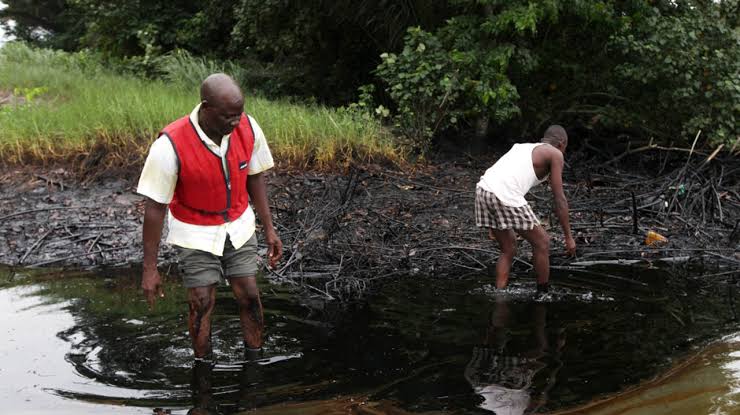
  • Oil spillage ravages Bayelsa

    Oil spillage ravages Bayelsa


    Indigenes of Lasukugbene in Southern Ijaw Local Government Area of Bayelsa State have lamented the adverse impact of crude oil leakage from an oil facility owned by Nigerian Agip Oil Company, NAOC.

    The natives are also calling on the oil firm to contain a second spill point from last month’s leakage from the Tebidaba/Brass Agip Trunk Line, which spewed crude into the aquatic environment.

    The facility, which was laid in the swampy environment in1974, according to the locals, has not been replaced by the operator.

    A Save-Our-Soul by the leadership of the community as contained in a field report by Environmental Rights Action/Friends of Earth Nigeria, ERS/FoEN, obtained by Vanguard read: “Lasukugbene community is on the verge of extinction due to the severe oil spillage, which occurred on the Tebidaba/Brass Agip Trunk Line.”An indigene of the area, Mr. Amos Ininimikiye, said though they noticed the spill on February 3, 2022, and duly informed Agip, “it was last Saturday that they were able to locate the actual spill point through the assistance of community folks.


    “They came with swamp buggie and, in the presence of the regulators and military, excavated the spot. And it was discovered that the exposed section of the pipeline was leaking right from under. There was another spill point not far from this excavated spot, but they refused to visit that spill point.”

    Also speaking, General Secretary of the community, Mr. Valiant Jackson, said: “Lasukugbene is suffering from lack of drinking water due to the current oil spill. Being a fresh water environment, the Nun River and surrounding swamps serve as our sources of drinking, especially as we are in dry season.

    It is serious. “The Nun River and swamps, including farmlands have been affected by the oil spill. Another impact of the current oil spill is the destruction of aquatic lives. Fishes and crabs are dying. As a fishing and farming community, this will have great impact on our means of livelihood and even health.

    “Our people have been reduced to the level whereby instead of sellers of fish, we now buy frozen fish from the city to the community. Also, instead of drinking from our natural source of water (the Nun River), we now buy sachet water for drinking. Fishing gears are affected by the oil spill. Even the air we breathe has been affected.

    “If not for the presence of NOSDRA and Ministry of Environment, Agip workers sent for this work last Saturday would have returned without identifying the ruptured spot on the company’s pipeline.

    “They claimed and insisted that there was nothing like a fresh oil spill, alleging that crude oil spreading in the environment was from an old spill, as against the position of the community.

    “At the end, the exact spot was identified and excavated. The exposed pipeline revealed rupture, as it was leaking right under the pipe. Everybody present saw it and all agreed that the leak was as a result of equipment failure.”

    (vanguard)

  • 100 million litres of fuel adulterated


    The Federal Government through its Nigerian Midstream and Downstream Petroleum Regulatory Authority may return to the overseas supplier, the contaminated Premium Motor Spirit, popularly called petrol, which was imported into the country by the Nigerian National Petroleum Company Limited.

    Oil marketers estimated that about 100 million litres of contaminated petrol were imported into Nigeria and had been recalled by the Pipelines Product Marketing Company, a subsidiary of the NNPC.

    The recall caused severe queues in Abuja, Lagos, Niger, Nasarawa and many other states, as the few petrol outlets that dispensed products were crowded by motorists and other PMS users.

    Many other filling stations were shutdown on Tuesday for lack of products to sell, while black marketers greeted various major roads in Abuja, selling products to interested consumers.

    It was also gathered that though efforts were being made to address the concerns, the queues and shortage of petrol might drag till this weekend.

    The NMDPRA said in a statement it issued in Abuja that limited quantity of PMS with methanol quantities above Nigeria’s specification was discovered in the supply chain.

    NNPC increases supply to bridge supply gap, recalls polluted fuel

    It said methanol was a regular additive in petrol and usually blended in an acceptable quantity, adding that contaminated product had been isolated.

    The statement read in part, “To ensure vehicular and equipment safety, the limited quantity of the impacted product has been isolated and withdrawn from the market, including the loaded trucks in transit

    “Our technical team in conjunction with the NNPC Limited and other industry stakeholders, will continue to monitor and ensure quality petroleum products are adequately supplied and distributed nationwide.

    “The source supplier has been identified and further commercial and appropriate actions shall be taken by the authority and the NNPC Limited. The NNPC Limited and all oil marketing companies have been directed to sustain sufficient distribution of petrol in all retail outlets nationwide.”

    Nigeria does not refine crude oil due to the dormancy of its refineries, hence the NNPC imports the commodity from international refiners. This implies that the source supplier is an overseas firm.

    The NMDPRA further stated that the NNPC had intensified efforts at increasing the supply of petrol into the market in order to bridge any unforeseen supply gap.

    When specifically asked whether the NNPC would return the contaminated petrol to the supplier, its spokesperson Garba-Deen Muhammad, referred our correspondent to the NMDPRA statement where it talked about the identification of the source supplier.

    Also, industry sources stated that the standard thing to do was to inform the source supplier and possibly return the product to it based on the terms of agreement reached between parties.

    On measures adopted to ensure that the product did not further get to consumers, the National President, Independent Petroleum Marketers Association of Nigeria, Debo Ahmed, stated that IPMAN had alerted all its units.

    Fuel queues at a filling station in Lagos. Photo: Stanley Ogidi

    He said, “We’ve discussed with all our zonal and unit chairmen to tell their members not to sell the products. And some of the products that got to the depots were not released to the public.

    “So on our part we’ve taken that precaution and we are waiting for the PPMC to call the trucks back to evacuate the products. So majority of the products are in the depots.”

    On whether the volume of the contaminated products was much, Ahmed replied, “Well, I don’t know the exact volume, but what I know is that we lifted from various depots in Lagos. But we don’t know the quantity, they say it is about 100 million litres or so.”

    On ways to avoid a recurrence of such situation, Ahmed stated that the agencies of government should carry out thorough inspection on products before releasing them to the Nigerian market.

    He said, “The PPMC has the whole gamut of officers, the NMDPRA has to take care of the quality through its sections on quality and safety. And even at the depots, before they load, there should be preloading and after-loading inspection.

    “They have to know the quality of the product before sending it out. But I think there was a mix-up somehow and the PPMC has already accepted that it is from their place and that they will evacuate the whole product.

    “So they stopped most of the trucks from going out when they discovered the situation and these trucks are right now in the depots.”

    On his part, the President, Petroleum Products Retail Outlets owners Association of Nigeria, Billy Gillis-Harry, said PETROAN was still looking for solutions to address the scarcity caused by the imports of contaminated products.

    He, however, noted that the queues across the country might drag till the weekend, as the impact of the recalled products would be felt in the supply chain.

    “We are trying to see how the situation can be remedied so that the country don’t run into any kind of crisis, but we see it dragging and hope that before the close of this week we will find a solution to it,” he stated.

    Implications of contaminated fuel

    An energy law specialist, Prof. Dayo Ayoade, told our correspondent that aside from the huge adverse environmental impact of such contaminated fuel, the product had already knocked the engines of some motorists.

    He said, “It is a big issue because the contaminated fuel has to be taken out of the system. It has to be extracted from the filling stations and depots and disposed off. This is because since it is contaminated, you can’t sell it to another person.

    “It has to be disposed in an environment that is sustainable, and in a proper manner. Now, do we have the equipment to properly take care of this contaminated fuel? That is a big issue.

    “Secondly, there is the issue of who is liable for the cost of replacement of the engines that have knocked? Because contaminated fuels have negative impact on engines and I heard that the engines of some customers have knocked.”

    But when asked if the NNPC would compensate motorists who had already used the contaminated petrol, the spokesperson for oil firm, Garba-Deen Muhammad, declined comments.

    Falana, Adegboruwa ask NNPC to compensate motorists

    Meanwhile, some senior advocates and rights activists have called on the NNPC – which is the sole importer of petrol – to compensate motorists who bought adulterated fuel.

    A senior advocate, Mr. Ebun-Olu Adegboruwa, said the government was wrong to have given the NNPC the monopoly of petrol importation.

    Adegboruwa said the oil firm cannot escape liability.

    He added, “If it is confirmed that there’s negligence on the part of the importer of the petroleum products, surely all those who bought the fuel are entitled to pursue their remedies against the agency especially where it affects vehicles among others.

    “They would be liable and this is because they have the monopoly of importing petroleum products to the country. So the citizens are limited in terms of their choice and so in that regard they have the responsibility of ensuring that they import what is suitable for use by the consumer.

    “The NNPC can’t escape being held liable and not just the NNPC, I think the government itself and the reason is because there’s no reason to monopolise the importation of petroleum products. Also, the reason we are experiencing this is because the government has failed to repair our refineries.”

    Also in a chat with The PUNCH, Mr. Femi Falana (SAN), said the NNPC must compensate those who bought the contaminated petrol.

    Falana advised victims to lodge a complaint with the Federal Competition and Consumer Protection Commission.

    He said, “The NNPC has to compensate consumers. They (consumers) should lodge a complaint with the consumer protection council. Victims can institute an action against the NNPC. The NNPC also has the right to sue those that sold the fuel to them.”

    Another senior advocate, Norrison Quakers, said it was irresponsible for the NNPC to have imported contaminated fuel, adding that they could be dragged to court for doing so.

    Quakers further argued that the marketers who bought the petrol from the NNPC ought to be compensated as well.

    The senior advocate added, “If I was an independent marketer and I bought the product from NNPC for the supply and suddenly it turned out to be adulterated fuel , the NNPC is duty bound to reimburse and compensate me for my loss. I could start first with an administrative process to demand for the reimbursement and when they refuse to do that I can now institute an action in that regard because I bought it from them.

    “Secondly, a car owner who goes to a filling station to buy petrol and his car develops a fault because some cars are very sensitive, can sue the supplier as well as the NNPC. It’s like a chain; you identify the primary source and the secondary. Honestly, it is highly irresponsible for the NNPC to have imported adulterated fuel. It means standards have really declined. How do you determine the fuel that is being sold, is it not at the point of purchase?

    “How do you end up buying adulterated fuel of that magnitude? Those are questions begging for answers. The president must intervene, heads must roll. It is quite painful in the age of the way we do things in this country.”

    Also in a chat with The PUNCH, the Executive Director, Civil Society Legislative Advocacy Center, Ibrahim Rafsanjani, said this was scandalous to Nigeria, calling on the anti-corruption agencies in the country to investigate the matter.

    He said, “I think this is an indictment on the NNPC, the sole importer of petroleum in Nigeria. They must be made to account for how it happened. Taxpayers’ money is used to import this petrol. This also goes to show the poor regulatory and supervision mechanism.”


    (Punch)

  • SERDEC demands justice, empowerment for FCT indigenes


    A civil society organisation, the Socio-Economic Research and Development Centre, SERDEC, Tuesday, called on the federal government, agencies and international bodies to put an end to what it called the marginalization and economic injustice being perpetrated against the Original Inhabitants, OIs, in the Federal Capital Territory, FCT.

    The group made the call at the launch of the project, “Promoting the rights of the Original Inhabitants in the Federal Capital Territory,” in Abuja.

    The project, supported by the MacArthur Foundation through the Resource Centre for Human Rights Education, CHRICED, has a two-year timeline under the Equitable Recovery Grant to work for ethnic injustice as it concerns the marginalized indigenes of the FCT.

    Addressing newsmen at the event, Executive Director, SERDEC, Mr Tijani Abdulkareem, said the project “will enhance equitable access to employment and empowerment programme information to all sections of OIs unemployed young women and men in order to support their enrolment into government programmes.”

    At the end of the project cycle in 2023, Abdulkareem said a good number of unemployed youths and women spread across the six Area Councils of the FCT “will benefit from the equitable process of empowerment and employment programmes that are being implemented by government agencies.

    He bemoaned the “statelessness” of the FCT saying as a result, “the original inhabitant communities find themselves building feelings of alienation, frustration and bitterness arising from inequitable access to state opportunities.”

    Also speaking, the Alkali of Rubochi community, Alhaji Yakubu Kure lamented what he called the lack of job opportunities for indigenes of FCT despite the fact that unlike in the past, they now boast of hundreds of thousands of graduates in various fields.

    He dismissed the notion that OIs prefer to sell their lands to non-indigenes for-profit purposes.

    According to him, “We have been deprived of our lands in the past but as peaceful people; we often relocate because we are not enemies of progress. We are traditionally farmers.

    “Government should come to our aid by providing job opportunities for our children. That way, some of the agitations you see today will die naturally,” he added.

    On his part, Dr. Mahmud Jibril, board chairman of SERDEC said the Gbagyi communities in Nigeria deserve a state of their own, lamenting that though they are present in large numbers in FCT, Plateau, Niger, Kaduna, Kogi and Nasarawa states, they are being treated as minorities in the allocation of government resources.


    (Vanguard)

  • Finance minister, others face committal trial today


    Abuja division of the National Industrial Court (NIC), Abuja, will, today, hear an alleged contempt suit filed by medical doctors operating under the platform of Association of Specialist Medical Doctors in Academics (ASMEDA).

    The doctors filed the action against the Minister of Finance, Zainab Ahmed, over alleged disregard to court order.

    Also joined in the motion on notice for committal for contempt of court marked: NICN/ABJ/145/2021, before Justice Osatohanmwen Obaseki-Osaghae of NIC, include the Chairman, National Salaries, Incomes and Wages Commission (NSIWC), Ekpo Nta and Account General of the Federation (AGF), Ahmed Idris.

    The court had, on July 23, 2021, in an exparte motion, moved by counsel to the claimants, Martin Agba, ordered the defendants to pay the doctors based on the Consolidated Medical Salary Structure (CONMESS) and the Associated Allowances.

    The salary was approved by the Federal Government on September 29, 2009, which was the status quo, pending the determination of the suit.

    But the claimants averred that from August 2021 till date, the defendants were yet to fully comply with the said order.

    The claimants, Christopher Sakpa, Momoh Mcsionel, Ahmed Rabiu and Darlington Akukwu, had, for themselves and on behalf of the affected members of ASMEDA, filed the motion against the defendants.

    The NSIWC, AGF and finance minister are 1st to 3rd defendants respectively in the motion on notice dated January 18 and filed by Agba on January 26.

    The claimants had sought an order for leave of the court to proceed with committal proceedings for disobedience to its order “made on July 23, 2021 against the executive chairman of the 1st defendant, chief executive officer of the 2nd defendant and the person of the 3rd defendant.

    “An order of the court for committal of the named principal officers of the defendants for their disobedience, jointly and severally, to the interim restraining and mandatory orders of injunctions of this court made 23rd July 23, 2021, and served on all the defendants on or about July 28, 2021.”

    The claimants prayed the court to proceed on the committal proceedings on the grounds that the court granted all their reliefs directing the defendants to restore them to the status quo as at April 2021 on the CONMESS and associated allowances pending the hearing and determination of the motion on notice.

    They said the enrolment order of the court was duly served on the defendants on or about July 28, 2021, followed up by an official letter dated, August 9, 2021 by their lawyer, urging the principal officers of the defendants to comply but failed to do so.


    (Vanguard)

  • Buhari pledges to support Nigerian Private Sector with Infrastructure.

    President Muhammadu Buhari, Thursday, pledged to continue to support the Nigerian private sector with policies and programmes to propel it toward higher investments and productivity in the various sectors of the economy, even as he acknowledged that economic policies of his administration are indeed working.

    Buhari, who spoke at the official commissioning of line 4 of the new BUA Cement 3MTPA plant in Sokoto, said he was excited to be back to the facility 37 years after he commissioned its line 2 in 1985.

    “The commissioning of this multimillion Naira plant today is an indication that our policies are working. As a government, we have continued to introduce policies to support private sector investments to achieve food self-sufficiency, artisanal gold mining and cement production, among others.

    “It is against against this backdrop that we have started the Abuja, Kaduna Kano (AKK) gas pipeline project to ensure that gas is available to all investors in order to reduce their cost of production.” Buhari said.

    The president said his government was also investing in road and railways infrastructure , all in a bid to reduce the cost of doing business in the country, stressing that the Federal Government would not relent in its effort to improve on security and ensure it wins the battle against criminal elements working against the collective interest of the nation.

    Buhari, however, called for stronger collaboration between the private investors and his government to ensure that the nation’s economy becomes more competitive among others.

    Commenting on the investment by the BUA Group, the Nigerian leader said its huge investment across the country was an indication that it is a firm believer in the Nigerian project, adding that BUA and other investors have made Nigeria self sufficient in cement.

    “ BUA is creating employment and it is indeed the largest employer of labour in the North West” the president said , while promising to continue to assist Nigerian entrepreneurs.

    In his welcome address, Executive Chairman of BUA Group, Alhaji Abdul Samad Rabiu, said the company has a vision to support government’s infrastructure agenda by ensuring it used locally available raw materials to produce cement in Nigeria.


    (Sun)

  • FG Promises 50% infrastructural support to oil marketers

    FG Promises 50% infrastructural support to oil marketers


    The Federal Government on Monday met with oil marketers in the downstream sector to perfect plans for the full deployment of autogas in filling stations and the conversion of 200,000 commercial vehicles to run on gas this year.

    At the meeting, which was convened in Abuja by the Minister of State for Petroleum Resources, Chief Timipre Sylva, the government unveiled the 2022 Framework for the deployment of CNG (Compressed Natural Gas, popularly called autogas) in Nigeria.

    Senior officials of the Major Oil Marketers Association of Nigeria, Depot And Petroleum Products Marketers Association of Nigeria, as well as other key players in the downstream sector attended the meeting.

    Sylva told his guests that the government was out to ensure that it made available the alternatives required before the removal of subsidy on Premium Motor Spirit (petrol), stressing that the deployment of autogas was one of such key alternatives.

    He also stated that the government would be supporting them with 50 per cent of the conversion kits to fast-track the process, adding that additional support as required would be given, going forward.

    “We said we must provide alternative fuel and the alternative that we concluded on was the autogas alternative. To provide it for our people,” he stated.

    He added, “Since this agreement between us (government and marketers), a lot of work has been going on and we have come to a certain point where we need to take it further. But we cannot move further without ensuring that you as our partners are fully on board.”

    In the framework, the government explained that with abundant gas reserves of about 206.53 trillion cubic feet, a population of about 200 million people, and the enactment of the Petroleum Industry Act, which eliminated the continuous absorption of petrol subsidy, it was now vital to deploy autogas.

    It stated that its priority now was the rapid and strategic introduction of Natural Gas Vehicles as an alternative fuel for transportation in Nigeria in line with the approved National Gas Policy.

    “This will pave the pathway to full deregulation of the downstream petroleum sector in Nigeria, while reducing the effect of deregulation on transportation costs,” the document read in part.

    It added, “The Ministry of Petroleum Resources was charged with the responsibility to provide autogas (LPG, CNG, LNG) as an alternative and competitive fuel for mass transportation

    “CNG was selected as the fuel of choice because it holds a comparative advantage due to its ease of deployment, its comparatively lower capital requirements, commodity’s supply stability, existing in-country volumes, and local market commercial structure which relies predominantly on the naira.

    “Hence a single track CNG deployment is proposed in the initial phase and other alternatives can be considered as the market attains maturity.”

    Three implementation options were highlighted in the document, as the government stated that in the first option, its target was to convert one million public transport vehicles and install 1,000 refueling centres within 36 months.

    For the first 18 months it targets to achieve 500,000 conversions and 580 refueling centres supplied by five Original Equipment Manufacturers, among other targets.

    In the plan, the government targets to convert 200,000 commercial vehicles this year, including tricycles, cars, mini-buses and large buses.

    The cities captured in Phase 1 of the project include Abuja, Kaduna, Kano, Kogi, Kwara, Lagos, Ondo, Oyo, Edo, Delta, Bayelsa, Niger, and Rivers.

    Cities under Phase 2 were listed as Sokoto, Katsina, Jigawa, Borno, Bauchi, Gombe, Yobe, Osun, Ekiti, Enugu, Anambra, Imo, Cross River, Abia, Akwa Ibom and Plateau. For Phase 3 cities, they were listed as Kebbi, Zamfara, Yobe, Gombe, Taraba, Adamawa, Benue and Ebonyi

    On the selection criteria for network operators, the government stated that the marketer must own and/or operate a minimum of 21 stations nationwide.

    The dealer must own and/or operate a minimum of five stations in each proposed city and must be willing to demonstrate creditworthiness and the ability to pay back within the stipulated timeframe.

    The Executive Secretary, MOMAN, Clement Isong, told the minister that marketers were willing to partner with the government and expressed delight in the government’s resolve to support marketers with 50 per cent of the required conversion kits.


    (Punch)