Category: Opinion

  • Gov. Soludo’s Ultimatum and the Battle for Anambra’s Mondays

    Gov. Soludo’s Ultimatum and the Battle for Anambra’s Mondays

    By Christian ABURIME

    Anambra State Governor, Prof Chukwuma Charles Soludo has ordered the immediate shut down of the Onitsha Main Market for one week, following defiance of the market leadership to open, against government directive.

    Governor Soludo’s order for a one-week shutdown of the sprawling market is more than an administrative penalty. It is the latest, and perhaps most drastic, salvo in a protracted war over who controls time and economic life in Southeast Nigeria on mondays. The enemy is the long-standing, fear-enforced Monday sit-at-home order, a ghostly mandate from non-state actors that has strangled businesses and normalized weekly monday sit-at-home for years.

    The Governor’s move is a direct response to what the government sees as baffling defiance. Despite repeated assurances of enhanced security and appeals to reclaim public spaces, many traders at the iconic market again chose to keep their stalls locked. Their absence was a quiet rebellion, but one that spoke volumes about the lingering climate of apprehension.

    “The government cannot stand by while a few individuals willfully undermine public safety and disregard official directives meant to restore normalcy, this is plain economic sabotage. We are not going to allow this”, Governor Soludo stated, framing the closure as a protective measure for the “law-abiding citizen.” But his subsequent warning carried the weight of an escalating ultimatum: if the market does not reopen for business after this one-week shutdown, it will be sealed for a month. “And so on and so forth,” he added, drawing a line in the sand.

    “You either decide that you are going to trade here or you go elsewhere. I am very serious about this”, the Governor insisted.

    The scene at the market was one of tense enforcement. A joint task force of police, army, and other security personnel moved swiftly to secure the perimeter, turning away the few hopefuls who approached.

    For the Soludo administration, the solution is unwavering enforcement to break a psychological barrier. The strategy is clear: make the cost of compliance with the illegal sit-at-home order higher than the fear that drives it. By targeting the economic heart of the region, the government aims to trigger a collective shift in behavior, betting that the traders’ desire to trade will ultimately outweigh their fear.

    As the gates remain locked this week, the standoff in Onitsha encapsulates the broader struggle in the Southeast. It is a fight over normalcy, authority, and the fragile psyche of a populace caught between enforced directives and imposed orders. When the gates are scheduled to reopen next Monday, all eyes will be on the traders. Will they return to their stalls, emboldened by the state’s show of force? Or will the silent, empty aisles deliver a different verdict?

    The answer will determine not just the fate of a market, but the rhythm of life in Anambra for Mondays to come.

  • Honours, Memory, and Those Yet to Be Honoured – By Osita Chidoka

    Honours, Memory, and Those Yet to Be Honoured – By Osita Chidoka

    When President Bola Tinubu announced the Democracy Day honours list in 2025, many Nigerians, myself included, assumed that evident omissions would be addressed in subsequent rounds of national recognition. That expectation now appears difficult to sustain. The recent conferment of the Grand Commander of the Order of the Niger (GCON) on a businessman whose career included close association with the Abacha era – however complex or commercially distinguished his later record – sits uneasily beside the continued silence surrounding many Nigerians who directly confronted military rule, often at the cost of detention, exile, or death.

    I raise this issue as an eyewitness to the struggle and a participant in its most perilous years. I served as Coordinator of the Youth Wing of the Eastern Mandate Union (EMU). I was present at EMU’s inaugural meeting at the Enugu residence of Arthur Nwankwo, with Patrick Dele Cole and Chuba Okadigbo as the intellectual arrowheads. It was at that meeting that Nwankwo was proposed and accepted as Chancellor of EMU. Liyel Imoke and Greg Mbadiwe are living witnesses to those early days.

    EMU, like NADECO, emerged in early 1994 to demand the de-annulment of June 12 and the restoration of a stolen mandate. Like NADECO, EMU issued an ultimatum to the Abacha regime. Only EMU was met with a 24-hour deadline to recant or face the full weight of the law. We did not. The consequences were swift. EMU leaders, Arthur Nwankwo and Udenta O. Udenta, were arrested and detained for over a week. Others, Chuba Okadigbo, Patrick Dele Cole, Polycarp Nwite, and the late Dubem Onyia, EMU’s tireless Secretary, were hunted for months and forced underground.

    Between 1994 and 1998, Nwankwo and Udenta endured more than five arrests and detentions. EMU leaders and younger stalwarts paid in lost livelihoods, truncated careers, interrupted education, physical distress and mental anguish. I nearly missed graduation in 1995 if not for the benevolence of the late Mrs Adichie, then Registrar of the University of Nigeria.

    Our democracy is dying in the hands of President Bola Tinubu and his hybrid regime – Prof. Udenta Udenta
    Prof. Udenta Udenta

    EMU’s emergence nationalised the June 12 struggle. It lifted the cause beyond regional or ethnic lines and anchored it as a Nigerian democratic imperative. That transformation culminated in 1997, when the entire AFENIFERE leadership travelled by night bus to the EMU chancery in Enugu.

    Led by Abraham Adesanya, the delegation included Bola Ige, Ayo Adebanjo, Solanke Onosanya, Olaniwun Ajayi, Kofo Akerele-Bucknor, Ayoka Lawani, Femi Okorunmu and others. I witnessed their arrival and the deliberations that followed. That Enugu meeting rebirthed NADECO as a truly national front. Leadership was recomposed: Anthony Enahoro as overall leader (including the Diaspora); Abraham Adesanya as Chairman (Nigeria); Arthur Nwankwo as Deputy Chairman (Nigeria); and Dan Suleman as Vice Chairman. EMU leaders – Udenta Udenta, Francis Ellah, Chike Obi and others – formed the backbone of the National Executive.

    Prof Udenta, in particular, represented EMU in NADECO’s engagements with the international community and major embassies, holding forth when colleagues were detained and serving as the most visible face of the resistance between 1996 and 1998. He would later emerge as the National Secretary of the Alliance for Democracy.

    It was also through EMU, partnering with NADECO, that the Commonwealth Ministerial Action Group (CMAG) submission for the Edinburgh meeting in 1997 was authored, tightening international pressure on the junta. By then, the democratic struggle rested on a triumvirate: AFENIFERE in the South-West, EMU in the East, and NEPU-PRP in the North. The day Balarabe Musa and Prof Bala Usman visited the EMU Chancery in Enugu, I was part of the reception team.

    My own engagement was not abstract. In 1993, I placed a newspaper advert—funded by my father—urging Nigerian students to vote for M.K.O. Abiola. That led to my first meeting with Abiola in Lagos, facilitated by Stanley Egbochukwu. He introduced me to Kudirat Abiola and his aide, Fred Eno, and asked me to help align student leadership with the mandate struggle.

    I was part of a small team that met regularly at Dr Edwin Madunagu’s office at Rutam House to push for the de-annulment of the June 12 result. My article, Pondering Over These Times, rebutting Peter Enahoro’s famous article A Time to Ponder, appeared in the final edition of The Concord before it was shut down by the junta.

    After the Epetedo Declaration, I served as liaison between Kudirat Abiola and Arthur Nwankwo. Shortly after one of my visits, Fred Eno was arrested and disappeared; months later, I traced him to Enugu prison, bringing relief amid fears he had been killed. Those were the stakes.

    EMU’s voice also drew attention at the highest levels. In 1995, Olusegun Obasanjo led his National Unity Organisation to parley with EMU; he was soon arrested and detained. EMU was among the most vocal platforms demanding the release of Obasanjo and Shehu Musa Yar’Adua—records attest to this.

    In 1998, as Abacha’s grip weakened, Arthur Nwankwo and Udenta Udenta were detained again; plans were underway to move them to Abuja when Abacha died, abruptly ending that chapter.

    These are not claims; they are facts – documented, witnessed, and verifiable. This is why the silence on EMU and the continued absence of names like Arthur Nwankwo, Udenta Udenta, Chike Obi, and others from Nigeria’s highest honours matter.

    It is time to complete the record. Nigeria should recognise Arthur Nwankwo and Udenta O. Udenta; Patrick Dele Cole and Chuba Okadigbo; and, posthumously, Dubem Onyia, Polycarp Nwite, Balarabe Musa, Prof Bala Usman, and others who gave NADECO a national character and paid dearly for it.

    Democracies endure by memory. Selective remembrance weakens the republic; full recognition strengthens it.

    Osita Chidoka
    21 January 2026

  • Shettima’s Passive Presence in Discussions About His Own Political Future

    Shettima’s Passive Presence in Discussions About His Own Political Future

    -By Abdul Mahmud

    Fresh political whispers drifting through news salons and media columns suggest that President Bola Ahmed Tinubu is quietly weighing alternative running mates ahead of the 2027 presidential election. The names most frequently mentioned are not obscure. They are prominent northern Christian figures with national visibility and symbolic weight.

    Former Speaker of the House of Representatives, Yakubu Dogara; Defence Minister, General Christopher Musa. Plateau State Governor, Caleb Mutfwang. And the Catholic Bishop of Sokoto, Matthew Hassan Kukah. The whispers share a common thread. They frame the alleged weighing of alternatives as part of a larger political calculation around religious and regional balance after the controversial Muslim-Muslim ticket of 2023. They also point to an inner circle that appears to be thinking ahead, testing options, and perhaps sending signals without formally committing to any course of action.

    The first sign came when campaign posters bearing President Tinubu’s image began appearing across the streets of Abuja, conspicuously without any trace of Shettima. Amid the whispers stands Vice President Kashim Shettima, elected on the same ticket as Tinubu, serving a mandate that runs concurrently with the President’s, and who, by constitutional logic and political convention, ought to be presumed the natural running mate in 2027 unless compelling reasons suggest otherwise.

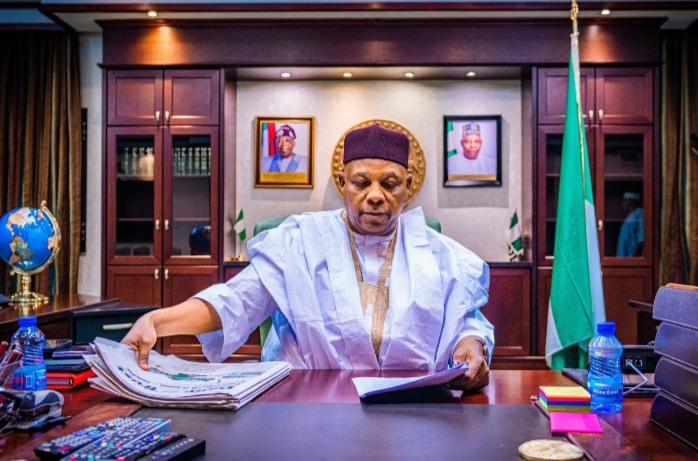
    VP Kashim Shettima

    What makes the current moment intriguing is not simply that names are being mentioned. Politics thrives on rumours after all. What shocks observers of the polity is the manner in which the Vice President appears reduced to a passive presence in discussions about his own political future. At one moment, he is treated as an afterthought; and at another moment, as a loyal functionary dispatched on errands while others debate whether he remains relevant to the project he helped midwife. The image calls to mind Oblomov in Ivan Goncharov’s novel, Oblomov. A character defined by inertia and resignation. A man whose life unfolds around him while he lies still, allowing others to decide what becomes of his estate, his relationships, and his destiny. When Shettima is not rendered invisible in elite conversations, he is portrayed as a man running presidential errands but without real agency. Flying out to represent the President. Receiving delegations. Offering dutiful loyalty, while the central question of his political fate hangs unresolved, sometimes discussed in rooms he has just exited and sometimes in rooms he may never enter.

    The irony is sharp. Shettima is not a novice. He is a former governor, and a seasoned party man. He was not selected in 2023 as a brooch fastened to presidential clothing or an ornamental addition. He was chosen despite strong objections from many quarters, including religious leaders and civil society voices who warned against the dangers of the same-faith ticket in a deeply plural country. Those warnings did not dissipate after the election. They lingered. They hardened into criticisms that have followed the administration. International partners, including voices from the United States, have made careful but pointed remarks about inclusion and representation. At home, the perception that Christian constituencies, especially in the North, felt alienated continued to shadow the government. The renewed circulation of alternative running mates must be read against this background. It signals an attempt to correct a political imbalance that many believe cost the ruling party moral capital. By floating respected northern Christian figures, Tinubu’s presidency appears eager to reassure sceptical audiences that lessons have been learned and that the future will look different. Still, the so-called attempt at weighing alternatives raises serious questions about political ethics and loyalty. What does it say about the stability of presidential and vice presidential partnerships when a sitting vice president is treated as expendable barely midway into the first term in office? What message does it send to party loyalists who defended the 2023 ticket at great personal cost? And what precedent does it set for the future?

    The Constitution grants the President wide latitude in selecting a running mate. That power is not in dispute. Political wisdom, however, demands more than constitutional permissibility. It requires sensitivity to process, respect for incumbents, and an understanding of how power is perceived as much as how it is exercised. There is also a deeper institutional issue at play. The office of the Vice President in Nigeria has long suffered from ambiguity. Its occupant is either overly powerful, a spare tyre that is painfully useless, or surplus to requirements. Rarely is there a stable middle ground defined by clear responsibilities and mutual respect.

    From Obasanjo’s frosty relationship with Atiku Abubakar to Buhari’s cautious sidelining of Professor Osinbajo, history offers little comfort. Shettima’s predicament fits neatly into this pattern. He is visible but constrained. Present but peripheral. Trusted enough to represent the President abroad, but seemingly not trusted enough to be shielded from speculation about his replacement. The mention of figures like Dogara, Mutfwang, Musa, and Kukah adds further layers to the conversation. Dogara brings legislative gravitas and a record of defying party lines on principle. Mutfwang represents a Christian minority state scarred by violence and neglect. Musa embodies military professionalism at a time of persistent insecurity. Kukah symbolises a strain of moral authority whose polish has worn thin, weakened by his muddled interventions on claims of Christian genocide in Nigeria. Each name appeals to a different constituency. Each underscores what the current ticket lacks in the eyes of critics.

    What remains missing is an honest conversation about governance performance. Electoral arithmetic alone cannot substitute for accountability. If the administration believes that changing the face of the ticket will cure deeper discontent, it risks mistaking symptoms for causes. Nigerians are burdened by inflation, insecurity, and a sense of economic drift. No vice presidential reshuffle can obscure these realities. For Shettima himself, the moment demands clarity and resolve. Silence can be dignified, but prolonged silence in the face of open speculation risks being read as acquiescence. Political survival in Nigeria rarely rewards quiet endurance and favours strategic assertion. More’s the pity for a Vice President who finds his future debated as an abstraction rather than being confronted as a political fact. More’s the pity for a power order that normalises such uncertainty at the heart of presidential power. And more’s the pity for a country whose politics revolves around personalities and permutations rather than the hard work of governance.

    Whether these discussions are trial balloons or serious plans, they reveal an administration already looking beyond its present mandate. That alone should give pause. Power is most effective when it is anchored in purpose, not perpetually distracted by succession. But do Tinubu and his goons care?

  • Love Other Ethnic Groups, But Prepare Against Political Revisionist – Part 1

    Love Other Ethnic Groups, But Prepare Against Political Revisionist – Part 1

    By Benjamin Okorie Ajah, PhD


    My personal experiences, both within and outside the country, compel me to write this post. Before delving into the meat of my post, I would love to state that I have close and wonderful friends across different ethnic `groups in Nigeria, starting from the Yoruba to the Hausa, from the Tiv to the Jukum, the Fulani to the Ijaw, etc. Instructively, countless people from other ethnic groups have played immeasurable roles in defending the Igbo.


    I never knew how deep the revisionists have gone in demarketing and projecting the Igbo as the only problem of Nigeria. In fact, it appears to be a grievous crime to be an Igbo. I had little experience of the extent the revisionists have gone in projecting the Igbo as the only problem of the country when one of my schoolmates in law school was telling me how he hates the Igbo, thinking that I’m an Ijaw man. When I asked him whether he had lived among the Igbo or transacted with them, he said no. I then told him that it is funny to hate people he never transacted nor lived with and reminded him that I’m Igbo and not Ijaw, as he had believed. He became uncomfortable and gradually petered out of our relationship.


    Unfortunately, I encountered deeper collateral damage the revisionists want to cause the Igbo on the course of traversing other universities outside Nigeria. It was in Kampala International University in Uganda that someone who claimed to be educated was besmirching the Igbo in my presence without minding that I’m Igbo. He specifically accused the Igbo of being the only tribe in Nigeria who are not only tribalistic and domineering but also the only tribe doing drug and human trafficking and internet fraud. He cited the case of how Peter Obi won the majority of his votes from states with a significant Igbo presence. When I reminded him that the Igbo voted massively for Obasanjo in 1999 and 2003. They repeated the same by voting massively for Yar’Adua in 2007 and Goodluck Jonathan in 2011 and 2015, respectively. I then asked him, how come it became tribalistic for the Igbo to vote for a candidate who they believe was the best? I reminded him that even the principle of zoning and justice demands that the president should come from the southeast. He became uncomfortable.


    When I attended a conference at the University of Leeds, UK, an Afrikaner asked me why the Igbo are practising cannibalism in Nigeria. I probed him to find out how he got his information; it happened that a Nigerian history professor told him negative things about the Igbo. I took time to re-educate and enlighten him about the situation of the country and how the political class are using divisional tendencies to strengthen their hold onto power.


    In the University of Pretoria and the University of South Africa—all in South Africa—some South African scholars were made to think that it is only the Igbo who are committing crimes within and outside Nigeria. They had been told that the Igbo are the ones committing crimes in their country. I had to re-educate them and bring to their attention that criminality has no ethnic colouration. I equally cited known cases of Nigerians arrested in South Africa for drug and other crimes that are not Igbo.


    When I visited the National University of Lesotho, I discovered that Basotho people were told similar negative stories about the Igbo like they did in South Africa, I had to equally reeducate them and cited known cases of Nigerians who committed crimes in their country that are not Igbo.


    The same trend reared its ugly head when I visited Côte d’Ivoire.


    Having said that, the revisionists are bringing the same energy they are using outside Nigeria to the fore to put the national political desire of the Igbo to the guillotine, of which I know they won’t succeed. Just recently, they brought about the history of the civil war on January 15, 2026, stating that only the Igbo military officers assassinated northern and southwestern political leaders and intentionally ignoring to state that the coupists comprised people from the Igbo, the Yoruba, and the North. Even a Hausa man was among the coupists. They intentionally refused to state the pogrom and genocide committed against the Igbo and other ethnic groups that share similar identities with the Igbo as a result of such misclassification.


    Now, the government revisionists want other Nigerians to believe that the Igbo are the only ethnic group demarketing Nigeria and that some random IPOB apologists are behind the classification of the Igbo by the US as a country of particular concern. They are doing that but intentionally ignore stating that an Igbo woman, Oge Onubogu, was in the US Congress re-educating the US congressmen about the need not to clothe security issues in Nigeria with religious colouration. They intentionally forget to state that the actions and inactions of the political class are what have compounded our security situation.


    The same revisionists are working hard to tribalise Peter Obi’s candidature, aided by some Igbo politicians who want to get political favour or appointment from the federal government. I’m pretty sure that if Soludo or Umahi, who has been working hard to belong and please the centre, decides to contest for president of Nigeria today, his candidature will be tribalised because it is the approach crafted to keep the Igbo away from becoming the president of Nigeria. They have started claiming that the Igbo cannot be contesting for president while agitating for independence from Nigeria but intentionally refused to mention that other sections of Nigeria are equally agitating for independence. The Oduduwa Republic is being agitated for in the southwest. The middle belt are equally agitating, etc.


    What can the Igbo do?


    It’s time to stop being aloof with what is happening in our political system. Yes, the federal government has not been fair to us and is engineering the revisionists, but we need to sustain a high tempo in countering them with facts devoid of insults and abuses. We equally need to pay attention to our own local political leaders. We need leaders who can offer qualitative leadership and technical know-how to reposition the east to be at the nerve of attracting urgently needed investors. For the political class and their foot soldiers, they can play their politics without demarketing their people in attempt to belong. The patterns of politics played by Mr Osita Chidoka and Mr Peter Mbah, Governor of Enugu State, are examples of how to play national politics without endangering the people you are meant to be representing.

  • Northern Comfort, Southern Complacency: A Tale of Two Elites’ Failures

    Northern Comfort, Southern Complacency: A Tale of Two Elites’ Failures

    -By Abdul Mahmud

    Dr. Bashir Kurfi, a former scholar in Public Administration at the Ahmadu Bello University, Zaria and a man who refuses to bow to orthodoxy, recently observed that the southern elites should protest against the northern elites for bearing the cost of their irresponsibility.

    It is a bold assertion, persuasive precisely because it draws strength from curated memory. For decades, sections of the northern elite have honed the politics of displacement, converting structural failure into a narrative of victimhood and external sabotage. Responsibility is endlessly declaimed or sometimes recast as the fault of history, colonial inheritance, regional imbalance, or the imagined hostility of others. This cultivated habit of excuse-making has become a political craft in itself, a means of masking failure while living in denial. Here, accountability is not merely avoided; it is rendered illegitimate, portrayed as an unfair demand imposed by adversaries rather than a civic obligation owed to the governed. Yet, any temptation to contrast this with the so-called “morally superior southern elites” collapses under closer scrutiny. Self-congratulation has long displaced self-scrutiny, as loud claims of progress, modernity, and enlightenment obscure deeply rooted habits of exclusion, corruption, and moral indifference.

    The language of merit and advancement advanced by both geographical sections of the national elite and their supporters often serves as a convenient alibi, allowing elite capture to proceed under the banner of regional exceptionalism. If the northern elite evade responsibility through grievance, the southern elite evade it through triumphalism. Between the two, the citizen is left with no moral refuge, only competing myths that justify failure while insulating power from consequences.

    Northern elites are celebrated for grandiloquent pronouncements on unity, development, and morality. They promise transformation but deliver stagnation. They speak of education while the region remains a desert of literacy, where enrollment figures mask a mass of uneducated youth and schools crumble under neglect. They preach an agricultural renaissance while malnutrition festers, rural communities are abandoned, and irrigation projects lie in rusting silence. They talk of industrialisation while local economies remain dependent on government largesse from Abuja. Corruption becomes not a scandal but a tradition, a rite of passage into power. Public infrastructure in the north tells the story of neglect more eloquently than speeches. Roads disintegrate, electricity remains a luxury, hospitals are monuments to absence, and clean water flows only in theory. Governors appear with fanfare to inaugurate projects that vanish as soon as cameras leave. Security is presented as a moral and cultural issue, yet decades of failed policing and recurring insurgency are shrugged off as misfortunes. Education, health, infrastructure, and security are left to chance while elites accumulate wealth, power, and prestige. Their failures are exported in blame, and in appeals to history, ethnicity, or religion. Yet, let us not pretend that the southern elite is a repository of competence or integrity. Southern elites enjoy their imaginary moral superiority while indulging in the same incompetence. The South accumulates debts with exuberance, borrows with abandon, and applauds itself for infrastructural projects that collapse within a few years. Governors and legislators steal openly, businesses thrive on political patronage, and the social contract is routinely violated. Health care is underfunded, education is increasingly privatised for those who can pay, and urban centers remain unplanned jungles where life is bestial, brutish and short.

    The southern elites’ failures are conspicuous in their feeble responses to crises. Floods destroy communities where emergency plans are paper buffers. Transport collapses under the weight of bad planning. Electricity is scarce, water is scarce, governance is scarce. They lecture, they condemn, they protest, but poor governance continues. Their moral outrage is selective, their complaints episodic. Corruption in Lagos, Port Harcourt, Ibadan, and other southern capitals mirrors the northern patronage networks in structure if not in style. The southern elite believes it is immune, superior, and innovative, but the truth reveals only adaptation of the same vices to local circumstances. One might ask whether Kurfi’s call has merit if the southern elite cannot even claim competence. Protesting northern failures without confronting southern failures is hypocrisy masquerading as moral indignation. Nigeria is littered with examples of southern elites failing spectacularly. Lagos State owes billions in debts. Rivers State is writhing from elites’ fights over its resources. Delta and Edo States oscillate between grandiose declarations of development and the steady reality of urban chaos. The elites’ ability to amass wealth contrasts sharply with their failure to build enduring legacies.

    Northern elites fail by neglect, southern elites fail by indulgence. The north deflects blame to the past and to others, the south revels in self-flagellation while repeating the same patterns. Both elites perpetuate poverty, insecurity, and underdevelopment. Both exploit ethnicity, religion, and regional sentiment to distract citizens from their failures. Citizens are left to navigate collapsed schools, inadequate hospitals, and non-functional roads while elites debate loudly in private clubs, social media platforms, and political conventions. Education provides a stark illustration. Northern elites pride themselves on historical institutions such as Ahmadu Bello University, Bayero University, and others, yet their policies yield mass illiteracy in primary and secondary schools. Southern elites boast universities and polytechnics, yet governance in the region often favours wealth, influence, and connections over merit. Both regions produce graduates who can recite theory but struggle with application, innovation, or problem-solving. Health care, too, reflects the dual failure. Northern hospitals lack staff, equipment, and medication, producing unnecessary deaths. Aishatu Umar died after a pair of scissors was allegedly left inside her abdomen during a surgical procedure at the Urology Centre in Kano state. Southern hospitals are overcrowded, underfunded, and often prohibitively expensive. Immunisation campaigns succeed sporadically, emergency response is haphazard, often resulting in deaths. Chimamanda Ngozi Adichie recently accused a hospital of negligence over the death of her 21-month-old son.

    Kurfi’s call for southern protest is tempting, dramatic, and rhetorically satisfying, but it falters under scrutiny. It assumes a competence and moral authority that southern elites cannot claim. The northern elites’ failures are egregious, systemic, and destructive, yet the southern elites mirrors the same structural indifference in different guise.

    To protest without introspection is to miss the point. To lament northern irresponsibility while ignoring southern complicity is moral posturing. If Kurfi insists, let the protest begin with both northern and southern elites simultaneously. Let both target neglect, incompetence, corruption, and the chronic failure to build their regions rather than personalities. Let both demand accountability, competence, and foresight. Let them challenge excuses, deflection, and the endless parade of promises that never materialise. Only then does Kurfi’s assertion escape the narrow confines of regional moralism and enter the territory of genuine public scholarship.

    Nigeria suffers not because one region fails, but because all elites fail differently, predictably, and consistently. Northern elites fail with grand narratives of history and victimhood, southern elites fail with self-flagellating and congratulatory spectacles of competence and progress. Citizens pay the costs. Kurfi’s assertion excites, provokes, and invites reflection, yet it should also invite humility. Protest, if it is to mean anything, must begin at home, in every elite enclave, and in every hollow institution across this divided country.

    Nigeria deserves elites who deliver rather than lecture, build rather than blame, and govern rather than perform theatrics. Until that happens, the theatre of irresponsibility continues, with citizens as perpetual spectators.

  • 2026 and the Architecture of Power (Part 2): Politics Without Opposition and the Burden of Contradiction

    2026 and the Architecture of Power (Part 2): Politics Without Opposition and the Burden of Contradiction

    -By Abdul Mahmud 

    We are here at last in the decisive year before the 2027 General election; and under a political sky shaped by cooptation, consolidation, realignment and fatigue. The governing order described in the first part of this essay has narrowed the arena of contest and redrawn the boundaries of participation.

    Power has been personalised through coordination at the apex of presidential power, while democratic life has thinned across the political spectrum. Against this backdrop, the central question concerns the prospect of change in a system where opposition appears weak, fragmented, and uncertain of purpose. The inquiry matters because politics without credible opposition drifts toward stagnation, and democracy without contest loses its animating force.

    The weakness of opposition in contemporary Nigeria does not arise from absence alone. Parties exist. Leaders speak. Platforms circulate. What has faded concerns coherence, imagination, and capacity to mobilise belief. Opposition formations struggle to present themselves as alternative governments rather than displaced elites. Electoral defeat has translated into strategic confusion. Litigation has substituted for organising. Negotiation has replaced confrontation. The result resembles a political field populated by actors who recognise the dominance of the ruling order and seek accommodation within it.

    This condition reflects the success of the early Tinubuist regime in redefining politics as alignment. The governing logic rewards proximity and punishes distance. Access to resources, protection, and relevance depends upon acceptance of the prevailing arrangement. Opposition figures face inducements to cross over, remain silent, or fragment their own bases. Party switching acquires normality. Ideological commitment dissolves into tactical survival. Politics loses its moral edge. And within such a landscape, prospects for change appear limited. The absence of a unified opposition weakens the capacity to challenge power electorally. Fragmentation disperses energy. Public cynicism deepens as citizens perceive politics as closed circuit. Many retreat into private life, informal economies, or migration. Democratic participation contracts further, reinforcing the governing logic that thrives on disengagement.

    Political history rarely moves in straight lines. Systems that prioritise stability over inclusion accumulate pressures beneath the surface. The early Tinubuist regime has secured coherence through elite consensus, though this consensus carries inherent limits. A governing order sustained through coordination rather than consent encounters stress when coordination fails or consent becomes necessary. The very mechanisms that weaken opposition also generate contradictions that destabilise authority over time. One such contradiction emerges within elite bargaining itself. The expansion of patronage networks strains finite resources. As more actors demand inclusion, distribution becomes contentious. Loyalty purchased through access requires constant renewal. Exclusion breeds resentment among former allies. Factional competition intensifies within the ruling coalition. Unity achieved through accommodation proves fragile when accommodation reaches saturation. Power consolidates by absorbing rivals, then weakens by carrying their ambitions. Another contradiction resides in the language of reform. Economic policies framed as necessity impose social cost that erodes legitimacy. The moral vocabulary of sacrifice wears thin amid widening inequality and visible privilege. Citizens endure hardship without corresponding voice. Over time, endurance transforms into anger or withdrawal. Governance grounded in inevitability confronts limits when inevitability loses credibility. Economic pain acquires political meaning despite efforts to depoliticise it.

    Institutional constraint presents further tension. Courts, legislatures, and regulatory bodies adjust to executive priorities, though such adjustment undermines their authority. As institutions lose autonomy, they lose capacity to absorb conflict. Disputes that once found resolution within formal channels spill into informal arenas. Legitimacy drains from procedures perceived as scripted. Law retains form while losing moral force. This erosion weakens the very stability the system seeks to preserve. Media management also carries contradiction. Selective tolerance creates uncertainty rather than silence. Critical voices adapt, migrate, and reappear through alternative platforms. Suppression fragments the public sphere without eliminating dissent. Information circulates through informal networks beyond regulatory reach. Attempts at narrative control encounter diminishing returns as trust declines. Control becomes labour intensive and brittle.

    The weakness of opposition thus operates as both symptom and accelerant of systemic tension. Absence of organised challenge removes pressure for responsiveness. Governance drifts toward insularity. Decision making narrows. Blind spots expand. The ruling order begins to mistake silence for consent and stability for legitimacy. In such conditions, disruption often arrives from unexpected quarters rather than formal opposition structures. Civil society offers one such site. Though constrained, social movements adapt through issue based mobilisation. Labour, professional associations, faith communities, and local networks articulate grievances that escape party structures. Their demands concern survival, dignity, and fairness rather than ideology. These movements resist easy cooptation. Their legitimacy derives from lived experience rather than electoral calculation.

    Power struggles to absorb them without conceding substance.

    Generational dynamics introduce further uncertainty. Younger Nigerians encounter a political order that offers little promise of inclusion. Their relationship to the state remains transactional at best. Digital spaces provide alternative arenas for expression and organisation. Political identity forms outside traditional party structures. When mobilisation occurs, it defies established channels. Authority confronts actors uninterested in elite negotiation. Regional and communal tensions also complicate consolidation. Nigeria’s diversity resists uniform management. Grievances rooted in marginalisation, security, and resource distribution persist beneath the surface of elite consensus. Centralised control struggles to accommodate local realities. When accommodation fails, dissent acquires territorial expression. Stability achieved at the centre confronts volatility at the margins.

    These pressures converge within the Tinubu’s Presidency attempt to construct a pan-hegemonic order. The project seeks to draw all significant political forces into a single architecture of power. Opposition becomes junior partner. Dissent becomes noise. Politics becomes administration. This ambition resembles suzerainty, a system of overlordship that tolerates autonomy only within limits defined by the centre. Such arrangements promise order through inclusion, though they contain seeds of collapse. Suzerainty demands constant management of loyalty. It relies on hierarchy without formal equality. Subordinate actors accept dominance in exchange for protection or access. Over time, the imbalance generates tension. Subordinates seek greater autonomy. The centre resists. Negotiation hardens into contest. The system’s stability depends upon continuous expansion or redistribution, both of which encounter limits. In Nigeria’s case, the attempt to fold opposition into a pan-Tinubu order produces contradictions at multiple levels. Political actors absorbed into the ruling coalition carry distinct ambitions and constituencies. Their presence dilutes coherence. Conflicts internalise rather than disappear. The line between ruling party and opposition blurs, weakening discipline. Authority fragments from within.

    Furthermore, forced consensus undermines accountability. Without credible opposition, policy failure lacks corrective mechanism. Mistakes compound. Governance loses feedback. Public frustration accumulates without outlet. When pressure releases, it does so abruptly and unpredictably. History records numerous regimes that mistook absorption for stability and silence for assent.

    The prospect of change in 2027 therefore does not hinge solely on the strength of formal opposition. It rests upon contradictions embedded within the governing order. These contradictions emerge from the tension between consolidation and inclusion, control and legitimacy, coordination and consent. The Tinubu’s Presidency has privileged the former in each pairing. Over time, the latter asserts its claim. Change may arrive through fracture rather than replacement. Elite alliances may splinter. Institutional actors may reclaim autonomy. Social movements may force recalibration. Economic realities may compel political adjustment. None of these paths guarantee democratic renewal. They do, however, disrupt permanence. The task for those concerned with democracy lies not in romanticising opposition weakness, but in recognising the limits of hegemonic control. Politics suppressed returns in altered form. Democracy hollowed seeks expression beyond formal channels. Power consolidated through suzerainty encounters resistance through contradiction.

    The race toward 2027 is now unmistakably underway, and the architecture of power erected in the early Tinubuist phase already circumscribes the realm of political possibility. The attenuation of opposition narrows the immediate field of contest, but it also produces a more dangerous compression of tension within the ruling order itself. In the absence of credible external challenge, conflict is displaced inward. What appears, on the surface, as dominance thus conceals a growing fragility. Efforts to impose a pan-Tinubu hegemonic alignment stretch the system beyond its elastic limits, as the ambition to absorb all forces into a single political orbit generates instability through overreach rather than coherence. At the core of this moment lies a set of contradictions that the Tinubuist project cannot indefinitely evade. A governing order premised on elite coordination and transactional discipline confronts a society increasingly defined by material deprivation, social exclusion, and unmet expectations. Politics treated as administrative management collides with demands that are moral, distributive, and existential, demands that cannot be resolved through calibration alone. Suzerainty endures only so long as consent is continuously renewed and rewards can be credibly dispensed. When subordinates hesitate, defect, or withdraw acquiescence, or when the centre’s capacity to allocate patronage and protection falters, the carefully managed order begins to fracture from within. Power secured without renewal discovers its limits not at the margins, but at the very heart of its own design.

    The effort to integrate opposition into a pan-Tinubu order is riddled with inherent contradictions. Efforts to co-opt, manage, and fragment dissent both consolidate power and generate tension. Alliances built on transactional loyalty are fragile, competing interests within the ruling coalition occasionally clash, and the pursuit of centralised control can produce uneven implementation across regions and institutions. These contradictions, if harnessed, contain the potential to weaken the Tinubu project from within. In theory, they reopen space for contestation and expose the limits of authority. In practice, however, the current opposition lacks the capacity to exploit these vulnerabilities. Neither Afiku nor Obi commands the organisational depths to transform these fault lines into a credible challenge for power. Their parties are fragmented, their coalitions brittle, and their ability to mobilise sustained mass support is limited. Meanwhile, the mechanisms of control like patronage, elite coordination, administrative alignment, and resource distribution continue to reinforce the presidency’s resilience. The contradictions that might, over time, undermine the system remain largely latent, their destabilising potentials unrealised, precisely because the opposition cannot translate structural weaknesses into actionable contest. The critical implication is that Tinubu’s project is not inherently unassailable. Its endurance depends on the careful management of these contradictions. Over time, misalignment within alliances, competing ambitions, and the tensions between inclusion and control could erode the foundations of dominance. The presidency’s strength lies not in immunity from these pressures, but in the current incapacity of rivals to convert them into effective resistance. The pan-Tinubu order, then, carries within it the seeds of its own transformation that are fragile, contingent, and ultimately dependent on the interplay between internal contradictions and the emergence of capable challengers.

    Happy New Year, folks.

  • Atiku’s Back to Back Party Primaries Hits, and Misses

    Atiku’s Back to Back Party Primaries Hits, and Misses

    By Demola Olarewaju

    The prowess of Atiku Abubakar when it comes to party primaries was not built in a day and his recent successes at that level are built on a foundation of loss, defeat and tears.

    His entry into politics in 1991 was marked by a bitter gubernatorial ticket rivalry between him and Bala Takaya, a rivalry so fierce that both men eventually were disqualified by the IBB regime. This disqualification was alongside the likes of Sule Lamido, Yusuf Sani, Dapo Sarumi, Femi Agbalajobi, Joe Nwodo, Hyde Onuaguluchi, Sergeant Awuse and others.

    Also disqualified were 23 aspirants for the presidential ticket in that 3rd Republic and Atiku was drafted by Shehu Musa Yar’Adua to run in his stead for President.

    With the backing of the powerful Yar’Adua machinery, Atiku came third in the first round of balloting, behind MKO Abiola and Babagana Kingibe. He was then asked to step down for Abiola and become his running mate but Abiola was forced by the SDP Governors to choose Kingibe instead. Atiku lost out, Atiku campaigned hard and Atiku delivered 140k+ Adamawa votes for SDP.

    In 1999 after running successfully for Governor, he became Vice-President and then clinched the ticket of the AC in 2007 by caucus consensus.

    By 2011, Atiku was back in the PDP and ran against sitting President Goodluck Jonathan, polling 805 delegates’ votes versus Jonathan’s 2,736. Atiku lost, Atiku campaigned hard and Atiku delivered Adamawa for PDP.

    2015, Atiku found himself in APC and ran against Muhammadu Buhari and others. He came in third place with 954 delegates’ votes. Atiku lost, Atiku campaigned hard and Atiku delivered Adamawa for APC.

    2019 – Atiku won the PDP presidential primaries in Port-Harcourt. Wike had then blackmailed PDP into bringing the National Convention to PH and within 24 hours, every single presidential suite in the city had become reserved. Wike claimed they said Atiku had paid for them and that he had asked them to return the man’s deposit. Atiku won the majority delegates’ votes defeating Saraki, Tambuwal, Sule Lamido etc.

    2023 – Atiku won the PDP presidential primaries after being stepped down for by Tambuwal, much to the chagrin of Wike who has been embittered since then.

    But notice Atiku never gets bitter after any primary or general election – he stays loyal and delivers votes for the candidate who defeated him and the party that hurt him.

    And that’s one secret of how the man does it: by staying loyal to the general cause even when his interest is threatened or eliminated, Atiku has built an army of trusted political friends that span into every single state, political party or group interest.

    By always subsuming his interest to the general interest per time, Atiku maintains razorlike focus on each KPI and in the process builds allies and sets up structure from the bottom up. Atiku doesn’t focus on the presidential primaries when Ward Excos are being elected, Atiku doesn’t think of his own aspiration while the party is looking for a National HQ building: to every political activity there is a time.

    Thirdly, Atiku’s structures aren’t ever only for him – this House of Reps aspirant, that senatorial or gubernatorial hopeful – his structural interests even push down to state excos – as I found out to my own party electoral loss when I ran for Lagos State PDP Publicity Secretary. Atiku never walks alone, he always aggregates other political interests.

    These are just three reasons (observable from outside) for why he is so formidable in party primaries. Those who think it is about money can go and ask Nyesom Wike about 2019 and 2023.

    I hope other presidential aspirants can learn from Atiku on both how to win primaries and how to accept defeat gracefully.

    As long as we agree that whoever loses will still work for the greater interest against the person now in Aso Rock, as Atiku has always done: we can meet at the primaries.

  • ADC – Power Dynamics and Realism – By Oseloka H. Obaze

    ADC – Power Dynamics and Realism – By Oseloka H. Obaze

    Political power is never given.  Hardly is it ever offered on a platter. Acquiring political power is hard work, even in a populist contest. In a diverse, multi-religious and multi-ethnic democracy like ours; you earn power. You work for it. You negotiate it. In extreme dubious cases, some will grab, steal or rig themselves into power. That option will always be infradig!

    There is a wholesale and very animated debate about the unfolding power dynamics within opposition alliance African Democratic Congress (ADC) ahead of the 2027 presidential elections.  That’s routine. That’s normal. Therefore, I consider their piece, a flip side contribution to that national debate. But there is more at play than meets the eye. And that is the focus of this analysis.

    For any subjective analysis of this nature to have credence, it is best to begin with some full disclosures. First, I believe only a formidable alliance of eclectic politicians will defeat President Bola Tinubu in 2027.  Unlikely as it seems, I believe that alliance is the unfolding ADC national coalition. Second, I’m an ADC card carrying member. I’m ex-APGA; I’m ex-PDP and ex-LP.  What this says, is that I have been in Nigeria’s political mix.

    Third, I’m pro-Peter Obi presidency.  I’ve always been.  I’m one of those who unapologetically say, “2027: Peter Obi or Nothing.”  We all make choices.  That’s mine.  I speak as a member of Peter Obi’s camp, but without prejudice to the rights, thinking and aspirations of the others. You can translate that to also mean; that I fully support the presidency being zoned as it is to the south, and especially, for the next president to come from Nigeria’s southeast. I know I am not alone in my thinking.

    Finally, I believe, despite our national consternation that a New Nigeria is possible, and I am willing and ready to work for its realization. What this means is that some of us in ADC envisage a negotiated power arrangement as a means of building the inevitable broad alliance required to uproot the rogue APC government from power. We are fighting for a better Nigeria. Sacrifices must be made.

    Some within and outside ADC have argued that what we should insist on is a free and fair presidential primary and support for whoever emerges.  That’s fair enough; convenient, but defeatist.  It just won’t work.  We need a negotiated outcome, which respects the extant zoning arrangement fully, and which Nigerians, Nigerian youths, the Obidients and the over 10 million voters, who supported Peter Obi in 2023, can buy into.

    Let’s draw from lessons.  In tandem with the rotational principles, the APC and Buhari were in power for eight years. Then power shifted to the south. Tinubu’s Muslim-Muslim ticket clinched the first 4 years by subterfuge. The question now, is; what happens to the second term of the south’s turn?  Clearly Nigerians don’t want Tinubu and APC. They need a credible alternative for the remaining four years. Anyone suggesting that the four years should go north is either not serious or pandering to their personal and localised interests. If a northerner vies for and wins the presidency in 2027, what happens in 2031? Indeed, assuming that is the fate of ADC, will it expect to remain whole in 2031?  It must learn from what has happened to the almighty PDP.

    What ADC needs to do and indeed any serious political party, is to constitutionally zone their 2027 presidential ticket to the south as the ruling APC has done.  Call it seamless equity. Call it respect for due process and the rule of law.  Above all, call it pragmatic and strategic. Any thinking that is otherwise, is fallacious!

    Just in case some have forgotten, let’s rehash some hard facts that can also be fact checked. Atiku Abubakar has run for the Nigerian presidency six times, between 1993 and 2023.  So, 2027 will be his 7th attempt. As has been surmised by those who follow political trends in Nigeria, in 2013 Atiku Abubakar proclaimed that it was the turn of the North. Feeling justified, and perhaps more out of conviction than desperation, he joined some state governors to quit PDP and joined APC. PDP is yet to recover from that near fatal injury.  In 2018, Atiku Abubakar was back in PDP; it was the turn of the North. He got the PDP ticket, made Peter Obi his running mate. In all probability, they won but presumably lost to APC.

    In 2023, when it was now indisputably the turn of the South, again, Atiku Abubakar insisted on running against the run of play that breached the orderly zoning arrangement. That excursion opened up old wounds and sensitivities that figuratively sent PDP back to the sick bay. It was that move that forced Peter Obi and some of us out of PDP and into Labour Party in late May 2022.  It needs recalling that while campaigning in Kaduna, Atiku Abubakar totally disregarding that the presidency was zoned to the south, reportedly said; “Northerners need someone from the North, not Igbo, or Yoruba.” It’s on public record also, that Atiku Abubakar’s running mate, Gov. Ifeanyi Okowa of Delta State, eventually admitted that it was an error and publicly apologized for supporting and partaking in a process that did not respect PDP zoning rules and the rights of the south.

    Here is a point for all to ponder. In the 2019 presidential election, Atiku Abubakar as the PDP candidate with Peter Obi as his running mate came in second with 11.2 million votes.  In 2023, Atiku Abubakar as the PDP candidate with Gov. Ifeanyi Okowa as his running mate came in second with 6.9 million votes.  So, the southeast votes still counts for something. Should Atiku Abubakar run in 2027, under any circumstance, he will certainly not get the southeast votes. Even, if he comes second, that is not a winning proposition for ADC.

    Let’s fast forward to the present.  The ADC has been adopted as national coalition platform. It has as its chair, esteemed Sen. David Mark from North Central.  It has broad diversity within its leadership ranks. It is a congregation of politicians, who despite their respective incongruence and proclivities, want to see a New Nigeria.  If there is one constant; the next four years of the presidency is tacitly still zoned to the South. It’s on that basis that ADC must now come up with a winning formula and strategy in order to win the presidency by defeating the incumbent.  This is not time to pussyfoot or pander to vested interests. It’s time to be strategic.

    Setting my preference and biases aside; what are those urging Atiku to run up to?  Are they enemies of the very democracy they wave as credential? Have they done the math?  As is now common knowledge, in 2023, Peter Obi defeated Bola Tinubu and Atiku Abubakar.  These are historical facts.  Insiders in INEC, as well those in APC, PDP and LP camps knew that besides winning Rivers and Benue States, Obi also leading in Adamawa State in 2023, even though he never physically campaigned there. After the counting and announcing of the Adamawa election results was halted mid-way, the outcome changed. Adamawa eventually went to PDP.

    What guarantees do those who suggest directly or obliquely that Peter Obi should run as deputy to Atiku Abubakar in 2027, offer to any southerner, including Peter Obi that they can run in 2031, when power rotates back to the North?  So, let the south complete its zoned eight years and the North can do as they wish in 2031.  The prime objective, is who Nigerians can trust sufficiently to deliver votes to; enough votes to dislodge APC.  The ultimate goal is to, put Nigeria back on a stable economic, political and development trajectory. If the ADC presidential tickets go to Atiku Abubakar, the southeast and the Obidients will surely demur, even if Peter Obi is the VP candidate.   That’s stark reality.  When Pat Utomi and Aisha Yesufu spoke their minds in that regard, some people trolled them.  Incidentally, I share their views, fully.

    If the inconvenient truth be told, any Northerner running for the presidency in 2027 after Buhari’s eight years, will be unfair to the south and especially the southeast, and only wants to upend the extant zoning arrangements. In seeking to do so, they are, and will continue to be unfair to the southeast, the only southern zone that hasn’t held the Nigerian presidency or the vice-presidency since the return to participatory democracy in 1999.

    I have the highest regards for Wazirin Atiku Abubakar. Honestly, he is not the problem of the south.  He is eminently qualified to be president; and he has a right to his aspirations. It is those in his camp, and  APC masterminds, who prod and give him the impetus to stomp on the south that are the Wahala.  The scenarios that they are replaying, is exactly what happened in PDP in 2023.   In 2018, at PDP convention in Port Harcourt, it was the turn of the North, and the PDP zoned it accordingly.  It remains instructive that all the 12 aspirants at the 2018 PDP primary in Port-Harcourt from which Atiku Abubakar emerged were Northerners.

    In 2018, the South-East and entire southern zone overwhelmingly delivered their votes to Atiku Abubakar making it possible for him to secure1,532 of the votes cast by 3,274 delegates. I was there and led the Anambra PDP delegation. I eventually served as the Chair of the Atiku-Obi Campaign Council in Anambra. We need to replicate that arrangement for the South as ADC goes to its 2027 primary. Nothing short will do.  Of course, the process has to be negotiated. It has to be arrived at, via the unfettered respect for zoning.

    This brings up the issue of the single four-year commitment.  Half loaf is better than none, is a worthy cliché in this regard.  It will be incumbent on the southeast elders in the ADC coalition, to guarantee that the four-year commitment and agreement is sacrosanct; and that power will return to the North in 2031. I know the consultations are ongoing.  It is from that arrangement that Atiku Abubakar will draw his own strategy and weigh in with his support for a southern, most preferably, southeast candidate.  As I see it, Atiku Abubakar can also accentuate his elder statesman’s role, by helping to determine the northern VP candidate.  There is even a more audacious possibility, assuming it’s constitutionally feasible.  Please, don’t consider this cheeky.  A reverse Obi-Atiku ticket will be awesome, at least in terms of political experience and exposure.  I’m just thinking outside the box!  Atiku Abubakar’s advisers know better if it’s a sellable idea.

    Regardless of what happens in the opposition camp, those southeasterners, including the incumbent southeast state governors, who have pitched camp with the ruling APC, know fully that their disposition is out of flank with mainstream southeast thinking. Some commodities don’t sell well in Ariaria, Ogbete, Ochanja, and Enyiogugu markets. If their respective and collective choices is their sense of justice to the southeast people, may it be so to them in their personal endeavours.

    ADC power dynamics and realism remain the exclusive remit of the ADC’s national leadership. I’m certain ADC leaders are fully attuned to the unfolding developments.  For me, it is better that Peter Obi runs for the 2027 presidency in ADC or anywhere else and let Nigerians be the judge. We must, however, respect the south’s zoning rights. There has to be honesty and morality in our politics. It’s time to cut to the chase and call a spade by its name. Political pandering has gotten us nowhere; not as a nation and certainly, not as a people.

    ———-

    Obaze is an ADC card-carrying member.

  • 2026 and the Architecture of Power: Understanding The Tinubu Presidency

    2026 and the Architecture of Power: Understanding The Tinubu Presidency

    -By Abdul Mahmud

    This new year scarcely requires a seer to reveal its gravity. It stands as a decisive threshold for both Nigeria’s political class and the country itself. As the final full year before the 2027 general election, it unfolds within an atmosphere markedly defined not by open contestation but by cooptation, not by ideological opposition but by realignment, not by persuasion but by careful calibration of power. The familiar nuances of electoral politics have been subdued, replaced by a quieter, sinister and more strategic choreography in which alliances are absorbed, dissent is neutralised, and political outcomes are increasingly prefigured long before the ballot is cast. Tinubu’s Presidency has thus inaugurated a governing order that resists casual description and demands sustained, rigorous analysis. Authority has grown more personalised, institutions have been subtly but decisively reoriented, and the space of democratic life has narrowed. Power is no longer primarily fought over; it is managed, conserved, and deployed through configurations that feel increasingly distant from Nigeria’s recent political experience. What is taking shape is not simply a new leadership style, but a political condition in which the contest for power has yielded to the meticulous administration of power already secured.

    So, what’s really taking shape?

    Tinubu’s presidency marks a formative phase of governance characterised by the consolidation of authority through elite bargaining, the steady attenuation of democratic institutions, and the managed retreat of competitive politics. It does not announce itself as ideological. No manifesto declares its worldview, and no doctrine articulates its philosophical commitments. Instead, it operates as a governing illogic grounded in transactional politics, and the strategic deployment of state power in the service of endurance. Its coherence lies not in ideas but in method. At the centre of this method is elite cooptation and coordination. Power circulates within a narrow political circle where loyalty is sustained by access, protection, and reciprocal advantage. Alliances cohere less around programmes than around proximity to authority. The ruling party functions primarily as an instrument of aggregation, not as a forum for deliberation or contest. Opposition persists within formal constitutional boundaries, but its capacity to shape outcomes continues to contract. Politics increasingly resembles a closed conversation conducted beyond the reach of popular intervention. Elections still punctuate the political calendar. Ballots are cast, results announced, courts convened, and ceremonies observed. Democratic form remains intact. Democratic substance, however, undergoes a quiet but persistent erosion. Participation thins as belief in the consequences of electoral choice diminishes. Voters engage with the process less in hope than in resignation. Political competition loses its transformative promise, reduced to a symbolic presence within an already determined architecture of power. The vote comes to affirm authority more than to interrogate it.

    This configuration invites comparison with certain early authoritarian systems, not in ideology or historical circumstance, but in structural logic. In those settings, power was consolidated through the fusion of party, state, and patronage, yielding stability through alignment rather than consent. Tinubu’s presidency reflects a comparable pattern. Control advances less through open persuasion than through administrative coordination. Loyalty steadily displaces representation as the central political currency, while stability is secured through managed inclusion and calibrated exclusion. What emerges is not the silencing of politics but its careful containment, a narrowing of the space in which dissent may operate without ever quite disappearing. It is within this logic that the recently constituted high-level party committee must be understood. Comprising governors of the ruling party, members of the Federal Executive Council, and other strategically placed stakeholders, the committee is chaired by the Governor of Yobe State, Mai Mala Buni, with Muiz Banire, former Legal Adviser of the APC, serving as Member-Secretary. Its membership spans the commanding heights of political power: Senator Adamu Aliero; AbdulRahman AbdulRazaq of Kwara State, who chairs the Nigeria Governors’ Forum; Hope Uzodimma of Imo State, Chairman of the Progressive Governors’ Forum; and governors from Benue, Jigawa, Cross River, Ekiti, and Delta. It also includes Governors Uba Sani of Kaduna and Siminalayi Fubara of Rivers, senior ministers of the Tinubu administration, former governors, and key presidential aides. The committee’s composition is revealing. It gathers together not merely party functionaries, but custodians of state power, administrative reach, and regional influence, signalling an effort to synchronise authority across multiple layers of governance.

    This architecture points to a broader project: the consolidation of a pan-Tinubu suzerainty that extends beyond party boundaries while steadily hollowing out the opposition. President Tinubu’s rhetoric of accommodation and tolerance, framed as a defence of democratic resilience, sits uneasily alongside the political realities taking shape. As Oyo State Governor Seyi Makinde has suggested, the role attributed to Nyesom Wike within this order is not incidental but instrumental, working across party lines in ways that weaken and fragment the opposition, particularly the PDP. The aim is not the outright abolition of rival parties, but their domestication. Opposition is permitted to exist, but only in diminished, divided, and ultimately manageable forms. In this sense, inclusion becomes conditional, tolerance selective, and pluralism subordinated to the overriding imperative of control. What is being constructed is a political order in which unity is achieved not through persuasion or shared purpose, but through dominance carefully disguised as consensus.

    Governance within this order privileges coherence and control over pluralism and dissent. Institutions remain visible, but their autonomy steadily contracts. Courts continue to function, though within a narrowing interpretive space. Legislatures exercise oversight through accommodation and bargaining rather than confrontation. Regulatory bodies increasingly align their conduct with executive priorities. Media organisations operate under diffuse but effective pressures that shape tone, emphasis, and silence. The outward continuity of institutional life thus conceals a deeper transformation in which independence yields to accommodation and restraint is replaced by compliance. Law sits at the centre of this transformation. Legal process retains its formal authority, but its connection to justice and accountability grows attenuated. Rules are deployed less as limits on power than as instruments for preserving stability. Procedure displaces principle. Political conflict is absorbed into litigation, translated from public disagreement into technical argument. Judicial outcomes, in turn, tend to affirm the prevailing distribution of power, conferring legal legitimacy on arrangements fashioned elsewhere. In this way, law operates not as an impartial arbiter but as a governing mechanism, ordering conflict rather than resolving it. Economic governance extends this same logic into the material lives of citizens. Policies presented as reform advance largely through executive fiat, with minimal public deliberation. Hardship is framed as necessity rather than consequence, sacrifice as virtue rather than failure. Social pain is moralised as discipline, while the language of inevitability accompanies decisions that reorder livelihoods, deepen inequality, and strain communal bonds. As legal process neutralises political contestation and institutions absorb dissent, economic policy completes the circuit of control. Public consent recedes in importance, displaced by appeals to expertise, urgency, and endurance. What emerges is a political economy in which adjustment replaces accountability, and endurance stands in for consent.

    In this political atmosphere, citizenship is quietly reconfigured. Active participation gives way to managed inclusion, while political agency is reduced from the capacity to shape outcomes to the freedom to comment upon them. Protest increasingly attracts securitised responses, and dissent is recoded as disruption rather than recognised as democratic expression. The public sphere does not collapse through decree; it contracts through mood and expectation. Fear need not be declared to be effective. Caution becomes internalised. Silence acquires the character of prudence rather than resignation. This transformation proceeds without the spectacle of overt repression. No dramatic bans signal a rupture with constitutional order. No formal emergency suspends democratic norms. Instead, change unfolds cumulatively. Each adjustment appears technical, even reasonable, when taken alone. Together, they produce a political climate marked by compliance, calculation, and quiet withdrawal. Democratic life thins through attrition rather than shock. What remains is not an absence of politics, but a diminished version of it, one in which engagement is carefully weighed against consequence, and participation is increasingly symbolic.

    Opposition is also redefined under these conditions. Critics are rarely confronted head-on; they are more often absorbed into negotiation, fragmented through inducement, or marginalised by selective exclusion. Disagreement persists, but it is stripped of leverage. Public intellectuals, activists, and commentators operate within a narrowing field where critique circulates without effect. Alternative visions struggle to gain traction because power presents itself not as a contingent arrangement open to challenge, but as a settled fact to be navigated. Politics shifts from contest over direction to adjustment within constraint. Patronage functions as the stabilising mechanism of this order. Access to state resources becomes the primary currency of loyalty. Appointments reward alignment, contracts reinforce networks, and economic opportunity increasingly follows political obedience. Dependency and compliance intersect, recasting the state from guarantor of collective welfare into distributor of selective benefit. As perceptions of fairness decline, public trust erodes. The language of corruption loses its moral urgency, reframed as an unavoidable feature of governance rather than an ethical failure demanding redress. Against this backdrop, the idea of reform assumes strategic importance. Reform rhetoric provides the moral cover through which consolidation is presented as progress. Structural adjustment is dressed in the language of modernisation; disruption is recast as courage. Resistance to reform is portrayed as nostalgia, sentimentality, or irresponsibility. In this way, critique is neutralised not by rebuttal but by delegitimation. Power is framed as necessity rather than choice, endurance as virtue rather than submission. The effect is not merely to govern policy outcomes, but to shape the terms on which political judgment itself is made.

    This condition shapes the national mood as Nigeria approaches 2026. Political expectation declines, cynicism spreads, and withdrawal often replaces engagement. Survival displaces aspiration. Younger generations encounter politics as a closed system rather than an open field, and hope shifts from public institutions to private strategies. Migration, informal economies, and personal networks emerge as alternative pathways to security. The danger lies not only in democratic erosion, but in habituation: as citizens adjust to limited agency, the possibility of recovery diminishes. Democratic capacity weakens through disuse, and memory of contest fades. Power consolidates not merely through control, but through the quiet acceptance of constraint. Naming this phase of governance as a distinct moment in Nigeria’s democratic trajectory performs both analytic and political work. It resists the personalisation of critique, framing Tinubu’s presidency as a system of governance rather than a reflection of temperament. It signals temporality, marking a phase rather than an immutable fate. Such naming preserves space for reflection, intervention, and alternative futures.

    The New Year is here. The architecture of power established during this formative period will shape what is possible. Whether this governing illogic hardens into permanence or encounters disruption will depend upon forces both within and beyond the state. That inquiry belongs to the next part of this essay, which turns to the prospects for politics and democracy under conditions shaped by consolidation, fatigue, and quiet resistance. For now, Tinubu’s presidency stands as a defining moment in Nigeria’s democratic journey: a moment of form without substance, of power without persuasion, and of consequences whose reverberations will extend far into 2027.

    Happy New Year. 

  • Now That We Have Opened A Case File For State Police

    Now That We Have Opened A Case File For State Police

    By Dr. Samson Abanni

    The President’s recent directive to the National Assembly, urging the legislative machinery to begin crafting laws for the establishment of State Police, marks a Rubicon crossed. It is a sombre admission that the federal security apparatus—an edifice straining under its own weight—can no longer guarantee the safety of the interior. By asking the legislature to act, the government has officially opened the case file on a decentralized force. While this move offers a potent solution to our deteriorating security conditions, it introduces a new, complex risk: the balkanization of safety based on geography.

    I foresee the introduction of State Police exacerbating the “Developmental Disparity” that already fractures the Nigerian federation. Security, after all, is the bedrock of development. Much like the National Bureau of Statistics reveals stark, morbid variances in healthcare outcomes between a wealthy littoral state and an agrarian hinterland state, so too shall it be with security.

    Without careful calibration, we risk a future where some states operate modern, tech-driven, FBI-style directorates, while others—hamstrung by poverty or lack of political will—rely on archaic, brute-force methods. We face the prospect of “differential security,” where one’s safety is dictated not by one’s citizenship, but by their standard of living and location.

    The Fallacy of Fear

    However, the fear of disparity or abuse must not paralyze us. It is a form of intellectual laziness to argue that because State Police can be abused by governors, it should not be established. Every instrument of state power carries the potential for tyranny; the answer is not to discard the instrument, but to refine the safeguards.

    Civil Society Organizations (CSOs) must shed their reticence and seize this moment. Rather than standing on the sidelines as critics, they must work directly with lawmakers to shape the clay while it is wet. They must influence the law to make it human-rights-centric.

    The “Control Knobs” and “Speed Bumps”

    To achieve this, the National Assembly (NASS) has a herculean task. They must “bake into” the legislation robust “speed bumps” to check the abuse of force. We cannot allow the creation of local fiefdoms used to foment genocide or marginalize minorities based on tribe, religion, or wealth.

    The operational independence of these forces relies on legal “control knobs” that are completely separate from the direct or indirect manipulation of the Federal Police.

    The most critical of these is finance. The allocation for State Police must never be subjected to the whim and caprice of a sitting governor. In a country where civil servants’ salaries are frequently in arrears, an underfunded police force is simply a state-sanctioned armed robbery gang. The law must mandate that police funding comes directly from the state’s allocation at the National level—a “First Line Charge.” If a state fails to meet the budgetary threshold, the federal government must retain the legal right to intervene.

    A New Genetic Code: Beyond the Colonial Legacy

    We must also address our current toxic policing culture. The Federal Police was originally designed by colonial masters as an instrument of occupation and suppression. We have decades of bitter experience to draw from; we know exactly what we do not want.

    This is our opportunity to do things right. The founding principles of the State Police must be radically different—purposefully set up to engender trust and work with the community, not against it. To achieve this, the very architecture of the force must take input from religious leaders, traditional rulers, and diverse interest groups.

    Jurisdiction and “Hot Pursuit”

    There is also the matter of friction. Crime respects no state line. If a kidnapping syndicate moves a victim across state lines, the law must be clear. We need a “Protocol of Cooperation” baked into the act, defining the rules of “Hot Pursuit.” Without this, we risk the absurdity of State Police units arresting one another at boundary lines while criminals escape in the confusion.

    The Accountability Mechanism

    Finally, there must be a robust remediation pathway for human rights abuses. This may require the establishment of special courts, ensuring that the State Police can be sued in any jurisdiction in Nigeria.

    We have to take the risk of governors attempting to abuse this power, for the status quo is no longer tenable. But in doing so, we must ensure the law is watertight. The State Police must be a shield for the people, not a sword for the powerful.

    Samson Abanni is a Medical Doctor and Member of the Board of Editors of Pacesetter Frontier Magazine.

  • Nigeria’s Dissonance and Loss of Global Leverage

    Nigeria’s Dissonance and Loss of Global Leverage

    By Oseloka H. Obaze

    Nigeria remains under the klieg lights. Regrettably, this is not for all-too-positive reasons.  There is a clear correlation between her domestic policy and governance dissonance and her discernible loss of global leverage. Once considered Africa’s bellwether, Nigeria has since fallen on hard times.  Relatedly, she has also lost the capacity to deploy both hard and soft power in tackling national interest matters. For now, she straddles the BRICS and the G-20 blocs and yet is neither a full member in either, which makes conversations with her international partners very awkward. It’s extremely sad that Nigeria is being described as a “now disgraced country.” But she has perhaps, unwittingly earned that sobriquet and comeuppance.

    What happened to Nigeria? In the local jargon, which has since gained currency, “Nigeria happened to Nigeria.”  Her plight is largely self-inflicted. And that is very bad news.  Conventional wisdom holds that Nigeria’s bane was and remains bad leadership. True; but several other variables have since further compounded her challenges.  Of her present predicaments, policy dissonance, which translates to the conflict “between stated policy goals and actual actions,” which creates “contradictions that hinder effectiveness,” seems to be the most palpable. Add to these, impunity, bigotry, ethnicity, and disrespect for the rule of law, factors that have all coalesced into a potpourri of negativity that continues to hobble good governance and nation-building.

    The resultant negative indices have not only created domestic policy dissonance hitherto unimagined, but have translated into the waning strength of government, both at home and in the international arena. Today Nigeria is very polarized and disunited.  Understandably, long held high expectations of Nigeria has been pretty much a bust.  In some ways, and perhaps counter intuitively, those who once had great hopes for Nigeria, are reflexively doing a rethink.

    Nigeria no longer commands the global respect it once had and did.  Her power of persuasion is badly eroded; as is her power to play the role of a regional hegemon and enforcer.  A nation that rewards thieves and scofflaws with honours, positions, and national awards, simply demarket itself as unserious and unreliable.  The capacity, by those presently in public offices to contrive, sustain and tolerate impunity is unprecedented. Some of the profligate happenings in Nigeria boggle the mind.  According to Prof. Chidi Odinkalu, they amount to “heaping unlawfulness upon criminality.”

    The 2025 Christmas night airstrikes by US forces on Islamic non-state, rogue actors and terrorists within her frontiers spoke volumes.  In 2007, Nigeria spearheaded the opposition to African states hosting the headquarters of U.S. Africa Command (AFRICOM).  The grounds were sovereignty concerns. The Buhari administration backtracked on that opposition. It’s hugely ironical, that the Tinubu administration now understands and appreciates sufficiently, the efficacy of AFRICOM in counter-terrorism, to have requested their assistance.

    Inviting AFRICOM is one thing, addressing factors that gave rise to and fertilized the grounds for terrorism is another.   Terrorism is terrorism; be it domestic or otherwise.  Nigerian authorities for religious reasons, loathed to brand the non-state actors within its jurisdiction as terrorist. So they elected to call them bandits.  Nigerian authorities discernibly pandered to such destabilizing actors; and they never exhibited zero-tolerance for their mission, presence or activities.   In fact, some in the governance circles reportedly financed and abetted the so-called bandits.  Indeed, some canvassed and succeeded in pushing through amnesty and rehabilitation policies, for those who in actual fact had clearly committed treason.

    In all these, Nigeria’s present leaders failed to learn from history.   If they were sufficiently curious, and had national interest at heart, they would have inquired how President Shehu Shagari, a Muslim, tackled robustly the extremist Muhammad Marwa-led Islamic Maitatsine sect that threatened Nigeria’s national security, with the Yan Tatsine insurgency.

    Several other recent indicators point to Nigeria’s increasing irrelevance as a regional or global player. The emergence of the AES cluster as a hump in the ECOWAS orbit, the recent coup in Guinea Bissau, her clearly bungled response to the coup in Benin Republic and her apologetic groveling in order to retrieve her military aircraft and crew that were seized by the authorities in Burkina Faso, are critical pointers to her vastly diminished status. Her recent inclusion on targeted travel ban by the U.S. also speaks to her progressive loss of clout.

    Paradoxically, all the variables that once qualified Nigeria as a potentially rich and powerful medium power are still in place.  The players and institutions that once drove Nigeria’s bullish disposition have not disappeared.  They have merely been weakened or sidelined by a clog and cadre of myopic leaders. Those who have the mindset and capacity to re-energize Nigeria have also been sidelined and are hardly consulted, incentivized or given the opportunity to make meaningful policy contribution.  Notable academic think-tanks from University of Lagos, University of Nigeria, Nsukka and Ahmadu Bello University, that once drove policy formulations and responses, are now moribund.

    Interestingly, this is a juncture when Nigeria’s Diaspora remains a behemoth in terms of numbers, knowledge and wealth transfer capacity, intellectual and fiscal wherewithal as well as patriotic fervour.  However, the inability of the incumbent administration to constructively rally the Nigerian Diaspora to the clarion call of nation building speaks volume.

    Characterizing Nigeria as having become a banana republic won’t be a tad unfair. It won’t be gross over exaggeration either. The political opposition, particularly those who have abandoned their moral and constitutional obligations and roles, by defecting to the ruling party, has validated that contention. To choose precepts over time-honoured practices might be expedient, but also mortally harmful to the republic.

    Were Nigeria still a parliamentary democracy, the public vote-of-no-confidence so far heaped on the Tinubu administration, would have warranted a snap election, and surely, a change in leadership. Assessing a nation’s strengths and weaknesses requires heady analysis of cause-and-effect.  The causative factors that brought the nation to its present conundrum are hardly alien.  They are all home-grown, self-inflicted, and self-imposed.

    It’s inexplicable, that the hitherto peaceful cattle ranching and husbandry industry, a major facet and revenue earner of Nigeria’s economy since 1914, would suddenly become a veritable source of conflict. It’s even more difficult to explain how in a pluralistic and secular Nigeria, religion was allowed to become justifiable grounds for visceral violence and internecine conflicts. One thing is certain; these are all domestic issues that are now laden with traditional emotionalism, thanks to very myopic and exploitative national leadership elite.

    Lack of consequences for crimes, impunity and for undermining the rule of law, is destroying Nigeria. When elected and appointed public officials disavow their sworn oaths of office and engage in nefarious acts, and grand larceny, the nation suffers.  The recently disclosed forgery and alteration of the Tax Reform Act, is a glaring example.  Some people ought to be held accountable and sanctioned.  But that is most unlikely.  And that is the crux of the rut and rot in Nigeria’s leadership circles.

    Insofar as Nigeria is unwilling to fix her domestic challenges, by fixing how she selects her leaders, her governance plight will persist. No consequences or reprisals for bad governance, is the green light for impunity, crime and criminality that continues to dog Nigeria.  In an executive presidential system, the “buck stops at desk” of the president.   Shall we remind the president of that reality? Shall we tell the President?


    ———-

    Obaze is MD/CEO, Selonnes Consult – a policy, governance and management consulting firm in Awka.

  • The Release of Sunday Jackson

    The Release of Sunday Jackson

    -By Abdul Mahmud

    The decision of the Adamawa State Governor, Rt. Hon Ahmadu Umaru Fintiri CON, to grant pardon to Sunday Jackson marks a moment of relief in a country weighed down by grief and exhaustion. The announcement, framed as part of the Christmas and New Year commemorations, carries moral weight far beyond seasonal goodwill. For Sunday Jackson, condemned to death and confined at the Kuje Medium Security Custodial Centre, freedom now opens after years of fear and abandonment. For his supporters, scattered across Nigeria and the wider world, the pardon vindicates a long campaign anchored in conscience and faith. For many Christians of Northern Nigeria, the gesture brings a fragile sense of hope within a legal order that often appears hostile to their survival. The celebration surrounding Jackson’s release springs from more than personal sympathy. His case symbolised the collision between vulnerable rural communities and a justice system unable or unwilling to recognise the reality of constant threat. Jackson was sentenced to death for killing one of his attackers during a violent confrontation with Fulani herders. The facts, as widely reported and understood, pointed to self defence. A man faced with imminent danger acted to preserve his life. The law, designed to protect the innocent, turned instead into an instrument of terror against the very person it should have shielded.

    The Supreme Court’s affirmation of the death sentence remains a dark chapter in Nigerian jurisprudence. Courts serve as the final refuge for the powerless, the arena where facts meet reason and where moral judgement tempers rigid and formalist doctrinaire. In Jackson’s case, that refuge completely collapsed. The apex court chose formalism over justice, procedure over humanity. A ruling that ignored the context of persistent attacks on farming communities sent a chilling message. Self defence, when claimed by a Christian farmer in Northern Nigeria, carries little weight before the scales of justice. Such judicial blindness cannot be separated from the broader climate of insecurity. Across large swathes of the Middle Belt and the North, Christian villages endure repeated assaults. Farmers abandon their land, churches mourn their dead, families live under the shadow of displacement. These attacks rarely lead to convictions. Perpetrators melt into the landscape, shielded by silence or official indifference. When a victim resists and survives, the full force of the state often descends upon him. That inversion of justice explains the outrage that followed Jackson’s sentencing. The pardon therefore reads as an implicit admission that the legal process failed. Executive clemency steps in when the machinery of law grinds out an unjust outcome. While the governor’s action deserves commendation, reliance on mercy rather than justice exposes a dangerous weakness. A society governed by pardons instead of fair trials risks normalising injustice while celebrating occasional relief as generosity.

    The international community played a visible role in altering Jackson’s fate. The United States government, alongside faith based organisations and human rights advocates, demanded his release. That external scrutiny embarrassed Nigerian authorities into action. Such intervention raises uncomfortable questions about sovereignty and accountability. Why must foreign governments amplify the cry of a Nigerian citizen before his own institutions respond. Why did the moral authority of local churches and civil groups fail to move the system without global attention. The answer lies partly in the structural bias embedded within state institutions. Christians of the North frequently encounter a legal environment shaped by majoritarian assumptions. Policing, prosecution and adjudication often reflect the prejudices of dominant groups. Complaints from minority communities disappear into bureaucratic voids. Investigations stall. Trials drag on until hope evaporates. When verdicts finally arrive, they often deepen wounds rather than heal them. The Supreme Court bears particular responsibility. As the guardian of constitutional values, its pronouncements shape the moral compass of the nation. By endorsing Jackson’s death sentence, the court reinforced the perception that Christian lives count for less in zones of ethno religious tension. The ruling suggested that survival in the face of attack attracts punishment while aggression enjoys tacit tolerance. Such reasoning corrodes public trust in the judiciary.

    Christmas, a season that celebrates deliverance and peace, provides a poignant backdrop to Jackson’s release. For him and his family, the holiday arrives with tears of gratitude. For campaigners who refused to accept his fate, the moment affirms the power of collective witness. Their persistence challenged a narrative of inevitability. They reminded our country that silence equals complicity. Still, celebration must coexist with sober reflection. Jackson’s freedom does not erase the sufferings of countless others trapped within the same hostile system. Many languish in detention without trial. Others carry wrongful convictions without the benefit of international spotlight. The structural conditions that produced Jackson’s ordeal remain intact. A serious reckoning demands reform at multiple levels. Law enforcement agencies require retraining to recognise patterns of communal violence and to protect threatened populations impartially. Prosecutors must abandon selective zeal that targets victims while ignoring aggressors. Judges must interpret self defence within the lived reality of insecurity, not as an abstract doctrine divorced from blood-stained farm lands and burned homes.

    The death penalty itself warrants renewed scrutiny. Capital punishment magnifies judicial error into irreversible tragedy. In a system plagued by investigative failure and bias, execution becomes a tool of injustice rather than deterrence. Jackson stood within hours of such finality. His escape through pardon exposes the fragility of life under the law. Faith communities have played a crucial role in sustaining the campaign for justice. Churches mobilised prayer, advocacy and documentation. Their efforts countered narratives that framed violence as spontaneous clashes rather than organised aggression. This engagement must continue beyond individual cases. Advocacy rooted in moral clarity offers one of the few counterweights to institutional inertia.

    The state must also confront the political dimensions of insecurity. Armed herder attacks reflect deeper failures of governance, land management and conflict resolution. Treating each incident as isolated obscures systemic breakdown. Until authorities address these root causes, the cycle of violence and selective justice will persist. Governor Fintiri’s pardon extended to other inmates alongside Jackson. That gesture hints at a broader recognition of flawed convictions. Such recognition should evolve into comprehensive review mechanisms. Independent panels could reassess cases involving communal violence, ensuring that self defence claims receive fair evaluation. The release of Sunday Jackson stands as a rare moment when mercy interrupts injustice. Gratitude remains appropriate. Applause remains deserved. Still, a nation cannot survive on exceptions. Justice must become the rule rather than a seasonal gift. For Christians of Northern Nigeria, the episode underscores both vulnerability and resilience. The law often appears hemmed against them, aligned with forces that threaten their existence. Even so, faith and solidarity continue to generate resistance. Jackson walks free today because many refused to forget him.

    As the celebrations fade, the challenge endures. The Supreme Court must confront the moral consequences of its rulings. Legislators must reform laws that punish survival. Executives must act before foreign governments intervene. Only then can future Christmas seasons arrive without the bitter aftertaste of preventable suffering.

    Sunday Jackson’s freedom restores one life. The task ahead seeks to restore justice itself.