Category: Opinion

  • The Ambassadorial Burden of a Failing Republic

    The Ambassadorial Burden of a Failing Republic

    -By Abdul Mahmud

    Nigeria has finally plunged into the depths of morass. Deep and troubling depths, difficult to climb out. The new list of ambassadorial nominees tells a familiar story. It is the story of a country that refuses to rise. A country that recycles its worst. A country that decorates failure and calls it service. The President has sent a fresh batch of names to the Senate. Thirty two in all. They join an earlier set of three. It should be a moment of pride for our country. It should be a moment to showcase our best. Instead, it is an embarrassing parade of deadwood and political survivors who have little business representing a country in need of credibility. Look closely at the list. Former governors who left no mark at home. Former commissioners who are remembered only for patronage. Former legislators who saw public office as personal property. Election riggers who supervised the erosion of trust in the ballot. People rejected by their states but rewarded at the national level. This is not a diplomatic corps. This is a retirement home for the politically displaced persons of dubious interest and politicians of particular concern.

    The diplomatic service is the face of a country. It is the voice of a people. It is the place where competence matters. It is the place where integrity stands firm. Countries rise or fall on the quality of the people they send abroad. That is why serious countries take diplomatic postings seriously. They understand the weight of consular and diplomatic representations. Nigeria does the opposite. We treat embassies as political rehabilitation centres. We treat foreign missions as consolation prizes. We reward political loyalty. We punish merit. We sideline career officers. We insult the service. We diminish the country.

    Look at how other countries behave.

    The United States sends seasoned diplomats with years of service. Sometimes it sends political nominees but even those are men and women with serious achievements. They are people with policy minds. People nuanced in policy. People who can open doors abroad, and in promotion of their countries’ national interest. France sends its finest administrators. China sends disciplined technocrats who understand the world. India sends highly trained officers drawn from its foreign service elite. South Korea sends competent professionals who understand trade, investment and technology. These countries understand diplomacy as a strategic asset. They understand that ambassadors carry the weight of national interest. They know that representation is a serious business. They know that no country rises when mediocrities carry its passport across borders.

    Nigeria stands alone in its contempt for excellence. Its rulers insist that political actors who have failed at home somehow succeed abroad. They believe that those who ruined local institutions will protect national interests in foreign capitals. This is an illusion built on arrogance. It is a tragedy built on notoriously poor habits. The damage is visible. Many of our missions are weak. Some are directionless. Some are barely functional. They cannot protect citizens. They cannot attract investment. They cannot sell the country. They cannot build serious bilateral ties. They cannot speak the language of global diplomacy. They cannot engage because they do not understand the issues. The result? Our passport is treated with suspicion across the world. Our missions cannot help. They lack the skill. They lack the influence. They lack the respect. Nigeria is big but its diplomatic voice is small. It whispers at foreign tables where others speak loudly. It watches while others act. The new list promises more decline. Rapid decline.

    There are career officers in the Ministry of Foreign Affairs who have trained for decades. They understand protocol. They understand negotiation. They understand the UN system. They understand the African Union. They understand the slow and patient work of diplomacy. In pursuit of tokenism, a few career diplomats are thrown into the appointment mix, while many watch politicians with no knowledge of international diplomacy take positions meant for professionals. It is demoralising. It is destructive. It weakens an institution that is already fragile. But, there is a grave cost to mediocrity. Every bad envoy carries Nigeria’s weaknesses abroad. Every failed politician posted to a foreign capital worsens our country’s poor reputation. Foreign governments know who is serious and who is not. They know when a country sends its best. They know when a country parades deadwood and sends political handshake dealers abroad to man its missions.

    Nigeria keeps promoting payback tokenism. Nigeria keeps sending liabilities abroad.

    Worse still, Nigeria keeps sending men and women whose only qualification is their usefulness to the President. This is the tragedy of a country caught in the cycle of low expectations and low standards. There is a moral problem as well. Some of the nominees helped produce the electoral chaos that Nigerians now live with.  Some supervised flawed elections. Professor Mahmood Yakubu is one example. Some defended impunity with unmatched zeal. Reno Omokri and Femi Fani-Kayode stand as its most enthusiastic evangelists, men who turned public discourse into theatrics and acrobatics. They did not merely excuse the excesses of power. They flipped. They flopped. They flip-flopped. They somersaulted around truth, to the point of eating their vomits. They justified impunity. They amplified falsehoods as if truth were an inconvenience. They embraced propaganda as a vocation. In a country struggling to rebuild trust in its institutions, their voices have too often deepened cynicism and normalised the erosion of accountability. Some weakened public trust. To reward them with diplomatic postings is to endorse their conduct. It sends a message that the state has no ethical core. It signals that public office is not a service but a spoil of war.

    The world is changing. Diplomacy is now about technology, climate change, migration, security, trade and innovation. Nations that understand this are recruiting the brightest minds. They are building strong foreign services. They are investing in knowledge. They are preparing for a complex future. Nigeria is doing none of this. Nigeria is moving backward while others are moving forward. There are Nigerians who can serve well. Distinguished scholars. Former international civil servants. Former judges. Entrepreneurs who built serious institutions. Career officers who have risen through merit. Professionals who have excelled across the world. They are not on the list. They are not considered. They are not invited. They are not valued. They are simply not wanted by power. They are not listening to scholars and practitioners in the field. Even if they don’t want to listen to the former Indian diplomat and scholar, Kishan Rana, who has written extensively on diplomatic professionalism and appointment criteria, our country has the respected Professor Bolaji Akinyemi who has consistently argued that the selection of ambassadors should be grounded in merit, professionalism, and national interest rather than political patronage. In his view, diplomacy is a specialised field that demands competence, experience, cultural sensitivity, and a deep understanding of international affairs. He stresses that career diplomats, trained within the foreign service system, are best positioned to represent the state effectively and maintain continuity in foreign policy. While acknowledging that political appointments may sometimes be unavoidable, he warns that excessive politicisation weakens professionalism, erodes institutional memory, and diminishes a country’s global standing. His overarching position is that ambassadorial appointments must prioritise expertise and integrity to protect the country’s diplomatic credibility.

    These ambassadorial appointments are a mirror. They show us what our rulers think of Nigeria. They don’t take Nigeria seriously, as the poet, Odia Ofeimun highlighted with intellectual verve and flourish two decades ago. They show us how little is expected of our country. They show us how low the bar has fallen. A country that wants greatness must send great people to represent it. A country that sends its failures abroad will receive the respect such failure deserves. The Senate will confirm the nominees. It always does. It will ask a few questions. It will praise the list. It will claim that the nominees are qualified. Then, it will ask the ambassadorial nominees to “take a bow and go”. It will then move on. Nigeria will move on as well but in the wrong direction. Another opportunity for progress will be lost. Nigeria deserves better. Nigerians deserve better. The world deserves to see our country takes itself seriously. A country that knows that dignity and competence matter. A country that believes that representation is sacred.

    One day our country will rise above the needless elephantine burden it chooses to place on its own back. The weight is heavy. It is the weight of recycled failures. It is the weight of institutions drained of confidence. It is the weight of a country that keeps dragging the carcass of its worst habits into a future that demands clarity, courage and competence. No country grows by carrying the load of its own mediocrity. No Republic moves forward when it insists on hauling along with the same tired figures who helped slow its steps. Nigeria must learn to travel light. It must learn to shed the burdens that weaken its ambition. Only then can it walk with purpose among countries that have already learnt that progress begins with choices that honour the present and protect the future.

    Today is not that day for our failing Republic.

  • Dangers of Semantics within the National Security Orbit

    Dangers of Semantics within the National Security Orbit

    By Oseloka H. Obaze

    To insiders, the proverbial glass is neither hardly ever half full nor half empty. Insiders, who also know where the proverbial corpses are buried, can always tell if a glass was half-filled, or full, and drank down to half. In our present national circumstances, only outsiders who are not within the realm and orbit of critical decision-making would presume a glass to be half full or half empty, more so in moments of heady decision making pertaining to national security issues confronting Nigeria.

    There are inherent dangers in deploying expedient semantics into national security matters.  For national security policies to be efficacious, the situations, issues, actors, scenarios, assessments and decisions must each be explicitly characterized; and those characterizations, must be commonly shared, without any ambiguities. Failure to do so has dire consequences. Consequently, lack of clarity in the identification, definition and assessment of prevalent challenges, risks eliciting inadequate or wrong policy responses. This is a risk presently comforting Nigeria. History can be instructive. In 1991, Iraq invaded Kuwait, months after an American envoy, reportedly offered a politically correct, but offer-hand response to Saddam Hussein that was laden with semantic ambiguity. The consequences were dire, for Kuwait and for Iraq.

    Whereas diplomats can and do have the professional prerogative of deploying obfuscating words when conveying variants of messages; in tactical, intelligence, military and security matters, wordings and language pertaining to policies, command, control and communication, has to be clear, precise, unfettered and disambiguated. There is clear and present danger inherent in the ensuing controversy over the semantics on the prevailing insecurity in Nigeria, and whether the conduct, actions and results of the ongoing visceral violence, bloodletting and killings, are tantamount to genocide or not.

    Genocide has very clear definition, global examples and thresholds.  Genocide is not a one-off event, but a progressive gruesome pogrom that manifests fully, if left unchecked.  By definition, “Genocide is the deliberate, systematic destruction of an ethnic, racial, religious, or national group.”   And here is the crux of the issue; has Nigeria reached the applicable threshold? Are the globally applicable benchmarks for determining genocide, now prevalent in Nigeria?

    Put in its proper context, Raphael Lemkin, the coiner of that terminology, did state that “genocide does not necessarily mean the immediate destruction of a nation. It is intended rather to signify a coordinated plan of different actions aiming at the destruction of essential foundations of the life of national groups, with the aim of annihilating the groups themselves.”  Coordinated plan.  Different actions. Destruction of essential foundations. Aim of annihilating groups.  These are critical component of the genocide mosaic. Horrible things happen when a series of small unchecked actions converge.

    In 1948, by virtue of the U.N. Genocide Convention, any form of linguistic ambiguities arising from semantics, was removed, and the legal definitional basis of measuring acts of genocide was expanded to include, “acts like killing, causing serious harm, imposing conditions of life that lead to destruction, preventing births, and forcibly transferring children of the group.”   The common variables of genocide are the perpetrators, the intent, the act, and the victims.

    Nigerians are acutely aware that numerous Nigerians have been and are still being killed.  Most are targeted and killed as a collective:  in their farms, homesteads, communities or in their churches. Nigerians know also of the pervasive insecurity nationwide, as well as killings arising from herders-farmers conflict, and those from Boko Haram insurgency.  Above all, Nigerians know of the rise in banditry, the ungoverned spaces, and undoubtedly, the fact that indigenous communities were being sacked and Christian churches were being razed, and their congregations brazenly killed in cold bold.   Names of communities like Owo, Basa, Oturkpo, Akpanta, Guma, Yelunta, Wanunne,  Gwoza, Tsafe, Giedam and Mangu,  gradually crept into the national consciousness and lexicon, as places where massacres took place.  These were places and silos where genocidal acts might have been committed.

    Across the nation, the number of killings has risen progressively. And beyond doubt, the key variables remain ever present in every instance:  the intent, the act, the victims, and the perpetrators. Because the perpetrators were extremist groups, notably Boko Haram and the Islamic State in West Africa Province (ISWAP), it matters little, if you term their activities Jihadist or Genocide.  The enormity and consistency of the killings cannot be ignored or diluted by labels and definitions. In 2024, well over 2,194 people were killed by Fulani armed bandits. In the first quarter of 2025 alone, 2,266 people were killed.  These represent a high fraction of the over 600,000 deaths arising from insecurity nationwide between 2024 and first half of 2025.

    The irony was and remains that those who obliquely and conveniently favoured or tacitly deferred to a jihadist intent and mission, were mute as their compatriots were being slaughtered. Once the acts were characterized as genocide, the same people turned defensive promptly.  As it turned out, the nation itself was in utter denial, more so, the leadership and the ruling APC government.  It took U.S. President Donald Trump to utter the defining G-word on 31 October, 2025 and declare Nigeria a “Country of Particular Concern” for the national leadership to awake from its pathetic slumber.

    Those who have argued that in Nigeria, Christian and Muslims alike were being killed may have a point, insofar as those killings were those resulting from farmers-herders and other resource-control induced conflicts.   But the ISWAP bandits and Fulani jihadists were and are still on a well-defined mission of annihilation.  We cannot gloss over this reality. Their audacity, scope, capacity, resources, are also indicative of broad internal or external support.   Nigeria’s combined national security apparatus seems by design or default, utterly incapable of interdicting and containing the bandits. As internal compromises are made, and infiltration becomes rife, Nigerian soldiers are being mercilessly slaughtered.  The fate of defenseless civilians is even more precarious and dire.

    Besides the annihilation tendencies, when entire communities are sacked, their homesteads are frequently occupied and their natural resources coveted by the bandits and their paymasters.  So, if the goal is not genocide, then it must be economic and the appropriation of rare earth minerals domiciled in the environs of the sacked communities.  Either way, Nigeria is at grave risk.

    While the inherent dangers of semantics in the national security orbit persists, secular Nigeria, certainly, does not want to join the  ranks of nations only remembered for being places where unfettered massacres took place and acts of genocide were perpetrated.  The trajectory to that dubious distinction, which is already afoot, starts with willful governmental indifference, denial and inaction.  Historically, there are striking similarities between the emergence of Fulani bandits in Nigeria and the emergence of the Al-Shabaab militia in Somalia and the Janjaweed militia in Sudan.  We know where Somalia and Sudan have been as war torn nations. We need not toe that path.

    Nigeria is already a very polarized nation at war with itself.  Early warnings are indicative. So, whether the ongoing killings in Nigeria are sufficiently sectarian to qualify as jihad, genocide or not, is immaterial.  This is not the time for our leaders to be apologetic or to deploy exculpatory semantics.  Given Nigeria’s diversity, the dismembering of any ethnicity, religion, or indigenous community is not a circus. Put plainly, here is the inconvenient truth. There is an unfolding dissembling process in Nigeria.  These killings represent a precursor to more entrenched mayhem if left unchecked. If these acts seem, smell, sound, feel, or are coloured like genocide, then the process must be stopped before it is concretized, and Nigeria arrives a point of no return, where it will be confirmed that acts of genocide were indeed perpetrated, even if in silos.

    Deploying semantics, apologies and negotiations as rationalizing ploys or policies is starkly defeatist. We are at war with the bandits.   Let’s fight that war in a full frontal manner or risk being consumed. Rule of law and the responsibility to protect Nigerians, compel immediate action, not apologia.  A stitch in time saves nine.


    ———-

    Obaze is MD/CEO, Selonnes Consult – a policy, governance and management consulting firm in Awka.

  • The Nigerian Press on Terrorism, Banditry and Kidnapping

    The Nigerian Press on Terrorism, Banditry and Kidnapping

    By Muiz Banire 

    In the last two weeks, the wave of violence in the country, be it terrorism, kidnapping, or banditry, has become a disturbing phenomenon. While the reality validates this position, the rate of sensationalism and hyperbole involved in the reportage of these incidents is, however, worrisome.

    As Nigerians wake up daily, they are confronted with depressing headlines of violence. It seems to me that journalists, particularly editors, take joy in such news items and reportage.

    In as much as I concede that in Nigeria, readers appear to be largely more interested in negative news than in positive developments, I do not agree that we must flow with the craze. I know that there are positive ways in which such events, even where true, can be calibrated so as not to continually give joy to the perpetrators while still achieving the same objective. It is to this extent that it has become increasingly vital to interrogate the role of the Nigerian press in shaping national understanding of terrorism, banditry, and the rising scourge of kidnapping.

    For a profession whose foundational pillars are public enlightenment, agenda-setting, and the defence of the public interest, a disturbing posture has emerged in recent years, one that neither strengthens national security nor deepens public confidence.

    Instead, it fosters confusion, amplifies fear, and sometimes unwittingly emboldens the very criminal networks threatening the soul of the nation. As is known, we have both the traditional media and the social media. While I concede that social media usage in Nigeria has become uncontrollable, notwithstanding the efforts of law enforcement agencies to curb its excesses, the same cannot be said of the conventional media, both print and electronic.

    There are sufficient legislations guiding their activities, as well as a formidable number of regulators. In spite of these, multiple and endless breaches still exist.

    The question then arises: who will tame the media? But perhaps more importantly today, who will tame the perpetrators? The media, by its calling, is the watchdog of society. But when the watchdog becomes frightened, compromised, sensational, uncoordinated, or excessively politicised, even the wolves become emboldened. The Nigerian press today stands at this dangerous crossroads. The manner and pattern of reportage is gradually exhibiting misplaced priorities.

    Most headlines are becoming hazardous. One of the recurring problems is the sensational framing of security incidents. A kidnapping scare in one village becomes “Nigeria Under Siege” in banner headlines; a single bandit attack becomes “Government Losing Control”; unverified body counts become gospel truth. Such alarmist reporting, while commercially attractive, creates a climate of heightened fear, undermines investor confidence, and corrodes public trust in state institutions.

    In battling terrorism, the greatest weapon of the enemy is psychological warfare. When journalists unintentionally amplify terror by dramatizing atrocities, repeating the propaganda of criminal groups, or presenting unverified claims as fact, they become conduits for the very intimidation terrorists seek to achieve.

    The press must understand that every headline carries consequences. In a nation already struggling with fragility, words can inflame tensions or calm a troubled populace. It is my hope that the press generally appreciates the dangers of the unverified information often peddled. Thus, another troubling posture of the Nigerian press is the persistent circulation of unverified reports, especially in fast-moving security crises. In the rush to “break the news,” accuracy is often sacrificed.

    How many times have we seen fabricated communiqués attributed to military formations? How regularly are casualty figures inflated without official confirmation? How often does the press rely on anonymous villagers, self-appointed “security experts,” or social media accounts to interpret complex insurgency operations? Terrorist groups thrive on misinformation.

    A single false report can undermine ongoing covert operations, endanger victims of kidnapping, or sabotage negotiations intended to secure the release of abductees. In moments of national security emergency, misinformation is not merely irresponsible, it is life-threatening.

    Perhaps the most dangerous posture is the politicisation of insecurity. Terrorism, banditry, and kidnapping are non-partisan national tragedies, yet media narratives increasingly reflect political allegiances. Every attack becomes an opportunity for partisan score-settling. For instance, if a state government is in the opposition, the incident becomes evidence of federal failure. If the federal government is from one party, the media framing may shield or amplify criticisms depending on ideological alignment. Editorial lines become attack tools rather than instruments for national healing and cohesion. The sad commentary is that those who claim to be leaders, or even potential leaders, colour these atrocities in political garb. One would have thought that as leaders or aspiring leaders, their thoughts would be nationalistic and patriotic, devoid of sentiments. Unfortunately, this has not been the nature of an average Nigerian politician.

    They tend to see everything from political perspectives only. Their greed and selfish interests seem to override their reasoning. They often forget that this politicisation undermines the collaborative spirit required for national security management. Terrorists do not care about party colours. Bandits respect no political manifesto. Kidnappers do not abduct based on political affiliation.

    When the press mirrors political battlegrounds instead of upholding the collective interest, the country loses the united front necessary to confront existential threats. Through this misguided reportage, the press also tends to glorify criminals.

    A distasteful trend is the romanticisation of bandit leaders and kidnap kingpins, an undue humanisation of criminals. Certain media reports provide unnecessary biographical detail, painting criminals as victims of circumstance or misunderstood “local champions.” Interviews are conducted to project their grievances. Their images are displayed repeatedly, giving them celebrity status. This inadvertently elevates criminals into figures of perverse inspiration for disillusioned youth. A nation cannot preach lawfulness while its press provides free publicity to merchants of death.

  • Nnamdi Kanu’s Case, The Nigerian State, And The Rule Of Law: Jurisdiction, Rendition, And The Politics Of Prosecution

    Nnamdi Kanu’s Case, The Nigerian State, And The Rule Of Law: Jurisdiction, Rendition, And The Politics Of Prosecution

    By Dr. Brian Vincent Ikejiaku

    Introduction

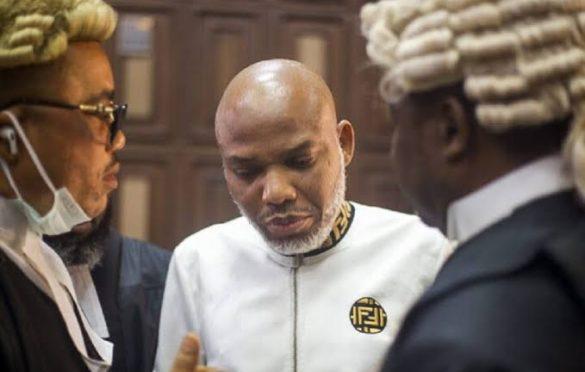
    The prosecution of Mazi Nnamdi Kanu, leader of the Indigenous People of Biafra (IPOB), remains one of the most complex intersections of law, politics, and international relations in contemporary Nigeria. His trial – originating from alleged acts of terrorism, secessionist agitation, and unlawful broadcasting – has become a crucible for testing Nigeria’s constitutional order, its commitment to the rule of law, and its approach to managing deep ethno-political divisions.

    Beyond its domestic significance, the case engages fundamental questions of jurisdiction, extraterritoriality, and international due process: whether a State may lawfully prosecute a person abducted from a foreign country without formal extradition, and whether prosecutions under repealed statutes remain valid under new laws with saving clauses.

    The issues raised mirror global tensions between State sovereignty and individual rights, resonating with precedents from the United States, United Kingdom, and India – all jurisdictions that have grappled with terrorism, unlawful rendition, and the reach of domestic law beyond borders.

    1. Background: Timeline of Acts, Arrests, and Legal Context

    Nnamdi Kanu’s legal odyssey began in October 2015, when he was first arrested and charged under the Terrorism (Prevention) (Amendment) Act 2013 and the Criminal Code Act. The counts included managing an unlawful society, importing radio transmitters, and committing acts amounting to treasonable felony.

    He was granted bail in 2017 but fled the country after a military operation at his residence in Abia State, later resurfacing abroad to continue his pro-Biafra broadcasts.

    In June 2021, Kanu was apprehended in Kenya and returned to Nigeria under circumstances widely described as extraordinary rendition – that is, an abduction and forcible return without following extradition procedures prescribed under the Extradition Act, Cap E25 LFN 2004.

    In May 2022, while his case was pending, Nigeria enacted the Terrorism (Prevention and Prohibition) Act 2022 (TPPA 2022), repealing the earlier 2011 and 2013 Acts. The new law introduced broader definitions of terrorism and explicit extraterritorial jurisdiction under Section 2(1)(c), covering acts committed abroad that threaten Nigeria’s security.

    The repeal raised a constitutional question: could Kanu’s ongoing trial, framed under the repealed 2013 law, validly continue under the new statute?

    2. The Legal Framework: Repeal, Savings Clauses, and Jurisdiction

    The TPPA 2022 addresses transitional issues in Sections 97 and 98, which expressly save ongoing prosecutions and subsisting charges under the repealed Acts. Section 98(3) provides that:

    “Any proceeding, prosecution, sentence, judgment, charge or cause of action pending or existing immediately before the commencement of this Act under any of the repealed Acts may be continued or commenced … as if this Act had not been made.”

    Thus, as of the repeal date – 12 May 2022 – Kanu’s prosecution was a “pending proceeding” within the meaning of the savings clause. The Federal High Court therefore retained jurisdiction to continue his trial, notwithstanding the repeal.

    This mechanism echoes Section 6 of Nigeria’s Interpretation Act, Cap I23 LFN 2004, which presumes that repeal of a statute does not extinguish rights, liabilities, or proceedings existing under it unless the repealing law expressly provides otherwise.

    3. Jurisdictional Challenges and Extraterritorial Reach

    Kanu’s defence team has repeatedly argued that some alleged offences – particularly the radio broadcasts advocating Biafra – occurred outside Nigeria’s territory, thereby stripping Nigerian courts of jurisdiction.

    However, both the repealed 2013 Act and the 2022 TPPA confer extraterritorial jurisdiction over terrorism offences. Section 2(1)(c) of the TPPA 2022 states that an offence may be tried in Nigeria where it is “committed partly in and partly outside Nigeria,” or where the offender is a Nigerian citizen abroad, or the act is directed at Nigerian interests.

    Under this provision, the Federal High Court may exercise jurisdiction over Kanu’s broadcasts – even those transmitted from the United Kingdom or Kenya – since the alleged intent was to incite violence within Nigeria.

    This model reflects global counter-terrorism statutes. The UK’s Terrorism Act 2006, the U.S. Patriot Act 2001, and India’s Unlawful Activities (Prevention) Act 1967 all recognise extraterritorial competence for offences threatening national security.

    4. The Extraordinary Rendition Controversy

    The more profound constitutional issue, however, arises from how Kanu was brought to Nigeria. He was not extradited under treaty procedures but allegedly abducted by Nigerian agents from Kenya – a method known as extraordinary rendition.

    Under Nigerian law, the Extradition Act requires a formal request, judicial hearing, and surrender order by the requested state. None of these steps occurred. Internationally, such conduct may breach the UN Charter (sovereignty of Kenya), the African Charter on Human and Peoples’ Rights (Article 12 on liberty and movement), and customary international law.

    The defence therefore contended that this unlawful rendition deprived the Federal High Court of jurisdiction to try him.

    5. Judicial Responses: The 2022 Court of Appeal Decision

    In October 2022, the Court of Appeal (CA/ABJ/CR/625/2022) agreed, holding that:

    “The extraordinary rendition of the appellant from Kenya to Nigeria is a gross violation of international law and the procedure under the Extradition Act … The trial court therefore lacks jurisdiction to continue his trial.”

    The court struck out the remaining counts and ordered Kanu’s release, declaring that the Federal Government could not “benefit from its own wrong.”

    That judgment marked a rare victory for procedural human rights in Nigeria’s anti-terrorism jurisprudence.

    6. The Supreme Court Reversal (December 2023)

    The Supreme Court of Nigeria (SC/CR/1361/2022) reversed that decision in December 2023, holding that although Kanu’s rendition was “unlawful and condemnable,” it did not oust the jurisdiction of the Federal High Court.

    The Court adopted the Ker–Frisbie doctrine, a principle from U.S. law (Ker v. Illinois (1886); Frisbie v. Collins (1952)) holding that the manner of a defendant’s capture does not preclude trial once he is physically before the court.

    By this reasoning, the illegality of rendition is a diplomatic or political issue, not a bar to criminal prosecution. The Supreme Court thus reinstated the trial, remitting it to the Federal High Court for continuation.

    7. The Nigerian Rule of Law Dilemma

    This ruling underscores a recurring tension in Nigeria’s legal order: the struggle to balance state security against constitutional due process.

    While the Court was doctrinally correct within common-law tradition, many critics argue it reflects an executive-centric conception of justice – one that prioritises state control over individual rights.

    The judiciary’s endorsement of Ker–Frisbie suggests that, in Nigeria, ends may justify means when national security is invoked. Yet this stance risks undermining public confidence in due process and further eroding the credibility of Nigeria’s human-rights commitments under the African Charter.

    8. Comparative Perspectives in Brief

    a) United States

    The Ker–Frisbie principle originates from U.S. jurisprudence. In Ker v. Illinois (1886) 119 U.S. 436, the Supreme Court held that a defendant abducted from Peru could still be tried in Illinois. Similarly, in Frisbie v. Collins (1952) 342 U.S. 519, the Court ruled that “due process of law is satisfied when one present in court is convicted of crime after being fairly apprised of the charges.”

    However, in later cases like United States v. Toscanino (1974) 500 F.2d 267, some U.S. appellate courts suggested that extreme governmental misconduct (e.g., torture) could deprive courts of jurisdiction. The standard remains narrow but shows a recognition of limits.

    b) United Kingdom

    In contrast, UK courts have increasingly emphasised procedural propriety. In Bennett v. Horseferry Road Magistrates’ Court, Ex p Bennett [1994] 1 AC 42, the House of Lords held that English courts could stay proceedings if the accused was brought by “a deliberate abuse of process,” such as illegal rendition.

    This approach aligns more closely with rule-of-law ideals, suggesting that unlawful conduct by the state can contaminate a prosecution.

    c) India

    India’s Supreme Court in D.K. Basu v. State of West Bengal (1997) 1 SCC 416 and Abu Salem v. Union of India (2011) emphasised that while extradition irregularities may not automatically vitiate trial, they can justify diplomatic intervention or limited judicial relief.

    India thus sits between the U.S. and U.K. positions – recognising jurisdiction but condemning state misconduct.

    d) Nigeria’s Position

    Nigeria’s Supreme Court has now aligned squarely with the U.S. model, privileging jurisdictional continuity over the integrity of extradition procedures. While doctrinally defensible, it reveals a security-state bias that risks normalising executive lawlessness in future cases.

    9. Repeal, Continuity, and the Saving Clause Debate

    A second strand of argument in Kanu’s case concerns charging under a repealed statute. Defence lawyers contend that since the Terrorism (Prevention) (Amendment) Act 2013 was repealed by the 2022 Act, prosecution under the old law is void.

    However, Sections 97–98 of the new Act create a robust saving clause preserving “ongoing cases in the courts.” This mirrors common-law interpretive presumptions (as codified in Section 6 of the Interpretation Act) that repeal does not extinguish vested proceedings unless the new statute clearly says so.

    Therefore, as long as the alleged offences occurred before May 2022 and prosecution was pending at repeal, the Federal High Court’s jurisdiction survives.

    This approach is consistent with decisions like A.G. Federation v. A.G. Abia State (2002) 6 NWLR (Pt. 764) 542, which affirmed that courts may not “breathe life into dead statutes” absent a saving clause – but where such a clause exists, it operates by legislative intent, not judicial invention.

    10. The Political Dimensions

    a) Ethno-Political Context

    Kanu’s prosecution is inseparable from Nigeria’s fragile federal structure and the enduring grievances of the South-East. IPOB’s agitation for self-determination echoes the historic Biafran secession (1967–1970), and Kanu’s popularity among Igbo youth reflects disillusionment with federal governance, economic exclusion, and militarised policing.

    Thus, the case is not merely about terrorism; it is a political crisis refracted through criminal law.

    b) Security vs. Legitimacy

    By insisting on prosecution despite procedural controversy, the Federal Government seeks to demonstrate state strength. Yet each procedural breach – unlawful rendition, indefinite detention, disregard of bail – undermines the very legitimacy the government seeks to assert.

    The politics of fear and selective justice risk transforming Kanu from an agitator into a symbol of resistance.

    c) International Implications

    Kanu holds dual Nigerian British citizenship, and the United Kingdom’s muted response to his rendition raised questions about the limits of consular protection when national security is invoked.

    Kenya’s government faced domestic backlash for alleged complicity in his transfer, highlighting how counter-terrorism cooperation in Africa can blur into violations of sovereignty and human rights.

    11. The Broader Rule of Law Question

    The essence of the matter lies in Nigeria’s constitutional self-image. The Supreme Court’s reliance on Ker–Frisbie may be doctrinally orthodox, but it also signals that executive illegality is tolerable if politically expedient.

    This risks eroding the constitutional guarantees of fair hearing (Section 36) and liberty (Section 35) of the 1999 Constitution, and Nigeria’s obligations under the African Charter on Human and Peoples’ Rights (domesticated by Cap A9 LFN 2004).

    A state cannot credibly claim to fight terrorism while disregarding the rule of law. The jurisprudence emerging from Kanu’s case will therefore shape not only Nigeria’s counter-terrorism regime but its broader constitutional morality.

    12. Table Illustration of Lessons from Comparative Jurisdictions

    Jurisdiction Approach to Unlawful Rendition Effect on Jurisdiction
    U.S. Ker “Frisbie: manner of arrest irrelevant    Trial proceeds
    U.K. Bennett doctrine: abuse of process may bar trial   Court may stay  proceedings
    India Mixed: jurisdiction continues but state censured   Limited relief, no dismissal
    Nigeria Aligns with U.S.; rendition condemned but jurisdiction retained   Trial proceeds under savings clause

    This comparative lens reveals a philosophical divide: whether law or sovereign power ultimately anchors justice. The UK model prioritises legality; the U.S. (and now Nigeria) prioritise prosecution.

    13) Political Reconciliation or Perpetual (Legal) Prosecution – ‘Similar Cases’?

    The persistence of Kanu’s detention despite multiple judicial orders for his release reflects the politicisation of justice. The government’s reliance on prolonged trial and national-security rhetoric has polarised public opinion, reinforcing narratives of marginalisation in the South-East.

    For sustainable peace, Nigeria may need to combine judicial accountability with political dialogue – a model seen in India’s handling of regional separatist movements, where amnesty and negotiation have at times been used in place of prolonged prosecution. This consideration is particularly relevant in light of the recent release of Sunday Adeniyi Adeyemo (aka Sunday Igboho) – another separatist figure (a Yoruba self-determination activist pushing for an independent ‘Yoruba Nation’ in Southwest Nigeria’) – and the President’s recent grant of amnesty to various offenders in Nigeria.

    Even though the cases of Nnamdi Kanu and Sunday are legally different in many ways and took place in different countries, they are both prominent regional agitators, representing two major ethnic groups (Igbo and Yoruba), and involved in separatist or self-determination rhetoric. Because of this, the different outcomes naturally cause comparisons.

    The contrasting cases of Nnamdi Kanu and Sunday Igboho highlight important legal and political tensions within the Nigeria’s federalism and democratic practice. Legally, Kanu’s prolonged detention and trial on charges including treasonable felony, alongside the government’s controversial handling of his extradition, raise questions about due process and the limits of federal power in confronting separatist movements. In contrast, Igboho’s release after detention in Benin Republic and the absence of ongoing prosecution in Nigeria illustrate a more restrained or inconsistent legal response to similar self-determination agitation. Politically, these divergent outcomes fuel perceptions of unequal treatment among ethnic groups, deepening debates about fairness, inclusivity, and trust in the Nigeria federation. They also expose the fragility of democratic governance when security concerns overshadow constitutional safeguard and when political considerations appear to influence the enforcement of law. Together, the two cases reveal how Nigeria’s multiethnic federal democracy continues to struggle with balancing national unity, regional grievances, and the rule of law.

    Conclusion

    Nnamdi Kanu’s case is a mirror held up to the Nigerian State: it reflects the contradictions between law and power, unity and federalism, nationalism and dissent. Legally, the 2022 Terrorism (Prevention and Prohibition) Act provides a saving clause validating ongoing prosecutions, and the Supreme Court has affirmed jurisdiction despite the illegality of rendition.

    Politically, however, the case exposes the fragility of Nigeria’s rule of law and the enduring mistrust between state and citizen. The government’s victory in court may prove Pyrrhic if it deepens alienation and delegitimises judicial institutions.

    In the end, the most important verdict will not be judicial but historical: whether Nigeria chooses to be a state governed by law, or a state that governs through law.

    Dr. Brian Vincent Ikejiaku Writes From The United Kingdom.
  • BudgIT’s 2025 Report: Dissecting Enugu’s Miracle of Five Loaves and Two Fish

    BudgIT’s 2025 Report: Dissecting Enugu’s Miracle of Five Loaves and Two Fish

    By Uche Anichukwu

    While discussing the 2025 edition of BudgIT’s State of the State Report, an annual publication that evaluates long-term fiscal performance and sustainability of Nigerian states, Arise News ace presenter and social activist, Rufai Oseni, described Enugu State’s emergence as the likeliest state to survive outside of the receipts from the Federation Account Allocation Committee, FAAC, as “The Enugu Miracle.”

    His words: “All of a sudden, Enugu has become a haven for raising money. The Governor Mbah some people never gave a chance is doing so well. He is putting digitisation in place. Enugu is now part of the few states in the country that are actually viable; that is, if they do not get FAAC, they should be able to run… If Enugu can do it, if Enugu can create a miracle – the Enugu Miracle – then what are others doing?”

    One cannot but agree with Oseni, especially given where the state is coming from. Indeed, Enugu’s surge under Governor Peter Mbah can be likened to the miracle of five loaves and two fish as recorded in Matthew 14: 14-21. Observing that the multitude that was with him since morning was hungry, Jesus’ disciples asked him to release them to go into the villages to find something to eat. But Jesus, instead, asked them to feed the multitude – to which they exclaimed in bewilderment that they had just five loaves of bread and two fish left. But Christ took that little, blessed it, and asked his disciples to serve it. 5,000 persons were fed. Yet, in the end, 12 baskets of leftovers were gathered.

    According to BudgIT’s 2025 State of the States Report, Enugu State is the most probable state to finance its operating expenses exclusively from internally generated revenue (IGR) without relying on FAAC. The findings were based on Index A, which measures states’ ability to meet recurrent expenditure obligations relying only on IGR. The research methodology for Index A was the ratio of operating expenses to the state’s IGR.

    According to BudgIT, states that rank higher on this index exhibit greater financial autonomy and long-term viability. “States that perform strongly on Index A have comparatively limited dependence on FAAC allocations and thus possess greater viability if they were to theoretically exist as independent entities,” the Report states.

    The ranking in this regard shows that Enugu State scored 0.68, implying that 68 percent of the state’s IGR would have catered to its operating expenses. Enugu is trailed in the top five states by Lagos State (0.83), Abia State (1.56), Anambra State (1.66), and Kwara State (1.73).

    On Index A1, which measures IGR growth, Enugu again leads the ranking, followed by Bayelsa, Abia, Osun, and Kano. These states recorded the strongest momentum in boosting internally generated revenues during the 2024 fiscal year. According to BudgIT, “While it may be too early to celebrate, as the uptick could partly reflect increased inflows from federation transfers, it is a much better performance than the previous year.”

    In the meantime, whereas Enugu and Lagos lead in IGR ranking, fewer states meet the 50 per cent threshold, as BudgIT’s 2025 State of the States report shows that the number of states generating enough revenue to cover their operating expenses has reduced compared to 2024. Unfortunately, according to BudgIT, 28 states still depend significantly on federal transfers and other external inflows to fund their operations.

    Meanwhile, whereas those who have expressed surprise at Enugu State’s ranking are in order, especially given where the state is coming from in terms of IGR, those who have keenly followed the state’s giant strides and redirection under Governor Peter Mbah, actually saw it coming.

    For instance, Mbah has drastically reversed the state’s Recurrent Expenditure-heavy budget culture – which is actually a subsisting national tradition. Before his coming, the state’s Capital Expenditure hovered around figures not exceeding N30bn, which amounted to about a Capital Expenditure to budget ratio of about 25 to 35 per cent. But in the 2024 budget, Mbah tweaked things positively for the state. That budget consisted of N107.2 billion Recurrent Expenditure or 21 per cent of the record N521.5bn budget and a Capital Expenditure of N414.3 billion, representing 79 per cent of the budget.

    While Nigerians thought that they had seen it, with the new order earning the Mbah Administration reviews by public analysts and editorial comments by several national dailies, he actually took it a notch higher in 2025 budget. The budget comprises N837.9 billion Capital Expenditure, representing 86 per cent of the N971 billion budget, and N133.1 billion Recurrent Expenditure, representing only 14 per cent of the entire budget.

    However, of great significance is the state’s quantum leap in terms of IGR profile. Although Mbah met the state’s IGR at N30bn in May 2023, he ramped it up to N37bn by the close of that year and scaled it up to N180.05bn by the end of 2024, marking a nearly 400 per cent increase in the state’s IGR profile.

    Expectedly, the question on the lips of many is: how was that possible? Basically, whatever has happened in the IGR space is rooted in the principles of transparency, traceability, and accountability of the Mbah Administration. The state’s IGR drive has benefitted so much from the technology to block leakages and also from widening the tax net to bring more people into the revenue stream without increasing the tax rate.

    The Secretary to the State Government, SSG, Prof. Chidiebere Onyia, provided a deeper insight into the state’s IGR revolution in his keynote address at a recent high-level strategy retreat organised by the Governor’s Revenue Assurance Team. In the keynote speech at the retreat themed “From Silos to Synergy: Achieving Unified Revenue Targets Through Coordination and Accountability,” Prof. Onyia gave a participant-witness account of Enugu’s transformative journey, which has practically redefined governance, accountability, and fiscal performance in the state.

    “When Governor Peter Mbah entrusted us with the mandate to reposition Enugu as a model of efficiency and innovation, we knew that business-as-usual would no longer suffice. We needed a bold shift from fragmented silos to a unified, data-driven, and performance-oriented revenue ecosystem. One of the most decisive reforms we undertook was the complete stoppage of cash collection across all MDAs. This was not merely a procedural change; it was a philosophical shift toward transparency and traceability,” he stated.

    The result is that in Enugu State of today, every payment is now routed through digital platforms, ensuring real-time monitoring and eliminating leakages. This bold move has radically reduced opportunities for sharp practices and also enhanced public confidence in the revenue collection system. It has equally helped the administration to build a central revenue intelligence dashboard, allowing the government to monitor every transaction across the state.

    Furthermore, the administration introduced a Performance Appraisal Framework for all Ministries, Departments, and Agencies, with each MDA now assigned clear revenue targets linked to their operational mandates. But it does not end with the targets. Monthly and quarterly reviews are conducted, with performance scorecards publicly shared. This enables the government to place underperforming agencies on corrective action plans, while high performers are recognized and rewarded. Importantly, this approach has promoted a culture of healthy competition, innovation, and ownership among public servants.

    The administration has also prioritised capacity building for revenue officers, concentrating on ethics, digital tools, and customer service, thus not just improving revenue, but equally strengthening the social contract between government and governed.

    In the same vein, sharp practices in the revenue collection space are no longer overlooked. As the governor often points out, accountability is not just about systems; it is about consequences. Thus, the administration has maintained a resolute stance against corruption, investigating and prosecuting several cases of fraudulent revenue diversion. The administration further set up a Revenue Compliance and Enforcement Unit, which works very closely with law enforcement and the judiciary, while whistle-blower channels have been activated, thus enabling citizens to report malpractices incognito.

    Importantly, the Mbah Administration has earned the faith or confidence of the people that whatever taxes and other payments they make would be used to work for them. Although there were initial hesitations primarily spurred by old experiences, the people soon realised that with Mbah, it is business unusual. With over 2,000 verifiable completed and ongoing projects spread across the 260 wards of the state, it is a case of the Igbo saying that you may preach to the blind that there is oil in the soup, but not about salt. He can tell them, using his buds.

    Again, the deployment of a real-time project management dashboard has, among others, visibly strengthened the link between revenue and results, as the citizens can now see how their taxes are transforming roads, schools, hospitals and water systems in real time.

    Yet, Governor Mbah will always be credited with giving governance a human face, ensuring that revenue drive is not without an ample touch of humanity. For instance, in response to complaints received about taxes and the like, he recently inaugurated a committee to carry out a comprehensive review of tax policies, rates, levies, and fees under the control of the state. The committee, which draws its membership from interest groups, market associations, government, organised labour, and the civil society, among others, is to benchmark Enugu State’s revenue practices against Lagos, Abuja, and other South East states as they relate to Land Use Charge, Certificate of Occupancy (C-of-O) fees, market levies, and stall rents, business premises registration, signage and advertisement fees, among others, and recommend reforms.

    Although there is still a long way to go, if Governor Mbah continues on this trajectory, then he is on his way to actualising his campaign promise to wean Enugu State off FAAC allocations and ensure they are saved for future generations, he will also be on the path to actualising his overarching vision to grow the state’s economy sevenfold from $4.4bn to $30bn, eradicate poverty and position it as the premier destination for investment, business, tourism, and for living may well become a fait accompli. It is only a matter of time.

    Anichukwu writes from Enugu

  • Forging a Pan-African Film Future: Nollywood and Southern Africa in Harmony

    Forging a Pan-African Film Future: Nollywood and Southern Africa in Harmony

    By Dr. Jamezany James 

    As a recipient of the Nelson Mandela Leadership Award for Excellence and Integrity, I carry forward Madiba’s dream of a united, prosperous Africa. That vision compels us today to align Nigeria’s powerhouse Nollywood with the dynamic film industries of South Africa (Mzansi), Zimbabwe, Botswana, Namibia and the broader Southern African region — creating a synergy that amplifies stories, markets, and opportunity across the continent.

    This article outlines a concrete roadmap for leveraging Nollywood’s scale, distribution networks, and production expertise to strengthen Southern Africa’s film sector, while honoring the legacy of Nelson Mandela, a true father of Africa.

    Why a Nollywood‑Southern Africa Partnership Makes Strategic Sense
    Opportunity. What Southern Africa Gains. What Nollywood Gains.

    -Co‑productions Larger budgets, access to world‑class equipment, and post‑production labs in Lagos/Kano

    -Fresh, authentic narratives rooted in Southern African cultures and stunning landscapes

    -Market Access & Distribution Entry to West African markets (180 million+ viewers) and diaspora platforms

    -Diversified audience for multilingual films (English, Zulu, Shona, Afrikaans, French)

    -Talent Exchange Skills transfer in script development, cinematography, digital marketing, and film finance

    -Exposure to Southern African storytelling traditions and emerging talent pools

    -Tourism Promotion Showcase iconic sites — Kruger National Park, Victoria Falls, Cape Town’s coastline — driving tourism revenue

    -New, cost‑effective location options for blockbuster shoots

    -Policy Advocacy Unified voice for tax incentives, reduced equipment tariffs, and stronger anti‑piracy frameworks across SADC and ECOWAS Strengthened bargaining power in continental forums such as AfCFTA and the AU Year of Arts, Culture and Heritage

    Pillars of the Collaboration
    1. Joint Production Fund
    – Seed capital from the Nigerian Film Corporation, the South African Film and Television Authority (SAFTA), and Zimbabwe’s Film Commission, plus private investors and development partners.
    – Prioritise projects that feature at least one Southern African location, a Nigerian crew member, and multilingual scripts (e.g., English, isiZulu, Shona).

    2. Talent Pipeline & Capacity Building
    -Mentorships: Emerging directors from Mzansi and Zimbabwe spend 3‑month residencies at Nollywood studios in Lagos or Enugu.
    -Reverse Residencies: Nigerian producers and technical staff work at Cape Town Film Studios or Zimbabwe’s New Horizons Studio to learn about shooting in diverse climates and terrains.
    -Workshops: Host joint training on film finance, intellectual property, and digital distribution, led by industry veterans.

    3. Distribution & Exhibition Synergy
    – Distribute curated Southern African films through Nollywood’s existing channels — YouTube, DSTV, Netflix, and emerging African streaming services like Showmax.
    – Reciprocal premieres at flagship festivals:South Africa’s Durban International Film Festival and my brother Zindela’s UGU Film Festival, Zimfest,Nigeria’s KILAF, LIFF, Africa International Film Festival (AFRIFF).

    4. Infrastructure Sharing
    – Use Cape Town’s advanced post‑production labs for colour grading and VFX; leverage Lagos’ sound‑mixing suites for large‑scale productions.
    – Establish equipment rental pools in Nairobi, Johannesburg, and Harare to lower costs for cross‑border shoots.

    5. Cultural Promotion & Tourism Tie‑ins
    – Embed authentic Southern African languages, music, and heritage sites into Nollywood narratives (e.g., a love story set against Victoria Falls).
    – Joint marketing campaigns: “Film Your Vacation” showcasing diverse African backdrops, encouraging tourists and filmmakers alike.

    A Call to Action
    -To Governments & Regional Bodies:
    -Fast‑track bilateral co‑production treaties with clear tax breaks, simplified permit processes, and anti‑piracy measures.
    -Align film policies under the African Continental Free Trade Area (AfCFTA) to remove barriers to cross‑border production and distribution.

    -To Industry Stakeholders:
    -Form a Pan‑African Film Integration Task Force comprising Azania Filmmakers Association, Nigerian Film Corporation, SAFTA, and Zimbabwe Film Commission.
    -Draft a measurable roadmap for 2025‑2028 with targets for co‑productions, audience reach, and job creation.

    -To Leaders and Honourables:
    -Honor Nelson Mandela’s legacy by championing cultural integration as a pillar of economic diplomacy.
    -Use platforms such as the AU Year of Arts, Culture and Heritage to spotlight this partnership.

    Closing Thought
    Nollywood’s scale, Mzansi’s production polish, and Zimbabwe’s emerging creative energy are not competing silos — they are complementary forces. When we combine resources, stories, and markets, we move from isolated film scenes to a resonant African cinema that speaks to the world.

    _Let our screens become bridges, our stories become unity, and our industries become one._

    Dr Jamezany James
    cultural diplomat, head of Azania Filmmakers Association (Pan‑Africa), recipient of the Nelson Mandela Leadership Award for Excellence and Integrity,

  • A Ruling Class That Eats Itself

    A Ruling Class That Eats Itself

    -By Abdul Mahmud

    Contemporary Nigeria feels like a country pulling against itself. Every day brings shock and surprises. Every night brings deeper worries. The country moves, but it moves without directions. It is not collapse, yet it is not order. It is something in between. Something that drags Nigerians down and wears them out. It resembles a place that has lost itself and the centre that no longer holds. A place where authority exists only in name. A place where power speaks loudly but acts weakly. Many Nigerians now describe the country in images borrowed from history. One of those images is China during its Warlord Era. It is not a perfect comparison. It is not even a comfortable one. But it is a useful frame for understanding the tragic drift of a country that cannot govern itself with clarity.

    China of the early twentieth century lived under fractured authority. Regional strongmen carved out fiefdoms. Armies answered to personal loyalty rather than the nation. Rulers acted like emperors. But they were actually terrors. Chinese struggled to stay alive between the shifting lines of conflict. Hope became a fragile currency. Trust disappeared. Nigeria today is not China of 1916. Still, it mirrors some of the same anxieties, the same sense of mercenary leadership, the same feeling that ruling elites no longer serve the people, the same mood of desperation among a population forced to improvise its survival; and the same suspicion that the state has become a shell that echoes emptiness, but never protects. Everywhere you look, you see a ruling class that feeds on the very system it was meant to sustain. It is a ruling class that eats itself. And in doing so, it consumes the country.

    Across Nigeria, the sense of safety has thinned to a whisper. Entire regions drift into insecurity. Armed groups take advantage of the vacuum. Communities mourn losses that have become too frequent to shock. The government responds with promises, yet the reality remains unchanged. Nigerians are stampeded with announcements, the type Fela once famously sang about as “government magic”, and endless condemnations. They hear everything except real solutions. Nigerians die on highways. They die on their farms. They die in their homes. They die while waiting for leaders who refuse to lead. It is a tragedy that repeats itself so often that it feels like part of the national routine. In China’s Warlord Era, leaders fought for territory. Control was the only ideology. The state became a broken vessel. Yet, something unexpected happened. Even in the midst of chaos, the Chinese clung to the idea of a future China. They nurtured the dream of a unified republic. They preserved their cultural memory. They produced thinkers, writers, and reformers who refused to surrender to the disorder around them. And when the warlords finally exhausted themselves, the country began the slow process of rebuilding. It was messy. It was violent. It was painful. But the idea of China survived.

    The idea of China survived because its deepest institutions outlived the warlords who tried to overthrow them. Local communities kept their traditions intact. Teachers educated children in classical texts. Merchants maintained networks that tied distant regions together. Reformers in cities like Beijing, Shanghai, and Guangzhou carried forward debates about national renewal. Newspapers, student groups, and emerging political parties kept alive a vision of a united republic, even when the country itself was fractured. These threads held society together when the state could not. The idea also survived because the Chinese never abandoned the belief that their destiny was collective. They experienced warlordism as a temporary betrayal of the national project, not its end. They protested fragmentation. They wrote against it. They fought against it. They imagined a future in which China would be whole again. This imagination created pressure that weakened the warlords’ grips, and when military exhaustion set in, the intellectual and cultural groundwork for rebuilding was ready. Out of that groundwork emerged the next phase of the Chinese state. As it was then, and as it had always been, the Chinese nation-state building was a fierce struggle for grounding visions and competing ideas, not a flippant appeal to sentiment or convenience. It required depth, conviction, and the hard labour of shaping a shared future rather than the easy pursuit of applause for the warlords.

    Nigeria is inching close to the point where it must reclaim itself from its own violent fragments. The danger of fragmentation continues to grow. The ruling elites continue to fight among themselves. They continue to chase influence and access while the country burns. They chase the next election cycle. They chase everything except the wellbeing of Nigerians. They do not confront the insecurity that terrorises ordinary Nigerians. They do not confront the poverty that reduces life to a miserable hustle. They do not confront the corruption that empties public coffers. They do not confront the decay of institutions that once held the country together. What they confront instead is each other: “Someone once said you are supposed be kept away in the zoo. Sincerely that’s where you belong”. And in that confrontation, they devastate the very system they claim to defend. The judiciary is hijacked. The legislature is compromised. The executive is swollen with power but thin on capacity. Agencies clash. Serving governors accuse past governors. They deflect; and when they are not deflecting on the real issues, they are busy abusing fellow Nigeria: “Go and die”. The federal state stumbles along as the subnational states burn. This is how a country eats itself. Not through dramatic implosion. But through constant erosion.

    China’s Warlord Era ended through exhaustion. Nigeria cannot afford such an ending. The cost in lives would be unbearable. The social damage would last generations. The economic ruin would push millions into irreversible poverty. Though the world is different now, populations are larger, weapons are deadlier, and the interdependence of communities is deeper, a Nigerian collapse would be disastrous. It would be a continental earthquake. So the question is simple. When will our ruling elite realise that it has consumed too much of the country’s vitality? When does it understand that its survival depends on the survival of the country? When does it learn that power cannot be sustained on the ruins of public trust? These lessons appear obvious. Yet they seem to escape those who hold office. A country cannot run on improvisation. It cannot survive on announcements. It cannot endure on propaganda. It needs a moral centre. It needs a political vision. It needs leaders who understand that governance is not performance. Governance is responsibility. It is a duty. It is courage. It is the ability to stand between citizens and danger. And it is the humility to know when the state is crumbling and must be rebuilt.

    China recovered because its people refused to let the idea of China die. Nigeria stands at a similar crossroads. Nigerians still believe in the idea of Nigeria. They show it every day. They show it in their stubborn resilience. They show it in their refusal to give up. They show it in their search for work, for safety, for dignity. They show it in their prayers. They show it in their grief. They show it even when the state ignores them. But belief is not infinite. Resilience is not eternal. Hope is not immortal. There comes a time when citizens look at their leaders and see nothing but hunger for power. There comes a time when they recognise that the ruling class feeds on the country like a parasite. There comes a time when they see that those who govern have no interest in building a future. At that point when the ruling class begins to devour itself, the people begin to chart a course of their own.

    If Nigeria is to avoid that fate, its ruling class must act now to save the country and itself. It must restore security. It must strengthen its institutions. It must clean its politics. It must rebuild public trust. These are not lofty ideals. They are basic responsibilities. They are the foundation of every functioning state. Without them, the country slips deeper into the logic of the Warlord Era. Disarray. Fragmentation. Fear. The tragedy of Nigeria is not that it lacks resources. It is not that it lacks ambition. It is that it lacks leaders who understand the moral weight of stewardship. Leadership is not enjoyment. Leadership is a burden. Leadership is sacrifice. Leadership is the understanding that every decision shapes the lives of millions. China’s past is a warning. Nigeria’s present is a plea. The ruling class can still step backwards from the path of self-destruction. It can still choose purpose over plunder. It can still rebuild the fragile trust that binds the country together. But it must act. It must reform. It must confront the insecurity, the corruption, the disorder, and the decay. A ruling class that eats itself leaves nothing behind. Nigeria deserves better. Nigeria deserves leaders who build. Nigeria deserves a state that protects. Nigeria deserves a future that is not swallowed by the failures of today.

  • Nigeria’s Insecurity and Leadership: The Growing Crisis of Confidence – By Dr. John Egbo

    Nigeria’s Insecurity and Leadership: The Growing Crisis of Confidence – By Dr. John Egbo

    For millions of Nigerians, the fear of being kidnapped on the road, at home, or even in school has become a grim part of daily existence. From the outskirts of Abuja to rural communities in Kaduna, Kwara, Niger, Katsina, Plateau, Benue, Rivers, and Zamfara, the wave of abductions continues to rise, eroding public confidence and raising urgent questions about the priorities of the country’s political leadership.

    Despite repeated promises from successive administrations, Nigerians widely believe that national security is still treated with alarming levity by those at the highest levels of government. From the Presidency to the National Assembly and the state governors, there is a growing public perception that the nation’s leaders are more focused on protecting themselves and their families, with troops of police officers, army personnel and DSS than ensuring the safety of the people they are supposed to serve.

    KIDNAPPINGS: A NATION UNDER SIEGE

    Kidnapping for ransom has evolved into a multi-billion-naira criminal industry. Major highways such as Abuja–Kaduna, Enugu–Abuja, Benin–Lagos, and Birnin Gwari–Funtua have witnessed repeated attacks. Communities in the Middle Belt and North-West live under a constant shadow of terrorists called bandits, militants and herdsmen while southern states once considered safe such as Edo, Delta, Imo, and Anambra, now report near-daily abductions.

    In early 2025 alone, several communities recorded mass kidnappings, including farmers, schoolchildren, church members, and even traditional rulers. For many Nigerians, these incidents underscore what they see as a failure of political will of Nigeria’s style of leadership. They travel overseas for medical treatment but will not hire foreign trained officers to help with their sick security condition.

    A trader in Suleja, who narrowly survived an attack, told our reporter: “We are left to protect ourselves. The leaders are surrounded by dozens of security men, but ordinary people are on their own. It seems we are not part of the security equation.”

    SECURITY FOR THE POWERFUL, INSECURITY FOR THE PEOPLE

    Analysts argue that a major source of public resentment is the disproportionate deployment of security personnel political leadership. Thousands of police officers are attached to politicians, government officials, business moguls, and their families, while rural communities and urban neighborhoods struggle with inadequate policing.

    A retired police superintendent, who requested anonymity, described the situation bluntly:

    “We lack manpower not because officers don’t exist, but because many of them are guarding VIPs. If you withdraw and equip half of those officers and send them back to communities, you will see an immediate improvement in national security.”

    Despite generous annual allocations running into trillions of naira for defense and monthly Security Votes to Governors, internal security, frontline officers often lack basic equipment such as bulletproof vests, patrol vehicles, communication gadgets, and sometimes even fuel. Many work long hours under hazardous conditions with limited insurance or welfare support.

    This mismatch between resources and results has fuelled widespread frustration among service men in uniform.

    POLITICAL INTERFERENCE AND REACTIVE MEASURES

    Critics say part of the problem lies in the politicization of security agencies. Postings, promotions, and procurement decisions have sometimes been influenced by political considerations rather than merit, weakening professionalism within the security sector.

    Moreover, security responses have often been reactive rather than proactive. Government interventions typically occur after tragic incidents as in mass abductions in Kebby school where there was an intelligence before the attack took place and Niger students incidents, attacks on villages, or high-profile kidnappings—rather than through coordinated preventive strategies.

    A security researcher at the University of Ibadan, Dr. Tolu Adebayo, summarized the problem: “We cannot continue waiting for attacks before deploying resources. Kidnapping gangs have saboteurs in the military and they are adapting faster than our institutions. Without intelligence-led policing, improved welfare, and professional autonomy, the cycle will continue unabated”

    CITIZENS LOSING PATIENCE

    For ordinary Nigerians, the consequences of insecurity are devastating. Farmers are abandoning their farmlands for fear of attack. Transporters avoid certain highways. Unity schools have been ordered closed in many states of the North while other Schools in high-risk regions operate under threat. Businesses are closing, and families are selling property to pay ransoms.

    An Enugu resident whose cousin was abducted in 2024 expressed anger at government inaction:

    “Every day we hear politicians talking about billions spent on security. But where is the impact? Bandits are still operating freely. We cannot live like this.”

    A CALL FOR GENUINE COMMITMENT

    The public is demanding a shift from rhetoric to action. Experts recommend:

    -Reducing VIP security escorts and redeploying personnel to communities

    -Ordering all National Assembly members and Ministers back to their respective towns to empower both Neighborhood Watch (Vigilantes) and Forest Guards as a first line protection for their people during the upcoming yuletide.

    -Improving welfare and insurance for police and military officers.

    -Deploying drones, surveillance systems, and intelligence tools for security personnel.

    -Creating  state policing structures as promised by the President to adopting a multi-layered policing model

    -Ensuring transparency in defence spending and procurement.

    -Sign an agreement with a foreign country to help flush out terrorists from the country and secure our porous borders.

    -Improving coordination among the armed forces, police, DSS, and local vigilantes.

    Ultimately, Nigerians want a leadership that demonstrates genuine commitment, not just speeches. A leadership that recognizes that security is not a privilege for the powerful, but a right for every citizen.

    As insecurity grows more brazen and kidnappers become more entrenched, the nation faces a stark choice: continue on the current path of reactive measures, or embrace bold reforms that restore public trust and reclaim Nigeria from the grip of fear. We all know that action speaks louder than words.

    The people have spoken loudly and the country’s leaders can no longer afford to ignore them.

    Dr. John Egbo is a Retired Deputy Sheriff from the United States of America and Security Consultant. Email: jnegbo1@gmail.com 

  • New Week, More Abductions and More Deaths

    New Week, More Abductions and More Deaths

    -By Abdul Mahmud

    Another week has opened in Nigeria with blood on the ground and fear in the air. The country wakes up each morning to new tragedies. Each day closes with fresh accounts of death, kidnappings, and retreats. Nigeria is living inside a vortex of violence. Nothing breaks it. Nothing interrupts it. The state has become pusillanimous, a timid spectator.

    The abduction of more than twenty five girls from Government Girls Comprehensive Senior Secondary School, Maga, in Kebbi State, is another grim reminder of how far the security collapse has travelled. The killing of the Vice-Principal in the attacks showed the brutality of the terrorists. These were girls preparing for a future that is constantly denied them. In that region, the education of girls has long been contested by extremists and patriarchal norms. The state promised to protect these children. It failed. Again.

    Across the north, the same story unfolds. In Tsafe Local Government Area of Zamfara State, entire families were taken. Women and children disappeared into forests controlled by terrorists. Homes were emptied without resistance. Communities now live under criminal rule. Citizens whisper not to provoke those who control their roads, markets, and farmlands. The state is absent. In the north east, the shock is deeper. The reported capture and killing of General Muhammed Uba, who the Army High Command assured the country was safe within his battalion, has shaken the country. A General of the Nigerian Army. Seized. Dragged away. Made to sit on the ground by his snatchers. Killed by terrorists who move on motorcycles. A military built on decades of training and investment was breached by a band that holds no formal command structure. It is shameful. It undermines morale. It raises a painful question. Is the Nigerian military still capable of fighting?

    Everywhere Nigerians turn, the failures of the state stare back at them. The military is stretched. The police is overwhelmed. Intelligence gathering is weak. Communities report danger and no one comes. Criminals move from state to state. Terrorists set up camps. They impose taxes. They administer their own justice. The state protects no one. It barely protects itself. The government keeps promising a turning point. Instead, we watch a point that turns in on itself, spinning without direction, circling like the widening gyre of WB Yeats’s The Second Coming. The turning point never arrives. Operations are launched with loud declarations of victory. The terrorists regroup. They reorganise. Villages burn. Schools fall. Families mourn. The cycle continues.

    Our country has normalised tragedy. Nigerians now expect bad news. They wait for the next report of abductions. They wait to hear which community has fallen. Prophet Amos once asked, “When will the new moon be over, so we can sell our corn?” It was a lament about a society rotting from inside. It was an indictment of leaders who worshipped power but abandoned justice. Nigeria carries that lament today. Nigerians now ask when this cycle of death will end. They now ask when the government will act with urgency. They now ask when rulers will remember that the first duty of the state is protection. Instead of answers, Nigerians see a president who governs from behind high walls. The fortress of Aso Rock grows more secure while the rest of the country grows more vulnerable. Terrorists move freely. Terrorists spread across territories untouched by government authority. Villages have no police presence. Cities shrink into islands of guarded estates. Nigerians travel only by daylight. Even then, they travel in fear.

    Nigeria cannot continue this way. Our country cannot survive when its armed forces appear unsure of their own strengths. The military once carried the weight of national pride. It was the symbol of unity. It was the institution that projected the authority of the federal government. Today, Nigerians ask if it is still primed for battle. They ask how a General can be captured. They ask why battalions retreat. They ask why weapons fall into the hands of those who seek to destroy the republic.

    These questions are fair. They must be asked.

    The military needs honest scrutiny. This government needs accountability. Nigerians deserve truth. If the armed forces are under-resourced, Nigerians need to know. If corruption has weakened capacity, the offenders must be punished. If political interference has crippled operations, it must be exposed. The attitude of silence, denial, and deflection is no longer acceptable.

    Nigeria and Nigerians are now trapped between the rock and the hard place. Some cling to patriotism, patience, and faith in the government’s ability to defeat the terrorists, mocking any notion of foreign assistance. Others insist that the country must seek help from beyond its borders. When President Donald Trump promised that he would send troops to our country to wipe out terrorists wherever they found them, Nigerians wondered what such intervention would mean here. They now ask when he intends to send help, since their own President cannot secure the country. It is a question born out of despair. A question rooted in frustration with a state that has abandoned its duties.

    The despair is not only in the number of dead. It is in the absence of hope. A country loses part of its soul when children are stolen from classrooms. A country loses its dignity when Generals are captured. A country loses its direction when leaders stay silent or offer empty speeches. Nigeria is losing too much. The new week has already brought more deaths. More abductions. The next week may bring the same. Nigerians pray it does not. Nigerians ask for a leadership that understands the urgency of the moment. They ask for a military that fights back. They ask for a police force that responds. They ask for a country that feels like a country.

    Nigeria must reclaim its security. It must rebuild its confidence. It must restore the bond between the state and the citizens. It must treat every abduction as an assault on the republic. It must treat every killing as a national injury. It must confront the terror networks with strength and strategy. It must do these things because no country can survive on a wing and on a prayer. The clock is ticking. The country is bleeding. The Nigerians are watching. The world is watching. The Nigerian state must show that it still has the will to protect itself. It must show that it can defend Nigerians. It must show that it is not a defeated republic.

    A new week has begun. The country cannot afford another filled with grief. While Nigerians sink deeper into despair, the pressing question remains: when will President Trump act, if at all, so that Nigerians can once again tend their farms, sell their corn, and bring their wheats to the market without fear? Nigerians are weary of waiting for rescue, yearning for the day they can live without daily encounters with violence, abduction, and the absence of security.

  • Wike, Yerima; Clash of Values and Authority – By Oseloka H. Obaze

    Wike, Yerima; Clash of Values and Authority – By Oseloka H. Obaze

    Two wrongs never make a right. When two people stridently but wrongly assert their rights over an issue, something is systemically wrong. That was the circumstance surrounding the recent Wike-Yerima standoff that has become the greatest content asset for social media lampooners.  But this is a very serious matter relating to military-civilian relations in Nigeria.  For starters, Wike and Yerima took the already fraught military-civilian relations to a whole new subterranean level.

    One of the greatest ills bedeviling good governance in Nigeria is the use of the military for purely civilian police duties in a democracy.  Soldiers by orientation are not good policemen.  It’s not their orientation. It is not their training.  As such they should not be. Yet, because of the military’s long sojourn in Nigeria’s leadership politics, certain traits imbued on the psyche of Nigerians continue to reflect the negative influence of military anti-politics.

    The recent shameful public altercation between Nyesom Wike, the Abuja FCT Minister and a young naval officer, Lt. AM Yerima, speaks to and epitomizes the prevailing crises of our national clash of values and lack of respect for constituted authority.  Those, who like Wike, who occupy high public offices, have unwittingly contributed to the crisis, often by their conduct and their utterances.  Some may say minister Wike deserved his comeuppance.  That’s debatable.  But a minister berating a uniformed military officer, as “a fool” and a “small boy,” lends credence to how deep-seated the crisis has become.   It speaks also to the dearth of patriotism in Nigeria.

    The now viral altercation presented a Catch-22 situation.  Heads both parties lose; tails, both parties lose.  Both Wike and Lt. Yerima, represent by their official positions, constituted authority.   Yet, they both cancelled each other’s prerogative, and shamelessly so.   Today, political leaders take full delight in legitimizing the militarization of our politics.  They have police and military officers guarding them and standing or sitting behind them at public events. Our civilian leaders all covet having ADCs; a purely military culture.  Incidentally, had officer Yerima been assigned as part of the Minister Wike’s security detail, -such assignments which happen frequently-  he would have executed  Wike’s orders the very way he executed the orders of his principal; reportedly a retired three-star military officer.  That’s the irony that was lost on Wike, and his cloistered civilian mindset.  It’s worth recalling that in July 2020, Gov. Wike used his security details to rescue embattled former NDDC managing director Joy Nnuieh from a supposed house confinement. If the truth be told; soldiers are meant to obey the last command.  They follow orders. Moreover, due process in enforcing a purely civic matter, required modalities other than the one deploy routinely by the FCT Minister.

    Here is the sad paradox of that altercation.  In a democracy, the military is statutorily supposed to be subservient to civilian authority.  That respect derives operationally, from the commander-in-chief to his alter egos.  It matters little, if the official is elected or appointed.  Then again, in the order of protocol and official precedence, a minister ranks about the same as a military general.   Interestingly, well before Wike became the FCT minister, four of his predecessors as ministers of the FCT, were soldiers; Gen. Mamman Jiya Vatsa, AVM Hamza Abdullahi, Gen. Gado Nasko and Gen. Jeremaih Timbut Useni.   Now, would young Lt. Yerima, have responded the same way to them in a similar circumstance? I think not.   What this says is that our military has this mindset that every non-military Nigerian, no matter how highly placed, is a “bloody civilian.”   Someone forgot to remind Wike of that reality.  Just as someone forget to tell him that he was not a judge, a sheriff or a bailiff.

    Relatedly, an incident that happened in the late 1980s that is worth recalling, illustrates how our values and respect for constituted authority has been egregiously eroded. During President Ibrahim Babangida’s rule, late Ambassador George Dove-Edwin, one of Nigeria’s most astute and highly respected diplomats, was the High Commissioner in London.  Prior to that assignment he had served as Permanent Secretary in the Foreign Ministry.  At that time, late AVM Hamza Abdullahi, an air force general, was the FCT Minister, a member of the ruling military council and as a very close ally of President Babangida, belonged to his close-knit kitchen cabinet.

    AVM Abdullahi had travelled to Germany and was returning to Nigeria via London.  The High Commission was duly informed of his transit so as to facilitate his transfer after his short layover in London. When High Commissioner Dove Edwin was informed that the FCT Minister would be passing through, he had indicated that he intended to personally go to the airport, and await the Minister’s arrival at the Heathrow Airport protocol lounge. His plan to spend the transit time with the minister was not out of obligation, but as a matter of courtesy and diligence.

    On the appointed day, several hours before Dove-Edwin was to go to the airport, he was summoned to Foreign and Commonwealth Office (FCO) at Whitehall.  Realizing that he might not make it to the airport on time, Dove-Edwin dispatched his Deputy Chief of Protocol to the airport to receive the minister and hold fort until he arrived, just in case he was delayed.  He went a step further.  He sent a personal handwritten note to the FCT Minister explaining his predicament.  The Deputy-Chief of Protocol received Minister Abdullahi, handed over the High Commissioner’s personal note, and reassured him that the High Commissioner would definitely arrive before his departure for Nigeria. AVM Abdullahi was visibly displeased; and made that known in very clear terms.

    When Amb. Dove-Edwin eventually arrived, and was already tendering his apologies as he entered the Protocol Lounge, an irate Minister Abdullahi publicly berated him, using expletives, despite the presence of other high ranking foreign dignitaries in the Lounge.  His grouse; he did not understand what was so important at the Foreign Office to warrant the High Commissioner not being on hand to receive him.  His ultimate faux pas was when he said; “We sent you here at great expense to serve us.”   It was not clear if the “us” was Nigeria, or Nigeria’s top military brass.  A totally stunned Dove-Edwin, though a civilian, stood erect, almost at attention, looked straight at the Minister, and said, “Honourable Minister, your language is most unbecoming and unacceptable. Have a good afternoon.”  He turned around and left.

    The postscript to that saga is that Amb. Dove-Edwin reported the incidence in a dispatch to the Minister of Foreign Affairs, with copy to the Chief of General Staff (CGS).  One point vehemently made in the demarche, was that traditionally, Ambassadors when at post, were only obligated to be present at the airport, when the Head of State, his Deputy or the Foreign Minister visited.  Any such presence, for other senior government officials, was simply, a matter of courtesy- a privilege, not a right.  The upshot is that Dove-Edwin was never queried and never sanctioned, even as some might have deemed his conduct insubordination.  The flip side is that the Minister’s conduct reflected a clash of values that also ridiculed constituted authority: his, and that of the High Commissioner.  In Nigeria, military-civilian relations are complex and fraught with imponderables.  Even when soldiers retire from active duty, and don agbada or kaftan mufti, most generally treat civilians with visible disdain, whenever there is a civil disagreement.  Officer Yerima exemplified that mindset. Also, in Nigeria, soldiers don’t submit to civilian police authority.  That’s a fact.

    The interface between Minister Wike and Lt. Yerima would have ended well, if Wike instead of publicly berating the officer had simply and civilly asked to speak to his principal or commanding officer.  That could have been done, without acrimony. No one appointed the FCT minister a law enforcement police officer or bailiff.  Wike should have also recognized and respected the officer’s obligation to carry out his orders by a constituted authority.  A proper and courteous interface would have also affirmed the Minister’s legitimate position and authority as someone, who was also carrying out his statutory duties at the behest of the commander-in-chief, without the engagement becoming vexatious.

    The Wike-Yerima face off, is a daily occurrence in Nigeria. What happens at military checkpoints across Nigeria is even more appalling. The only difference is that this incident involved a well known public official, whom most Nigerians already consider obtuse and very controversial.   But it was not just Wike that the soldier disrespected; it was the commander-in-chief, who appointed him and the senate that confirmed him. Likewise, it was not only Yerima that Wike called a “small boy” and “a fool”.  Indeed, it was the entire armed forces of the Federal Republic of Nigeria that Wike abused. Admittedly, Lt. Yerima did professionally well, not to be provoked by the abuses and name calling. Two wrongs never make a right.

    Even though it is well and good that Lt. Yerima stood his grounds, some of his military superiors know too well that his conduct, despite being polite to Wike, perceptibly did not enhance military-civilian relations.  Often, perception is worse than reality. The messaging was visibly conflictual and condescending.  If a junior officer can publicly do that to a serving minister, what then, can they do to the common man? And on the flip side, can a junior civil servant do same to a serving or retired military general without agonizing reprisals?  I think not! Beyond right and wrong, the Wike-Yerima episode raises more questions than answers. One can only hope that this saga will prompt the urgent rethink and redress of deploying military officers to enforce law and order tasks that are within the statutory remit of the Nigerian police.


    ———-

    Obaze is MD/CEO, Selonnes Consult – a policy, governance and management consulting firm in Awka.

  • Misreading Realities -By Abdul Mahmud

    Misreading Realities -By Abdul Mahmud

    There are times when ideas become prisons. When ideology blinds those who hold it. When conviction turns into a wall that shuts out reality. This is what has happened to some of the comrades on the Nigerian Left. They have chosen to see the world only through the prism of anti-imperialism. So much so that they can no longer see the blood that stains the Nigerian earth in Benue, Plateau, and Taraba. Two Comrades stand as examples of this blindness. Femi Falana, a lawyer and long-time human rights advocate. Owei Lakemfa, a trade unionist and columnist. Both men have done admirable work in the past. Both have fought the military. Both have defended the weak. But, on the question of the slaughter of Christians in northern Nigeria, they have become prisoners of old dogmas. Falana says Donald Trump’s claim that Christians are being exterminated in Nigeria is false. Lakemfa goes further. He says the killings are not genocide but the outcome of land grabbing. Both Comrades take comfort in argument. They seek refuge in needless semantics. They forget that while they debate definitions, human beings are being wiped out in their ancestral homes. Perhaps not referring to both, Tunde Aremu, a respected member of the Nigerian Left who has devoted much of his adult life to development work, captures what is essentially a cry of moral frustration at the intellectual dishonesty of denial. Hear him: “You understand now, my brother, why some of us grow infuriated when people paid to deny the reality of our people sit behind their computers, in air-conditioned comfort, spreading falsehoods”.

    There is a difference between skepticism and denial. The Left generally thrives on skepticism. It questions power. It exposes imperial propaganda. But when skepticism becomes denial, it becomes cruel. When Falana dismisses the idea of genocide, he denies the testimony of survivors. He denies the bones of the dead. He denies the evidence that lies scattered across the valleys of the Middle Belt. Lakemfa too misreads the tragedy. He sees it as a struggle for land. As though land, not faith, is the reason villages have been emptied out and churches burned. As though northern Christians are being violently turned on without the ideological poison of jihadism. To call it land grabbing is to flatten reality. It is to erase the religious hatred that fuels the violence.

    The Nigerian Left once prided itself on standing with the oppressed. But some of its comrades now stand not with the people but with rhetoric that is ideologically dishonest, slogans that serve dogma rather than truth. Everything America says must be wrong. Everything the West condemns must be exaggerated. So, when Trump or Western observers describe the killings of Christians as genocide, the instinct of some members of the Left is to dismiss it outright. They would rather defend their ideology and be wrong than confront the enemies of the people and be right. This is not new. A few scholars of the Left have long called out this intellectual arrogance. The late Polish philosopher, Leszek Kołakowski, wrote that the tragedy of Marxism was not only political but moral. He argued that the Left had become so fixated on its struggle against capitalism that it lost the ability to see evil elsewhere. Terry Eagleton, the Marxist literary critic, later warned that the Left’s obsession with imperialism made it blind to new forms of domination, whether religious, cultural, or ethnic. In the same way, Falana and Lakemfa display what the prominent US political theorist and philosopher, Michael Walzer, once described as “the moral blindness of the sectarian Left”. They see imperialism everywhere except where it is absent. They read northern Nigeria as a chessboard where America moves pieces and fabricates narratives. They cannot accept that local actors masquerading as ethnic militias, religious fundamentalists, and entrepreneurs of religious conflicts can produce violence on their own.

    But they are wrong. The massacres in Benue, Taraba, Plateau, and southern Kaduna are not Western fiction. They are not stories written by the CIA. They are realities witnessed by those who bury their dead in mass graves. Reporters, missionaries, aid workers, and local NGOs have documented the killings. Satellite images have shown razed villages. Survivors tell of attacks that begin with chants of Allahu Akbar and end with burning crosses. These massacres are not mere accidents of land disputes. They are the result of deep-seated religious hatred fueled by a violent ideology.

    To call the massacres anything less than genocide is to play with words. Raphael Lemkin, who coined the term genocide, defined it as the destruction of a group in whole or in part. He did not say that the group must be annihilated completely. Nor did he say the motive must be purely political. He said it is enough if the intention is to destroy the group’s existence, culture, or faith. By that standard, the targeted killings of Christians in northern Nigeria fit the definition. The Marxist suspicion of religion adds another layer to the blindness. For many on the Left, religion has always been the opium of the masses. A distraction from material struggle. So, when Christians are killed, they see not believers but pawns. They reduce faith to false consciousness. They cannot imagine that people might die for belief, not for land. They forget that even Marx, in his later writings, softened his stance on religion as he observed the social sufferings of real people. There is also an element of moral cowardice. To acknowledge genocide would require confronting the failure of the Nigerian state. It would mean admitting that ideology cannot explain away every atrocity. It would mean standing with victims who may not share the Left’s worldview.

    The Nigerian Left has not always lacked empathy. It has long combined careful analysis with genuine compassion, dissecting suffering while identifying with those who endure it. So what has gone wrong? Some of its leading cadres seem to have ignored Mark Lilla, who, in The Reckless Mind, warned that intellectuals who subordinate morality to ideology become servants of abstraction. These intellectuals defend ideas at the expense of real people. That is where Falana and Lakemfa now stand. They frame every argument through the lens of anti-imperialism, even when the subject at hand does not warrant such a perspective. They cling to a narrative that has become disconnected from the immediate suffering it ought to address.

    But, one must ask: what does it profit some cadres of the Nigerian Left to win an argument against Trump but lose its moral compass? Trump may be cynical. He may exploit Christian persecution for political gain. But his cynicism does not erase the truth of the persecution. To reject his statement simply because it came from him is to mistake the messenger for the message. It is to allow hatred of the West to become hatred of truth. The violence in northern Nigeria has roots in history, religion, and state failure. Colonial boundaries, demographic pressures, desertification, and elite manipulation all play their part. But to deny the religious dimension is to deny the essence of the conflict. When priests are beheaded at the altar, when worshippers are burned inside churches, when attackers shout Islamic slogans, the motive speaks for itself. Some Comrades on the Left must learn to see, and learn to glimpse realities. They must learn that reality is not what ideology permits it to see. The poor and oppressed they claim to defend are not abstractions. They have names. They have graves. Falana and Lakemfa have misread this reality. In their zeal to challenge imperial narratives, they have joined the list of Comrades who confuse skepticism with denial. The result is a moral failure. It is time for them, and others like them, to lay down the old dogmas and face the facts. The truth is simple. People are being killed for their faith in northern Nigeria. That is not a Western script. It is a Nigerian horror. The Nigerian Left once called on society to speak truth to power. Today, it must speak truth to its own ideology.

  • The Trails of Nnamani – By M.O Ene

    The Trails of Nnamani – By M.O Ene

    A dozen days after Air Marshal SK Aneke of Ụmụaga, Udi LGA, another eagle landed in Ọzara, Nkanu West LGA. In Igbo folkloristics, such sightings are rare and revered.

    Rumors had been rampant about nominating Ifeanyi Ugwuanyi, Sullivan Chime, Chimaroke Nnamani, or Jeff Nnamani for the open Enugu State seat in the federal executive council.

    On November 4, President Tinubu nominated Attorney-General Kingsley Tochukwu Udeh, LL.D/PhD, SAN. I was not surprised: Gov. Peter Mbah had imbibed Chimaroke Nnamani’s style of appointments for the future.

    I took note of Dr. Udeh in Ugwuanyi’s regime. As a Special Adviser and later Commissioner for Rural Development, he took on stabilizing town governments. While he ran in the 2023 PDP gubernatorial primaries, two of his native Ọzara dudes duked it out on APGA party platform: Frank Nweke and Dons Udeh (now late).

    Mbah won eventually. I openly endorsed him for the same spot in the executive council to persevere on the peacemaking paths. Without stable and strong community governments, elitist city changes will benefit few Enugu people. I didn’t know he was a lawyer! Boom: He became the AG and later Senior Advocate of Nigeria, SAN. During the lawyers’ 2025 convention in Enugu, Senator Dino Melaye saw something and said something. Nigerians noticed.

    With the exit of Uche Nnaji and the PDP-APC defection wave in October, Mbah captured the power to anoint a ministerial replacement. He deployed Dr. Chimaroke Nnamani philosophy: the perspective that projected Hon. Frank Nweke, then chief of staff to Gov. Nnamani, to become a minister and catapulted Mbah, fresh out of law school at Agbani, into the corridors of power in 2003.

    The name “Nnamani” has become a recurring surname in politics. From DO Nnamani to Jeff Nnamani, we got the quintessential Chimaroke of the dividends-of-democracy fame and Senate President Ken Nnamani, the big barrier to President Obasanjo’s third-term vision.

    Which Nnamani is Dr. Udeh trailing, thanks to the dividends of defection? No, it is not Chimaroke Nnamani, the erudite Ebeano exponent—another Nnamani, his uncle: Revered Supreme Court Justice Augustine Nnamani, Esq., PhD, SAN, a man of majesty, dignity, and integrity,

    Justice Augustine Nnamani was a trailblazer. Before his 11 years on the Supreme Court, he was the Attorney General of Nigeria, a commissioner for housing, lands, and survey in East Central State, and an attorney-general of Anambra State. An erudite economist and a juggernaut of jurisprudence, he was one of the first five SANs from the East (including Olisachukwura, Nwakamma Okoro, Nwabueze, and GCM Onyiuke).

    “The Oracle at the Pinnacle of Justice” was the first SAN in the Supreme Court. Nnamani nailed these stellar successes in his mid-50s. He passed away before becoming a surefire Chief Justice of Nigeria.

    Good fruits do not fall far from the tree. Down the road from Augustine Nnamani Campus of the Nigerian Law School, a seed has germinated in Ọzara. From Dr. KT Udeh, “Ude Enugu,” we will pluck many more fruits from 042: the land of law lords. Just up the Udi Hills, we had the mightiest of Supreme Court: Justices Dadi Onyema (World Court), Nnaemeka Agu, Anthony Aniagolu, Dennis Edozie, Chris Chukwuma-Eneh, and Chima Centus Nweze, PhD.

    Here is crossing fingers for a competent and capable citizen who is yet to display his full potential.

    @OkaaMOE
    Friday, November 7, 2025