Category: Opinion

  • A Viper In My Bosom – A Love Story

    A Viper In My Bosom – A Love Story

    Ben and I dated for two years. Ben was my first boyfriend ever. Our relationship started off on a weird note.

    I had gone over to my colleague’s place to pick an item she bought for me from her recent trip abroad, when I stumbled on Ben. He was the new lesson teacher my colleague had hired for her kids through one of the agencies in town. That happened to be his first day at their residence.

    He was already done with the kids whom I think had retired to their rooms, and was already packing up to leave when I got into the apartment. There was this strange chemistry between us as soon as I got in and sighted him. I could feel it. We clicked immediately. My heart began to race and dance around. I could literally hear my heartbeats. I was thrilled staring at a perfect, cute gentleman standing in front of me.

    He flashed me a warm smile as he reached out  for my hands to get a handshake. It was then I jolted back to reality.

    “Hello.. my name is Ben, I am the kid’s new lesson teacher…”, he said with a very firm and sweet baritone voice.

    His voice sent cold shivers down my spine. I think this could be “love at first sight”. I wondered.

    I stretched my hands and buried my palms In his as we stared into each others eyes.

    “Well… I am Oma, Shade’s colleague at work”, I answered shyly. “Nice to meet you Oma”, Ben said still holding my hand while exposing his set of well arranged dentition. “Same here”, I retorted, as I comported myself and withdrew my hand.

    It was at this point Shade came downstairs and exchanged pleasantries with me. Ben decided to take his leave. I became disappointed that we didn’t get the chance to talk or even exchange contacts.

    I felt I should join him outside to get to know him better but I shoved the idea. No matter what, I am the woman, he should do the chasing, not me. Thank God Shade didn’t notice anything and I didn’t spill anything about what just transpired between I and Ben either. I spent about an hour at Shade’s place, before I left with the item I came over to pick.

    As soon I got outside, went into my car and was about to zoom off, I heard a tap on the door. I looked up and there he was standing and giving me that cute smile.

    My heart melted instantly. It was then I realized Ben hung around to wait, probably to get to know me better. I was thrilled. I let him into the car, and that was the beginning of my woes I thought was going to be a perfect love story.

    By the way, My name is Omar Edmunds. In my late 20’s and the only daughter of my parents. I am a graduate and I work as a staff in one of the Lead advertising firms in the country. Up until the time I met Ben at Shade’s residence, I have never been in a relationship.

    Although I have been getting loads of advances from guys but I was still waiting for that one person whose love was going to be magical and intriguing. That prince charming who was going to sweep me off my feet. I wanted to feel those butterflies in my tummy. I really wanted to experience something beyond the ordinary just like the way it happens in movies.

    And I felt so with Ben. I didn’t hesitate to give him my entire heart, body and soul.

    Ben; very smart, and captivating graduated with good grades, although still struggling to get a good job at the time. He decided to become a private lesson tutor as a means of livelihood pending when a better job offer would come. I didn’t still mind he was still struggling, all I wanted was his love. I was willing to assist him in any way I can until he finds something more tangible.

    I started spoiling Ben with cash and gifts. Since I am from a rich home and I have a well paid job, taking care of Ben was like a piece of cake.

    I made sure I gave him money whenever I sensed he needed it, almost weekly. I changed his wardrobe and got him very expensive wears. I also got him a more befitting apartment. Ben couldn’t do without me anymore, maybe because of all I was doing for him.

    I was doing all of those for Ben including giving him my body at will because I loved him so much but I didn’t know I was shooting myself on the foot.

    Few months into the relationship, I had already terminated 2 pregnancies for Ben, because he told me he wasn’t ready to become a father yet and he detests using protection.

    Ben started hitting me. He would beat and hurt me at the slightest provocation. I was enduring those treatments because to me he was the head of the relationship, so he was just trying to  protect and discipline me to become better. After all, when you love, you chasten.

    On several occasions I went over to Ben’s apartment unannounced after I closed from work to spend the night as usual, and I sometimes found different women in Ben’s house making out with him. It really broke me into shreds. Ben will always apologize to me and order the so called ladies out of his house. He always promised me he was going to change but that change never came.

    After two years in my horrible relationship with Ben, I seemed to have lost my esteem and identity because Ben doesn’t hesitate to hit, insult, molest, threaten and hurt me with words, while extorting lots of money from me to sustain his frivolous lifestyle.

    I already had 7 abortions for him and the Doctor said anymore attempt to abort will put my life in jeopardy. I became a shadow of myself but I kept hoping that one day Ben was going to change for the better. I didn’t want to give up on him, afterall Love is kind and patient, it doesn’t give up easily. I was willing to wait for Ben to change and begin to realize that I am the perfect woman meant for him.

    Due to what was going on with me, ny parents and a few close friends began wondering what was going on with me. I was always moody and withdrawn. They never sensed what it could be because I painted Ben to be a picture of a perfect gentlemen to them.

    One faithful day, I had a fight with Ben at his apartment. I threatened to leave him, he began his usual beating, and at the verge of escaping, I fell and hit my head on a concrete pillar and every where became black.

    I woke up on a hospital bed and I saw my mum and cousin Nnenna sitting in the room. They were happy to see me awake. I learnt I had been unconscious for over 1 month. I tried to remember what happened to me. It was quite difficult, but thank God I did after a few hours of being awake.

    I was in tears as I narrated my ordeals to my mum and cousin who was shocked hearing I passed through all those tragic events without speaking out.

    I learnt I was a few weeks pregnant when I was brought to the hospital, but due to the trauma, I lost the baby. According to the Doctor, my womb has been badly affected as a result of numerous abortions and there are slim chances of me ever conceiving again. The news really devastated me.

    After I was discharged, I fell into depression. My family and few of my friends supported me and encouraged me to start life afresh.

    Although it was hard, but I moved on with life.  I heard Ben left town after what he did to me and I haven’t heard from him ever since.

    Ben was indeed the true definition of “A viper in my bossom”.

    I still hope to find true love someday. There are so many mistakes I made while I was with Ben that I will never let to repeat itself.

    _______

    Never ignore red signs in your relationship. Once you sense some unhealthy and toxic signs that cannot be corrected, leave before it leads to Marriage. Don’t let it damage you beyond repair before you learn. Love is not foolishness. You deserve to be happy.

    ©️ Fiction by Blessing Nnanna.

  • Happiest People on Earth – By Samuel Ameh

    Happiest People on Earth – By Samuel Ameh

    All happy families are alike, each unhappy family is unhappy in its own way__ Tolstoy in Anna Karenina

    Years ago, a certain report had come up naming my compatriots as the happiest people on earth. A report that sometimes makes you wonder about the parameters through which such judgment was made. It also makes one ponder about what happiness genuinely implies. Does laughter signify happiness? Does the ability to hide pain make one a happy man? The truth is, some people are stronger than others. What breaks one man emboldens another. So, to date, we still don’t know what prompted their report.

    Truthfully, we are known as one of the most resilient bunches in the history of humanity. In fact, one of our prophets, whom we wrongly call a musician, said we are people suffering and smiling. Indeed, we are good at hiding our pains with a big, fat, and large smile. However fragile. We may cry in our rooms, complain to our neighbors, shout in the public bus, rant online, but our divine creator was so effective in His craft that He molded us with a clay of hope with touches of all shades of resilience.

    The decibel of our pain used to be very low beneath the surface until one bright afternoon, a man working in the government blared out that a man who had lost in the previous election was orchestrating a disaster. He said this failed politician and his supporters were trying to capitalize on the underlying hunger and yet-to-materialize anger of the people, to spur them into mayhem. He further said that these agents of democracy were planning to burn the country down and barricade our fundamental right to the pursuit of happiness.

    This was the first time my compatriots came to realize that we have a fundamental human right to pursue happiness. We know of happiness, but God’s truth, we did not know it is something that can be pursued, let alone a human right to its pursuit.
    However, God’s truth, we knew we were not happy, just that we didn’t expect this man in government to lay the brick of blame on his fellow politician. And we do not also believe the world must be divided into two boxes: Happy-Sad, Good-Bad, friendly-unfriendly, etc. We believe there are different shades of grey. We used to believe that there is a middle ground, but we don’t have a name for it. But I like to call it bland or blank.

    The man in government did not owe us any responsibility to appeal to our expectations. It was a waste of expectations and hope. When has it not been about politics? When has it not been about blame distribution? Even when the government came into power, they had to blame their predecessor even though they were fragments of the same fabric. Same party. Their predecessor blamed the one before it… It has always been a rigmarole. The blame must go to someone, but it must not be the incumbent. It was an unwritten rule.

    For my compatriots, many things had informed our unhappiness. At least now that we know we are unhappy, I can tell you about things that informed it. There have been many of them in the last decade, but none is as scorching as what’s now faced by the people. But most painfully, from the coastal villages down to the metropolitan cities, debilitating hunger has eaten deep into society. In all ramifications, families can’t afford to feed. People, especially children, now walk slowly around in the likeness of ghosts due to hunger.

    A popular opinion is already taking root among the elite group. The opinion, devoid of human feelings, holds that people should only bring to the world the number of children they can afford to feed and cater for. With the current hunger, many can’t even feed themselves, so it’s logical to say, the opinion implies that the poor shouldn’t bring any child into the world. A subtle version of Jonathan Swift’s modest proposal. Jonathan proposed that the poor and their children should be eaten by the British parliamentarians of his days, but the opinion of today is that the poor should tie their manhood because they are not man enough. Some mothers now whisper about the children that hunger had forced them to abort.

    As a researcher and journalist, it’s handy to have a small vocabulary in my line of work. But one hardly knows what stronger vocabulary can be attributed to hunger. The whole issue makes you think the country is recovering from a war. In 1945, the reporter Wilfred Burchett broke the story of a nuclear warhead exploding over the city of Hiroshima for the London Daily Express. He covered what he called “the most terrible and frightening desolation in four years of war.”

    Like Burchett, I am a reporter. My nation has not experienced a physical war recently, but a war of hunger waged by the high and mighty. If one looks out of his or her window, the city has taken on a very gory color. The color of hunger. If you can’t see it, then you are one of the people who built their houses in the high hills and look down at our city through a tiny hole on the wall of your building.

    Apart from hunger, other things that informed the unhappiness include deepened poverty and hopelessness. Hope has always been a bleak discussion in our national story, but never has it been bleaker. When Sola Owonibi wrote “Homeless not Hopeless,” hope was still a tenable national currency. But today, hope is a lost coin. Many are indeed homeless and hopeless. Hope itself is a long rope many of my compatriots have hanged themselves with.

    In the hospitals, there were corpses every night at the height of death from curable diseases. Some from minute illnesses like malaria. Cholera later broke out in the city because our people now feed from waste bins and dungeons. Seven, twelve, twenty-six, fifty-six, hundred, people now die without meaning, some killed by people trying to survive the harsh economy. The brutality can be reduced to a paragraph, sometimes only a sentence each, but the deep stench of penury ravaging my compatriots can’t be well described in an encyclopedia. It’s indeed a multidimensional destitution and hopelessness that we will need more words and new language to describe.

    If you define happiness by Hunger, Hopelessness and Hardship, then we are the happiest people on earth. Call us HHH (Hunger, Hardship and Hopelessness).

  • The Gospel of Gwo-gwo-gwo-Ngwo – M.O Ene

    The Gospel of Gwo-gwo-gwo-Ngwo – M.O Ene

    From the epistles of Ejeagha, we have arrived at the gospel of “Gwo-gwo-gwo-ngwo”: Two individuals walk past each other. They stop. Suddenly, they simulate synchronized steps to a chorus of “Gwo gwo gwo ngwo.” They are amazed and amused by the elaborate and entertaining but deceptive dance steps. Then, for no rational reason and in no obvious order, one chases after the other.

    Whatever meanings emerge from the trending viral dance, the renaissance of “Egwu Ejeagha” is a welcome development. The track has made it to nightclubs and wedding receptions. Imagine! Huge kudos to Chukwuebuka Emmanuel Amuzie, the comedian and content creator known as Brain Jotter.

    I have known of Gentleman Mike Ejeagha since childhood. I recall listening to my father, an amateur guitarist, stringing tunes from musicians of that era: Celestine Okwu, Mike Ejeagha, Osadebe, Okonkwo Asaa (Seven Seven), etc. Postwar, we fed our ears with the melody and words of Wings, Wrinkars Experience, Semi Colon, Sweet Breeze, Founders 15, The Apostles, etc., Don Williams/Kenny Rogers-type American country music, and servings of Kris Okotie, Jide Obi, Ofege, Sunny Okosun, Fela, etc.

    In 2009, I was in Enugu and attended the Coal City Centenary Celebration. On arrival with Emecca Ani, then a state commissioner in Sullivan Chime administration, I saw Ejeagha and his ensemble playing under a tree. I was so shocked I froze. The wail of Chime’s entourage sirens jolted me back.

    Released over 40 years ago, “Ka e si le Onye Isi oche” (in “Akụkọ n’Egwu Vol. I) is an Ejeagha classic, as are many others, but it was not expected to lend its repetitive ostinato chorus, “Gwo gwo gwo ngwo,” to a global deceptive dance challenge.

    The song tells the story of a crafty tortoise that tricked his friend (“ényì”)—an elephant (“ényí”)—into becoming a gift to a king in exchange for his daughter’s hand in marriage. The first part of the song sets the story with a pleasant piece of music. The lyrics begin with the tortoise telling the king that he has brought the requested elephant.

    Curiously, the tortoise uses the word “ịkpata” (to lure). The unsuspecting elephant is baffled: “Little Tortoise, whom do you say you have lured?” The tortoise breaks no sweat in spewing a full-chest fib: “I said that ‘Anị’ [the Earth deity on which Igbo spirituality is anchored] should guide and guard the Elephant: It sounded like ‘I have lured the Elephant’! Isn’t the Elephant going to be the chairman? Elephant, keep stepping; we are behind you.”

    Ejeagha alerts his audience: “If you listen, you will hear how the so-called ‘chairman’ was sold!” To sustain the story summary, he repeats the long chorus:

    “Nna m Eze, akpata m Enyi…. “ (Your Majesty the King, I have lured the Elephant.)

    “Nwa mbe, ị sị na ị kpata onye?” (“Little Tortoise, whom do you say you have lured?”)

    ::::::

    Gwo gwo gwo ngwo!

    Ejeagha tells the story: After rejecting several suitors, the king summons Adaeze, the princess royal, and the royal household. He wonders when the serial rejection will end. The princess declares that whoever will marry her must gift her an elephant, so she can parade on top of the mammoth mammal at community ceremonies.

    The tortoise has his ears to the ground. He has shown interest in the princess. Though disdainfully dismissed, the tortoise won’t back down. He conceives a coup. He lies to his friend, the elephant, that the king is celebrating his anniversary (ọfala) and has requested his presence as chairman of the occasion. The elephant is thrilled. The opportunity to woo and win the hand of the princess in marriage is music to his large ears.

    The rest of the story is how the tortoise pulled off one of his many fraudulent schemes in Igbo mythology: In pretending to hitch a ride, he got a rope around the neck of the elephant (a symbol of proprietorship), and delivered the animal as demanded by the princess. The tortoise temporarily got away with bamboozling an elephant!

    Ejeagha shares the moral of the story: If you are escorting a friend to anywhere outside your comfort zone, make sure you understand the mission. Indeed, it is said that some folks strolled into slavery by embarking on such an escorting trip with supposed friends. A terrible trip could be aborted if one stops to get critical clarity.

    “Akụkọ n’Egwu Ejeagha” (the musical epistles of Ejeagha) meant a stretched story of continual chorus, a tall tale—like most myths. The gospel of ‘gwo-gwo-gwo-ngwo’ now connotes obvious lies packaged to mean well but ultimately lead to a possible costly consternation. It’s no wonder the choreographed dance steps and apparent amicability of total strangers end with the pointless proposition of a chasing challenge.

    The trend has rekindled interest in Igbo folklores. Unbeknownst to many Gen-Zies, there are scores of such stories about the legend of tortoise. Coming at these terrifying times in the country’s cultural sphere, it provokes interest in revisiting traditional tenets that sustained stable societies of yore: handwork, honesty, humanity, and humility.

    MOE, 7.28.2024

  • Lessons From The UK Elections

    Lessons From The UK Elections

    By Lasisi Olagunju

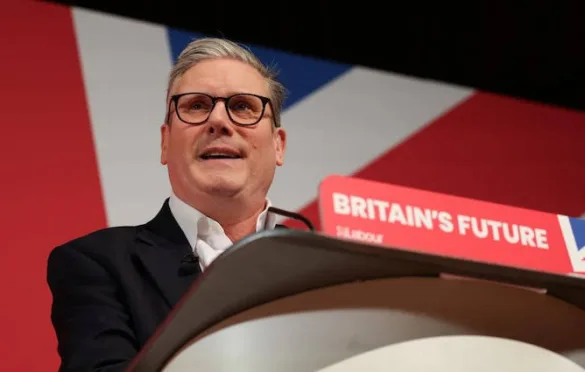
    Number 10, Downing Street has been home to Britain’s prime ministers since 1735 AD. Why would a hugely popular new prime minister move into a 289-year-old mansion without spending good pounds on it to buff it up to today’s taste? Keir Starmer, the new British prime minister, moved into that official residence soon after he was appointed last Friday. There was neither a renovation of the building nor a sanctification of the rooms by clerics and priests. Red candles, white tapers were not lit; neither was turari (incense) assigned a role.

    You would think that the British who always hailed the way we elected our leaders would copy our ways. This past weekend, the teacher didn’t do the nonsense they taught their students. Their dog refused to follow our monkey to do what locusts do to grain farms. They chose those they wanted as leaders without our usual fireworks and water cannons.

    For the winner, it was straight from the polling booth to the Government House; there was no interlude, no respite, no recess. There was even no transition committee; neither was there a budget for new furniture and new cars for the prime minister’s family. The Prime Minister took over almost immediately after the sun set for the man whose party lost in spectacular detail.

    Ministers were appointed the same day and portfolios assigned them on the spot, leaving us to wonder why the haste. We didn’t hear of the parliament grilling the appointees and asking them to sing ‘God save the King’ – their national anthem. Was the head of government even sworn in? Who did?

    here is nothing they do in the husband’s bedroom that does not happen in the concubine’s bedchamber. We have rats here that eat vital documents and get presidents sick. The British have over there too. But the PM’s residence in London has a simple solution to the problem: a mouser, a celebrity cat is in firm control of the rodent issues there. The cat’s name is Larry; for the past 13 years, it has been helping heads of government in that country to fix what our cowardly presidents run away from here. We’ve not heard that Labour’s Starmer aims at sacking the cat from the residence because the conservatives took it there.

    Since his appointment on Friday last week, Starmer, with his family, has settled in properly in 10 Downing Street.

    Our own President Muhammadu Buhari moved into our Presidential Villa late in June 2015 – three weeks after he was sworn in. The old man needed to be sure that the residence was properly fumigated of the sacked party and be rid of rodents and cockroaches – visible and invisible. Despite all his carefulness, impudent rats still ran the ramrod General out of the building and out of the country. He was away in London for months suffering from what could be anything.

    He came back and, again, got run out of the office part of the building by the same rats. We forget things here. Seven years ago (August 2017), one of Buhari’s spokespersons announced (with uncommon sensation) that rodents had damaged furniture and air conditioning fittings in the president’s “official” office while he was in London receiving treatment. The gentleman said our leader wouldn’t, therefore, be seen working in the president’s office until the damage was undone. And that was it. The big boss stayed off work until the rats accepted his sacrifice and said he should come in.

    In his own case, President Bola Tinubu has been more attentive to details. The Yoruba man is well acquainted with the functional relationship between the rolling eyes of the crab and its delicate head. He was sworn in on May 29, 2023, made a rash of careless policy pronouncements but was careful about where he would be accommodated. Unlike Starmer who rushed into the PM’s mansion like a hungry cat, Tinubu rushed nothing and overlooked nothing.

    Sixty-three days after he took over power, a reluctant Tinubu gingerly detoured into a villa building called the Glass House on Sunday, July 31, 2023. It was there he hibernated until the main residence begged him to come and occupy it. Perhaps because he is the Capone, we have not heard stories about ratty encounters in the nation’s most secure edifice.”

    ~ Lasisi Olagunju,Tribune

  • Nigeria’s Not Too Big to Fail – Oseloka Obaze

    Nigeria’s Not Too Big to Fail – Oseloka Obaze

    Deciphering Nigeria can be depressing. Interrogating her history and present political trajectory can also be disconcerting. That awkwardness is further complicated by the fact that, in a nation where governance is now rife with propaganda, the truth is always a conspiracy; and truth-tellers, traducers. That disposition did not prevent two recent unvarnished and non-salutary New York Times assessment of the state of Nigeria. 

    Both pieces represent a reality check and the proverbial writing on the wall. Despite the pushback by the ruling All Progressives Congress (APC) government, what is dawning stealthily on Nigerians is that Nigeria’s long-forecast implosion might actually be self-fulfilling. Put differently, Nigeria is not too big to fail. 

    While the Nigerian government recently marked the 25th anniversary of Nigeria’s return to participatory democracy with bizarre fanfare, in reality, democracy in Nigeria is in auto-reverse. For the majority of Nigerians, these uncommon times underpin the tribulation confronting a vastly emasculated nation. Nigeria’s fate this past year belies the triumphalism of those who eerily coveted the promise of “renewed hope” with a sense of near eschatological recompense at the cusp of the 2023 presidential election. Now that the incumbent government suffers from legitimacy and incompetence crisis, the “had-we-known” is routinely expressed, hardly ever whispered anymore in deference, denial or fear. For Nigerians, reality bites; and “we are hungry” is as much a national refrain as “Nigeria we hail thee.”

    Yet, the past one year in the nation’s life has been most instructive, for all comers. Egregiously missed opportunities and biting lessons learned run in tandem on a lengthy swath of parallel tracks of introspection and retrospection. Bitterness, regrets and consternation are commonplace as is denial and myopia, fraught by excessive excuses, hypocrisy, impunity, recriminations and cocoon-like insularity. The period has also been markedly an era of revelation and conversion for some primordial recidivists. Acquiring power by stealth has an anecdotal slant that parodies the famous song, “Now that we found love what are we gonna do with it?” For some still realistic APC aficionados, the question seems to be: “Now that we found power, what are we going to do with it?”

    Presently, nation-building is halting, as the pangs and pains of a traumatized nation are broadly felt. The rich and poor now share a common bucket list of deprivation, insecurity, bloodletting, decrepit and crumbling infrastructure and dissembling leadership ineptitude. It’s now crass to think of the grass being greener on the other side. Sadly, the present leadership is clearly bereft of a magic wand and their stockpile of political legerdemain is badly depleted. In 2023, 39 percent of Nigeria’s eligible voters presumably voted for the present government. One year later, 84 percent of the national population is reportedly “dissatisfied” with the present leadership.  That speaks volumes. In reality, the “renewed hope” has metamorphosed into hopelessness that, comparatively, makes the preceding failed Muhammadu Buhari administration seem like a positive benchmark. Really, karma has a consistent address.

    The Nigerian state has like never before been captured by the political elite. The ruling cabal is now ethnic and collegiate. Nigeria’s kakistocracy – personalities, power, prosperity and poverty – challenges are orchestrated by the unaccountable national leadership elite for whom two operational governance modalities are ‘state capture’ and ‘cancel culture.’ Invariably, that has made Nigeria a case study and attestation of how nations fail.

    In a brilliant and compelling book by Daron Acemogul and James A. Robinson, titled Why Nations Fail, Nigeria is clustered with some nations, where weak institutions combine with “extractive political institutions” that “tend to create a vicious circle because they provide no line of democracy against those who want to further usurp and misuse the powers of the state.”  Contextually, think of NASS, INEC, NNPC, and the CBN and, of course, the judiciary.  Seemingly apropos of Nigeria, the point was also made that “creating unconstrained power and great income inequality increase the potential stakes of the political game. Because “whoever controls the state becomes the beneficiary of this excessive power and wealth that it generates, extractive institutions and create incentives for infighting in order to control power and its benefits.”

    Hitherto, the lack of equity in power and resource-sharing had been contentious grounds in Nigeria; now the roots of our collective discontent lie in the shared commonality of expansive multi-dimensional poverty and broad-based deprivation of resources, amenities and the commonwealth. Our growing begging culture and demand-and-give nexus between the rich and poor makes this shared commonality tangible and palpable.

    The crux of our dilemma is that, regardless of ethnicity, political tendency and ethnic or religious persuasion, Nigeria is still occupied predominantly by post-millennial EndSARS youths in search of a new, viable nation they collectively believe is attainable. They seek a nation they can be proud of, a nation reflective of the good old days, where “tribe and tongue may differ” yet there was manifest brotherhood across regions and across the confluences. Their unyielding commitment and quest to wrest Nigeria from aged analogue geriatrics subsists, front and centre. That itself is acute grounds for inter-generational conflict across ethnic and religious divides. 

    The overarching job of Nigeria’s elected leaders, especially the President and Commander-in-Chief, is the responsibility to protect Nigerian citizens by keeping Nigeria safe. That task, by any assessment, has, unfortunately, been abandoned. Nigeria’s farms and bread baskets have been abandoned due to insecurity and visceral violence against local populations. A corollary is that Nigeria is gradually creeping toward food insufficiency and widespread hunger. Non-state actors now control or dominate pockets of territories nationwide. Nigeria’s means of sustainable production and manufacturing is being decimated daily, with the exit of multinational companies. Such corporate flight is accompanied by intensive capital flight and persistent diminution of the national currency. In lieu of legitimate revenue generation, Nigeria is now sustained routinely by massive oppressive borrowings and endless resort to fiscal ways-and-means ploys.

    The upshot of Nigeria’s reality is that the present government does not behave like an administration confronting a national crisis. Indeed, the ruling government acts and behaves as if they have concluded that the nation will soon implode and, as such, are bent on reaping all they can in form of governance largesse before the final collapse. They spend frivolously, a habit that is quite in conflict with their commitment to cut costs and rationalize bogus government by implementing the Oronsaye Report. Such ostentatious profligacy is contraindicative and belies the government’s inability to negotiate and pay reasonable living wages to the larger national population. It’s becoming hard to contemplate how the ruling APC contemplates going into general elections in 2027, with its past and present recklessness and dismal governance record.  Then again, they may have concluded that a second term is not feasible or indeed, that there will be no elections in 2027. Any flawed general election in Nigeria will be an inevitable tripwire. But holding credible elections in 2027 will be contingent on the immediate restructuring of the INEC and the security agencies. 

    A nation fails, when essentially; it cannot achieve its responsibility to protect its citizens; when pockets of its sovereign territory are controlled by non-state actors, and when every strand of the social contract that binds leaders and the governed stand broken. That is exactly where Nigeria is. It is delusional to think Nigeria is too big to fail. Her implosion if not forestalled, portends grave geo-political and geo-strategic implications that will reverberate well beyond West Africa.  Nigeria’s collapse will make the collapse of Libya look like a child’s play. May anarchy and chaos not be our portion!

      • Obaze is MD/CEO, Selonnes Consult – a policy, governance and management consulting firm in Awka.

  • Celebrating Rt. Hon. Prince U.S.A Igwesi (Ikemba Enugu) On His Birthday

    Celebrating Rt. Hon. Prince U.S.A Igwesi (Ikemba Enugu) On His Birthday

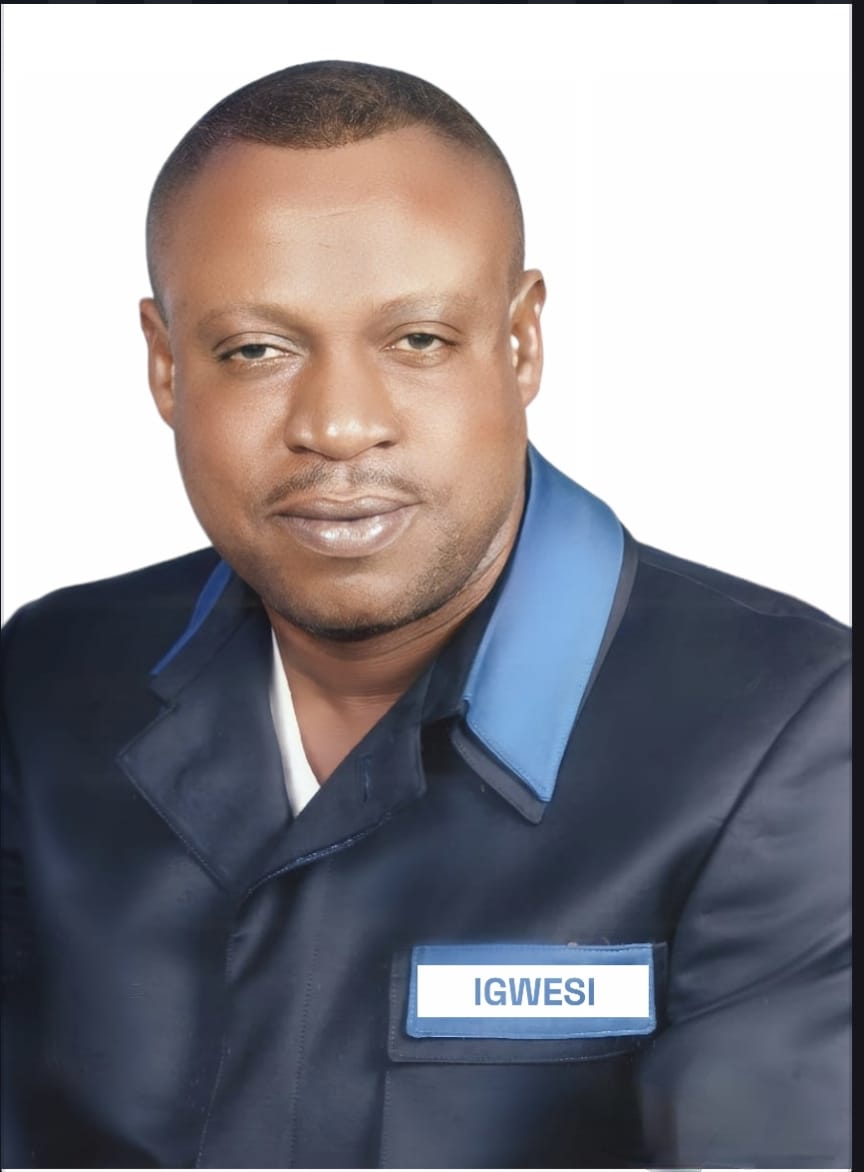
    Rt. Hon. Ikemba U.S.A Igwesi

    It is often said that when a child of promise is born somewhere on the globe, another great son with incredible potentials is also given birth to in another community where the stage has been divinely set for him to do exploits to the glory of God’s name.

    Such is the story of Rt. Hon. U.S.A Igwesi, a Prince that have never had his head bloated by his Blue Blood, whose birthday is being celebrated today, the 18th day of June, 2024. The fact remains that Prince U.S.A Igwesi – the Great IKEMBA ENUGU means a lot of things to a lot of people. Throughout his educational career from the primary, to the secondary and to tertiary levels, he soared above the eagles and stood out amongst his peers as a collosus.

    As a community leader who has contributed immensely to the wellbeing of humanity, he was bestowed with the title “IKEMBA ENUGU” in 2002 by the then Chairman of Enugu State Council of Traditional Rulers, who authorised the oldest man from Obuoffia to perform the rite as Omuoha-Obuoffia Awkunanaw community had no traditional ruler as at that time. The epoch event was witnessed by Governor Chimaroke Nnamani, the entire State Executive Council, Members of Enugu State House of Assembly and other notable personalities.

    Politically, Rt. Hon. Prince U.S.A Igwesi has distinguished himself as a Master Strategists and Game Changer. It was Maya Angelou who succinctly posited that one’s mission in life should not merely be to survive, but to thrive and to do so with some passion, some compassion, some humour, and some style.

    These words on marble have been translated to existential reality by the indefatigable U.S.A. Igwesi. As a former leader of the Enugu State House of Assembly, he exemplified the true meaning of quality representation to the good people of Enugu South Urban Constituency, through very insightful motions and high impact bills which he sponsored in the hallowed chambers as a two time elected member of the State Assembly (first, in 1997, but the House was not inaugurated due to the death of the then Head of State, Late Sani Abacha, secondly in 1999). He was the defunct NRC Flag-bearer for the then Enugu South Federal Constituency for the House of Representatives in the year 1991 and thereafter continued his meteoric rise in politics by overwhelmingly winning the election that took him to the Green Chambers as member of the 5th National Assembly representing the good people of Nkanu East and Nkanu West Federal Constituency.

    Rt. Hon. Prince U.S.A Igwesi had at various times been called upon to superintend vital functions at both National and State levels. He served as the Chairman, APD, at the Governing Board of the National Directorate of Employment, NDE. He was a former Head of the Media and Publicity Department at Enugu State Agricultural Development Programme (ENADEP) – a World Bank Project and also held the same portfolio at the Enugu State Flour Mills Limited, Emene.

    It is an incontrovertible fact that IKEMBA U.S.A Igwesi, the man who saw tomorrow, remained an indispensable stakeholder that saw to the emergence of the present political order in Enugu State. As the convener of the Two Million Man March for Barr. Peter Mbah, he mobilized ndi Enugu to rally support for the actualization of the present political engineering in Enugu State, and when it appeared that victory seemed to hang in the air, the Master Strategist again convened the OCCUPY INEC FOR PETER MBAH.

    Ikemba was the Founder of Peter Mbah Grassroot Canvassers Support Group and was later appointed Director of Support Groups Coordinating Committee, Enugu State PDP Campaign Council. Of course, such feats are not unexpected of a man who has held sway as an astute member of the Nigerian Institute of Public Relations.

    It is therefore little wonder that eminent friends and associates of the Great IKEMBA ENUGU Rt Honourable Prince U.S.A Igwesi have gathered under the umbrella of IKEMBA GUYS Association (Inc.) to give honour to who honour is due by organizing a befitting Birthday Celebration for the political Icon and Game Changer who has not only distinguished himself in service to the Coal City people but at the state and National levels, but has also mentored men and women who are today movers and shakers in the society.

    As we join the IKEMBA GUYS both at home and in the Diaspora in celebrating a worthy leader today, the 18th day of June, 2024, we pray God to grant the Obuoffia Awkunanaw born Political Heavyweight, Rt. Hon. Prince U.S.A Igwesi to continue in good health, and the capacity to continue to do good to all manner of men.

    HAPPY BIRTHDAY THE GREAT IKEMBA U.S.A IGWESI

    Chukwudi Owube, a public affairs analyst writes from Enugu.

  • Minimum Wage: Strike likely to resume as Organised Labour plans to reject ₦62,000

    Minimum Wage: Strike likely to resume as Organised Labour plans to reject ₦62,000

    The organised labour has vowed to reject any ₦62,000 or ₦100,000 minimum wage proposal for Nigerian workers by the federal government.

    Speaking in an interview on Channels Television on Monday, the Assistant General Secretary of the Nigeria Labour Congress (NLC), Chris Onyeka, described such a proposal as a “starvation wage”.

    Onyeka insisted that labour won’t accept the latest government’s offer of ₦62,000, saying that its latest demand as the living wage for an average Nigerian worker remains ₦250,000.

    He said, “Our position is very clear. We have never considered accepting ₦62,000 or any other wage that we know is below what we know can take Nigerian workers home. We will not negotiate a starvation wage.

    “We have never contemplated ₦100,000, let alone ₦62,000. We are still at ₦250,000, that is where we are, and that is what we considered enough concession to the government and the other social partners in this particular situation. We are not just driven by frivolities but the realities of the marketplace, realities of things we buy every day: a bag of rice, yam, garri, and all of that.”

    Onyeka said the one-week grace period given to the Federal Government to review its proposal last Tuesday, June 4, 2024, would expire by midnight on Tuesday, June 11, 2024.

    He said organised labour would meet to decide on the resumption of the nationwide industrial action if the Federal Government and National Assembly fail to act on workers’ demands by tomorrow.

    He added, “The Federal Government and the National Assembly have the call now. It is not our call. Our demand is there for them (the government) to look at and send an Executive Bill to the National Assembly, and for the National Assembly to look at what we have demanded, the various facts of the law, and then come up with a National Minimum Act that meets our demands.

    “If that does not meet our demand, we have given the Federal Government a one-week notice to look at the issues and that one week expires tomorrow (Tuesday). If after tomorrow, we have not seen any tangible response from the government, the organs of the organised labour will meet to decide on what next.”

    When asked what the decision of labour would be should the government insist on ₦62,000, he said, “It was clear what we said. We said we are relaxing a nationwide indefinite strike. It’s like putting a pause on it. So, if you put a pause on something and that organs that govern us as trade unions decide that we should remove that pause, it means that we go back to what was in existence before.”

    After weeks of failed talks on a new minimum wage for workers in the country, organised labour, comprising the NLC and TUC, embarked on a nationwide strike last Monday to demand a new wage and the reversal of the electricity tariff hike.

    The labour unions said the current minimum wage of ₦30,000 can no longer cater to the well-being of an average Nigerian worker, saying the government should offer workers something economically realistic in tandem with current inflationary pressures.

    However, the labour leadership suspended the strike for five days after signing a commitment with the Federal Government to resume negotiations and come up with a new minimum wage within a week.

    The suspension of the strike followed a six-hour meeting between the leadership of labour and the National Assembly in Abuja, on Monday night.

    To fast-track the talks, the President, last Tuesday, directed the Minister of Finance, Wale Edun, to present the cost implications for a new minimum wage within two days.

    Tinubu also directed the government representatives to work collectively with the organised private sector and the sub-nationals to achieve a new affordable wage award for Nigerians.

    On Thursday, the finance minister presented the cost implications of implementing a new national minimum wage to Tinubu at the Presidential Villa, alongside the Minister of Budget and National Planning, Atiku Bagudu.

    Before the directive, the minister described the proposal made by organised labour as “unaffordable. Also, the 36 state governors said labour union demand was not sustainable.

    However, on Friday, June 7, 2024, labour and the government failed to reach an agreement. While labour dropped its demand again from ₦494,000 to ₦250,000, the government added ₦2,000 to its initial ₦60,000 and offered workers ₦62,000.

    Both sides submitted their reports to the President, who is expected to make a decision and send an executive bill to the National Assembly to pass a new minimum wage bill, which the president will then sign into law.

    Punch

  • #PNM@1: A Quick-Write Memo – By M.O Ene

    #PNM@1: A Quick-Write Memo – By M.O Ene

    In one of the first memes of his campaign’s vision, before he mentioned his mission, then PDP gubernatorial candidate stated succinctly, “I am ready to work.” With the election won amidst opposition dramas and demarketing by proxy, the people of Enugu State expected work, work, and work!

    Governor Peter N. Mbah got the memo. He said so in his inaugural address, soon after becoming the 4th governor of the 4th Republic and, in 2023, the 23rd head of government in postcolonial Enugu. His campaign mantra, “Tomorrow is Here,” was now evident: the touted “tomorrow” had come. A simpler slogan sustained: “Innovative disruption.”

    In the first 100 days, Mbah showed signs that it was not going to be business as usual. “Business unusual” became another mantra. Notable early disruption was stopping Sit@Home. Non-state actors may request subscribers to stay at home, but they must not impose on anyone to sit or stand anywhere.
    Aside Abacha’s Axiom (“Any insurgency that lasts more than 24 hours, a government official has a hand in it”), the state should not have tolerated this situation for two years! Mbah refused to bow, though the anniversary of an aberration elevates it to the throne of a tradition. (Alụlụala gbaa afọ….)

    When overzealous ENSG officials overstepped boundaries by forcing folks to open for business on a Monday, Mbah quickly corrected the wrong move. Peace restored. Mission accomplished.

    The post-election legal battle took its toll. The opposition parties glued to needless NYSC certification, instead of querying numbers. They should have spent resources shining lights on INEC’s abracadabra arithmetic, if only to improve on future electoral exercises. That’s how democracies grow. Refer to USA-Y2K’s ‘hanging chads’ in Bush v. Gore. It led to reliable electronic voting protocols.

    The banning of illegal mining in Enugu could not have come a day sooner. In no civilized community do poachers forage for minerals without apt approval and official oversight. Mining is in Enugu DNA.

    In addition to Enugu being an oil-bearing state, Mbah began work on connecting Enugu to the Atlantic. Working with Vice Admiral Emmanuel Ogalla, CNS, the Nigerian Navy established a naval operational base at Ogurugu Inland Water.

    Although Mbah delivered on his promise of portable water to Coal City, unforeseen issues popped up in reticulating the fluid of life to many more homes. Stuff happens; there was no need to fuss: Our people are smart. They understand; just give them the facts—good or bad.

    The greatest of all goals is the free-and-compulsory education policy. Smart schools are not far behind. Mbah also extracted seized state assets from EFCC, as promised in 2022. The British consulate in Enugu is worth noting.

    Kidnappings and killings keep coming. The setup of Distress Rapid Squad (DRS) on Day 36 was hailed, but the solution to insecurity remains consolidated community policing. The notorious Nike-Nsukka patch and Ọzara-Udi rugged terrain remain repeat hot spots. Nimbo-2 was a double whammy: another bloodletting and a reminder of past anomie.

    On Day 91, Sunday, August 27, 2023, Enugu @32, “Mbah says administration will realise dreams of founding fathers through disruptive innovation.” If the idea had not stuck, it sure was in the air. Ndị Enugu understood the distractions that came with fighting legal battles, especially within a judiciary many adjudge painfully corrupt. They gave Mbah a pass, but that would change later when demolitions preceded innovation!

    With his seat secured and no godfather breathing down his neck as in Fubara-Wike fiasco, Mbah should deliver on his proposals, especially the low-hanging promises. While the big bucket multibillion-naira items are showcased and reportedly running (ICC, posh hotels, palm plantations, new Enugu city, roads, etc.), a communication disconnect drums down Mbah’s good deeds and exaggerates every seeming slip-up as atrocious. A fix is easy: Information is power; facilitate its free flow.

    Sadly, the evisceration of organized opposition in the House of Assembly denies the people alternative narratives in the formulation of policies; the ranch bill refers, albeit reportedly apt.

    This is an anniversary, but there is no going to town with bullhorns and confetti. The federal government has made bad Buhari programs look better. Still, Mbah should raise the bar above the status quo. Admitted that he has erased the eyesores and encumbrances inherited from the years that the locusts ate, ndị Enugu expect a lot more and better.

    Deputy Governor Ifeanyi Ossai remarked at a seminar last year: “I am left with no doubt that our people will be happy at the end of the day because there is capacity in the governor to navigate us through a complex and possibly complicated process. But that process is the only pathway to the great Enugu State we have all envisioned.”

    You cannot make omelets without an innovative disruption (breaking eggs). The character, the competence, the commitment, and the compassion of Governor Peter Mbah to deliver on his magnificent manifesto of good intentions are evident. Alas, many highways paved with good intentions from a “complicated process” do not lead to haven. In defleaing dogs, therefore, we are enjoined to expose extracted fleas periodically, so the canine knows that the compression is consequential and constructive.

    Kudos to #ENSG and #PNM! Tomorrow is another day. Let’s make it matter. Long live Enugu-042, the Coal City State, and long may we live: “ndụ bụ isi.” (Life is the essence of existence.) Everything else is embellishment.

    M.O Ene,

    May 29, 2024

  • Mbah’s One Year of Disruptive Governance in Enugu State

    Mbah’s One Year of Disruptive Governance in Enugu State

    By Prince Ejeh Josh

    The process encountered a set of radical disruption which upsets the status quo. It was a remarkable departure from the established incremental governance model to one described as a paradigm shift that has no regard for norm and convention. This redefined the trajectory of governance in its broad perspective. No longer an evolution that followed a traditional trend where the system is the guiding principle rather than human ingenuity that could interrupt and rupture the process with a new set of new ideas and solutions. The Enugu’s eccentric example is worth interrogation under the leadership of Dr. Peter Mbah, the state’s governor.

    From “The Innovator’s Dilemma” to “The Innovator’s Solution”, Clayton Christensen, a Harvard professor and business consultant, had posited that only businesses that could relentlessly apply new set of ideas that breaks down the complexity of business model, affording a hitherto luxury product to the reach of the basic or the generality of the public could quickly displace other competitors from the market. This is only possible through innovative thinking and creativity. However, being innovative is not a guarantee to achieving this new status since there exist variants of innovation. From sustaining innovation to disruptive Innovation, often not achieved by wishes or knee-jerk approach.

    Enugu pre-May 2023 had a historical pattern of development; incremental evolution of development where governance is built on binary layer of arithmetics. It is an establishment that allows players to fit in and sustain the trend. Development in economy, infrastructure and other sectors progressed in that layer, often rigid and insipid. However, the Enugu governor had reiterated an uncanny resolve to make a contrasting departure from the model to a new strategic pattern of thinking he termed, like Christensen, radical innovation. His philosophy quickly dawned on analysts of his abhorrence for developing status and economy that never developed in reality.

    Mbah spoke about his new set of leadership mechanisms and how things would take shape in his administration. Every project proposed had a timeline. Weirdly, these proposals were not the kind that the nation was used to. Growing an economy sevenfold in eight years, constructing 260 smart green schools, making the state a premier destination for investment, and eradicating poverty through capacity building, infrastructure rebirth were some of the consequential pronouncements that had left many interrogating his background and his audacity. Enugu had grown marginally and minimally in development over decades, and in less than a decade, a man had proposed a new phase, that will supremä past records.

    With his roadmap presentation, the journey began. Signing three significant executive orders 001, 002 and 003 representing citizens charter for accountability and public participation to hold his administration accountable to its promises; elimination of barriers and illegal structures for public safety and security, and activation of an investment-friendly state through policies and principles that could materially translate to reality. These reinforced the governor’s commitment that he stood by his campaign promises as sacred. Within the first 100 days in office, the manifestation of these orders began to take a defining shape of a state in dire need of a new foundation.

    The administration met an obsolete, dysfunctional system that required an urgency of displacement for a new system if the administration must work. New policies and frameworks were evolved to support the vision and mission of the government. Enugu was becoming attractive as the clock ticked but the governor was in a hurry, torpedoing inefficiency, underdevelopment and deconditioning the established norm of Enugu being an administrative and civil service state that would never have anything with industry or business.

    Mbah recognized that disruption must take place to eliminate that age-long orientation of idleness and narrative if the administration meant everything it had outlined. To eradicate poverty, there must be a change. A disruptive rather than a sustaining incremental innovation. To move the economy from the static $4.4 billion to an ambitious $30 billion, the state must drift exhaustively from its revenue model of dependency on the federal coffers to looking inwards with a can-do-spirit of creativity. To build a brain that would match and outsmart the 21st century innovation and think into the future, a smart form of education that would impact these futuristic features must first be conceived, articulated and executed. To construct a 10,000km road within the space of 8 years across the state, things must be done differently, and the state fiscal status must leapfrog exponentially.

    Assembling a team of principled experts was a no brainer to achieve the humongous vision by the administration. Mbah, although rooted in thought, quickly scouted the best of the brains around the world to drive the governance process. Indeed, his team has been described as one of the best sourced team,cutting across disciplines and expertise.

    The team was not only driven by the motivation of making a new state and creating a niche for the administration but also the fact that the principal piloting the statecraft would not accommodate unproductive and inefficient leadership on the part of his officials. It was a year that displayed utmost commitment, dedication, team spirit, responsibility and firm resolve to delivery from the team.

    Then, the seemingly intractable and protracted curse in the water sector reared its ugly head. The governor screamed at every given opportunity that in 180 days, the hydra-headed perennial water problem would not only be reversed, potable water would be taken for granted among residents who had been consigned to despondency of accepting their fate of a “waterless” state. Cynics and skeptics fired gloating missiles, interrogating the nature of magic wand Mbah would deploy in the water sector. Moses, in the Bible, had struck a rock from which water gushed for the children of Israel. What tool would Mbah employ and what would be the source of the much promised water? In less than 180 days, with the aid of disruptive innovation, Mbah demystified the jinx and Enugu today is adjudged a water city.

    In security, one of the top and most critical challenges faced by the budding administration was the issue of insecurity. A precursory into the dark realm of security in the state showed, as a baseline data, that Enugu was dripping with blood and sorrow. From the suffocating economy, almost collapsed to extinction, precipitated by insecurity notoriously nicknamed sit-at-home orders from criminal gangs and enemies of the people, to senseless killings by herders, cultists and communal clashes.

    Mbah identified these as big elephants that must be crushed and sent packing. Sit-at-home, although banished to the sad memories of our past, had become an undignified issue that demeaned the psychic of our people. Businesses were paralyzed. Education was almost grounded. Life became an anomaly and one could infer that era from what the English Philosopher, Thomas Hobbes, described as the state of nature where life is brutish, nasty and short.

    Mobilizing strategic resources, the defeat of the sit-at-home, unknown gunmen, bloodletting by herdsmen and other attacks were imminent and eventually became a thing of the past. From a ghost city, Enugu progressed to the most peaceful and thriving state in Nigeria. The audacity and political will to do the impossible were only possible because of the governor’s leadership posture.

    Only in 365 days, Mbah declared an infrastructural renaissance. It was a new dawn in the history of the state as Enugu departed from deteriorated state of governance to one worth celebrating. Major roads were carefully paved with modern fixtures while new ones were opened up. This was a deliberate step to make the state attractive to Investors. The governor had assured that his administration would de-risk investment flow and create a conducive environment where returns on investment would be lucrative.

    Today, investors are striking deals. The state is becoming a hub for manufacturers, service providers, tourists, and dormant assets are being revamped. The promise that no abandoned asset would be left out in the rebirth struggle is yielding result. The international wing of the Akanu Ibiam Airport, the international conference Centre, the Hotel Presidential, the Niger Gas Industry, the United Palm Produce, among other moribund assets are having life injected in them, all this within one year.

    Enugu’s system of education is becoming top-notch in Africa, migrating from the archaic and unproductive teaching method to a digital, experiential learning where school children are exposed to tools that are required to key into and drive today’s economy. The new smart green schools are modeled to impart specialisations as robotics, artificial intelligence, mechatronics, among other advanced technology and innovation. This is unheard-of in Nigeria but the can-do-spirit of disruptive governance is only playing out.

    The pride of having Mbah as a governor in a time like ours; a time that requires urgency and sense of creativity, disruption in the status quo and a rebirth couldn’t have been better explained than all the projects holding sway in the state to the consternation of admirers and adversaries. While the 260 smart schools are rapidly undergoing construction, Mbah added another 260 Type-2 primary healthcare centres. That not enough, workers and civil servants in the state are still celebrating the new lease of life and wage award which has strengthened their purchasing power. Interestingly, available data had shown that against the backdrop of his promise to train and empower 40,000 youths, that figure has been surpassed. It isn’t surprising that all this is possible because of the disruptive governance introduced into the administration.

    With a sense of fulfillment and patriotism, the people of Enugu could only look back with nostalgia, saying, “We made the right decision at the polls. Democracy triumphed over the forces of dark principalities who were bent on smuggling accidental candidates and imposing them on the good people of Enugu State”. May Enugu State continue to succeed.

  • Gov. Mbah: Reviewing One Year of Effective Governance – By Anayo Edeh

    Gov. Mbah: Reviewing One Year of Effective Governance – By Anayo Edeh

    On May 29th, it will be exactly one year since Dr. Peter Mbah was sworn in as Enugu State Governor.

    I make haste to say that Mbah’s one year in office has witnessed the conception and commencement of major projects in all Sectors that are capable of transforming the economy of Enugu State and giving the people a new lease of life.

    A critical look at some of the Sectors would buttress the fact that Mbah’s reign will change the course of the history of the State.

    For the first time in our history, Enugu is witnessing the construction of 260 World-class Smart Schools and another 260 Health Centres in all the Political Wards in the State. The Smart Schools and Health Centres will be equipped with State-of-the art facilities seen in the developed Climes of the World.

    To further boost Healthcare in the State, Governor Mbah is constructing new Wards in Parklane Hospital. This will ensure that more people have access to health care in the hospital.

    To re-position education in the State, Governor Mbah is recruiting qualified teachers who can groom our children and prepare them for the challenges of the future.

    Governor Mbah has also embarked on aggressive construction of roads and bridges to effectively link up all parts of the State and aid commercial activities.

    It is irrefutable that poor road infrastructure in the State was hindering both human and vehicular movements and making the evacuation of agricultural produce from the rural areas to urban Centres very difficult. Farmers have seen their yields waste as a result of their inability to move them to Urban Centres where they are needed more. The new roads being constructed by the Mbah Administration will open up Enugu for the World and also help in attracting Foreign Direct Investments (FDIs). It is reassuring that most of the roads are also being constructed simultaneously with Fly-overs for ease of traffic.

    Another re-assuring project of the Enugu Government, is the provision of water in every home in Enugu, the re-modeling of the Enugu International Conference Centre and the construction of a Five-star hotel which will make Enugu a destination for international Conferences. The International Conference Centre, the Central Terminal Stations, the Five-star hotel and the revamping of the hitherto comatose Presidential Hotel will, obviously, help in boosting the internally generated revenue (IGR) of Enugu State and create jobs for our youth.

    The N100billion Palm Deal will also be a major move that will help in re-positioning Enugu economy.

    It is gratifying that Enugu Pensioners and Workers no longer gnash their teeth before they receive their emoluments and gratuities.

    Governor Mbah has also demonstrated the will and determination to tackle the security challenges confronting Enugu State. Efforts are ongoing to confront the trouble makers who are causing mayhem in the State with the assistance of Security Agencies. The strategies of the Governor will make Enugu, a hot Zone for all classes of criminals.

    The intention of the State Government to move the State economy from $4 billion to a $30 billion based one is an uncommon feat that can only be achieved by a Transformational Leader of Mbah’s Class.

    Morning, certainly shows the day. As we march forward, there is no doubt that Enugu will witness total transformation under Governor Mbah. Enugu is bound to stand out among the States in Nigeria.

    Despite the fact that Enugu is not an Oil-producing State, Governor Mbah is using the meagre resources of the State to positively change the lives of the people and place Enugu on the path of irreversible and sustainable development.

    Anayo Edeh is the Convener of Nkanu-east Consultative Forum.

  • Begging? I Beg Your Pardon!

    Begging? I Beg Your Pardon!

    By Okey Ikechukwu

    As the Igbo would say, the man who sets out to marry a wife and celebrate his wedding in the Village square while wearing stolen and brightly coloured clothes of another should pray that the owner of the apparel on his back does not turn up in the Village Square while he is rocking his new-found body gear of questionable origins. And this saying has an extension: He who prays that the owner of the stolen clothes he chose to wear to a public event should not attend the event and see him should remember that the village is a small place and that the original owner of the clothes has friends and relations who will carry home a report that would make the thief unable to sleep after close of the day’s business.

    But the matter of whether Ohaneze was planning to embark on a begging expedition or not has been laid to rest for good. Just when it was beginning to look like a crescendo was about to be attained by drivers of the campaign of calumny, the project ran out of gas. Untruth may rear its head, and even display some bright colours you cannot ignore, but it can never last long enough to challenge the truth. The mischief makers who tried to float the totally reprehensible narrative lost out in the end. But there is still the after-smell of un-sanctity in the air. No matter.

    In reaction to the shocking tale of beggary, the President-general of Ohaneze and the organization’s Secretary General rolled out the tanks of public discourse and drowned out the ridiculous, but viral, claim that the organization came up with the had the hare-brained idea going on some kind of begging expedition to the northern part of the country. To begin with, there was nothing remotely resembling that thought in the two-day Ohaneze retreat where the idea was alleged to have sprouted.

    I was at the event. I was also the Lead Speaker at the retreat held in Enugu. My presentation, and other presentations, were focused on new paradigms for Igbo self-actualization in the nation that essentially undergirded by a conspiratorial, and not openly and freely competitive, political economy. It was a soul-searching and truth telling outing. The ensuing Communique spoke to the issues discussed, as well as the new programmes and focal concerns of Ohaneze Ndigbo, Worldwide. So where did the tale of begging and supplication come into it?

    Ohaneze, and Ndigbo generally, had a chance to “beg” the North or, more specifically, the Fulani, for support about a year ago. That was before the Last presidential elections, when Peter Obi was a candidate. They did not such thing. Instead, a meeting was called some five months before the elections between the South East Elders Forum and the Northern Welders Forum. In attendance covered the confederacy of all otherwise distinct platforms from both parts of the country, all with a common interest on the issues the coming elections were likely to put the table.

    Prof Ango Abdullahi led the Northern team, while the South east team was led by Chief Simon Okeke, for Chairman of the Police service Commission (PSS) and Chairman of the Anambra Public Officers and Elders Forum (ASPOF). The atmosphere was sombre. The air was charged with barely concealed expectations of horse-trading proposals, since it was a question of an election wherein the highest position in the land was being sought by an Igbo man.

    There was a smell of “What is in it for us” in the air. So, it was for the South East Elders Forum to “Make their case” and convince their counterparts that a Peter Obi Gamble was worth their while. The Northern Elder presented Dr Hakeem Baba Ahmed as spokesman, while the South East Elders presented Prof Okey Ikechukwu, mni, as spokesman. And so, Ikechukwu was invited to address the Northern elders after the leaders of the two teams had put forth their opening pleasantries.

    As one of the very highly respected and also very old Northern Elders later quipped, after the three-hour interaction and exchanges, “We did not see it coming at all. That your Ikechukwu just compelled some of us to thinks about things we probably have bever adverted my mind to in the politics of the momen”. So, what really happened?

    As the designate spokesperson for our own side of the table, I started by saying that we had come with a central message; which is captured in the statement: “Come let us reason together”. I said the we had not come to beg them to vote for Mr. Peter Obi, or to ask them to support our son and brother, no. Instead, had come to compare notes with them, on the good product that Nigeria needed a tthat historical hour.

    I pointed out that Obi’s choice of their son and brother as running mate was based on his assessment of the latter, as enlightened, successful, and hands-on manager of human and material resources. Obi chose one of their best, who, in addition to being broad-minded, was also known for his substantial, and sustained, investments in human capital development. So, let us reason together, with these questions in mind: (1) “What sort of leadership and navigational skills do we need to save Nigeria. (2) What type of person can deliver on this, and is Peter Obi, alongside his running mate, the type of team that dan do this job well?

    Then came my clincher: “Gentlemen and elders, what every one of us here has in common is that we have all the attributes of people who can be kidnapped for ransom. are prime targets for kidnappers. That is not to say that we are wealthy by any stretch of the imagination in the conventional sense of Nigerians who can routinely sign off millions of naira, or eve n dollars, without blinking; no”!

    I pointed out that we all came in more than passably clean air-conditioned vehicles; all in relatively good condition. We all look a little less harassed and less desperately hungry than the average person out there. So, anyone seeing us, and who has caught unto the new-fangle trade of capturing human beings in order to release them again after being paid, will see a potential product he can secure and use to make money”. Everywhere was dead quiet.

    I continued: “No bandit, kidnapper or terrorist who accosts any of us on the road will first try to find out who we are, how good or bad we are and whether we are doing our best for humanity and for our fatherland. We would all be just, “ransom-able commodity” and nothing more. Professor, Imam, Senator, Senior military officer, students, name is!

    Turning to the Prof Abdulahi, I said: “Recall, sir, that your son was one of the unfortunates of the Kaduna-bound train mishap. Fortunately, no stray bullet found him. But unfortunately, he was taken captive alongside everyone else they people could get hold of after derailing the train and killing some of the passengers. The young man’s identity as your son your son did not make any difference to them, or to anyone for that matter. No! with all the sacrifice you and many other people have made over the last 50 years?

    I spoke if the demand for ransom and of the fact that the criminals held unto the young man until the full ransom was fully paid. Shortly thereafter, an incident involving the kidnap of another of your relations, this time with four of your beloved grand children in tow, was reported. It was all Ango Abdullahi’s problem while it lasted.

    “The concern for us at the South East Elders Forum had more to do with a desperate need to rescue even our humanity as a people, in addition to all the hullabaloo about elections and positions after the elections. The coming elections, we held, must be sued as a tool for the restoration of the people-centred leadership ideals that characterized the era of the Ahmadu Bellos, Ziks, Awolowos, and so many others of that era.

    I reminded us of the circumstances under which Prof Onyemelukwe lost his life in Anambra State, at the age of 84. He was accosted on the road by armed young men. Then they discovered that he was a saboteur working with the Fulanis in Nigeria against Igbo interests. Yes! And they had clear evidence and proof of his treachery before their very eyes. They also told him about this evidence and proof before they shot him. Guess what proof of his treachery and betrayal of Ndigbo they had against him? The 84-year-old man was wearing a caftan. That was all. He had to be executed for wearing Fulani dress in Biafra Land. That was the end of a great scholar of international repute and community leader.

    Traditional rulers hitherto thought to be untouchable in various parts of the country are now routinely picked off their royal stool in their kingdoms and emirates like hapless chickens I nan exposed cage. Alongside the foregoing several other issues that were discussed in confidence on both sides.

    Baba Ahmed was at his eloquent, and also very realistic best when it was his turn to speak for his side of the table. He raised all the relevant issues, forever focusing on the things that mattered the most. There was neither begging nor demand for begging. The gathering did not query, or try to impugn, the reputation or aspirations of other candidates besides the ones we had on the table at our meeting.

    Then the meeting rose, agreeing embark of serious group reflections and introspection, and to reconvene soon thereafter to determine next steps. It was about Nigeria, about or physical, economic, political and moral survival as a people facing common problems that we needed to “reason together” and chart a way forward.

    Imagine if a man who, as Vice chancellor of Ahmadu Bello university, did so much to fast-track tertiary education for Northerners were to lose his son to criminals at whose current means of livelihood is the fact that they had no education and no socially useful survival skills. The north stood by and Ango’s son was held captive for months. Just as the East watched the husband of Dora Akunyili bumped off in broad daylight by gunmen.

    Going back to the matter of whether Ohaneze was planning to beg anyone or not, ”Untruth may rear its head, and even display some bright colours you cannot ignore. But it can never last long enough to challenge and permanently displace the truth”. Begging? I beg your pardon!

  • [ANALYSIS] Will Wike vs Fubara feud rip Rivers NASS caucus apart?

    [ANALYSIS] Will Wike vs Fubara feud rip Rivers NASS caucus apart?

    By Order Paper

    The unyielding political face-off rocking the Rivers state chapter of the Peoples Democratic Party (PDP) is gradually eating into the brotherhood of the Rivers NASS (National Assembly) caucus that was hitherto united under the firm grip of Rep. Kingsley Chinda, minority leader of the House of Representatives. 

    The feud is between Nyesome Wike, Minister of Federal Capital Territory (FCT) and his successor and incumbent Governor of Rivers State, Siminalayi Fubara. Both gladiators have divided not just the party in the state but the national structure of the PDP is now also at the mercy of the tiff.

    Amaewhule

    A ‘Captured’ State Assembly

    Before the factionalisation of the Rivers NASS caucus blew open to Abuja, the state assembly had been subjected to a bitter capture by Wike.

    The defection of 27 members of the Rivers State House of Assembly, said to be loyal to the minister, from the PDP to the All Progressive Congress (APC) was a strategic move against Fubara. Martin Amaewhule is the speaker of the faction backed by Wike while Edison Ehie, a former leader of the assembly, who was removed for not supporting Governor Fubara’s impeachment, leads the faction loyal to the governor.

    A coalition ‘unknown’ to parliament

    The crack in the NASS Rivers caucus blew open into the precinct of the federal legislature when a group of opposition lawmakers addressed the media on Monday 8th April, 2024 ostensibly to put pressure on the Wike faction of the party. Led by Imo Rep, Ikenga Ugochinyere and Fubara ally, Rep. Awaji-inombek Abiante, representing Andoni/Opobo/Nkoro federal constituency of Rivers State of Rivers State, the group of four demanded the immediate resignation of the Acting National Chairman of the PDP, Umar İliya Damagum. 

    Damagum is seen in some quarters as Wike’s ally, a belief that gained momentum when the former Rivers State Governor dared him to sanction him for alleged anti-party activities before, during and after the 2023 elections. The attack on the PDP national big wig was understood therefore as a proxy war with Wike being waged from Rivers. 

    The ‘coalition of opposition lawmakers’ led by Rep. Ugochinyere approached the Rivers crisis from the Abuja angle.

    But Rep. Abiante revealed the real intentions of the group when he condemned alleged illegalities being perpetuated in Rivers by the federal might. The press conference was widely reported by the media and in no time, the minority caucus of the House signed a joint statement dismissing the coalition, The Chinda-led caucus, comprising lawmakers of the PDP and Labour Party, etc, said emphatically that Ugochinyere‘s coalition is unknown to parliamentary practice and should not be disregarded. 

    Where does the Rivers NASS caucus stand?

    Given this scenario, OrderPaper delves into the politics of Rivers State to deduce the impact of the crisis on the legislative effectiveness of lawmakers from the state. Where do each member of the House and Senator from the state stand on the feud? Are they making any attempt to resolve it so that peace and stability can return to the state for good governance to thrive unhindered?

    Chinda, leader of the Reps minority caucus
    Rep Chinda

    Rep. Kingsley Chinda – He is the minority leader of the House and close confidant of Wike for many years. While he has not openly taken sides on the feud, it is indisputable that his loyalty lies with the minister, who is believed to have pulled strings to ensure his emergence as a principal of the House. Chinda, highly cerebral and politically adroit, commands immense respect and following, not just among the Rivers caucus, but among all spectrums of the lower chamber of the House of Representatives.

    Inclination: Chinda stands solid with Wike

    Dum Dekor, Rivers NASS caucus leader
    Dekor

    Rep Dunamenne Dekor – Representing Khana / Gokana Federal Constituency, he is the leader of the Rivers caucus in the House. Also, a staunch ally of the minister, Dekor is a quiet but highly tactical politician who served under Wike as commissioner for works after a brief stint as a member of the 8th assembly. A former deputy speaker of the Rivers assembly, Dekor showed his hand in the Rivers crisis when he cautioned his colleagues against attacking the minister to please the governor. In December 2023, he signed a statement on behalf of the Rivers caucus cautioning Rep. Boma Goodhead to be civil and mind her utterances on the political logjam in the state.“Goodhead went far beyond her calling by delving into a political issue that has no bearing on her person as if she has had a personal beef with her former principal for eight years. As a caucus, we can’t sit and watch our members openly display and utter words that smirk of gutter behavioural patterns. Hon Boma Goodhead should immediately tender an unreserved apology to her former principal,” he had said.  

    Inclination: Dekor stands solid with Wike

    Rep Abiante on the Wike vs Fubara feud
    Abiante

    Rep. Awaji-inombek Abiante – He is arguably the first member of the Rivers NASS caucus to openly identify with Gov. Fubara. While others were measuring their steps and weighing their options, Abiante moved in to fill a vacuum and is believed to be heavily supported by the governor to gain inroads into the federal legislature and counter Wike’s influence. The outing by the Ugochinyere group was a manifestation of his loyalty to the governor. The ranking member of the House however seems to have a long way to go if he must break into the stronghold Wike has on the Rivers NASS caucus.

    Inclination: Abiante stands solid with Fubara

    Goodhead

    Rep. Boma Goodhead – Strong-headed and unabashed, Boma Goodhead is also a ranking member of the House of Representatives. Representing Akuku/ Asari Toru federal constituency, she had, on December 15, 2023, led a solidarity protest in support of the programmes and activities of the incumbent governor of the state and dared the Minister of the Federal Capital Territory to return to Rivers State. According to Rep. Goodhead, “I want to send a clear message to the Federal Government of Nigeria. Tinubu believes that Wike delivered Rivers State to him but even Wike failed in his unit. He failed in his ward and even in his LGA. We are here to tell Ahmed Bola Tinubu to call Wike to order because the next time he comes into Rivers State to disturb the peace of the state we will not fold our hands and watch. Wike should come to Rivers State and we will show him what it means to hold Rivers State. We dare you to come back to Rivers State again if you are a man.” Wike had been to the state a couple of times after that outburst and returned safely to his base in Abuja. Curiously, Goodhead was not on the lineup when the Ugochinyere group briefed the press.

    Inclination: Goodhead stands solid with Fubara

    Rep Emerengwa iswith Fubara
    Emerengwa

    Rep. Boniface Emerengwa – This is another member of the House of Representatives, representing the Ikwerre/ Emohua federal constituency, who has openly declared support for Governor Fubara thereby denouncing his long-standing political alliance with Wike. Emerengwa, a third termer in the House made the declaration during a visit to Governor Fubara in Port Harcourt some weeks ago and said “he (Fubara) deserves the support of the people to grow the State.”

    Inclination: Emerengwa stands solid with Fubara

    Allison

    Rep. Anderson Allison representing Okirika/Ogu-Bolo of the APC who is the only member of the House of Representatives from Rivers State, elected under the platform of APC,  supported Wike’s appointment as minister. There is no doubt that Wike has been romancing with the ruling APC hence his appointment by President Tinubu which is automatic for Allison to queue behind the FCT Minister for fear of losing out his reelection bid come 2027.

    Umezuruike

    Rep Manuchim Umezuruike – The Labour Party (LP) member representing Port Harcourt Constituency 1 is not keen on being a neutral observer in the fight. Despite belonging to a different political party, Umezurruike is aligned with Governor Fubara. This is no surprise because the gubernatorial candidate of the LP in the State, Beatrice Itubo is also in support of Fubara.

    Inclination: Umezuruike stands with Fubara

    Rivers NASS
    Opuzor

    Rep. Obuzor Victor Chukwuemeka – This member representing the Ogba/Egbema/Ndoni/Ahaoad federal constituency is a newbie. He has kept mute in the Rivers PDP brouhaha thus far.

    Inclination: Obuzor is perceived to be undecided

    Godwin

    Rep. Hart Cyril Godwin – This lawmaker who represents Degema/Bonny Federal Constituency had in July 2023 reportedly described Governor Fubara as “a leader with foresight.” This was concerning the signing of the N195.3 billion Port-Harcourt Ring Road project. But since then, lots of water has passed under the bridge, political pundits are unsure where he stands on the crisis. 

    Inclination: Hart is tilted to Fubara

    Uche

    Rep. Nwaeke Felix Uche – This lawmaker is undeniably an ally of the former governor, Wike,  judging by the closeness between the duo but he has neither openly condemned nor supported any side in the political crisis in the State. 

    Inclination: Tilted to Wike

    Nwogu

    Rep. Nwogu Kelechi – This federal representative is a former member of the Rivers State House of Assembly. He maintains a close relationship with former governor Wike who is believed to be instrumental to his election to the House of Representatives. He has been sighted with Wike at different events within the FCT. The FCT Minister had in June 2021 while commissioning a road project described Kelechi as “a politician you can trust, a politician that will stand by you and fight when it is time to fight and a politician while working with, one can go home and sleep with two eyes closed because he will not betray”. Nwogu might be mute but from his latest antecedents, his loyalty seems to lie with Wike. 

    Inclination: Nwogu is strong with Wike

    Chigeru

    Rep. Amadi Blessing Chigeru – This female representative is believed to stand behind Wike because she had expressed her profound gratitude to President Bola Tinubu for appointing him to his cabinet. She was a former Rivers state Treasurer of the PDP before emerging as a member of the House of Representatives representing Port Harcourt II. But she is not known to have openly taken sides in the conflict. 

    Inclination: Amadi Blessing stands with Wike 

    Rivers NASS
    Rep Bob

    Rep Solomon Bob (PDP) – Solomon Bob represents the Abua/Odual and Ahoada East federal constituency in the House of Representatives. He was first elected in 2019. He is a former Special Adviser to Wike. Although he has remained mum amidst the political chaos, it is unclear if Bob has shifted loyalty to Fubara.

    Inclination: Bob tilts to Wike 

    The three senators representing Rivers State in the National Assembly appear to be acolytes of the minister.

    Sen. Banigo Ipalipo-Harry (Rivers West)- She served as deputy to Wike for eight years and was loyal all through. It is believed that her loyalty has not waned.

    Inclination: Ipalibo-Harry stands with Wike

    Sen. Onyesoh Alwell (Rivers East) – This senator was one of the two longest commissioners who served in the administration of Dr Peter Odili as Commissioner for Education, and later Sports. Wike consequently supported his nomination and eventual emergence as the Rivers East Senatorial flag bearer. With Odili backing Fubara, is Alwell still with Wike?

    Inclination: Alwell is perceived to be undecided 

    Rivers NASS caucus
    Sen Mpigi

    Sen. Mpigi Barinada – This Rivers South-east senator is a proven Wike loyalist. He served as a member of the House of Representatives, representing the constituency of Tai–Oyigbo–Eleme for two terms between 2011 to 2019 before he was elected into the red chamber. In December 2023, Mpigi expressed the displeasure of his senatorial district with Governor Fubara. He said, “Anybody that sows must also reap. We have all sown. So it is not Wike now, because I want things to be very clear. We the leaders of this State are not happy with what the governor (Fubara) is currently doing. So he should not say it is Wike. I represent the governor I know what is happening, so I’m not happy.” He recently tried to sideline Fubara for Wike.

    Inclination: Mpigi stands solid with Wike

    Odili

    Will Peter Odili’s verdict sway the Rivers NASS caucus?

    Former Rivers State Governor and highly regarded political icon, Peter Odili, recently declared the incumbent governor as the political leader of Rivers State, a move that may further worsen his frosty relationship with Wike, who is hitherto seen as a godfather to the minister. He made this known on Thursday, April 11th 2024 while commissioning a primary healthcare centre in Ogba-Egbema-Ndoni Local Government Area of the state, Mr Odili said, “Having secured electoral victory through the ballot and the courts, Mr Fubara is now the political leader of the state. Will this declaration by Odili sway the NASS members in favour of Fubara?

    2027 NASS tickets in view? 

    The Rivers NASS caucus is not seen to be making any move to broker a truce between Wike and Fubara; rather alliances are being formed for their political benefits. Out of the 13 House of Representatives lawmakers and 3 Senators, totalling 16 in the federal legislature, 3 House of Representatives members have openly challenged Wike and thrown their weight behind Fubara. The remaining 10 House members appear to be still loyal to their godfather while the 3 Senators have remained mum.

    In a recent meeting summoned by Chinda at the National Assembly ahead of Thursday’s National Executive Committee (NEC) of the party PDP, it was said that the main agenda of the Pre-NEC meeting was to pass a vote of confidence on Damagun by lawmakers loyal to Wike. 

    This attempt failed woefully as the group of lawmakers under the auspices of the opposition lawmakers coalition maintained their ground that the acting chairman should resign and someone from the North-central zone take the position.

    Meanwhile, the National Working Committee (NWC) of the Party on Wednesday, 17th April 2024 passed a Vote of Confidence on the party’s Acting National Chairman. The party’s National Publicity Secretary, Debo Ologunagba, said this in a statement on Wednesday in Abuja.

    In another dramatic twist, loyalists of Governor Fubara, including the lawmaker representing the Ahoada West Constituency of the state House of Assembly, Sokari Goodboy; were reported to have been arrested at the FCT, Abuja.

    Also arrested by the police was a chieftain of the PDP in the state identified as Ezebunwo Ichemati. The duo were arrested by policemen outside the venue of the National Executive Committee meeting of the PDP in Abuja on Thursday (18 April 2024).

    It is interesting how this political war will pan out. Would there be more grandstanding and alliances? What becomes of the ordinary masses in all these fights and would it define those who will be returning to the National Assembly in 2027? All these are questions begging for answers as the Rivers NASS caucus toggles from both ends.

    OrderPaper