Category: Opinion

  • [NKANU TODAY] A Tribute To A ‘Messiah’ [Icon], His Royal Majesty, Hon. J.E Igwesi

    [NKANU TODAY] A Tribute To A ‘Messiah’ [Icon], His Royal Majesty, Hon. J.E Igwesi

    EDITOR’S NOTE: April 11, 2024 marks the 43rd anniversary of the death of HRH Rt. Hon. John Egbo Igwesi.

    By Chief Mark A. Ngene

    God in His infinite mercy created Hon. J.E Igwesi to liberate Nkanu and Awkunanaw people from primitive and timid lifestyle and obnoxious custom and tradition. He also created him to salvage the people from the clutches of backwardness.

    The early life of Hon. J.E. Igwesi was very clear from when we were all in school. While some of us were eager to pass standard 6 (six) and went to teachers training schools, John, as he was called, had his own ambition going into secondary school because teachers training school and secondary school education were at variance.

    There was no secondary school around our area, the few secondary schools could be found at Agrey Memorial College, Arochukwu, Methodist College, Uzu Akoli and D.M.G.S, Onitsha.

    John Igwesi was one of the foremost students of Nkanu. He attended the college, Agrey Memorial College with one Ezekiel Nnamoko from Akpawfu. So, when he came out of the school he secured employment in Nigeria Coal Services; from thence John started his natural assignment. First, he summoned Awkunanaw people to discuss and revert the old insinuation that Awkunanaw people denounced colonial administration and all its benefits. He did this with the cooperation of the newly recruited colliery workers of Awkunanaw origin.

    While he was still in the services of coal mining, parliamentary election into Eastern Region of Nigeria came into focus. John joined forces within N.C.N.C with Chief Daniel Nnamani of Agbani, Chief Denis Nnaji of Oruku, Chief Aneke Chime of Udi and Chief Charles Abangwu of Nsukka; they all won the elections into Eastern Nigeria House of Assembly, Enugu. There and then John made manifest of his wisdom and sagacity.

    The following were some of his notable achievements in the parliament:

    -Nkanu and Udi earlier merged were demerged [and the whole area, is presently recognized as Nkanu East, Nkanu West, Enugu East, Enugu South and Enugu North.]

    -Wawa State Movement: Hon. J.E. Igwesi was one of the foremost Architect of the Wawa State movement, renamed Enugu State. The victory of the movement was the full concern of Hon. J.E Igwesi, Hon. Christian Onoh and Barr. Enechi Onyia. The road to the victory was rough and perilous because some of the militants of the movement were wounded during encounter with Chief C.O.C Chiedozie led opposition group.

    -The acquisition of the entire Enugu township from Udi hill down to Ayo River acquired as coal field and signed by paramount Chief Onyema of Eke in Udi. The process and the signatory were erroneous thereby these named parliamentarians went into the House of Assembly and cancelled the acquisition. The Akwuke people who were paying annual rent stopped. Ugwu Akum Attakwu took over their land from the wrongful acquisition. Amagu, Akegbe took over their land from within. Also, Umuatugbuoma, Amechi Awkunanaw also took over their land within, so also the pople of Nike.

    -Also on the floor of the House of Assembly, they jointly sponsored a motion calling on each representative to advice their people not to come to Enugu township bare bodied, either to come and sell or buy, and nobody should bath openly on the running waters such as mmiri Akegbe, Asata River and Ekulu River. Open defecation from all sides was abolished, also encouraged was wearing of footwears.

    Hon. J.E Igwesi made Awkunanaw situation his primary objective because he was instrumental to the establishment of Awkunanaw first and second layouts, Achara Layout. He encouraged land owners from various villages that their lands fell within the layout to exercise caution in the sell and maintainace of their various plots/portions of the lands. He also co-sponsored other bills on the floor of the House of Assembly.

    Hon. J.E Igwesi was an Ambssador Extraordinaire to various areas of the country where there were conflicts among our members. When chieftaincy issue arose in Eastern Nigerian, John had no problem in becoming Chinawaeze of Obuoffia Awkunanaw.

    In his early days, he invited all headmasters in Awkunanaw and advised them to establish literal members to enable the children develop their talents and become well educated and go into various fields such as law, medicine, engineering and others.

    The life and times of Hon. J.E. Igwesi by our assessment, had no dull moment. It was because of this, because of all the engagements here and there, materially he was disposed to being very rich but his principal aim was to develop the people through education.

    In the final analysis. Hon. John Igwesi had, in obedience to our ancestors’ traditional prayer, that the family after his demise be greater than the family in his lifetime. Therefore, the children of Hon. J.E Igwesi had kept the flag flying, they are vibrant, vocal and eloquent.

    His first son has immortalized his dear father by establishing schools of various branches to foster education which was the cardinal policy of their late father.

    May the soul of Hon. John Egbo Igwesi rest in perfect peace, Amen.

    Chief Mark A. Ngene (“JP” Egbeanuzu)

  • Okra Soup – By Uchenna Amobi-Okoli (Chef Enna)

    Okra Soup – By Uchenna Amobi-Okoli (Chef Enna)

    In my childhood days, we used to eat to swallow every time we came back from school in the afternoon. My mom always cooked two or three soups and kept in the freezer so we could rotate them. When going to school in the morning, we bring out the soup so it will be defrosted by the time we come back in the afternoon. When we come back, we make this swallow that was called ‘aligbo’. I still don’t know what it was made from up till now, but I’m sure that it is from cassava. How we hated it because when we got older we had to make it ourselves. Argggggghhhhh! It was stressful to make.

    Okay, enough about the swallow. One of the soups I loved was okra soup. My mum always made it amongst other soups. Also, when we had to buy soup from a restaurant, it was either okra or egusi soup. I love okra soup so much. It tastes great with goat meat (I mean goat meat is the goat innit?), tastes good with very soft chicken or beef and has the best taste with smoked fish (Amazinggg). My mum didn’t always make it with fresh fish to avoid us swallowing bones (The pain), so she usually cooked it with beef and it always had the okporoko and dried fish. My mum never cooks soup without okporoko and dried fish. The flavor it adds to the soup is phenomenal.

    Most people cook okra and add ogbono (African mango seed) to it. I prefer to eat okra alone or to eat ogbono soup alone. Okra soup can also be referred to as ‘draw soup’. They call it this because of the way the soup ‘draws’ when you take it to eat. Some people might not like the soup because of the way it ‘draws’ and if not eaten properly can become very messy and embarrassing too in the public.

    Alright! Enough of the gushing about okra soup. Let’s go on and cook some okra. You’ll need;

    • Goat meat (or beef or any other protein of choice)
    • Palm oil
    • Ground crayfish
    • Ground pepper (or fresh pepper)
    • Onions
    • Okporoko and dried fish
    • Smoked fish (optional)
    • Ugu leaves
    • Uziza seeds or Okpei(for extra flavor)
    • And the main ingredient- okra.

    First, you have to prep all the ingredients for cooking. I believe this makes cooking easier and faster when all the ingredients are all prepped and when you start cooking, before you know it you’re done. 

    Wash and cut okra neatly and put in a plate, wash your meat and put in a pot, rinse onions and cut, pick ugu leaves, wash and cut the leaves and put in a plate. Debone the smoked fish, pound uziza seeds and keep in a plate. Alternatively, dissolve the okpei in little water to form a paste. Wash okporoko and dried fish in warm water with salt and keep in a plate.

    Time to coooooooook! 

    Put the washed meat in a pot, add thyme, seasoning cubes, pepper and onions. Add very little water and parboil on low heat. Once it boils, add some water and increase the heat. When the meat is almost done, add okporoko, dried fish, crayfish, more pepper and seasoning cubes to taste. Leave to boil for 5 minutes and bring down from the fire.

    In another pot, on medium heat, put in some palm oil and onions and stir fry for a while. Add okra and stir. You have to keep stirring it with the onions and palm oil for a while till it cooks a little. While stirring occasionally, you begin to add the meat broth little by little, still on medium heat. Adding the broth little by little while stirring makes the okra to start ‘drawing’.  You keep adding the broth till it’s finished or your soup is as thick or runny as you want it to be.

    Lastly, you add the cooked meat, opkoroko, dried fish, smoked fish, uziza seeds or okpei, more crayfish, pepper and seasoning cubes (if needed) and ugu leaves. Leave to boil for a couple of minutes, stir one last time and your soup is ready.

    This soup can be served with any swallow of your choice or even eaten alone. My go to swallow is either very soft garri or pounded yam. I can eat either of these any day with any soup. Enjoy!

    If you like okra or will be trying this, I would love to hear from you. You can send an email to enaamobi98@gmail.com or a DM on instagram @thecravefactory.ng

    With Love,

    Chef Enna.

  • Ways To Inspire Your Child’s Curiousity

    Ways To Inspire Your Child’s Curiousity

    By Doris Chisom Ewo

    Children are naturally curious; they are wired to want to know, ranging from a suckling baby to a toddler who hits his spoon on the glass dining room and is excited by the sound it makes. He gradually continues to hit the dining table until he’s cautioned to stop.

    Have you ever wondered why your child keeps going back to a restricted area after all the warnings and punishment? It’s nothing more than the eagerness to know what’s there; in his thoughts, he wants to know what’s in that area.

    The same way you might not consider what’s been covered in a basket until you are given the instruction never to touch it, you don’t become only worried but equally curious to know why it’s forbidden to be touched by you.

    Although adults have learned how to manage their curiosity on their own, unlike our kids, who have to air every one of their thoughts, it can be tiring to listen to all a child has to say and more frustrating to provide them with all the answers they need. But then we can’t run away from this duty of ours as parents, guides, and caregivers. We ought to help inspire this curiosity in them because it’s one of the traits of having a healthy baby who is aware of his environment and the happenings around him.

    Even as adults, we live in curiosity till our very last breath; not being eager to know is the same as being dead.

    To help your child explore his creativity and stir his curiosity, these are things you ought to do.

    WAYS TO FIRE UP CURIOSITY IN A CHILD ARE AS FOLLOWS:

    ASK QUESTIONS: I always emphasize asking children questions because I understand the effect on a child’s brain. When having a conversation with a child, make sure you probe further to ask questions; don’t let the dialogue end on the surface. Learn to use the words ‘what if’ and ‘why’ more often.

    LISTEN AND HEAR THEM: Don’t shush your child when they come to you with questions; it’s just proof that your child’s imagination and creativity are at work, which is a good thing. Calm down to listen and give answers to the questions asked.

    LET THEM SEE YOU CURIOUS: Have you ever let your thoughts out in the midst of your kids? Try that out to hear what they have to say about it. I want to believe you are not a know-it-all parent; let them see that you are curious about a thing and want to know more about it. You don’t have to be the one to provide them with all the answers they seek; you can as well meet them in the middle: “Oh, Danny, I don’t know much about this, but we can figure it out together” or “Mr. Williams knows better about this; we should ask him.” This is a reply that shows you also have the spark to know, which is what curiosity is all about.

    Take them away from their comfortable zone. This might be taking them away from their environment to see what life on the other side looks like, but it isn’t limited to that. What about trying to flip their books from the fiction they love to non-fiction books? I know you will get funny looks from them, but I am sure you can do well to convince them. You can actually make Danny do volleyball for the next few weeks instead of soccer. This is him trying to handle a new skillset and getting curious about new things. You can also take them to places of interest, like the museum, art gallery, beach, and many other places.

    PROVIDE THEM WITH THE NECESSARY GADGETS: Providing your kids with the necessary tools and gadgets can be a way of firing up their curiosity. Gadgets like laptops, magic cubes, tablets, ULesson, building blocks, etc. Even when you choose to get toys for them, make sure it’s something realistic that fits into the world they are in. You can choose to get them toys of different animals and other things in society. Children learn faster with practice and what the eyes can see.

    MAKE ROOM FOR PLAY AND OUTDOOR ACTIVITIES: Playing is also a way of helping your child’s creativity and curiosity. Too much restrictions limits your child’s imagination. Let them play, but also create a safe environment for playtime.

  • But Who Said Our Leaders Are Corrupt?

    But Who Said Our Leaders Are Corrupt?

    By Dr. Samson Abanni 

    “Nigerians are good people, it’s our leaders that are bad”. 

    “Nigerians are hardworking and conscientious, but our leaders are heartless”. 

    “Nigeria would not be associated with corruption if not for our leaders”.

    Statements like these give the impression that corruption is a disease that afflicts only the top even though we know many of these leaders were like ordinary Nigerians before leadership came calling. We have to wake up from this self-deception and face reality. Nigerians are corrupt, simple. Except you have not lived in Nigeria, this leadership/followership dichotomy when discussing the corrupt ruination of the country is a comfortable lie, but one may think it holds water if he hasn’t held a position of leadership. When you draw from a population many times and consistently get the same results, it simply means that the characteristics found in the sample is coming from the population.

    We can choose to believe a lie and keep running in cycles. We have to wake up to the reality that the majority who may not have stolen haven’t done so because the opportunity hasn’t come – and when they haven’t done so, they give their full backing to those who do, as long as they are from their part, at least by not being as mad at their own thieves, as they are at the thieves of others. 

    I have held a position of public trust and I know those who come to “teach” you how to steal – the same people who lose the most to the plundering of the system. I know how one is required to pay bribe just to be able to work, to do good, to carry out projects to benefit people. They will tell you “I don’t care if the hospital you are building will save a million lives, if I don’t get my cut, you are not building anything “. Nigerians have a way of thinking or acting the thought that, “Everyone can starve as long as I and mine have more than enough”. That’s the root of our woes. It is not hunger that breeds our corruption, we keep making the case to justify the evil, that they keep us poor so they can bribe us during elections.  Rubbish! It’s either we are ignorant of what actually happens or we don’t take the time to find out. Some say or believe that it is the billions of naira taken by the MDA head that ruins us and not the petty-corruption by the low level clerk. Don’t forget there are thousands of such clerks chipping at the nation’s core, daily. N50,000 taken by 50,000 people monthly is not small. 

    The poor harm themselves more by their little compromises. You can finally build your house from your cut, but you can’t buy an army or own your roads or hospital.  You will send your child to Canada and lose him there because there will be no country to return to, you sold a part of it to train your son. We may all have our reasons for bending the rules, but we cannot afterwards, retain the moral justification to pass on the blame to higher ups. The Minister who accepted a hundred million naira bribe is not guiltier than the messenger who accepted a ten thousand naira bribe to leak confidential information. Each is only stealing according to his capacity. Each was needed for the loop of corruption to be complete. It’s easy to think that your small corruption is not what is holding Nigeria back, but it’s an important part. My opinion is that it’s the smaller corruption that’s more dangerous because if a community stands against an oil company robbing them of billions, it’s the youth leader who will accept one million naira to talk his people out of a protest that is most destructive to his people.

    We cannot afford to continue this lie even if we refuse to do anything about it. Nigerians are corrupt and sometimes I even feel it comes from somewhere deep down. Maybe it’s the effect of forever living in lack but there are other poor countries lacking such wide-spread corruption.  In therapy, healing cannot begin without acceptance. People who pass blame rarely know good success.

    Abanni is a Medical Doctor and Member of the Board of Editors of Pacesetter Frontier Magazine. 

  • [OPINION] Dan Nwomeh: Celebration of Humanity, Commitment to Duty

    By Prince Ejeh Josh

    Even though we are still quietly mourning and missing our beloved mother, Late Mrs Ezinne Margaret Nwomeh, the beautiful and virtuous woman who gave birth to Mr. Dan Nwomeh and the other Nwomeh’s of great family who slept in the Lord on February 25, 2024, at the age of 77, with funeral arrangements ongoing and scheduled for Saturday, April 27, 2024, when we will bid Mama goodbye at Ozalla in Nkanu West local government area of Enugu State, coincidentally within this transition and preparation phase is Mr Dan Nwomeh’s birthday.

    It’s quite a solemn moment for us who are friends, brothers, colleagues, staff, employees and admirers of Mr. Nwomeh because we’re boxed into the corner at a time like this. To be or not to be? That’s a recondite question. But we have taken refuge in God Almighty and accepted the will of the Creator who gives and takes at the right time. Mama lived a life full of grace, virtue, responsibility, love, compassion and affection for humanity. She lived a dedicated and faithful life of a Christian (devoted Catholic) who altered the course of history of those around her. She gave all to humanity. It was a dedicated and selfless service to humankind, and we have been enjoined to follow the steps to make our society a better place. Indeed, Mama was a nurse and a midwife of uncommon repute with records of successfully delivering all women in labour in the course of her profession. To God be the glory, for the hundreds of deliveries she handled, no single child was lost. It was a fulfilled life that history and prosterity will be kind of. We appreciate all that she did for us. Eternal rest, oh Lord, grant unto the souls of the departed. Amen. One day, we shall the story in a more elegant manner.

    Meanwhile, here we are glad to celebrate one of the fruits of Mama. This is the reason behind this short apostolic and literary epistle. While exploring the beautiful world of artistic and poetic appreciation to draw inspiration that would enable a graphic, precise and remarkable description of the fascinating qualities that ought to adorn the human existence and shape our world to a just, peaceful, secure and egalitarian society where the spur and urge to live life itself to the fullest would be motivated by neighbors, I found a vast swamp replete with agony, cobwebs entrapping and eliminating humanity in a display of Hobbesian’s state of nature where life is brutish, nasty and short.

    My composure of a lyrical serenade in a world where humanity is progressively running on a treadmill of selfishness compounded by the entrenched commodification of self and autogenous desire borne by introversion, narcissism and egotism, I could only find solace in the faintest part of the sphere after a flash of luck. After all, all hope is not lost on humanity as very few in the crowd of overlords is still dedicated to the restoration of that pride and goal of being, first and foremost, humankind.

    It’s this cradle of hope, though faint but flickering within the globe and spatially distributed even amongst our neighbors that compels me never to be dismissive of the benevolence of the human race.

    Coincidentally, in the Christian calendar, we’re still in the Easter period or what the Catholics called “Pascha or Festa Paschalia”. A period of hope and reconciliation of humanity with God following the death and resurrection of our Lord Jesus Christ. In the Catholic liturgical reading, one could glance from the community reading of the book of Isaiah and the Gospel of Luke the foundation of the restoration of that search for the “just, peaceful and secure” world amidst tumults, confusion and distortion. We need not be religious before these values of brotherhood, selflessness, good samaritanism and love for the neighbors can be fulfilled. “Jesus was going about doing good without asking whose religion or faith his good deeds were being extended,” a strategic scholar once ended his remark.

    Like Prophet Isaiah tersely worded the true message of hope, and not only being fulfilled by Christ unrolling the scroll and reciting the good news; “The Spirit of the Lord is upon me, because he has anointed me to preach the good news to the poor. He has sent me to proclaim release to the captives and recovering of sight to the blind, to set at liberty those who are oppressed, to proclaim the acceptable year of the Lord,” but far beyond that. The message was handed down to us as a cross to shoulder the burdens of our neighbors, of the oppressed, of the wounded, of the captives, of those depressively leaning at the “extreme corner of the earth”. Franz Fanon, the famous Algerian psychiatrist would refer them collectively as the “Wretched of the Earth”.

    To be justified by those relishing on self-pleasure, the holy book had it that the “lawyer” asked Christ, “Lord, who is my neighbor”. Such a refined question. It’s question as this that sundered the world into the centre and the periphery with centrifugality of a polarised creed and sectarian appeal. This has ripple effect ad infinitum. Within the centre is the centre of the centre, periphery of the centre, centre of the periphery and periphery of the periphery. It’s quite understandable. The definition of who a neighbor is has been narrowly defined not only by the human minds generally but by those that heard the message of Christ, insisting neighbor encompasses the known and the person unknown. To me, my mind overstretched such imagination to even animals and nature in need of our help. Weirdly, while humans are yet to come to term on their moral obligation to lend help to even persons known, the crass was given another dimension. In a recently shared video clips and pictures, a dog could be seen consoling a actor acting Jesus Christ during the past Good Friday’s Passion of Christ. Whether real or imaginary, one could imagine the dog leaning on the “wounded Jesus” with the thought that “You’re not on this alone. I’m with you.” It’s a challenge to humanity to love, care and be compassionate regardless of whether person known or person unknown.

    In all this, like the American priest of the Maryknoll Order, James Keller, factly stated, which to me is incontrovertible in thought, a candle loses nothing by lighting another candle. This is where I draw my inspiration and love for humanity. Among people who could have had this philosophy as naturally ingrained in them is my senior colleague, Mr. Dan Nwomeh, the Senior Special Assistant to Enugu State Governor on Mainstream Media.

    I have an undefined sphere of immutable deference for this character and outstanding figure whose neighborhood principle is beyond the stretch of imagination. Far beyond the propagation of egocentrism, Chief Nwomeh (even though he kicks against attachment of titles) believes in the philosophy that there is nothing more beautiful than someone who goes out of their way to make life beautiful for others.

    Permit me to deviate a little. When Governor Peter Mbah was vying for the governorship position of Enugu State, some of us couldn’t understand the motive behind his passion because of his successful background in the private sector as a global entrepreneur. A man sitting on the top echelon of a multi-billion dollars investment would climb down from that Olympian height and join the murky waters of politics where hungry hyenas and vultures prowl. In the words of the former governor of Lagos State and sometime minister of the Federal Republic of Nigeria, Mr. Fashola Raji, “When you fight a pig in a mud, the pig gets happier and you get dirtier.” Politics in Nigeria is like the mud where a herd of pigs find solace.

    But Governor Mbah had explained the justification for his decision – the love of humanity. Perhaps, he couldn’t understand why bad leadership had been the bane of the country in the public space. He came to reframe and retell the narrative not minding the mudslinging from pigs and hyenas that were already operating effortlessly there. And Jesus said: “My Father’s house shalled be called the house of prayers and not the den of robbers.” Here we are today with a New Enugu State in the Making. A transition from the old order to a new order where humanity will live a fulfilled life. Some have been ordained with such mission to bring good news to humankind. Enugu people are today happier and confortable with the system of leadership Governor Mbah has heralded. Selfless service to humanity in action.

    Back to our primary focus. It’s often acclaimed that helping one person might not change the world, but it could change the world for one person. I could vouch that meeting Mr Nwomeh has been a new turn in my life and has, indeed, changed my world. It’s a new phase of a new beginning. Not peculiarly for pecuniary measure; that benefit spans through intellectual inputs, new formation, learnings, and attitude to work. It’s a value that I would forever cherish as I sojourn through life.

    We’ve seen in Dan Nwomeh, the passion, desire and transcendental motivation to reach out to neighbors and persons unknown immaterial of where and when of the environmental consideration once all ethical principles are complied with. He remains unassuming, friendly, and lively to work with. I appreciate his experience and intellectual grits. That equal measure of treatment, egalitarian pursuit and undying, sincere love to ensure justice for all, especially for the weak and oppressed is anchor of hope for many.

    Hon. Nwomeh, describing you as a man changing the world in every slightest opportunity that presents itself is not an overstatement. It’s a testament of fact and testimony for us. You’re showing the light and setting the pace for others to follow. I have no doubt that the numerous lives you’ve touched positively and genuinely impacted upon will also be proud of you. You have shown you can work with people of diverse backgrounds and orientations. You’ve shown that you command respect through legitimacy and special character.

    As you celebrate today, I want to commend you on how you piloted the Governor Media Team with adroitness, understanding, maturity, love, compassion and competence in the face of pressure, storm, and calm. You have displayed mastery of team spirit with your other colleagues in the Governor Media Team and the State Information Management body. I’m happy working with you and toeing that path of commitment to serving the people of the state. Many more years of God’s goodness and grace.

    Congratulations.

  • Old Crucible for New Igbo Trajectory

    Old Crucible for New Igbo Trajectory

    By Okey Ikechukwu

    As Lead Speaker at the Ohaneze Ndigbo Retreat which ended a few days ago in Enugu, I saw the gathering as part of the cocktail of measures being put in place by the current leadership of Ohaneze to ensure greater group cohesion and more strategic engagement, going forward. As Ndigbo would say, the mother hen that does not bring its chicks together from time to time to educate them about their environment, to warn them about the dangers in that environment and also to explain to them how to successfully navigate the environment, has laid a solid foundation for their eventual decimation by hawks and other predators. Ndigbo say that it is by coming together to review existential issues that a family can periodically re-ignite and strategically address its interests in a lasting and sustainable way.

    I had the option of giving the theme of the retreat, “Ako Bu Ije” a purely academic treatment. I could have delved into the foundations of this deep philosophical concept, its meanings, its implications for social morality and cohesion, and how this could be used to carry out a review of the Igbo worldview as a whole. But the clear and present existential dangers facing Ndigbo as a people ruled out that option. It was better to use the occasion to trace the possible root causes of these dangers and propose viable remedial actions; weaving same around the concept of Ako Bu Ije; as the essential philosophical, and even spiritual, underpinning of a way forward.

    It is a matter of record that some of the problems of Ndigbo today are self-inflicted. It is also a matter of record that many of these problems have been externalized in such a way that others are being blamed for them. The factors undermining Igbo collective political and even spiritual well-being revolve around a mercilessly conspiratorial (and not objectively competitive) political environment that the people do not seem to fully understand.

    I touched on the significance of the kolanut, on the essence of the ritual of the breaking of the kolanut and on why the kolanut is a symbol of communion and not a snack in Igboland. The full spiritual meanings, and implications, of the statement “He who brings kolanut brings life” was explained. The ceremonial consecration of the kolanut by Ndigbo was represented as no empty social gesture, but as a very important step of first calling on the forces of nature for protection and guidance in support of all that is good.

    The bringing of the kolanut is, first and foremost, an opportunity for prayers for life more abundant. Since prayers bring blessings and is meant to strengthen life, whoever brings and offers the kolanut has brought an opportunity for life to be enhanced through prayers; hence the call at the beginning: “He Who lives Above, the Giver of life, protect us”.

    The kolanut ceremonies also emphasize the interdependence in the community of all living things. That is why it is said: “May the river not dry up and may the fish not lack water to swim in”. The river looks more beautiful because of the fish, while the life of the fish depends on the steady flow of the river. Ndigbo also pray this before and after eating the kolanut: “Elders shall live and the young shall live. Our harvest shall be rich and none shall pray for the misfortune of another, lest his farm be the only patch of earth without rain’, etc.

    From the foregoing, a proper understanding of who the Igbo man really is, is central to any attempts at finding a lasting solution to any, or all, of his problems. The average Igbo man likes to be consulted, noticed or at least taken into account as part of what is going on around him. He does not like to be hurried to a decision, or asked to simply comply with what has been decided upon. He would rather be involved in events he can influence to some extent. He likes to air his opinions and be acknowledged as a person, a contributor, or facilitator. He loves fair competition and visible, effective and sometimes dramatic performance.

    Many proverbs bring out these points about the Igbo essence. He will proudly declare: “Onye aju na-ebu anaghi aza ide ji uno” (A person who is unsteady on his feet, drowsy, or staggering, is never given the title of “The pillar that holds the edifice). Ndigbo will also tell you: “Onye nmanya na egbu anaghii aza akwaa akwuru”. (A drunken person is never hailed as the unshaken, and unshakable, one)”. No family or kindred sends out its mad offspring to represent it in the village square as “Onu na-ekwuru oha” (Voice of the people).

    These proverbs point to core values that make a clear distinction between the appropriate and the inappropriate, between the absurd and the norm, and between the sublime and the ridiculous. It was with this last observation in mind that the discussion dovetailed into the notion of Ako Bu Ije.

    The deeper “sense” of Ako bu ije literally means “Wisdom and deep insight into the core values of life gives you the true path to anything lasting in the journey of life”. We can describe “ako” as “having deep inner promptings”, or knowing how to navigate life in a sustainable way and without undermining yourself or harming others in the long run. The Igbo saying “Agbusi gbaa otele, ya amuru ako’ (when the buttock is stung by an ant, it learns the wisdom of paying close attention before choosing where to sit) bears this out.

    “Ije”, on the other hand, literally means to walk. But its deeper meaning refers to the journey of life, or the way to go in what you are doing and maintain an edifying and sustainable trajectory.

    From the foregoing, therefore, we said, for the purpose of the retreat, that ako bu ije simply means: Life is best guided by wisdom, insight, discretion and a deep sense of propriety. The question that arose therefrom was this: In what ways can ako bu ije now become the rousing bell for a gathering of wits in the form of an Igbo renaissance? The answer is simple. It means that deep thinking, patient understanding of the operating environment, commitment to lasting values, or strategic engagement and evidence-based decisions and alliances, offer the best foundation for lasting success in every sense of the word.

    The dummy out there, that the Igbo society is always essentially atomistic, and in a way that makes it largely ungovernable, does not have a leg to stand on at all. This questionable thesis is sometimes justified by referring to the misunderstood saying: “Igbo enwe eze”. (Igbos know/have no kings). This assertion simply means that Ndigbo do not confer on any single feudal authority an unquestioned, and unquestionable, right to decree and overrule all and sundry. When the Igbo man says: “Agbara nyekaria nsogbu ezi ya osisi esi nweta ya” (literally “when the oracle, or your talisman, becomes so powerful as to even try to terrorize its owner, then it is time to take it outside and show it the tree from which it was carved”).

    Ndigbo are simply saying that the collective right of the people should be invoked to remind anyone with tyrannical aspirations that a hero is always a people’s hero. That is also why Ndigbo say that “A masquerade that flogs its drummers and followers ceases to dance, because it walks alone”.

    From the foregoing, it should be clear that the Igbo concept of power and authority rests more on respect for the laws of the land, than on personal whims. The true Igbo concept of success is always linked with respect for Omenala. The people, and the laws of the land, always determine the difference between right and wrong. That is also why Ndigbo say: “Asokalie eze anya ekpuchie nkata na iru wee gwalua ya okwu aru”.

    The idea of covering the face with a basket is often assumed to be out of fear for the life of the person who decides to speak out before the king. But it is not! No one has the right to walk up to the community leader and insult him, for any reason. It is just not done, no matter how wealthy you are. To dare such, you must either be part of a select group sent to admonish the leader, or you are stepping forward as the messenger of the community – sent by the community.

    Once you are sent in this way, you no longer represent yourself; just as a man is presumed to have transcended to the spirit world once he is dressed up as a masquerade. The covering of the face upholds the dignity of the office of Eze and affirms that no one may insult the office in his capacity as a mere mortal. But this mysterious being from the beyond, speaking for the gods and men (but using the voice of a man) may do so to any unworthy occupant of an office.

    The major trade mark of the traditional Igbo charlatan is that nothing he does can ever lead to sustainable development, or a healthy communal, religious or Family life. He is dangerous to social morality and the economic life of the people; because of his ‘Okpata otitaa’ approach to life.  It is such charlatans who parrot the proverbs like: “Ewu na eso onye bu igu” (The goat runs after whoever has palm fronds – read ‘green leaves ‘)

    This statement is true, but it applies only to goats and any other nonvolitional living thing that behaves like a goat. Such sayings were originally meant to warn people against thoughtless materialism and immorality as a philosophy of life. But today it is freely used to justify irresponsibility, unfaithfulness and every form of debauchery.

    How can it be true that only the person who offers immediate material satisfaction deserves loyalty? In Igboland, where the cardinal communal philosophy says: “A human being is no goat’’ The fact that this proverb and others like it have become the most popular in Igboland in recent times shows that we Ndigbo are facing greater existential threat at the philosophical level of distortion of pristine concepts than at the purely material.

    The road from this culture of leadership charlatanry lies in progressively creating and nurturing new values. If all the avenues and platforms for opinion molding machines are deployed in the right way, there should eventually arise the needed critical mass of Ndigbo who will one day say: “Thus far and no further”.

    Ako Bu Ije can only hold true where reciprocity is nurtured alongside the need for self preservation.

  • Are Our Universities Learning Anything?

    Are Our Universities Learning Anything?

    By Dr. Samson Abanni

    If there’s something we all agree about nature, it is this fact – Nature is unkind to those who cannot adapt and makes no allowance for them.

    If an institution or system is crushed by change, nature dictates that it be allowed to die.

    The best help that our educational institutions need now is help to adapt to a changing environment . The cost of running the universities is going up and they need more IGR. I don’t know if the head of our tertiary institutions look at their numbers.

    Postgraduate admissions are not rising and in some cases, they are dropping. The reasons are obvious. At the same time, we have many Nigerians enrolling into postgraduate programs online with foreign universities because our schools have failed to adapt. In a difficult economy, how many people can come to the class and spend two years for a masters. How will they eat if they don’t work? The administrators need to offer incentives to their staff to innovate.

    ONE SOLUTION: ONLINE PROGRAMS

    One opportunity is online program. We need to look at courses that can be done online, and there are many, and put up a robust, competitive online program with effective hands to make sure the technology is at par. If 2% of Nigerians want a postgraduate degree all the current capacity of our public universities will struggle to cope because that will be about 5 million people, that is like the population of Enugu state.

    BENEFITS OF ONLINE LEARNING AND SUCCESS STORIES

    Online programs are cheaper for the university and convenient for the students, the savings can also be passed on to the students making it cost-effective.

    University of Port Harcourt just started some of such programs in their school of public health, ABU, Zaria is already a national leader in Online education.

    Other universities have to wake up from their sleep. The occupiers of the ivory towers have to realise that the world around them is changing, the student is now king, not the Lecturer.

    So, you must make your processes efficient and competitive to attract more “clients” or you will go bankrupt, for gradually FG is easing itself out of her traditional responsibilities. Craft attractive, modern programs. Do surveys in local industries and design programs to fill knowledge gaps. Give opportunities for fast-track masters of one year, six months or one year, let students pay fees based on the number of courses, set up digital payment system that accepts pay-small-small, tailor programs to meet current job market needs. A degree is an investment, design them to pay a huge ROI and market them well.

    FINANCIAL INDEPENDENCE

    As we cry to the government to fund education better, we also have to find creative ways of making universities financially independent. Set up consultancy groups based on industry and lobby industry and government to patronise you.

    LEVERAGING UNIVERSITY RESOURCES

    Set up a university endowment to fund startups where you can own equity. Lobby multinationals to setup research centres which can earn the university money through use of scientific equipment by the public.

    ENTREPRENEURIAL VENTURES

    Set up businesses with half of the staff being students who will be there on industrial training and thus not be paid, making it more profitable. Bank of Industry can be lobbied to fund these businesses.

    The students health insurance should be run by university owned HEALTH INSURANCE company. The most popular bottled water in Enugu should be UNN water and so on.

    BRIDGING EDUCATION AND BUSINESS

    Universities need to get creative. Unizik should have a program that enables businessmen in Onitsha to earn degrees without having to leave their shops, except for a few days in a month.

    EMPHASIZE THE BUSINESS ASPECT OF UNIVERSITY LEADERSHIP

    If the universities or at least their administrators, do not see the business part of education, our professors would remain beggarly dependent on the govt.
    All administrators would benefit from MBAs irrespective of their areas of specialization. Being a Professor alone does not guarantee that you will lead well in the current complex, regulatory and business environment. In this world of today, the hallmark of academics is intellectual humility. Our academics need this more now.

    Abanni is a Medical Doctor and Member of the Board of Editors of Pacesetter Frontier Magazine.

  • Nigeria’s Opposition Abet APC’s Grim Governance

    Nigeria’s Opposition Abet APC’s Grim Governance

    By Oseloka H. Obaze

    Disfranchised Nigerians continue to rebuke the Tinubu Administration for its lackluster governance performance. That is as it should be. On balance, the APC Administration also has its defenders and apologists. That too, is as it should be. Both are essential parts of any democracy. Democracies tend to mimic a broad spectrum; there are left and right wing extremists and centrists aka moderates. There are also the rulers and the opposition. Ultimately, the sweep and sway of the pendulum can be wide.

    The All Progressive Congress’s (APC) weak electoral mandate still dominates the discourse in Nigeria’s political space. As if that was not enough, the ruling APC has again gone rogue by being immersed in the news for the wrong reason; budget padding. In early 2016, President Muhammadu Buhari told Nigerians that in the many years he served as governor, minister and headed the Petroluem Trust Fund, he had never heard the phrase “budget padding.” Two years later in 2018, President Buhari accused the National Assembly of padding Promissory Notes Programme and debts to be reimbursed to states by the Federal Government by N890.5 million. All these happened on APC’s watch. Budget padding, now seemingly habitual for APC, has resurfaced again. Whereas APC is answerable for the latest unsavory development, Nigeria’s political opposition must share part of the blame.

    It is commonly accepted that the strength of political-party opposition affects government. Since democracy is about rationalizing divergent and convergent choices, it means that those constituting the opposing minority in a democracy, still have a critical role to play. For this singular reason, political opposition in a democracy, no matter its lesser numerical strength, retains the capacity to influence legislative processes. Regrettably, a SWOT analysis of Nigeria’s present political opposition leaves a lot to be desired.

    Truly, the All Progressive Congress controls the Executive and Legislative Branches of Government as they have for the past eight years. Yet, of the 18 recognized political parties in Nigeria, six have elected representatives within the Federal Legislature and in State Government Houses and State Assemblies. The main political opposition cluster, which consists of the PDP, LP, NNPP, SDP, APGA and ADC, all have representation in the National Assembly, and therefore, represent the collective voice, no matter how infinitesimal.

    The National Assembly has a total of 469 elected members; 109 in the Senate and 360 in the Federal House. In the Senate, the numerical difference between the ruling APC and the collective minority, is just 9 votes; APC’s 59 to Minorities’ 50 votes. The House of Representatives breakdown is as follows: All Progressives Congress: 176 seats; the opposition has cumulatively 182 seats, which outstrips the ruling APC by 6 votes. The foregoing numbers notwithstanding, since the inception of the Tinubu administration, the political opposition has been ominously silent and seemingly inactive. PDP, the former ruling party, as opposition seems to have lost its voice. Nigerians still recall the diligence, vehemence and robustness with which Chief Olisa Metuh of PDP singularly dogged the Buhari administration.

    Regardless of party affiliation, Nigerian legislators are elected to pass legislation to benefit Nigerian citizens. Pursuant to the 1999 Constitution, the legislators are, inter alia, vested with the statutory powers to make laws for the peace, order and good governance of the Federation, as well a regulatory powers, investigatory powers, financial powers, and confirmation and impeachment powers.  Accordingly, if the legislature has its wits about it, when it speaks, the Executive and Judiciary branches ought to pay very keen attention. The same is true of the opposition cluster within the government.
    As it is, evidence abound that the Nigerian opposition is failing in its responsibility to provide checks and balances and adequate oversight, either because they seem not to understand their statutory remit; or perhaps, because Nigerians hardly hold them accountable. It could also be attributed to most Nigerians being far too preoccupied with existential concerns to worry about realpolitik. Besides, most Nigerians seem to have lost confidence in the political party system, given the transactional nature of political alignments. Contextually, it can be asserted without equivocation that Nigeria’s incumbent political opposition in the legislature for whatever reasons, abet APC’s grim governance.

    Three discernible factors, possibly more, contribute to the ineffectiveness of the political opposition. First, is the absence of binding or contrasting political ideologies. Second, is absence of punitive and agonizing sanctions for cross-carpeting and antiparty activities? Third is the transactional nature of Nigerian politics. Although the 2022 Electoral Act now makes it more difficult to decamp, the political opposition is yet to leverage on that advantage. Presently, the only strident opposition voices in the national political sphere, seems to be that of Peter Obi, the Obidients, some forthright politically conscious individuals and some not-yet-co-opted CSOs. This is evidenced by the fact that social media platforms are awash with complaints from Labourites and Obidients that elected Labour Party legislators seem content to enjoy the honorifics of their positions, without doing the heavy lifting that comes with their offices. The same sentiments apply to PDP legislators.

    Nigeria’s present opposition cluster seems to gloss over their collective strength and role. Such disposition weakens our democracy. What is missing is the bi-partisan caucus expected of the opposition collective in the national interest. Ignored also, is the fact that political opposition anywhere that understands its collective bargaining power, will also grasp its strength and resultant ability to shape policies as well as modify the effects of autocratic state control and state capture. Nigeria is worse off if the prevailing resignation is based primarily on enlightened self-interest. Given the state of the nation, for the opposition to pally and dally around with the APC leadership may not be politically career-enhancing.

    Because the PDP, LP and NNPP have been immersed in all manners of visceral leadership crisis, the reticence of the leaders of the main national parties might be understandable; but certainly, not those of their elected legislators. Routinely, “The Opposition’s main role is to question the government of the day and hold them accountable to the public. This also helps to fix the mistakes of the Ruling Party.” At a time when there is increased deprivation and hardship across the nation, Nigerians are neither witnessing the robustness nor feeling the pulse of the political opposition. Rather, opposition apathy is contributing to leadership inertia, indolence as well as brinkmanship. As empirical studies and experience instruct, weak political opposition only accelerates democratic erosion and democratic backsliding.

    Acceptably, roadblocks to a strong democracy in Nigeria exist in all tiers of government. But Nigeria is especially confronted by a dual-tracked Orwellian challenge: danger of apathy and danger of silence. Whereas APC legislators can conveniently wish to transform the federal legislature to a rubber stamp institution; must opposition legislators follow blindly, without questioning their decisions and without a modicum of independent critical thinking and assertiveness? A clear divide exists between building consensus, compromise and capitulation. Clearly, they seem to have abdicated the vital role of an alternative government and indeed, the role of a government in waiting. The prevailing optics relative to the latter is dreadful.

    Right now, legislative opposition members hardly reecho or buttress political positions enunciated by Peter Obi of the Labour Party, Atiku Abukakar of PDP or Rabiu Kwankwaso of the NNPP. Opposition legislators have never aligned publicly with the Nigeria Labour Congress (NLC). They hardly appear on national television to advance opposition legislative agenda or rebut the excesses of the ruling APC government. Whilst Nigerians clamour for restructuring, the political opposition hardly makes demands for constitutional reforms. Rather, members of the Nigeria opposition appear to spend more time and efforts feathering their nests than confronting the APC government. It is thus increasingly hard to convince various federal constituents that their elected opposition members have not sold out to the ruling party. Indeed, words can’t describe the dissoluteness of most of our opposition legislators.

    The proactive role of the political opposition in Nigeria is now more imperative than ever, since the ruling APC government is clearly struggling with governance and nation building. With entrenched poverty, hunger and insecurity, the voice of the opposition, which should be a salve for the national population, is remarkably muted. That ought to be very troubling for all concerned.

    ——
    Obaze is MD/CEO, Selonnes Consult – a policy, governance and management consulting firm in Awka.

  • [OPINION] Medical Outreach: Ikot Ekpene Senatorial District Beneficiaries Praise Gov. Umo Eno For Medical Intervention 

    [OPINION] Medical Outreach: Ikot Ekpene Senatorial District Beneficiaries Praise Gov. Umo Eno For Medical Intervention 

    Pst. Solomon Essiet (ACIA)

    The Free Medical Outreach for Ikot Ekpene Senatorial District currently ongoing at the General Hospital, Ikot Ekpene Local Government Area continue to gather momentum as the number of beneficiaries from the Free Medical intervention by Pst. Umo Bassey Eno, the Governor of Akwa Ibom State increases by the day.

    From the available information from the officers in charge of the collation unit of the Medical Outreach as regards number of patients attended to on the first day of the Medical Outreach, Monday, 11th March, 2024, about 86 Major and Minor surgical operations have been conducted successfully without any form of casualties.

    Today, I was able to have first hand information directly from some of the beneficiaries who could not hold back their tears of joy for the Governor’s intervention in their medical conditions.

    Mr. Emmanuel Effiong Nelson from Ikot Abia Idem in Ikot Ekpene Local Government Area was the first beneficiary to be interviewed by me today. With joy in his voice, he told me he has been suffering from a medical condition known as Hernia and enlargement of the Scrotum for the past 15 Years but could not go for any operation due to none availability of finance. He thank the Governor profusely for the medical intervention while pleading that similar exercise should be conducted annually for several others to benefit from the exercise.

    Mr. Aniefiok Monday Udo from Ikot Asukpong, Ika Local Government Area could not hide his feelings of appreciation to the Governor of Akwa Ibom State, Pst. Umo Bassey Eno. He was suffering from Hernia, Diabetes and Hypertension for 5 Years of which he was successfully operated upon on the day one of this medical outreach. In his words “I voted for Pst. Umo Eno in 2023 and I will vote for him again in 2027 if I am alive till then.” I pray Papa who is 68 Years of age stays alive to fulfill his promise of voting for the Governor in his second term Gubernatorial election bid.

    Mr. Ezekiel John Akpan, from Ukana Mkpa Eyop, Afaha-Obong, Abak Local Government Area, another beneficiary of the free medical outreach who has been suffering from Hernia for the past two years had a successful surgical operation yesterday and was full of thanks to the Governor of Akwa Ibom State, Pst. Umo Bassey Eno. He said that all the money he saved was never enough for him to go for the operation. In his words, “When you see Gov. Umo Eno, tell him I say thank you for saving my life.”

    The Bible made mention of Jesus Christ in Act. 10:38 stating that “Anywhere He went, He was doing good…” Pst. Umo Bassey Eno, the Governor of Akwa Ibom State has been doing good anywhere he went since he emerged victorious on 18th March, 2023, during the last Gubernatorial election and successfully sworn into the office on 29th May, 2023 as the Governor of Akwa Ibom State.

    My visit to the female surgical ward for an interface with the beneficiaries of the free medical outreach who had gone through major surgical operations the previous day was also met with excitement from the beneficiaries, of which some were discharged to go to their various places of abode on the day one of the Medical Outreach.

    Speaking with Miss Immaculata Malachi from Nto Eto Village in Obot Akara Local Government Area, she mentioned that she has been suffering from Fibroids since last year but could not go for any operation for lack of funds. Having been operated successfully, she was full of praises to our golden Governor, Pst. Umo Bassey Eno.

    Mrs. Eunice Titus Udoh from Nkari in Ini Local Government Area who was suffering from the medical condition known as Hernia for the past 7 Years, could not help thanking the Governor of Akwa Ibom State, having gone through a successful operation still on the day one of the free medical outreach.

    Mrs. Glory Etido Augustine from Ikot Essien Okon Essien who reportedly had Fibroids for 6 Years and needed Myomectomy operation was full of thanks to the golden Governor of Akwa Ibom State after a successful operation, stating that “The Governor has done very well and deserves a second term in office.”

    As the Free Medical Outreach continues till Friday, 15th March, 2024, we hope to give a comprehensive report of the number of beneficiaries from the medical intervention by the Governor of Akwa Ibom State, Pst. Umo Bassey Eno in Ikot Ekpene Senatorial District. Thank you very much Your Excellency, Pst. Umo Bassey Eno, the performing Governor of Akwa Ibom State for embarking on this lives saving exercise. You are indeed a man of compassion.

    Arise, that same God.

    • Pst. Solomon Essiet (ACIA)
      Special Assistant on New Media to the Governor of Akwa Ibom State
  • Mr Ibu: Tribute To The Man Who Made Nigerians Laugh

    By Kayode Adebiyi, News Agency of Nigeria (NAN)

    Saturday, March 2, 2024, was a sad day for the family, friends, colleagues and fans of `Mr Ibu`, the veteran Nigerian actor whose demise was announced on that fateful day following a protracted illness.

    Announcing the death of the popular comedian, the President of the Actors Guild of Nigeria, Emeka Rollas, said in a social media post: “I announce with deep sense of grief that Mr Ibu didn’t make it.”

    Born John Ikechukwu Okafor on Oct. 17, 1961, and hailed from Umunekwu in Nkanu West Local Government Area of Enugu State, Mr Ibu took ill in October 2023.

    One month later, his family confirmed that an amputation procedure had to be carried out on his legs to keep him alive.

    Okafor’s popular stage nickname, `Mr Ibu` came about when he rose to stardom in 2003 with the comic movie with the same name as its title.

    More than two decades later, the man had brought so much happiness and laughter from the TV screens of many Nigerians and Africans that he was easily regarded as one of Nigeria’s most talented entertainers.

    But like many of his colleagues in the entertainment industry, Mr Ibu’s road to fame was not paved with roses.

    He lost his father after his primary education in 1974 and moved to Sapele (in today’s Delta State) to live with his brother, where he survived on menial jobs.

    To underscore how Mr Ibru “hustled”, he experimented with so many jobs, including being a hairstylist, trying his hands on photography, butchering, and working in factories.

    Before his acting career, Mr Ibu was also a boxer, football coach, and karate practitioner

    Having pulled out of the College of Education, Yola, due to paucity of funds, he later enrolled in the Institute of Management and Technology (IMT), Enugu.

    In an interview, Mr Ibu said he bore the scars of the Nigerian Civil War, and in the process lost his father and several other close relatives.

    He also said he inherited his comic nature from his grandfather.

    Having featured in over 200 movies, music videos, comedy skits, commercial soap operas and adverts, perhaps what first endeared Mr Ibu into the hearts of his fans were those movies featuring Aki and Pawpaw.

    The seemingly Siamese twins, played by Chinedu Ikedieze and Osita Iheme, had a way of matching Mr Ibu’s mischief for mischief and their combination brought so much laughter to many homes.

    Many believe that the Minister of Arts, Culture and Creative, Hajia Hannatu Musawa, spoke for the vast majority of Nigerians when she said Mr Ibu made families happy.

    “I’m deeply shocked at too many deaths occurring at the same time. Mr Ibu was a household name who made families happy throughout his acting career.

    “His death at this time is very unfortunate and a sad one for us all in the entertainment industry. We will sorely miss him. May his soul rest in peace,” she said.

    Prof. Joy Ezeilo, a law professor and former UN rapporteur, also echoed the minister’s statement when she referred to Mr Ibu as a beloved figure who brought laughter to many.

    Many of his fans agree that Mr Ibu, just like other mere mortals, was not perfect, but his infectious sense of humour redefined the comedy sub-genre of the Nigerian entertainment industry during his time.

    It was that humour that beamed happiness into many homes for the better part of the 62 years of his sojourn on earth.

  • Blame Game Is Not Policy Game – Oseloka H. Obaze

    Blame Game Is Not Policy Game – Oseloka H. Obaze

    A befuddling vagary of Nigerian politics is that some who seek political power on getting into office don’t seem to know what to do. Yet, the abandonment of Nigerian political space to transactional politicians is deeply rooted in the “Sit George faciam” and “Laissez George le faire” culture. The English counterpart, is “Let George do it.” The language notwithstanding, the mantra underpins the willful abdication of moral responsibilities; good men abandon politics to fraudsters and elected officials lack of the political will to take hard-headed decisions, or take responsibility for governance successes or failures. An adjunct to that leadership hubris is The Blame Game (TBG).

    Nigeria’s major governance challenge has always been bad leadership, on which greed and corruption pivot. But governance dysfunction is also totally rooted in another leadership oddity. It has become a cliché to speak of lack of political will as an albatross, but hardly is it defined. ‘Let George do’ is squarely about passing the buck. In definitional terms, the blame game, “a situation in which one party blames others for something bad or unfortunate rather than attempting to seek a solution,” is also passing the buck. For long, Nigeria’s politics has been fraught with the blame game and finger pointing. It happens in a warped political environment, in which elected leaders at the federal and state levels, instead of engaging in problem solving, resort to blaming their predecessors.

    The blame game is a form of psychosis; a miasma and national malaise that continues to hobble Nigeria. It retards her development insidiously, in very oblique ways. The syndrome has a tight knit correlation and an inextricable nexus to lack of elite consensus in Nigeria. Overcoming such mindset, perhaps, is the only way to extricate Nigeria from her present governance and development rut.

    Ironically, it is the overarching need for continuity-in-government (CiG) and sustainability of policies that compel exiting administrations to work assiduously to ensure that they are succeeded by leaders from their own party. Such succession planning would readily explain why, the outgoing Buhari-led All Progressives Congress (APC) administration ensured -at all costs, including the most egregious methods- that it was not succeeded by a Labour Party (LP) or Peoples Democratic Party (PDP) administration; but by another APC administration. As far as strategic ambiguity goes, there are still clearly defined lines between the blame game and policy game. Yet, rather than govern, the present APC administration has made the blame game its favourite pastime. Hence, Nigeria observers are witnessing gross dissonance within the government and deep-seated consternation nationwide.

    First, as hunger manifested in Nigeria thanks to the subsidy removal, the grossly devalued naira and road food and general inflation; the Presidency blamed political opponents for the sad state of affairs; with Vice President Kashim Shettima, alluding that smugglers and politicians were the brains behind the attempt to pull the nation backward. Second, as hungry Nigerians expanded their protestations and some resorted to self-help with food, wherever they could find it; Senate President Godswill Akpabio publicly suggested that the hunger protests were not genuine, but were sponsored presumably to embarrass the Tinubu administration.

    Third, Mr. Wale Edun, the finance and coordinating minister of the economy, publicly and on record, blamed former President Muhammadu Buhari’s administration for causing Nigeria’s hyperinflation “by aimlessly” printing trillions of naira, without productivity. As he asserted; “The N22.7 trillion printed by the Central Bank of Nigeria (CBN) through Ways and Means overdraft for the federal government from 2015 to 2023 landed Nigeria into hyper-inflation.” In a nutshell, for the entire eight years of the Buhari administration, the federal government printed money without commensurate productivity, and aimlessly so.

    The vexatious paradox is that while in 2015, the Buhari Administration spent its early years blaming the out gone Goodluck Jonathan PDP administration for all governance ills it seemed incapable of addressing, in 2023, the Bola Tinubu’s APC’s administration is doing exactly the same thing; except that its predecessor-in-office was also an APC administration. Such uncharitable recriminations assumes even more insidious colouration, when it is recalled that in 2022, candidate Tinubu had pledged that if elected, “he will show due honour to the efforts and legacies of the President and work in the spirit of unity, national purpose that informed the creation of the party” and that “his government will be devoted to continuity.”

    What Minister Edu expediently ignored, is that like the Tinubu-led government, the Buhari-led government was also an APC Government; two ugly sides of the same counterfeit coin. He also ignored the fiscal profligacy exhibited by the Tinubu administration since its inception on 29 May 2023. The pathology of the blame game is that “a person consciously puts allegations against others without accepting one’s faults.” Should Nigerians assume that the two APC administrations are incompatible and have different ideologies, or different governance ethos? The reality is that Nigerians no longer make any pretenses of their politics being driven by any form of ideology. As a people, political ideology never got stuck in our craw. Yet, APC of yesterday is the APC of today! The ‘Change’ and ‘Renewed Hope’ Buhari and Tinubu respectively promised Nigerians are fungible. Both emanate from the APC stable.

    The blame game is neither a good policy game nor good governance attributes. It is neither a badge of honour nor political bibelots. The blame game is hardly ever mirific. The blame game is never a solution. Rather, it is simply passing the buck and not taking responsibility or ownership for failing or failed governance policies. In present day Nigeria, this is standard fare at the federal and state levels. But something ought to be clear. “Every time our government plays the policy game, some of us win and some of us lose;” but every time our government plays the blame game, the entire nation lose. Repeating the exact mistakes of the Buhari administration, means the Tinubu’s Government is entirely oblivious of missed opportunities and lessons learned. Nigerians must recognize the blame game syndrome and its increasing adverse impact on her national wellbeing. The blame game translates to lack of accountability. Grasping that reality entails also grasping why leaders double down on faux positions and policies, rather than explore proactive and purposeful transformative and redeeming policies.

    Perhaps, pretty soon, the Buhari administration will be blamed for not prosecuting those public officers who were publicly accused, arrested and charged with various forms of grand larcenies. Such non-fiscal liabilities were also inherited. That being the case, Nigerians may yet be told that the Tinubu government cannot do anything about such cases; as if the statute of limitations has run out. Just as there were perceived ‘sacred cows’ during the Buhari administration – those beyond the reach of the law- who enjoyed unfettered immunity, the same mindset is emerging with the present administration. Will the blame game be deployed for the ensuing inaction?

    Nigeria, like most nations, has its schizophrenic history. In Nigeria, where most of the national elite and leadership have no allegiance to pristine ethics, the challenges become even murkier. Our predisposition –a predilection of sorts- is that resort to the blame game contributes invariably to the weakening of national institutions, a reality that runs in parallel with the decimation of the national economic strata. Perhaps, a word of caution here will suffice; playing the blame game can be extremely toxic. There are some notable personalities in the present executive and legislative branches of the Tinubu administration, who were also key players in the Buhari administration. They were party to the legislation that facilitated the Ways and Means overdraft for the federal government. Will their roles be audited and if need be, will they be prosecuted, if found liable?

    As an Africa adage says, “While one finger is pointed at a presumed culprit, three fingers point back at the accuser.” In present day Nigeria, there are enough blames to go round; and certainly, finger-pointing will not solve the nation’s onerous leadership and governance predicament. Purposeful leadership and governance goes well beyond sloganeering and political sound bites; and certainly, the resort to blame games. Leadership must strive for governance that is positive — via positive governance and robust institutions. Only in that context can we as a nation pursue the rule of law in all sincerity, while emphasizing the core pillars of “development” and “empowerment” firmly anchored on unbiased “enforcement” of extant laws, rules and regulations.

    It’s important to grasp fully, what true leadership and governance represents. Inheriting a bad economic situation is not peculiar to Nigeria. At different times, in the U.S., China, Vietnam, Argentina, etc., incoming administrations inherited parlous economies. Rather than waste time and energy blaming the predecessor administrations, they respectively focused on problem solving and particularly, on how to structurally transform their economies. If our leaders have not been told, engaging in the blame game is tantamount to gross abdication of leadership responsibilities by those elected to govern. That such abdication now seems collective and predisposed to groupthink, will explain our intractable national rut and sustained dysfunctionalism.

    ——
    Obaze is MD/CEO, Selonnes Consult – a policy, governance and management consulting firm in Awka.

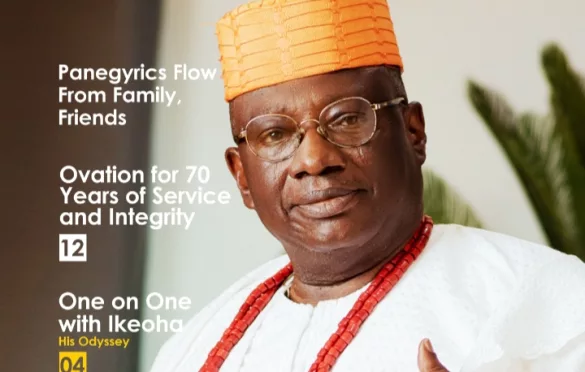
  • IKEOHA: Ovation for 70 years of Service and Integrity

    IKEOHA: Ovation for 70 years of Service and Integrity

    By Chinwuba Aneke

    It is said that a good service to God is service to humanity, and a good service to humanity is service to God. A good and honest service is a humane and integral aspect of life, albeit it can get difficult most times. People who can still stand tall and serve for a higher good even in tough situations, similar to what Gandhi calls losing oneself in the service of others.

    Sir Nwabueze Nnamani is a special gift to not just the people of Nkanu West, Enugu, but to Nigeria. Anyone who suggests that Sir Nnamani dedicated his life to serving the country and his people as a way to thank God for surviving the war would not be far from the truth.

    After the war, instead of grumbling about how the war had destroyed the region, or letting himself get dragged down by the emotional part of the war, he got down to work, earned some living, and finished with Grade One in his secondary school. When it was clear his parents couldn’t afford to send him to the university, he picked the best part of himself again, to serve.

    The disappointment of his parents not meeting his demand to go to the university did not discourage him like it would have done to many. He got into the Nigerian Customs Service, to serve his country.

    At Customs, he did not just deliver diligent service at all times, but with a smile on his face no matter what, and with an unrepentant sense of patriotism and integrity. When the British writer C. S. Lewis wrote that “Integrity is doing the right thing even when no one is watching,” Sir Nwabueze Nnamani must have burned the words into the core of his mind and in his breath. Sir Nnamani would stick to the right thing, to the law, to his values even in the dark of under his bed.

    Living a life of indefatigable and unflagging integrity is as demanding as it is mostly selflessly rewarding. It is mostly for the higher good than it is for personal gains. Most times you may lose some personal advantage in order to stand by the law, by the right thing, by the truth. Sir Nnamani while on maritime duty was almost drowned because of his unrepentant insistence on standing by the law, it did not change him.

    It didn’t end there, he was denied a lot of promotions and some advantages at the customs, not to mention being posted at dangerous and rather disadvantaged customs centres just to get him and his integrity out of the way, and perhaps to force him to change his principles, but he never budged. The Nigerian nation needs more citizens and leaders like Sir Nwabueze Nnamani. Citizens who would do the right thing in public and in private no matter the toughness of the situation; citizens who shun corruption by all means.

    While working at Customs, notwithstanding how exhausting the job was, when his people called on him to serve at Awkunanaw Welfare Association, he didn’t think twice. He served as the Vice President of the body for at least a decade as a pioneer member, and you never found him wanting either at the body or in delivering his duty at Customs. At the same time, he also headed the body of Akegbe Ugwu indigenes resident in Lagos until he was transferred to Kaduna.

    There is hardly a time that Sir Nnamani was called to serve the country or nation that he turned it down. After retiring from the Nigeria Customs Service, instead of retiring to rest as would be expected, Sir Nnamani retired to community service. When his state and people called on him to serve as the Council Chairman, he embraced the challenge.

    As the Chairman of Nkanu West Local Government Area, Sir Nnamani went full force on different big projects from his first month in office, even as a Caretaker Chairman before being voted in as the Chairman. He saw the state of the council secretariat at Agbani, and got to work, gave the secretariat a new face with full renovation which is how it looks to this day.

    He didn’t stop there. One of the biggest markets in the council, Eke Agbani was managed badly and in a sorry state, with no modern facility, no toilet facility, and more. He stepped in, modernized the market, and built a toilet facility with a borehole powered by solar energy.

    Knowing how much Sir Nnamani values serving his people and their wellbeing, it raised no surprise when he started renovating and equipping some state health centres within the Nkanu West Council. Among the health centres he renovated is the Umueze Health Centre, and then he intervened in providing hospital equipment to health centres at Obe, Ugwuafor, and others.

    Beyond building roads, which he did at different parts of the council, building bridges, like the bridge at Nvene River in Akegbe Ugwu, encouraging education, providing succour to the needy, and increasing social security, he also understood that since money must be spent, the council must make revenue as well. He did something that was largely unprecedented in the council for years. He attracted private investors to build a plumbing material market, a hub at Agbani, the centre of the council. The investors started work on the market based on Private-Public Partnership, PPP, and the project was in its final phase before his tenure ran out. The council was to provide no funds, as the private investors were to cover the cost as agreed. This way, the council will have more options to earn handsome revenue and keep developing. Sir Nnamani has the rare vision of the Eagle to see into the far future, knowing that an independent revenue is important to the council should, God help it never happens, the FAAC allocation fail to come some months.

    Ikeoha as he is also called, is a character that everyone should admire and emulate; if one looks long enough into the life of Ikeoha, one must part with some rare life values. It is said that duty maketh a man, in addition to his sense of service, duty, and moral, is his sense of contentment. His virtue of balancing ambition and contentment without allowing either of both to tip over a sensible par is one many will be envious of. Little wonder he often smiled even more after being denied many due promotions at Customs for long because of his total insistence on what’s right. That is likely the reason he stepped away after a tenure as a council chairman for others to have it, not minding that he could go a lawful second term if he wanted.

    He lives by his name Ikeoha, which means the strength of the people. He believes power does not belong to one person, but to the people, that is why even at 70, he is still willing to serve his people if and when called upon. An elder like Sir Nnamani should be made to have a lot of young people around him, to learn the ropes of life, so he will rub off his many excellent virtues on the youth, as we believe his chi will still keep him long enough with us.

    Sir Nwabueze Nnamani, my prayer is that you live long in good health to continue passing your wisdom down to the young ones, after all, good men are not simply born, they are made.