Senegalese President Bassirou Diomaye Faye waves to supporters from a car after taking the oath of office as president during his inauguration ceremony near Dakar on April 2, 2024.
Bassirou Diomaye Faye was sworn in Tuesday in Diamniadio as Senegal’s fifth president, having defeated main rival and ruling party coalition candidate Amadou Ba and winning the delayed election with over 54% of the vote.
Following the ceremony in Diamniadio, which is about an hour from the center of the capital, Dakar, Faye reassured the people who elected him that he’s ready to move Senegal forward, saying the election results showed a profound desire for systemic change.
The Senegalese people have chosen to build a country that is just, he said, adding that he will work tirelessly to preserve the peace and national cohesion.
At 44, Faye is the youngest man elected president in Senegal.
Maimouna Dieye, who leads the women’s wing of the opposition Pasteef party, has been working with Faye for the past 10 years. She said Faye might not have much experience in running a country, but he has a lot of experience in his field, including 15 years as a tax inspector.
Dieye said she believes Faye will deliver on his proposed solutions to the everyday problems of ordinary Senegalese.
Jean Charles Biagui, researcher and political science professor at the Cheikh Anta Diop University of Dakar, said it will be important for the new government to make some changes right away, primarily reducing the advantages associated with government officials’ lifestyles.
That way, he said, the ordinary Senegalese can see that those who are running the country are serving the nation and not serving themselves.
Biagui also said it’s time to think about what constitutes good governance. Governments of the past few decades have provided little to no assessments of what they have accomplished, he said, but the Senegalese people want their leaders to account for what they’ve done.
Meanwhile, many of the new president’s supporters who witnessed the swearing in are hopeful the tensions of the last few months will fade away and be replaced by the hope that their country’s reputation as a beacon of democracy in West Africa is restored.
The presidents of neighboring Guinea-Bissau, Guinea, Sierra Leone, Gambia, Ghana and Nigeria, as well as high-level officials from other African nations, attended.
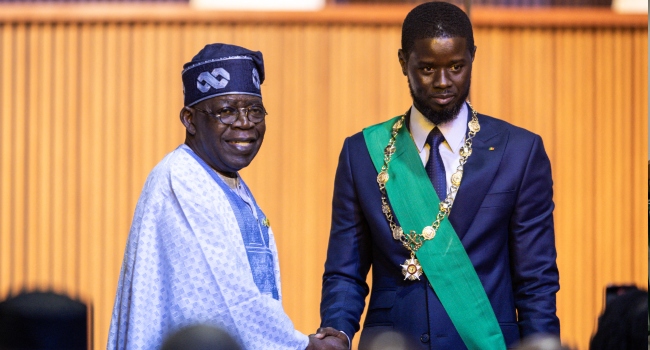
Bassirou Diomaye Faye (C) and President of Nigeria, Bola Ahmed Tinubu (L) pose for images after his swearing in as Senegal’s President at an exhibition centre in the new town of Diamniadio near the capital Dakar on April 2, 2024. Bassirou Diomaye Faye was sworn in on April 2, 2024 as Senegal’s youngest president after sweeping to a first-round victory on a pledge of radical reform 10 days after he was released from prison. (Photo by JOHN WESSELS / AFP)
The Nigerian President attended the event in his capacity as the Chair of the Economic Community of West African States (ECOWAS) Authority of Heads of State and Government.
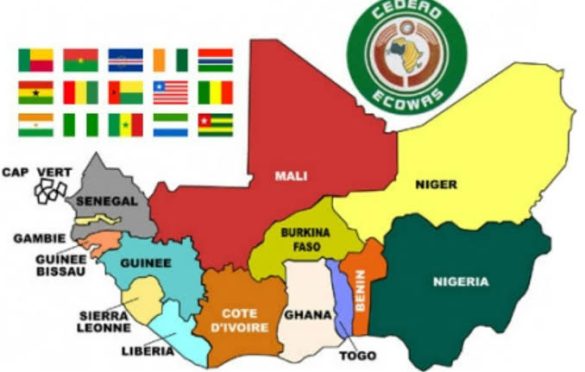
The Economic Community of West African States (ECOWAS Commission) has reacted to the media report of withdrawal of membership by Burkina Faso, Mali and Niger Republic, saying it was yet to receive any direct formal notification from the three Member-States about their intention to quit the regional bloc.
Recall that the juntas in Mali, Niger Republic and Burkina Faso had on Sunday announced the immediate withdrawal of their membership from ECOWAS in protest to their suspension from the regional bloc following coup d’etats in their countries.
The leaders of the three West African countries issued a statement on Sunday, saying it was their “sovereign decision” to leave the ECOWAS “without delay”.
Struggling with jihadist violence and poverty, the regimes have had running battles with ECOWAS since coups took place in Niger on July 26, 2023, Burkina Faso in 2022 and Mali in 2020.
All three were suspended from ECOWAS, with Niger and Mali facing heavy sanctions.
However, in a communique issued by the ECOWAS Commission in Abuja on Sunday evening, the body said it had been working assiduously with the three countries for restoration of constitutional order, while insisting that Burkina Faso, Niger, and Mali remained important members of the Community and the Authority of Heads of State and Government remained committed to finding a negotiated solution to the political impasse.
The statement reads: “The attention of the Commission of the Economic Community of West African States (ECOWAS Commission) has been drawn to a statement broadcast on the National Televisions of Mali and Niger announcing the decision of Burkina Faso, Mali and Niger to withdraw from ECOWAS.
“The ECOWAS Commission is yet to receive any direct formal notification from the three Member States about their intention to withdraw from the Community.
“The ECOWAS Commission, as directed by the Authority of Heads of State and Government, has been working assiduously with these countries for the restoration of constitutional order. Burkina Faso, Niger, and Mali remain important members of the Community and the Authority remains committed to finding a negotiated solution to the political impasse.
“The ECOWAS Commission remains seized with the development and shall make further pronouncements as the situation evolves”.
(L-R ) The leader of Burkina Faso, Ibrahim Traoré, Mali’s military leader Colonel Assimi Goita and Niger’s General Abdourahmane Tchiani.
The military regimes in Burkina Faso, Mali and Niger announced Sunday their immediate withdrawal from the West African bloc ECOWAS, saying it has become a threat to member states.
The leaders of the three Sahel nations issued a statement saying it was a “sovereign decision” to leave the Economic Community of West African States “without delay”.
Struggling with jihadist violence and poverty, the regimes have had tense ties with ECOWAS since coups took place in Niger last July, Burkina Faso in 2022 and Mali in 2020.
All three — founding members of the bloc in 1975 — were suspended from ECOWAS with Niger and Mali facing heavy sanctions as the bloc tried to push for the early return of civilian governments with elections.
The sanctions were an “irrational and unacceptable posture” at a time when the three “have decided to take their destiny in hand” — a reference to the coups that removed civilian administrations.
The three nations have hardened their positions in recent months and joined forces in an “Alliance of Sahel States”.
The leaders’ joint statement added that 15-member ECOWAS, “under the influence of foreign powers, betraying its founding principles, has become a threat to member states and peoples”.
They accused the grouping of failing to help them tackle the jihadists who swept into Mali from 2012 and then on to Burkina and Niger.
But leaving ECOWAS could make trade more difficult for the three land-locked nations, making goods more expensive, and could also see visa requirements re-imposed for travel.
Under pressure from the military regimes, former colonial power France has removed ambassadors and troops and watched Russia fill the void militarily and politically.
The French army’s withdrawal from the Sahel — the region along the Sahara desert across Africa — has heightened concerns over the conflicts spreading southward to Gulf of Guinea states Ghana, Togo, Benin and Ivory Coast.
The prime minister appointed by Niger’s regime on Thursday blasted ECOWAS for “bad faith” after the bloc largely shunned a planned meeting in Niamey.
Niger had hoped for an opportunity to talk through differences with fellow states of ECOWAS which has cold-shouldered Niamey, imposing heavy economic and financial sanctions following the military coup that overthrew elected president Mohamed Bazoum.
Niger’s military leaders, wrestling with high food prices and a scarcity of medicines, have said they want up to three years for a transition back to civilian rule.
In Mali, the ruling officers under Colonel Assimi Goita had pledged to hold elections in February this year, but that has now been pushed back to an unknown date.
Burkina Faso, which has not been put under sanctions although Captain Ibrahim Traore seized power in September 2022, has set elections for this summer, but says the fight against the insurgents remains the top priority.
The Commission of the Economic Community of West African States (ECOWAS/CEDEAO) has officially suspended the Republic of Niger’s membership until constitutional order is restored in the country.
This was contained in a statement by the regional body, following the decisions taken at the summit of heads of state and government held on Sunday in Abuja.
“Until the 64th ordinary session held on 10 December 2023, the Conference of Heads of State and Government considered the situation in Niger as a coup attempt and continued to consider Mohamed Bazoum the President of the Republic of Niger, Head of State,” the statement said.
“Due to this position, Niger was not suspended from ECOWAS’ decision-making bodies and members of Bazoum’s government were authorised to represent Niger in ECOWAS’ statutory meetings.”
“The 10 December summit recognised that Mohamed Bazoum’s government had effectively been overthrown by a military coup.
“Consequently, beginning from 10 December 2023, Niger is suspended from all decision-making bodies of ECOWAS, until constitutional order is restored in the country,” the statement said.
On Sunday, the ECOWAS leaders’ meeting in Abuja asked the military junta of Niger, which came to power in a coup on 26 July, to release the deposed president Mohamed Bazoum in exchange for the lifting of the sanctions imposed on the country.
The proposal was, however, rejected by the leader of the junta, Omar Abdourahmane Tchiani, who reiterated that Mr Bazoum would not be released.
After the summit, the bloc presented the proposal to lift the sanctions in exchange for the freedom of the deposed president, also asking the junta to shorten the duration of the transition period, currently set at three years.
Mr Tchiani agreed to this last request, without, however, specifying by how much.
The sub-regional body also announced the maintenance of sanctions against Niger.
Image caption, Some Namibians say President Hage Geingob should provide proof that his children’s Dubai trip was privately funded
Some Namibians have been outraged after learning that President Hage Geingob’s four children joined the government’s delegation to the COP28 climate summit.
They were among six of the president’s family members listed as part of Namibia’s delegation in Dubai.
President Geingob’s office on Monday confirmed his children travelled to the city, but denied claims that their trip was state-funded.
The office did not say how other family members were paid for.
“President Geingob and Madame Geingos (first lady) paid for the flights and accommodation expenses of their children,” the Namibian Presidency posted on X on Monday.
“The Namibian public and the media should be rest assured that not a single cent of public funds has been spent on the children of the first couple.”
The presidency added that the claims were “malicious and politically motivated” and intended to distract from the “excellent work” by President Geingob and the Namibian delegation at COP28.
But some Namibians have dismissed the presidency’s response as unsatisfactory, saying it fails to prove that the travel of President’s Geingob’s children and his family members was privately funded.
Some critics have also asked the president to explain the role of his family members at COP28 and why they were listed on the government’s delegation if their trip was privately funded.
“You guys really think we are dumb? Why would they be included in the delegates list if they ain’t part of it? What is the relevance of them being in Dubai together with state delegates?” one Namibian replied on X.
“We anticipate a comprehensive report to be presented in [parliament],” said Namibian MP Inna Hengari.
She had earlier criticised the government for reportedly sponsoring the travel of the president’s family, yet claiming it lacked funds to facilitate the travel of an MP and parliamentary official to COP28.
The outrage echoes wider criticism against African governments for sending large delegations to COP28, which some citizens say exhibits financial extravagance.
Some governments including Nigeria, Tanzania and Kenya have defended their actions by saying that many of the delegates are not state-funded as they are representing the media, civil society organisations and private institutions.
Mali’s ruling junta on Monday announced a delay to a presidential election scheduled for February that was aimed at returning civilian leaders to power in the jihadist-hit West African nation.
The two rounds of voting—initially set for February 4 and 18, 2024 – “will be slightly postponed for technical reasons”, government spokesman Abdoulaye Maiga said in a statement read out to reporters.
Those reasons include issues linked to the adoption this year of a new constitution and a review of the electoral lists, he said.
He also cited a dispute with French company Idemia, which the junta says is involved in the census process.
“The new dates for the presidential election will be communicated later,” Maiga said.
Authorities are also refusing to organise legislative elections, initially scheduled for the end of 2023, before the presidential election.
The junta “has decided to organise, exclusively, the presidential election”, the statement said.
Other elections will be held on a schedule “established by the new authorities, under the directives of the new president”.
The postponement is yet another delay to the junta’s schedule for handing back power to elected civilians.
The soldiers, who carried out back-to-back coups in 2020 and 2021, had earlier promised legislative elections for February 2022.
But the junta, led by Assimi Goita, announced at the end of 2021 that it was unable to respect the timetable agreed with the regional bloc ECOWAS.
It said it needed more time to carry out deep reforms.
Security situation
In response, ECOWAS in early 2022 imposed heavy sanctions on Mali, severely affecting the poor and landlocked country.
It lifted them the following July when the junta agreed to leave power in March 2024, and announced an electoral calendar that set the presidential election for February 2024.
The junta had also scheduled a constitutional referendum for March 2023, which finally took place in June.
Critics of the new constitution describe it as tailor-made to keep the junta in power beyond the presidential election.
Since Mali’s back-to-back putsches, West Africa has seen a series of military coups, including in Burkina Faso and Niger, which have also been hit by jihadism and violence, as well as in Guinea.
The militaries in each case have said they are carrying out “transitions” before a return to “constitutional order”.
Mali currently faces heightened activity by jihadist groups and a resumption of hostilities in the north by armed separatist groups.
Since August, there has been a series of attacks against army positions and civilians in the Timbuktu and Gao regions.
The junta pushed out France’s anti-jihadist force in 2022 and the UN peacekeeping mission MINUSMA in 2023.
It has turned politically and militarily towards Russia.
Monday’s statement made no mention of recent security developments, saying only that junta leader Goita intends “to return to a peaceful and secure constitutional order, after carrying out as a priority institutional political reforms”.
President of the Republic of the Congo Denis Sassou-Nguesso, poses during a photo session at the Palais Brongniart for the New Global Financial Pact Summit in Paris on June 23, 2023. (Photo by JOEL SAGET / AFP)
The Congolese Government has denied reports about a coup attempt against President Denis Nguesso who has been in power for 38 years.
This is according to Congo’s Minister of Information Thierry Moungalla who tweeted on his X handle.
“URGENT – Fanciful information suggests serious events that are underway at #Brazzaville,” he wrote on the social media platform with the statement also posted on the government’s website.
“The Government denies this fake news. We reassure public opinion about the calm that reigns and invite people to calmly go about their activities.”
Nguesso, 78, has spent 38 years at the helm of the country in central Africa. He was president from 1979 to 1992, then returned in 1997 after a civil war, and has remained in power ever since.
There has been a wave of coups across Africa with the most recent one in Gabon where the military seized power in the Central African nation.
Rescuers and relatives search for bodies of the flood victims at the Corniche of the city of Derna [Abdulaziz Almnsori/AP Photo]
A desperate search for the missing people continues in the Libyan city of Derna, where bodies are still washing up on its shores or decaying under the rubble, a week after Storm Daniel triggered devastating floods in the country’s east.
The United Nations said in a report on Sunday that the death toll in Derna alone has risen to 11,300.
Citing the Libyan Red Crescent, the UN Office for the Coordination of Humanitarian Affairs (OCHA) added that 10,100 others were missing in the devastated city.
“These figures are expected to rise in the coming days and weeks as search-and-rescue crews work tirelessly to find survivors,” the OCHA report said.
The revised death toll came as international aid started trickling in, with the UN and countries in Europe and the Middle East offering relief to survivors, including 40,000 people who have been displaced in the wake of the disaster.
The aid includes essential medicines, food, tents, blankets and hygiene kits, as well as heavy machinery to help clear the debris and body bags to allow corpses to be moved.
At Derna’s seafront on Saturday – where a wrecked car could be seen perched on top of concrete storm breakers and driftwood was strewn across muddy pools – diggers worked to clear the path for rescue teams and a helicopter scanned the sea for bodies.
Kamal al-Siwi, the official in charge of the identification of missing people, said more than 450 bodies had been recovered in the past three days from the seashore, including 10 from under rubble.
“The work is ongoing and is very, very, very complicated,” he told the Reuters news agency. “This operation, in my opinion, needs months and years.”
Rescue members from the NGO IAE work in Derna [NGO IAE/Handout via Reuters]
A week after the disaster, hopes of finding survivors are dimming.
Al Jazeera’s Mohamed al-Bakkali, reporting from Derna, said he saw rescuers recover at least 10 bodies from the coast on Saturday morning. “Chances of finding any survivors are very slim. Instead, rescuers are finding more bodies than survivors,” he said.
The devastating flooding brought by Storm Daniel was exacerbated by poor infrastructure in Libya, which was plunged into turmoil after a NATO-backed uprising toppled and killed longtime ruler Muammar Gaddafi in 2011. In Derna, which has an estimated population of at least 120,000, entire districts were swept away or buried in brown mud after two dams south of the city broke on Sunday night, unleashing torrents of floodwater down a usually dry riverbed.
“We were all taken by surprise. We never expected such a catastrophe,” Derna resident Khalid told Al Jazeera. “I lost my young daughter. May God accept her and have mercy … we are helpless. God almighty is our rock.”
Turkey-based journalist Nour el-Jebri, who hails from Derna, said dozens of her family members were stuck on the roof of their two-storey house for a whole night as water from the collapsed dams inundated their house.
“It was a very tragic night. They could hear people shouting and screaming … as the water took them towards the sea. They were helpless,” el-Jebri told Al Jazeera from the Turkish city of Istanbul. “My family is not in a very good mental state.”
The UN humanitarian affairs office has launched an appeal for $71m for those affected.
The World Health Organization said on Saturday it had flown in enough emergency aid to reach nearly 250,000 people affected by Storm Daniel across eastern Libya, including essential medicines, surgery supplies and body bags for the deceased.
Saudi Arabia announced the departure of its first aid flight to Libya and Russia said the third of its aid flights had arrived carrying a mobile hospital.
Meanwhile, an Italian naval ship docked in Derna with supplies, including tents, blankets, water pumps and tractors, Italy’s embassy in Libya said, posting photos of smaller vessels bringing equipment ashore.
People look for survivors in Derna, Libya [Yousef Murad/Reuters]
Rescue and reconstruction will be a challenge as Libya is now run by two administrations – one based in the capital Tripoli and another administration in the country’s east.
Renegade military commander Khalifa Haftar, who backs the eastern administration, visited Derna on Friday. His forces have now allowed entry to aid convoys dispatched by the rival government in a sign of cooperation to ensure aid gets to where it is needed.
Caroline Holt, the director of disaster, climate and crises at the International Red Cross, said the presence of landmines across Libya due to the ongoing civil war will be one of several challenges in trying to get aid to those affected by the floods.
“We know that there will be security issues on the ground such as unexploded landmines. When a flood this size comes through and disturbs the earth, to the extent that this one has, those landmines, that may once upon a time had been mapped clearly and we understood the location of them, now all of that will be disturbed,” she told Al Jazeera.
More than 1,000 people have been buried in mass graves, according to the UN, drawing warnings from aid groups about the risk of contaminating water or causing mental distress to families of the deceased.
However, the head of Libya’s National Centre for Disease Control, Hayder al-Sayah, said there was little risk from corpses unless they were carrying diseases.
But he said recorded cases of diarrhoea had risen to 150 from 55 on Friday due to people drinking polluted water.
Buildings have caught fire in Sudan’s capital after heavy fighting between the army and rival forces.
Videos posted online on Sunday showed the iconic Greater Nile Petroleum Oil Company Tower engulfed in flames.
“This is truly painful,” said Tagreed Abdin, an architect of the building, in a post on X, formerly known as Twitter.
Air strikes and ground battles have continued in Khartoum and other towns and cities since fighting broke out in April.
Over one million people have been forced to flee the country, the UN has said.
Located near the River Nile, the 18-storey oil firm skyscraper is one of the most recognisable landmarks in Khartoum.
Ms Abdin said it defined the skyline of the city, and lamented “such senseless destruction”.
It is not yet clear what caused the building’s cone-like structure, which has a glass facade, to catch fire. There have been no reports of injuries or deaths.
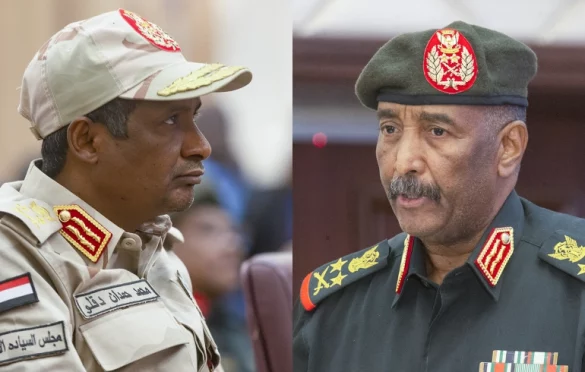
The violence in Sudan began on 15 April, triggered by a power struggle between the leaders of the Sudanese army and the paramilitary Rapid Support Forces (RSF).
It followed days of tension as members of the RSF were redeployed around the country in a move that the army saw as a threat.
The Sudan War Monitor, which provides analysis of the conflict, said the RSF had attacked areas controlled by the army on Saturday, including an office block at the justice ministry. Several government buildings are reported to have caught fire as a result of the attack.
Attacks on army premises continued into Sunday, witnesses told AFP news agency.
Residents in a southern district of the city – where the army was targeting RSF bases – told AFP they heard “huge bangs” as they woke up.
Health authorities announced on Sunday that all the main hospitals in Khartoum – as well as the Darfur region – were out of service.
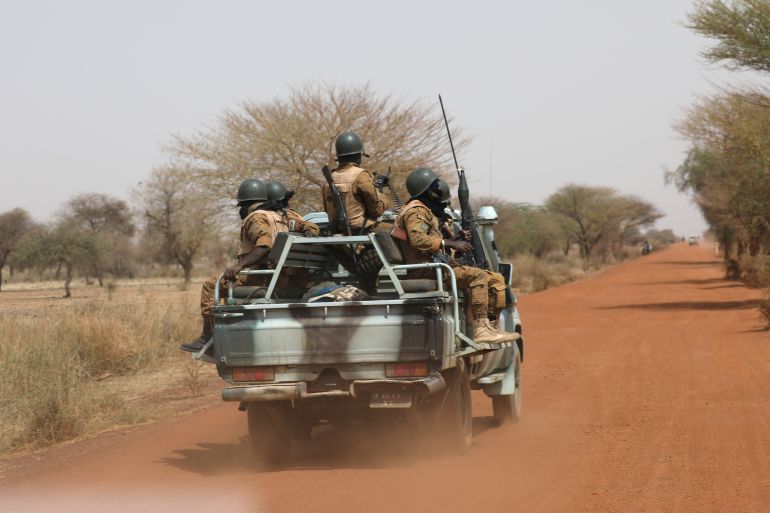
Soldiers from Burkina Faso patrol on the road of Gorgadji in sahel area, Burkina Faso March 3, 2019. [File: Luc Gnago/Reuters]
Mali, Burkina Faso and Niger have signed a mutual defence pact, as the three Sahel countries aim to help each other against possible threats of armed rebellion or external aggression.
The charter, known as the Alliance of Sahel States, signed on Saturday binds the signatories to assist one another – including militarily – in the event of an attack on any one of them.
“Any attack on the sovereignty and territorial integrity of one or more contracted parties will be considered an aggression against the other parties,” it says. It also binds the three countries to work to prevent or settle armed rebellions.
“I have today signed with the Heads of State of Burkina Faso and Niger the Liptako-Gourma charter establishing the Alliance of Sahel States, with the aim of establishing a collective defence and mutual assistance framework,” Mali military leader Assimi Goita said on his X social media account.
The Liptako-Gourma region – where the Mali, Burkina Faso and Niger borders meet – has been ravaged by armed rebellion in recent years.
“This alliance will be a combination of military and economic efforts between the three countries”, Mali’s Defence Minister Abdoulaye Diop told journalists in Bamako, the capital of Mali.
“Our priority is the fight against terrorism in the three countries.”
An armed rebellion that erupted in northern Mali in 2012 spread to Niger and Burkina Faso in 2015.
Mali military leader Assimi Goita posted about the establishment of the Alliance of Sahel States on X. [Francis Kokoroko/Reuters]
Armed rebellion in Sahel region
All three states were members of the France-supported G5 Sahel alliance joint force with Chad and Mauritania, launched in 2017 to tackle armed groups linked to al-Qaeda and ISIL (ISIS) groups.
They have undergone coups since 2020, most recently Niger, where soldiers in July overthrew President Mohamed Bazoum, who cooperated with the West in the fight against Sahel-based armed groups.
The West African regional bloc ECOWAS has threatened to intervene militarily in Niger over the coup, but the regional bloc has toned down its war rhetoric in recent weeks.
Mali and Burkina Faso quickly responded by saying that any such operation would be deemed a “declaration of war” against them.
Relations between France and the three states have soured since the coups.
France has been forced to withdraw its troops from Mali and Burkina Faso, and is in a tense standoff with the military that seized power in Niger. Mali has also asked the UN peacekeeping mission MINUSMA to leave the country.
Niger’s military rulers have asked France to withdraw its troops and its ambassador, as France has refused to recognise the new military authority.
Meanwhile, Mali has seen a resumption of hostilities by predominantly Tuareg armed groups over the past week, threatening a 2015 peace agreement.
Rescuers raced against time on Monday to find survivors in the rubble more than 48 hours after Morocco’s deadliest earthquake in over six decades, with nearly 2,500 killed in a disaster that devastated villages in the High Atlas Mountains.
Search teams from Spain, Britain and Qatar are joining efforts to find survivors of the 6.8 magnitude quake that struck late on Friday night 72 km (45 miles) southwest of Marrakech.
Many survivors spent a third night outside, their homes destroyed or rendered unsafe by Morocco’s most powerful earthquake since at least 1900. The death toll has climbed to 2,497 with 2,476 people injured, the state news agency reported on Monday.
In Imgdal, a village about 75 km (45 miles) south of Marrakech, women and children huddled early on Wednesday morning under makeshift tents set up along the road and next to damaged buildings. Some gathered around an open fire. Further south, a car stood crushed by boulders that had fallen from the cliff.
In the village of Tafeghaghte, Hamid ben Henna described how his eight-year-old son died under wreckage after he had gone to fetch a knife from the kitchen as the family were having their evening meal. The rest of the family survived.
With much of the quake zone in hard-to-reach areas, the full impact has yet to emerge. The authorities have not issued any estimates for the number of people still missing.
Roads blocked or obstructed by dislodged rocks have made it harder to access the hardest hit locations.
People have been salvaging possessions from the ruins of their homes and describing desperate scenes as they dug with their bare hands to find relatives.
Many structures, including homes built in traditional methods using mud bricks and timber, crumbled easily.
The damage done to Morocco’s cultural heritage has been emerging gradually. Buildings in Marrakech old city, a UNESCO World Heritage Site, were damaged. The quake also reportedly did major damage to the historically significant 12th-century Tinmel Mosque in a remote mountain area closer to the epicentre.
Survivors struggling to find shelter and supplies have voiced criticism of what they have described as an initially slow government response.
Morocco has deployed the army as part of its response and has said it is reinforcing search-and-rescue teams, providing drinking water and distributing food, tents and blankets.
A person carries an item of furniture, in the aftermath of a deadly earthquake, in a hamlet on the outskirts of Talaat N’Yaaqoub, Morocco, September 11, 2023.
It was the country’s deadliest earthquake since 1960 when a tremor was estimated to have killed at least 12,000 people.
‘MISPLACED CONTROVERSY’
In a televised statement on Sunday, government spokesperson Mustapha Baytas said every effort was being made on the ground.
King Mohammed VI had instructed the prime minister to meet on Monday with a ministerial committee that is developing emergency plans, including for home reconstruction, he added.
Neither King Mohammed nor Prime Minister Aziz Akhannouch have addressed the nation since the disaster.
King Mohammed thanked Spain, Qatar, the UK and United Arab Emirates for sending aid, state TV reported. Morocco had assessed aid needs and considered the importance of coordinating relief efforts before accepting their help, it added.
State television reported on Sunday that the government might accept relief offers from other countries and would work to coordinate them if needed.
Search-and-rescue specialists with sniffer dogs have been sent by Britain and Spain. For its part, Qatar said on Sunday its search-and-rescue team departed for Morocco. Spain said it received an official request for aid from Morocco on Sunday.
France, among the countries offering assistance, said on Sunday it stood ready to help and was awaiting a formal request from Morocco.
French Foreign Minister Catherine Colonna said it was up to Morocco whether to seek French aid.
“This is a misplaced controversy,” Colonna told BFM television when asked why Morocco had not made an official request to Paris for urgent assistance despite accepting help from Spain, Britain, Qatar and the United Arab Emirates.
“We are ready to help Morocco. It’s a sovereign Moroccan decision and it’s up to them to decide,” she said.
Paris and Rabat have had a difficult relationship in recent years notably over the issue of Western Sahara, a disputed territory that Morocco wants France to recognise as Moroccan. Morocco has not had an ambassador in Paris since January.
Raymond Ndong Sima, a former opposition leader, walks after being appointed as prime minister of its transitional government by Gabon’s ruling junta, which seized power in a coup
A 24-month transition to elections in Gabon would be “reasonable” after last month’s coup, junta-appointed Prime Minister Raymond Ndong Sima was quoted as saying by French news agency AFP on Sunday.
Army officers seized power on Aug. 30, annulling an election minutes after an announcement that President Ali Bongo had won, which they said was not credible. Bongo, in power since 2009, had succeeded his father Omar Bongo, who ruled for 42 years.
The junta has promised to oversee free and fair elections, but has not given a timetable for organising them.
In the first comments on a possible length of this transition, Ndong Sima told AFP: “It is good to start with a reasonable goal by saying: ‘We hope to see the process completed within 24 months so that we can return to elections.’”