Tag: #PacesetterFrontier

  • Nigeria at 65: Is Our Constitution Helping or Failing Us?

    Nigeria at 65: Is Our Constitution Helping or Failing Us?

    By Sebastine Chukwuebuka Okafor, Ph.D.

    On the first of October 1960, Nigeria became an independent state and adopted the Independence Constitution, discarding the Lyttleton Constitution of 1954, which had earlier established federalism in the country. Prior to independence, Nigeria had operated under five other constitutions: Sir Frederick Lugard’s Constitution of 1914, the Clifford Constitution of 1922, the Richards Constitution of 1946, the Macpherson Constitution of 1951, and the Lyttleton Constitution of 1954. Each of these shaped the foundation of Nigeria’s political journey.

    These constitutions introduced various changes in the way Nigerians lived together and managed national affairs. The 1914 framework brought about amalgamation. The 1922 Clifford Constitution introduced elective principles in Lagos and Calabar. The Richards Constitution of 1946 ushered in regional representation. The Macpherson Constitution of 1951 expanded regional autonomy and exhibited federal tendencies. The Lyttleton Constitution of 1954 then brought Nigeria closer to full federalism before independence arrived.

    After independence, Nigeria entered another phase of constitutional experimentation. The Republican Constitution of 1963 replaced the Queen of England with a Nigerian President as Head of State. The 1979 Constitution introduced a presidential system of government modeled after that of the United States. The 1989 Constitution was drafted but never fully implemented due to the political crisis following the annulled June 12 election. The short-lived 1993 Constitution also failed to stand the test of time. Finally, the 1999 Constitution ushered Nigeria into the Fourth Republic, which remains in effect today.

    When we consider both the pre- and post-independence documents, it becomes clear that Nigeria has had a total of eleven constitutions: 1914, 1922, 1946, 1951, 1954, 1960, 1963, 1979, 1989, 1993, and 1999. Each came with its own strengths and weaknesses, reflecting the country’s ongoing search for a system that suits its diverse population.

    Today, many Nigerians are asking whether the 1999 Constitution is truly serving the people. Some argue that it has helped stabilize democracy since 1999 by ensuring regular elections and continuous civilian rule without military interference. Others contend that it remains flawed, retaining too much influence from the military era and lacking a truly people-centered foundation.

    One of the Constitution’s strengths is its clear definition of the separation of powers among the executive, legislature, and judiciary. It also guarantees fundamental rights for citizens and provides a framework for elections through INEC, elements that have helped democracy endure for over two decades.

    However, its weaknesses cannot be ignored. The Constitution grants excessive power to the Federal Government, leaving states with limited control over resources and security. The immunity clause has often been abused by leaders who use it to shield themselves from accountability. Many Nigerians also believe that local governments lack true autonomy under the current structure.

    Another concern is the rigidity of the Constitution. For a law meant to serve the people, it is far too difficult to amend. Even when changes are made, as in 2010, 2011, 2018, and 2023, many feel these amendments fall short of addressing the country’s core governance and development challenges.

    So, is the Constitution working or not? In some respects, yes, it has kept Nigeria under uninterrupted civilian rule for 26 years. But in many other ways, it falls short, as too many citizens still feel excluded from the system, and too many everyday issues remain unresolved under the current constitutional framework.

    What Nigeria needs is not just another piecemeal amendment, but a more inclusive process where the people have a stronger voice in shaping the rules that govern them. Until that happens, the Constitution will remain a blend of progress and problems, leaving the question of whether it is truly working open for debate.

  • Love in the Time of Banditry

    Love in the Time of Banditry

    -By Abdul Mahmud

    They dress it up as negotiation and baptise it as dialogue, but it is nothing more than doublespeak. A masquerade of words. Behind the velvet of their language lies deceit. To call surrender by another name does not change its essence. To dignify capitulation with the vocabulary of peace is to mock both truth and justice. What they parade as dialogue is often a transaction of power, a bargain struck in whispers, where the people, unseen and unheard, are the coin of exchange. Yet, they justify it as the only path to peace. When northern governors sit across from bandits and terrorists, what unfolds is not negotiation in any true sense. It is courtship. It is a series of dates. It is love in the time of banditry. A theatre of intimacy staged under the shadow of violence. A ritual that strips empathy of its nobility, reducing what should be the compassion of leadership to the self-serving whispers of survival and convenience, which recalls obsequious intimacies that surface in times of adversity, only to blur the line between fear and affection. Gabriel García Marquez, in his literary opus, Love in the Time of Cholera, wrote of a love that endured through decay, war, and pestilence; love that was obstinate, enduring, and almost absurd in its persistence. But, what we are witnessing here is its inversion: not fidelity through ruin, but complicity masquerading as affection. It is surrender disguised as closeness; it is the twisted parody of love, showcased as reconciliation. Not love shaped by hardship.

    The first date was awkward. In Zamfara, officials drove into Shinkafi and Dansadau forests to meet warlords who had already massacred villagers and burned farmlands. The state came clothed in the uniform of authority. The bandits came with blood on their hands. Victims were not invited. There was no room for mothers who lost children in Anka or for fathers who buried their sons in Maru. The girls kidnapped from Jangebe Secondary School were absent too. Instead, the state leaned across the table, desperate for calm, while the bandits leaned back, aware of their power. In Katsina, the dates were even more surreal. Former Governor Aminu Masari presided over gatherings in Faskari and Safana, asking men who roamed the forests with Ak-47s to sheathe their swords. He offered them amnesty. He promised them a chance to return to normal life. He said forgiveness was the only way forward. The bandits promised to stop attacks. Weeks later, children were abducted from Kankara school. The romance soured, but the cycle continued. In Niger State, the story was not different. Officials met with gunmen in Shiroro and Rafi, pleading for the release of students kidnapped in Kagara and Tegina. The bandits named their price. Parents sold farmland. Traders emptied their savings. Communities gathered ransom. And still, the killers smiled at state officials, knowing that power sat firmly on their side of the table. Here’s the Babanla of it all. El-Rufai once confessed to sitting with bandits. He called it negotiation. But in truth, it was an act closer to courtship, a ritual of appeasement that gave men of violence the recognition they craved. And like all bad romances, it ended with betrayal of citizens who were left abandoned while the suitors walked away unharmed.

    Every courtship has its rituals. Ours, between the state and bandits, has acquired a disturbing familiarity. It begins with what GenZ lovers now call the talking stage – the tentative exchanges where boundaries are tested and each side pretends to listen. Soon it drifts into the season of promises. Governors, with anxious smiles, place their offerings on the table: amnesty, cash, reintegration into a society they once helped to fracture. Bandits, in turn, whisper their vows of restraint: to slow the killings, to reduce the kidnappings, and to hold their fire for a while. These are not promises of love, but pacts of convenience. They are not born of conviction, but of fatigue. It is less negotiation than seduction; and less about peace than about buying time. And like all rituals of courtship gone wrong, the words exchanged are designed not to bind hearts, but to mask betrayal. Both sides know these promises will be broken. Yet they return to the table again and again, like lovers in a toxic affair. This romance is costly. Citizens are the ones who pay the bill. In Sokoto, villagers in Isa and Sabon Birni sold goats to rescue their daughters. In Kaduna and Abuja, families borrowed money to pay ransom for their sons seized on the Abuja – Kaduna highway. When the ransom was paid, when the family was ruined, when the dead were buried, the government still appeared in public with the men who caused the pain. The same killers were photographed shaking hands with officials. The logic of this courtship is simple: violence seduces. The bandits hold power. They can stop attacks or restart them at will. They control vast forests. They instill fear more effectively than the police. The state, weak and insecure, clings to them in the hope that kindness will tame them. But kindness never tames abusers. It emboldens them. Each meeting shifts the line of what is normal. What once outraged citizens now barely raises eyebrows. A mass abduction? There will soon be talks. A massacre on the highway? Another round of dialogue. The extraordinary has become ordinary. The courtship is now part of our political culture that has taken its own linguistic ascription. Listen closely to the language officials use. They speak of “understandings”. They speak of “forgiveness”. One Zamfara governor once urged citizens to “show love” to bandits. These are not the words of justice. These are the words of romance. They reveal the dangerous intimacy between the state and cold-blooded murderers, while citizens stand abandoned.

    The Constitution does give not blessings to this romance, nor does the Terrorism Prevention (Prohibition) Act, 2022. The law does not say: dine with terrorists. It says: arrest, prosecute, punish, and protect. Yet, governors bend the law in the name of expedience. Federal law enforcement and state security officials who should protect the state and the law do more than keep quiet. They drape a cloak of protection over such encounters, ensuring that the lovers are not disturbed. Their silence is never neutral. Their silence is both complicity and consent. But, here’s the kernel: each time Abuja averts its gaze, it does more than ignore such encounters. It blesses the rendezvous. It sanctions another tryst between power and violence, another betrayal recorded in the register of statecraft. The flashing convoys, the armed escorts, and whispered briefings are not signs of resistance, they are choreography. They turn meetings that should be interrogation into consecrations shielded by the very institutions sworn to protect citizens. And so, with every silence, Abuja redraws the map of loyalty: not to the governed, but to those who terrorise them.

    The human cost is huge. Schoolgirls from Jangebe were abducted with hundreds of classmates. They returned shaken, hungry, and traumatised. When they heard that the governor negotiated with the same men who abducted them, they asked: “Why are they free? Why did they do this to us?” There was no answer. Comrade Muhammad, one of the passengers abducted from the Kaduna-bound train in 2022, once told a chilling story. He said he encountered Abubakar, one of his kidnappers, not in a forest or a hideout, but in a mosque in Kaduna. Face to face. In the open. Among worshippers. The implication is terrifying. For a man who once held a gun to his head to stroll so casually into a mosque suggests more than mere audacity of courage. It suggests assurance. It suggests the confidence of someone shielded by invisible hands. Perhaps, Abubakar had just emerged from one of those secret meetings with the state, the kind where promises are exchanged in whispers and guarantees are offered in silence. Perhaps, he knew he had little to fear. That encounter captured the paradox of our times: victims carry scars into prayer halls while perpetrators walk in with a swagger, as though their crimes had been baptised by power itself.

    There is a point that renders these grotesque courtship tragic, and it is this: the closer the state draws to the bandits, the farther it drifts from its people. Each gesture of appeasement towards killers deepens the abandonment of citizens who look to the state for protection. Every deal struck across the table with gunmen is not a negotiation, it is a betrayal carved into the memory of widows and orphans. Every handshake extended to men of violence lands as a slap across the faces of the grieving, a cruel reminder that the state has chosen to share intimacy with those who spill blood rather than solidarity with those who shed tears. In such rituals of compromise, power becomes complicit, and the line between protector and predator begins to blur. The tragedy further deepens in the symbolism of such encounters. To romance bandits is to abandon the living for the company of death. It is to sit in a room perfumed by the ghosts of the slain, and choose intimacy with murderers. Every concession to the gunmen becomes a mirror in which the people glimpse the frailty of the state that prefers to keep company with killers rather than stand vigil with victims. And so the people learn, slowly but bitterly, that the state is not a fortress built for their defence, but a stage where betrayals are performed in plain sight, leaving citizens to wonder: when their protectors embrace their tormentors, who is left to stand with them, the powerless?

    This toxic romance has no future. The bandits are not changing. They are growing richer and bolder. Each meeting gives them legitimacy. Each promise emboldens them to demand more. The state, meanwhile, grows weaker. With every compromise, it loses moral authority and public trust. If this continues, the state risks becoming indistinguishable from its new partner; a willing accomplice in crime. Nigeria must end this romance. The state cannot keep dating its killers. It must return to its first love to the people. That requires justice, not appeasement. It requires prosecutions, not reintegration. It requires investment in security forces, reform of intelligence, and development in villages long abandoned. Citizens must feel the presence of the state not only through uniforms, but through working schools, safe roads, and real jobs. The only “dates” worth keeping are with survivors, victims, and communities that still hold faith in Nigeria. They are the true partners of the state. They are the ones who deserve love, not the men who burn villages and steal children. What the government has called peace talks are not peace at all. They are surrender disguised as negotiation. They are betrayal dressed as dialogue. The Nigerian state must choose where its heart lies – with citizens or with cold-blooded murderers.

    The dates with bandits must end.

  • The Schools’ Graduation Ban

    The Schools’ Graduation Ban

    -By Abdul Mahmud

    A few States have announced the ban on graduation ceremonies in public and private schools. Ekiti State, in particular, the ban affects pupils in kindergarten, nursery, primary, and secondary schools. These states say the practice is unnecessary, costly, and distracting. They insist that schools should focus on learning rather than ceremonies. On the surface, the ban sounds like discipline. In reality, it raises troubling questions about constitutionality, overreach, and the role of the State in shaping childhood experiences. At its heart, this ban is about memory. For many parents, school celebrations are not frivolous things. They are part of the social fabric. In the 1970s and 1980s, primary schools’ leavers were sent forth with assemblies, plays, prize-givings, and little parties. The schools gathered to applaud their efforts. Parents brought food and drinks. Teachers gave certificates of merit and School Leaving Certificates were handed out to pupils who performed plays and dances in turn. There was no degree involved. No official qualification. Yet, it was an important rite of passage. Those ceremonies marked a transition. From childhood to adolescence. From primary to secondary. From one stage of life to the next.

    That is why the ban cuts deep. It tells families and children that memory and joy do not matter. It tells them that the state knows best how childhood should be experienced. It puts the government’s heavy hand where it should not be. The 1999 Constitution provides a clear framework for the limits of state power. Section 36 guarantees the right to freedom of thought, conscience, and expression. Section 40 protects freedom of assembly and association. Section 42 guarantees freedom from discrimination. The ban raises issues under these provisions. If parents, teachers, and pupils freely choose to organise an end-of-school celebration, does the state have the power to stop them? Is that not a violation of freedom of assembly? When the state prevents children and families from gathering to mark milestones, is it not infringing on rights that the Constitution protects? Supporters of the ban argue that many schools abuse the idea of graduation. They impose heavy financial levies on parents. They turn ceremonies into money-making events. They stage elaborate occasions, with expensive clothes and pageantry. There is truth in this complaint. Some schools exploit parents’ desire to celebrate their children. But is banning the answer? Must the government always reach for the instrument of ban when regulation or guidance could suffice? Couldn’t the states simply issue rules to prevent exploitation? A cap on levies. A code of conduct. A requirement that participation be voluntary. Instead, it reached for the axe.

    This is not the first time our states have chosen prohibition over engagement. We live under governments that see control as the first reflex – a certain reflexivity which lies at the heart of ill-thought public policy. From banning Okadas to banning street processions to banning social gatherings, the instinct is the same: to stop, not to guide. But societies evolve. And when they evolve, governments should respond with care, not with bans.

    But, how did we get to this point? In the 1970s and 1980s, our country was different. Schools were simpler. Communities were close-knit, and tighter. Parents came to watch their children march or perform a drama on the last day of school. Nobody called it a graduation. Yet, it was a celebration of achievement. These small events mattered. They created memories that stayed with children long into adulthood. They gave children a sense of recognition. A sense that their efforts were noticed. Fast forward to today. Society has changed. Education is more competitive. Families want to acknowledge their children’s progress. Celebrations have become more elaborate. Some are excessive. Some are modest. But at the root, they are about joy. A child leaves the crèche for nursery; and then for primary school. A girl completes junior secondary and moves to senior secondary. A boy finishes his WAEC examinations. Parents want to mark these steps. They are not trivial. They are phases in a child’s growth.

    So the question arises: are these States responding to this evolution in the wrong way? Should governments tell families how to celebrate their children? Should they insist that childhood must be stripped of public markers of achievement? When governments deny children these moments, they risk creating a sterile environment where joy is suspect. This is why the ban feels cruel. It is not about education. It is about control. The state says: “We know what is best for your child”. Parents and proprietors of schools say: “We know how to mark our children’s and pupils’ growth”. The Constitution sides with parents and proprietors, not with arbitrary public policies and the whimsical actions of States’ governors. Unless a celebration violates public order, governments have no business forbidding it.

    Critics will say, “But children are underage. They do not decide for themselves”. That is true. But parents and guardians do. And under Nigerian law, parents have rights to bring up their children in line with their values. The state should not interfere except where harm is clear. There is no harm in a modest school celebration. There is only joy.

    To humanise this debate, we return to Ado-Ekiti and see the folly of the ban through the eyes of a ten-year-old girl, or picture it in the experience of an eight-year-old child in Orlu. She has finished primary school. She has worked hard. She has learned to read and write. She has made friends. On the last day, she expects a party. A small event where she will sing a song, receive a prize, and take photographs with her classmates. That memory will carry her forward. It will give her confidence as she enters secondary school. Now, imagine telling her: “No. There will be no party. No gathering. The government says it is banned”. What message does that send? That her effort is invisible? That joy must be regulated? That memory must be denied? What memory will that leave her with? What does she learn from this? That her progress is unworthy of celebration? That even childhood joy lies at the mercy of state decrees?

    This is not trivial. Psychologists remind us that rites of passage are essential to human growth. They help children make sense of transitions. They provide closure and anticipation. They bind communities together. By banning them, the state undermines children’s social and emotional development. But, the larger issue is constitutional in my estimation. Our country is a federation. States have powers to administer schools. But those powers are not unlimited. They do not have authority to outlaw private gatherings of parents and children in schools. When they do so, they trespass into rights protected by the Constitution. They mistake administration for ownership. This is the heart of the problem. Our states often behave like masters of society rather than servants of it. They imagine they can dictate how citizens live their lives. But, governments exist to enable, not to disable. To guide, not to control. To facilitate joy, not to ban it.

    The schools’ graduation ban is a small example of a larger malaise. The creeping idea that the state is wiser than the society. That citizens cannot be trusted to organise their lives. That every excess must be met with prohibition. It is a philosophy of fear. And it is wrong.

    What should be done instead?

    Governments can regulate without banning. They can set rules to stop exploitation, and to enthrone the regime of transparency in levies. They can encourage modesty in celebrations. They can even partner with communities to make events educational as well as joyful. Plays that teach history. Prizes that reward academic excellence. Speeches that inspire. That is how societies evolve. By guidance, not by prohibition. Come to think of it, how do governments that inaugurate every flyover and bridge with extravagant fanfare, that turn ribbon-cuttings into carnivals, and that dress up the most routine achievements as if they were feats of civilisation, suddenly presume to teach parents restraint? Is this not hypocrisy dressed as virtue? The same officials who convert public duty into private spectacle now lecture families about the dangers of celebrating their children. It is the old parable of the physician who refuses to heal himself. For what is more excessive, parents buying cake and fabric to mark the passage of childhood, or governments spending millions to stage ceremonies for projects already funded by taxpayers?

    Truth be told, this is not just about graduation ceremonies. It is about how governments see  citizens as children to be placed under control? Or as partners to be engaged? If the former, then bans will multiply. If the latter, then society will flourish.

    Those governors rubbing their hands in premature triumph should stop and reflect on the shortsightedness of such a ban. Childhood is short. Memory is precious. Education is not just about books. It is also about community, recognition, and joy.  States’ governors that deny this deny their own future. For today’s children will remember. And what they will remember is whether their society celebrated them, or silenced their joy. Think.

  • Africa’s Debt Paradox: Rising Liabilities vs Stalled Development – Why Borrowing Has Not Delivered Growth

    Africa’s Debt Paradox: Rising Liabilities vs Stalled Development – Why Borrowing Has Not Delivered Growth

    By Dr. Okelue David Ugwunta 

    Africa’s mounting debt crisis reveals a troubling paradox: a continent rich in natural wealth yet burdened by rising liabilities, infrastructure gaps, persistent poverty, and weak institutions. From Ghana’s prolonged debt distress to Nigeria’s liabilities consuming 75% of revenue alongside $24.14 billion in external borrowing—the pattern is clear: borrowing without transformation. In contrast, Rwanda has deployed debt more strategically, echoing Asian success stories like South Korea, Singapore, and China, where disciplined investment turned liabilities into engines of growth. Although Rwanda’s debt-to-GDP ratio surged from 20% in 2010 to over 80% in 2025 triggering a Fitch downgrade its borrowings have been capitalized into infrastructure, health, and technology, anchored by long-term planning and relatively strong governance. The contrast is stark: while African giants struggle with rising debt and limited returns, Rwanda and Asia demonstrate that, under the right conditions, debt can drive growth. The central question for Africa is no longer whether to borrow, but why decades of borrowing have failed to deliver sustained prosperity and what lessons can be drawn to rewrite the continent’s debt path in line with productivity.

    2.0 Public Debt vs Growth Productivity: Africa vs Asia

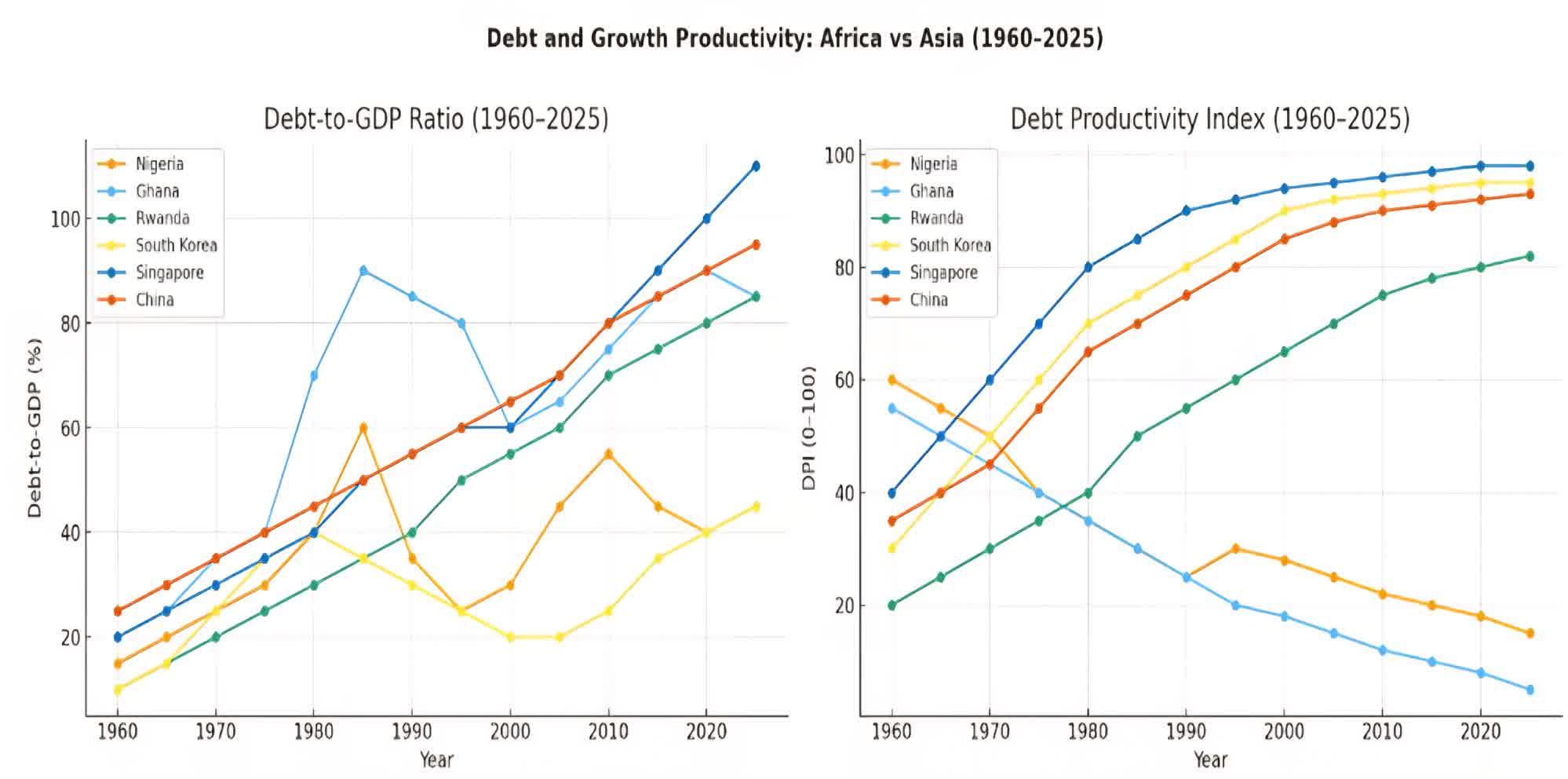
    The “Debt Productivity Index” (DPI), an analytical construct using debt-to-GDP and GDP per capita growth, captures the correlation between debt and productivity.

    Nigeria’s debt-to-GDP ratio rose from 39.1% in 1989 to 56.6% in 1990, then declined to 39.4% in Q1 2025 after GDP rebasing. Yet Nigeria’s DPI has steadily declined, mirroring Ghana’s trajectory despite Ghana’s debt-to-GDP peaking above 80% in the mid-2010s and again in 2023–2024. Rwanda’s debt-to-GDP rose from 20% in 2010 to over 80% in 2025, but its DPI shows a corresponding positive increase. This mirrors patterns in South Korea, Singapore, and China. For example, South Korea’s debt-to-GDP is forecast to reach 53.6% by 2028, China’s to 110% by 2029, and Singapore’s to 175% in 2025. These countries demonstrate that rising debt, when tied to productivity, can yield transformative outcomes.

    3.0 Africa’s Debt Landscape

    Over the past 15 years, Africa’s debt has surged. The Sub-Saharan Africa median debt-to-GDP ratio reached 60% in 2025—double the 30% recorded in 2010. Nigeria’s 2025 ratio of 45% sits below the continental average, while Ghana’s exceeds 80%. Sudan remains in chronic debt distress, unable to regain international creditworthiness.

    Africa’s debt structure is increasingly dependent on external borrowing—Eurobonds and bilateral loans from China. Domestic debt markets remain shallow, constrained by weak savings and fragile financial systems. Global shocks, commodity price volatility, and interest rate hikes have pushed many African countries into unsustainable debt service positions.

    4.0 The Debt Paradox in Africa: Rwanda as an Outlier

    Africa’s paradox is multifaceted: resource-rich yet fiscally distressed, attracting financial inflows but suffering from debt overhang. The continent faces power shortages, food insecurity, and illicit financial flows exceeding $89 billion annually. Debt servicing diverts funds from health, education, and infrastructure, undermining human capital and deterring investment.

    Rwanda stands apart. Its long-term plans such as Vision 2050 focus on productivity-enhancing investments in transport, ICT, and health. Stronger governance and alignment with donors and multilaterals rationalize its debt-to-GDP climb to over 80% in 2025. While not risk-free, Rwanda’s debt strategy shows that high debt can support transformation if well managed.

    5.0 Africa vs Asia: What Went Wrong?

    Asian economies once faced similar savings gaps. South Korea’s economic miracle was driven by heavy borrowing tied to industrial policy, mass education, and export-oriented manufacturing. Singapore’s borrowing between 1970 and 1990 funded world-class infrastructure and human capital. China’s 1978 reforms leveraged debt to finance infrastructure and technology, lifting over 800 million people out of poverty. The common thread: long-term planning, institutional discipline, and strategic use of debt for development. In contrast, African borrowing has often been reactive, fragmented, consumption-driven, and applied to politically motivated projects rather than productivity multipliers. Weak institutions and corruption crowd out fiscal space, trapping governments in cycles of refinancing without growth.

    6.0 Lessons for Nigeria and Africa

    To escape perpetual fiscal fragility, Africa must go beyond debt restructuring. Key reforms include:

    •Fiscal discipline and transparency: Align debt with credible development strategies and national priorities.

    •Domestic revenue mobilization: Tax reforms must reduce dependence on borrowing. In Nigeria, scepticism around the 2025 tax reforms fuels non-compliance, highlighting the need for public trust. This is because trust in governance is critical to long-term fiscal sustainability.

    •Growth-enhancing investment: Debt must fund projects tied to measurable growth multipliers and long-term planning.

    •Institutional strengthening: Democratic institutions must be fortified to eliminate inefficiencies and inconsistent borrowing.

    •Governance and accountability: Prevent misuse of debt and ensure high returns on public investment.

    •Strategic deployment: Debt must be a deliberate development tool—not a reactive deficit plug.

    Unproductive debt must not define Africa’s destiny. Rwanda, South Korea, Singapore, and China show that debt, when anchored in discipline, vision, and strong institutions, can fuel transformation. For Nigeria and its peers, the debt paradox is not just fiscal, it is systemic. The task is clear: close governance and strategy gaps, turn liabilities into productivity, inclusive growth and lasting prosperity.

    David Ugwunta
    David Okelue Ugwunta, PhD

    Dr. Okelue David Ugwunta is a Nigerian University Lecturer and an Economic Planning Specialist.

  • Reuniting with the Past

    Reuniting with the Past

    -By Abdul Mahmud

    Last week, my phone rang. The voice on the other end was familiar. It was Mike Igini, the former Resident Electoral Commissioner of the Independent National Electoral Commission and my old comrade from the student movement. “Comrade Mahmud, how you dey na?” he asked with a chuckle. His call was brief, yet loaded with memory. After a few pleasantries, he said, “I’ve passed your number to Kennedy. He will call you”. I didn’t ask who this Kennedy was. The name was enough to stir my mind. I instantly thought of my former classmate at Essi College, Warri. Kennedy, the boy with quick wit and a restless mind. I had not seen him since late 1994. That year, I had returned to the High Court of Justice in Warri to challenge the expulsions of student leaders from Delta State University, Abraka. We met by chance, exchanged words, then life again took us in different directions.

    The following day, the phone rang again. This time, it was Kennedy. His voice carried across the Atlantic. Ecstasy reborn. We spoke as though the years had collapsed into seconds. We caught up on our boyhood years, old teachers, and forgotten mischiefs. The laughter was genuine, the kind that makes the chest lighter. That call sparked many more. Kennedy reconnected me to other former classmates, some in Nigeria, others scattered abroad. The joy was overwhelming. But grief came too. Some of our friends had gone ahead. Daniel Ifemeni. Emuesiri Osagada. Names once called in classrooms and dormitories, now only spoken in remembrance. May their souls rest in power.

    Memory is cruel and kind at the same time. It gives us joy, then leaves us with loss.

    While I was still swimming in nostalgia, another surprise came. My former classmate, Akan Akpan, added me to the WhatsApp group of my year group at Lutheran High School, Ikot Ekpene. Another reunion, though virtual. Another rush of excitement. Names I hadn’t heard in decades suddenly lit up my phone screen. Those who departed our earthly shores. “War Party”, who wore his nickname like a warrior on the football pitch. “Tolade”, who was fascinated by the nickname he adopted from the Yoruba nation he had not visited. And the recently diseased Vincent whose remains have not been interred. We greeted each other with emojis, memes and laughter. Stories began to pour in. I realised something simple. Reuniting with the past is both an act of joy and an act of healing. I lived an itinerant life as a boy. My late father’s job as a senior federal government employee meant constant movement. Town to town. School to school. Friendships began and ended in cycles. Every new place was a chance to start again. At the time, I resented the uprooting. But looking back, it gave me a country of memories. Our country became my oyster.

    These recent reunions have forced me to reflect. What is it about reconnecting with old friends that touches us so deeply?

    First, it is the reminder of who we once were. Life has a way of pushing us into roles that are professional, political, and parental. We wear these masks daily until we forget the raw, unpolished versions of ourselves. Talking to Kennedy and chatting with my former classmates pulled me back to Warri, Ikot Ekpene and to the restless teenager I once was. That boy had dreams, fears, and an unshakable belief in our country and its people. He still lives in me, though buried under adult responsibilities.

    Second, reunions remind us of the passage of time. Hearing the names of those who have died struck me deeply. Daniel. Emuesiri. “War Party”. “Tolade”. Vincent. They were once full of energy, running across fields, arguing in classrooms, laughing at jokes. Now they are gone. Death turns classmates into memories. And yet, in remembering them together, we honour them. We keep them alive in the small spaces of our conversations.

    Third, reconnecting with old friends is a mirror. We see ourselves reflected in their stories. Some have succeeded. Some have struggled. Some carry scars we never imagined. But, through them, we recognise how far we have come. The boyhood fears and the mischiefs of teen years that have shaped the men and women we are today.

    The virtual WhatsApp groups of my Lutheran High School and Essi College classmates have been a revelation. Technology has collapsed distance. Former classmates in Lagos, Abuja, Port Harcourt, Warri, Benin City, Ikot Ekpene, London, and cities in the United States now speak as though they sit in the same room. The groups are alive with memories. “Do you remember this teacher?” one asks. “Who recalls the mischief of the palm plot?” another teases. “Do you remember the cries of the bush baby?”  another asks. Each story builds a bridge to the past. But these reunions are not just about nostalgia. They are about grounding. They remind us that we belong to a web of shared experiences. In a society where politics divides and hardship isolates, reconnecting with old friends brings warmth. It restores a sense of the family, one community of shared love and lived experience.

    Old friendships are unique. They are not based on power, money, or status. They are rooted in innocence. They were formed before titles mattered, when all we had were chalkboards, football fields, and teenage dreams. That is why they feel pure when we return to them. Yet, there is also a lesson in humility. Reuniting shows us that life is unpredictable. Some of my classmates have achieved success beyond imagination. Others have endured pain, loss, or poverty. In these conversations, there is no competition. We share as equals. We encourage one another. We laugh at our past. We grieve our dead. And in doing so, we recognise the simple gift of life.

    I have also realised that reunions are acts of gratitude. Gratitude for friendships that once carried us. Gratitude for memories that still make us smile. Gratitude for survival, for being alive to answer the call of an old friend. As I reflect, I think about the young people of today. Will they, in thirty years, find the same joy in reconnecting? Or has technology changed friendship too much? Our bonds were forged in classrooms, assembly grounds, and on football pitches. Today’s bonds are formed on screens. Time will tell if they endure the same way.

    For now, I hold on to these reconnections. They remind me that the past is never truly gone. It waits quietly, until one phone call, one message, one WhatsApp group brings it rushing back. Reuniting with former classmates is more than nostalgia. It is a reminder of who we are, of what we have lost, and of what we still share. It is an act of memory, an act of love, and above all, an act of hope. So, when the phone rings and a familiar voice says, “Comrade, how you dey na?” – answer it. It may carry you back to the boy or girl you once were. And it may remind you that life, despite its trials, still holds spaces of joy reborn. While I wait for that call from a classmate of my primary school years in Benin City, Kwale, Sapele, or Warri, I am reminded that friendship is a river. It may dry in places, it may bend and twist, yet it always seeks a way to flow again. May the bonds of old companions be replenished, not merely by memory, but by love, and love again. For in the quiet return of friendship lies the miracle of time redeemed, and in its renewal, the heart learns once more that nothing of true value is ever truly lost.

  • [VIDEO] Ikemba Friends Association Confers Patronship on HRH Maduabuchi Cyprian Nevobasi

    [VIDEO] Ikemba Friends Association Confers Patronship on HRH Maduabuchi Cyprian Nevobasi

    Doris Ewoh, Enugu

    The Ikemba Friends Association, under the leadership of Rt. Hon. USA Igwesi, a former House of Representatives member, has conferred the prestigious title of Patron on the Chairman of the Awgu Traditional Rulers Council, His Royal Highness Igwe Maduabuchi Cyprian Nevobasi.

    The official conferment ceremony took place on Thursday, 4th September 2025, at the Enugu residence of Igwe Nevobasi, marking him as the first-ever Patron of the Association.

    Speaking with PACESETTER, Rt. Hon. Igwesi explained that among several nominees for the role of patron, the association unanimously chose Igwe Nevobasi due to his outstanding contributions to humanity.

    “We concluded that Igwe deserves this honor based on his philanthropy and the ways he has uplifted both the rich and the poor. His economic legacy is unquantifiable, and that informed our choice,” Hon. Igwesi stated.

    He emphasized that with this new role, they believe Igwe Nevobasi will guide the association with the wisdom and grace of a Royal Father, adding that, “to whom much is given, much is expected.”

    In response, HRH Igwe Maduabuchi Cyprian Nevobasi expressed deep appreciation for the honor, saying:

    “It came to me as a shock. They have always been my allies, especially the leader, Rt. Hon. USA Igwesi. We’ve known each other for over forty years. I am very delighted by this recognition.”

    He pledged to serve diligently as the “chief pilot” of the association, stating his commitment to navigating the organization through challenges and elevating it with divine wisdom.

    “As the Lord gives me wisdom, I will do the right things and take this organization to greater heights,” he added.

    Also speaking at the event, Hon. Sunny Eze, Chairman of the Ikemba Friends Association, expressed confidence in Igwe Nevobasi’s leadership.

    “We are happy to have him as our patron, a father figure who will oversee and support us from a distance. With his philanthropic nature, we believe we will accomplish a lot together.”

    The ceremony marked a significant milestone for the Ikemba Friends Association as they look forward to a new era under the guidance of their royal patron.

  • The Hollow Nigerian Way of Fighting Terror

    The Hollow Nigerian Way of Fighting Terror

    -By Abdul Mahmud 

    Simon Ekpa has been sentenced to six years in Finland for terrorism-related crimes. His arrest by Finnish police in 2024, which was public was followed by criminal charges, trial, and conviction handled by the courts of that country – in quick time.  No politics. No ethnic undertones. No religious sentiment. No ifs. No buts. Just the law. That is how serious nations combat terrorism. They use laws. They use institutions. They make the courts, not politicians, the final arbiters. Finland has shown that when citizens wage wars against the state, there is only one path; the path of justice. Our country and its puissant rulers should take notice. But, will they?

    For years, our country has lived under the weight of terrorism and banditry. From Boko Haram in the Northeast, to bandits in the Northwest, to armed herdsmen across the Middle Belt, to secessionist violence in the Southeast, our country has been battered. Yet, ask yourself: who are the high-profile terrorists that our country has ever successfully tried and jailed? Tukur Mamu, the man the SSS named as a terrorist who was arrested in September, 2022? Three years later the hearing of the criminal charges filed against him at the Federal High Court, Abuja, has not gone bail hearing. Who else? None. Rather than pursue justice, our country has embraced appeasement. Rather than resort to trials, it has embraced settlements. Rather than apply the law, it has enthroned the politics of kid gloves. Terrorists, rather than being dragged before our courts, they are courted with amnesty. That kind of détente plays out in grotesque rituals. Men who once stormed villages, who left behind charred homes and unmarked graves, now appear draped in camouflage. Bandoliers of ammunition hang across their chests. Kalashnikovs, the same weapons that mowed down innocents, slung confidently across their shoulders. They grin for the cameras. In those staged moments of “surrender”, the mass killings and abductions they committed, including the humiliation inflicted on our sovereign state, are made to vanish into thin air. Governors pose beside them as though they were statesmen, not outlaws. Soldiers and police officers stand by in silence, complicit in the theatre. What should be a reckoning becomes a performance. What should be justice becomes indulgence. And what should reaffirm the authority of the state instead diminishes it, making the law itself look like a prop in a grotesque show.

    They also have a way of christening the rituals to make them appear legit. They call it “deradicalisation”. They call it “reintegration”. They call it “rehabilitation”. In truth, it is a capitulation. It is the surrender of the state to its enemies. The hypocrisy is glaring. When petty thieves are caught, they rot in jail. When kidnappers without political links are arrested, they face endless trials. When poor youths are caught for petty crimes, they are paraded before cameras. When the hideouts of Yahoo-Yahoo boys, the so-called Aza men, as the streets now describe them, are raided, it dominates the headlines and fills the evening news. But when men with blood on their hands, when men who sack villages and massacre innocents are caught, they are offered seats at the table. They are told to lay down their arms. They are “reintegrated” into the very society they destroyed.

    This policy of appeasement did not begin today. It has a history. Nasir El-Rufai, former governor of Kaduna State, openly admitted that he paid bandits to stop attacks. He was not ashamed. He said he travelled out of the country to meet them. He said he settled them. His justification was crude: to stop them from killing his people, he had to give them what they wanted. Other governors followed the same path. Bello Matawalle of Zamfara embraced negotiations with bandits, granting them amnesty. Aminu Masari of Katsina tried the same. In Niger State, Abubakar Bello also pursued dialogue and settlement. The logic was always the same: better to settle killers than confront them. Better to appease terror than uphold the law. But what has this brought our country? Nothing but emboldened terrorists. Bandits who now fly helicopters into forests. Bandits who tax farmers before they can plant or harvest. Bandits who shoot down military aircraft. Terrorists who walk free while victims bury their dead.

    Ekpa’s sentencing in Finland throws all this into sharp relief. Here was a man who incited violence from abroad. Here was a man who issued threats, who enforced stay-at-home orders in the Southeast, whose words and actions paralysed local economies and endangered lives. Our puissant rulers cried out, again and again, until their voices broke and turned hoarse. Our country itself wailed in anguish. But nothing tangible happened here. It took a foreign country, thousands of miles away, to act. Why? The answer isn’t farfetched. In Finland, the law is supreme. In our country politics is supreme and it trumps law. Yet, hypocrisy rises to the surface, traded as the common currency of power and persuasion. Our leaders say they are fighting terrorism; but, they refuse to use the one tool that makes nations strong: the impartial force of justice. They are quick to parade the poor. They are quick to jail the powerless. But they refuse to jail terrorists. They refuse to even try them. So we must ask again: who are the high-profile terrorists that Nigeria has jailed? Is it Shekau? No. He died by his own hand. Is it any of his commanders? No. Is it the masterminds of the Chibok abductions? No. Is it the killers of students in Katsina, Kankara, Kagara, or Yobe? No. Is it the men who sacked hundreds of villages in Zamfara, Benue, Plateau? No. The answer is clear. No one.

    But, every other market day, the military announces the surrender of hundreds of “repentant” Boko Haram fighters. They are fed. They are clothed. They are trained. They are sent back into society. Their victims, the widows, the orphans, the displaced, are left with nothing. This is not justice. This is betrayal.

    Our country has turned upside down the meaning of justice. Instead of trials that affirm the rule of law, it creates photo opportunities for terrorists and bandits who shake hands with governors. Instead of courtrooms, it arranges negotiation tables. Instead of jail cells, it sets up reintegration camps. Ekpa’s case is instructive. He was not tried here. He was not punished here. He was punished in Finland. And he was punished because a nation that values law and order cannot allow terrorism to fester unchecked. Our country, by contrast, has allowed terrorism to become an industry. An industry of settlements. An industry of amnesty. An industry of deals. The consequences are dire. Terrorism has metastasised. Banditry has grown. Kidnapping for ransom has become the national enterprise. Farmers are abandoning their land. Children are being denied education because schools are unsafe. Citizens are paying for the failure of the state to act. It is time to say the truth: our country is not fighting terrorism. Our country is accommodating it. Our rulers are bargaining with it. Our rulers are feeding it.

    Those who defend the appeasement policy argue that our country lacks the capacity to fight. They argue that the military is overstretched. They argue that negotiation saves lives. But they miss the point. No country has ever secured itself by appeasing terror. No state ever won peace by rewarding killers. Peace without justice is an illusion. Finland has shown what is possible. Finland has shown that when institutions work, the law can confront terror. Our country must learn. Our country must rise. Our rulers must stop hiding behind appeasement and confront the reality that they have abandoned justice.

    The question remains: who will bell the cat? Who will summon the courage to prosecute terrorists? Who will put Shekau’s successors on trial? Who will bring the leaders of bandit cartels to court? Who will give our citizens the assurance that the state is not in league with killers? Our hypocrisy will remain exposed. We jail the petty thief. We reintegrate the mass murderer. We punish the weak. We reward the strong. We claim to fight terror while pampering terrorists. This is why trust in the state is collapsing. Citizens see a government that cannot protect them, yet embraces those who butchered their families. They see widows mourning while killers are feted. They see children out of school while warlords are called “repentant”. In such a climate, the idea of justice becomes hollow, the meaning of citizenship erodes, and the authority of the state shrinks into ridicule.

    A nation that cannot punish its worst offenders cannot command the loyalty of its people.

    And so the cycle continues. Bandits strike, the state negotiates. Terrorists kill, the state forgives. Villages are burnt, the state calls for dialogue. The message is clear: in our country, crime pays when it is scaled high enough. Small men are crushed by the system; big men are courted by it. This inversion of justice is not only obscene; it is suicidal for a fragile state. For no republic can endure when the sword is turned against the weak while the strong are shielded from the law. The lesson from Finland is plain. Nations that survive are those that make no distinction between the weak and the powerful in the eyes of the law. They understand that justice is not an option, but the very lifeblood of order. Our country with its rulers must decide whether its wants to remain a theatre of indulgence or a country governed by law. Until it chooses justice, our citizens will keep burying the dead, keep mourning the abducted, keep watching governors shake hands with killers. And our hypocrisy, already naked before the world, will become the grave digger of our republic.

    Ekpa’s sentencing is a mirror. A mirror that shows us the face of our country’s failure. The question is: will our country’s rulers look into it? Or will they, as always, look away?

    Time will tell.

  • [VIDEO] Chief Nwabueze Nnamani Hosts Methodist Church Prelate During Apostolic Visit to Diocese

    [VIDEO] Chief Nwabueze Nnamani Hosts Methodist Church Prelate During Apostolic Visit to Diocese

    Doris Ewoh, Enugu

    In a display of love for the church and God, a former Chairman of Nkanu West Local Government Area of Enugu State, Chief Nwabueze Nnamani (Ikeoha), has hosted the Prelate of the Methodist Church Nigeria, His Eminence Dr. Oliver Ali Aba, to a civic reception at his country home, during the Prelate’s Apostolic visit.

    The visit, which took place on Thursday, September 4, 2025, was part of an apostolic tour of the Akegbe-Ugwu, Awgu, and Aninri Diocese (AAA Diocese). Chief Nnamani hosted the Prelate at his residence in Umuetugbu Oma, Akegbe-Ugwu.

    Expressing his gratitude and joy, Chief Nnamani likened the moment to a biblical encounter, saying, “I feel like Zacchaeus who climbed the sycamore tree just to see Jesus.”

    He described the visit as significant and spiritually uplifting, adding that it would inspire many unbelievers in the community to turn to Christ.

    The Archbishop of Enugu Diocese, His Grace, Most Reverend Barr. Christopher Edeh, commended Chief Nnamani for his hospitality and steadfast support for the Church.

    “Ikeoha means the people’s strength. He is the strength of this Diocese; he is the strength of this community. For someone of his caliber, he’s not ashamed to identify with us, and he’s not ashamed to identify with the Methodist Church Nigeria. To have Ikeoha is to have strength. We thank him for what he’s doing, and we appreciate him,” said Archbishop Edeh.

    As part of the visit, the Prelate was also conferred with a chieftaincy title, Enyioha I of Enugu State, by the Chairman of the Akegbe-Ugwu Traditional Rulers Council, HRH Igwe Greg Ugwu.

    In an interview with PACESETTER, His Royal Highness Igwe Greg Ugwu expressed delight over the Prelate’s visit, describing it as a historic moment for the community during his reign.

    “Titles are given to exceptional people, and today he is being conferred a chieftaincy title due to his outstanding qualities. He is a great man. We see the good works he is doing to ensure that people serve God in spirit and in truth,” the traditional ruler said.

    In response, the Prelate, His Eminence Dr. Oliver Ali Aba, expressed heartfelt gratitude for the honor. He noted that the chieftaincy title made him feel truly embraced as a “son of the soil” and assured both the community and the palace of his continued prayers.

    Archbishop Edeh further noted that the Prelate rightly deserves the title Enyioha of Igbo Land, highlighting that he is the first Prelate in the 183-year history of the Methodist Church Nigeria to initiate the construction of a Methodist university in Igbo Land.

  • Chijioke Edeoga Again?

    Chijioke Edeoga Again?

    By Sebastine Chukwuebuka Okafor , Ph.D

    On Saturday, August 30, 2025, political leaders from Enugu East Senatorial District gathered at the Enugu International Conference Centre to discuss the progress of the state. Many notable figures from the zone who are progressives attended, and serious deliberations were made on unity and development, especially in the zone.

    During the session, Barr. Chijioke Edeoga was invited to move a motion affirming that Governor Peter Ndubuisi Mbah has performed well and therefore deserves the full support of the zone beyond 2027, so that power could eventually rotate to Enugu West Senatorial District which he did unapologetically. After Edeoga moved the motion, Hon. Anioma Frank, the Special Adviser to the Governor on Political Matters, who served as moderator, called on Dr. Ben Nwoye, leader of the progressives, to second it.

    In the course of seconding, Dr. Nwoye digressed a bit to speak about Minister Uche Nnaji. He also used the opportunity to call on Governor Mbah to join APC and realign Enugu with national politics, because his roadmap to development aligns with that of the renewed hope agenda of President Ahmed Bola Tinubu.

    It was at this point that some paid persons deliberately twisted Edeoga’s mere presence on the podium to suggest that he was part of Nwoye’s remarks. Such a false narrative is not only dishonest but also a show of cowardice and immaturity. Everyone present knew that Edeoga’s mission was solely to move a motion in support of Governor Mbah, not to contribute to what Nwoye said. He has devoted his time and energy to support the Governor, after being convinced that such is the best way to approach development through politics and it seems his support to the Governor is even more pure than that of many who are even in PDP.

    For the record, there is a political battle currently in Enugu APC, that is between APC Progressives led by Dr. Ben Nwoye, which I am part of, and those who have weakened the party, led by Minister Uche Nnaji. Linking Barr. Edeoga to APC quarrels where he has no involvement is nothing but an attempt to create needless unrest in Enugu and those behind it should abstain from that.

    What they intend to achieve is still oblivious to me, howbeit, it is also important for all to know that Barr. Edeoga has been a friend of the Minister since 1998, and nothing visible has happened to change that relationship.

    Therefore, the social media attacks that followed against the Isi Uzo born legal luminary are clearly coordinated onslaughts by sponsored data boys and political actors unsettled by the implications of his return to the PDP and his decision to stoically work with Governor Mbah. To me, these attacks might have also come from different directions, but all of them are threatened by Edeoga’s renewed alignment and still allegedly and conveniently sponsored through the machinery of those in the APC, Labour Party and no party.

    Using his appearance on the podium as an excuse to launch attacks with deepfake apps is childish. Rather than embrace progress, these groups have chosen to spread deepfake videos and manipulated narratives to tarnish his image. Their fear is simple. They know that unity between Edeoga and Governor Mbah strengthens not just the Governor but also the political stability of the state.

    Politics of development should not be about falsehoods or propaganda. It should be about service, loyalty, and truth. Governor Mbah has already shown leadership that inspires confidence, and Edeoga believes that supporting the Governor is the right step for the people of Enugu.

    Those who attack him today will later understand that his actions may have been guided by a higher principle, which is the pursuit of unity and progress. No deepfake or propaganda can erase the fact that his role at the meeting was only to move a motion of support for Governor Mbah in the collective interest of the zone.

    When I had a chat with Edeoga to understand his position on the politics of Enugu State, he made it very clear that Governor Mbah’s performance is already building and nourishing a special brand new unity across the state and thus has his full support. Such is the position of a man who is experienced in the game and though I may not like the Governor, that is his stance which he does not look perturbed.

    Instead of resisting this progress, those who are sad should either respect his decision or mind their business. To me, Edeoga’s decision may favour or harm him, depending on the sincerity between Governor Mbah and him even though I still do not trust the latter. In all honesty, the future of Enugu State lies with leaders who can work across divides and put the people first.

    Until then, no amount of lies, manipulations, or manufactured controversies will succeed in hiding the truth, which is simple. To tell the truth, APC needs Governor Mbah, and he should listen to the calls made by the progressive agenda leader led by Dr. Ben Nwoye.

    Those attacking Barr. Edeoga should remember that he simply exercised his right to take a political decision that he believes will serve his people. It is better for others to also make their choices openly instead of spreading confusion.

    No one should create tension in the state because of differences in political direction. Peace is more useful than strife, and progress can only come when leaders allow one another the freedom to choose their path.

    “Dey your dey, and allow ndị ọzọ to also dey their dey, to avoid imebi Enugu; makana onye mebie Enugu, ọ kwụọ anyị ụgwọ.”

  • [WATCH] Southeast Retired Customs Officers Hold Annual General Meeting in Enugu

    [WATCH] Southeast Retired Customs Officers Hold Annual General Meeting in Enugu

    …Welfare of retired officers top agenda

    The South East Retired Customs Officers Association convened in Enugu for its Annual General Meeting, bringing together retired officers from across the region to focus on welfare initiatives, shared experiences, and the celebration of life after service.

    The meeting, hosted by Chief Nwabueze Nnamani, a retired customs officer and former Council Chairman of Nkanu West took place on Saturday, 30th August, at his country home in Umuetugbu Oma, Akegbe Ugwu, Enugu.

    While speaking with PACESETTER, the President of the Association, Hon. Uzochukwu Eminent, said the gathering, held once every year, serves as a forum for all retired customs officers from the five Eastern states to come together and address the welfare of their members.

    According to him, the hosting of the AGM rotates among the states, and it was now Enugu’s turn. He acknowledged the positive changes in Enugu made by the current Governor since his early days in the city during his customs service. He said:

    “Coming to Enugu is an eye-opener. Enugu is something else. I started my work here in Enugu in 1979; it wasn’t like this. This Governor came here and made it innovative.

    Other governors should come to Enugu and be briefed on how to govern states. What is seen here is out of this world. It’s a landmark, it’s a masterpiece something you wouldn’t imagine happening in Nigeria. The few days I have spent here make one long to return.”

    Hon. Uzochukwu noted that one of the key problems customs officers face is inadequate funding. He urged the National Assembly to pass legislation ensuring that anyone who serves the country is well taken care of, including access to housing and other basic amenities that support a good quality of life. This, he said, would allow officers to focus fully on their duties without external distractions.

    Chief Sir Nwabueze Nnamani, the chief host, stated that the main purpose of the meeting was to discuss the challenges faced by retirees and explore possible solutions among themselves, while also seeking assistance from external sources.

    Recalling his days in Customs before retiring 15 years ago, he said: “It was interesting, sometimes challenging. I enjoyed my stay in Customs.”

    Barr. C.O.C. Chukwuma, a legal practitioner and retired customs officer, acknowledged that one of the common problems faced by retired officers is poor health. He said that in the course of serving the country, many endured harsh conditions frequent relocations, poor feeding, and inadequate rest.

    “All of these have a big impact on our lives at this old age we are presently in. Most of us who wanted to be here are not here because of health issues,” said Barr. Chukwuma.

    He appealed to the government to heed the cries of South East Retired Customs Officers whenever they speak out, adding that they would be deeply grateful.

    He also advised younger officers still in active service to prioritize their health, noting that health is the foundation for life after service. “The future lies in their health,” he said.

    Emphasizing the health challenges facing many retired officers, Mrs. Okpara Obiageli, wife of a retired customs officer, stated that many retirees are unwell, and a significant number are not yet aware of the Association. She expressed hope that as the AGM continues to rotate across states, more retirees will be encouraged to join.

    The Secretary to the Enugu State Government, Professor Chidiebere Onyia, also addressed attendees at the event.

    Following the meeting, members of the Association paid a courtesy visit to Senator Okey Ezea, who is also a retired customs officer. They later toured the city, acknowledging the developmental efforts of the Governor of Enugu State, Dr. Peter Ndubuisi Mbah. Sites visited included the International Conference Center, Presidential Hotel Enugu, Holy Ghost Bus Terminal, and Gariki Bus Terminal.

    Also in attendance were traditional rulers, members of the Association, and other distinguished guests.

  • [WATCH] Anambra 2025: LP’s Moghalu Visits ADC’s Nwosu

    [WATCH] Anambra 2025: LP’s Moghalu Visits ADC’s Nwosu

    The Labour Party (LP) Governorship candidate, Dr. George Moghalu (Ohamadike Nnewi), yesterday paid a fraternal visit to his kinsman, Chief John Nwosu, the Governorship candidate of the African Democratic Congress (ADC), at his residence in Nnewi.

    The visit, described by his Special Assistant on Media, Johnson Okoye, as warm and cordial, went beyond partisan boundaries as both leaders, proud sons of Nnewi, reaffirmed their enduring bond of brotherhood and mutual respect. Their discussions focused on the unity, peace, and progress of Anambra State.

    Speaking after the visit, Dr. Moghalu underscored that leadership must always be anchored on service to the people and the pursuit of the common good. He noted that while political parties may differ, what unites Ndi Anambra and particularly the Nnewi spirit of solidarity is far greater than what divides them.

    “Chief John Nwosu is not just a fellow Governorship candidate, he is my brother and my kinsman. Our conversation was about how to build a better Anambra where peace, prosperity and development will thrive. As proud sons of Nnewi, we share a duty to show that politics should strengthen our unity, not divide us. Maka na Anambra ga adị mma ozo,” Moghalu declared.

  • 2027: Enugu APC Stakeholders Woo Governor Mbah to Join Party

    2027: Enugu APC Stakeholders Woo Governor Mbah to Join Party

    Doris Ewoh, Enugu

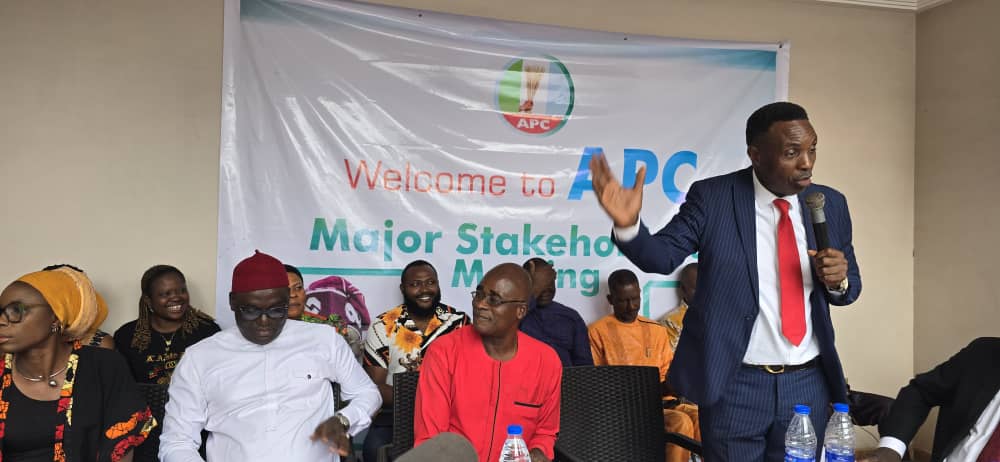
    At a strategic stakeholders’ meeting in Enugu, APC leaders, including Dr. Ben Nwoye and Barr. Eugene Odo, have signaled their readiness to welcome Governor Peter Mbah into the party, as internal rifts over leadership and integrity continue to stir debate.

    This declaration was made during the Enugu APC Stakeholders’ Meeting held on Tuesday, August 26, 2025, at De Sheriff Hotel, Enugu, which was monitored by several members of the press, including PACESETTER correspondent. The meeting focused on the theme: “Repositioning APC Enugu State to Win Elections in 2027 and Beyond.”

    Speaking at the meeting, Dr. Nwoye emphasized that the only way to sustain the current legacy and development in Enugu State is for Governor Mbah to continue beyond 2027. He appealed to Mbah to join the APC, noting that every new member strengthens the party.

    Following this, a motion was moved by Dr. El Ajah to formally accept Governor Mbah into the party if he chooses to join. The motion was seconded by Comrade Ngene Obama, and unanimously supported by all members present.

    Barr. Eugene Odo, former Enugu House of Assembly Speaker, also expressed his support, stating that he would be pleased if Mbah joined the APC. He went further to reference a recent Enugu State High Court ruling declaring that Ugo Agballa is no longer the state chairman of the party and should cease parading himself as such.

    Odo also addressed ongoing controversies involving the Minister of Innovation, Science and Technology, Hon. Uche Nnaji, who, he said, has been accused of presenting a fake certificate. He called on the party leadership to set up a committee to visit the University of Nigeria, Nsukka, to verify the Minister’s academic credentials.

    “We want to advise the leadership of the party to possibly set up a committee to go to the University of Nigeria, Nsukka, to confirm, so we can know what the Minister represents,” Odo said.

    Also speaking, Barr. Bartholomew Ugwuoke, former ACN chairman, noted that the “genuine APC” is back in Enugu and called on former members to return, saying, “We are moving fast.”

    In his remarks, Hon. Sunday Onah, Deputy Chairman of the party, cautioned Chief Uche Nnaji on the continued support of Barr. Ugo Agballah, alleging that Agballah was expelled as state party chairman.

    He noted that the State Working Committee would be left with no option but to take disciplinary action if the support continued.

    Barr. Godwin Onwusi, Chairman of the 2023 House of Assembly APC Aspirants Congress, criticized the party’s recurring practice of suspending members.

    “I have never seen a party where the stock-in-trade is to sack people. People come in, and when asked to view things from different angles, they get suspended. We cannot leave our party to birds of passage. These people will come and go. Hopefully, we are here to take back our party,” he said.

    Mrs. Kate Nwafor, former Enugu State APC Publicity Secretary, expressed optimism, stating that with the renewed direction, the APC in Enugu is returning to its original path and purpose.

    “With this new trend, I’m confident we are going back to our original stance to become what we used to be,” she said.

    Reacting to the allegation of forgery of results by the Minister, an Enugu APC youth leader, Chidiebere Ezeh, who spoke to our correspondent over the phone, stated that the allegations were “just propaganda”.

    “This is a non-issue, as it’s just propaganda by the opposition to tarnish the image and name of Chief Uche Nnaji.

    “The DSS and other relevant bodies screened him before his assumption of office, so if there are any issues of certificate forgery, the DSS and NYSC should be in a position to address that.”