Tag: Buhari

  • Terrorists should not be spared or forgiven – Buhari

    President Muhammadu Buhari has described the brutal terrorist attacks in Kanam and Wase communities in Plateau State as heinous, saying that the perpetrators should not be allowed to escape justice.

    According to a statement by Senior Special Assistant to the President on Media and Publicity, Garba Shehu, Buhari said: “They should not be spared or forgiven.”

    The president, who said he has full details of the attacks, ordered law enforcement agencies to work strenuously with the government of the state, to bring the situation under control and take steps to bring the culprits to justice quickly.

    President Buhari expressed condolences over the terrorist incident, saying that as a matter of priority, peace must return at all costs to the state and the entire country.

    “I urge all our citizens, the people of Plateau State in particular to expose the perpetrators of such incidents, their sponsors and those who encourage such criminals who carry out these dastardly acts of murder, so that the law will take its course. They must not be forgiven,” the president said.

    (Sun)

  • Why Senators rejected Buhari’s Electoral Bill ammendment – Abaribe

    SENATE Minority Leader, Senator Enyinnaya Harcourt Abaribe, PDP Abia, has given reasons the Senate rejected President Muhammadu Buhari’s bill to amend Section 84 (12) of the Electoral Act 2022 that was recently passed into law.

    According to him, amending the section would be going against the civil service norms and would be injurious to the well-being of the society.

    While signing the 2022 Electoral Amendment Bill on February 25, President Buhari complained that the provision constituted fundamental defect, saying it was in conflict with extant constitutional provisions.

    He said Section 84 (12) constitutes a disenfranchisement of serving political office holders from voting or being voted for at conventions or congresses of any political party.

    The section reads: “No political appointee at any level shall be voting delegate or be voted for at the convention or congress of any political party for the purpose of the nomination of candidates for any election.”

    He stated that the provision introduced qualification and disqualification criteria that wad ultra vires the Constitution by way of importing blanket restriction and disqualification.

    Shortly after signing the Bill into law, President Buhari sent an amendment to the National Assembly, which the Senate refused to pass into law last week.

    Speaking on the issue, weekend, Abaribe, who is angling to succeed Governor Okezie Ikpeazu of Abia State in 2023, said the Electoral Act is a piece of good legislation that is meant to cure the ills of previous electoral acts and makes rigging of elections almost impossible.

    Aside providing for direct transmission of results from polling booths, it empowers the Independent National Electoral Commission, INEC, to reject results its officers announced under duress.

    On the controversies trailing Section 84 (12), Abaribe said the section codifies what already is supposed to be the norm in our civil service and society.

    “Before, the norm is if you want to run for office, you resign. Now, people stay in office and use state resources to run for office and the office suffers. No law is made to be retrogressive. It did not say you should resign three months to the elections. It says if you want to be a delegate, you will have to resign. The stipulation as to time is what is in the Civil Service Rule, that is 30 days before primaries or congresses you ought to resign.

    “The parties have not set their dates for primaries. When they do, the 30 days will now set in. The President says it conflicts with the Constitution. We don’t know what he meant. What we know is that if you are in office and running without resigning, your office will suffer. When we got his letter, we said he must have been misadvised by some people.”

    On Abia, he said currently he is the most experienced and capable person to take the state to greater heights after Ikpeazu’s tenure.

    (Vanguard)

  • Buhari pledges to support Nigerian Private Sector with Infrastructure.

    President Muhammadu Buhari, Thursday, pledged to continue to support the Nigerian private sector with policies and programmes to propel it toward higher investments and productivity in the various sectors of the economy, even as he acknowledged that economic policies of his administration are indeed working.

    Buhari, who spoke at the official commissioning of line 4 of the new BUA Cement 3MTPA plant in Sokoto, said he was excited to be back to the facility 37 years after he commissioned its line 2 in 1985.

    “The commissioning of this multimillion Naira plant today is an indication that our policies are working. As a government, we have continued to introduce policies to support private sector investments to achieve food self-sufficiency, artisanal gold mining and cement production, among others.

    “It is against against this backdrop that we have started the Abuja, Kaduna Kano (AKK) gas pipeline project to ensure that gas is available to all investors in order to reduce their cost of production.” Buhari said.

    The president said his government was also investing in road and railways infrastructure , all in a bid to reduce the cost of doing business in the country, stressing that the Federal Government would not relent in its effort to improve on security and ensure it wins the battle against criminal elements working against the collective interest of the nation.

    Buhari, however, called for stronger collaboration between the private investors and his government to ensure that the nation’s economy becomes more competitive among others.

    Commenting on the investment by the BUA Group, the Nigerian leader said its huge investment across the country was an indication that it is a firm believer in the Nigerian project, adding that BUA and other investors have made Nigeria self sufficient in cement.

    “ BUA is creating employment and it is indeed the largest employer of labour in the North West” the president said , while promising to continue to assist Nigerian entrepreneurs.

    In his welcome address, Executive Chairman of BUA Group, Alhaji Abdul Samad Rabiu, said the company has a vision to support government’s infrastructure agenda by ensuring it used locally available raw materials to produce cement in Nigeria.


    (Sun)

  • Buhari orders the Military to deal with anybody undermining Peace efforts


    The President, Major General Muhammadu Buhari (retd.), has directed the military and other security services to deal decisively with any person or group undermining efforts at achieving sustainable peace, security and stability in the country.

    This is as he assured that the country will ultimately defeat the forces of evil.

    According to the Special Adviser to the President on Media and Publicity, Femi Adviser, Buhari said this when he paid a visit to the palace of the Sultan of Sokoto, Muhammad Sa’ad Abubakar III, on Thursday.

    “I gave them specific orders not to spare any bandit or terrorist threatening the lives and property of innocent Nigerians,” Buhari was quoted as saying.

    According to Adesina, Buhari commiserated with the government and people of Sokoto over the recent loss of lives and property as a result of outrageous attacks by bandits and other criminal gangs.

    He said the President assured the people that he remains unrelenting in his resolve to put an end to heinous criminal activities in the state and other parts of the country.

    Buhari wrote in the visitors’ register, “My condolences to the Sultanate, the government, and people of Sokoto State over the recent mindless killings by bandits and terrorists.

    “Nigeria shall win the battle over evil.”

    The Governor of Sokoto State, Aminu Tambuwal, and the Sultan thanked the President for the show of sympathy, assuring him of continued support towards peace and stability in the country.


    (Punch)

  • President Muhammadu Buhari launches Nigeria’s National Development Plan 2021-2025.


    The plan, which was approved by the Federal Executive Council earlier in November, was launched, yesterday, at the State House in Abuja.


    Prior to the public presentation of the official document, the Minister of Finance, Budget, and National Planning, Zainab Ahmed disclosed that the new document replaces the Economic Recovery and Growth Programme 2017- 2020.


    The plan replaces the Economic Recovery and Growth Programme 2017- 2020.


    The plan, according to her, is designed to among other things facilitate the nation’s robust development in the area of science and technology as well as achieve its agendas on the continental and global levels.


    Meanwhile, the Federal Executive Council, FEC, yesterday, approved N5.7 billion for contracts in the Agriculture and Water Resources ministries.

    The government also explained that the National Development Plan, NDP, has a financing plan to increase the Gross Domestic Product, GDP, from the current seven per cent to 15 per cent


    Briefing State House correspondents at the end of the virtual council meeting presided over by President Buhari at the Council Chambers, Presidential Villa, Abuja, Minister of Water Resources, Engr. Sulaiman Adamu said his ministry obtained approval for the execution of two water projects in Gashua, Yobe State.

    He said the projects became urgent because of an observed surge in the prevalence of kidney diseases and kidney failure among people living in the Gashua region in the last few years.

    According to him, the two water projects were approved at the sum of N3.51 billion, adding that while one is to extend water supply service to Zango and Sabongeri Lamido, the other project is for an upgrade of existing waterworks.


    Also, briefing, the Minister of State for Agriculture and Rural Development, Mustapha Shehuri, said the council approved two memoranda for his ministry.


    On his part, the Minister of State, Budget and National Planning, Mr Clement Agba, while speaking on the unveiling of the National Development Plan, NDP, earlier by President Buhari, said: “The difference with this plan is that it provides a mechanism to engage, empower, and employ our teeming energetic youth.

    “The plan puts opportunities for inclusiveness for young people, women, people with special needs, and the vulnerable ones, mainstreaming women gender into all aspects of our social, economic and political activities.”

    “This plan also has a financing plan to increase revenue to 15 per cent of GDP. Currently, revenue to GDP is seven per cent. This plan also separates sports from youth and take sports as a business.

    “For the first time in our planning history, we have three volumes of the plan. In the past, we have always had one volume, which is the plan itself. But this time, we have three volumes. Volume One is the main plan, and that’s what will be accessible to the public.

    “Volume two is then a prioritised and sequential list of programmes and projects that will be fed into the annual budgets. While Volume Three are the legislative imperatives.”

    The FEC had at the meeting, observed a minute silence in honour of former Minister of Labour and Productivity, Hussaini Akwanga, who passed on December 17, at 77.

    Secretary to the Government of the Federation, SGF, Boss Mustapha, informed council members of the demise of the former minister and urged that a minute silence be observed in his honour.

    The late Akwanga served as minister in 2003 during the administration of former President Olusegun Obasanjo.


    Source: www.vanguardngr.com

  • President Buhari urges for Protection of Highways


    President Muhammadu Buhari, yesterday, commissioned the 40.27 kilometres Nenwe-Oduma and Ishiagu-Mile 2 roads connecting Enugu and Ebonyi states.


    Buhari, who was represented by the Minister of Science, Technology and Innovation, Ogbonnaya Onu, said the project was a demonstration of his administration’s commitment to improve road transport infrastructure in the country.


    Breaking News, Nigerians can now work in Nigeria and get paid in US Dollars Click here to apply today .


    “As you can all see, we are handing over today the 40.27 Kilometres Road which is Nnenwe-Oduma-Uburu Road Section I (26.27km) and Section II: Spur to Ishiagu – Mile 2 Road (14km).


    “This road links Enugu and Ebonyi states, and it is a critical component of our national road network. This road has been built to the highest quality of design and workmanship and if it is well used and not abused, it should last for the designed service life,” he said.


    He, however, cautioned against all forms of road abuse such as overloading of vehicles, spilling of petroleum products on the roads and converting the road shoulders to permanent parking places among others.


    “We must all do our best to avoid these practices, report them when they occur and act in a lawful manner to stop them.


    “The road is also a story of the capacity of our people. The patriotic Nigerians who were employed directly to build this road, the scores of suppliers employed indirectly who are responsible for providing the machines utilised in the construction.


    “This road is also a statement of economic efficiency and ease of doing business. Of course, this road is part of our many roads to prosperity because reduced journey times means reduced expense on travel, because time is money,” Buhari said.


    Earlier in an address, the Minister of Works and Housing, Babatunde Fashola, said the progressive train of the Federal Government and President Buhari administration has arrived the South East.


    “It, therefore, gives me great pleasure to bring the good tidings of our administration, to the people and governments of Enugu and Ebonyi states, that will be impacted by the Nnenwe-Uduma road sections I and II that our president will hand over today.


    “After the handing over of the Sokoto-Tambuwal-Jega- Kontagora-Makera road and the Vandeikya-Obudu Cattle Ranch road within the last 10 days. I am happy to reiterate that this is the third of many more project completion and handovers our country will experience in the next few weeks and months as we enter what I call a season of completion and impact,” he said.


    According to Fashola, the projects, and many more in various parts of Nigeria, represent major investment in road transport infrastructure, which is a commitment of the Buhari administration as a driver for economic growth and prosperity.


    “They are visible and incontrovertible assets in proof of what Nigeria’s resources are invested in, from a combination of our earned resources and borrowings,” he said.


    Source: www.sunnewsonline.com

  • Petrol Subsidy Morass


    THE All Progressives Congress, APC, Federal Government must accept the blame for the fact that after six years in power, we are still deeply mired in our intractable petrol subsidy regime.


    As the leader of the then opposition party, Muhammadu Buhari had intensely argued that there was no fuel subsidy; that the subsidy which the then Peoples Democratic Party, PDP, government was paying was used to oil the wheel of corruption. He promised to stop the subsidy and even reduce the pump price of petrol if elected.


    Many Nigerians believed Buhari because as a former Oil Minister who oversaw the establishment of the Nigerian National Petroleum Corporation, NNPC, he was seen as an expert of sorts. He also assumed the portfolio of Petroleum Resources Minister, a post he still occupies.


    It will be recalled that the APC had led a massive protest which ended former President Goodluck Jonathan’s plan to remove petrol subsidy to save one trillion naira in 2012 alone.

    Shockingly, Buhari continued subsidy payments until May 2016 when it was announced that the Federal Government had withdrawn the policy, thus jerking petrol price to N145 per litre. Since then, it has been confusion galore, as the Federal Government keeps paying huge subsidies even after several announcements of “full deregulation”.


    The Country Director of the World Bank in Nigeria, Shubham Chaudhury, recently disclosed that Nigeria is on track to spend almost N3trn on subsidies this year. The Federal Government itself says it will continue to pay the subsidy till June next year.


    Spending over seven out of its maximum eight years in power nursing this massive drain on our resources amounts to failure. Unless the regime begins now to align policies towards minimising the social pains of complete and genuine deregulation, we will be back to January 1, 2012 when the APC led out Nigerians against subsidy removal.


    Measures that must be taken include helping the Dangote Refineries meet the December 2021 for full commencement of operations. As a critical shareholder, the Federal Government has a duty to do this.


    The Federal Government must extend the same gesture to all upcoming private refineries to ensure adequate servicing of their immediate vicinities. More importantly, the revival of all viable public refineries must be completed before June next year.


    We should also resuscitate the practice of supplying crude at subsidised price to all local refiners to enable them sell at affordable prices to the Nigerian market. Full downstream deregulation is the desired final destination for the Nigerian economy.


    But it must be done with the social safety net of subsidising local refining for the domestic market. If Buhari plans to withdraw subsidy in June 2022 without providing these palliatives just because he is on his way out, he risks getting his party  voted out of power.


    Source: www.vanguardngr.com­

  • Missing N881bn: SERAP sues Buhari

    Socio–Economic Rights and Accountability Project (SERAP) has filed a lawsuit against President Muhammadu Buhari over his failure to probe allegations that over 880 billion of public funds are missing from 367 ministries, departments and agencies (MDAs), to ensure the prosecution of those suspected to be responsible, and the recovery of any missing or diverted public funds.

    The suit followed allegations contained in part 2 of the 2018 annual audited report by the Office of the Auditor General of the Federation that 880,894,733,084.811 was spent by 367 MDAs without any appropriation.

    In the suit, number FHC/ABJ/CS/1281/2021, filed last week at the Federal High Court in Abuja, SERAP is seeking: “an order of mandamus to direct and compel President Buhari to promptly investigate the alleged missing N881 billion of public funds, and to ensure the prosecution of those suspected to be responsible, and the full recovery of any missing, mismanaged or diverted public funds.”

    In the suit, filed by its lawyer, Kolawole Oluwadare, SERAP is arguing that: “complying with constitutional requirements and international standards on spending of public funds would ensure effective and efficient management of public resources, and put the country’s wealth and resources to work for the common good of all Nigerians.

    “It is in the interest of justice to grant this application, as it would improve respect for the rights of Nigerians, and improve their access to essential public goods and services, which ought to be provided by the indicted MDAs.

    “President Buhari has a constitutional duty to ensure the investigation and prosecution of allegations of corruption, as well as recovery of any missing public funds. Section 15(5) of the 1999 Nigerian Constitution (as amended), requires the Buhari administration to abolish all corrupt practices and abuse of power.

    “Granting the reliefs sought would help to address the adverse consequences of unconstitutional and poor management of public resources on the human rights of poor Nigerians.”

    Joined in the suit as respondents are the Minister of Justice and Attorney General of the Federation, Abubakar Malami, and the Minister of Finance, Budget and National Planning, Zainab Ahmed.

    No date has been fixed for the hearing of the suit.

    Source: www.sunnewsonline.com

  • Buhari has expressed hope that e-Naira “ll help tackle money laundering


    President Muhammadu Buhari has expressed hope that the recently launched eNaira would buoy and reposition Nigeria’s economy to attract investors.


    He also said the Treasury Single Account (TSA), Bank Verification Number (BVN), and National Identification Number (NIN) initiatives have reinforced his administration’s efforts in tackling corruption.


    Speaking at the fifth edition of Future Investment Initiative Summit in Riyadh, Saudi Arabia, Buhari assured that his administration would encourage public and private initiatives that increases investments in health, education, capacity building, youth empowerment, gender equality, poverty eradication, climate change and food security.


    “e-Naira, the electronic version of our national currency, which puts us on track to become the first African country to introduce a Central Bank Digital Currency was launched on October 25th, 2021. We believe this and many other reforms, will help us increase the number of people participating in the banking sector, make for a more efficient financial sector and help us tackle illicit flow of funds. To further strengthen our anti-corruption drive, increase accountability and transparency, we have centralised government funds through a Treasury Single Account, and ensuring that all Nigerians with a bank account use a unique Bank Verification Number (BVN). These initiatives, coupled with our nationwide National Identification Number (NIN) exercise, reinforce our efforts to tackle corruption and fraud. We believe that this should give investors a lot of comfort.”

    USA companies need customer service reps to work from home, hourly pay in $13 per hour, must have a quiet environment to work, internet access.Click here to apply .

    The president, who described the summit as a credible forum for interaction between public and private sectors, to explore ways of advancing economic growth, development and global prosperity, said Nigeria’s diversification efforts have continued to yield results, particularly in agriculture.


    “We introduced policies that supported investments in agriculture and food processing. We provided loans and technical support to small holder farmers, through the Anchor Borrowers Programme. As a result, Nigeria today has over 40 rice mills from less than 10 in 2014. Nigeria also has over 46 active fertiliser blending plants from less than 5 in 2014.


    “Furthermore, in agriculture, we have reformed the process of obtaining inputs such as fertiliser and seeds. We have several million hectares of available arable land and have embarked on the creation of Special Agriculture Processing Zones across the country. These initiatives we believe will make it easier for investors in agriculture,” he said.


    President Buhari told the gathering of world leaders, global investors and asset managers that the oil sector was already undergoing a reform that would make it more attractive and inclusive.


    “Two months ago, I signed the Petroleum Industry Act. The Act will serve as a catalyst to liberalise our petroleum sector. It has introduced a number of incentives such as tax holidays, 100 percent ownership, zero interest loans and easy transfer of funds. In addition, we have highly skilled in-country workforce and a large domestic market. In mining, we have also made several opportunities available for investors. Nigeria is a country rich in minerals from gold, iron ore, tin, zinc, cobalt, lithium, limestone, phosphate, bitumen and many others. We have made the licensing process easier and also made extensive investments in rail and transportation.


    “Infrastructure investments represent significant potential for investors in Nigeria. We have opportunities in seaports, rail, toll roads, real estate, renewable energy and many others. We have created several institutions that are available to co-invest with you in Nigeria. We have the Nigeria Sovereign Investment Authority and more recently, I approved the creation of Infrastructure Corporation of Nigeria. These institutions are run as independent world class institutions to make investments in the country and are available to co-invest with you.”


    Buhari urged more interest in infrastructure such as healthcare and education, which “present enormous opportunities for investors in a country our size.”


    The president also drew attention of world leaders to the devastating effect of climate change on livelihoods of people around the Lake Chad.


    “As we strive to build resilience towards a sustainable economy in our various countries, let us not forget the negative impact of climate change on our efforts to achieve this goal. Nigeria and many countries in Africa, are already facing the challenges posed by climate change. Climate change has triggered conflicts, food insecurity, irregular youth migration, rising level of sea waters, drought and desertification, as well as the drying-up of the Lake Chad.


    “In the Lake Chad Basin region, where Boko Haram insurgency continues to undermine the peace, security and development of the region, climate change is largely responsible for the drying up of the Lake Chad which has shrunk by more than 85 per cent its original size. The diminishing size of the lake is at the root of the loss of millions of livelihoods, displacement of inhabitants and radicalisation of teeming youths in the region who are recruited to serve as foot soldiers in the insurgency.


    “In order to redress this situation and restore the lost fortunes of the Lake Chad Basin region, strong public-private partnership through massive investments will be needed to recharge the waters of Lake Chad. I am confident that this forum will rise to the challenge in the interest of durable peace and sustainable devel opment of our region.”


    Source: www.sunnewsonline.com

  • SERAP sues Buhari over plan to intercept and monitor phone calls, WhatsApp and text messages of Nigerians.


    Socio–Economic Rights and Accountability Project (SERAP) has filed a lawsuit against President Muhammadu Buhari, asking the court to declare illegal and unconstitutional plan by the administration to track, intercept and monitor WhatsApp messages, phone calls, and text messages of Nigerians and other people, as it severely threatens and violates the right to the preservation of privacy.


    The suit followed the proposal in the Supplementary Appropriation Act signed in July 2021 to spend N4.87 billion to monitor private calls and messages. The amount is part of the N895.8billion supplementary budget approved by the National Assembly.


    In the suit number FHC/ABJ/CS/1240/2021 filed last Friday at the Federal High Court in Abuja, SERAP is seeking an order of perpetual injunction restraining President Buhari and any other authority, persons or group of persons from unlawfully monitoring the WhatsApp messages, phone calls and text messages of Nigerians and other people.


    SERAP is also seeking a declaration that any monitoring of WhatsApp messages, phone calls and text messages is oppressive and draconian, as it threatens and violates sections 37 and 39 of Nigerian Constitution 1999 (as amended); Article 9 of the African Charter on Human and Peoples’ Rights and Articles 17 and 19 of International Covenant on Civil and Political Rights, to which Nigeria is a state party.


    The suit filed on behalf of SERAP by its lawyers, Kolawole Oluwadare and Kehinde Oyewumi, read in part: “The plan to monitor WhatsApp messages, phone calls and text messages is an arbitrary interference by the administration into respect for family and private life, the home, and correspondence. It also fails to meet the requirements of legality, necessity, and proportionality. The Buhari administration has legal obligations to protect Nigerians and other people against arbitrary interference and violations of their human rights. Monitoring of WhatsApp messages, phone calls and text messages would grant free rein to government agencies to conduct mass surveillance of communications of people. The mere threat of mass surveillance, even when secret, coupled with the lack of remedy, can constitute an interference with human rights, including the rights to privacy, freedom of expression, peaceful assembly and association. Privacy and expression are intertwined in the digital age, with online privacy serving as a gateway to secure exercise of the freedom of opinion and expression. Therefore, targets of surveillance would suffer interference with their rights to privacy and freedom of opinion and expression whether the effort to monitor is successful or not.”


    Joined in the suit as respondents are Minister of Justice and Attorney General of the Federation, Abubakar Malami and Minister of Finance, Budget and National Planning, Mrs Zainab Ahmed.


    “The powers to conduct arbitrary, abusive or unlawful surveillance of communications may also be used to target political figures and activists, journalists and others in the discharge of their lawful activities. Any spending of public funds should stay within the limits of constitutional responsibilities, and oath of office by public officers, as well as comply with Chapter 2 of the Nigerian Constitution relating to fundamental objectives and directive principles of state policy. The lack of any safeguards against discriminatory decision-making, and access to an effective remedy shows the grave threats the purported plan poses to constitutionally and internationally recognised human rights.


    “Section 37 of the Nigerian Constitution and Article 17 of the International Covenant on Civil and Political Rights provide for the right to freedom from arbitrary or unlawful interference with privacy and correspondence, communications and private data. Section 39 of the Nigerian Constitution and Article 19 of the Covenant also guarantee the right of everyone to hold opinions without interference and to seek, receive and impart information and ideas of all kinds, regardless of frontiers and through any media. The UN General Assembly has condemned unlawful or arbitrary surveillance and interception of communications as ‘highly intrusive acts’ that interfere with fundamental human rights (see General Assembly resolutions 68/167 and 71/199). Interference with privacy through targeted surveillance is designed to repress the exercise of the right to freedom of expression. Surveillance of journalists, activists, opposition figures, critics and others simply exercising their right to freedom of expression – would lead to violations of other human rights. Targeted surveillance creates incentives for self-censorship and directly undermines the ability of journalists and human rights defenders to conduct investigations and build and maintain relationships with sources of information.”


    No date has been fixed for the hearing of the suit.


    Source: www.sunnewsonline.com

  • Budget deficit has risen to N20.64tn under Buhari Regime


    Budget deficit has risen to N20.64tn under the president, Major General Muhammadu Buhari (retd.), according to analysed data from the budget office.


    The data covered periods from 2016 to 2020.


    According to the budget office, more than N7.97tn was borrowed from foreign and domestic sources to fund these deficits.


    According to Investopedia, a budget deficit occurs when expenses exceed revenue and indicate the financial health of a country.


    The budget office said the Federal Government generated a revenue of N3.42tn to fund the budget in 2020.


    It said total government spending for the year was N10.02tn, 0.43 per cent above the N9.97tn budgeted.


    Hence, the budget deficit for the year was N6.59tn (14.17 per cent of the 2020 GDP), and this was partly financed through domestic borrowing of N2.06tn.


    In 2019, the Federal Government generated a total of N4.12tn to fund the budget.  For the year, total expenditure was N8.29tn, a decrease of N618.14bn (6.93 per cent) from the annual projection.


    Budget deficit stood at N4.18tn (2.9 per cent of 2019’s GDP), and was partly financed through domestic borrowing of N912.82bn.


    In 2018, a total of N3.48tn, excluding other funding sources, was generated in revenue to fund the year’s budget.


    For the year, total spending was N7.51tn, a decrease of N1.61tn from the budget. This meant a budget deficit of N3.65tn (2.85 per cent of the 2018 GDP), which was financed to the tune of N2.50tn through foreign borrowing of N1.17tn and domestic borrowing of N1.34tn.


    According to the budget office, the implementation of the 2017 budget was affected by poor revenue outturn as oil production and exports remained below the budget estimates while the performance of the economy continued to impact negatively on non-oil revenue.


    The office said a total of N2.38tn revenue, excluding other funding sources, was generated to fund the budget in 2017.


    It added that actual expenditure in 2017 was N6.46tn, a N977.57bn decrease from the annual projection.


    This left a budget deficit of N3.81tn, which was financed to the tune of N2.50tn, comprising of N1.17tn and N1.34tn of external and domestic borrowings respectively.


    In 2016, the Federal Government generated a revenue of N2.95tn to fund the budget. For the year, total government spending was N5.36tn, an expenditure shortfall of N700bn of the budget estimate of N6.06tn for the period.


    Budget deficit was N2.41tn (2.37 per cent of GDP) or 45 per cent of total expenditure.


    For the period under review, N7.76tn was released for the implementation of capital projects and programmes of MDAs for the years under review.


    In descending order, N1.95tn was released in 2020, N1.17tn was released in 2019, N1.86tn was released in 2018, N1.56tn was released in 2017, and N1.22tn was released in 2016.


    In her budget presentation for 2015, then Coordinating Minister for the Economy and Minister of Finance, Dr Ngozi Okonjo-Iweala, disclosed that the budget deficit for the year was going to be N755bn (or 0.79 per cent of GDP).


    She added that the budget deficit for 2014 was N994bn (or 1.24 per cent of GDP).


    According to her, there was a need to keep the deficit under three per cent of GDP because of the Fiscal Responsibility Act, 2007 and in accordance with the international norm.


    Recently, the Minister of Finance, Budget and National Planning, Mrs Zainab Ahmed, disclosed that the Federal Government was going to borrow to fund its N6.25tn deficit in the proposed 2022 budget.


    She said, “If we just depend on the revenues that we get, even though our revenues have increased, the operational expenditure of the government, including salaries and other overheads, is barely covered or swallowed up by the revenue.


    “So, we need to borrow to be able to build these projects that will ensure that we’re able to develop on a sustainable basis.


    “Nigeria’s borrowing has been of great concern and has elicited a lot of discussions. But if you look at the total size of the borrowing, it is still within healthy and sustainable limits. As of July 2021, the total borrowing is 23 per cent of GDP.”


    Echoing the words of his minister, the President, Major General Muhammadu Buhari (retd.), while presenting the 2022 budget to the joint session of the National Assembly, said his government planned to borrow as much as N5tn from local and foreign sources to cover the budget deficit for 2022.


    He said, “We plan to finance the deficit mainly by new borrowings totalling N5.01tn; N90.73bn from privatisation proceeds and N1.16tn drawdowns on loans secured for specific development projects.”


    The President of the Senate, Ahmad Lawan, had at the joint session of National Assembly for the budget raised concern about the rising spate of borrowing.


    He had said, “Mr President, the need to enhance revenue generation and collection cannot be overemphasised.


    “The level of budget deficit is high, and both the legislature and the executive should work to reduce this deficit through the availability of more revenues.”


    Lawan added that the government should consider other sources of funding its projects in order to reduce borrowing.


    In a recent interview with The PUNCH, the Chief Executive Officer of Financial Derivatives Company, Bismarck Rewane, said the only way to finance a deficit was by borrowing.


    In April 2021, the Edo State government accused the FG of printing money indiscriminately to be able to meet up with some of its obligations.


    A report by The PUNCH in August showed that the Federal Government’s total borrowing from the Central Bank of Nigeria through Ways and Means Advances had ballooned to N15.51tn under Buhari.


    Ways and Means Advances is a loan facility used by the central bank to finance the government in periods of temporary budget shortfalls subject to limits imposed by law.


    According to Section 38 of the CBN Act, 2007, the bank may grant temporary advances to the Federal Government in respect of temporary deficiency of budget revenue at such rate of interest as the bank may determine.


    While the FG has borrowed N7.97tn from domestic and foreign sources to finance its N20.64tn budget deficit in the period under review, the shortfall of about N12.67tn may have been financed by the CBN.


    In June, London-based Capital Economics, in a report titled ‘The perils of deficit monetisation in Nigeria’ disclosed that the FG had been turning to the CBN to plug its budget deficits.


    They added that this move would deepen some of Nigeria’s existing economic woes, including high inflation, downward pressure on the naira and weak economic growth.


    The organisation said, “The authorities in Nigeria have routinely relied on the Central Bank of Nigeria to help finance budget deficits in recent years.


    “This was the case even before the onset of the pandemic and has also occurred irrespective of whether the budget shortfall was in line with official projections or not – Nigeria has a pretty poor track record of sticking to its budget plans.”


    It added that over the past six years,  on average, around 55 per cent of annual budget shortfalls had been financed by the CBN.


    Source: www.punchng.com

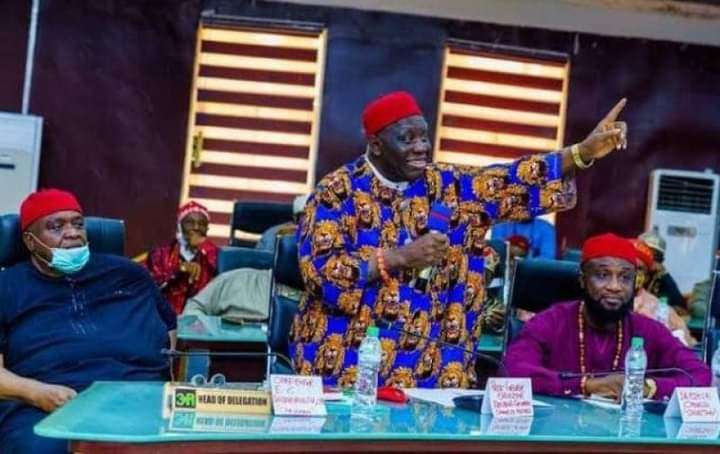
  • Ohaneze Ndigbo Dissociates Self From Purported Boycott of President Buhari’s Visit to Imo State

    Ohaneze Ndigbo Dissociates Self From Purported Boycott of President Buhari’s Visit to Imo State

    Ohaneze Ndigbo Dissociates Self From Purported Boycott of President Buhari’s Visit to Imo State

    The National Publicity Secretary of the Apex Igbo Socio-cultural association, Ohaneze Ndigbo, Chief Alex Ogbonnis has disowned news making rounds of their aversion to President Muhammadu Buhari’s visit to Imo State.

    In a press release which was sighted by our reporter, he described the news as the work of mischief.

    The press release read “The attention of the leadership of Ohanaeze Ndigbo has been drawn to a statement making rounds in the media and purportedly issued by the President-General of Ohanaeze Ndigbo. The purported press statement issued by one Chidi Ibeh, a nondescript and unknown to Ohanaeze, gave the impression that Ohanaeze Ndigbo is at odds with the planned visit of His Excellency President Muhammadu Buhari GCFR to Imo State on Thursday September 9, 2021.

    Nothing can be more dishonest than this.

    Ohanaeze Ndigbo, under the leadership of Prof. George Obiozor, dissociates itself from the purported statement and urges Ndigbo to disregard same.

    “We are appalled that some miscreants, masquerading as leaders of Ohanaeze Ndigbo could issue such rheumy and dubious statement on behalf of Ndigbo”. The statement is mischievous, ill-intended and a deliberate attempt to put Ndigbo in harms way.

    May we reiterate here that Ohanaeze Ndigbo Worldwide welcomes His Excellency, Muhammadu Buhari, GCFR, President and Commander in Chief of the Armed Forces of the Federal Republic of Nigeria to Owerri in Igbo Land.

    We are, therefore, deeply delighted that President Muhammadu Buhari has chosen to visit Ndigbo in Igbo Land at this critical juncture in Igbo history. By this visit, the President has proven, beyond doubts, that he is the father of the Nation.

    It is, therefore, the height of wickedness, callousness, mischief, rabble-rousing, and miscreancy for Mr. Chidi Ibeh and his co-travellers to issue such a discordant statement in the name of Ndigbo.

    Ohanaeze Ndigbo would no longer take such idiosyncracy and urge our people to totally disregard the mischief of Mr. Chidi Ibeh and his recalcitrant, misguided impostors, impersonators and pretenders.

    We urge Ndigbo to troop out en-mass to welcome our President and accord him the honour due to him. The Ohanaeze Ndigbo Worldwide are persuaded that this land-mark visit to the South East of Nigeria by Mr. President is critical and a turning point in the Igbo political history.


    Signed:

    Hon. Chiedozie Alex Ogbonnia

    National Publicity Secretary

    Ohanaeze Ndigbo Worldwide.