Category: Opinion

  • Enugu Smart School Debate and Mbah’s Relentless Vision

    Enugu Smart School Debate and Mbah’s Relentless Vision

    By Dan Nwomeh

    I have taken time to peruse the avalanche of comments that have trailed the Enugu Government and Sujimoto saga. They range from those who genuinely mean well, to those who think they have finally found the soft underbelly of Governor Peter Mbah’s administration to viciously attack, sometimes for unrelated grudges, to the habitual armchair critics who neither understand nor care to understand the concept of the Smart Green School, nor even what it looks like. I noticed some private school entrepreneurs and their beneficiaries who are threatened by the very idea of tuition-free, free-uniforms, free-learning-materials, and free-meals-per-day Smart Schools. There are also those who persist in asking why the government should construct new schools rather than renovate the existing dilapidated ones, most of them relics of the colonial era, eyesores that stand shamefully beside magnificent churches in many of our villages.

    But let us pause and ask: Who among these loud critics would renovate a crumbling family house left by their grandfather when they have the resources and desire to build a new home designed for modern living? Who among them would patch up cracked walls, replace leaking roofs and broken windows, instead of constructing a brand new house with electricity, ensuite rooms, screeded walls and tiled floors, POP ceilings, conduit wiring and plumbing, solar lights, internet connectivity, smart security doors, and CCTV camera surveillance? Who does that? If no one in their right senses does that for their family, why do we want such treatment visited on our children, especially those who cannot afford expensive private schools? Why should we condemn them to learning in depressing classrooms that belong to the past, while their age mates elsewhere enjoy environments tailored for today’s realities and tomorrow’s opportunities? And would those who advocate for renovation alone send their own children to those schools? If not, what does that say of their wish for other people’s children, so long as nobody asks them to pay taxes?

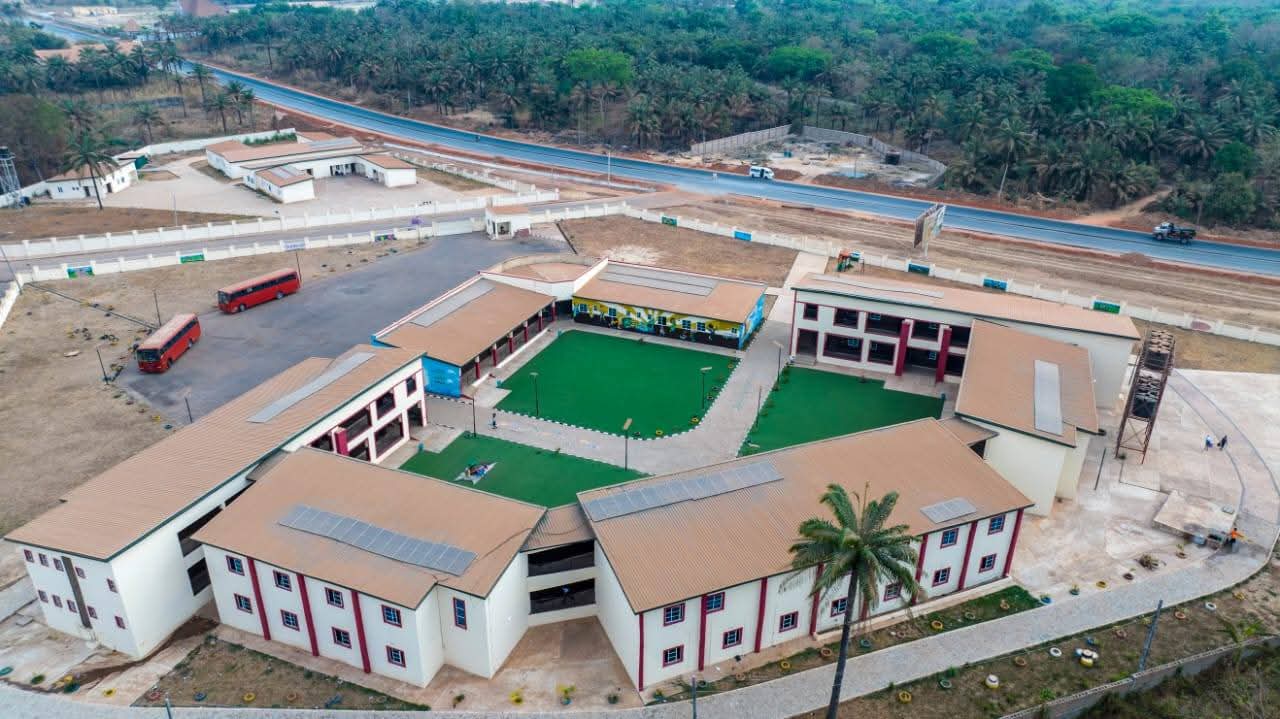
    The Smart Schools initiative is not about erecting just another set of classrooms; it is about redefining the very idea of education in Enugu State. The brick and mortar, 260 expansive pentagon-shaped buildings across all wards, are only the beginning. Within those walls lie the foundations of an entirely new model of learning, a complete shift from rote memorization to experiential, hands-on education. A space where tech and innovation are embedded into daily learning — coding and robotics, digital labs and libraries, innovation hubs, and multimedia studios. These schools are designed to prepare our children not only to pass exams, but to create tools, solve problems, and compete with their peers across the world. The children of Enugu deserve better. For too long they have been cheated, their today and tomorrow denied and mortgaged, forced to endure outdated structures and outmoded methods while their counterparts in organized societies moved ahead.

    Governor Mbah has left no one in doubt as to the depth of his commitment. He has said repeatedly that his dream is for his grandchildren, if not his children, to be educated in the Smart Schools right here in Enugu. He is not allocating 33% of the state budget to education, back-to-back in two years, if he did not consider this the most consequential paradigm shift in the life of our state. Investment and spending are always a statement of priority, and in Mbah’s case, he is literally putting our money where our mouths are.

    It is therefore astonishing that some would question the integrity of the governor, who has shown uncommon transparency in this entire matter. When questions arose over Sujimoto, owned by Olasijibomi Ogundele, it was the governor himself who invited the Economic and Financial Crimes Commission (EFCC), opened the books, and placed every transaction on the table for scrutiny. Who does that if he has anything to hide? Which leader engaged in shady deals has so openly embraced accountability, welcoming investigators to track the financial trails? If anything, this is the clearest sign that the governor has nothing to conceal, only a determination to deliver a bold vision for our children.

    Some have even raised the disappointing argument of why 22 Smart Schools were awarded to a Yoruba contractor in the first place. But this is petty tribalism at its worst, however it is dressed. Let’s face it: should an Enugu boy who conquered the downstream oil sector in Lekki, Lagos, thanks to the accommodation and support he enjoyed there, end his story by erecting walls of ethnic suspicion at home? Do Igbo contractors not get contracts in Lagos, Abuja, Kano, and elsewhere? Why then should 22 schools out of 260, a mere 8.4 percent, be turned into an ethnic slur? What matters is whether the job is delivered, not where the contractor comes from. A Yoruba contractor may have failed Ndi Enugu, but his failure lies squarely with him.

    Sujimoto tried to rationalize his failure by citing price increases. Yet other contractors delivered the same Smart Schools within the same cost framework. He also argued that N523 million per school (buildings only, it must be added) was insufficient, but that claim only further demolishes the falsehoods of government critics. If indeed the amount was not enough, then it proves there was no contract padding, and no excess slush funds to siphon. This is a case of a contractor with fraudulent motive ab initio, a contractor defaulting on a contractual agreement, not of a government conniving in fraud.

    Our people love to speak of Lee Kwan Yew of Singapore, the man who transformed a small island into a global economic powerhouse. Yet very few care to understand the painful side of reforms, the sacrifices the people endured for the tomorrow they now enjoy. Smart Schools are that kind of reform. They may disrupt the old order, they may demand more investment and patience, but they are the road to a future where Enugu’s children are no longer left behind. Greatness is never built on convenience; it is built on vision, sacrifice, and perseverance.

    The Smart Schools are far too advanced to be derailed. Beyond the hoopla, the construction and equipping of these schools are ongoing across the state, with many already completed and equipped. The vision is undimmed and the pace undeterred, whatever the minor challenges. The governor remains focused on giving our children a new learning experience, one that rivals the best private schools and outclasses anything public education in this state has ever known. It is not about optics; it is about outcomes. It is about ensuring that the child in my village of Ozalla, or in Umuida, or Nkwe, has the same chance at a 21st-century education as the child in advanced societies.

    In the end, the voices of destructive criticisms and sponsored attacks will fade. Those attacking the government today will tomorrow return to praise it because results will speak louder than rhetoric. When the Smart Schools open their doors, when children in uniform sit behind computers, design robots, create gadgets, act on modern stages, learn in well-lit classrooms cooled by solar power, use digital boards and android tablets with internet access, and are inspired by teachers trained in modern pedagogy, the truth will be undeniable that Enugu State has raised a new standard in public education and produced new generations of tech-savvy children equipped to take on the world.

    Again and again, Governor Mbah will not be deterred by detractors. He is not in the business of appeasing cynics or seeking public applause or cheap popularity. He is in the business of preparing our children for a tomorrow that is already here.

  • The Hollow Nigerian Way of Fighting Terror

    The Hollow Nigerian Way of Fighting Terror

    -By Abdul Mahmud 

    Simon Ekpa has been sentenced to six years in Finland for terrorism-related crimes. His arrest by Finnish police in 2024, which was public was followed by criminal charges, trial, and conviction handled by the courts of that country – in quick time.  No politics. No ethnic undertones. No religious sentiment. No ifs. No buts. Just the law. That is how serious nations combat terrorism. They use laws. They use institutions. They make the courts, not politicians, the final arbiters. Finland has shown that when citizens wage wars against the state, there is only one path; the path of justice. Our country and its puissant rulers should take notice. But, will they?

    For years, our country has lived under the weight of terrorism and banditry. From Boko Haram in the Northeast, to bandits in the Northwest, to armed herdsmen across the Middle Belt, to secessionist violence in the Southeast, our country has been battered. Yet, ask yourself: who are the high-profile terrorists that our country has ever successfully tried and jailed? Tukur Mamu, the man the SSS named as a terrorist who was arrested in September, 2022? Three years later the hearing of the criminal charges filed against him at the Federal High Court, Abuja, has not gone bail hearing. Who else? None. Rather than pursue justice, our country has embraced appeasement. Rather than resort to trials, it has embraced settlements. Rather than apply the law, it has enthroned the politics of kid gloves. Terrorists, rather than being dragged before our courts, they are courted with amnesty. That kind of détente plays out in grotesque rituals. Men who once stormed villages, who left behind charred homes and unmarked graves, now appear draped in camouflage. Bandoliers of ammunition hang across their chests. Kalashnikovs, the same weapons that mowed down innocents, slung confidently across their shoulders. They grin for the cameras. In those staged moments of “surrender”, the mass killings and abductions they committed, including the humiliation inflicted on our sovereign state, are made to vanish into thin air. Governors pose beside them as though they were statesmen, not outlaws. Soldiers and police officers stand by in silence, complicit in the theatre. What should be a reckoning becomes a performance. What should be justice becomes indulgence. And what should reaffirm the authority of the state instead diminishes it, making the law itself look like a prop in a grotesque show.

    They also have a way of christening the rituals to make them appear legit. They call it “deradicalisation”. They call it “reintegration”. They call it “rehabilitation”. In truth, it is a capitulation. It is the surrender of the state to its enemies. The hypocrisy is glaring. When petty thieves are caught, they rot in jail. When kidnappers without political links are arrested, they face endless trials. When poor youths are caught for petty crimes, they are paraded before cameras. When the hideouts of Yahoo-Yahoo boys, the so-called Aza men, as the streets now describe them, are raided, it dominates the headlines and fills the evening news. But when men with blood on their hands, when men who sack villages and massacre innocents are caught, they are offered seats at the table. They are told to lay down their arms. They are “reintegrated” into the very society they destroyed.

    This policy of appeasement did not begin today. It has a history. Nasir El-Rufai, former governor of Kaduna State, openly admitted that he paid bandits to stop attacks. He was not ashamed. He said he travelled out of the country to meet them. He said he settled them. His justification was crude: to stop them from killing his people, he had to give them what they wanted. Other governors followed the same path. Bello Matawalle of Zamfara embraced negotiations with bandits, granting them amnesty. Aminu Masari of Katsina tried the same. In Niger State, Abubakar Bello also pursued dialogue and settlement. The logic was always the same: better to settle killers than confront them. Better to appease terror than uphold the law. But what has this brought our country? Nothing but emboldened terrorists. Bandits who now fly helicopters into forests. Bandits who tax farmers before they can plant or harvest. Bandits who shoot down military aircraft. Terrorists who walk free while victims bury their dead.

    Ekpa’s sentencing in Finland throws all this into sharp relief. Here was a man who incited violence from abroad. Here was a man who issued threats, who enforced stay-at-home orders in the Southeast, whose words and actions paralysed local economies and endangered lives. Our puissant rulers cried out, again and again, until their voices broke and turned hoarse. Our country itself wailed in anguish. But nothing tangible happened here. It took a foreign country, thousands of miles away, to act. Why? The answer isn’t farfetched. In Finland, the law is supreme. In our country politics is supreme and it trumps law. Yet, hypocrisy rises to the surface, traded as the common currency of power and persuasion. Our leaders say they are fighting terrorism; but, they refuse to use the one tool that makes nations strong: the impartial force of justice. They are quick to parade the poor. They are quick to jail the powerless. But they refuse to jail terrorists. They refuse to even try them. So we must ask again: who are the high-profile terrorists that Nigeria has jailed? Is it Shekau? No. He died by his own hand. Is it any of his commanders? No. Is it the masterminds of the Chibok abductions? No. Is it the killers of students in Katsina, Kankara, Kagara, or Yobe? No. Is it the men who sacked hundreds of villages in Zamfara, Benue, Plateau? No. The answer is clear. No one.

    But, every other market day, the military announces the surrender of hundreds of “repentant” Boko Haram fighters. They are fed. They are clothed. They are trained. They are sent back into society. Their victims, the widows, the orphans, the displaced, are left with nothing. This is not justice. This is betrayal.

    Our country has turned upside down the meaning of justice. Instead of trials that affirm the rule of law, it creates photo opportunities for terrorists and bandits who shake hands with governors. Instead of courtrooms, it arranges negotiation tables. Instead of jail cells, it sets up reintegration camps. Ekpa’s case is instructive. He was not tried here. He was not punished here. He was punished in Finland. And he was punished because a nation that values law and order cannot allow terrorism to fester unchecked. Our country, by contrast, has allowed terrorism to become an industry. An industry of settlements. An industry of amnesty. An industry of deals. The consequences are dire. Terrorism has metastasised. Banditry has grown. Kidnapping for ransom has become the national enterprise. Farmers are abandoning their land. Children are being denied education because schools are unsafe. Citizens are paying for the failure of the state to act. It is time to say the truth: our country is not fighting terrorism. Our country is accommodating it. Our rulers are bargaining with it. Our rulers are feeding it.

    Those who defend the appeasement policy argue that our country lacks the capacity to fight. They argue that the military is overstretched. They argue that negotiation saves lives. But they miss the point. No country has ever secured itself by appeasing terror. No state ever won peace by rewarding killers. Peace without justice is an illusion. Finland has shown what is possible. Finland has shown that when institutions work, the law can confront terror. Our country must learn. Our country must rise. Our rulers must stop hiding behind appeasement and confront the reality that they have abandoned justice.

    The question remains: who will bell the cat? Who will summon the courage to prosecute terrorists? Who will put Shekau’s successors on trial? Who will bring the leaders of bandit cartels to court? Who will give our citizens the assurance that the state is not in league with killers? Our hypocrisy will remain exposed. We jail the petty thief. We reintegrate the mass murderer. We punish the weak. We reward the strong. We claim to fight terror while pampering terrorists. This is why trust in the state is collapsing. Citizens see a government that cannot protect them, yet embraces those who butchered their families. They see widows mourning while killers are feted. They see children out of school while warlords are called “repentant”. In such a climate, the idea of justice becomes hollow, the meaning of citizenship erodes, and the authority of the state shrinks into ridicule.

    A nation that cannot punish its worst offenders cannot command the loyalty of its people.

    And so the cycle continues. Bandits strike, the state negotiates. Terrorists kill, the state forgives. Villages are burnt, the state calls for dialogue. The message is clear: in our country, crime pays when it is scaled high enough. Small men are crushed by the system; big men are courted by it. This inversion of justice is not only obscene; it is suicidal for a fragile state. For no republic can endure when the sword is turned against the weak while the strong are shielded from the law. The lesson from Finland is plain. Nations that survive are those that make no distinction between the weak and the powerful in the eyes of the law. They understand that justice is not an option, but the very lifeblood of order. Our country with its rulers must decide whether its wants to remain a theatre of indulgence or a country governed by law. Until it chooses justice, our citizens will keep burying the dead, keep mourning the abducted, keep watching governors shake hands with killers. And our hypocrisy, already naked before the world, will become the grave digger of our republic.

    Ekpa’s sentencing is a mirror. A mirror that shows us the face of our country’s failure. The question is: will our country’s rulers look into it? Or will they, as always, look away?

    Time will tell.

  • [OPINION] Police Misconduct and Public Complicity: Why Reform Requires Collective Action

    [OPINION] Police Misconduct and Public Complicity: Why Reform Requires Collective Action

    By Daniel Ndukwe 

    Public conversations about policing in Nigeria often focus on misconduct, extortion, and unprofessional behaviour by security operatives. These concerns are genuine and troubling. Yet, an equally important but less discussed issue is the role of citizens in enabling and sustaining such misconduct.

    Corruption, particularly bribery, is never a one-sided affair. For every officer who solicits or accepts a bribe, there is usually a citizen who, out of fear, impatience, or convenience, chooses to give it. This shows that while reforms and accountability are necessary within the police institution, citizens must also reflect on and address their own role in this cycle.

    Examples are common: drivers who prefer to “settle” at checkpoints rather than pay official fines, face arrests or other penalties. Individuals who pay to skip due process, or bystanders who watch officers collect money without speaking up. Each of these actions reinforces the perception that unethical behaviour pays.

    Of course, many citizens feel intimidated when confronted by armed officers, and this reality cannot be ignored. However, over time, the widespread acceptance of “settling” has normalised corruption, making it an informal but entrenched system. Public condemnation in speeches or online contrasts sharply with private compliance in daily encounters, thereby perpetuating the problem.

    Police misconduct cannot be eradicated if citizens remain willing participants. Reporting wrongdoing, resisting bribes, and insisting on due process may be inconvenient or even risky, but they are essential first steps toward reform. Complaint mechanisms and accountability units exist, yet they remain underused because many Nigerians choose not to engage them.

    There is no excuse for corruption or unprofessional conduct in law enforcement. Officers must be held accountable, and reforms within the police must be strengthened and sustained. At the same time, citizens cannot demand professionalism while actively enabling shortcuts and bribery.

    Real and lasting reform will require collective responsibility. The police must embrace transparency and professionalism, while citizens must refuse to be complicit. Only then can Nigeria move towards building a policing system that is trusted, accountable, and effective.

    Daniel Ndukwe is an expert in strategic and crisis communication, public relations, security, and development, as well as a writer and public speaker.

  • Chijioke Edeoga Again?

    Chijioke Edeoga Again?

    By Sebastine Chukwuebuka Okafor , Ph.D

    On Saturday, August 30, 2025, political leaders from Enugu East Senatorial District gathered at the Enugu International Conference Centre to discuss the progress of the state. Many notable figures from the zone who are progressives attended, and serious deliberations were made on unity and development, especially in the zone.

    During the session, Barr. Chijioke Edeoga was invited to move a motion affirming that Governor Peter Ndubuisi Mbah has performed well and therefore deserves the full support of the zone beyond 2027, so that power could eventually rotate to Enugu West Senatorial District which he did unapologetically. After Edeoga moved the motion, Hon. Anioma Frank, the Special Adviser to the Governor on Political Matters, who served as moderator, called on Dr. Ben Nwoye, leader of the progressives, to second it.

    In the course of seconding, Dr. Nwoye digressed a bit to speak about Minister Uche Nnaji. He also used the opportunity to call on Governor Mbah to join APC and realign Enugu with national politics, because his roadmap to development aligns with that of the renewed hope agenda of President Ahmed Bola Tinubu.

    It was at this point that some paid persons deliberately twisted Edeoga’s mere presence on the podium to suggest that he was part of Nwoye’s remarks. Such a false narrative is not only dishonest but also a show of cowardice and immaturity. Everyone present knew that Edeoga’s mission was solely to move a motion in support of Governor Mbah, not to contribute to what Nwoye said. He has devoted his time and energy to support the Governor, after being convinced that such is the best way to approach development through politics and it seems his support to the Governor is even more pure than that of many who are even in PDP.

    For the record, there is a political battle currently in Enugu APC, that is between APC Progressives led by Dr. Ben Nwoye, which I am part of, and those who have weakened the party, led by Minister Uche Nnaji. Linking Barr. Edeoga to APC quarrels where he has no involvement is nothing but an attempt to create needless unrest in Enugu and those behind it should abstain from that.

    What they intend to achieve is still oblivious to me, howbeit, it is also important for all to know that Barr. Edeoga has been a friend of the Minister since 1998, and nothing visible has happened to change that relationship.

    Therefore, the social media attacks that followed against the Isi Uzo born legal luminary are clearly coordinated onslaughts by sponsored data boys and political actors unsettled by the implications of his return to the PDP and his decision to stoically work with Governor Mbah. To me, these attacks might have also come from different directions, but all of them are threatened by Edeoga’s renewed alignment and still allegedly and conveniently sponsored through the machinery of those in the APC, Labour Party and no party.

    Using his appearance on the podium as an excuse to launch attacks with deepfake apps is childish. Rather than embrace progress, these groups have chosen to spread deepfake videos and manipulated narratives to tarnish his image. Their fear is simple. They know that unity between Edeoga and Governor Mbah strengthens not just the Governor but also the political stability of the state.

    Politics of development should not be about falsehoods or propaganda. It should be about service, loyalty, and truth. Governor Mbah has already shown leadership that inspires confidence, and Edeoga believes that supporting the Governor is the right step for the people of Enugu.

    Those who attack him today will later understand that his actions may have been guided by a higher principle, which is the pursuit of unity and progress. No deepfake or propaganda can erase the fact that his role at the meeting was only to move a motion of support for Governor Mbah in the collective interest of the zone.

    When I had a chat with Edeoga to understand his position on the politics of Enugu State, he made it very clear that Governor Mbah’s performance is already building and nourishing a special brand new unity across the state and thus has his full support. Such is the position of a man who is experienced in the game and though I may not like the Governor, that is his stance which he does not look perturbed.

    Instead of resisting this progress, those who are sad should either respect his decision or mind their business. To me, Edeoga’s decision may favour or harm him, depending on the sincerity between Governor Mbah and him even though I still do not trust the latter. In all honesty, the future of Enugu State lies with leaders who can work across divides and put the people first.

    Until then, no amount of lies, manipulations, or manufactured controversies will succeed in hiding the truth, which is simple. To tell the truth, APC needs Governor Mbah, and he should listen to the calls made by the progressive agenda leader led by Dr. Ben Nwoye.

    Those attacking Barr. Edeoga should remember that he simply exercised his right to take a political decision that he believes will serve his people. It is better for others to also make their choices openly instead of spreading confusion.

    No one should create tension in the state because of differences in political direction. Peace is more useful than strife, and progress can only come when leaders allow one another the freedom to choose their path.

    “Dey your dey, and allow ndị ọzọ to also dey their dey, to avoid imebi Enugu; makana onye mebie Enugu, ọ kwụọ anyị ụgwọ.”

  • First Lady Turns Chief Librarian-in-Begging

    First Lady Turns Chief Librarian-in-Begging

    -By Abdul Mahmud

    Nineteen years ago, our country set out to build Africa’s largest library. The site was perfect. A cultural landmark between the National Mosque and the Ecumenical Centre in Abuja. The vision was bold. A national monument to scholarship, research, and civic learning. The contract was awarded in 2006 to Reynolds Construction Company. Cost: N8.59 billion. The project was to be finished in record time. Some of our country’s finest architects, engineers, and surveyors were on board. Abuja would boast a library complex that matched the grandeur of its religious monuments.

    It never happened.

    Costs ballooned. First to N17 billion. Then N38 billion. Now almost N100 billion. Work stalled. The site is abandoned. When you visit today, weeds cover the grounds. Cranes rust. Steel rots. Rain eats away at the concrete. A national dream has become a national embarrassment. Why? Funding problems. Exchange rate fluctuations. Ministerial inertia. Bureaucratic apathy. The project was eventually abandoned twelve years ago. Every government since then has promised revival. Every promise wasn’t unfulfilled. In 2019, the then Education Minister, Adamu Adamu, said “alternative funding” was being pursued. He told whoever cared to listen that Buhari has directed TETFUND to look at the possibility to resuscitate the project. Typically, that entered into the voice mail. In 2025, President Tinubu reportedly directed TETFUND to complete the library. Still, nothing moved. Now, the President’s wife is soliciting public donations for her 65th birthday. Donations to complete the national library. A project meant to stand as a public monument. Government business reduced to crowd-funding. It is madness.

    Our country spends billions on frivolities. Billions vanish daily in corruption. Yet, it cannot build a library. It cannot finish a building that should symbolise knowledge, culture, and civic pride. Look at Egypt. In 2019, terrorists attacked Dar El Kotob, the national library. Within record time, the government restored it. In Alexandria, the Bibliotheca Alexandrina was rebuilt in seven years. Reopened in 2002, it stands today as a global hub of culture and tourism. Both libraries are monuments of pride. Both generate revenue. Both embody the Egyptian spirit of cultural reimagination and renewal. In our country, the rulers abandon legacies in pursuit of the mundane.

    A national library is not just a building. It is a statement. It is the mind of a people made concrete. It is where young people learn, researchers explore, and the public gathers to exchange ideas. It is a place of memory and imagination. A pillar of lifelong learning. Libraries also have practical value. They support literacy. They provide access to ICT. They train citizens in digital skills. They serve as delivery points for government services. They build social inclusion. They foster community. To abandon a national library is to abandon national imagination. It is to say that books, knowledge, and culture do not matter. It is to treat learning as a luxury, not a necessity.

    Our country has built monuments to faith. The mosque. The church. Both completed. Both maintained. But our monument to knowledge stands derelict. What does that say about our priorities?

    The Abuja National Library should have been a symbol of our country’s future. Rather, it is an eyesore. A ruin in the making. A silent reminder of wasted ambition. If Egypt could rebuild its libraries after terrorist attacks, why can’t our country finish one after 17 years? This is not about money. It is about will. It is about what we value as a people. Do we value prestige projects that do not produce knowledge? Or do we invest in monuments that shape minds and societies? Consider France. The Bibliotheque nationale de France was modernised in the 1990s as part of a presidential legacy project. Today it anchors Paris as a city of letters. Consider Qatar. In 2018, it opened its national library with a vision of linking the Gulf to the world of ideas. These are not just buildings. They are declarations of ambition. They are signals to citizens and the world that knowledge matters.

    Our country and its rulers have chosen the opposite path. They have chosen decay. They have chosen the weeds and the rusting cranes. They have chosen to treat learning as optional. They have chosen to turn a public obligation into a private fundraiser.

    A library is the most democratic of spaces. Anyone can walk in. Anyone can read. Anyone can learn. It is the one place where class dissolves. It is the one place where the son of a poor can sit beside the child of the Rich, the wealthy and the nouveau riche.  Both bent over books. Both reaching for the same light. That is what our country has denied itself. A library is also a place of memory. It holds the records of a people. It preserves history against forgetfulness. It safeguards the written word against decay. It ensures that future generations know where they come from. Without libraries, nations drift. Without libraries, memory is lost. Without libraries, culture dies.

    The shame is profound. Abuja is a capital built on symbols. Monuments dot the skyline. The National Assembly dome. The Aso Rock Villa. The Supreme Court. The Central Mosque. The National Christian Centre. But the one symbol that should embody knowledge, enlightenment, and civic imagination stands unfinished. What legacy does this leave? What story does it tell to the young? That worship matters more than knowledge? That politics matters more than culture? That corruption matters more than memory? It is a cultural disgrace. A nation that cannot build a library cannot build a legacy. A nation that abandons its books abandons its future.

    The government must act. Now. TETFUND has the mandate. The presidency has the authority. The Education Ministry has no excuse. The National Library should be completed before it collapses. Delay is dishonour. Here, the more poignant point which underlines this piece sticks out as a crest: if a country cannot build a library, it cannot build a nation. For a library is more than bricks and mortar; it is the vault of a people’s memory. If a country cannot preserve knowledge, it cannot preserve culture, for culture is nothing without the written and remembered word. If it cannot value reading, it cannot value progress, because progress is born from ideas, and ideas are born from books. A nation without libraries is a nation without imagination.

    It is a house without windows. It is people wandering without maps. It is a state condemned to repeat mistakes because it refuses to keep records. A country that leaves its national library in ruins leaves its future in ruins.

    The National Library must not become another ruin. It must not be allowed to sink into history as a failed monument. It must be completed and opened. Not in another seventeen years. Not as a birthday fundraiser. Not as a political token. But as a statement of national renewal. Other nations build legacies through culture. Our country must do the same. This is the test of leadership. This is the call to government. In the end, the question is simple: what kind of a country do we want to be remembered as? One that built churches and mosques but abandoned its library? Or one that built a future on books, knowledge, and learning? The answer lies in the weeds of Abuja. The shame lies in the unfinished walls. And the responsibility lies with those in power today.

    History is watching.

    And history will not forgive our rulers, past and present.

  • Justice for Sale

    Justice for Sale

    -By Abdul Mahmud

    When the Sultan of Sokoto rose at the just concluded Nigerian Bar Association (NBA) Conference in Enugu to declare that “justice is now purchasable in Nigeria”, his words struck a raw national nerve. It was not merely an observation; it was an indictment. It was the voice of moral authority saying what Nigerians whisper under their breath in court corridors and in the dark alleys of daily life. Justice, once the hallowed preserve of principle, has become a commodity in the open bazaar of our democracy. The Sultan’s lament is not a hyperbole. It reflects a crisis that has eaten deep into the marrow of our legal system. Justice is not blind in Nigeria; it peers closely at the purse of the litigant. Those who command higher purchase power buy it. The poor man, unable to raise the Shekels, is left stranded on the steps of a courthouse that has become hostile to his hope. What should be the last sanctuary of the common man has mutated into a trading post of the powerful. No country progresses this way.

    In a previous op-ed, I noted that we now live with “judges who have become kings who sit on imperial thrones where they measure justice by the Shekels”. That is not a metaphor stretched beyond its shape. It is reality. We have enthroned judges as kings in black robes, surrounded by the rites and rituals of power, dispensing justice not by law but by patronage. Richard Joseph’s conceptual coinage, prebendalism, which Oby Ezekwesili deployed at the same conference to rebuke the legal profession, best describes the patronage-clienteleism within the bench. The gavel, that ancient symbol of fairness, no longer falls with the weight of principle but with the heaviness of cash. In this new order, judgments are not delivered; they are purchased.

    But how did we get here?

    Two forces sustain this decay. The first is the culture of unaccountability. In Nigeria, judges are rarely punished – in the real sense of punishment – for misconduct. A judge who’s found to have fudged his age is merely given a wrap on the wrists. Voila, he is compulsorily retired! The act of forgery, which is a crime, is thus overlooked. No trials. No convictions. Only newspaper reports of the NJC dismissing judges – which are, of course, framed as aberrations, not the failure of a judicial system which provides soft landing for errant judges. The result is a bench that behaves like an untouchable caste, shielded from scrutiny by the black robe. The judicial branch that bends to its obsequious convenience, with unbothered judges sitting as kings above the law. The second force is more pernicious: the politicisation of the judicial process. As I wrote in the same op-ed, “A politicised judicial process invites corruption. When judges are seen as gatekeepers to power, the temptation to influence them becomes overwhelming. The judiciary, once the last hope of the common man, has become a marketplace of elite bargains. Those who command higher purchase power buy justice”. Politics has corrupted justice because every election dispute, every transfer of power, every clash of political titans, ends at the altar of the court. The judge, in such moments, ceases to be an impartial arbiter. He becomes a broker in the grand bazaar of power.

    We are left with a tragic irony: the very institution meant to defend the law is now guilty of betraying it. And the consequences are grave. When justice is sold, the poor retreat from the law, and with them retreats faith in the social contract. When justice is sold, the rich grow more arrogant, convinced that the courts are but one more arm of their wealth. And when justice is sold, the very idea of the rule of law collapses. What replaces it is anarchy dressed in the garments of legality.

    This is why the Sultan’s words must not be dismissed as mere rhetoric. They are an urgent call to conscience. Nigerians already live with cynicism about every institution. The legislature is seen as self-serving. The executive is viewed as predatory. The only branch that once retained a flicker of reverence was the judiciary. But now that flame is dimming. Once the judiciary becomes an auction house, what remains of our republic? Let us remember that nations do not collapse first through war or famine. They collapse when their institutions lose legitimacy. Rome did not fall merely because of the barbarian invasion; it fell because its institutions rotted from within. Nigeria faces the same danger. A judiciary that sells verdicts undermines the very possibility of citizenship. It tells the ordinary Nigerian: you do not belong here unless you can pay. And a citizen who does not belong ceases to believe in the nation itself. We have seen this rot play out in high-profile cases. Gubernatorial elections decided not by ballots but by dubious rulings. Here is that familiar case in point: a governorship candidate who came fourth in a returned poll was subsequently declared by the judges as the winner! Billionaire politicians escaping accountability with a wave of a judge’s hand. Corruption cases dragging for decades, only to end in acquittals for the wealthy while petty thieves rot in jail. Each of these stories is a needle piercing the fragile fabric of trust between citizens and the state. Each confirms the marketplace that our courts have become.

    The question, then, is whether reform is possible. Can Nigeria reclaim its judiciary from this descent? Reform will require courage, courage from within the legal profession, and courage from the society that empowers it. Lawyers must refuse to be agents of manipulation, filing frivolous applications that clog the system and trading influence on behalf of their clients. Judges must be subjected to real accountability: transparent trials, open disciplinary records, and the removal of those who disgrace the robe. And above all, politics must be decoupled from justice. So long as the judiciary remains the final battlefield for political wars, it will remain compromised. But reform also requires something deeper: a cultural shift in how Nigerians think of justice itself. Justice cannot be reduced to transactions. It cannot be a trophy won by the rich. It must be a common good that protects the weak, restrains the strong, and binds society together. Without justice, there is no order; without order, there is no society. As the philosopher Heraclitus once said, “The people should fight for their law as they would for their city wall”. In Nigeria, we must fight for our judiciary as if our very survival depends on it.

    Surely, we won’t realise that our lives depend on it, until Nigeria happens to us!

    The Sultan’s cry at the NBA Conference is more than a passing lament; it is the cry of a nation wounded in its soul. His words carry the anguish of countless litigants who have knocked at the temple of justice only to be turned away by the gatekeepers of power. It is the voice of citizens who have been betrayed by the very institution meant to defend their dignity. It is the sigh of a democracy steadily hollowed out by corruption and elite bargains. In that moment, the Sultan did not speak for himself alone; he gave voice to the unspoken despair of millions.

    We deceive ourselves if we think this is only about the poor. When justice is commodified, it poisons the entire body politic. The wealthy may think they can purchase verdicts, but in doing so they dismantle the very foundations that protect their own power. A court that sells judgments to one bidder today can just as easily sell them to another tomorrow. What begins as the privilege of the powerful ends as the peril of all. A nation that abandons justice abandons stability, for injustice is a fire that consumes indiscriminately.

    History teaches us that when the courts fail, society itself unravels.

    Rome, in its decay, learned that law without justice is merely violence in disguise. Nations of our own time, scarred by authoritarianism, remind us that when courts become markets, the people cease to believe in the state. Nigeria stands dangerously at that threshold. The gavel, once a symbol of fairness, risks becoming a tool of oppression. If this collapse is allowed to continue, the people will no longer seek redress in the courts; they will seek it in the streets. And when lawless streets replace lawful courts, democracy dies. A nation without justice is not a nation; it is a mere marketplace of power. And in marketplaces, bargains are struck, but no one truly wins. The powerful may strut like victors for a season, but the erosion of justice eventually sweeps them into the same abyss as the weak. The warning of the Sultan, therefore, is not a cry to be ignored. It is a summons to conscience, a call to rescue the judiciary before the ground beneath us gives way. For without justice, we are not citizens bound by law; we are only traders in a soulless bazaar where, in the end, everyone loses.


  • Enugu @ 34: As Mbah Runs with Dreams of Founding Fathers

    Enugu @ 34: As Mbah Runs with Dreams of Founding Fathers

    By Uche Anichukwu

    “I am not a stranger at all to Enugu State. To deny Governor Peter Mbah’s transformative leadership will be sinful“- Chief Mike Ozekhome, SAN

    Growing up, I heard how my paternal grandfather, the late Ofia Inyinya Okereke Igboke Anyioma, a highly respected personality, and a wealthy man by their standard in those days, offered three-point prayer as he broke kolanut and poured libations to Chukwu Okike Abiama (God) and his ancestors every morning: “If I ever conceive evil against anyone, may it return to me and vice versa; may everyone prosper, but may the kindest-hearted prosper the most so that the poor would not suffer; may my descendants surpass me and also actualise any of my unfulfilled dreams, for they are too big to be fulfilled in a lifetime.”

    Not many places in Nigeria have enjoyed Enugu State’s rich history and special bestowals of mother nature. It is a city built on a hill that cannot be hidden. Yet, something was missing: the founding fathers – Chief Christian Chukwuma Onoh, HRH Igwe Edward Nnaji, Chief Enechi Onyia, HRH Igwe Charles Abangwu, Chief Basil Okwu, HRH Igwe John Nwodo, HRH Igwe Ezeudo Abel Nwobodo, Prof. Samson Ukpabi, HRH Igwe Udemgaba Maduka, Justice Augustine Nnamani (JSC), HRH Igwe Paul Egbogu, HRM Igwe John Igwesi, Chief Dan Agbo, and Chief Nduka Eya, among a host of others – dreamt big. They believed that the people known as Waawa would do better with a state of their own to expand the social, political, and economic opportunities for their people. Their prayer was answered on August 27, 1991, when former Head of State, General Ibrahim Babangida, announced the creation of Enugu State.

    Like my grandfather, they understood that having done their bits, the creation of Enugu State was only the beginning of the quest for the larger dream. Consequently, from the first military administrator to successive civilian administrations various degrees of progress have been made.

    However, as I have often held, in the life of a people, once in a blue moon, providence throws up that one extraordinary person who must take them to unimaginable heights in such a very short time. I have always cited the likes of Lee Kuan Yew, often referred to as the father of modern Singapore. He literally transformed Singapore from a Third World nation to a developed economy in one generation. I have also often cited Park Chung Hee, who engineered the Miracle on the Han River, transforming South Korea to an industrial cum economic giant; Deng Xiaoping, who lifted millions of Chinese out of poverty in a most dramatic manner; Franklin D. Roosevelt whose ‘New Deal’ rescued the USA from the Great Depression; and our own legend, Dr. Michael Iheonukara Okpara, whose “Pragmatic Realism” transformed the defunct Eastern Region into the world’s fastest growing economy between 1954 and 1964.

    Today, Mbah is following in their footsteps. Having observed his modus operandi, and interacted him at a close range, I must confess that he is possessed by some positive forces greater than him. His quest to transform Enugu is an obsession – literally speaking.

    Driven by his Disruptive Innovation approach, Mbah made it clear right from the campaigns that his was a transcendental calling to fast-track the dreams or tomorrow to reality, today. He came with a vision to exponentially grow the state’s economy from $4.4 billion to $30 billion in four to eight years through private sector investment, make it one of the top three states in Nigeria in terms of GDP and ensure that Enugu State achieves a zero per cent headcount rate inl poverty headcount index.

    Two years and three months after, Enugu has become the cynosure of all eyes and the national reference point in good governance. He is proving, daily, and in practical and verifiable terms that the dreams of our founding fathers were not malarial fever dreams – they are realisable.

    Mbah has demonstrated his commitment to realising the dreams of our founding fathers through the rapid resuscitation of moribund assets in line with his campaign promise. Unlike the national norm where new governments abandon the projects of their predecessors, he set out to revive the Enugu Palm Products Limited, EUPPL. Originally founded by the government of the defunct East Central State in 1970 on 6,700 hectares that traverses Ibite-Olo in Ezeagu LGA, Ugwuoba in Oji River LGA, and Umulokpa in Uzo-Uwani LGA, it was destroyed by the “Nigerian factor.” But with a N100bn deal between the Enugu State Government and Pragmatic Palms Limited in May 2024, a five-year aggressive plan is now being implemented to reposition EUPPL as one of the leading integrated oil palm establishments in Nigeria, playing in the upstream, midstream, and downstream sectors.

    In addition, he has revamped the long-abandoned iconic Hotel Presidential founded by the legendary Dr. Michael Okpara some 63 years ago (1963) and Nigergas founded in 1962. He has recovered and completed the International Conference Centre, ICC, commenced by former Governor Chimaroke Nnamani. Today, the carcass he inherited has been transformed into a magnificent complex commissioned by His Excellency, President Bola Tinubu, in January 2025. Today, it has become a beehive of activities, drawing visitors from across the country and beyond. Among many other conferences that drew thousands of participants, over 20,000 lawyers are presently having a wonderful experience at the sprawling complex and the Okpara Square where the 2025 Annual General Conference of the Nigerian Bar Association is taking place.

    These conferences and a retinue of other programmes also means huge sums of money coming into Enugu State. the hotel proprietors, taxi drivers, phone accessories sellers, restaurant proprietors, and even the “Mama Put,” etc. are all smiling to the bank. In fact, for the NBA conference, hotels as far as adjourning local governments to the state capital are fully occupied.

    Also, standing just beside the ICC is the ICC 5-Star Hotel, commenced by the Mbah Administration on May 27, 2024. Today, the structural work is completed and it will be delivered before the end of 2025. Around the same ecosystem is also the Enugu International Hospital, a world-class quaternary state-of-the-art multi-specialty facility, that will not only help Nigeria reverse medical tourism, but also strengthen Enugu’s robust bid for a substantial share of Nigeria’s overseas medical tourism market valued at over $1 billion annually.

    Only recently, a trending and geotagged video showed parts of some neigbouring states deserted by community members due to insecurity orchestrated by unknown gunmen. But today, Enugu is rated as one of the safest states in Nigeria, thanks to the bold and creative steps taken by Governor Mbah since May 2023. He banned the illegal sit-at-home that had virtually crippled Enugu’s economy and invested heavily in resources to tame and route out the enforcers. Today, some forests that used to house such non-state actors are now home to some of the 200-hectre Farm Estates being developed across the 260 wards.

    In addition, Enugu houses the biggest and most sophisticated Command and Control Centre in Nigeria today. All the AI-enabled digital cameras installed across the state for surveillance are connected to the centre. Likewise, the AI-enabled cameras installed on all the over 150 security vehicles operated by the Distress Response Squad.

    To make good his ambition to attract investors and at least 3 million visitors to Enugu State. annually starting from 2027, Mbah recently launched five ultramodern terminals, 100 CNG Mass Transit buses, the Enugu Transport management System, and 80 modern bus shelters and terminals. Biodun Otunola, is the Managing Director, Planet Projects Limited, which handled some of the Enugu transport terminals. Planet Project also built the Oshodi Transport Interchange and Ikeja Bus Terminal in Lagos. He captured the enormity of what Mbah has done: “This is the first time a project of this magnitude is experiented. Not only that a bus terminal is being built, but five bus terminals are being built. No administration has ever done this before since the history of Nigeria. We are in this industry and we have the records.”

    It is also recalled that the state government had on July 7, 2025, rolled out three aircraft to launch Enugu Air as part of the administration’s integrated blueprint for a modern, multimodal transport ecosystem and vision to make Enugu a major aviation hub. And more are being expected before the end of the year.

    One can actually go on and on, reeling out Mbah’s trailblazing accomplishments within a very short stay in power: construction of 260 Smart Green Schools in 260 ward to equip the children and youth of Enugu with 21 century skills and make them relevant in the emerging global economy; construction of 260 Type 2 Primary Healthcare Centres; over 1,000km of ongoing and completed road projects; creation of Enugu electricity market; establishment of 160 tons per our asphalt plant; establishment of Nortra Tractor Assembly Plant and Service Centre, an investment by ODK Group of Denmark; transformation of GTC from a collection of decrepit structures to a world class Technical, Vocational Education and Training (TVET) College with full boarding for 1,000 students; ongoing resuscitation of the long-abandoned Sunrise Flour Mills; and the massive New Enugu City, an ongoing smart city project, just to name a few.

    The important thing to note, however, is that these projects are not isolated thinking. They are all connecting the dots in delivering the governor’s vision to grow Enugu State into a $30 billion economy. But even more important, they are all connected to the overmatching dreams of our founding fathers, for the tomorrow they all dreamt about is finally here, fast-forwarded by a visionary leader, Dr. Peter Mbah. As Ndi Enugu celebrate the 34th anniversary of their state, they can now confidently say that tomorrow is here indeed.

    Anichukwu is media aide to Governor of Enugu State

  • For Deki Agbahovbe at Seventy-Nine

    For Deki Agbahovbe at Seventy-Nine

    -By Abdul Mahmud

    A few days ago, specifically on Thursday, 21st August, 2025, Mrs. Deki Agbahovbe turned seventy-nine. She was my teacher. She taught me Literature-in-English at the Federal School of Arts and Science, Ondo, Ondo State, in the mid-1980s. But she was far more than a teacher to me. She became a mother, a guardian, a compass. I still see her in the classroom. Firm. Disciplined. Sharp-witted. Her voice steady, her eyes alert. She had no patience for sluggish thinking. You had to be quick on your feet. You had to listen, to think, to respond. Literature, for her, was not just about books. It was about life, about human choices, about clarity. She made us wrestle with texts until the words yielded their truths. She would scold us with precision. Everyone had a nickname, which elicited from those hiding their faces from her darting eyes between the pages of their notebooks. The nicknames weren’t meant to wound, but to awaken to one’s failing. She wanted us to think. She wanted us to know that words carried weight, that language was power. That was her gift to us. She made us better readers, and by extension, better human beings.

    But my story with her began outside the classroom.

    When I arrived in Ondo to begin my Advanced Level, the admission process had long closed. I came late. The admission window was already shut. It was her husband, Pa Agbahovbe, now late, who helped secure my place, on seeing my WAEC result. “I won’t let this slip. Not with your top grades”, he said. Bless his soul. My mother, relieved that I had not lost the opportunity, later entrusted me to Mrs. Agbahovbe, leaving what was a paltry sum at the time with her and for my care.. She became my loco parentis. It was not a title she carried lightly. She stepped into the role of mother with the same seriousness she brought into teaching. In her, I saw the vigilance each time I wanted to buy something. She would scrutinise my request. Was it necessary? Was it useful? Would my mother have approved? There was no room for waste. No space for frivolity. She wanted me to grow with discipline and purpose. She guarded me like one of her own. From there on, I didn’t miss my biological mum who had assumed both the fathering and mothering roles over me and my other six siblings after our dad suddenly passed on a year and half earlier. She guarded the money my mother left in her care as though it were her own. She watched over me as if I had been born from her womb. I called her mummy. She was mum really. Not in the ordinary sense of affection. But, in the true, living sense of mothering. The name was natural. She earned it, not by indulgence, but by discipline, by care, by the quiet insistence that life must not be wasted. Looking back now, I realise how formative those years were. To be young, away from home, with the temptations and freedoms of student life, and yet to have someone watching, guiding, restraining – it was a blessing, indeed. She did not smother me. But, she would scold. Typical of Bendel mothers. She did not overprotect me. But, she would set boundaries with her eyes, the way mothers do. I feared walking into her path or going to the staff room. But she gave me a structure, a fence within which I could grow. That, perhaps, is the highest form of mothering.

    Seventy-nine is not just a number. It is a testament. It is the story of a life given to shaping others. A life that chose the classroom as its altar, and young minds as its offering. For how do we measure the worth of a teacher? By the books covered in a syllabus? By the marks on an exam sheet? Or by the human beings who rise, decades later, to say: “She taught me. She shaped me. She mothered me”. Teachers like Mrs. Agbahovbe live in the lives of their students. We carry them forward.

    We hear their voices in our own speeches. We remember their warnings when we are tempted to stray. We recall their encouragement when we are tempted to give up. Her sharp wit still echoes in me. Her firm discipline still steadies me. And her care, her quiet, and watchful care still warm me. At seventy-nine, I honour her. But more than honour, I thank her. I thank her for the discipline that never allowed waste. I thank her for the firmness that sharpened my mind. I thank her for carving in me the love for literature and letters. I thank her as a mum who kept watch, who cared enough to say no, who shaped me in ways only time can fully reveal. I thank her and Pa Agbahovbe for the humanity that saw a young boy, late for admission, and chose not to let him fall by the wayside.

    We live in a world that often forgets teachers. We celebrate politicians, businessmen, celebrities. But teachers? They fade into the background. Yet they are the ones who make all the others possible. Without a teacher, no leader rises. Without a teacher, no thinker emerges. Without a teacher, the world has no compass. Mrs. Agbahovbe belongs to that quiet army of nation-builders. They work in classrooms with little recognition. They labour over students, planting seeds they may never live to see bloom. They shape destinies quietly, one mind at a time. But beyond being a retired teacher, she remains a mother. And this is where I must insist: the mothering of others is one of the noblest acts of humanity. She did not choose me. I was handed to her. Yet she embraced me, guarded me, disciplined me, and guided me. That act alone speaks volumes of her heart.

    Seventy-nine years is a long journey. It carries laughter, tears, struggles, triumphs. It carries the memory of her late husband, who once opened the door of opportunity for me. It carries the many students who passed through her hands, each with a story to tell. It carries the weight of decades of giving, of caring, of standing firm in the classroom and at home. But seventy-nine also carries light. It carries the glow of legacy. For a teacher’s true legacy is not in her own years, but in the years of her students. Every life she touched carries her forward. Every success her students achieve echoes back to her. Every grateful memory, like this one, keeps her alive in ways age cannot diminish. Whenever I read her posts on Facebook and look at her photos, I see a woman of balance. This is in spite of the vagaries of life, of changing seasons and changing circumstances. She hasn’t changed. She is still stern, stubborn to upholding truths in her posts. She is still demanding accountability, this time from the band’s of looters that continue to ruin our country. She still shows care, with light the dominant motif of her posts. Above all, she is still the mother I knew almost forty years who celebrates every landmark in the life of her biological children and her many online children. That balance is rare. It is what makes her unforgettable. As she walks slowly into her eightieth year, I pray strength for her. I pray joy for her. I pray that she knows, deep within her, how much she is loved and remembered. For memory is a form of honour, and gratitude is a form of prayer.

    Mummy at seventy-nine. That is what she remains to me. A mother in the classroom. The forever teacher. A guardian of discipline. A keeper of care. We, her students, are her testimony. We carry her name not in titles or accolades, but in the quiet ways we live our lives. Every time I resist waste, I hear her. Every time I choose discipline over indulgence, I see her. Every time I read a text with care, I remember her. That is how teachers live forever. Not in boastful gestures or grand claims, but in the subtle ways they leave their marks on the world. They live in the lessons that echo in our minds long after the bell has rung, in the wisdom we carry when we face moments of doubts, and in the values that guide our decisions. Every act of kindness, every choice rooted in integrity, every word spoken with care are the true living testaments to their influence. Like the living oracles.

    Teachers endure because they become part of the lives they touch. They are woven into our successes and failures, our laughter and our grief, our quiet moments of reflection and our boldest leaps forward. When we act with courage, patience, or generosity, we do so in the shadow of those who taught us how. In this way, they never truly leave us; they continue to shape the world through the people they have nurtured, loved, and believed in.

    Last week on Facebook, as you turned seventy-nine, I bowed and paused to say thank you, Mummy. For the firmness that shaped us, for the discipline that steadied us, for the care that healed our wounds, and for the humanity that shone through every gesture of your life. Yours was never the loud voice of power, but the quiet insistence of love and principle, teaching us that strength does not need to raise itself above others to be felt. The world may not carry your name on its billboards, or in its histories, or on streets’ signposts; but I do. And I will never forget.

    Happy birthday, Mummy Deki Agbahovbe. May the days ahead be kind to you, and may the memories of the countless students whose lives you touched wrap around you like a shawl. At seventy-nine, you remind us that teachers are custodians of memory and guardians of futures yet unseen. For you are, and will always remain, our Mummy.

  • GEJ, Please, Don’t Go There – By Oseloka H. OBAZE

    GEJ, Please, Don’t Go There – By Oseloka H. OBAZE

    Good day, President Jonathan.  In the local parlance of Otu Eke and Otu Nkwo, I come in peace.  Sir, may I ask a question you need to ponder deeply before you respond? Did you forget anything at the Aso Rock Villa?  Regardless of the answer, Sir, here is the generalized message.  Please do not under any circumstance be lured or swayed by any individual, group or political party into seriously considering running again for the Nigerian presidency, especially in 2027. GEJ, please, don’t go there.

    Those who contrive such machinations merely wish to deal you a bad and devilish political hand. Your running will not serve your purpose; and it will not add fillip to nation-building.  It will merely worsen the prevailing leadership hubris, political disequilibrium, distrust and national miasma.

    Hence, you must reject the poisoned chalice being dangled before you. The purveyors are the same political cabals that betrayed you, destroyed your erstwhile presidency and hounded you out of the same presidential office that they are now egging you on to attempt to reoccupy. What changed? Nothing! Please don’t even think of it. If you do, you may face a stormy backlash. History will forever be unkind to you. That’s the truth; and I will offer other cogent reasons.

    First, the constitutional validity of your making another (technically third) run at the Nigerian presidency after having been sworn in twice is fraught with controversy and imponderables. In my simple, but not-so-legal mind, you are no longer eligible to contest. If you run and win, the same cabal will use the courts to abort your victory, and take over the presidency. Please don’t humour them!

    Second, those pushing you to run were the same people who tried to block you from legally succeeding indisposed President Umaru Yar’Adua, thus compelling the invocation of the Doctrine of Necessity. They only want to use your running in 2027 to forestall Peter Obi and the southeast from having a shot at the Nigerian presidency. They serve primordial interests and are neither reformed nor converted.

    Third, to those pushing for your presidential run, your candidacy merely represents a default fourth strategic option. First, they are disgusted with the Tinubu-Shettima Muslim-Muslim ticket, which they foisted on secular Nigeria.  Second, they don’t want Peter Obi and his one term declamation out of fear that it might turn into a full eight-year term. And third, they know that no Northerner can win the presidency in 2027, given that it is the second segment of a southern eight-year mandate. Ostensibly, you are their fourth choice and expedient tool; not necessarily a credible alternative. They believe that constitutionally, you are, ab initio, limited to one term. That’s what makes you attractive to them.

    Fourth, in April 2011, the southeast zone delivered the largest chunk of 22.4 million votes that guaranteed your winning that presidential election.  The southeast zone delivered 97.2% of their cumulative votes to you. Mr. President if you run and foreclose on a southeast candidate, you won’t get those southeast votes, and your candidacy will surely smack of ingratitude. Nigerians don’t know you as an ungrateful person. Don’t alter that attribute and humility. Keep your credibility intact.

    Fifth, the incumbent administration has notoriously weaponized the use of governmental institutions to harass the political opposition or “forgive the sins” of those malleable few, who are willing to join them.  Don’t bet that they will not come after you if you ever decide to challenge the status quo.

    Sixth, it’s only the cabal’s groupthink that makes it utterly seductive to suggest that your candidacy represents the most formidable rallying impetus for the national alliance required to unseat President Bola Tinubu and the APC. Yet, your candidacy will be the proverbial double-edged Brutusque sword that cuts both ways, and very deep too.

    Finally, Sir, your credentials as an elder statesman have grown exponentially both at home and abroad since you left office on 29th May 2015. Don’t alter that trajectory for no just cause.  Your  decision not to run will do more for nation-building than the decision to run.  Nonetheless, the decision is yours.  But history will ultimately, be the judge. If my analysis seems presumptuous, please pardon me.  As a student of politics and a patriot, I’ve only elected to speak truth to power.

    ——

    Obaze is MD/CEO, Selonnes Consult – a policy, governance and management consulting firm in Awka.

  • Slapping the State: Nigeria’s Descent into Anarchy

    Slapping the State: Nigeria’s Descent into Anarchy

    By Osita Chidoka 

    Nothing captures Nigeria’s progressive descent into lawlessness more starkly than the growing readiness of citizens to abuse and defy law enforcement officers. The recent incidents in the aviation sector, from physical altercations with crew to outright defiance of security protocols, are merely the visible crest of a deeper, more dangerous wave.

    The logic is simple. Law enforcement officers are the most visible expression of state authority. An attack on them is a frontal challenge to sovereignty. Whether it is a celebrity blocking an aircraft, a passenger ignoring lawful orders from crew, or a traveller physically assaulting airport security, the effect is the same: the corrosion of the state’s capacity to maintain order.

    None of these excuses the deep institutional rot that exists. Nigerian law enforcement can be officious, sometimes predatory. But the remedy is not mob defiance. It is due process. A nation that normalises violence against its agents will soon find the violence turned inwards, against itself.

    As I watched the videos of the young lady in Ibom Air slap the crew and later the Aviation Security staff, I was appalled and personally felt affronted. When the musician who blocked an aircraft refused to move despite security staff’s efforts, I wondered if he would have done this at a foreign embassy in Nigeria, not to mention at a foreign airport. I have not heard of any Nigerian attacking or slapping a US embassy Nigerian security guard, even when they are obnoxious. We have lost faith in our institutions, but a resort to self-help is the surest route to collective anarchy.

    During my tenure as Corps Marshal of the Federal Road Safety Corps (FRSC), I took a clear, uncompromising position: the moment a citizen attacked or obstructed an officer, the substance of the original grievance ceased to matter. That was no longer a traffic dispute; it was a direct assault on the Nigerian state. My response was equally unambiguous. Licences were withdrawn where the law permitted, offenders were charged in court, and vehicles were impounded. The Corps stood squarely behind its officers.

    At the same time, we opened channels for accountability. We created the 122 emergency line for road crash reports and as a dedicated number for reporting officer misconduct. Public complaints, handled through the Corps’ robust disciplinary process, led to the dismissal of over 300 staff during my time. Military and Paramilitary disciplinary mechanisms are exacting, rigorous and fair; officers understand the consequences of misconduct. But once you cross the line into assault, the defence ends, and the law must speak.

    On January 15 2025, in the United States, Captain David Allsop of Southwest Airlines was arrested and escorted out of the cockpit at Savannah/Hilton Head International Airport after Transportation Security Administration officers smelled alcohol on his breath. Within hours, he was removed from duty, charged with DUI, and suspended. The chain of accountability was swift, transparent, and uncompromising.

    In Nigeria, however, serious breaches in aviation or public safety too often become drawn-out public dramas, where elite interference dilutes investigations and offenders are recast as “brand ambassadors.” This inversion of accountability erodes safety culture and signals that infractions are negotiable for the well-connected.

    The federal government should resist treating these episodes as another 48-hour news cycle distraction. Every security and regulatory agency should publicly display and publicise redress hotlines. Officers should wear visible tags displaying the redress numbers and inform citizens of their right to complain. The Federal Ministry of Information and the National Orientation Agency (if it still exists) should mount a sustained campaign promoting lawful redress over physical confrontation.

    Since the return to democracy 26 years ago, our collective restraint has steadily eroded. Official violence and a weakened criminal justice system have brutalised the national psyche. Rebuilding the rule of law cannot wait. The presidency, the National Assembly and the judiciary must recognise that each unpunished assault on an officer is not an isolated event, but a step further down the path towards state failure.

    I do not support the sanctification of misbehaviour. If the government cannot punish the offenders, they should not canonise them and, worse still, impose them on our collective psyche as “Ambassadors”. It is wrong. We must protect workers and promote the rule of law.

    The line between democracy and disorder is thinner than we imagine. And in Nigeria today, it is fraying.

    Osita Chidoka
    18 August 2025

  • Voyage Around Memory

    Voyage Around Memory

    -By Abdul Mahmud

    Memory is a mischievous marvel, fleet-footed, capricious, and ever faithful only to its own whimsy. It ducks and weaves between time and consciousness, slipping out of reach just when you think you’ve grasped it. One moment, I am scanning the horizon of remembrance, combing the scattered debris of vanished moments while looking for things that have taken flight into the silence of disappearance or loss. And then, without warning or logic, a story appears. Insistent. Clear. Seemingly unconnected to the search I’m making.

    This time, it is the tale Italo Calvino recounts in the closing section of Quickness, one of his Six Memos for the Next Millennium. He tells of the Chinese painter, Zhuang Zhou, who was summoned by the Emperor to paint a crab. But rather than reaching for his paint and brush, Zhou made an unusual request: a villa to live in, twelve servants to attend to him, and five years to contemplate the task. At the end of the five years, Zhou asks for five more. The Emperor, bemused but patient, grants the request. Then, in the tenth year, Zhou walks into the room, picks up his brush, and with the swiftness of lightning, paints the crab. One stroke. A perfect crab. Alive on the canvas.

    This tale lives in me not because of its absurdity or its humour. It lives in me because it reveals something elemental about how memory works. About how nothing is ever truly lost. Not to time. Not to space. What appears to vanish merely sleeps. It waits in the folds of consciousness for the right light, the right silence, the right inward gesture to stir it awake. In that sense, memory is not a storage shelf or an archive. It is a living presence. An oracle that chooses what to reveal and when. For many of us, memory feels like a thing stored. A fixed cabinet inside the brain, with drawers and files, some in order, others scattered. This is how we’ve been taught to understand it. But, the neuroscientists of the early 20th century, as my Comrade, Daniel Ishaya, reminded me only recently, began to see memory differently. Not as a fixed structure, but as a process. A movement. An act of reconstruction.

    In the 1920s, researchers, like Karl Lashley, who experimented on rats, tried to locate where in the brain memories were stored. Lashley in particular failed. No matter how much they removed from the rat’s brain, they still managed to remember how to solve the maze they had once learned. This led Lashley to a radical and, at the time, heretical conclusion: memory, he said, doesn’t live in one place. It resides everywhere. And nowhere. This insight set the tone for what memory studies would become: a field that increasingly acknowledged the fluid, unpredictable nature of how we recall, store, and retrieve experience. It isn’t a family photo album where you point to the deceased parents or long lost loved ones. It isn’t a hard drive. It’s something more subtle. More alive.

    Professor Steven Rose, the British neuroscientist and neurobiologist who passed away last week, spent a lifetime thinking about this. For him, memory wasn’t simply about biology; it was about meaning. About culture. About history. He once said that memory is both a personal and a political act. That what we remember, how we remember, and what we choose to forget all say something about who we are. Rose, writing with his partner, Hilary, argued that memory exists at the intersection of brain, body, and society. That even though memory has a biological basis, which requires neurons and synapses, it is shaped by our relationships, our language, and our political environments. But, it was Antonio Damasio, the Portuguese-American neuroscientist and philosopher, who offered one of the most humanising views of memory in our time. In books like ‘The Feeling of What Happens’ and ‘Self Comes to Mind’, Damasio reminded us that memory is not a sterile archive. It is soaked in emotion and imprinted in the body.

    According to him, our memories are encoded not just as images or facts, but as “somatic markers”; bodily feelings attached to lived experiences. When we remember something painful or joyful, we don’t just recall a picture, we have a feeling of the moment over again. The rush of blood, the tightening of the chest, the warmth or sting. For Damasio, this emotional echo is what makes memory so powerful and so central to identity. Memory, he says, is the basis of the self. Not just what we have, but what we are.

    I know this to be true in my own life. I still remember my late dad’s voice. The rhythm of his humming Kenny Roger’s Lucille while polishing his black leather boots on the veranda of our house in Kwale. I cannot tell where in my brain this memory resides. But I know it lives. I know that when I smell the scent of the black Kiwi polish or hear Roger’s Lucille, the memory rises. Whole. Intact. Not because I summoned it, but because something did. That’s the mystery of memory. We don’t control it. We live with it, occasionally embarking on a voyage around it. Like an adventurer on a familiar path. It plays with time. It interrupts. It waits. And sometimes, it surprises. So, think of all the things we carry without knowing: the smells of childhood, the sting of a slap, and the trees that once seemed to journey alongside us in childhood, keeping pace as we gazed out of the windows of moving cars. These things sleep in us. Then, years later, they rise. In moments of joy. Grief. In dreams. In sudden laughter. In the way your child tilts their head, just like your father once did. Memory doesn’t die. It lingers.

    It was that great French writer, Marcel Proust, who, in his In Search of Lost Time, described the moment he dipped a madeleine into a cup of tea; and suddenly, involuntarily, the entire world of his childhood in Combray flooded back. Not because he tried to recall it. But because memory chose that moment to return. As a voyage of return. As a gesture to the determinism of time. Every returns in time.

    We live our lives imagining that the past is behind us. That it is over. Closed. Filed away. But memory reminds us otherwise. The past lives in the present. It shapes how we see, feel, act. In truth, there is no clean break between now and then. There is only continuity.

    Though, it is not always a gift. Memory, that is.

    For survivors of war, for those who have suffered abuse, trauma, loss, memory can be a wound that never heals. Neuroscientists now speak of “traumatic memory” as a different kind of memory etched deep in the amygdala, often immune to time and rationality. You don’t remember the trauma. It remembers you. But memory can also be redemptive. It can rescue us from oblivion. Bring back the voices of those long gone. Give us a sense of who we are and where we’ve been. I often think about this in relation to our country. A place with a fractured relationship to memory where citizens forget too easily. Rulers bury histories. Power silences witnesses. Our textbooks skip over  massacres. Our Streets squares do not bear the names of our heroes and heroines. As citizens, we are asked to move on too quickly. To forget too much. And we wonder why our wounds fester. What a country remembers says everything about its soul. That’s why memory is not just personal. It is political.

    Zhuang Zhou didn’t need ten years to study a crab. He needed ten years to enter the space where memory, imagination, and vision become one. And when the time came, he painted from that still place. One stroke. One breath. A perfect crab. In our frantic world of instant recall, Google searches, Artificial Intelligence, it is tempting to treat memory as information. As data. But true memory is something else. It is not just what we remember. It is also what remembers us. My late dad’s voice. The scent of the Kiwi polish. These are not echoes. They are presences. To voyage around memory is to sail across a sea without a map. The waters change. The shorelines shift. But if you listen carefully, something inside you still knows the way.

    There are moments in my long voyage when I pause, seized by a quiet tremor, and ask myself: What is it you’re truly seeking, Mahmud? The question arrives like a knock on the door. And just as I begin to sink into the quietude of unknowing, memory drifts in like an old friend who needs no introduction. Recall the story of the emperor, the painter and the crab. Perhaps, like the painter, Zhuang Zhou, memory has been ensconced all these years in its silent villa, waiting. It lays a gentle hand on my shoulder and whispers, “Here I am. I’m what you were searching for all along”. It doesn’t so much answer the question as gently reminding me that the question itself was always part of the remembering. Here, it wasn’t speed that mattered, but the slow steeping of insight. It wasn’t the painter’s brushstroke that was miraculous, but the decade of unseen preparation.

    And so I wonder: is that what memory does with us? Withdraws into its chambers, waiting until the question is properly formed, before returning with a simple and clean truth drawn in one swift line.

  • Run, Peter, Run…

    Run, Peter, Run…

    By Oseloka H. Obaze

    When I appeared on Arise Prime Time interview with Charles Aniagolu on 2nd June, 2025, I said amongst other things, that any political opposition coalition for the 2027 presidency, which did not include Peter Obi, will not succeed. I stand by that statement. From the caption of this piece, any discerning reader would have already guessed the singular objective of this write-up; to encourage Peter Obi not to be deterred by any force or persuasion from running for the Nigeria presidency in 2027. Here’s the upshot. If Obi runs, he might not win; if he does not run, he is guaranteed not to win.

    The fate of Nigeria hangs on the balance. Most of the Nigerian masses desirous of real leadership change, regardless of their social stratification, education, religion, tribe or political affiliation, hardly consider any person – not Bola Tinubu, Atiku Abubakar, Goodluck Jonathan, Rabui Kwankwaso, Rotimi Amaechi, Aminu Tambuwal, Bukola Saraki or Nasir El-Rufai – as genuinely representing their hope, better than Peter Obi. As contentious as this assertion may seem, it’s no hyperbole. That’s the conflated perception and reality in present day Nigeria.

    Some politicians with vested interests, who understand this reality fully, are already fighting back. They are strategically deploying all forms of trolls and subterfuge to demarket Peter Obi. Corruption is also fighting back, albeit, covertly. The onslaught against Peter Obi is so well oiled and funded; you’d think he is the only person running for the presidency in 2027. Obi’s delegitimization and demythologization are being orchestrated by those awestruck by fear. Two years away from the 2027 presidential election, pre-purposed and pre-positioned media goons are already traducing and pummeling Peter Obi without let or hindrance. Also, those hired hands pretending to be from Obi’s Igbo tribe, are rendering what they want many to believe are even more persuasive, potent, and factually damaging anti-Obi sentiments. They are dredging up vexatious dregs. The assault was long anticipated by those of us aligned with Obi. Still, some heady questions persist: who is afraid of Peter Obi’s presidency and whatever hope it holds out for Nigeria or whatever ill-fate it portends for members of Nigeria’s political elite that belong to the roguish fringe?

    Peter Obi is not a saint. He is the first to admit that publicly. Those who have worked closely with him don’t always agree with him. But he listens. He reads and accepts bad news. He accepts criticisms with saint like equanimity. Because he is human, he does make mistakes. But he is also a servant leader who is willing to adapt; correct his ways and apologize if he errs. He is as deliberate as he is frugal. Also, Peter Obi has the ability to cultivate friends, allies, and adversaries. He is visibly doing that nationwide to the chagrin of his political adversaries. He has left most confused.

    Those who still claim Obi is not known in the North, only tell yesterday’s tales. When ahead of his initial presidential run, they said he was not known in the North and rarely visited the region; he toured the 19 Northern States in two weeks despite the prevailing insecurity. Of recent, more than any rich Nigerian we know, Obi has spent his personal wealth and resources doing altruist work and offering social welfare support around the nation, in the most critical and collectively beneficial sectors. He has given a new face and modality to philanthropy. His public munificence contradicts boldly, the allegations of his stinginess. Yet, some say he is only showboating and wasting his time and resources. Interestingly, his political peers, who possess or have acquired huge largesse from public coffers, have not done half as much.

    I was fully entrenched in the national political mix in April 2022, when Nigerian youths begged the political class to give them Peter Obi. They paid the PDP for Obi’s presidential nomination form, yet PDP’s leadership demurred. Obi and his embryonic Obidient Movement left PDP and found a political haven elsewhere. When thereafter, Peter Obi’s critics and opponents contended that he had no political structure, except for “four men in a room tweeting,” he rallied and grew his “Mustard Seed” support base to well over 20 million voters, and astounded the nation by winning the 2023 presidential elections handily, only for that mandate to be wrested away from him via the INEC legerdemain and judicial subterfuge. When the grab-jacking of the 2023 elections, and the consequent charade of judicial petitions and verdict did not dissuade Peter Obi from further politicking, pro-establishment forces went after his Labour Party, infiltrated it’s ranks with rogue elements, causing its inevitable implosion.
    As an insider, I know and can aver that perhaps, Peter Obi’s main oversight in 2023, was that you never become the leader of labyrinthine Nigeria, without first negotiating with the so-called “owners of Nigeria” about their individual and collective safeguards. Such expedient guardrails not only protect their vested interests, but also form the stickum that holds the Nigeria mosaic in place. Peter Obi needed the “owners of Nigeria” to know, understand, trust, and accept him. The often proffered notion of the “failure to protect his votes,” has merit but was hardly the core culprit. Lack of national elite consensus on the need for sweeping political change was fully at play.

    There were other discernible, if tangential factors. For balance, Obi needed a Northern Muslim running mate. Some of the Northern Muslim politicians, who were approached to run with Peter Obi in 2023, pulled back or pulled out. Almost all wanted Obi to be the number two on any such ticket. Three years later, almost all may have realized their strategic mistake and have changed their minds. Given a second chance, they will readily pair with him in 2027, with Obi heading the ticket.

    Broad realizations of what Nigeria has become, and may yet become, now compels a new thinking. Setting aside the rabble rousing and the revanchists’ default to the tired narrative about the strategic votes required from various parts of the nation to win the presidential elections; the political groundswell for change will trump every other consideration. For most Nigerians, 2027 cannot be business as usual. Nigeria’s political elite know this fact and certainly understand the dire consequences of overplaying their hand.

    Nigerians have heard Peter Obi say routinely that he is not desperate to be president. Yet, many Nigerians at home and abroad are desperate on his behalf. They’ve also heard him say that he will be on the presidential ballot in 2027. Of that I’m dead certain. This has nothing to do with sentiments. As is already unfolding, there will be all forms of political permutations and combinations. Some insidious forces will be planted to derail Peter Obi from running. Some will aim to foreclose on his running. Others will be orchestrated to purvey presumably, better winning options and combinations that can unseat the incumbent. Of the latter, Obi might even be offered yet again, the place of the second fiddle on a ticket. For most Nigerians, this option is off the table as it was in 2023.

    The reality is that the top 2023 presidential candidates, Bola Tinubu, Atiku Abubakar and Rabui Kwankwaso, all knew that Peter Obi defeated them in that election. So, too, did INEC Chairman, Mahmood Yakubu. Of late, some of those politicos initially opposed to Peter Obi are openly confessing that he won the 2023 presidential election. The electoral mandate stolen in 2023 was not just Peter Obi’s votes and victory. It was the votes Nigerians freely cast for Obi and for the betterment of Nigeria and her posterity. The second time around, such votes will double and will be amply protected, even with blood and lives. That much is certain. That’s the present national mindset.

    Four variables make Obi’s run in 2027 imperative. Regardless of the party platform he chooses, his popular support will not wane. His run will also sustain the zoning arrangement that underpins the equity and efficacy of Nigeria’s wobbly federalism; add fillip to Nigeria’s democratic credentials and affirm that a new Nigeria is indeed possible. Every man, woman, and child old enough and registered to vote in 2027 will endeavour to do so. It will most ill-advised for entrenched forces of government and politics, to risk profound fissures and conflict that would arise from any attempt to support or uphold illegalities that will upend the votes and choices freely made by Nigerians. There is only one factor that could change the realities in 2027; that Peter Obi is not willing to be on the ballot. And that is not even an option anymore. Nigerians own Peter Obi as much as he owns himself. He is now a national asset.

    Of Nigeria’s 95 million eligible registered voters, over 33 million or one-third are Nigerian youths, and their votes far outnumber the votes collectively garnered by Tinubu, Atiku, Obi and Kwankwaso in the 2023 presidential election. In 2027, most of those votes, if not all, will go to Peter Obi. They will be protected and will count. Those who think or say otherwise, only unmask their naïveté or profound fears of the prospects of a Peter Obi presidency. Despite all imponderables relative to 2027, I’ll only state by way of advice, support, and affirmation; Run, Peter, Run. Let history take its rightful course.

    ——
    Obaze is MD/CEO, Selonnes Consult – a policy, governance, and management consulting firm in Awka.