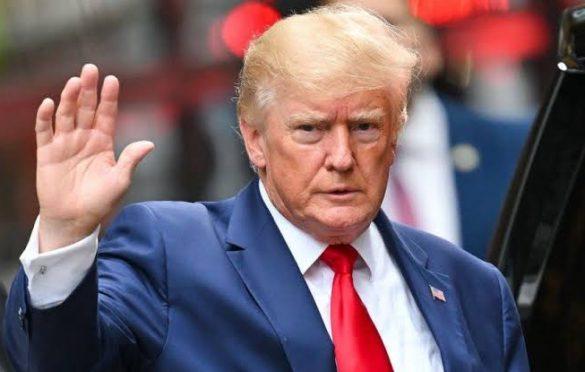
Republican presidential candidate Donald Trump is safe after an incident on Sunday in which two people exchanged gunfire outside his Florida golf club, the New York Post said, citing law enforcement sources.
Trump’s campaign had earlier said he was safe following gunshots in his vicinity but gave no details.
“Sources said that Trump was never in danger,” the newspaper said. The incident took place outside the Trump International Golf Course in West Palm Beach, it added.
Trump campaign spokesperson Steven Cheung did not immediately respond to a request for comment.
Representatives of the Palm Beach Sheriff’s Office did not immediately respond to requests for comment.
Trump was injured in an assassination attempt in Pennsylvania on July 13, just months ahead of what looks likely to be highly contested Nov. 5 election in which he will be pitted against Democratic Vice President Kamala Harris.
The first shooting of a U.S. president or major party presidential candidate in more than four decades was a glaring security lapse that forced Kimberly Cheatle to resign as Secret Service director under bipartisan congressional pressure.
Trump was grazed in the right ear and one rallygoer was killed in the gunfire. The gunman, identified as a 20-year-old Thomas Crooks, was shot and killed by a Secret Service sniper.
Here are some quick takeaways from the first portion of the debate:
A turning point when Harris jabs Trump over the size of his rally crowds
Harris came onstage with a clear plan: Throw Trump off his game.
It was, by any measure, a dramatic success. When the vice president mentioned Trump’s criminal conviction and outstanding legal issues, he bit. When she called him out for sinking a bipartisan immigration bill, he bit harder. And when Harris suggested Trump’s rallies were boring, he nearly choked on the bait.
Rather than engage on the issues raised by the moderators, including a few that Trump considers some of his political strengths, the former president went on at length about the entertainment value of his rallies, claims the Biden administration was legally targeting him and, in a long, bizarre spell, insisted – against all available evidence, that migrants were eating Americans’ pets.
“They’re eating the dogs, the people that came in, they’re eating the cats, they’re eating the pets of the people that live there,” Trump said, after Harris criticized him for tanking the immigration bill.
Harris looked on as though she was puzzled, but rarely returned to the claims, apparently content to allow Trump go off.
Trump seemed especially aggrieved by the vice president’s aside about his campaign events. Even after Muir sought to redirect the debate to immigration – again, one of Trump’s preferred topics – the former president refused to let it go.
“First, let me respond as to the rallies,” Trump said, mocking Harris’ crowds before returning to his own. “People don’t leave my rallies, we have the biggest rallies, the most incredible rallies in the history of politics.”
The first hour of the debate then ended much like it began – with Trump off on a long, narrowcast tangent about the 2020 election, which he claimed, falsely once again, was stolen from him.
Trump traffics in conspiracy theories
Despite signals from even his running mate, Trump did not refrain from repeating the conspiracy theory du jour during the debate.
The former president brought up the unfounded conspiracy theory that migrants from Haiti living in Springfield, Ohio, are eating people’s cats and dogs.
The former president brought up the unfounded conspiracy theory that migrants from Haiti living in Springfield, Ohio, are eating people’s cats and dogs. He said at one point “in Springfield, they’re eating the dogs. They’re eating the cats. They’re eating the pets of people who live there.”
When ABC News moderator David Muir pointed out that city officials denied any evidence that migrants in Springfield were actually eating pets, Trump doubled down, saying “the people on television” were saying it. When pressed, Trump just said, “We’ll find out.”
When the debate moved to crime, Trump claimed that crime was up in the United States contrary to the rest of the world. There too Muir pointed out that, according to FBI data, crime had actually declined in the past few years.
Trump, again, deferred to a different conspiracy theory that the FBI is deeply corrupt and issuing “defrauding statements.” He argued “it was a fraud.”
Later in the debate, Trump argued that US elections are “a mess” and claimed that Democrats are trying to get undocumented immigrants to vote in elections.
Fierce argument over abortion, a key issue for both candidates
Few moments highlighted the difference between Biden’s June debate performance and Harris’ on Tuesday as much as the abortion debate.
The vice president, who has long been one the administration’s strongest surrogates on reproductive rights, was able to respond to the former president’s defense of his abortion policy in a way Biden was not.
The former president, who appointed three of the Supreme Court judges who overturned federal abortion protections, has sought to moderate his stance on the issue by criticizing six-week abortion bans and reiterating his support for exceptions for rape, incest and the life of the mother. But he has also defended the overturning of Roe v. Wade.
“Now it’s not tied up in the federal government,” Trump said. “I did a great service in doing it. It took courage to do it.”
Trump repeated several of the arguments he made about abortion during his June debate with Biden. He argued that “everyone” wanted the issue returned to the states, despite widespread resistance from Democrats and some independents. He argued inaccurately that a former governor of Virginia said that babies should be executed – a reference to comments former Democratic Gov. Ralph Northam, a doctor, made about care for births after nonviable pregnancies.
And Trump repeated the false claim that some states allow abortions to be performed after a baby has been born, which drew a fact check from ABC News’ Linsey Davis.
“There is no state in this country where it is legal to kill a baby after it’s born,” Davis said.
Harris responded by highlighting cases where women have been unable to get abortions after being victims of rape or struggled to get miscarriage care.
“You want to talk about this is what people wanted?” Harris said. “Pregnant women who want to carry a pregnancy to term, suffering from a miscarriage, being denied care in an emergency room because the health care providers are afraid they might go to jail, and she’s bleeding out in a car in the parking lot – she didn’t want that.”
Vice president casts Trump as out for himself
Seeking to introduce herself to voters, Harris set the tone early, drawing contrast with Trump by framing herself as an advocate for middle-class Americans – and framing her opponent as self-absorbed.
“Donald Trump has no plan for you,” Harris said in response to a question on the economy, looking into the camera in a direct appeal to voters.
Leaning into her personal biography as she cast herself as a “middle class kid,” Harris outlined an economic vision including tax cuts for families and tax deductions for small businesses, while Trump, she said, will “do what he has done before, which is to provide a tax cut for billionaires and big corporations.”
Trump, Harris continued, “actually has no plan for you, because he is more interested in defending himself than he is in looking out for you.”
Her campaign has argued in its ads and talking points that Trump is a candidate looking out for himself, and Harris took that message to the debate stage Tuesday.
“I will tell you, the one thing you will not hear him talk about is you. And I’ll tell you: I believe you deserve a president who actually puts you first,” she said.
A handshake sets the tone
When Harris and Trump walked onto stage in Philadelphia, it was the first time they’d met in person. Trump, after all, skipped Biden’s inauguration.
Harris set the tone by walking across the six feet separating her podium from Trump’s and reaching out for a handshake. She introduced herself and said, “Let’s have a good debate.”
“Nice to see you,” Trump responded.
It was the first handshake in a presidential debate since Trump and Hillary Clinton squared off in 2016. Trump famously loomed uncomfortably close to Clinton during their town hall-style debate.
Trump generally looked forward as Harris spoke, while the vice president communicated through facial expressions. She laughed at some Trump comments, smirked at others, shook her head at some and at times appeared bemused.
When Trump repeated a debunked myth about Haitian immigrants eating pets in Springfield, Ohio, Harris laughed mockingly while shrugging and pointing at Trump.
When Trump was asked about his comment last month falsely claiming Harris only recently started to identify as Black, the former president defended his remarks as something he’d read somewhere.
“I couldn’t care less,” Trump said. “Whatever she wants to be is OK with me.”
In the weeks since those comments, the vice president has avoided engaging in that personal attack beyond calling it the “same old tired playbook.”
At the Philadelphia event, however, Harris responded to Trump’s attacks on her identity a meaningful way. But instead of defending her indisputable racial identity, the vice president laid out the former president’s history of past racial discrimination and racist behavior.
That history includes investigations of housing discrimination, calling for the death penalty for the Central Park Five – young teenagers of color falsely accused and convicted of raping and assaulting a woman in the New York park – and fueling the false birther allegation that former President Barack Obama was not born in the United states.
“And I think the American people want better than that. Want better than this,” Harris said. “We see in each other a friend. We see in each other a neighbor. We don’t want a leader who is constantly trying to have Americans point their fingers at each other.”
Trump pushed back, arguing that others, such as former New York Mayor Michael Bloomberg, also supported the case against the Central Park Five. He called the Biden-Harris administration divisive and argued that the vice president’s examples were outdated.
“This is a person that has to stretch back years – 40, 50 years ago – because there’s nothing now,” he said.
Trump and Harris dig their heels in on major global flashpoints
If anyone on stage Tuesday has a clear, point-by-point plan for ending the wars in Gaza and Ukraine, they did not share it with the viewers at home.
Asked how she would secure peace in Gaza, Harris first recalled the horrors of Hamas’ October 7, 2023, attacks inside Israel. She offered some mild criticism of Israel’s response, an ongoing bombardment that’s killed tens of thousands of Palestinians, before pivoting to her support for a two-state solution, Israel’s right to defend itself and a commitment to rebuilding Gaza.
“We need a ceasefire deal and we need the hostages out,” Harris declared. Biden and others recently conceded such an agreement is a long way off.
Trump offered even fewer details.
“She hates Israel,” he said of Harris, adding that she also hates “Arabs.”
Trump has occasionally sought to inflame anger among Arab Americans over Biden’s handling of the conflict. But on Tuesday he quickly abandoned the tactic, instead chiding Harris for slighting Israeli Prime Minister Benjamin Netanyahu during a recent visit to Capitol Hill – she did, in fact, meet with him; she did not attend his speech to Congress – and declaring again that none of it “would have never happened” if he were still in the White House.
Ditto for the Russian war in Ukraine, per the former president, who – after stopping to note that he “know(s) Putin very well – said “Russia would have never ever … have gone into Ukraine” on his watch.
“I’ll get it done before even becoming president,” Trump added, claiming his election would reset the geopolitical state of play and, almost by definition, herald a deal.
Harris, for her part, used the Russia-Ukraine talk to attack Trump over his well-documented fondness for international strongmen and despots.
“It is well-known that these dictators and autocrats are rooting for you to be president again,” Harris said, “because it is so clear they can manipulate you with flatter and favors.”
Trump fought back there, recalling his push to get NATO member nations to pay more into the alliance and slamming Harris for Biden’s refusal to do the same, before saying the vice president “does not have the courage to ask.”
A countdown clock over debate moderators David Muir and Linsey Davis shows how much time former President Donald Trump has left to answer a question during Tuesday’s debate with Vice President Kamala Harris.
Harris replied that she believed Trump might, in fact, put a quick end to the war – by capitulating to Putin. And in so doing, she added, endangering Poland on Ukraine’s western border. (Pennsylvania has a large Polish-American population, Harris noted.)
Trump repeatedly brought up the administration’s handling of the US’ withdrawal from Afghanistan, arguing it showed weakness in the White House and that Biden did not fire enough people in response to it. Harris said she agreed with Biden’s decision to pull US troops out of Afghanistan in 2021, asserting that Trump “negotiated one of the weakest deals you can imagine” on the matter during his time as president.
Trump – having been accused repeatedly of going starry-eyed for strongmen – quoted the one running Hungary, Prime Minister Viktor Orban.
“Orban said it, he said, ‘The most respected, most feared person is Donald Trump. We had no problems when Trump was president,’” Trump said.
Vice President Harris formally secured the Democratic presidential nomination on Friday, culminating a long career and dramatic rise to become the nation’s first Black woman selected as a major party’s nominee and capping one of the most tumultuous months in recent American political history.
The virtual vote by nearly 4,000 Democratic delegates began at 9 a.m. on Thursday, and by a little after 1 p.m. on Friday, Harris had secured enough votes to win the nomination. Ultimately there was little suspense — Harris was the only candidate who qualified for the roll call vote, and most of the delegates had already endorsed her — but the formal ascent of the first woman of color to lead a presidential ticket marked a milestone for a nation long riven by racial and gender issues.
“I will officially accept your nomination next week, once the virtual voting period is closed,” Harris said on a live stream as delegates continued to cast ballots. “But already I’m happy to know we have enough delegates to secure the nomination.” The process officially continues through Monday, despite the foregone conclusion.
Attention now shifts to whom Harris will pick as a running mate, a process that is expected to wrap up in coming days before she and her vice-presidential pick launch a nationwide campaign tour next week across seven battleground states.
She has narrowed her search for a running mate to six finalists and is planning to conduct interviews with them this weekend, according to two people familiar with the process who spoke on the condition of anonymity to discuss confidential deliberations.
Those finalists are Govs. Andy Beshear of Kentucky, J.B. Pritzker of Illinois, Josh Shapiro of Pennsylvania and Tim Walz of Minnesota, as well as Transportation Secretary Pete Buttigieg and Sen. Mark Kelly of Arizona, the people said. Representatives for Beshear, Buttigieg and Shapiro confirmed that those officials had canceled previously scheduled plans for this weekend.
Harris, who was born in California to an Indian mother and Jamaican father, becomes just the second person of color in America’s nearly 250-year history to head a major presidential ticket, after Barack Obama did in 2008. If she prevails over Republican Donald Trump, she would be the nation’s first female and first Asian American president.
The Democratic Party has also never had before a presidential nominee from the West, a 2019 analysis from FiveThirtyEight found.
Parties typically nominate their ticket during their in-person convention, but Democrats were worried about ballot qualification deadlines in several states and decided instead to hold a virtual nomination before the Democratic National Convention later this month. Convention planners are preparing a symbolic roll call for prime-time television coverage at the gathering in Chicago, with representatives of each state offering their votes for Harris in a customized fashion.
Trump agrees to Fox News offer of debate with VP Harris on Sept. 4
U.S. Republican presidential nominee Donald Trump has agreed to an offer from Fox News to hold a debate with Democratic U.S. Vice President Kamala Harris on Sept. 4, he said in a post on Truth Social late on Friday.
“Rules will be similar to the rules of my debate with Sleepy Joe, who has been treated horribly by his party, but with a full arena audience,” Trump said, referring to President Joe Biden, who has since dropped his reelection bid.
The post was removed for a few minutes before being reposted, with Trump deleting his proposal for a “major” town hall gathering on the same date if Harris was “unwilling or unable to debate”.
Harris had responded last month that she was “ready” after Fox News proposed the presidential debate between the two candidates on Sept. 17.
After Biden dropped out of the race on July 21 and backed Harris, Trump said he would not debate her because she was not the official candidate.
As proof of her lack of support, he added that former President Barack Obama had yet to endorse her. But Obama did so a day later, and on Friday, she secured the delegate votes needed to clinch the Democratic nomination.
Former President Donald Trump was injured Saturday evening during his rally in Butler, Pennsylvania, in what the FBI says was an assassination attempt. The gunman and at least one audience member are dead, the Secret Service said, and two other attendees are critically injured.
Trump said on social media that he was shot and hit by a bullet in the “upper part of my right ear.” The Secret Service said the former president is safe after he was rushed off the stage with blood on his face.
The FBI has identified the gunman as Thomas Matthew Crooks, 20, from Bethel Park, Pennsylvania. Authorities say he fired multiple shots from a building rooftop just outside the rally venue, before he was killed by Secret Service agents.
“The FBI has identified Thomas Matthew Crooks, 20, of Bethel Park, Pennsylvania, as the subject involved in the assassination attempt of former President Donald Trump on July 13, in Butler, Pennsylvania.
“This remains an active and ongoing investigation, and anyone with information that may assist with the investigation is encouraged to submit photos or videos online at FBI.gov/butler or call 1-800-CALL-FBI”, a statement from FBI read.
Eyewitnesses described a “bloody” and chaotic scene. “It’s pure insanity,” said one rally attendee.
President Joe Biden spoke with Trump after the shooting. Biden denounced the violence in remarks Saturday night and said in a statement earlier that he’s “grateful” Trump is safe. Biden, who was planning to stay in Delaware for the weekend, returned to the White House earlier than planned so he can continue receiving briefings from law enforcement.. FBI identifies Trump rally shooter as Thomas Matthew Crooks
…Rishi Sunak concedes election, saying he’s sorry for defeat
…Conservatives forecast to win fewest seats in their history
…Farage elected to parliament with his right-wing Reform UK
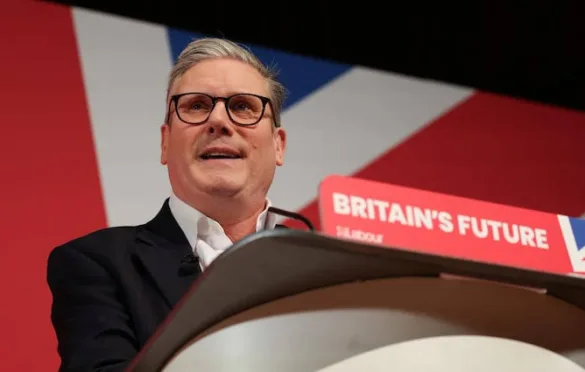
Keir Starmer vowed to bring change to Britain as its next prime minister after his Labour Party surged to a landslide victory in a parliamentary election on Friday, ending 14 years of often tumultuous Conservative government.
The centre-left Labour won a massive majority in the 650-seat parliament with Rishi Sunak’s Conservatives suffering the worst performance in the party’s long history as voters punished them for a cost of living crisis, failing public services, and a series of scandals.
“We did it,” Starmer said in a victory speech. “Change begins now … We said we would end the chaos, and we will, we said we would turn the page, and we have. Today, we start the next chapter, begin the work of change, the mission of national renewal and start to rebuild our country.”
With about a dozen results still to come, Labour had won 410 seats, the Conservatives 117 and the centrist Liberal Democrats 70 – their best ever performance.
About 250 Conservative lawmakers were ousted in the crushing defeat, including a record number of senior ministers and former Prime Minister Liz Truss.
A glum Sunak conceded defeat and said he had called Starmer to congratulate him on his victory.
“Today power will change hands in a peaceful and orderly manner, with goodwill on all sides,” Sunak said. “There is much to learn and reflect on and I take responsibility for the loss to the many good hardworking Conservative candidates … I am sorry.”
Despite his convincing victory, polls have suggested there is little enthusiasm for Starmer or his party. Thanks to the quirk of Britain’s first past the post system, Labour’s triumph looked set to be achieved with fewer votes than in both 2017 and 2019 – the latter its worst electoral showing for 84 years.
Starmer also comes to power at a time when the country is facing a series of daunting challenges.
Britain’s tax burden is set to hit its highest since just after World War Two, net debt is almost equivalent to annual economic output, living standards have fallen, and public services are creaking, especially the much cherished National Health Service which has been dogged by strikes.
He has already had to scale back some of Labour’s more ambitious plans, such as its flagship green spending pledges, while he has promised not to raise taxes for “working people”.
“I don’t promise you it will be easy,” Starmer said. “Changing a country is not like flicking a switch. It’s hard work. Patient, determined, work, and we will have to get moving immediately.”
Much of the heavy damage to the Conservative support was inflicted by the right-wing Reform UK party, headed by Brexit campaigner Nigel Farage, who had campaigned strongly on curbing immigration.
Starmer has promised to scrap the Conservative’s controversial policy of sending asylum seekers to Rwanda, but with migration a key electoral issue, he will be under pressure himself to find a way to stop tens of thousands of people arriving across the Channel from France on small boats.
Within the Conservative Party, the recriminations and debate over its future direction began immediately, with some saying its failure stemmed from abandoning the centre ground while others argued Reform had won over voters who felt the party had deserted its roots.
Reform has captured four seats, with Farage himself finally being elected to parliament at his eighth attempt, and won more than 4 million votes, often taking more than the Conservatives across swathes of the country.
“There is a massive gap on the centre right of British politics and my job is to fill it, and that’s exactly what I’m going to do,” a triumphant Farage said. “Believe me folks, this is just the first step of something that is going to stun all of you.”
The growth in support for a right-wing alternative echoed recent similar results in Europe, where the far right have been surging.
But, unlike France where Marine Le Pen’s National Rally party made historic gains in an election last Sunday, overall the British public has plumped for a centre-left party to bring about change.
Starmer has promised to improve relations with the European Union to resolve issues created by Britain’s split from the bloc. However, despite opposing Brexit, rejoining the EU is not on the table.
He may also have to work with Donald Trump in the United States if he wins November’s presidential election. Trump has already sent congratulations to his friend and supporter Farage, via his social media platform Truth Social.
While he has promised to bring change domestically, Starmer has vowed to continue London’s unequivocal support for Ukraine in its war against Russia. On many foreign issues, his policies are similar to Sunak’s.
The election victory represents an incredible turnaround for Starmer and Labour, which critics and supporters said was facing an existential crisis just three years ago when it appeared to have lost its way after its 2019 drubbing.
A series of Conservative scandals – most notably revelations of parties in Downing Street during COVID lockdowns – undermined then prime minister Boris Johnson and its commanding poll lead evaporated.
Truss’ disastrous six-week premiership, which followed Johnson being forced out at the end of 2022, cemented the decline, and Sunak was unable to make any dent in Labour’s now commanding poll lead.
Sunak stunned Westminster and many in his own party by calling the election earlier than he needed to while trailing badly in the polls, and his campaign then proved a disaster.
“We deserved to lose. The Conservative Party just appears exhausted and out of ideas,” Ed Costello, the chairman of the Grassroots Conservatives organisation, which represents rank-and-file members, told Reuters.
“But it is not all Rishi Sunak’s fault. It is Boris Johnson and Liz Truss that have led the party to disaster. Rishi Sunak is just the fall guy.”
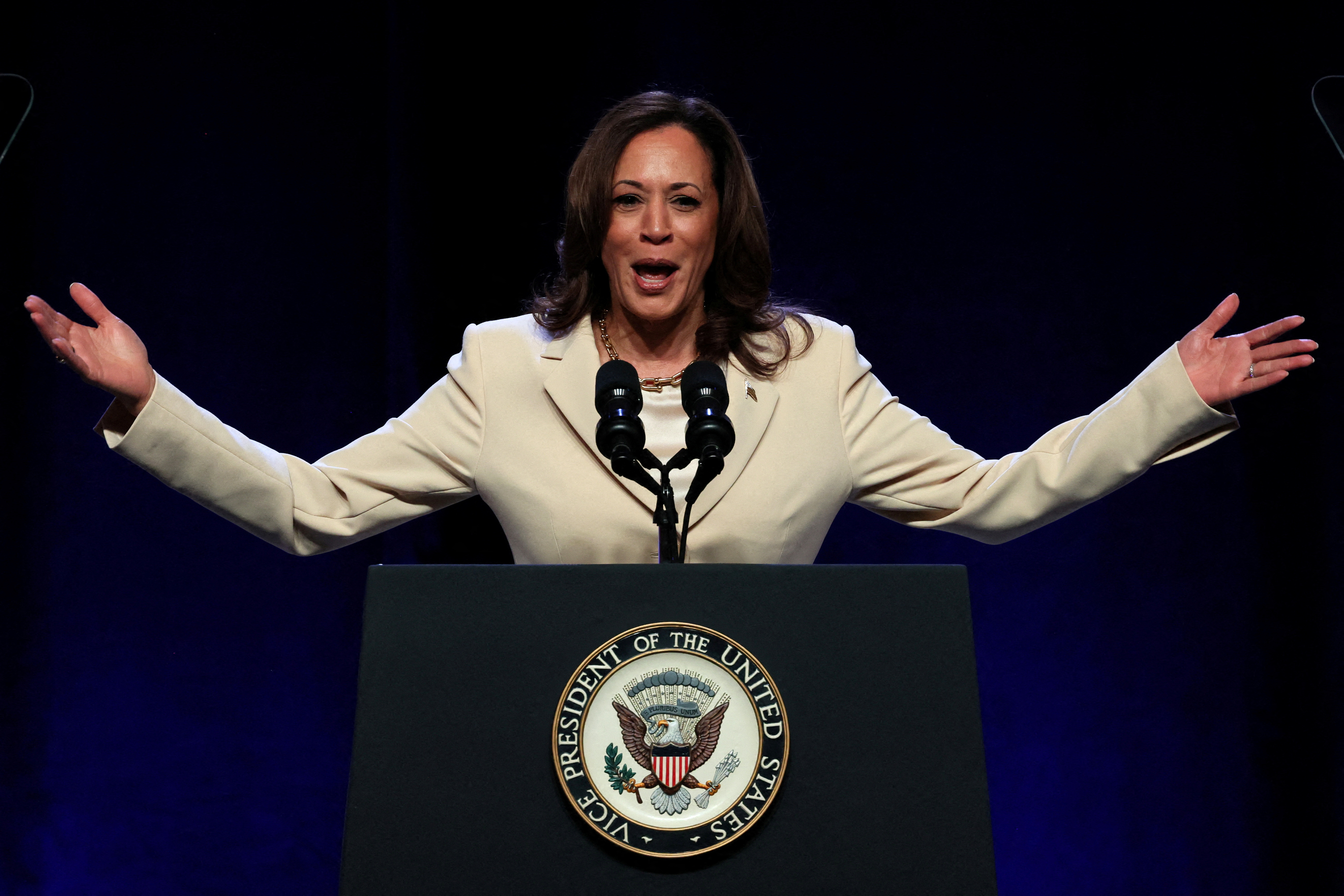
U.S. Vice President Kamala Harris speaks during the Constitutional Convention of UNITE HERE, the nation’s largest hospitality workers’ labor union, in New York City, U.S., June 21, 2024.
Vice President Kamala Harris is the top alternative to replace U.S. President Joe Biden if he decides not to continue his reelection campaign, according to seven senior sources at the Biden campaign, the White House and the Democratic National Committee with knowledge of current discussions on the topic.
Biden’s fumbling, sometimes-incoherent and widely-panned first-debate performance against Republican rival Donald Trump last week set off a wave of panic within the Democratic party over concerns that he may not be fit enough to serve a second term, and prompted calls for top aides to resign.
Some influential Democrats have floated alternatives to Biden besides Harris, including popular cabinet members and Democratic governors like Gavin Newsom from California, Gretchen Whitmer of Michigan and Josh Shapiro of Pennsylvania. But trying to sidestep Harris is wishful thinking and would be nearly impossible, these sources, who did not wish to be named, said.
If named as the party nominee, Harris, 59, would take over money raised by the Biden campaign and inherit campaign infrastructure, the sources said. She also has the highest name recognition among all the alternatives, and the highest polling among Democrats who could seriously be considered a candidate, the sources said.
In a Reuters/Ipsos poll published Tuesday, Harris trailed Trump by one percentage point at 42% to 43%, a difference that was well within the poll’s 3.5 percentage point margin of error, a showing statistically just as strong as Biden’s.
In addition, she has already been vetted for national office and has survived intense scrutiny from Republicans, they said. Also, U.S. Representative Jim Clyburn, the man who was key to Biden’s 2020 win, told MSNBC he would support Harris to be the Democratic nominee if Biden stepped aside.
“It’s pretty near impossible to win the nomination over the vice president,” said Michael Trujillo, a Democratic strategist from California who worked for Hillary Clinton’s campaign in 2008 and 2016.
White House Press Secretary Karine Jean-Pierre said on Tuesday that Biden just had a “bad night” at the debate and would continue to make his case for reelection to the American people. The Biden campaign deferred to Harris’s team for comment on the story.
Harris’s aides dismissed any talk of a Democratic ticket that doesn’t include both Biden and Harris. “Vice President Harris looks forward to serving a second term with President Joe Biden,” a statement from her office said.
Biden’s campaign has amassed 3,894 delegates after state primaries, leaving only a few dozen “uncommitted” delegates outstanding. They are expected to formally nominate Biden later this month in a virtual meeting, ahead of the Democrats’ nominating convention in August.
“All of the delegates are not just Joe Biden delegates, they are Kamala Harris delegates,” Trujillo said, adding “she will have a sizable delegation and support in all 50 states on day one,” he said.
Donna Brazile, the former interim chair of the Democratic National Committee, who has a key committee role at this year’s Democratic National Convention in August, said the person who can step in right away, if Biden decides not to run, is Harris.
“People may have dreams of another superhero but there is a process and the last time I checked it’s a Biden-Harris ticket, she’s number two on the ticket,” Brazile said, adding Biden remains the nominee for the Democratic party and “is not going anywhere.”
Passing over the first Black and woman vice president for another candidate would lead to a backlash from Black and women voters who are key to any victory, several Democratic strategists said.
‘IMPOSSIBLE TO IGNORE KAMALA’
Still, Harris has been sidestepped in a lot of the speculation since the debate because some influential Democrats have little faith she can beat Trump, four of the sources said.
The United States has never elected a woman president, and Harris has spent much of her time as vice president struggling to distinguish herself in a role that is by definition a supporting one. As recently as last year, many inside the White House and the Biden campaign privately worried she was a liability for the campaign.
Since then, Harris has managed to find her stride on the issue of abortion rights but her polling has not improved significantly. Harris’s approval ratings hover under 40%, but according to recent polling highlighted by the Biden campaign, she and the president have similar odds of beating Trump.
The vice president has also been consistently targeted by Republicans and conservative media in attacks many allies consider sexist and racist.
Three Democratic donors, who have recently been pushing for Biden to step aside, also said this week they think it will be “impossible” to sidestep Harris. The donors had been floating Whitmer and Newsom’s names as possible alternatives until the past weekend.
“There is a real conversation in the Democratic party about leadership right now, but fair to say, and I’m not thrilled about this… it will be impossible to ignore Kamala,” said one of the donors.
Another donor said “she’s nobody’s choice, but yeah, nearly impossible.”
Still, the president’s reelection campaign is standing its ground, emboldened by a stronger performance by Biden during a scripted speech in North Carolina even as calls for him to step aside grow.
Stephanie Cutter, deputy campaign manager for former President Barack Obama, whose firm is on contract to produce the Democratic National Convention in August, said “President Biden is the nominee and he’s going to remain the nominee.”
“For those who are looking for some sort of interparty fight, be careful what you wish for because that would ensure a Trump victory,” she said in a statement.
Four men were arrested on suspicion of aggravated trespass at Prime Minister Rishi Sunak’s home in northern England on Tuesday, local police said in a statement.
“We have arrested four people in the grounds of the Prime Minister’s constituency home this afternoon. Our officers were with the four men within one minute of them entering the grounds,” the statement said.
Campaign group Youth Demand posted videos on X of a man entering a lake on the property and defecating in what he said was an act of protest against Sunak’s government.
The group wants to stop new oil and gas licences being issued and also calls for a two-way arms embargo on Israel.
Rishi Sunak has called a surprise early election for 4 July in a contest that will see Keir Starmer try to take power for Labour after 14 years of Conservative-led government.
The prime minister announced the election would be in the early summer in a high-risk move for the Conservative party as it trails 20 points behind Labour in the polls.
Sunak finally decided to name the date after claiming inflation was back under control and the economy was improving.
“I hope that my work since I became prime minister shows that we have a plan and are prepared to take bold action necessary for our country to flourish,” he said.
“Now I’ve stuck with that plan and always been honest with you about what is needed even when that’s been difficult.”
The prime minister added: “I cannot and will not claim that we have got everything right. No government could, but I am proud of what we have achieved together, the bold actions we have taken. I’m confident about what we can do in the future.”
However, Starmer is widely expected to become the next prime minister after transforming his party since its historic election defeat almost five years ago.
Sunak made his announcement in heavy rain outside No 10 Downing Street, as the New Labour anthem, D:ream’s Things Can Only Get Better, was blasted out on the street outside.
It followed a day of febrile speculation in Westminster, triggered by rare good economic news for the government and an unusually timed cabinet meeting, with senior ministers changing their plans to attend.
The prime minister, who has long said his “working assumption” was that the election would be held in the second half of the year, was previously thought likely to wait until the autumn and a further tax-cutting budget before holding a contest when so far behind.
However, government insiders suggested Sunak had been convinced that with the economic backdrop unlikely to improve significantly before the autumn, and questions over the delivery of his Rwanda deportation scheme, he would be better off going now.
The “wash-up”, when the government finalises non-contentious bits of legislation, is expected to take place next week before parliament is dissolved.
Before the announcement, a spokesperson for Starmer said: “We are fully ready to go whenever the prime minister calls an election.
“We have a fully organised and operational campaign ready to go. And we think the country is crying out for a general election so I would urge the prime minister to get on with it.”
Supreme Leader Ayatollah Ali Khamenei has declared five days of national mourning for Raisi, Foreign Minister Hossein Amirabdollahian and six others killed in the helicopter crash in a remote part of northwest Iran on Sunday. The shock incident wiped out two of the Islamic Republic’s key political figures, raising questions about its leadership beyond Khamenei, its ultimate authority.
Thousands of mourners gathered for the first funeral event early Tuesday in Tabriz, the closest major city to the crash site.
Crowds of people filled the area of the procession, with some carrying posters of the deceased as the vehicle carrying the coffins of those killed in the crash moved by.
The bodies will then be taken to the holy city of Qom in the afternoon.
Wednesday will be a public holiday as a funeral for Raisi will be held in the capital, Tehran. The ceremony is expected to feature high-ranking foreign dignitaries, state news agency IRNA reported, but it was not clear yet who exactly would attend given Iran’s status on the global stage.
Funerals will be held in two more cities on Thursday. Raisi is expected to be laid to rest in the holy city of Mashhad on Friday.
Raisi’s unexpected death led to scenes of mourning in Iran on Monday, as messages of condolences poured in.
But it was unclear whether Raisi’s death would draw public grieving on the scale of mass funerals like that for Gen. Qassem Soleimani, a top Iranian commander who was killed in a U.S. airstrike in 2020. The theocratic regime often uses such events as a display of national strength and unity.
Some expressed relief at the death of Raisi, 63, who was also known for presiding over brutal crackdowns on political opponents and protesters.
Laila, a 21-year-old student in Tehran, told the Reuters news agency that she was not saddened by the news, “because he ordered the crackdown on women for hijab.”
“But I am sad because even with Raisi’s death this regime will not change,” she said by phone.
In a short statement late Monday, the State Department said the United States expressed its “official condolences” for the deaths of Raisi and the seven others killed. “As Iran selects a new president, we reaffirm our support for the Iranian people and their struggle for human rights and fundamental freedoms,” the statement added.
State Department spokesman Matthew Miller also said that the Iranian government had asked the U.S. for assistance in the aftermath of the crash. Washington agreed, Miller said, but ultimately was not able to provide it, largely for logistical reasons.
The United Nations Security Council, of which the U.S. is a permanent member, also held a moment of silence for Raisi Monday.
Mourners follow a procession carrying the coffins of president Ebrahim Raisi and his seven aides in Tabriz, Iran on May 21, 2024.Ata Dadashi / AFP – Getty Images
Raisi was a conservative hardliner, unlike his more moderatepredecessor Hassan Rouhani. His tenure saw the country increasingly clash with the West, particularly over the role of Tehran-backed militant groups like Hamas and Hezbollah, and advance its nuclear program after the U.S. withdrew from a landmark nuclear deal.
Although most observers agreed there was no major threat to the stability of the regime, the late president was among the top contenders to replace the aging Khamenei. His death sparked fears of a succession crisis amid already heightened tensions after Tehran’s unprecedented direct retaliatory attack against Israel.
Iran’s first vice president, Mohammad Mokhber, was quickly named a temporary caretaker ahead of an election to choose a new president that has to take place in the next 50 days.
Iran has not offered a cause for the crash that killed Raisi, but there has been no suggestion of foul play.
It officially launched a probe into the crash on Monday. The model that crashed amid heavy fog was a U.S.-made Bell helicopter that Iran bought in the early 2000s, Iranian state media said.
Former Foreign Minister Mohammad Javad Zarif blamed U.S.-led sanctions on the Iranian aviation sector for the crash.
Miller, the State Department spokesman, later told reporters that Washington was not going to apologize for its sanctions, adding that it was the Iranian government that was responsible for the decision to fly a 45-year-old helicopter in what were described as poor weather conditions.
Ebrahim Raisi, whose helicopter crashed in the northwest of Iran on Sunday, was both the President of Iran and a candidate jockeying to succeed the elderly actual ruler of the country, Supreme Leader Ali Khamenei. Both political positions carried an elevated risk level roughly comparable with that of traveling by air inside Iran—where aviation safety, compromised by decades of sanctions and uneven maintenance, has claimed the lives of almost as many senior Iranian officials as its shadow war with Israel, which also loomed over Raisi’s reported demise.
The cause of the crash—which also killed Iranian Foreign Minister Hossein Amirabdollahian, the governor of Iran’s East Azerbaijan province, andothers—is pending investigation. But any official finding will be open to interpretation—like the fireworks that erupted in the streets over Tehran on Sunday night: were they celebrating the eve of the holiday marking the birth of Reza, known as the 8th Imam? Or the death of Raisi, the notoriously hardline President?
Suspicions abound. The crash came two months after Iran launched a massive missile and drone attack on Israel, retaliating for an Israeli airstrike that killed two senior Iranian generals in Syria on April 1. Israel’s initial response to the unprecedented direct attack on its territory was so muted as to qualify as symbolic: targeting an anti-aircraft battery guarding a nuclear facility.
For those disposed to believe the crash was Tel Aviv dropping the other shoe, the site of the incident encourages speculation. Raisi’s helicopter went down in mountainous forest near the border with Azerbaijan, which is the least friendly of Iran’s neighbors—in part because it maintains relations with Israel, and has a history of cooperating with Mossad.
But the weather was also a suspect. Iranian state reported efforts to locate the crash site were impeded by fog, winds and heavy rain, and released footage of rescue crews rushing through an enveloping mist.
Finally, there’s the internal politics of the Islamic Republic—notoriously brutal in the best of times, but even more so given persistent rumors that Khamenei, who has ruled for 35 years, is ailing.
“Raisi’s death would create a succession crisis in Iran,” Karim Sadjapour, a senior fellow at the Carnegie Endowment for International Peace, told TIME on Sunday, as the anchors on state television donned black. “He and Mojtaba Khamenei—son of the 85-year-old Supreme Leader—are the only talked-about candidates for succession. In Iran’s conspiratorial political culture, few will believe Raisi’s death was accidental.”
Raisi, 63, thrived in that conspiratorial culture. The name of his political faction, the Combatant Clergy Association, hints at his place in the authoritarian theocratic system that in 1979 replaced the monarchy that had ruled Iran for much of the 20th Century. Raisi made his career as an enforcer, serving as prosecutor in a variety of provinces, and demonstrating his commitment as a hardliner. In the late 1980s, he served on a “death committee” that human rights groups say ordered the execution of thousands of political prisoners without trial.
The executions upset the succession plan of Grand Ayatollah Ruhollah Khomeini, the Shi’ite cleric who had led the 1979 Revolution, after his own outraged protégé, declared: “I said I would follow you anywhere, but I will not follow you to hell.” The job went instead to the similarly named Khamenei, with an expeditious promotion to Ayatollah. In the decades that followed, Raisi rose as well, eventually heading the judiciary, which reports directly to the Leader.
Raisi had no apparent political following, however, beyond the regime loyalists who make up some 20 percent of Iran’s 88 million people. His 2021 election as President, amid record low turnout and allegations of rigging, was seen by observers as a signal that “the system,” as Iranians call the ruling apparatus, no longer regarded elective offices as a necessary pressure valve for the majority of Iranian society that resents the combined rule of hardline clerics and the Islamic Revolutionary Guard Corps.
That calculation survived the strongest internal challenge to the regime in decades, when women led nationwide protests that went on for months following the September 2022 death of Mahsa Amini, who had been detained by “morality police.” More than 500 protesters were killed by the regime’s security forces, and more than 20,000 arrested.
A year later, Raisi was in New York to visit the United Nations. Protected by diplomatic immunity from arrest on charges over the 1980s executions, he used a meeting with U.S. reporters to boast that the “Woman, Life, Freedom” uprising, which he blamed on the U.S. and Europe, had failed. “Last year, during the course of the instability brought about by the rioters, in only 48 days, over 36,000 lies were produced and propagated and disseminated in the media,” Raisi said. “Did it work? The proof is in the pudding, as they say.”
Melinda French Gates, one of the world’s preeminent philanthropists, said Monday she would resign as co-chair of the Bill & Melinda Gates Foundation that she has helped lead since 2000.
The foundation has made nearly $78 billion worth of grant payments in the nearly 25 years since its founding.
French Gates made the decision “after considerable reflection, based on how she wants to spend the next chapter of her philanthropy,” the foundation’s CEO, Mark Suzman, wrote in a statement Monday. “Melinda has new ideas about the role she wants to play in improving the lives of women and families in the U.S. and around the world. And, after a difficult few years watching women’s rights rolled back in the U.S. and around the world, she wants to use this next chapter to focus specifically on altering that trajectory.”
As part of her separation agreement from former husband Bill Gates, French Gates said she will receive an additional $12.5 billion for her charitable work.
“This is not a decision I came to lightly,” she said in a statement posted on X. “I am immensely proud of the foundation that Bill and I built together and of the extraordinary work it is doing to address inequities around the world.”
French Gates said she plans to leave the Bill & Melinda Gates Foundation on June 7, and she will share more about her future charitable plans in the near future.
The organization will change its name to the Gates Foundation, and Bill Gates will become the sole chair, Suzman said.
“I am sorry to see Melinda leave, but I am sure she will have a huge impact in her future philanthropic work,” wrote Bill Gates in a separate statement Monday, also posted on X.
“Looking ahead, I remain fully committed to the Foundation’s work across all our strategies, and to realizing the opportunities we have to continue improving the lives of millions around the world,” he wrote.
French Gates’ planned exit
French Gates’ exit had been telegraphed for several years. Bill Gates and French Gates announced their divorce in May 2021. They said at the time they would allow themselves a kind of trial period through 2023 to determine if they could continue working with one another to oversee their massive charitable foundation.
Suzman announced in July 2021 a contingency plan “to ensure the continuity of the foundation’s work.”
“If after two years either decides they cannot continue to work together as co-chairs, French Gates will resign her position as co-chair and trustee,” Suzman said.
Gates will remain in control and, essentially, buy French Gates out of the foundation, Suzman said at the time. French Gates would receive “personal resources” from Gates for her own philanthropic work — resources that would be “completely separate from the foundation’s endowment.”
In January 2022, the foundation announced four new members to its board of trustees to help bolster the foundation’s governance in the wake of the divorce. It marked the first time the Gates foundation added outsiders to the charity’s board in its two-decade history. The charity had no trustees beside Bill and Melinda French Gates since Bill Gates Sr.’s death in 2020 and Warren Buffett’s resignation in June 2021 after 15 years on the board.
“I want to reassure you that the millions of people our work serves and the thousands of partners we work alongside can continue to count on the foundation,” said Suzman in a post on the foundation’s website Monday afternoon. “The foundation today is stronger than it has ever been.”
“I know we all wish Melinda the best in her next chapter,” he added, noting that French Gates “will not be bringing any of the foundation’s work with her when she leaves.”
The $75.2 billion Bill & Melinda Gates Foundation’s mission is to improve health care in developing countries, enhance educational opportunities and reduce poverty by providing grants and support to various initiatives and organizations around the world.
French Gates also founded Pivotal Ventures, a separate charity that focuses on removing barriers for minorities and women in the United States, in 2015. She committed $1 billion to the organization in 2019.
In an interview with CNN’s Fareed Zakaria in January, Gates said he and partners like Buffett have given away about $100 billion into the foundation. With plans to spend $9 billion a year, Gates anticipates he’ll have given away all of his money in about 20 years.
President Vladimir Putin won a record post-Soviet landslide in Russia’s election on Sunday, cementing his grip on power though thousands of opponents staged a noon protest at polling stations and the United States said the vote was neither free nor fair.
For Putin, a former KGB lieutenant colonel who first rose to power in 1999, the result is intended to underscore to the West that its leaders will have to reckon with an emboldened Russia, whether in war or in peace, for many more years to come.
The early result means Putin, 71, will easily secure a new six-year term that would enable him to overtake Josef Stalin and become Russia’s longest-serving leader for more than 200 years.
Putin won 87.8% of the vote, the highest ever result in Russia’s post-Soviet history, according to an exit poll by pollster the Public Opinion Foundation (FOM). The Russian Public Opinion Research Centre (VCIOM) put Putin on 87%. First official results indicated the polls were accurate.
Communist candidate Nikolai Kharitonov came second with just under 4%, newcomer Vladislav Davankov third, and ultra-nationalist Leonid Slutsky fourth, results suggested.
“The elections are obviously not free nor fair given how Mr. Putin has imprisoned political opponents and prevented others from running against him,” the White House’s National Security Council spokesperson said.
The election comes just over two years since Putin triggered the deadliest European conflict since World War Two by ordering the invasion of Ukraine. He casts it as a “special military operation”.
War has hung over the three-day election: Ukraine has repeatedly attacked oil refineries in Russia, shelled Russian regions and sought to pierce Russian borders with proxy forces – a move Putin said would not be left unpunished.
While Putin’s re-election was not in doubt given his control over Russia and the absence of any real challengers, the former KGB spy wanted to show that he has the overwhelming support of Russians. Nationwide turnout was 74.22% at 1800 GMT when polls closed, election officials said, surpassing 2018 levels of 67.5%.
Supporters of Putin’s most prominent opponent, Alexei Navalny, who died in an Arctic prison last month, had called on Russians to come out at a “Noon against Putin” protest to show their dissent against a leader they describe as a corrupt autocrat.
There was no independent tally of how many of Russia’s 114 million voters took part in the opposition demonstrations, amid tight security involving tens of thousands of police and security officials.
Reuters journalists saw an increase in the flow of voters, especially younger people, at noon at polling stations in Moscow, St Petersburg and Yekaterinburg, with queues of several hundred people and even thousands.
Some said they were protesting, though there were few outward signs to distinguish them from ordinary voters.
As noon arrived across Asia and Europe, crowds hundreds strong gathered at polling stations at Russian diplomatic missions. Navalny’s widow, Yulia, appeared at the Russian embassy in Berlin to cheers and chants of “Yulia, Yulia”.
Exiled Navalny supporters broadcast footage on YouTube of protests inside Russia and abroad.