Tag: Bola Tinubu

  • Atiku Accuses Tinubu Administration of Worsening Poverty, Insecurity

    Atiku Accuses Tinubu Administration of Worsening Poverty, Insecurity

    Precious Nwonu, Enugu

    Former Vice President and African Democratic Congress presidential candidate, Atiku Abubakar, has accused the administration of President Bola Tinubu of worsening poverty and the cost of living in Nigeria.

    Atiku made the allegations in a state-of-the-nation address delivered at the ADC secretariat in Abuja on Thursday as Nigeria marked its 66th Independence Anniversary.

    He criticised the Federal Government’s economic policies, particularly the removal of the petrol subsidy, arguing that the reforms had increased the financial burden on households.

    According to him, rising prices of food, transportation and other essential goods have left many Nigerians struggling to meet their basic needs.

    Atiku also faulted Tinubu’s claim that the country was entering an era of prosperity, arguing that economic growth and lower inflation would have limited meaning if Nigerians could not afford food, healthcare, transportation and education.

    He said, “At 66, Nigeria has come a long way. Independence has offered us liberty and self-determination. We are also making considerable progress in nation building.”

    The former vice president also criticised the government’s handling of insecurity, saying attacks by armed groups had displaced communities, affected farming activities and created fear among families.

    He further questioned the government’s management of public funds, debt and development projects, calling for greater transparency in contracts, loans and social intervention programmes.

    On the economy, Atiku proposed what he described as a capped and budgeted production subsidy for petrol refined in Nigeria, including fuel produced by modular refineries.

    He said the proposed scheme should be independently audited and designed to ensure that any benefit reached consumers through lower pump prices.

    Atiku also raised concerns about the government’s borrowing plans, citing Nigeria’s public debt and the proposed $1.5bn World Bank loan. He called for greater disclosure on how existing borrowed funds had been spent and the projects they had financed.

    The ADC candidate also criticised the government’s handling of student loans, budgets, contractors’ payments and cash-transfer programmes, demanding greater accountability.

    On security and civil liberties, Atiku called for the release of individuals he described as being unlawfully detained and urged the government to uphold due process.

    He also appealed to Nigerians to participate actively in the 2027 general election, urging voters to protect their ballots and reject intimidation.

    Atiku said the election would provide Nigerians with an opportunity to determine the country’s direction, while promising that, if elected, he would prioritise affordability, security, healthcare, education and accountability in public spending.

    He said Nigerians should scrutinise the programmes and promises of all candidates, including himself, and demand measurable commitments from those seeking public office.

    The former vice president concluded by urging Nigerians not to lose hope despite the economic and security challenges facing the country.

  • 2027: Wike Vows To Resign If Tinubu Loses FCT, Rivers

    2027: Wike Vows To Resign If Tinubu Loses FCT, Rivers

    Precious Nwonu, Enugu

    Minister of the Federal Capital Territory, Nyesom Wike, has vowed to resign from office if President Bola Tinubu loses the Federal Capital Territory and Rivers State in the 2027 presidential election.

    Wike made the declaration on Wednesday in Abuja during a meeting with members of the Apo Mechanics and Traders Association, where he reaffirmed his support for Tinubu’s re-election bid.

    The minister said the presidential election is scheduled for January 16, 2027, and pledged to announce his resignation the following day if Tinubu fails to secure victory in both the FCT and Rivers.

    “The presidential election is on January 16, 2027. By January 17, 2027, I will announce my resignation as FCT Minister should the President lose in Rivers State and the FCT,” Wike said.

    Wike, a former governor of Rivers State, said the FCT was particularly important to him because it was where he currently served, while Rivers remained his home state.

    He said failure to deliver electoral support for Tinubu in the two areas would raise questions about his continued suitability as FCT minister.

    “FCT is where I work. Rivers is my state. If I cannot deliver where I work, then I’m not worthy to be here,” he said.

    Wike also disclosed that a multi-party political coalition was being mobilised in the FCT ahead of the 2027 elections.

    He said the coalition, which he referred to as the “Rainbow Coalition,” included members of different political parties who were backing Tinubu for the presidency.

    The minister also endorsed candidates for legislative positions in the FCT and urged his supporters to work towards securing electoral victories for the candidates backed by the coalition.

    Wike’s declaration comes as political parties and their supporters intensify preparations for the 2027 general elections, with the presidential poll scheduled for January 16, according to his remarks and reports of the event.

    The minister also addressed the planned relocation of mechanics and traders operating around Apo, assuring them that arrangements were being made to move them to the Wasa informal sector by the end of the year.

    He said physical enumeration of affected traders and mechanics was being conducted as part of preparations for the relocation.

    Wike’s proposed resignation would take effect only if Tinubu fails to win both the FCT and Rivers State, based on the condition he publicly set at the Abuja meeting.

  • Tinubu Returns To Nigeria After Four-Week European Vacation

    Tinubu Returns To Nigeria After Four-Week European Vacation

    Precious Nwonu, Enugu

    President Bola Tinubu has returned to Nigeria after a four-week working vacation in Europe, dismissing concerns about his health and declaring that he is ready to resume his activities.

    Tinubu spoke with journalists on Tuesday shortly after arriving at the Presidential Wing of the Murtala Muhammed International Airport, Lagos, from Paris, where he spent the final part of his extended stay.

    Asked about concerns raised in some quarters about his health, the President said there was nothing wrong with him.

    “Ready to kick, ready to walk. There’s nothing wrong. Rumour will always be emanating from politics, but the facts remain: I’m here. Healthy, sound, and ready to go,” Tinubu said.

    The President’s aircraft touched down in Lagos at about 6.22pm. He was received at the airport by Lagos State Governor Babajide Sanwo-Olu, Speaker of the House of Representatives Tajudeen Abbas, Deputy Senate President Jibrin Barau, Chief of Staff to the President Femi Gbajabiamila and other senior government officials.

    A cultural troupe was also present to welcome the President.

    Tinubu departed Abuja on August 30 for what was initially announced as a three-week working vacation. He spent about a week in London before travelling to Paris, where he held several official and business-related engagements. The Presidency later announced that his stay had been extended by a few days.

    Before his return, the Presidency said Tinubu chose to travel to Lagos first to honour the memory of the late Chief MKO Abiola, the winner of the annulled June 12, 1993 presidential election and a prominent figure in Nigeria’s democratic struggle.

    The President is expected to attend the October 1 premiere of a film honouring Abiola at the Wole Soyinka National Theatre in Iganmu, Lagos.

    According to the Presidency, Tinubu will also hold strategic meetings with political leaders and associates in Lagos ahead of the 2027 elections before returning to Abuja.

    During his stay in France, the President held a private dinner with French President Emmanuel Macron and met with business executive Vincent Bolloré of the Bolloré Group.

    He also witnessed the signing of a Memorandum of Understanding between the Ogun State Government and DP World for the development of a Gateway Deep Sea Port in Ogun Waterside and a Blue Marine Economic Zone, with DP World planning to invest $7bn in the project.

    On Monday, Tinubu also met with the Chairman of First HoldCo Plc, Femi Otedola.

    His extended absence from Nigeria had generated public and political discussion, including questions about his health and his decision not to personally attend the 81st United Nations General Assembly in New York. Vice President Kashim Shettima represented Nigeria at the gathering and delivered the country’s national statement.

    With his return to Lagos, Tinubu is expected to resume physical engagements in Nigeria after spending about four weeks abroad.

  • Tinubu Ends Working Vacation, Heads To Lagos

    Tinubu Ends Working Vacation, Heads To Lagos

    Precious Nwonu, Enugu

    President Bola Tinubu has concluded his working vacation in France and departed Paris for Lagos, where he is expected to hold meetings with political leaders and associates ahead of the 2027 general elections.

    The President’s return flight is expected to arrive at the Murtala Muhammed International Airport in Lagos later on Tuesday, according to a statement by his Special Adviser on Information and Strategy, Bayo Onanuga.

    Tinubu left Abuja on August 30 for the working vacation, spending about a week in London before proceeding to Paris.

    The Presidency said the President chose Lagos as his first destination on returning to Nigeria in order to honour the memory of the late Chief Moshood Abiola, widely recognised as the winner of the June 12, 1993 presidential election.

    As part of activities planned in Lagos, Tinubu is expected to attend the October 1 premiere of a film celebrating Abiola at the Wole Soyinka National Theatre in Iganmu.

    The President is also expected to meet with political leaders and associates in Lagos during his stay.

    The Presidency said the meetings would focus on political engagements ahead of the 2027 elections.

    During his stay in France, Tinubu held several engagements, including a private dinner with French President Emmanuel Macron.

    He also met with businessman Vincent Bolloré of the Bolloré Group, whose interests include media and digital businesses such as Canal+, MultiChoice and Universal Music Group.

    On Monday, Tinubu met with businessman and Chairman of First Bank Holdings, Femi Otedola.

    The President also witnessed the signing of a Memorandum of Understanding between the Ogun State Government and DP World for the development of a deep seaport in Ogun Waterside and a Blue Marine Economic Zone.

    The proposed project is expected to attract a reported $7bn investment by DP World.

    Tinubu is expected to proceed to Abuja after completing his engagements in Lagos.

  • 2027: Otti Backs Tinubu, Rules Out Presidential Ambition After Tenure

    2027: Otti Backs Tinubu, Rules Out Presidential Ambition After Tenure

    …Explains his support for Tinubu

    Precious Nwonu, Enugu

    Abia State Governor, Alex Otti, has explained his support for President Bola Tinubu’s 2027 re-election bid while ruling out any plan to contest for the presidency or another elective office after completing his tenure as governor.

    Otti spoke during an interview with ARISE News on Friday, where he addressed his political position ahead of the 2027 general election and his relationship with other political actors, including former Anambra State Governor Peter Obi.

    The governor, who was elected on the platform of the Labour Party, said his support for Tinubu’s administration should not be confused with the Labour Party’s position on the 2027 presidential election.

    Otti said his position was influenced partly by his role as a governor and member of the National Economic Council, where state governors participate in discussions and decisions concerning the country.

    “It works the way you have said. It’s a statement of fact. I am not in a position to oppose his candidacy,” Otti said.

    He explained that governors could disagree with certain government policies but should raise their concerns through appropriate government channels rather than create unnecessary confrontation.

    “And sometimes people don’t understand opposition. When you say opposition, and you are part of a government, then what you are driving towards is implosion,” he said.

    “So if I do have a problem with anything, I’ll sit down in one of our meetings and I’ll make my point. So I’m not going to oppose his candidacy.”

    Otti, however, maintained that he had previously indicated support for a Labour Party presidential candidate, distinguishing that position from his support for Tinubu in his capacity as the incumbent President.

    When asked whether Tinubu was the Labour Party candidate he had referred to, Otti rejected the suggestion.

    “No, that’s not what I said,” he said, adding that he was referring to a candidate of the Labour Party.

    The governor also identified some Tinubu administration policies that he said were consistent with his own views, particularly the removal of the petrol subsidy.

    “Quite frankly, there are a lot of things that we have talked about now, that he has implemented, that resonate with me and my thinking,” Otti said.

    “People don’t have to agree with me, but from where I sit, I know that for instance, the fuel subsidy was even unsustainable.”

    The interviewer then returned to the question of whether he was supporting Tinubu.

    “What do you expect me to say? To say I’m not supporting him?” Otti responded.

    He said Tinubu had a right to contest the 2027 election and noted that, as a state governor and member of the National Economic Council, he was involved in some of the decisions and policies of the Federal Government.

    “I had also said that as a governor in this republic, that a lot of the things that are being, in fact, I’m part of all the things that have been done as a member of National Economic Council. So, we should distinguish that.

    “When somebody now says, ‘Oh, you are supporting or you’re not,’ I have to support him,” he said.

    Otti Rules Out Presidential Ambition

    Despite his active participation in political discussions ahead of 2027, Otti said he had no plans to seek another elective position after completing his tenure as governor.

    He ruled out running for president, the Senate, local government chairmanship or any other elective office.

    “I had said just a few days ago that by the time I’m done with this, I’ll retire. So I’m not going to run for any other thing, not local government chairman, not Senate, not president, no,” he said.

    Otti said his political career was driven by what he described as a sense of duty and that he intended to leave politics after completing the work he set out to do in Abia.

    “I think I came to deliver a calling, and that is what I’m doing now. Once I finish it, I’ll retire. And I’m not getting any younger anymore,” he added.

    Otti Says Obi, Atiku Can Campaign In Abia

    The governor also said opposition politicians would be free to campaign in Abia State, regardless of their political affiliations.

    He specifically mentioned Peter Obi, saying there was no disagreement between them that would prevent the former Anambra governor from campaigning in the state.

    “Oh, absolutely. Anybody that wants to campaign in my state will be allowed. Peter Obi and I are not fighting. Just like there’s nobody I’m fighting,” Otti said.

    He added that former Vice President Atiku Abubakar and other presidential candidates would similarly be allowed to campaign in the state.

    “So if he wants to campaign in the state, he will be allowed to campaign. If any other person, even Atiku, if he wants to campaign, he will be allowed to campaign. So that is what democracy is about,” he said.

    Otti’s comments come as political parties and their potential candidates intensify preparations for the 2027 general election, with discussions around alliances, presidential candidates and the future direction of the opposition continuing across the country.

    The governor, meanwhile, said his immediate priority remained the completion of his tenure in Abia rather than pursuing another political office.

  • Tinubu Celebrates Wife Oluremi at 66, Calls Her ‘Truest Friend and Confidante

    Tinubu Celebrates Wife Oluremi at 66, Calls Her ‘Truest Friend and Confidante

    Precious Nwonu, Enugu

    President Bola Tinubu has celebrated his wife, Oluremi, on her 66th birthday, describing the First Lady as his “truest friend and confidante.”

    Tinubu, in a birthday message shared on his verified X account on Monday, praised his wife for her patience, courage, compassion and unwavering support throughout their years together.

    The President said Oluremi had remained by his side through different phases of his life, sharing his burdens and offering counsel during challenging periods.

    “Today, I celebrate the woman who has walked beside me with patience, grace and uncommon courage. Àwọn àgbà sọ pé, ‘Ìyàwó rere ni adé ọkọ rẹ̀.’ A good wife is her husband’s crown,” Tinubu wrote.

    He said Oluremi had exemplified the qualities of a virtuous woman and remained a source of strength and understanding to him.

    According to him, she often carried some of his burdens and understood concerns he was unable to express in words.

    “In difficult times, when the future was uncertain, you stayed calm beside me and prayed with me,” the President said.

    Tinubu described the First Lady as someone who was willing to give him honest advice, even when it was difficult to hear.

    “I call you my truest friend and confidante because you speak the truth plainly, even on the days I would rather not hear it,” he said.

    The President also praised Oluremi for her contribution to raising their children and grandchildren, saying her commitment to faith and kindness had left a lasting influence on the family.

    “Our home bears the lasting imprint of your devotion. Our children and grandchildren have grown beneath the shelter of your prayers. They carry your values of faith and kindness wherever life takes them,” he said.

    Tinubu further highlighted his wife’s humanitarian activities, citing her work through the New Era Foundation and the Renewed Hope Initiative.

    He said the initiatives had touched the lives of young people, widows, elderly citizens and women farmers in different parts of the country.

    “Nigerians know you for your compassion, kindness, generosity of spirit and steadfast faith. I have watched you touch lives quietly and consistently, offering hope and support to those in need,” Tinubu said.

    The President also acknowledged Oluremi’s advocacy for people affected by tuberculosis and other health challenges, describing her as a committed advocate for vulnerable Nigerians.

    He said her humanitarian work had remained independent of ethnic, regional or religious considerations.

    “For you, compassion has never recognised the boundaries of tribe, region or religion,” he said.

    Reflecting on their years together, Tinubu said the challenges, sacrifices and difficult decisions they had faced had strengthened their relationship.

    “A long journey teaches a man the true value of a good partner. We have travelled a long road together. I think of the difficult decisions we talked through for hours and the sacrifices no one else saw,” he said.

    He added that prayer and laughter had helped them through difficult periods.

    The President concluded his tribute by saying he would make the same choice if given another opportunity to live his life.

    “If life returned me to the beginning, I would choose the same road that led me to you. Through every mile

  • Enugu LG Polls: Obuoffia, Akpugo 2 Endorse Ogbodo, APC Candidates

    Enugu LG Polls: Obuoffia, Akpugo 2 Endorse Ogbodo, APC Candidates

    …John Ogbodo is one of the best performing Chairmen – Gov. Mbah

    Chetanne Chinelo, Enugu

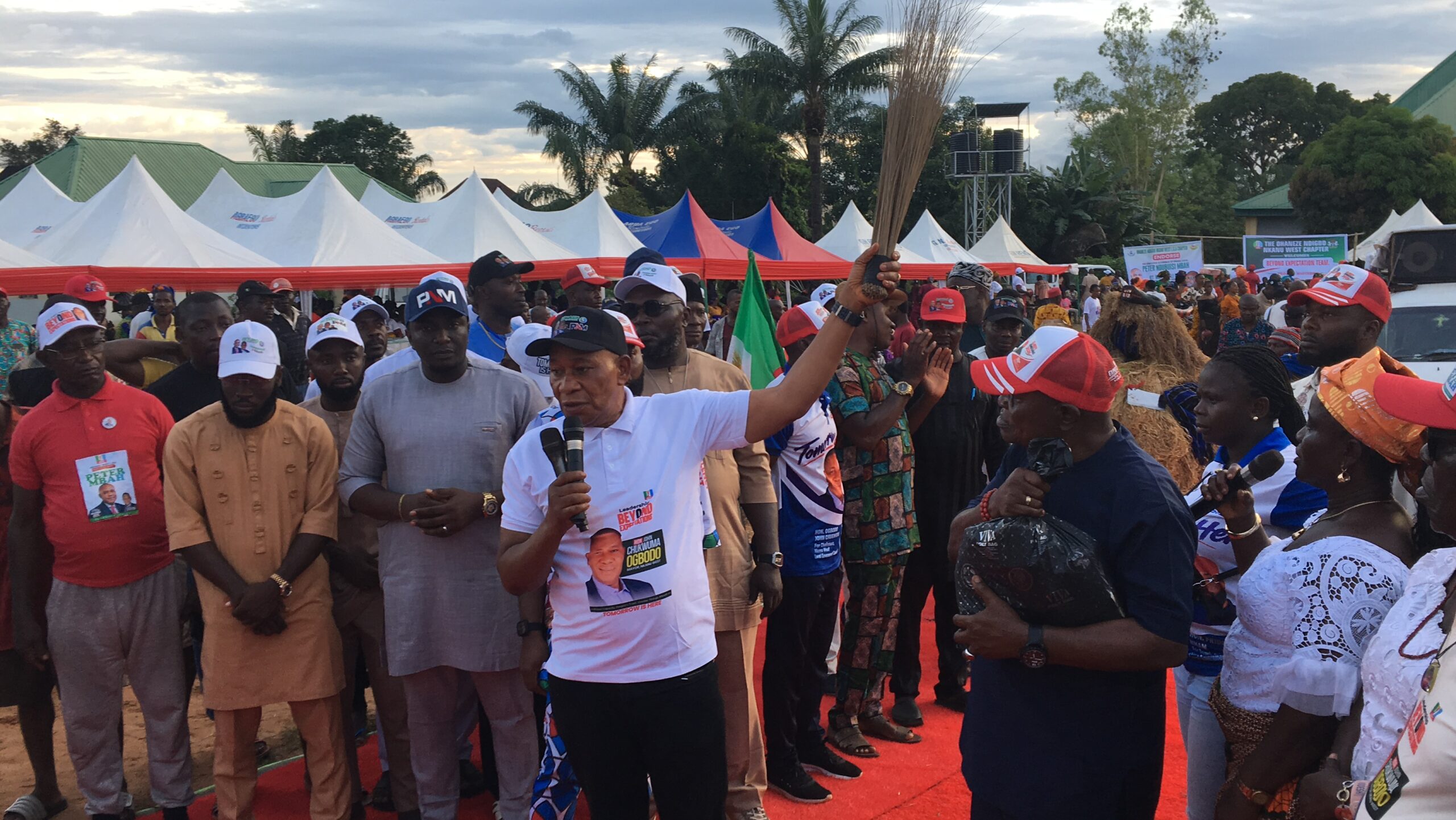
    The All Progressives Congress (APC) campaign for the September 26 Enugu State local government elections received further endorsements in Nkanu West Local Government Area as stakeholders in Obuoffia and Akpugo Ward 2 declared support for Executive Chairman and chairmanship candidate, Hon. John Chukwuma Ogbodo, and other party candidates.

    The endorsements were made during the “Beyond Expectations” campaign train’s engagements in the communities, culminating in a grand finale at Akpugo Ward 2.

    Obuoffia

    In Obuoffia, stakeholders pledged the ward’s support for all APC candidates, with the Chairman of the Nkanu West Traditional Rulers Council and Obuoffia Traditional Rulers Council, HRH Eze Barr. Igwesi Obi Igwesi, describing the choice of Governor Peter Mbah as one without a credible alternative.

    Igwesi said Obuoffia remained willing to demonstrate its solidarity with the governor, while also urging residents to support the APC candidates in the local government election.

    A former member of the House of Representatives and Enugu State Coordinator of the Renewed Hope Ambassadors for the re-election of President Bola Tinubu, Rt. Hon. USA Igwesi, also expressed support for the APC candidates.

    He said Mbah would be re-elected in 2027 and urged the people to vote for President Tinubu as well.

    Another stakeholder, Owelle Steve Avah, called on Ogbodo to convey the gratitude of Obuoffia residents to Governor Mbah over what he described as the governor’s numerous infrastructural interventions in the ward.

    Avah said the September 26 election would provide an opportunity for the people to reciprocate the support, saying:

    “Chairman, the coming election for Local Government is our own way to pay you back.

    “We have nothing much to say other than to ask God to help you, Obuoffia will help you, Nkanu will help you, Nigeria will help you”.

    The State Deputy Youth Leader of the APC, Ogonna Aneke, also declared support for Mbah and the party’s candidates, citing what he described as extensive development across Enugu State.

    Similarly, the Secretary of Nkanu West LGA, Onochie Jon-Igwesi, said past political developments had shown that Mbah had prevailed in situations where he was underestimated.

    Tracing the governor’s political journey from his former party, Jon-Igwesi expressed confidence that Mbah would again overcome his critics and secure a second term in 2027.

    Akpugo Ward 2 rally

    At the grand finale of the campaign in Akpugo Ward 2, Ogbodo, who is the incumbent Executive Chairman of Nkanu West LGA and APC chairmanship candidate, appealed to the people to support the governor and the party’s candidates in the election.

    Ogbodo said Akpugo Ward 2 comprises Ndiagu Obuno and Obununo communities and noted that no previous chairman of Nkanu West had come from the area before Mbah supported his emergence.

    “Since the start of politics, no Chairman of Nkanu West LGA has ever come from here until His Excellency graciously found me worthy, and with the support of the people, I became council chairman,” he said.

    He thanked the people for what he described as their recognition of his administration’s work across Nkanu West and appealed to them to extend their gratitude to Mbah.

    Ogbodo also highlighted infrastructure and education projects in the area, including the road linking Amodu, Akpugo, Akpawfu and Amagunze.

    According to him, the road had previously posed difficulties for residents, particularly during burial ceremonies, when ambulances reportedly stopped at a bridge and corpses were carried by hand to burial venues because of the condition of the road.

    He said the situation had changed following the ongoing road construction.

    Ogbodo further said all the Smart Schools in Nkanu West had been onboarded and equipped with modern facilities, including computers, interactive boards, boreholes and lighting.

    “So, we are eagerly waiting for January and February to reciprocate the hard work of His Excellency and all the APC candidates,” he said.

    Representing Governor Mbah at the rally, the Secretary to the Enugu State Government, Prof. Chidiebere Onyia, urged residents to vote for Ogbodo and his running mate on September 26.

    “We have only one person to vote for on September 26, John Ogbodo and his deputy,” Onyia said.

    He said he was at the rally to represent the governor and demonstrate the state government’s support for Ogbodo, whom he described as “one of the most performing mayor in Enugu State today.”

    “We fully endorse Peter Ndubuisi Mbah for 2027 because he has done a lot of work and we’re sure that he will do more. Anyone that wants to be Governor of Enugu State will have to wait after his tenure,” he said.

    The SSG further told the gathering that aspirants interested in the governorship from Nkanu West would have to wait, saying, “I know that there are people vying for Governorship in Nkanu West but there is no vacancy there.”

    Several speakers in Obuoffia and Akpugo highlighted infrastructure and education projects in the area as the reasons for their support.

    The campaign ended with APC stakeholders and supporters reaffirming their support for Ogbodo and other party candidates ahead of the September 26 local government election.

  • Keyamo Criticises Atiku Over Reference to Tinubu as ‘Bola’

    Keyamo Criticises Atiku Over Reference to Tinubu as ‘Bola’

    Precious Nwonu, Enugu

    Minister of Aviation and Aerospace Development, Festus Keyamo, has criticised former Vice-President Atiku Abubakar over his repeated reference to President Bola Tinubu by his first name during a press conference in Abuja.

    Keyamo, in a post on his X account on Friday, described Atiku’s reference to the President as “very disrespectful and discourteous”, arguing that the office of the President should be treated with dignity despite political disagreements.

    “The continuous reference to President Bola Ahmed Tinubu by His Excellency, ex-Vice-President Atiku Abubakar in his Press Conference earlier today as ‘Bola’ is very disrespectful and discourteous,” Keyamo said.

    He added that political differences should not affect the respect accorded to the office of the President.

    “He should know better that no matter your differences with Mr President, for the sake of the country, that office should be accorded all the dignity it deserves,” the minister said.

    Keyamo also took issue with the tone of Atiku’s remarks, alleging that they reflected personal grievances.

    “The tone reeks of pain and bitterness in his heart,” he said.

    The minister further referred to Atiku’s recent comments about the ages of the two politicians, arguing that it was inconsistent for the former vice-president to describe Tinubu as older than himself while addressing him by his first name.

    “After all, he made the outlandish claim the other day that Mr President is older than himself. It is therefore a contradiction that he would also refer to an ‘elder’ by his first name,” Keyamo said.

    Atiku had, during the Friday press conference, called on Tinubu to take measures to reduce petrol prices and ease the pressure of rising living costs.

    The former vice-president urged the President to consider his proposed government intervention, saying Tinubu could rename the idea and take credit for it if that would result in lower petrol prices for Nigerians.

    “Tinubu should not be ashamed to do what is necessary to lower the price of petrol simply because Atiku Abubakar proposed a government intervention.

    “He should just take the idea, rename it if he wishes, and even take the credit. What matters to me is that Nigerians pay less,” Atiku said.

    He also argued that a policy proposal should not be rejected simply because it came from a political opponent and called for measures that would provide more lasting relief to households.

    Atiku’s remarks came amid continuing concerns over petrol prices and the wider impact of energy and transportation costs on the cost of living.

  • Mambilla project: Nigeria defeats $3.38bn arbitration claims

    Mambilla project: Nigeria defeats $3.38bn arbitration claims

    Precious Nwonu, Enugu

    Nigeria has secured a major legal victory in the long-running dispute over the Mambilla Hydroelectric Power Project, with an International Chamber of Commerce arbitration tribunal dismissing claims by Sunrise Power and Transmission Company Limited that could have exposed the country to more than $3.38bn.

    President Bola Tinubu announced the development in a statement issued by the State House on Thursday, saying the ICC tribunal in Paris ruled in favour of Nigeria in the latest phase of the nearly nine-year legal battle.

    The dispute began in October 2017 when Sunrise initiated arbitration proceedings against Nigeria over an alleged breach of a 2003 agreement relating to the development of the Mambilla power project in Taraba State.

    According to the Presidency, Sunrise had sought $680m, including settlement payments and interest, in the latest proceedings, while a separate related claim involved more than $2.7bn in compensation and interest.

    The combined claims therefore placed Nigeria’s potential financial exposure at more than $3.38bn.

    The final award was issued on September 17, 2026.

    Tinubu described the ruling as a significant development for the stalled hydropower project, saying it had removed a major legal obstacle that had hindered its progress for years.

    “Today’s ICC ruling clears the single biggest legal hurdle that has paralysed the Mambilla hydro power project for years,” the President said.

    ### Tribunal dismisses Sunrise claims

    Details of the arbitration award reported by TheCable showed that the three-member tribunal rejected Sunrise’s request for a declaration that Nigeria had violated its contractual obligations under a settlement agreement and an addendum entered into by both parties.

    The tribunal also dismissed Sunrise’s demand for $400m, comprising a $200m settlement payment and another $200m described as a default payment.

    It further ruled that Leno Adesanya, promoter of Sunrise Power, was bound by the arbitration agreement with Nigeria under the settlement agreement and addendum.

    The tribunal consequently affirmed its jurisdiction over Nigeria’s counterclaims against Sunrise and Adesanya.

    As part of the award, Sunrise and Adesanya were ordered to reimburse Nigeria for 75 per cent of the legal costs and expenses incurred in defending the case.

    Nigeria’s legal expenses were estimated at $11.82m. Of that amount, $2.5m is expected to be paid from funds held in escrow by the ICC and released after notification of the final award.

    The defendants were ordered to pay the remaining $9.32m, with interest at 10 per cent annually, compounded yearly, from the date they are notified of the award until the outstanding sum is settled.

    The arbitration costs were fixed at $1.66m, with Sunrise and Adesanya responsible for 75 per cent and Nigeria responsible for the remaining 25 per cent.

    The tribunal comprised Melaine van Leeuwen as president, with Stavros Brekoulakis and Simon Nesbitt serving as co-arbitrators.

    Nigeria’s legal team was led by Elizabeth Oger-Gross and Tolu Obamuroh of Paul Hastings LLP.

    Tinubu commended Attorney-General of the Federation and Minister of Justice, Lateef Fagbemi, officials of the Federal Ministry of Justice and members of the legal team for their handling of the case.

    He also acknowledged former President Olusegun Obasanjo and the late former President Muhammadu Buhari for appearing as witnesses in Nigeria’s defence.

    “I commend the patriotism and support of former President Olusegun Obasanjo, GCFR, and late President Muhammadu Buhari, GCFR, who testified in the case,” Tinubu said.

    The President also recognised former ministers Babatunde Fashola and Suleiman Adamu, as well as other experts who participated in the proceedings.

    He credited the National Security Adviser with supporting the government’s case and the Economic and Financial Crimes Commission with investigating aspects of the dispute.

    ### Project scaled down

    The Mambilla project dates back to a 2003 agreement for the construction of a 3,050MW hydroelectric power plant in Taraba State under a build-operate-transfer arrangement.

    The project was subsequently subjected to several revisions as the government sought to make it financially viable.

    In 2016, Fashola, who was then Minister of Power, Works and Housing, described the proposed facility as a project capable of generating about 3,000MW.

    However, in February 2021, former Minister of Power Saleh Mamman announced that the government had reduced the planned capacity by about half, from 3,050MW to approximately 1,525MW.

    The reduction was intended to cut the estimated project cost by about $1bn and improve its financial viability.

    Several months later, Mamman told the Senate Committee on Power that the project had been further rescoped to approximately 1,500MW to make it “bankable” and acceptable to prospective lenders.

    The original project was estimated to cost between $5bn and $5.8bn, while the revised 1,500MW to 1,525MW project was estimated at about $4bn.

    ### Settlement dispute

    The disagreement between the Federal Government and Sunrise continued despite attempts to settle the matter.

    The parties entered into a settlement agreement in 2020, but subsequent disagreements over its implementation resulted in another round of arbitration.

    Sunrise alleged that the Federal Government failed to fulfil its obligations under the settlement and sought financial compensation.

    The latest ruling brings another chapter to the prolonged legal dispute surrounding the project.

    Despite being identified by successive administrations as a major project for expanding Nigeria’s electricity generation capacity, the Mambilla plant has yet to become operational.

    Its progress has been affected by legal disputes, financing difficulties and changes to its implementation structure.

    A Federal Ministry of Power implementation document previously listed the arbitration, completion of financing arrangements with the Export-Import Bank of China and the need to rescope the project among the issues delaying its execution.

    Tinubu said the Federal Government remained willing to work with legitimate investors and fulfil valid contractual commitments, while challenging claims it considers unjustified.

    “I want to assure you that while our country remains committed to partnering with genuine investors and honouring its legal obligations, it will continue to defend all opportunistic claims instituted against our commonwealth strongly,” he said.

    The Mambilla ruling is the latest in a series of major international legal disputes involving Nigeria and multibillion-dollar claims.

    In 2023, a UK court overturned an $11bn arbitration award obtained by Process & Industrial Developments Limited in connection with a failed gas processing agreement.

    The Mambilla dispute has also featured in domestic investigations into alleged financial misconduct. The PUNCH previously reported that Justice James Omotosho of the Federal High Court sentenced former Power Minister Saleh Mamman to 75 years in prison in absentia following his conviction in a N33.8bn money laundering and fraud case brought by the EFCC.

    The court also ordered Mamman to refund the outstanding portion of funds allegedly diverted from money earmarked for the Mambilla and Zungeru hydroelectric projects.

    Meanwhile, former Power Minister, Prof. Barth Nnaji, recently attributed Nigeria’s prolonged difficulty in attracting investment into new power plants to policy inconsistency, inadequate infrastructure and changes to financing arrangements.

    Speaking at the 2026 conference of the Nigerian Association for Energy Economics in Lagos, Nnaji discussed the country’s energy transition, the role of natural gas, financing challenges and delays affecting major projects, including Mambilla.

    He said Nigeria had gone 11 years without financing a new major power plant and linked the situation to the discontinuation of a government-backed financing mechanism introduced during his tenure.
  • ADC Raises Alarm as Petrol Price Rises to N1,470

    ADC Raises Alarm as Petrol Price Rises to N1,470

    Precious Nwonu, Enugu

    The African Democratic Congress has raised concerns over the latest increase in petrol prices, warning that the rising cost of Premium Motor Spirit is deepening the economic pressure on Nigerian households and businesses.

    The opposition party’s warning came as petrol prices at some Nigerian National Petroleum Company Limited retail outlets in Abuja rose to as much as N1,430 per litre, while prices in some locations were reported at about N1,470 per litre.

    In a statement issued on Monday by its National Publicity Secretary, Bolaji Abdullahi, the ADC said the increase was already affecting the cost of transportation, food, electricity, education and other essential services.

    The party said the impact of higher fuel prices went beyond motorists, arguing that increased transportation and operating costs were being passed on to consumers and businesses.

    “President Tinubu has turned the petrol pump into an instrument of punishment for Nigerians,” the party said.

    The ADC also expressed concern over reported increases in private school fees, with some schools allegedly raising charges by between 30 and 40 per cent.

    It said the increases were adding to the financial burden on families whose incomes had not increased at the same pace as the cost of living.

    “Parents are not earning 40 per cent more. Their salaries have not risen with the prices of fuel, food, rent, transportation and school fees,” the party said.

    The opposition party, however, acknowledged that school proprietors were also facing higher operating expenses, including electricity bills, fuel costs, taxes, rent and staff salaries.

    The ADC urged President Bola Tinubu’s administration to take urgent measures to ease the pressure on households and businesses, warning against interpreting Nigerians’ ability to cope with the situation as acceptance of government policies.

    Meanwhile, checks at several NNPCL retail outlets in the Federal Capital Territory showed that petrol was being sold at between N1,395 and N1,430 per litre.

    The latest prices represent increases of between N50 and N80 per litre, depending on the location.

    The new pump prices were observed at NNPCL stations around Airport Junction, Gwarinpa, Kubwa Expressway, Wuse Zone 4 and other parts of Abuja and its environs.

    However, Sunday Asefon, National Director of Students Engagement of the City Boy Movement and Senior Special Assistant to the President on Students Engagement, attributed the latest petrol price increase to international market pressures rather than subsidy removal alone.

    In a statement titled, “The Pain Is Not From Subsidy Removal, It’s From Geopolitical Tensions Including the War in the Middle East,” Asefon linked the development to tensions involving the United States, Iran and Israel.

    He argued that the rise in petrol prices from about N800 per litre at the Dangote Petroleum Refinery’s gantry to between N1,300 and N1,400 at filling stations could not be explained solely by the removal of fuel subsidy.

    “The real enemy is the ongoing global geopolitical tension. The missiles being fired by the United States, Iran and Israel are the unseen hands shaping the global oil market,” Asefon said.

    He pointed to instability around the Strait of Hormuz, a major route for global oil shipments, as another factor capable of affecting international crude prices and, consequently, domestic petrol costs.

    According to Asefon, the Bank of England had warned that a complete disruption of the waterway could push global crude prices to between $100 and $130 per barrel.

    The contrasting positions come as Nigerians continue to contend with higher fuel and transportation costs, with the latest pump price adjustments adding to concerns over the cost of living.

  • Atiku Knocks Tinubu Over 24.7tn Borrowing, Says Government Is Choking Businesses of Credit

    Atiku Knocks Tinubu Over 24.7tn Borrowing, Says Government Is Choking Businesses of Credit

    Atiku says government borrowing surged to N24.7tn despite higher oil prices, squeezing private-sector credit and worsening economic hardship.

    Former Vice President, Atiku Abubakar, on Monday described the federal government’s ‘unprecedented’ appetite for domestic borrowing as evidence of dangerous fiscal indiscipline that is starving Nigerian businesses of credit, killing jobs and worsening the cost-of-living crisis.

    In a statement issued by his Senior Special Assistant on Public Communication, Phrank Shaibu, Atiku said it was particularly alarming that the Bola Tinubu administration continues to borrow at such a frightening pace at a time when crude oil prices have risen substantially above the assumptions upon which the 2026 budget was built.

    “At the beginning of this fiscal year, the federal government budgeted on an oil benchmark of $64.85 per barrel. Today, crude oil prices have risen substantially above that benchmark.

    “Yet, instead of this windfall translating into lower borrowing, stronger businesses and relief for Nigerians, the federal government went into the domestic market and borrowed a staggering N24.7 trillion between January and August 2026 — 90.5 per cent more than the N12.98 trillion borrowed in the corresponding period of 2025.

    ‘’This is a government borrowing like drunken sailors in the middle of a revenue windfall. Tinubu removed fuel subsidy and told Nigerians the sacrifice would free up money. He floated the naira and government revenues consequently received a massive nominal boost. Oil prices have risen sharply. Revenues have improved. Yet the borrowing has not gone down — it has exploded,” the former vice president stressed.

    According to him, Nigerians must begin to ask what the money saved fromfuel subsidy has been spent on.

    “What makes this recklessness even more damaging is that the government is now competing directly with Nigerian businesses for money. Credit to the government grew by 43 per cent, while credit to the private sector grew by only 9.6 per cent. Government credit is expanding about 4.5 times faster than credit to businesses.

    “This is yet another troubling signal that the Tinubu economic reforms have failed to produce any meaningful impact on the private sector,’’ Atiku added.

    Atiku said that ordinarily, the outlook and performance of the private sector should serve as one of the clearest yardsticks for measuring the effectiveness of government economic policy.

    He said: ‘’If businesses are expanding, investing, hiring and gaining easier access to capital, then reform can claim some measure of success.

    “But under Tinubu’s economic policy, the exact opposite is happening. The public sector is exerting an increasingly parasitic effect on the private sector — consuming the credit, capital and financial oxygen that productive businesses desperately need. That, at a glance, is one of the clearest indictments of the failure of these so-called reforms.

    “When banks can lend to the government at attractive, risk-free rates, why would they lend cheaply to the manufacturer in Aba, the furniture maker in Kaduna, the agro-processor in Kano or the young entrepreneur in Lagos?

    “The result is obvious: businesses pay more for credit, expansion is postponed, factories struggle, jobs disappear and the cost of producing everything from food to household goods rises. This government is not merely borrowing money; it is borrowing away the future of Nigerian businesses.”

    He stated that Nigeria cannot achieve prosperity by allowing the government to swallow the credit that should finance production, stressing that an economy grows when businesses borrow to build factories, farmers borrow to expand production and entrepreneurs access affordable capital to create jobs.

    “My administration will impose fiscal discipline, cut waste, prioritiseproductive expenditure and progressively reduce the government’s suffocating dependence on the domestic credit market.

    The government must make room for the private sector to breathe, invest, produce and employ.

    “After three years of sacrifice, Nigerians deserve to see what happened to the subsidy savings, the additional revenues and the crude-oil windfall. You cannot collect more, earn more and still borrow more — while asking hungry Nigerians to sacrifice more. Something is fundamentally wrong with that equation,” he argued.

    Meanwhile, the African Democratic Congress (ADC) on Monday alleged that the Auditor-General’s finding that N33.75 billion in cash transfers to 3.29 million households cannot be verified was proof that under Tinubu, social investment had become a racket run for the benefit of officials, not the poor.

    In a statement, ADC’s National Publicity Secretary, Mallam Bolaji Abdullahi, stated: “Let us call this what it is. Not mismanagement. Not an oversight. It is an organised racket, which this government has run under the guise of a social intervention programme. They are stealing from the poor and telling them to continue to endure hardship.

    “This latest report of an unaccounted N33.75 billion intervention fund, buried inside a larger N78 billion fund, and the historical pattern of corruption that has trailed this kind of programme would suggest that this government has found a way to steal from the poor by turning the social intervention programme into a criminal enterprise,” the party stated.

    Abdullahi said instead of the federal government addressing the wanton corruption associated with such interventions in the past, it has announced an even bigger package of $1 billion without demonstrating that it has made any effort to ensure greater transparency and accountability.

    “Barely weeks before this audit blew up in their faces, they wheeled out a new $1 billion so-called ‘Renewed Hope Social Protection Programme’ with the usual State House fanfare. Given the familiar history, we are in no doubt that even in the unlikely event that this latest intervention is ever implemented, it would end up like the others before it: another racket.”

    While demanding a full probe into the scheme, the ADC noted that interventions such as this became necessary because the APC government has made it impossible for people to earn a dignified living.

    “Their twin disastrous policies of fuel subsidy removal and currency devaluation have exploded the population of Nigerians living in extreme poverty and therefore needing cash handouts from the government, which has now become a mere pretext for stealing in the name of the poor.

    “This is a government that manufactured hardship with one hand and pocketed the relief with the other. Fuel prices up. Transport costs up. Food prices up. And the one programme meant to soften the blow turns out to be a black hole. Enough is enough,” it added.

    The party, therefore, demanded the immediate publication of the full beneficiary register, the REMITA payment trail, and the names of every official who obstructed the auditor-general. Arise News


  • President Tinubu and the Antiquity of Hunger

    President Tinubu and the Antiquity of Hunger

    -By Abdul Mahmud

    “There was hunger before I was born,” President Bola Tinubu told the Catholic Bishops. He is right, only to the extent that hunger did not begin with him. Neither did it begin with Muhammadu Buhari, Goodluck Jonathan, Umaru Musa Yar’Adua, Olusegun Obasanjo, Abdulsalami Abubakar, Sani Abacha, Ibrahim Babangida, nor any single occupant of Aso Rock. Hunger has stalked Nigeria through military rule and civilian governments alike, surviving constitutions, economic reforms, structural adjustment programmes, oil booms and democratic transitions. The more important question, however, is not whether hunger existed before he was born, but why it still exists after more than six decades of independence and why every generation of political leaders has found explanations more readily than solutions.

    This is the question he must answer.

    History may explain the origins of a problem, but it cannot excuse its persistence. Every President inherits unfinished business from its predecessor; none inherits the right to treat inherited suffering as an adequate defence of present performance. The legitimacy of political power lies in its capacity to interrupt history’s cruelties rather than recount them. When citizens complain of hunger, they are not asking for a lecture on its antiquity; they are asking what the President is doing to ensure that their children do not inherit the same empty stomachs that haunted their parents and grandparents. In this respect, the President’s remark carries an unintended irony: an admission that the Nigerian state has repeatedly failed to discharge one of its most elementary obligations by creating the economic conditions that force citizens to go to bed hungry daily.


    This, however, is only one way of reading the President’s words. There is another, and perhaps more troubling, interpretation. The statement suggests a President whose understanding of the country is increasingly mediated by the protective layers that invariably surround political power. It is difficult to listen to a remark that treats hunger as a historical inheritance without wondering whether those who stand between the President and the people have succeeded in insulating him from the immediacy of the suffering outside the gates of government. Hunger may have existed before he was born, but the hunger confronting Nigerians today is not an historical abstraction; it is today’s reality, demanding today’s response. Power has always had a peculiar tendency to create its own reality. Every presidential palace in history has always developed mechanisms for protecting presidents from uncomfortable truths. Courtiers once performed that function. Today, it is discharged by image-makers and gatekeepers who often mistake loyalty for the suppression of truths. Their instincts, which rarely convey the voices of the people into the seat of power, convey the preferences of the president’s men back to the people. Between instincts and preferences, truth is frequently the casualty. The separation begins when official briefings are treated as more reliable than the  the lived experiences of ordinary citizens.

    There is, of course, no honest argument that Nigeria’s present economic difficulties were created solely by the present administration. The structural weaknesses of the economy accumulated over decades. Dependence on oil revenues, weak industrial capacity, chronic fiscal indiscipline, insecurity in agricultural communities, persistent currency instability and the failure to build resilient social protection systems long predate President Tinubu. Yet that acknowledgement strengthens rather than weakens the obligation resting upon the present government. Democratic elections do not transfer only power; they transfer responsibility. Every President inherits yesterday’s failures together with the duty to prevent them from becoming tomorrow’s inheritance. The greatest leaders have always understood that the first duty of political power is not merely to govern but to remain teachable. Governments that lose the capacity to hear unpleasant truths soon lose the capacity to correct their mistakes. Democracies survive because citizens possess the freedom to tell those who govern that their experience differs from official optimism. Whenever that conversation becomes obstructed by gatekeepers who regard criticism as disloyalty or by advisers who fear delivering unwelcome news, the President begins governing an imaginary country while citizens continue living in the real one.

    President Tinubu’s statement should therefore be heard as more than an observation about history. It should serve as an invitation to examine the distance between political power and public reality. Hunger existed before he was born. It also existed before he became President. Those are historical facts. The question that history will ask, however, is not whether he correctly identified the antiquity of hunger. It is whether, having acknowledged its long history, he succeeded in shortening it. That is the measure by which every democratic leader is remembered. History explains where suffering begins. Leadership is judged by whether it allows suffering to continue. No President earns distinction by reminding the hungry that hunger is old. Distinction belongs to the leader who ensures that future generations can no longer truthfully say, “There was hunger before I was born.”