Tag: 2027

  • 2026 and the Architecture of Power: Understanding The Tinubu Presidency

    2026 and the Architecture of Power: Understanding The Tinubu Presidency

    -By Abdul Mahmud

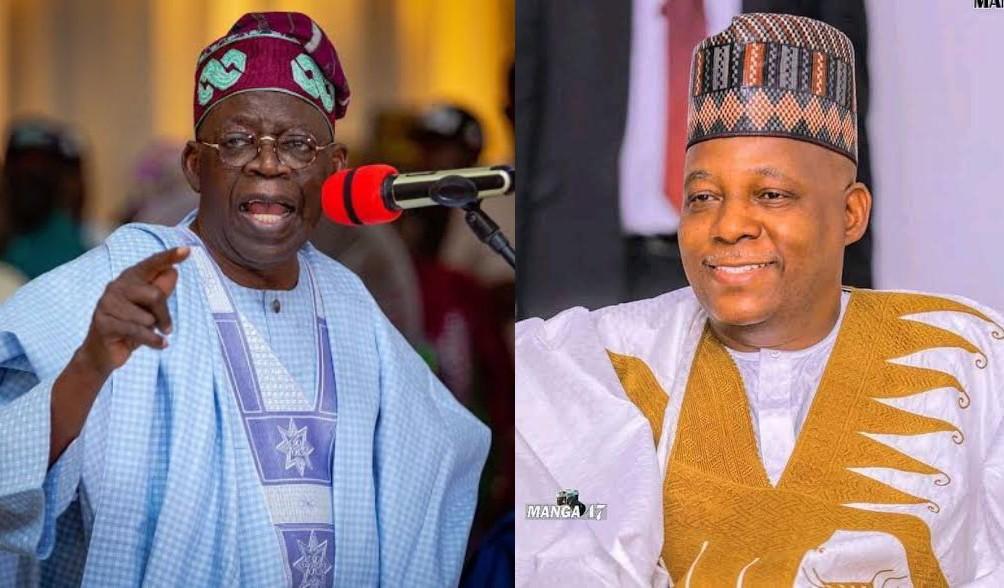
    This new year scarcely requires a seer to reveal its gravity. It stands as a decisive threshold for both Nigeria’s political class and the country itself. As the final full year before the 2027 general election, it unfolds within an atmosphere markedly defined not by open contestation but by cooptation, not by ideological opposition but by realignment, not by persuasion but by careful calibration of power. The familiar nuances of electoral politics have been subdued, replaced by a quieter, sinister and more strategic choreography in which alliances are absorbed, dissent is neutralised, and political outcomes are increasingly prefigured long before the ballot is cast. Tinubu’s Presidency has thus inaugurated a governing order that resists casual description and demands sustained, rigorous analysis. Authority has grown more personalised, institutions have been subtly but decisively reoriented, and the space of democratic life has narrowed. Power is no longer primarily fought over; it is managed, conserved, and deployed through configurations that feel increasingly distant from Nigeria’s recent political experience. What is taking shape is not simply a new leadership style, but a political condition in which the contest for power has yielded to the meticulous administration of power already secured.

    So, what’s really taking shape?

    Tinubu’s presidency marks a formative phase of governance characterised by the consolidation of authority through elite bargaining, the steady attenuation of democratic institutions, and the managed retreat of competitive politics. It does not announce itself as ideological. No manifesto declares its worldview, and no doctrine articulates its philosophical commitments. Instead, it operates as a governing illogic grounded in transactional politics, and the strategic deployment of state power in the service of endurance. Its coherence lies not in ideas but in method. At the centre of this method is elite cooptation and coordination. Power circulates within a narrow political circle where loyalty is sustained by access, protection, and reciprocal advantage. Alliances cohere less around programmes than around proximity to authority. The ruling party functions primarily as an instrument of aggregation, not as a forum for deliberation or contest. Opposition persists within formal constitutional boundaries, but its capacity to shape outcomes continues to contract. Politics increasingly resembles a closed conversation conducted beyond the reach of popular intervention. Elections still punctuate the political calendar. Ballots are cast, results announced, courts convened, and ceremonies observed. Democratic form remains intact. Democratic substance, however, undergoes a quiet but persistent erosion. Participation thins as belief in the consequences of electoral choice diminishes. Voters engage with the process less in hope than in resignation. Political competition loses its transformative promise, reduced to a symbolic presence within an already determined architecture of power. The vote comes to affirm authority more than to interrogate it.

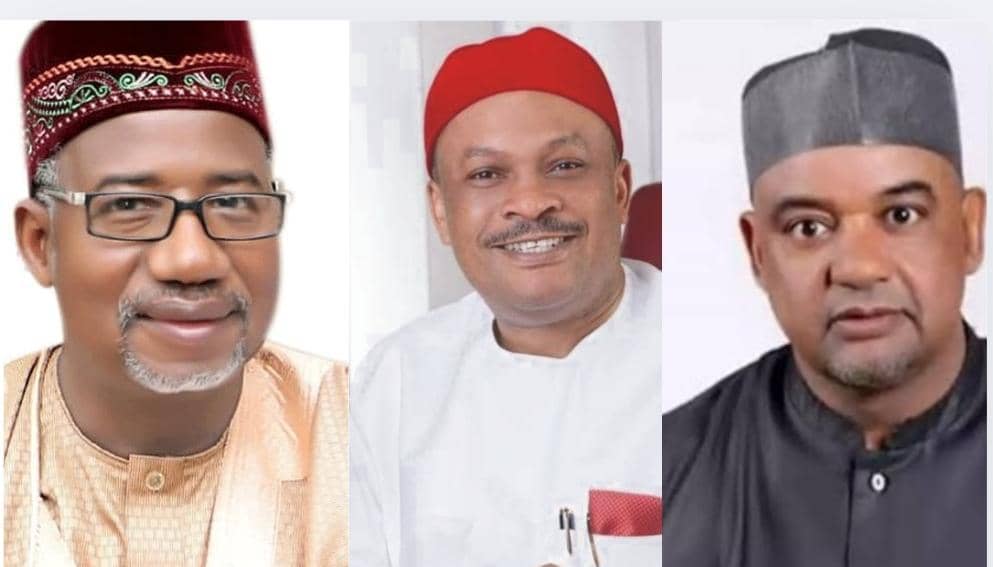
    This configuration invites comparison with certain early authoritarian systems, not in ideology or historical circumstance, but in structural logic. In those settings, power was consolidated through the fusion of party, state, and patronage, yielding stability through alignment rather than consent. Tinubu’s presidency reflects a comparable pattern. Control advances less through open persuasion than through administrative coordination. Loyalty steadily displaces representation as the central political currency, while stability is secured through managed inclusion and calibrated exclusion. What emerges is not the silencing of politics but its careful containment, a narrowing of the space in which dissent may operate without ever quite disappearing. It is within this logic that the recently constituted high-level party committee must be understood. Comprising governors of the ruling party, members of the Federal Executive Council, and other strategically placed stakeholders, the committee is chaired by the Governor of Yobe State, Mai Mala Buni, with Muiz Banire, former Legal Adviser of the APC, serving as Member-Secretary. Its membership spans the commanding heights of political power: Senator Adamu Aliero; AbdulRahman AbdulRazaq of Kwara State, who chairs the Nigeria Governors’ Forum; Hope Uzodimma of Imo State, Chairman of the Progressive Governors’ Forum; and governors from Benue, Jigawa, Cross River, Ekiti, and Delta. It also includes Governors Uba Sani of Kaduna and Siminalayi Fubara of Rivers, senior ministers of the Tinubu administration, former governors, and key presidential aides. The committee’s composition is revealing. It gathers together not merely party functionaries, but custodians of state power, administrative reach, and regional influence, signalling an effort to synchronise authority across multiple layers of governance.

    This architecture points to a broader project: the consolidation of a pan-Tinubu suzerainty that extends beyond party boundaries while steadily hollowing out the opposition. President Tinubu’s rhetoric of accommodation and tolerance, framed as a defence of democratic resilience, sits uneasily alongside the political realities taking shape. As Oyo State Governor Seyi Makinde has suggested, the role attributed to Nyesom Wike within this order is not incidental but instrumental, working across party lines in ways that weaken and fragment the opposition, particularly the PDP. The aim is not the outright abolition of rival parties, but their domestication. Opposition is permitted to exist, but only in diminished, divided, and ultimately manageable forms. In this sense, inclusion becomes conditional, tolerance selective, and pluralism subordinated to the overriding imperative of control. What is being constructed is a political order in which unity is achieved not through persuasion or shared purpose, but through dominance carefully disguised as consensus.

    Governance within this order privileges coherence and control over pluralism and dissent. Institutions remain visible, but their autonomy steadily contracts. Courts continue to function, though within a narrowing interpretive space. Legislatures exercise oversight through accommodation and bargaining rather than confrontation. Regulatory bodies increasingly align their conduct with executive priorities. Media organisations operate under diffuse but effective pressures that shape tone, emphasis, and silence. The outward continuity of institutional life thus conceals a deeper transformation in which independence yields to accommodation and restraint is replaced by compliance. Law sits at the centre of this transformation. Legal process retains its formal authority, but its connection to justice and accountability grows attenuated. Rules are deployed less as limits on power than as instruments for preserving stability. Procedure displaces principle. Political conflict is absorbed into litigation, translated from public disagreement into technical argument. Judicial outcomes, in turn, tend to affirm the prevailing distribution of power, conferring legal legitimacy on arrangements fashioned elsewhere. In this way, law operates not as an impartial arbiter but as a governing mechanism, ordering conflict rather than resolving it. Economic governance extends this same logic into the material lives of citizens. Policies presented as reform advance largely through executive fiat, with minimal public deliberation. Hardship is framed as necessity rather than consequence, sacrifice as virtue rather than failure. Social pain is moralised as discipline, while the language of inevitability accompanies decisions that reorder livelihoods, deepen inequality, and strain communal bonds. As legal process neutralises political contestation and institutions absorb dissent, economic policy completes the circuit of control. Public consent recedes in importance, displaced by appeals to expertise, urgency, and endurance. What emerges is a political economy in which adjustment replaces accountability, and endurance stands in for consent.

    In this political atmosphere, citizenship is quietly reconfigured. Active participation gives way to managed inclusion, while political agency is reduced from the capacity to shape outcomes to the freedom to comment upon them. Protest increasingly attracts securitised responses, and dissent is recoded as disruption rather than recognised as democratic expression. The public sphere does not collapse through decree; it contracts through mood and expectation. Fear need not be declared to be effective. Caution becomes internalised. Silence acquires the character of prudence rather than resignation. This transformation proceeds without the spectacle of overt repression. No dramatic bans signal a rupture with constitutional order. No formal emergency suspends democratic norms. Instead, change unfolds cumulatively. Each adjustment appears technical, even reasonable, when taken alone. Together, they produce a political climate marked by compliance, calculation, and quiet withdrawal. Democratic life thins through attrition rather than shock. What remains is not an absence of politics, but a diminished version of it, one in which engagement is carefully weighed against consequence, and participation is increasingly symbolic.

    Opposition is also redefined under these conditions. Critics are rarely confronted head-on; they are more often absorbed into negotiation, fragmented through inducement, or marginalised by selective exclusion. Disagreement persists, but it is stripped of leverage. Public intellectuals, activists, and commentators operate within a narrowing field where critique circulates without effect. Alternative visions struggle to gain traction because power presents itself not as a contingent arrangement open to challenge, but as a settled fact to be navigated. Politics shifts from contest over direction to adjustment within constraint. Patronage functions as the stabilising mechanism of this order. Access to state resources becomes the primary currency of loyalty. Appointments reward alignment, contracts reinforce networks, and economic opportunity increasingly follows political obedience. Dependency and compliance intersect, recasting the state from guarantor of collective welfare into distributor of selective benefit. As perceptions of fairness decline, public trust erodes. The language of corruption loses its moral urgency, reframed as an unavoidable feature of governance rather than an ethical failure demanding redress. Against this backdrop, the idea of reform assumes strategic importance. Reform rhetoric provides the moral cover through which consolidation is presented as progress. Structural adjustment is dressed in the language of modernisation; disruption is recast as courage. Resistance to reform is portrayed as nostalgia, sentimentality, or irresponsibility. In this way, critique is neutralised not by rebuttal but by delegitimation. Power is framed as necessity rather than choice, endurance as virtue rather than submission. The effect is not merely to govern policy outcomes, but to shape the terms on which political judgment itself is made.

    This condition shapes the national mood as Nigeria approaches 2026. Political expectation declines, cynicism spreads, and withdrawal often replaces engagement. Survival displaces aspiration. Younger generations encounter politics as a closed system rather than an open field, and hope shifts from public institutions to private strategies. Migration, informal economies, and personal networks emerge as alternative pathways to security. The danger lies not only in democratic erosion, but in habituation: as citizens adjust to limited agency, the possibility of recovery diminishes. Democratic capacity weakens through disuse, and memory of contest fades. Power consolidates not merely through control, but through the quiet acceptance of constraint. Naming this phase of governance as a distinct moment in Nigeria’s democratic trajectory performs both analytic and political work. It resists the personalisation of critique, framing Tinubu’s presidency as a system of governance rather than a reflection of temperament. It signals temporality, marking a phase rather than an immutable fate. Such naming preserves space for reflection, intervention, and alternative futures.

    The New Year is here. The architecture of power established during this formative period will shape what is possible. Whether this governing illogic hardens into permanence or encounters disruption will depend upon forces both within and beyond the state. That inquiry belongs to the next part of this essay, which turns to the prospects for politics and democracy under conditions shaped by consolidation, fatigue, and quiet resistance. For now, Tinubu’s presidency stands as a defining moment in Nigeria’s democratic journey: a moment of form without substance, of power without persuasion, and of consequences whose reverberations will extend far into 2027.

    Happy New Year. 
  • Mbah’s Defection to APC Strategic for Enugu, South East – USA Igwesi

    Mbah’s Defection to APC Strategic for Enugu, South East – USA Igwesi

    Former House of Representatives member, USA Igwesi, has described Governor Peter Mbah’s defection to the All Progressives Congress (APC) as a bold and strategic move for the people of Enugu State and the South East region.

    Speaking with journalists in Enugu, Igwesi said Mbah’s decision to move with the entire Peoples Democratic Party (PDP) structure was “timely and visionary,” reconnecting the Coal City State to the nation’s political mainstream after years in opposition.

    “Governor Mbah is smart and strategic. He knows what and when to act. Everyone who followed events in the PDP knows he had had enough of the shenanigans in that party. The PDP is irredeemable, and its crises are self-inflicted. Enugu people are happy with his decision,” he stated.

    Igwesi, a former Majority Leader of the Enugu State House of Assembly, said the governor’s alignment with the Federal Government would accelerate development across the state. “With Enugu and Abuja now under the same party, Mbah’s mission to reposition the state is fully assured,” he said.

    He noted that the massive turnout during Mbah’s defection reflected genuine grassroots support. “The holistic political shift from PDP to APC will reinforce the governor’s visionary infrastructural revolution,” he added.

    According to him, Governor Mbah will be remembered for reconnecting Enugu to the national political grid after years of isolation.

    Igwesi lamented that despite the South East’s decades-long loyalty to the PDP, the zone gained little in return. He argued that Mbah’s switch to the APC serves the region’s strategic interests.

    “The move is significant because it aligns Enugu and, by extension, the South East with the political mainstream. It makes no sense for Enugu, the capital of the region, to remain in opposition,” he said.

    Igwesi further praised Mbah’s leadership record, noting that his defection would give fresh impetus to the state’s infrastructural transformation.

    “Governor Mbah’s defection will strengthen Enugu’s ties with the Federal Government and help the entire South East benefit from President Bola Tinubu’s Renewed Hope Agenda,” he said.

  • 2027: Enugu APC Stakeholders Woo Governor Mbah to Join Party

    2027: Enugu APC Stakeholders Woo Governor Mbah to Join Party

    Doris Ewoh, Enugu

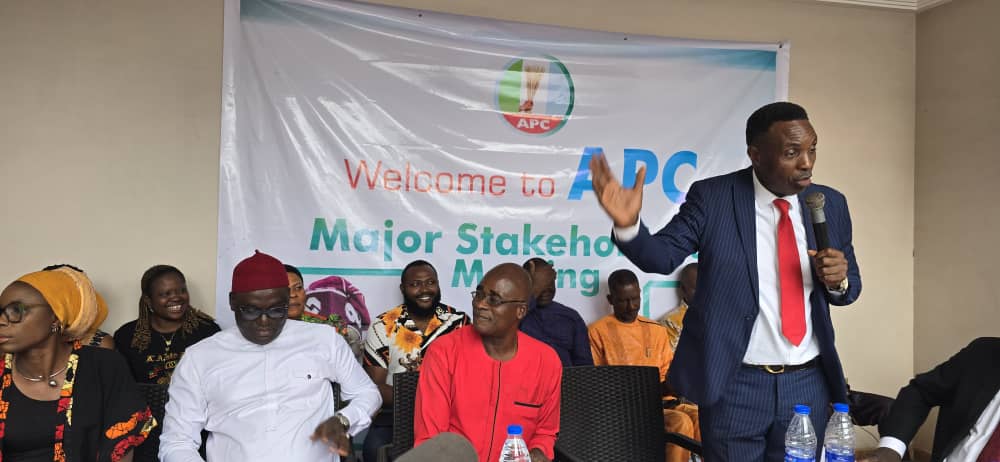
    At a strategic stakeholders’ meeting in Enugu, APC leaders, including Dr. Ben Nwoye and Barr. Eugene Odo, have signaled their readiness to welcome Governor Peter Mbah into the party, as internal rifts over leadership and integrity continue to stir debate.

    This declaration was made during the Enugu APC Stakeholders’ Meeting held on Tuesday, August 26, 2025, at De Sheriff Hotel, Enugu, which was monitored by several members of the press, including PACESETTER correspondent. The meeting focused on the theme: “Repositioning APC Enugu State to Win Elections in 2027 and Beyond.”

    Speaking at the meeting, Dr. Nwoye emphasized that the only way to sustain the current legacy and development in Enugu State is for Governor Mbah to continue beyond 2027. He appealed to Mbah to join the APC, noting that every new member strengthens the party.

    Following this, a motion was moved by Dr. El Ajah to formally accept Governor Mbah into the party if he chooses to join. The motion was seconded by Comrade Ngene Obama, and unanimously supported by all members present.

    Barr. Eugene Odo, former Enugu House of Assembly Speaker, also expressed his support, stating that he would be pleased if Mbah joined the APC. He went further to reference a recent Enugu State High Court ruling declaring that Ugo Agballa is no longer the state chairman of the party and should cease parading himself as such.

    Odo also addressed ongoing controversies involving the Minister of Innovation, Science and Technology, Hon. Uche Nnaji, who, he said, has been accused of presenting a fake certificate. He called on the party leadership to set up a committee to visit the University of Nigeria, Nsukka, to verify the Minister’s academic credentials.

    “We want to advise the leadership of the party to possibly set up a committee to go to the University of Nigeria, Nsukka, to confirm, so we can know what the Minister represents,” Odo said.

    Also speaking, Barr. Bartholomew Ugwuoke, former ACN chairman, noted that the “genuine APC” is back in Enugu and called on former members to return, saying, “We are moving fast.”

    In his remarks, Hon. Sunday Onah, Deputy Chairman of the party, cautioned Chief Uche Nnaji on the continued support of Barr. Ugo Agballah, alleging that Agballah was expelled as state party chairman.

    He noted that the State Working Committee would be left with no option but to take disciplinary action if the support continued.

    Barr. Godwin Onwusi, Chairman of the 2023 House of Assembly APC Aspirants Congress, criticized the party’s recurring practice of suspending members.

    “I have never seen a party where the stock-in-trade is to sack people. People come in, and when asked to view things from different angles, they get suspended. We cannot leave our party to birds of passage. These people will come and go. Hopefully, we are here to take back our party,” he said.

    Mrs. Kate Nwafor, former Enugu State APC Publicity Secretary, expressed optimism, stating that with the renewed direction, the APC in Enugu is returning to its original path and purpose.

    “With this new trend, I’m confident we are going back to our original stance to become what we used to be,” she said.

    Reacting to the allegation of forgery of results by the Minister, an Enugu APC youth leader, Chidiebere Ezeh, who spoke to our correspondent over the phone, stated that the allegations were “just propaganda”.

    “This is a non-issue, as it’s just propaganda by the opposition to tarnish the image and name of Chief Uche Nnaji.

    “The DSS and other relevant bodies screened him before his assumption of office, so if there are any issues of certificate forgery, the DSS and NYSC should be in a position to address that.”

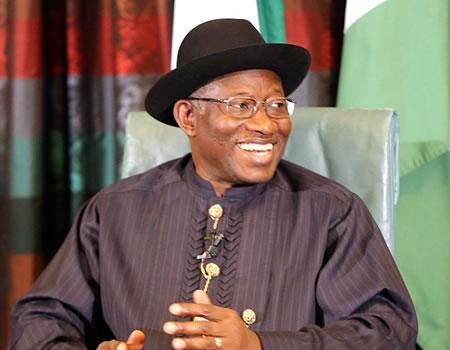
  • GEJ, Please, Don’t Go There – By Oseloka H. OBAZE

    GEJ, Please, Don’t Go There – By Oseloka H. OBAZE

    Good day, President Jonathan.  In the local parlance of Otu Eke and Otu Nkwo, I come in peace.  Sir, may I ask a question you need to ponder deeply before you respond? Did you forget anything at the Aso Rock Villa?  Regardless of the answer, Sir, here is the generalized message.  Please do not under any circumstance be lured or swayed by any individual, group or political party into seriously considering running again for the Nigerian presidency, especially in 2027. GEJ, please, don’t go there.

    Those who contrive such machinations merely wish to deal you a bad and devilish political hand. Your running will not serve your purpose; and it will not add fillip to nation-building.  It will merely worsen the prevailing leadership hubris, political disequilibrium, distrust and national miasma.

    Hence, you must reject the poisoned chalice being dangled before you. The purveyors are the same political cabals that betrayed you, destroyed your erstwhile presidency and hounded you out of the same presidential office that they are now egging you on to attempt to reoccupy. What changed? Nothing! Please don’t even think of it. If you do, you may face a stormy backlash. History will forever be unkind to you. That’s the truth; and I will offer other cogent reasons.

    First, the constitutional validity of your making another (technically third) run at the Nigerian presidency after having been sworn in twice is fraught with controversy and imponderables. In my simple, but not-so-legal mind, you are no longer eligible to contest. If you run and win, the same cabal will use the courts to abort your victory, and take over the presidency. Please don’t humour them!

    Second, those pushing you to run were the same people who tried to block you from legally succeeding indisposed President Umaru Yar’Adua, thus compelling the invocation of the Doctrine of Necessity. They only want to use your running in 2027 to forestall Peter Obi and the southeast from having a shot at the Nigerian presidency. They serve primordial interests and are neither reformed nor converted.

    Third, to those pushing for your presidential run, your candidacy merely represents a default fourth strategic option. First, they are disgusted with the Tinubu-Shettima Muslim-Muslim ticket, which they foisted on secular Nigeria.  Second, they don’t want Peter Obi and his one term declamation out of fear that it might turn into a full eight-year term. And third, they know that no Northerner can win the presidency in 2027, given that it is the second segment of a southern eight-year mandate. Ostensibly, you are their fourth choice and expedient tool; not necessarily a credible alternative. They believe that constitutionally, you are, ab initio, limited to one term. That’s what makes you attractive to them.

    Fourth, in April 2011, the southeast zone delivered the largest chunk of 22.4 million votes that guaranteed your winning that presidential election.  The southeast zone delivered 97.2% of their cumulative votes to you. Mr. President if you run and foreclose on a southeast candidate, you won’t get those southeast votes, and your candidacy will surely smack of ingratitude. Nigerians don’t know you as an ungrateful person. Don’t alter that attribute and humility. Keep your credibility intact.

    Fifth, the incumbent administration has notoriously weaponized the use of governmental institutions to harass the political opposition or “forgive the sins” of those malleable few, who are willing to join them.  Don’t bet that they will not come after you if you ever decide to challenge the status quo.

    Sixth, it’s only the cabal’s groupthink that makes it utterly seductive to suggest that your candidacy represents the most formidable rallying impetus for the national alliance required to unseat President Bola Tinubu and the APC. Yet, your candidacy will be the proverbial double-edged Brutusque sword that cuts both ways, and very deep too.

    Finally, Sir, your credentials as an elder statesman have grown exponentially both at home and abroad since you left office on 29th May 2015. Don’t alter that trajectory for no just cause.  Your  decision not to run will do more for nation-building than the decision to run.  Nonetheless, the decision is yours.  But history will ultimately, be the judge. If my analysis seems presumptuous, please pardon me.  As a student of politics and a patriot, I’ve only elected to speak truth to power.

    ——

    Obaze is MD/CEO, Selonnes Consult – a policy, governance and management consulting firm in Awka.

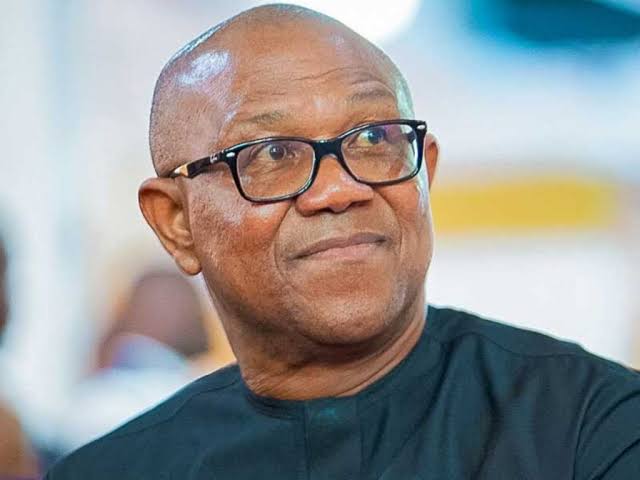
  • Run, Peter, Run…

    Run, Peter, Run…

    By Oseloka H. Obaze

    When I appeared on Arise Prime Time interview with Charles Aniagolu on 2nd June, 2025, I said amongst other things, that any political opposition coalition for the 2027 presidency, which did not include Peter Obi, will not succeed. I stand by that statement. From the caption of this piece, any discerning reader would have already guessed the singular objective of this write-up; to encourage Peter Obi not to be deterred by any force or persuasion from running for the Nigeria presidency in 2027. Here’s the upshot. If Obi runs, he might not win; if he does not run, he is guaranteed not to win.

    The fate of Nigeria hangs on the balance. Most of the Nigerian masses desirous of real leadership change, regardless of their social stratification, education, religion, tribe or political affiliation, hardly consider any person – not Bola Tinubu, Atiku Abubakar, Goodluck Jonathan, Rabui Kwankwaso, Rotimi Amaechi, Aminu Tambuwal, Bukola Saraki or Nasir El-Rufai – as genuinely representing their hope, better than Peter Obi. As contentious as this assertion may seem, it’s no hyperbole. That’s the conflated perception and reality in present day Nigeria.

    Some politicians with vested interests, who understand this reality fully, are already fighting back. They are strategically deploying all forms of trolls and subterfuge to demarket Peter Obi. Corruption is also fighting back, albeit, covertly. The onslaught against Peter Obi is so well oiled and funded; you’d think he is the only person running for the presidency in 2027. Obi’s delegitimization and demythologization are being orchestrated by those awestruck by fear. Two years away from the 2027 presidential election, pre-purposed and pre-positioned media goons are already traducing and pummeling Peter Obi without let or hindrance. Also, those hired hands pretending to be from Obi’s Igbo tribe, are rendering what they want many to believe are even more persuasive, potent, and factually damaging anti-Obi sentiments. They are dredging up vexatious dregs. The assault was long anticipated by those of us aligned with Obi. Still, some heady questions persist: who is afraid of Peter Obi’s presidency and whatever hope it holds out for Nigeria or whatever ill-fate it portends for members of Nigeria’s political elite that belong to the roguish fringe?

    Peter Obi is not a saint. He is the first to admit that publicly. Those who have worked closely with him don’t always agree with him. But he listens. He reads and accepts bad news. He accepts criticisms with saint like equanimity. Because he is human, he does make mistakes. But he is also a servant leader who is willing to adapt; correct his ways and apologize if he errs. He is as deliberate as he is frugal. Also, Peter Obi has the ability to cultivate friends, allies, and adversaries. He is visibly doing that nationwide to the chagrin of his political adversaries. He has left most confused.

    Those who still claim Obi is not known in the North, only tell yesterday’s tales. When ahead of his initial presidential run, they said he was not known in the North and rarely visited the region; he toured the 19 Northern States in two weeks despite the prevailing insecurity. Of recent, more than any rich Nigerian we know, Obi has spent his personal wealth and resources doing altruist work and offering social welfare support around the nation, in the most critical and collectively beneficial sectors. He has given a new face and modality to philanthropy. His public munificence contradicts boldly, the allegations of his stinginess. Yet, some say he is only showboating and wasting his time and resources. Interestingly, his political peers, who possess or have acquired huge largesse from public coffers, have not done half as much.

    I was fully entrenched in the national political mix in April 2022, when Nigerian youths begged the political class to give them Peter Obi. They paid the PDP for Obi’s presidential nomination form, yet PDP’s leadership demurred. Obi and his embryonic Obidient Movement left PDP and found a political haven elsewhere. When thereafter, Peter Obi’s critics and opponents contended that he had no political structure, except for “four men in a room tweeting,” he rallied and grew his “Mustard Seed” support base to well over 20 million voters, and astounded the nation by winning the 2023 presidential elections handily, only for that mandate to be wrested away from him via the INEC legerdemain and judicial subterfuge. When the grab-jacking of the 2023 elections, and the consequent charade of judicial petitions and verdict did not dissuade Peter Obi from further politicking, pro-establishment forces went after his Labour Party, infiltrated it’s ranks with rogue elements, causing its inevitable implosion.
    As an insider, I know and can aver that perhaps, Peter Obi’s main oversight in 2023, was that you never become the leader of labyrinthine Nigeria, without first negotiating with the so-called “owners of Nigeria” about their individual and collective safeguards. Such expedient guardrails not only protect their vested interests, but also form the stickum that holds the Nigeria mosaic in place. Peter Obi needed the “owners of Nigeria” to know, understand, trust, and accept him. The often proffered notion of the “failure to protect his votes,” has merit but was hardly the core culprit. Lack of national elite consensus on the need for sweeping political change was fully at play.

    There were other discernible, if tangential factors. For balance, Obi needed a Northern Muslim running mate. Some of the Northern Muslim politicians, who were approached to run with Peter Obi in 2023, pulled back or pulled out. Almost all wanted Obi to be the number two on any such ticket. Three years later, almost all may have realized their strategic mistake and have changed their minds. Given a second chance, they will readily pair with him in 2027, with Obi heading the ticket.

    Broad realizations of what Nigeria has become, and may yet become, now compels a new thinking. Setting aside the rabble rousing and the revanchists’ default to the tired narrative about the strategic votes required from various parts of the nation to win the presidential elections; the political groundswell for change will trump every other consideration. For most Nigerians, 2027 cannot be business as usual. Nigeria’s political elite know this fact and certainly understand the dire consequences of overplaying their hand.

    Nigerians have heard Peter Obi say routinely that he is not desperate to be president. Yet, many Nigerians at home and abroad are desperate on his behalf. They’ve also heard him say that he will be on the presidential ballot in 2027. Of that I’m dead certain. This has nothing to do with sentiments. As is already unfolding, there will be all forms of political permutations and combinations. Some insidious forces will be planted to derail Peter Obi from running. Some will aim to foreclose on his running. Others will be orchestrated to purvey presumably, better winning options and combinations that can unseat the incumbent. Of the latter, Obi might even be offered yet again, the place of the second fiddle on a ticket. For most Nigerians, this option is off the table as it was in 2023.

    The reality is that the top 2023 presidential candidates, Bola Tinubu, Atiku Abubakar and Rabui Kwankwaso, all knew that Peter Obi defeated them in that election. So, too, did INEC Chairman, Mahmood Yakubu. Of late, some of those politicos initially opposed to Peter Obi are openly confessing that he won the 2023 presidential election. The electoral mandate stolen in 2023 was not just Peter Obi’s votes and victory. It was the votes Nigerians freely cast for Obi and for the betterment of Nigeria and her posterity. The second time around, such votes will double and will be amply protected, even with blood and lives. That much is certain. That’s the present national mindset.

    Four variables make Obi’s run in 2027 imperative. Regardless of the party platform he chooses, his popular support will not wane. His run will also sustain the zoning arrangement that underpins the equity and efficacy of Nigeria’s wobbly federalism; add fillip to Nigeria’s democratic credentials and affirm that a new Nigeria is indeed possible. Every man, woman, and child old enough and registered to vote in 2027 will endeavour to do so. It will most ill-advised for entrenched forces of government and politics, to risk profound fissures and conflict that would arise from any attempt to support or uphold illegalities that will upend the votes and choices freely made by Nigerians. There is only one factor that could change the realities in 2027; that Peter Obi is not willing to be on the ballot. And that is not even an option anymore. Nigerians own Peter Obi as much as he owns himself. He is now a national asset.

    Of Nigeria’s 95 million eligible registered voters, over 33 million or one-third are Nigerian youths, and their votes far outnumber the votes collectively garnered by Tinubu, Atiku, Obi and Kwankwaso in the 2023 presidential election. In 2027, most of those votes, if not all, will go to Peter Obi. They will be protected and will count. Those who think or say otherwise, only unmask their naïveté or profound fears of the prospects of a Peter Obi presidency. Despite all imponderables relative to 2027, I’ll only state by way of advice, support, and affirmation; Run, Peter, Run. Let history take its rightful course.

    ——
    Obaze is MD/CEO, Selonnes Consult – a policy, governance, and management consulting firm in Awka.

  • Imperatives of a Single Term Presidency

    Imperatives of a Single Term Presidency

    By Oseloka H. Obaze

    When Governor Charles Soludo of Anambra State recently took a dig at his political opponents, from Anambra South, who had pledged to serve a single four-year term, in lieu of an abridged term for the incumbent, he stirred a hornet’s nest. Some by conjecture and others by acute rationalization believed Soludo’s Igboukwu Doctrine was targeted at Peter Obi. As it were, by sheer coincidence, Obi had earlier on, made public his willingness to serve in the Nigerian presidency for one term, if elected in 2027. That unscripted arrangement would guarantee maintaining the unwritten zoning arrangement between the North and the South.

    Only Gov. Soludo can say for sure, who his barb about such candidates and aspirants requiring “psychiatric evaluation” was meant for. The reactions elicited by Soludo’s remarks, have been trenchantly acerbic. His rebutters and traducers include defenders of Peter Obi, as well as the governorship candidates from Anambra South. In summary, they have categorized the governor’s contention as pretentious, pedestrian , nd induced by fear of potential loss of power.

    Incidentally, the only guardrail and determinant of the one-off single term narrative , e it at the presidential or gubernatorial levels, is the constitutional validity of such a decision. In the case of the presidency, and in the broader Nigerian context, the sole determinant of that single story narrative that Soludo stoked, ought to be the Doctrine of Necessity, anchored on the provisions of the 1999 Constitution, as amended.

    Both at the national level and at the state level in Anambra, the pledge by aspirants and candidates to serve for one term is not unconstitutional. Not by any means. Second, it respects and seeks not to upend the extant zoning arrangements. Third, the offer arises primarily from the conclusions that the incumbents have not acquitted themselves creditably in office to merit a second term. For people peddling that notion, as it is with President Bola Tinubu, so it is with Gov. Charles Soludo.

    This much is clear. The 1999 Constitution delimits every presidential or governorship tenure to four years, in the first instance. While the second term is statutorily allowed, it is not mandatory. Thus, to do one term only, or two consecutive terms, is the prerogative of the candidate. History, including Nigerian political history, is replete with leaders who served a single term by design or default and still accomplished much. Even some who left office via natural attrition had accomplished much in those short periods. It is all about personal leadership commitment, dedication , and focus.

    Clearly, Peter Obi’s offer to do only one term is necessitated by political realities, well beyond his control. Such a pledge, in real terms, ought to be a mark of sincerity, statesmanship, integrity and respect for zoning and regional equity, not the contrary. Regrettably, in Nigerian politics , skepticism is habitual.

    Those who argue that not much can be accomplished during one term or that any such pledge is a sign of desperation, utterly miss the impetus and thrust of the evolving debate. They default to the proverbial single story narrative. The ultimate selling point of that proposal is that a president committed or constrained to one term, will not be saddled with reelection responsibilities and will inevitably focus on his or her legacy projects and programmes, and other good governance deliverables and dividends.

    It has become customary, given the complex nature of Nigerian politics to adopt in the national interest, the Doctrine of Necessity when seeking to solve thorny political pproblems That same principle should apply now, just as it did, in 1999, when Olusegun Obasanjo was chosen as the “safe hands” to lead Nigeria, but in essence, his choice was meant to assuage the southwest for the annulment of the 1993 presidential election and truncating MKO Abiola’s presidency. The same principles would apply in the succession battle for bed-ridden President Umaru Yar’Adua. Applying the Doctrine of Necessity as an interim measure for arresting Nigeria’s drift, restoring confidence in the presidency , and moving Nigeria forward has become imperative.

    Also, applying the Doctrine of Necessity to give effect to a one-term arrangement will, in the present instance, address several festering sectoral concerns. First, it keeps the North-South zoning arrangement intact. Second, it offers common grounds for the political opposition to rally to a consensus and form a formidable bloc capable of unseating the incumbent president. Third, it guarantees the North (whether monolithic or not) the uncontested assumption of the presidency in 2031 for an eight-year term, just as was the case in 2015.

    Fourth, it guarantees the South that their zoned eight-year tenure, 2023 to 2031, will be respected. Fifth, it reassures the progressive elements within the southwest, especially those in political opposition, that in seeking to unseat their kith and kin, they will not be accused of breaching the zoning arrangement due to ethnic considerations. Sixth, and perhaps the most salient, it compels, the southeast, to make a huge sacrifice to serve only one term; to vouch to do so and indeed, to do so as an affirmation that they can be trusted as integral players in Nigerian. This aspect will also bring to closure, residual discomfitures from the Nigerian-Biafran civil war. Such a guarantee is one the entire southeast zone has to make, regardless of whether the presidential candidate is Peter Obi or not.

    Finally, if that arrangement works, and achieves its ultimate goal of defeating President Bola Tinubu, it will offer President Tinubu the unique opportunity to remediate and buttress his questionable bonafides as a democrat; and also as an incumbent, who ran credible elections, was defeated and willingly handed power to the opposition. He would join the league of sitting African heads of state that lost popular elections and did not use executive and extraordinary means to stay in power.

    The one-off single term presidency debate in Nigeria is now beyond an academic discourse. It is what Nigeria requires to move forward. It will address several distressing and persisting concerns, some subliminal and others, transparently concrete. The core North in its enlightened self-interest should support the plan since their unfettered support for a Muslim-Muslim ticket in 2023 in a secular state like Nigeria has yielded less than the desirable dividends They must also put to rest the prevailing belief that the North cannot trust an Igbo man with the Nigerian presidency. To help the North make up its mind, they need to revisit the 1960, 1963, and 1979 North-East alliances that yielded tangible political results, especially as regards equity and political stability.

    Bluntly, the stark reality is that despite the North’s long and overwhelming dominance of national leadership in Nigeria, their region remains the poorest, most undeveloped, and now, the most insecure. Their hitherto robust and thriving agricultural, mining, hides and skins, textiles, and manufacturing industries are all in ruins. Perhaps, it’s time for the North to think progressively outside the box. Finally, the North might use the four-year single term to address its persisting internal contradictions; specifically the internecine ethnic and religious conflicts and the rise of home grown non-state actors, who as bandits are putting the North asunder.

    Some vested interests in the south will indubitably oppose the single term presidency for the Southeast under various pretexts. Expectedly, most of their supporting arguments will be counter-intuitive. But they will surely be made, covertly or overtly. Peter Obi made a valid point that “if service is the motive, turning the tide in four years is possible.” There’s not much to add to that non-axiomatic contention. All we need to bear in mind is that we need to save and turn around Nigeria.

    The singular challenge confronting Nigeria’s political establishment at this juncture is mainly that of trust. Trust is Nigeria’s red herring. The trust deficit chasm in Nigeria is wide and expanding daily. In the several discussions I’ve been involved in on this issue; the recurring question still revolves around trust. Can Peter Obi be trusted? Can the North be trusted? Can the Igbo be trusted? Can INEC be trusted? Can the Coalition members be trusted? Can the judiciary be trusted? Can the Southwest be trusted? What is left for Nigerians to ask is: Can God or Allah be trusted?

    If Nigerians can find the courage this time around to exhibit a modicum of trust in their compatriots, then we stand a chance of making headway. Then again, arriving at a consensus on issues even as basic as elemental trust within our body politics might require a Doctrine of Necessity. That is where we are and who we have become as a nation.

    ——
    Obaze is MD/CEO, Selonnes Consult – a policy, governance and management consulting firm in Awka.

  • PDP Problems Require Legal and Not Political Solution

    PDP Problems Require Legal and Not Political Solution

    By Godswill Eketabubu

    The above caption appears strange given the well advertised succession of political problems that have afflicted the PDP since 2015; problems that became exacerbated during the 2023 presidential election cycle. Yet, as grave as these political maladies appear, they currently pale into relative insignificance in relation to the complex legal challenge the party is facing. My theory of the case is thus very simple: tackle and resolve this knotty legal challenge and the party’s political pathologies will begin to disappear rapidly but ignore it, throw it under the bus or attend to it half heartedly and the envisaged political solution canvassed for will only bring temporary relief.

    PDP’s 2023 Political ‘Wahala’

    The enormity of the crippling political crises that the PDP faced during the 2023 presidential election season are very well known. From the party’s ambiguous decision over the zoning of the presidential ticket, the refusal of Dr. Iyorcha Ayu, then National Chairman of the party to resign and the open rebellion mounted by the Nyesom Wike led G-5 Governors, the party’s fate and fortune was quickly sealed. Its perennial candidate, Atiku Abubakar, lost the presidential election, Wike landed the top job as President Bola Tinubu’s minister of the FCT, and a vicious political war was levied at the heart of the party’s functioning as a coherent political apparatus. Those angry about the party’s behaviour in 2023 were then resolved to get their pound of flesh and to achieve this, the party must be taught a lesson and made to suffer so much so that it would have broken into many pieces before 2027- thus paving the way for President Tinubu’s leisurely re-entry into office.

    At this stage the driving force in the party’s persistent crises was political contestation – who will control the party’s institutional machinery, determine its direction and to what use it will be put to. There are three forces engaged in this political rofo-rofo: those who insist that the party must remain an autonomous political entity, free from external control so that it can wage and possibly win the political war of 2027; those who want the party to be tied to the apron strings of President Tinubu and the ruling APC; and those who neither want the party to be strong, firm and united because “they have no portion in it again” nor want Tinubu to have anything to do with it. Without a shadow of a doubt, the Governor of Bauchi state and Chairman of the PDP Governors’ Forum, Sen. Bala Mohammed best exemplifies the first tendency. He has of late been joined in that space by the Ag. National Chairman of the party Amb. Illiya Damagun whose loyalty to the party was initially perceived to be questionable.

    PDP Lands Itself in a Legal Quagmire

    The noise over these political challenges was so loud and heavy that scant attention was paid to the legal challenge that sneaked into the party’s core: what has now become the epic battle over the National Secretary position. Why this struggle is existential to the party is not merely the perception of institutional disorder but that unless it is resolved the future of the party will be in grave danger. The matter is fairly straightforward. There are three claimants to that throne- the elected National Secretary, Sen. SamDaddy Anyanwu; Comrade Ude Okoye who the South East Caucus of the party nominated to takeover the position when Sen. Anyanwu contested for the Governorship of Imo state; and Setonji Kosheodo, the Deputy National Secretary who emerged as the Ag. National Secretary to resolve the fight between two brothers.

    Any member or leader of the party who fails to recognize the centrality of this legal tussle to the future survival of the party is either being mischievous or is downright clueless and politically idiotic. If this tussle is resolved speedily, the party will be able to hold a valid and legally sound NEC, ratify the appointment of valid and legally tenable convention and zoning of elective positions committees, hold a valid and legally sound National Convention where it will elect a new NWC, and thereafter in 2026 hold presidential primaries that will produce its Presidential Candidate for the 2027 general elections. If the party does the wrong thing with regard to the National Secretary position, retain the wrong person and proceed to unleash the processes I enumerated above thereof, the fate that befell APC in Zamfara state in 2019 will befall it. This will not only be with regard to all PDP candidates in off season elections but indeed all its governorship, senatorial, House of Representatives and State House of Assembly elections in 2027. Period.

    INEC Holds the Ace in Resolving PDP’s Legal Problem

    There is a loud noise out there that it is unbecoming of the party to call upon INEC to help resolve its problems, that INEC has no business interfering in its affairs or summoning its leaders to a meeting, that the June 30th NEC meeting is sacrosanct and must hold and that Sen. SamDaddy Anyanwu can never return as its National Secretary. While it may be necessary to let off steam and hold onto this kind of outlandish immature political reasoning approaching and tackling the reality on ground must be done devoid of this kind of emotion and sentiment. Only by such a deliberate, rational and logical mode of reasoning and acting will the party come out this mess and solve its problem.

    In Nigerian Constitutional democracy and with regard to multiparty political practices, INEC is the Alpha and Omega. As awful as this sounds, it is the truth. As a regulator INEC has powers that few people comprehend. INEC’s legal team is deep and formidable because of the nature of its work and the legal challenges it faces on a daily basis. I will rather go with INEC’s interpretation of the Supreme Court ruling on the question of who the National Secretary of the party is than that of 100 SANs combined! On this matter INEC has spoken and as regrettable and odious as it may sound to many people, this stance is FINAL. If the PDP does otherwise, trust me, it will be the end of the party, not today but after the 2027 elections – especially if it succeeds in dethroning President Bola Tinubu.

    What is this INEC position? Simply put and devoid of sentiment it is this: that the 30th June NEC meeting was illegally convened and thus cannot hold; that the National Secretary ought to have co-singed the notice with the Ag. National Chairman; that Sen. Anyanwu remains the party’s National Secretary till its next elective convention; and that anything to the contrary will spell legal doom for the party down the road. This picture is stark and clear whether INEC has said so directly or not. A visit to INEC secretariat and a perusal of its records will attest to this loud and clear.

    Gov. Bala Mohammed’s Rescue Mission

    The Governor of Bauchi state and the Chairman of the PDP Governors Forum appears to have recognized this fact given his tenacity, relentless drive and immense sacrifices in hosting countless meetings of the various organs of the party in the search for solution to this problem. He appears to have recognized that Sen. Anyanwu’s moral conduct in refusing to resign when he became the party’s flag bearer in the Imo governorship election or the kind of friends he keeps are irrelevant in the task of saving the party. His embrace of Sen. Anyanwu is thus a logic of common sense and wisdom that emotions and sentiments don’t win legal arguments. The Ag. National Chairman appears to have embraced this position given his stance on the postponement of the 30th June NEC and Sen. Anyanwu’s restoration as the party’s National Secretary. Sen. Bukola Saraki, the Chairman of the Reconciliation Committee appointed by the Gov. Bala Mohammed led PDPGF and other stakeholders appears to be working towards this sound outcome.

    My charge to all members of the party, sympathizers like myself and indeed all lovers of multiparty democracy which is under severe pressure by a frightened APC and its vauntingly ambitious Presidency is to rally round those working day and night to salvage it. If the likes of Gov. Bala Mohammed is to turn his back on the party as this point in time, one wonders what its fate will be. Rather than being vilified and called names, patriotic party faithful will gain more by chipping in their bit in the urgent task of rescuing the party from the jaws of APC sharks.

    Plea to South East Party Leaders

    My plea to the South East leaders of the party, particularly to the dynamic, high performing Gov. Peter Mbah of Enugu state and Sen. Adolphus Wabara who is the Chairman of the party’s BOT, as a neighbour from the South South and a long time PDP sympathizer, is to calm down, rise above your righteous anger over Sen. Anyanwu’s apparent betrayal of trust and unethical conduct and allow peace to reign. You cannot destroy that which you created. You cannot win this case in the eyes of INEC and the eyes of INEC is ultimately the eyes of the law in this regard. This may sound harsh and defeatist but it is the truth. Trust me. Unless you have some other reason why you want to leave the party which you formed that will be fine. It cannot be because of Sen. Anyanwu, whose tenure will lapse in November of this year.

    What will it profit you to ruin it all because you cannot stomach your anger for three or four months and demand that the party re-zones the position to the South East at the next convention so that you can finally get your person in for four years.

    The South East leaders of the PDP has everything to gain by working with the likes of Ag. Chairman Damagun and Gov. Bala Mohammed to put to rest, once and for all, the vexatious issue of the National Secretary, abandon the delusion of a NEC meeting on 30th June 2025 and see that gathering as an Expanded National Caucus during which the party can resolve the date of the next NEC and the upcoming National Convention. To do otherwise is to play into the hands of the enemies of the party and partake in its ultimate ruination.

    Dr. Eketabubu wrote from Port Harcourt Rivers state

  • 2027: Atiku, El-Rufai, others pick new All Democratic Alliance party for coalition, writes INEC for registration

    2027: Atiku, El-Rufai, others pick new All Democratic Alliance party for coalition, writes INEC for registration

    Opposition leaders under the banner of the Nigeria National Coalition Group (NNCG) have adopted the All Democratic Alliance (ADA) as the platform to use in tackling the ruling All Progressives Congress (APC) in 2027.

    NNCG has also formally applied to the Independent National Electoral Commission (INEC) to register as a party ahead of the next general elections. The coalition’s application letter addressed to INEC chairman, Prof. Mahmood Yakubu, and dated June 19, was co-signed by the National Chairman of ADA, Chief Akin Ricketts and Protem National Secretary, Abdullahi Musa Elayo.

    The letter which was stamped received by the office of the INEC chairman on June 20, 2025, was titled: “Application for registration as a political party” with ADA name and flag.

    “We respectfully write to the Independent National Electoral Commission requesting the registration of our association, the All Democratic Alliance as a political party.

    “This is sequel to the decision taken by the Nigerian National Coalition Group to sponsor our association for full registration.

    “The name of the party shall be All Democratic Alliance with ADA as our acronym and ‘Justice for All’ as our slogan.

    “The National Secretariat of the party is as stated at the bottom of the association’s letterhead used in this application.

    “We have also herewith attached our logo describing in details the symbolism of our party colours and the their configuration and the corn (Maize).

    “We have further attached our manifesto encompassing details of our party ideology, and our constitution providing the legal framework that defines our identity, structures and organization, regulates our affairs and guides our actions in alignment with Section 40 and 222 of the Constitution, Section 75 of the Electoral Act (2022) and global democratic principles and objectives.

    “Please find attached the following documents: our party flag depicting our name, acronym and slogan, manifesto, constitution and minutes of meeting.

    “While we eagerly await further action from the commission on the next step forward towards attaining our desired goal, please accept the consideration of our highest respect. Thank you yours most sincerely; Chief Akin A. Rickets, Protem National Chairman,” the letter read.

    Members of the coalition include: Former Vice President, Atiku Abubakar; ex-Rivers State governor, Rotimi Amaechi; his Kaduna State counterpart, Nasir El-Rufai; the convener of the League of Northern Democrats, Dr. Umar Ardo, and former Senate President David Mark, among others.

    The group had considered joining an existing political party which saw the African Democratic Congress (ADC), and the Social Democratic Party (SDP) being earlier considered.

    The coalition later set up a committee to consider the option of registering a new platform where all members will start on equal footing in terms of membership.
    This was after several members of the coalition expressed concerns over the internal wrangling within existing parties, which in some cases led to litigation. Daily Trust

  • Presidency Dismisses Tinubu-Shettima Rift, Says Tinubu Will Pick 2027 Running Mate After APC Convention

    Presidency Dismisses Tinubu-Shettima Rift, Says Tinubu Will Pick 2027 Running Mate After APC Convention

    Special adviser to President Bola Tinubu on information and strategy, Bayo Onanuga, says the president will select his running mate for the 2027 election only after the ruling All Progressives Congress (APC) holds its next national convention.

    Onanuga made the clarification during an interview, amid growing controversy over perceived sidelining of Vice-President Kashim Shettima during a recent APC stakeholders’ summit in Gombe. The event, which saw several speakers endorse Tinubu for a second term without any mention of Shettima, ended in chaos as some delegates protested with catcalls and threats of violence.

    Responding to questions about the silence from the presidency and rumours of a potential fallout between Tinubu and Shettima, Onanuga described the speculation as baseless.

    “The debate is a non-issue,” he said. “In a presidential system, the candidate is nominated first and later picks a running mate. That’s what happened under Buhari — he was nominated first and later picked his running mate. You don’t do both at once.”

    He explained that the timing of the selection would follow the release of the Independent National Electoral Commission (INEC)’s timetable: “Once INEC releases the timetable, the party convention will hold, and if the president is nominated again, he will choose his running mate.”

    Onanuga also dismissed claims of a strained relationship between Tinubu and Shettima, insisting the two leaders have a strong working rapport.

    “I’m not aware of any issues between the president and the vice president. From what I know, they have an excellent working relationship. All the speculation is just beer parlour gossip,” he said.

    “People even say ridiculous things like Seyi Tinubu is the vice president. Absolute nonsense.”

    He noted that in Nigeria, rumours often surround those in deputy positions, whether at the state or federal level: “Even when there’s no conflict, people around them will concoct stories. But as far as I know, Tinubu and Shettima work together very well.”

    Reacting to suggestions that Tinubu’s track record as Lagos State governor — during which he had two deputies — could be a sign of future changes, Onanuga cautioned against drawing false parallels.

    “That’s just speculation. Yes, when he was governor, there were issues. In his first term, he and his deputy, Kofo, didn’t get along, and she had to leave. Femi Pedro replaced her. In the second term, he retained Pedro, but Pedro later defected — he wanted to be governor. That’s why he had to go,” he explained.

    “I don’t want to reopen old wounds, but that’s what happened. So, it’s wrong to say he has a pattern of discarding deputies. There were specific political circumstances each time. That’s what I’m explaining.” Arise News

  • How Enugu PDP is Gaining Strength Through Edeoga’s Return

    How Enugu PDP is Gaining Strength Through Edeoga’s Return

    By Sebastine Chukwuebuka Okafor

    When the former Gubernatorial candidate of the Labour Party, Barr. Jonathan Chijioke Edeoga left the Labour party to rejoin the Peoples Democratic Party, PDP, a lot were said about such move both from his supporters, close allies, political foes, opposition party leaders and their members amongst others.

    In all these postulations, analysis and questions, one crucial aspect was whether it was a right or wrong move and also whether he actually defected with anybody. There were lots of write-ups saying that he was alone and thus, does not have any political will to effect changes in the PDP. The people making these comments are neither PDP members nor leaders of the party but people who are political bats with no place to lay hands on.

    Immediately Edeoga defected from the Labour Party, he collapsed the party and exposed their weaknesses. He delivered Enugu State House of Assembly to PDP and ensured that their majority numbers increased. First, his State House of Assembly member, Hon. Eberechi Ezeh joined him together with the State House of Assembly candidates of the party in Nkanu West Local Government Area, Awgu North and South, Aninri, as well as Hon. Engr. George Ugwu from Ugwogo Nike who was the former spokesman of the LP’s gubernatorial campaign. He then went to Enugu North Senatorial Zone being his stronghold and annihilated the party with the defection of Hon. Dennis Agbo, the federal lawmaker representing Igboeze North and Udenu Federal Constituency who entered with his teaming grassroots supporters, same with his colleague, Hon. Mark Chidi Obetta, who represents Nsukka – Igboeze South Federal Constituency. He also followed that up with the defection of Hon. Emeka Mamah, Hon. Malachy Okey Onyechi, Nsukka West State Assembly member, Hon  Titus Odoh amongst others.

    Recall that prior to Edeoga’s defection, the APC was very confident of receiving the entrants of these people to an extent that the chairman of their Governors Forum, Chief Hope Uzodimma, announced that they were joining the party in a few weeks time. So, as soon as all these defections from LP to PDP started to happen, it became clearer to other objective members of the party to look for a better platform and they began to join APC, because of some reasons best known to them. This leaves Labour Party with only 3 State House of Assembly members and 2 Senators who are, arguably, not also recognized by the party in both the state and national level, which has left them to be in motion waiting for a coalition that may never take place. It is very clear they will either join PDP or APC because the LP has made them persona non grata to the party.

    Whether you are reading this objectively or with sentiments, Edeoga’s defection has eliminated the Labour Party in Enugu State, creating a political vacuum that the PDP quickly filled with strategic placements and strengthened structures. His tactical maneuver not only destabilized the LP but also sent a strong message to both his supporters and critics that politics is not driven by empty propaganda but by calculated moves and influence. Those who doubted his capacity have been left speechless, while those who stayed close are already reaping the dividends of alignment with a reinvigorated PDP.

    One thing that cannot be denied is that Barr. Edeoga understands the political terrain of Enugu State more than many of his peers. His movement was not one born out of desperation, but a well-thought-out plan to reposition his people and allies in the centre of decision-making. The LP, once seen as a third force, is now left fragmented, disoriented, and directionless. While some of its vocal social media handlers still try to give the illusion of relevance, the ground reality paints a picture of a party that is gasping for breath. It has no viable structure, no rallying point, and certainly no leadership cohesion.

    Moreover, the ripples of Edeoga’s defection did not only resonate in Enugu North but across the entire political spectrum of the state. Even in places like Enugu East and Enugu West Senatorial Zones, Labour Party’s influence has fizzled out with most of their local leaders either defecting silently or sitting idle without clear directives. The PDP, on the other hand, has seized this opportunity to consolidate its grassroots strength, making sure that the gap left behind by the LP is sealed with responsive and strategic mobilization. If elections were held today, it is not hard to predict that Labour Party would not only perform poorly but might struggle to field serious candidates in many localities.

    However, the party is still a better option in the state than APC if it can reorganize itself and settle its internal crisis because those defecting to APC are largely driven by personal interests, opportunism, and the illusion of federal alignment rather than genuine ideological commitment. Many of these defectors have no grassroots followership and are merely seeking political survival. If the Labour Party can rise from its current disarray, rebuild its structures, reconnect with the masses that once gave it overwhelming support, and present credible candidates, it stands a chance of reclaiming its lost ground.

    What the party needs now is a sincere, selfless, and strategic leadership, a leadership that will move beyond social media noise and engage the real voters on the streets, in the markets, in the churches, and in the villages. The energy of the Obidient movement that once shook the foundations of the old order in Enugu State is not dead; it is simply dormant and disillusioned. With proper reorientation, reconciliation, and grassroots engagement, the Labour Party can revive its vision and reassert itself as the true alternative voice in the state’s political discourse. The journey may be tough, but it is far from impossible.

  • The PDP should be embarrassed that Wike is still its member – Prof. Okey Ikechukwu

    The PDP should be embarrassed that Wike is still its member – Prof. Okey Ikechukwu

    The Executive Director of Development Specs Academy, Okey Ikechukwu, has said that the PDP should be embarrassed that the former governor of Rivers State and Minister of FCT, Nyesom Wike is still a member, given his alleged anti-party activities.

    Ikechukwu, who spoke on Channels Television’s The Morning Brief, however added that the former Rivers State governor remains a political asset.

    Ikechukwu said, “Wike, whether you like him a not, you must ask yourself: is this man a fool? The answer is no. Does he know what he is doing? Maybe. Can you disregard him? The answer is no. It is the PDP that should be embarrassed that Wike is still a member, given all that he has done and all that he’s doing.

    “It’s the PDP that should be embarrassed that it has not been able to manage such a man because Wike will be a political asset to anybody he works for. For those he is working for now, he is a political asset. But to allow him to bestride both lanes and be doing 160 kilometers per hour shows there is nobody controlling the traffic.

    “The PDP, with all due respect to the distinguished people in that party, is making itself look more ridiculous, not every day but every hour as the next hour comes. They should stop kidding themselves.”

    He slammed the opposition Peoples Democratic Party(PDP) for failing to manage its internal crises.

    The policy analyst said, “The PDP, a very robust party, a party which, during the days of (former President) Obasanjo, Audu Ogbe, and even Atiku (Abubakar) ran impressive campaigns. You had, I think, in 2003, three campaign teams. Today, it has shrunk into a whimpering collection of confounded men and women who are pretending to have a political party.

    “What else does the PDP do today other than talk about its quarrels? Well, occasionally, it makes press releases attacking the APC, thinking that that is political opposition.”

    According to him, the opposition to President Bola Tinubu’s administration is activists, civil society groups, concerned commentators, and elder statesmen who speak on national issues.

    “The whole point of opposition is that you present a profile that will make you attractive to the next person, that will make somebody say to themselves, ‘No, no, no, I need this man to replace this other guy; they don’t know what they are doing.’

    “Please, tell me what makes the PDP attractive today. Internally, it is in total disarray,” he added.

    The professor said that the party’s current preparations for the 2027 general elections, amid the internal crises, do not show that it will perform better at the polls, except it manages the problems.

    “So, in the next election, it will participate but it will not contest; it sounds contradictory.

    “You are taking part in an event but your preparation is such that we know that you are going to get there and get beaten thoroughly and carried out on a stretcher, except a dramatic reconfiguration occurs within that party, with clear attention to the need to modify the optics of people you see in the party,” he said.

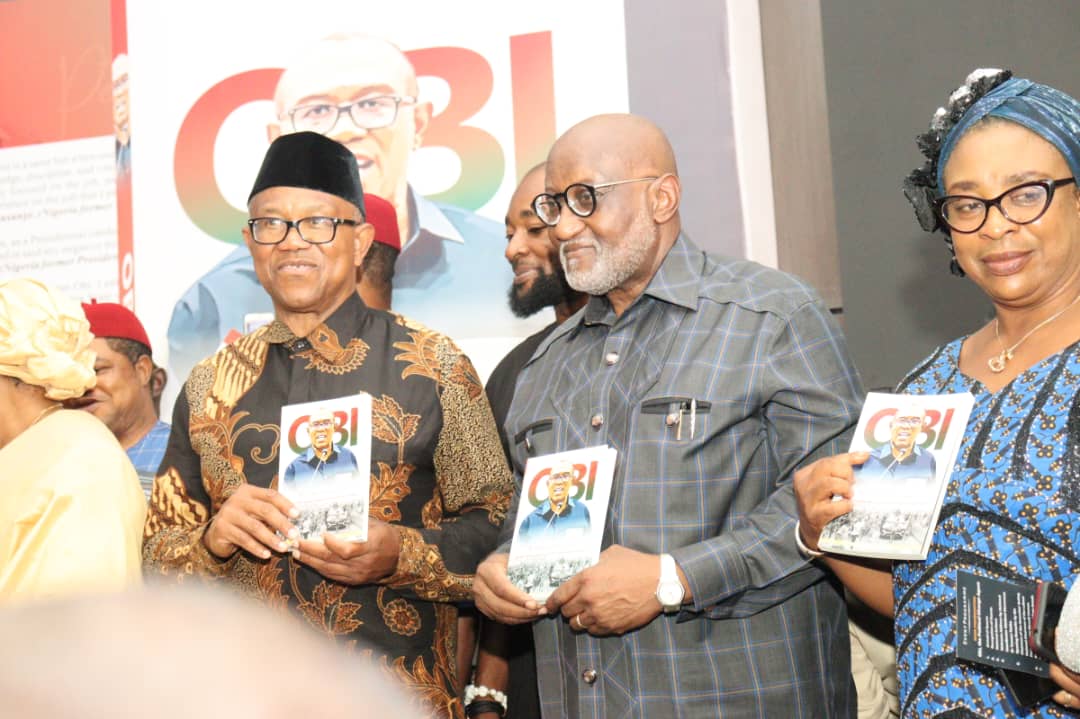
  • Obi: The Political Change Agent – Book Review By Oseloka Obaze

    Obi: The Political Change Agent – Book Review By Oseloka Obaze

    Obi: The Political Change Agent

    The story of the man who changed the face of electioneering in Nigeria

    ***********

    A Review by Mr Oseloka H. Obaze

    At the NAF Center Kado, Abuja FCT, Monday 10th June, 2025

    [Protocols]

    As conventional wisdom admonish us, “never judge a book by its cover.” But we are also told that “There is no friend as loyal as a book.” My favorite quote on books is the one by Jeanette Winterson, which says “Books and doors are the same thing. You open them, and you go through into another world.”  I sincerely hope that today we will present a book, which will serve as an open door to closed minds.

    By June 2025 – a span of three years from May 2022 – when Peter Obi became the presidential candidate of the Labour Party, no less than fifteen books have been published on his foray into Nigeria’s political space. Many observers consider that three-year span as a redefining era in Nigeria’s electioneering and partisan politics.

    The book being presented today, Obi: The Political Change Agent -The story of the man, who changed the face of electioneering in Nigeria, is yet another brick in the wall of a fast growing historical record on Peter Obi’s brand of politics.

    As the book’s title suggests, Peter Obi is by every adjectival qualification, a political change agent in Nigerian politics.  He is also an adroit competitor, in a marathon race that is far from over. So this literary work is about Peter Obi; but in the context of Nigeria, it is about the unheralded rise of Obidient Movement phenomenon between 2022 and now.  It is also about an unfinished business of nation-building, and renewal, and ultimately, a preface to the inevitability of a New Nigeria.

    The core value and potency of this book, is that is written from an insider’s perspective. Ike Abonyi, my friend and the author, has done a yeoman’s job. With a keen sense and eyes for details, he has done what adroit researchers and veteran journalists do best; render credible account of seminal events without embellishments.

    If per chance, you do not intend to read this book immediately, I will advise you to read the foreword by my brother, Dele Farotimi, in order to get the gist of this work.  Characteristically, Mr. Farotimi did a positively magisterial job, with some four hundred insightful words. He concluded with his non-hesitant recommendation of the book, “to scholars of Nigerian politics, elections and society.”

    According to Farotimi, “Obi represents an anomaly in Nigeria’s political landscape; a politician who genuinely desires to work for the betterment of society…Peter Obi is a politician unlike any other in Nigeria.  Ike Abonyi’s work looked at the campaign and organic growth of the Obidient Movement and how Peter Obi’s candidacy has rewritten the manual for future aspirants to public office.”  To that very candid summation, I will only add that any book about an enigmatic personality or an icon is worth reading and owing.

    For the sake of brevity and convenience, I am minded to dispense with the formality of the book’s nomenclature, before delving further into its substance and flourish.

    The book, Obi: the Political Change Agent consists of 252-pages, and twenty-six stand-alone compact chapters. Each chapter, adapted from original real-time op-eds and essays, details Peter Obi’s odyssey from the juncture when he ventured into Nigeria’s political setting, through his uncharted trajectory to becoming the Labour Party 2023 presidential candidate on 30th May, 2022 and thereafter.

    I’ve only offered a synopsis of the structure of the book, to get the full gist or chapter-by-chapter narration, please purchase a copy of the book. Now to the historical flourish of the work.


    ***********

    Chapter 1 is essentially a backdrop, and the condensed story of Nigeria’s return to participatory democracy, from 1999 to date.

    Chapter 2, x-rays the man Peter Obi, and captures his essence and bonafides via his abridged official biography.

    Chapter 3 is revelatory. It documents that fortuitous but life-changing encounter that took Obi into politics. It narrates how Peter Obi’s encounter with Professor Donald Jacob, the Dean of the Kellogg School of Management in the USA, altered his views on politics. Ultimately, the unforeseen outcome of that six-week executive course was his decision to go into politics. It’s a thought-provoking story.

    Chapters 4 and 5 encapsulate the Ojukwu and APGA factors; as well the Anambra governance revolution. Obi’s and sojourn in Anambra was not without its vagaries, but would have been utterly impossible without the overwhelming influence of the iconic Igbo leader, Chukwuemeka Odumegwu-Ojukwu, who was the leader of the All Progressives Grand Alliance (APGA).

    Chapter 6 and 7 surveys Obi’s Journey to the center and Obi’s political dalliance with the PDP.  This chapter speaks to Obi’s political movement from the state to the federal level after his successful tenure as Governor of Anambra State. The narration segues into the political leap that made him the running mate to Atiku Abubakar in the 2019 presidential election.

    Chapter 8 and 9 is a periscope of how Obi’s 2023 Presidential Journey begins and landed him in the Labour Party. It chronicles Obi’s encounter with the vicissitudes of Nigeria’s rotational national politics, unkept promises and his eventual divorce from PDP. The factors at play were mot mere imponderables as much as they were a manifestation of human foibles, political machinations and shortsightedness.

    Chapter 10 is about the birthing of the Obidient Movement. The chapter chronicles the emergence of the Obidient Movement in the nation’s political trajectory and how it impacted greatly on the polity during the 2023 electioneering.

    Chapters 11 narrate the already well-documented 2023 election intrigues by the INEC and the ultimate Judiciary ambush. This is one of the longest chapters in the book for obvious reasons; it captured all the election intrigues, the preparations from voter registration to election proper and the post-election drama.

    Chapter 12 is about ‘The Media and the Obi’s Politics.’ This chapter captures media involvement in Obi’s Presidential ambition and how the social and mainstream media played some significant roles in Obi’s politics. Some believed that Obi was a media hype that would fade away with time. They were wrong.

    Chapter 13, narrate the well-known folktale of Peter Obi’s “Madman” friend, affirming ultimately, that ‘all politics is local’. During his Presidential campaigns, Peter Obi frequently recalled how in his quest for adaptive leadership, he opened himself to learning from everybody. In that context, he often recalled how during his tenure as Governor of Anambra State, he got one of the best advices that helped him tackle very naughty security issues from a “madman.” The author corroborates the seemingly bizarre story, by seeking and finding the “madman.”

    Chapter 14 captioned ‘Anatomizing The Peter Obi Character’ offers an insight into varying perceptions of Peter Obi’s persona; Such perceptions are mixed and complex. Some people saw Obi is a stingy and difficult man to deal with, but to others, he is the prudent man, who detests corruption and extravagant living. To some, he was a quiet philanthropist. This chapter looks at his personality from these contrasting and eclectic perspectives.

    Chapter 15 is the author’s published rendition of Obi’s experience during his brief sojourn in PDP. He facetiously asked: “Obi in PDP; was a Celibate in the Whorehouse?” He surmised how Obi’s clean character and credentials meant nothing to some of the PDP leaders who were bent on frustrating him. This narration validates Obi’s frequently uttered contention that any foray into Nigerian politics was an entanglement with “pimps and prostitutes, not priests and nuns.”

    Chapter 16 and 17 titled ‘A Political Phenomenon Called Peter Obi,” is also another published op-ed by the author capturing the enigma in Peter Obi’s politics. The chapter segues to an analysis of ‘LP’s Obi and the Involuntary Campaigners.’ This article talks about how Obi campaigners emerged involuntarily after hearing his disarming messages on how to create a new Nigeria, with his “Go and verify” and “consumption to production” and “a New Nigeria is Possible” Mantras.

    Chapter 18 & 19 are respectively titled “How Obi-phobics Chased the Wind” and “As Campaigns Flag off, it’s Obi…kererenke.”  These chapter mirrors and juxtaposes the twin developments of dislike and, like, hate and love, ignominy and fervor Obi candidacy elicited nationally. It synoptically captures the futility of the quest by Obi’s political traducers, who embarked on a massive search for something negative about him, but failed woefully. On the flip side was the fervent mob like national support during the same period as Obi’s campaign flagged off, to endless chants of ‘Obi…kererenke’. Rather than the unfolding of scandals, that zeal would eventually transform into the electrifying campaign mood that was replete with various campaign songs and slogans that dominated the political space.

    Chapter 20: captioned “OBI’s quest for Justice and Repetition of History,” recalls how Obi has always been treated unjustly since he entered politics and how he has continued to seek Justice undauntedly via legal redress.

    Chapter 21 tackles the very sensitive issue of ethnified politics and the costs and challenges of being Igbo impacted Obi’s and candidacy. It further explores how that negative narrative was used derogatorily to douse Obi’s potentials.

    Chapter 22 highlights the use of political trolling and fake news to demarket Obi. One such instance was the allegation that as governor, “Obi demolished Mosques.” This chapter captures endless calumny, some blatantly religious against Peter Obi during the campaigns. But as it turned out he actually built a mosque and had fantastic relationships with Muslims in his state during and after leaving office.

    Chapter 23 captioned “Peter Obi, the Opposition’s Talking Drum,” documents Obi’s involuntary post-election role after being manipulated out of the presidency in the 2023 polls.  The intention, as the author averred was to frustrate Obi and force him to quit the political stage. Instead, Obi chose to keep playing a proactive role from the opposition desk, becoming as it were the opposition’s vanguard. It was not to be an easy task; but Obi has remained undaunted.

    Chapter 24 is captioned “Can the Labour Party Go Far Without the Obidients?” The chapter grapples with the evidential hesitance of the Labour Party leadership to fully embrace the efforts of the Obidients Movement by bringing its structure in its fold. It wonders what will become of the Labour Party without the Obidient Movement and Peter Obi and his numerous supporters. The answer as the famous song says: ‘Is blowing in the wind.”

    Chapter 25 is titled “In Whose Interest Is Soyinka’s Obidient-Phobia?” Nigeria’s literature icon, Nobel laureate Professor Wole Soyinka, known for his progressive position on issues, has strangely been at the forefront in the campaign against Peter Obi and the Obidients. This chapter examines what may have caused his shocking position and volte face.

    Chapter 26: “Obi on Marble” is a glossary of some of the many quotable quotes of Peter Obi. Most of these became the political refrain for his legion of followers. Their inclusion aligns well with historical records, for which the book is meat to amplify.

    ***********

    If this book offers one unique essence, it is that in politics and governance, we must continue to use history in our decision making. The utility of history remains ever pertinent. As such, any book such as this, which offers a glimpse into history in the making, ultimately adds value to our politics, our history and our decision-making processes.

    In the 25 years of uninterrupted democracy in Nigeria, six consecutive presidential elections were held in 1999, 2003, 2007, 2011, 2015, and 2023. The 2023 elections perhaps, stand out the most. It was a redefining moment. Like most presidential elections –except that of 2015 – the 2023 elections ended up in litigation and was eventually decided; by the Supreme Court.

    In 2023, Nigerian youths, were sufficiently incentivized to play a role in politics. Peter Obi was the catalyst to that foray. It was he who instigated, exhorted and encouraged Nigeria youths to “take back their country”. Even though the outcome of the 2023 election fell far short of expectations in reflecting the desire of Nigeria voters, the unprecedented landmark electoral awareness remains memorable.  This huge change in our electioneering mindset and modalities will forever be attributable to one political character; Mr Peter Obi the former Governor of Anambra State, and the 2023 Presidential flag bearer of the Labour Party.

    Unwittingly, Obi’s unheralded presidential candidacy –in and by itself, an instrument of soft power- gave Nigeria’s electioneering process a new image, impetus and colouration; focusing as it were on issues designed to turn the country away from her dysfunctional economic fixation of “consumption” and channel that inclination to “production.”

    His issues-based campaign had focused on poverty alleviation, economic growth, job creation, educational reform, efficient healthcare delivery, and anti-corruption mode and mindset. His advocacy for broad policy shifts, enjoyed unprecedented support from many discerning minds and gained significant support among young Nigerians, who saw him as a fresh face and an alternative to the traditional selfish and corrupt political elite. Indeed, Obi even made cutting cost of governance sexy and attractive.

    But trying to dislodge the entrenched system was never going to be a walk in the park. Peter Obi was aware of this and so too, were his followers. Thus Obi faced stiff competition from established political parties, candidates, and critics, who initially took him for granted and questioned his ability to win a national election. Indeed, a ranking politician had characterized Peter Obi and the Obidients as largely “effervescent” – a phenomena that would blow away with time. He was wrong. He had since changed his mind and said so publicly.

    Despite the challenges he encountered, Obi’s candidacy generated significant interest and enthusiasm, particularly among Nigerians seeking real change. And despite the fervour and commitment, the eventual outcome of the 2023 presidential elections was not what Nigerians hoped for; but the outcome was also not totality unexpected.  Like most of the prior presidential elections, the Courts would eventually decide who became president, regardless of public opinion and the electoral evidence presented.  This proved the cliché that “the law is an ass.”

    As the author rightly surmised, the political fervour ignited by Obi is still flaming. Nigerian youths appear through Obi’s prompting to have discovered their potential and are not letting go. Consequently, Nigerian youths are now at the center of a struggle to reset Nigeria under the Obidient Movement that has become the platform for the inevitable discovery of a New Nigeria.

    ‘Obi: The Political Change Agent’ the story of the man who changed the face of electioneering in Nigeria, is politically enriching as it captures the historical background of our democratic struggle and offers various insightful perspectives on the different administrations since 1999. This work is a well-researched by an experienced journalist who has been part of Nigeria’s political trajectories. The book captures profusely our contemporary political journey for 25 years with all its vagaries, upheavals and proclivities.

    Written in very easy-to-read prose and elegant language, I find this book very enriching for any inquisitive mind; and for anyone who desires to know more about Nigeria’s uninterrupted two and half decades of the democratic journey. It offers unvarnished insight into how the issues-driven campaign messages by Peter Obi helped to revolutionize and compel Nigerian youths to discover themselves and prepare for the inevitable and proactive role they must play in nation-building. For Nigerian youth’s Peter Obi’s “take back your country” was not just a slogan, it was a clarion call that resonates till this day.

    Political campaign books are usually about train wrecks and triumphs. Most are about introspection and retrospective reconstructing of issues that mattered or played out. Obi: The Political Change Agent is none of these. It is straightforward recording of events as they happened.

    Oftentimes, political campaign books, historical books and memoirs are richer because they include or reveal snippets of undisclosed confidential discussions or events. From my vantage point as a 2023 presidential campaign insider; perhaps two yet undocumented remarks relative to the 2023 elections remain vital.  While visiting Kaduna on 17th October 2022, Sheik Ahmed Abubakar Gumi told Peter Obi, “Even if you don’t win, beyond the 2023 elections don’t let the Movement you have started to end”(p237). I believe Gumi was speaking of the Obidient Movement. He may be clairvoyant.

    The second was what President Muhammadu Buhari told Peter Obi on 22 October 2022: “From what I read in the newspapers, Nigerians, especially the Nigerian media like you. You may not win this particular election, but age is on your side. I tried four times before I finally won.”  I’m certain both messages have stayed with Peter Obi. Both, I believe, will instinctively undergird the inevitability of a New Nigeria that is Possible.

    If this book has any shortcoming, it is not out of dereliction or inattention. Besides the protagonist, the book does not hap on the role of other key campaign dramatis persona. It does not for instance delve deeply into how the choice of Labour Party over the Social Democratic Party was made, or how the Vice-Presidential Candidate was selected over the other possible and probable candidates.

    Finally, I recommend this book for academic work, politics, and leisure reading; and to political party managers. This book will be an integral part of any serious library and an invaluable reference material for anyone sufficiently passionate about political and governance reforms Nigeria.

    I thank you all for your kind attention.