Tag: 2027

  • Frontier Discourse: Organisers Unveil Topic for 6th Annual Public Lecture, Awards in Abuja

    Frontier Discourse: Organisers Unveil Topic for 6th Annual Public Lecture, Awards in Abuja

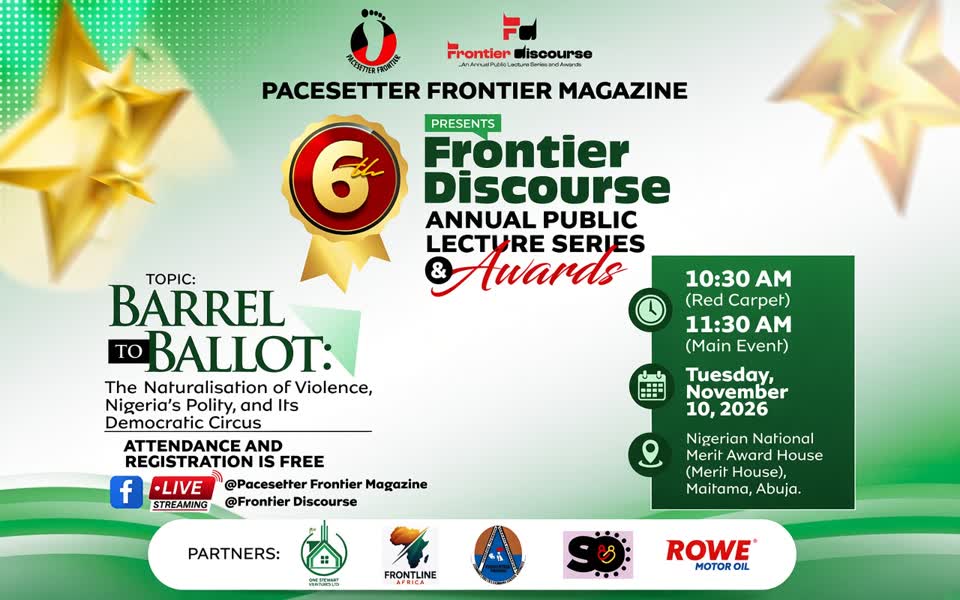
    Organisers of the 6th Frontier Discourse Annual Public Lecture Series and Awards have unveiled the topic for this year’s event, scheduled to hold in Abuja on Tuesday, November 10, 2026.

    The lecture, organised by Pacesetter Frontier Magazine, will focus on “Barrel to Ballot: The Naturalisation of Violence, Nigeria’s Polity and its Democratic Circus.”

    Disclosing this in a statement issued in Abuja, a member of the Local Organising Committee, Frank Ufondu, said topics selected for the annual lecture were usually timely and connected to prevailing national issues.

    Ufondu said the theme was designed to examine if there is a relationship between Nigeria’s prolonged insecurity, electoral politics and the state of democracy ahead of the 2027 general elections.

    Explaining the rationale behind the topic, he said:

    “For decades, our nation’s landscape has been deeply troubled by the hydra-headed challenges of insecurity and a democracy that has become more about spectacle than substance. Disappointingly, the more we are scorched by these, the more the troubling responses of indifference and blunted public outrage envelop the nation.

    According to him, “Barrel” symbolises guns, arms and the suffering inflicted on Nigerians through terrorism, banditry, kidnapping and other crimes, while “Ballot” represents democratic governance and electioneering.

    He explained that the phrase “Naturalisation of Violence” refers to the prolonged nature of insecurity and the danger that the resulting violence and suffering could become normalised in Nigerian society.

    Ufondu said that as the country approaches the 2027 elections, Nigeria’s political landscape faces two interconnected challenges: chronic insecurity and a high-stakes national election increasingly viewed by some citizens as a democratic circus.

    He said the lecture would interrogate how the country reached a point where gun violence and terrorism routinely shape daily life and how the normalisation of violence threatens the integrity of the electoral process.

    The lecture will also examine the state of Nigeria’s democratic institutions, the factors contributing to what organisers describe as chronic democratic stagnation, why electoral reforms continue to stall, assess expectations and responsibilities ahead of the 2027 elections, and consider the roles of political actors, institutional stakeholders and citizens.

    Ufondu also announced that the keynote speakers, panellists and other resource persons for the event would be unveiled in the coming days.

    He said, “The 6th edition promises to be our most impactful yet. ​Watch this space—you won’t want to miss what we have lined up. Keep a date with us”.

    The event will hold at the Nigerian National Merit Award House (Merit House), Maitama, Abuja.

    The red carpet begins at 10:00am, while the main event starts at 11:00am.

    The organisers said attendance and registration are free. Interested participants can register to reserve a seat using: https://forms.gle/C6Rtpjv5gQUBm31T9

    For sponsorship, partnership or enquiries, organisers provided 09137940957 for calls and WhatsApp messages.

    The event partners are One Stewart Ventures Limited, Frontline Africa, Igwesi Human Development Centre, Steve Oruruo Foundation and ROWE Oil.

  • FACT-CHECK: Did the Police Arrest Enugu Traditional Ruler, Ex-Lawmaker, 8 Others Over Attack on NDC Meeting?

    FACT-CHECK: Did the Police Arrest Enugu Traditional Ruler, Ex-Lawmaker, 8 Others Over Attack on NDC Meeting?

    𝗖𝗹𝗮𝗶𝗺: Police has arrested an Enugu traditional ruler, ex-lawmaker, 8 others over attack on NDC meeting

    𝗩𝗲𝗿𝗱𝗶𝗰𝘁: 𝗙𝗔𝗟𝗦𝗘

    𝗕𝗮𝗰𝗸𝗴𝗿𝗼𝘂𝗻𝗱:

    A SaharaReporters publication dated September 27, 2026, reported that “a prominent Enugu traditional ruler, Igwe Obiora Igwesi, his brother, former federal lawmaker Hon. Uchenna Sunday A. Igwesi, popularly known as USA Igwesi, and eight other suspects have been arrested over the violent attack on a Nigeria Democratic Congress (NDC) ward meeting in Obuoffia, Nkanu West Local Government Area of Enugu State.”

    According to the online platform, it “gathered that their arrests on Tuesday, September 22, ordered by the Inspector-General of Police, were executed by detectives from the Zone 13 Command in Ukpo, Dunukofia, Anambra State.”

    Continuing, SaharaReporters revealed that their sources “told SaharaReporters on Sunday that those arrested alongside the traditional ruler and the former lawmaker include Uchenna Moses Ani (alias Odogwu), Chidi Ani, Oko Nwodo (alias Buzuzu), Dominic Arum (alias City Hangout), Ifeanyi Solomon Nwobodo (alias Agege), Victor Okechukwu (alias Ogboni), Nnabuike Ani (alias Stone), and John Chukuma Ogbodo.”

    This claim was also repeated in a Punch Online publication dated September 28, 2026. Titled “Enugu monarch, ex-lawmaker, others in custody over NDC attack”, part of the report by a Punch correspondent, Raphael Ede, also read “Eight people were reportedly injured in the incident. They were identified as Donald Onovo, a local government ward councillor;…”

    𝗩𝗲𝗿𝗱𝗶𝗰𝘁: 𝗙𝗔𝗟𝗦𝗘

    𝗩𝗲𝗿𝗶𝗳𝗶𝗰𝗮𝘁𝗶𝗼𝗻: 𝗧𝗵𝗲 𝗧𝗿𝘂𝗲 𝗣𝗶𝗰𝘁𝘂𝗿𝗲

    Our findings revealed that there was no arrest of Igwe Obiora Igwesi, his brother, former federal lawmaker Hon. Uchenna Sunday A. Igwesi, popularly known as USA Igwesi, and eight others by the Nigerian Police on Tuesday, September 22, 2026.

    Our findings also revealed that there was no arrest of Igwe Obiora Igwesi, his brother, former federal lawmaker Hon. Uchenna Sunday A. Igwesi, popularly known as USA Igwesi, and eight others by the Nigerian Police on any day whatsoever before or after the reported Tuesday, September 22 date of arrest.

    A search on the verified social media accounts of the Nigerian Police Force on X (@PoliceNG), Facebook (@ngpolice), or Instagram (@nigeriappoliceforce), showed that there was no report of such arrest on, before, and after September 22, 2026.

    On X, a verified user, Alhaji Afunwa (@Krucifix), while responding to the claim of the arrest shared by another X user, Chuks (@ChuksEricE), asked grok to confirm the report of the alleged arrest. Grok responded: “Unable to confirm. No official police statement or credible news reports verify the arrests of Igwe Obiora Igwesi, USA Igwesi or others. SaharaReporters covered the earlier NDC meeting attack in Obuoffia but has no article on these arrests. The claim appears unverified and circulating only on social media.”

    Additionally, PACESETTER can confirm that it has received videos of Igwe Obiora Igwesi, and his brother, Rt. Hon. USA Igwesi participating at the September 26, 2026 local government election in their Obuoffia ward. The video has been attached to this report. If Igwe Obiora Igwesi and his brother and ex-lawmaker, Hon. USA Igwesi were actually arrested, how were they also present to carry out their civic obligation of exercising their franchise?

    Another person named as one of those arrested is Ifeanyi Solomon Nwobodo (alias Agege), who confirmed to PACESETTER that he was not in Enugu State on the September 22, 2026 date, but only returned to participate in the local government election on Friday, September 25, 2026.

    The claim that one of those injured is a local government ward councillor is false as reports obtained from Nkanu West local government indicates that the named individual had been suspended by the Nkanu West Legislative Council and was no longer a sitting councillor of the local government.

    John Chukwuma Ogbodo was also named as one of the eight persons in the alleged arrest. However, our findings revealed that John Chukwuma Ogbodo is the current Executive Chairman of Nkanu West LGA and was the APC Chairmanship Candidate in the local government election held on September 26, 2026, an election he eventually won and received his certificate of return from the Enugu State Independent Electoral Commission (ENSIEC) on Sunday, September 27, 2026. If he was actually in police detention, he couldn’t have been physically present as a candidate for the Saturday election.

    The report by SaharaReporters from which the claim went viral did not imply or categorically state that the named persons were on bail but reported thus: “a prominent Enugu traditional ruler, Igwe Obiora Igwesi, his brother, former federal lawmaker Hon. Uchenna Sunday A. Igwesi, popularly known as USA Igwesi, and eight other suspects have been arrested over the violent attack on a Nigeria Democratic Congress (NDC) ward meeting in Obuoffia, Nkanu West Local Government Area of Enugu State”, an indication that the named persons were currently in police custody, according to them. If the arrest ever happened, Igwe Obiora Igwesi, Hon. USA Igwesi and the eight others couldn’t have participated in the local government election in full public view.

    Igwe Obiora Igwesi, according to our findings has been in his Obuoffia palace, attending to his duties as a traditional ruler. His brother, Rt. Hon. USA Igwesi, has also been circulating in Enugu State, both unfettered.

    𝗖𝗼𝗻𝗰𝗹𝘂𝘀𝗶𝗼𝗻:

    The report of the arrest is entirely 𝗙𝗔𝗟𝗦𝗘 and should be disregarded by the public.


  • NDC Enugu at a Crossroads: The Crisis, the Revelations and the Road to 2027 — Part 2

    NDC Enugu at a Crossroads: The Crisis, the Revelations and the Road to 2027 — Part 2

    By Sebastine Okafor, Ph.D.

    In the part 1 of this piece, I alluded to how I was able to extract the information of all that transpired as a well-trained columnist, investigative and interpretative journalist. I will proceed with detailing my findings in this part 2.

    Less than 24 hours after a meeting with the National Leader of the party, Sen. Seriake Dickson, another meeting was held at the residence of an aide to the National Leader in Maitama Extension, Mpape, Abuja. The meeting was moderated by the National Secretary, who reportedly presented a version of events that was strongly disputed. Perhaps he forgot that he was dealing with young people who keep records and documentation.

    The meeting lasted more than three hours and was attended by only some of those who had participated in the earlier meeting with Senator Dickson. Several others reportedly stayed away, including the Enugu East Senatorial candidate backed by one faction, the gubernatorial aspirant from Nike and former Senator, and the House of Representatives candidate for Enugu North and South Federal Constituency, among others.

    The moderator, during his speech, said that the National Leadership had agreed to return all the Protem Chairmen who were in place prior to the congress across the nation and that this was the reason they were at a crossroads with Enugu. He also asserted that Dr. Johnpaul and his team had been defiant and never wanted to participate in any discussion, which, according to him, made the National Leadership ignore them.

    These were claims that even he himself knew were untrue. As our elders say, “An elder who lies forgets that the younger ones may still remember the truth.” A man who stands before people must be careful with his words because records do not forget what the mouth says.

    Taking the floor, he accused the National Secretary of presenting what he described as “childish lies” and questioned the basis of his narrative. He recounted how his team waited for him at Transcorp Hilton until 3 a.m. on May 6, how they met him in his office on May 7, and how appointments were subsequently fixed at Guzape on two occasions, only for the team to arrive and wait for hours without meeting him. He also questioned the planned installation of Prof. Akubue as the State Chairman, among other issues.

    These questions, among others, exposed serious contradictions in his narrative and left his claims difficult to defend. As the saying goes, “When a man digs a pit with his own hands, he should not be surprised when he falls into it.” The attempt to rewrite the sequence of events only made the existing records more relevant.


    The meeting also descended into heated exchanges between an Awgu-born Senatorial aspirant and the gubernatorial candidate backed by one faction. The gubernatorial candidate reportedly accused the Senatorial aspirant of abusing and maligning him in the media. The Senatorial aspirant rejected the allegation and responded in equally strong terms. It was reported that, in his words, he said he could not support a placeholder who was not running an election to win but was allegedly participating merely to play a role and secure space for the APC.

    The confrontation became so heated that the convener had to intervene to prevent the meeting from breaking down completely.

    To me, the exchange further exposed the deep mistrust and unresolved disagreements among the various interests claiming to represent NDC in Enugu State.

    After the situation became calm, a proposal was presented which, according to many observers, suggested that those who claim to be Enugu NDC leaders either do not genuinely want peace or may be pursuing interests that are inconsistent with the party’s growth in the state.

    They agreed that there had been a congress whose outcome was not properly managed and that there was therefore a need for harmonisation. However, they proposed that the harmonisation should take place after the election among three groups: the Dr. Johnpaul group, Protem Obetta and other interested parties.

    Under the proposal, the Dr. Johnpaul group would provide only 5 out of the 29 State Executive positions. They would also retain the Protem Chairman whom the National Secretary claimed was brought in by an NWC member and former APC Enugu lawyer who, according to the account presented, is from the same village and ward as the said Protem Chairman.

    They further proposed that all court cases should be withdrawn, after which the party structure would be announced and properly authenticated after the election.

    If that account is correct, it raises legitimate questions about the basis for the choice. The central political question remains: why should a disputed structure be the foundation of a reconciliation process that is supposed to resolve a disputed structure? That, in my view, is hardly a convincing formula for reconciliation. It is increasingly difficult to understand how a lasting peace can emerge when individuals who are themselves accused of contributing to the crisis are expected to determine the terms of its resolution. A genuine reconciliation process must be transparent, inclusive and acceptable to all sides.

    It is also clear why people should be wary and meticulous about supporting or investing in NDC-peddled candidates because, from the events unfolding, such candidacies may struggle to gain the legitimacy, structure and organisational backing required to fly.

    Political investors, aspirants and supporters must therefore ask difficult questions before committing their resources, reputation and political future to candidates presented under a disputed structure. They must demand clarity on the party’s leadership, congresses, primaries, legal standing and the authenticity of the structures under which candidates are being presented.

    A political party cannot build confidence among voters while its own internal processes remain surrounded by contradictions, competing structures and unresolved litigation. Until there is genuine reconciliation, proper documentation and a transparent resolution of the Enugu crisis, anyone dealing with the party must exercise caution and conduct proper due diligence.

    The records are available, the meetings took place, the appointments were made, and the communications exist. Those who attempt to rewrite history should therefore remember that political arguments may be forgotten, but documented records remain available to speak for themselves.

  • Peter Mbah: The Governor Redefining Enugu’s Story — Let the People Decide

    Peter Mbah: The Governor Redefining Enugu’s Story — Let the People Decide

    By Emmanuel Uchenna Chukwu

    Leadership is ultimately judged by impact.

    Not by the number of promises made during campaigns. Not by the volume of political speeches. And certainly not by how loudly supporters or opponents speak on social media.

    Leadership is judged by what changes.

    It is judged by what the people can see, what they can feel and what they can point to.

    This is why the leadership of Governor Peter Ndubuisi Mbah deserves a careful and objective assessment.

    Who is Peter Mbah?

    He is not simply the man occupying the Lion Building. He is a governor who came into office with an ambitious vision of transforming Enugu State from a predominantly civil-service economy into a more productive, investment-driven and economically competitive state.

    And that vision is increasingly becoming the central conversation about his administration.

    From infrastructure and road construction to education, healthcare, urban renewal, economic development and efforts to attract investment, the administration has placed development at the centre of its agenda.

    But beyond government statements and political arguments, the most important question remains:

    What can the people see?

    THE ROADS ARE SPEAKING

    Across Enugu State, infrastructure remains one of the most visible areas through which citizens assess government performance.

    Roads connect communities.

    Roads open up businesses.

    Roads reduce travel difficulties.

    Roads create opportunities.

    That is why investments in road infrastructure are not merely about constructing roads; they are about creating the physical foundation for economic growth and improving everyday life.

    For many residents, the most meaningful measure of government is not a speech delivered in a conference hall but the road leading to their community.

    INVESTING IN THE FUTURE

    Another important part of the Mbah administration’s agenda is education.

    A state cannot build a strong future without building strong minds.

    Investment in schools, learning environments and human capital is therefore not simply another government project. It is an investment in the next generation of Enugu.

    The same principle applies to healthcare.

    A government that wants to build a prosperous society must ensure that its people have access to quality healthcare and the basic conditions necessary to live productive lives.

    BEYOND TODAY: THE VISION FOR ENUGU

    Perhaps the most important aspect of the Mbah administration is that its conversation is not limited to what is happening today.

    It is also about what Enugu can become tomorrow.

    The administration’s economic vision is centred on building a state that can attract investment, expand opportunities, create employment and develop an economy capable of generating sustainable prosperity.

    That is a bigger conversation than politics.

    It is a conversation about the future of our children.

    It is a conversation about whether young people will have to leave Enugu to find opportunities elsewhere.

    It is a conversation about whether businesses will see Enugu as a place where they can confidently invest and grow.

    It is a conversation about whether Enugu can become one of Nigeria’s most competitive subnational economies.

    These are the questions that should dominate our public discourse.

    LET THE PEOPLE JUDGE

    Nobody should be asked to support a government simply because somebody praises it.

    Neither should anybody be asked to reject a government simply because somebody criticises it.

    The people deserve better than that.

    Let them look.

    Let them ask questions.

    Let them compare.

    Let them examine the projects.

    Let them listen to the communities.

    Let them assess the direction of the state.

    Let everybody bring their scorecard.

    Governor Peter Mbah is bringing his.

    2027 should therefore not be reduced to political noise, social-media battles or empty promises.

    It should be about performance.

    It should be about vision.

    It should be about capacity.

    It should be about continuity.

    And above all, it should be about the future of Enugu State.

    The conversation is no longer simply about what has been promised.

    The evidence is everywhere.

    The roads are speaking.

    The schools are speaking.

    The healthcare system is speaking.

    The communities are speaking.

    The business environment is speaking.

    And ultimately, the people are speaking.

    This is not the time to be distracted by political noise.

    This is the time to look around and ask one simple question:

    WHO IS MOVING ENUGU FORWARD?

    The answer is in the work.

    The answer is in the vision.

    The answer is in the results.

    ENUGU IS MOVING FORWARD.

    THE VISION IS CLEAR.

    THE WORK CONTINUES.

    THE PEOPLE CAN SEE IT. ENUGU CAN FEEL IT. OUR TOMORROW IS HERE.

    And when the time comes for the people to decide, let them decide not from rumours, not from propaganda and not from political emotions, but from the evidence before them.

    Let the people decide.

  • Nigeria’s CODESA Moment – By Abdul Mahmud

    Nigeria’s CODESA Moment – By Abdul Mahmud

    The proposal by the G-100, a coalition of 100 Nigerians advocating that the opposition parties should unite behind a single presidential candidate for the 2027 election, deserves to be taken more seriously than the familiar reactions that greet every attempt at opposition consolidation in Nigeria. The group’s intervention comes at a particularly important moment because, unlike the opposition movements of countries where the governing party has already entered a period of unmistakable electoral decline, Nigeria’s APC has not yet reached that point. The G-100 is therefore attempting to solve the problem before the ruling party becomes vulnerable enough for opposition victory to appear inevitable.

    There is a useful historical lesson in this for Nigeria, and it can be found in South Africa’s transition from apartheid; though, it is convenient nowadays, especially among younger South Africans who have grown impatient with the economic limitations of the post-apartheid order, to remember 1994 simply as the moment when the African National Congress (ANC) came to power. That interpretation misses the extraordinary complexity of the period that preceded the election. The negotiations were not conducted after the apartheid state had been militarily defeated, nor did the ANC enter them with an unlimited revolutionary mandate. The international environment had changed fundamentally. The Cold War had ended, the Soviet Union was collapsing, the strategic circumstances that had sustained armed liberation movements were disappearing, and liberal democracy and market capitalism had become the dominant global order. South Africa itself remained a formidable state with its bureaucracy, security establishment and economic elite intact. The genius of the South African transition was therefore not that the ANC obtained everything it wanted; it was that the liberation movement recognised the limits of what could be obtained at that particular historical juncture and concentrated on securing political power. The Convention for a Democratic South Africa (CODESA), which began formally in December 1991, brought together nineteen political parties and political formations, including the ANC, the National Party and Inkatha Freedom Party, while the subsequent negotiating process widened the field further. The participants were not united by ideology. They were simply united by the recognition that their country had to find a political mechanism for transferring power without descending into civil war.

    The South African experience offers a useful lens through which to examine Nigeria’s present opposition politics.

    The opposition today appears to be approaching the 2027 election as though its principal challenge is to discover which individual politician is personally capable of defeating President Bola Tinubu. That is too narrow a conception of the problem. The question is whether the opposition can construct a political alignment capable of converting dispersed dissatisfaction into a coherent electoral majority. The G-100’s call for a coalition president therefore deserves to be understood not only as an appeal for politicians to surrender their ambitions but as an attempt to solve the structural problem created by a fragmented opposition confronting an incumbent political establishment that has not yet demonstrated serious electoral exhaustion, regardless of the outcome of the Osun governorship election over the weekend.

    The experience of CODESA suggests that political consolidation does not require agreement on everything. South Africa’s negotiators came from organisations with sharply different ideological positions and competing conceptions of the future state. The National Party wanted institutional protections for minorities and a constitutional arrangement that would prevent the ANC from exercising unrestricted power of the majority. The ANC resisted arrangements that it believed could preserve minority domination through constitutional mechanisms. Inkatha had its own conception of federalism and regional autonomy. But, the negotiations proceeded because the principal actors eventually understood that agreement on the fundamental rules of political transition was more important than agreement on every substantive question.

    Nigeria’s opposition needs precisely this kind of political realism. Peter Obi does not have to become Atiku Abubakar. Neither does Atiku have to become Rotimi Amaechi, nor does Kwankwaso have to abandon the political constituency he has built in the North. The parties do not need to dissolve their identities into some artificial ideological uniformity. What they need is an agreement on the minimum political objective that can bring their constituencies into one electoral arrangement. That is where the G-100 proposal becomes important. A coalition president should not be selected merely by determining which aspirant has the largest following on social media or which politician commands the loudest applause at political gatherings. The choice must be based on the candidate’s capacity to aggregate the geographically and politically diverse constituencies required to win a Nigerian presidential election. The candidate must be the product of a negotiated electoral calculation, not the prize awarded to whoever is first to declare himself the natural leader of the opposition.

    There is another lesson from South Africa that Nigeria’s opposition must not miss. Negotiations work when they are connected to organised political power outside the negotiating room. CODESA was not simply an elite conversation in Johannesburg. The parties represented mass constituencies, political organisations and movements with the capacity to mobilise. When the process broke down, the ANC did not cease to exist as a political force. When violence and deadlock threatened the transition, negotiations were repeatedly restructured until a workable settlement became possible. The September 1992 Record of Understanding between the government and the ANC helped reopen the process, while the subsequent Multi-Party Negotiating Forum produced the framework that eventually led to the Interim Constitution and the 1994 election. For Nigeria, this means that a coalition agreement signed by political leaders in Abuja will achieve little if it is not translated into organisation at the polling-unit level. The opposition must be capable of protecting the votes it intends to win. It must know where its strength lies, where the APC is vulnerable and where the coalition can realistically add votes. It must build the organisational capacity to ensure that the result announced at the polling unit reflects the votes cast there. The negotiation among political leaders is only one part of the exercise; the electorate must eventually ratify that agreement with actual votes.

    There is also a lesson about timing. South Africa’s political actors did not wait until the National Party had become electorally irrelevant before beginning to negotiate the transition. They negotiated while the old order still possessed substantial power. That is perhaps the most important lesson for Nigeria. An opposition movement that waits for the APC to collapse before constructing its coalition may discover that the collapse never comes, or that when it finally begins the opposition is too divided to take advantage of it. The Nigerian opposition should therefore think of 2027 not simply as an election but as a contest over the configuration of political power. If the APC has not shown significant electoral decline, the opposition must create the conditions under which its own disparate constituencies become greater than the sum of their separate parts. This requires compromise, and compromise requires political actors who understand that losing personal control of the presidential ticket may be the price of obtaining collective access to political power.

    The final lesson from South Africa is perhaps the most difficult. The ANC understood that political power had to come before the larger struggle over the economic and institutional transformation of the country. The 1994 settlement did not resolve every historical injustice. It established a democratic state within which those questions could subsequently be contested. Whether the ANC made the best use of that power afterwards is a legitimate subject for historical criticism, but that later question should not obscure the strategic achievement of securing political power under extraordinarily constrained circumstances. Nigeria’s opposition faces a different historical problem, but the principle is comparable. It cannot approach the future as though history has already chosen its winner. The opposition must confront the balance of forces as it exists and organise accordingly.

    The continued strength of the APC is not an argument for opposition despair; it is an argument for opposition seriousness.

    The G-100’s call for a coalition president should therefore be treated as the beginning of a political negotiation rather than the conclusion of one. What Nigeria needs is not merely a coalition of politicians who agree that President Tinubu should be defeated; it needs a coalition capable of persuading Nigerians that the political differences among its component parts can be subjected to a credible national alternative. South Africa’s experience demonstrates that political transitions are rarely delivered by one party possessing all the advantages. They are produced when politicians recognise that the balance of forces requires them to negotiate, compromise and construct an arrangement capable of winning the moment that history has opened before them.

    For the Nigerian opposition, that moment has not yet arrived. The wiser course is to prepare for it before it does.

  • 2027: Nkanu West Pledges Block Votes for APC as Presidents General Endorse Nnolim Nnaji

    2027: Nkanu West Pledges Block Votes for APC as Presidents General Endorse Nnolim Nnaji

    The Executive Chairman of Nkanu West Local Government Area, Hon. John Chukwuma Ogbodo, says the people of the council will deliver block votes for the All Progressives Congress (APC) in the 2027 general election, as Presidents General from communities across Nkanu East and Nkanu West Federal Constituency endorsed the member representing the constituency in the House of Representatives, Rt. Hon. Nnolim Nnaji, for a third term.

    The endorsement was announced on Friday, July 31, 2026, at the Nkanu West council headquarters by the Presidents General from communities in the federal constituency, led by the Enugu State Coordinating President General, Hon. Chief Arinze Ogbodo, alongside the Coordinating Presidents General of Nkanu East and Nkanu West, Hon. Okey JS Nwatu and Hon. Jonathan Onyema Ugwu, respectively.

    Presenting a letter of endorsement, vote of confidence and appreciation, Chief Arinze Ogbodo said the community leaders were impressed by what he described as Nnaji’s “uncountable projects” and developmental interventions across Nkanu East and Nkanu West.

    He assured the federal lawmaker of the continued support of the Presidents General, saying they would mobilise grassroots support for his re-election.

    Receiving the delegation, the council chairman, John Ogbodo described the endorsement as well deserved, saying Nnaji had demonstrated effective representation since assuming office.

    He also commended Governor Peter Ndubuisi Mbah for improving security and accelerating infrastructure development across Enugu State, particularly in Nkanu East and Nkanu West.

    According to him, improved security under the Mbah administration has made it possible for residents to hold large public gatherings in areas that were previously affected by insecurity.

    Urging the Presidents General to mobilise their communities ahead of the 2027 elections, Ogbodo expressed confidence that Nkanu West would deliver overwhelming support for the APC.

    “We cannot stop eulogising the transcendental projects of our governor. Governor Mbah is so strategic and deliberate in fulfilling his campaign promises that he has sited in each political ward in Enugu State projects worth at least 1.1 billion naira. So, why won’t the people return him in 2027,” Ogbodo queried.

    “For us in Nkanu West, our stakeholders, leaders of thought and the good people of our local government will deliver block votes to the APC,” he added.

    He also urged the Presidents General to remain steadfast in supporting the administration, avoid political betrayal, and take ownership of state and local government projects in their respective communities.

    In separate remarks, members representing Nkanu West and Nkanu East in the Enugu State House of Assembly, Rt. Hon. Iloabuchi Aniagu and Rt. Hon. Okey Mbah, the APC candidate for Nkanu West State Constituency, Ifeanyi Nnamani, and Hon. Afam Nnaji, Member I of the Governing Board of the Enugu State Universal Basic Education Board (ENSUBEB), commended Governor Mbah for ongoing development projects across the state and praised Nnaji’s grassroots style of representation.

    Responding to the endorsement, Nnolim Nnaji thanked the Presidents General and the people of the constituency for the confidence reposed in him, pledging to sustain his development efforts.

    The lawmaker urged community leaders to adopt a village-based mobilisation strategy ahead of the 2027 elections.

    “Each ward has communities and these communities have villages, that in turn have village heads. This is the model we should explore in driving our campaign message ahead of the 2027 general elections,” he said.

    Nnaji also called on the people of Nkanu East and Nkanu West to vote for President Bola Ahmed Tinubu, Governor Peter Ndubuisi Mbah, and all APC candidates in the 2027 elections, saying strong electoral support would strengthen the constituency’s voice at the national level.

    The Secretary of Nkanu West LGA, Prince Barr. Onochie Igwesi, was among the dignitaries present.

  • 2027: Who Is Afraid of Nelson Maduka Arum?

    2027: Who Is Afraid of Nelson Maduka Arum?

    By Dr. Chukwuebuka Agah

    ​Politics has never been a contest of ideas alone; it is also a battle of narratives. Throughout history, candidates who inspire enthusiasm, attract grassroots support, or threaten entrenched political interests often become targets of coordinated attacks aimed at diminishing their public appeal.

    ​There is an old saying in politics: when your opponents stop debating your ideas and start attacking your name, it is because they have begun to fear your popularity.

    ​The emergence of Hon. Nelson Maduka Arum, popularly known as Mama na Malaga, as the Nigeria Democratic Congress (NDC) candidate for the Enugu North and South Federal Constituency in the upcoming 2027 general elections appears to be following that familiar script.

    ​Arum, who secured the NDC ticket after a fiercely contested and transparently conducted primary election, has been reaching out behind the scenes to party members to galvanize support and foster unity of purpose. In recent weeks, his political profile has continued to attract attention in Enugu’s evolving political landscape. Yet, as his visibility increases, so too do the calculated assaults on his reputation—most notably, spurious allegations seeking to link him to violent crimes.

    ​State-sponsored actors have launched a campaign of calumny, and it’s not even the official campaign season yet.

    ​Such accusations, if true, would be matters for law enforcement and the courts. Instead, every rumor is deliberately amplified, every whisper becomes a headline, and every anonymous social media account suddenly claims to possess “inside information.” It is a familiar script.

    ​Why? Because some people have realized that Mama is a political force they can no longer afford to ignore. Mama is coming.

    ​In any democratic society governed by the rule of law, reputations should not be destroyed through anonymous social media posts, political gossip, or coordinated disinformation campaigns.

    ​The question, therefore, begs to be asked: Who is afraid of #MAMA2027? Who is afraid of Mama?

    ​Political smear campaigns are rarely random acts; they emerge when political opponents perceive a candidate as capable of altering the political equation. Rather than debating policy frameworks, legislative priorities, or leadership qualities, attention is diverted toward sensational claims designed to provoke emotional reactions and dominate public discourse.

    ​This strategy is not unique to Enugu. Across democracies, misinformation has become a common political weapon. False or exaggerated claims spread rapidly through social media, often travelling much faster than verified information. By the time the truth catches up, the intended damage is already done.

    ​Who benefits when public discourse shifts from policies to personal attacks? Who gains when voters spend more time discussing rumors than evaluating representation? Who fears allowing the people to make their own judgment at the ballot box?

    ​The answers will become clearer as the campaign progresses.

    ​For now, one thing is certain: ideas must confront ideas, records must confront records, and leadership must confront leadership. That is the only mechanism through which a democracy matures. Those who cannot beat Mama at the polls are seeking to distract him with baseless personal attacks.

    ​If Hon. Nelson Maduka Arum has committed any crime, the appropriate institutions are the police, investigative agencies, and the courts—not politically motivated rumor mills. Conversely, because these allegations are entirely fabricated, those responsible are undermining not only a singular candidate but the very integrity of the democratic process. Mama should identify and sue them, letting the law take its full, punitive course.

    ​Democracy demands better.

    ​Elections should be won through ideas, competence, vision, and public service—not through character assassination. Voters deserve the opportunity to assess candidates based on their developmental blueprints and their capacity to offer effective representation.

    ​Arum’s supporters remain confident that the people of Enugu North and South will not allow noise to replace reason. They will examine every candidate, reject the politics of division and innuendo, and ultimately cast their ballots for the individual best suited to champion their collective interests. If anything, the attacks proves that his candidacy has become politically significant.

    ​When that day comes, it will not be political gossip that will determine the outcome. It will be the voice of the people. And that voice, as always, remains the ultimate authority.

    ​As #MAMA2027 evolves into a formidable movement promising liberation and systemic progress in Enugu North and South, the conversation should center on what he intends to achieve, his execution strategies, and whether he deserves the people’s mandate. Anything less weakens our democratic culture and shifts attention away from the issues that matter most to the citizens.

    ​The answer to the question, “Who is afraid of #MAMA2027?” may not lie with a single individual or political group. It is found in the growing intensity of those trying to define a candidate before voters have the chance to judge him on his own merits.

    ​Hon. Nelson Maduka Arum maintains that he is running for #TheLoveOfTheCity—a city we all agree is in dire need of rescue and visionary leadership, far removed from the opportunistic representation it currently endures. It certainly deserves better than the influence of the worst political party to exist in the history of Nigeria, the All Progressives Congress (APC), unfortunately for us, our dear federal constituency.

    ​This journey is demanded by love. It is required by a very deep connection to the city and its people. It is for #TheLoveOfTheCity that we all agree that #MAMA2027 for the Enugu North and South Federal Constituency is non-negotiable. In Mama, the people see someone like them, with the same drive, resilience, and passion for progress—and they will deliver him triumphantly at the polls.

  • 2027: Ogbodo rallies G17 members, vows to work for APC victory in Nkanu West

    2027: Ogbodo rallies G17 members, vows to work for APC victory in Nkanu West

    The Executive Chairman of Nkanu West Local Government Area in Enugu state, John Chukwuma Ogbodo, has reaffirmed his commitment to strengthening the All Progressives Congress (APC) ahead of the 2027 elections following the inauguration of the G17 Nkanu West Chapter.

    Speaking during the inauguration ceremony, Ogbodo urged members of the group to remain united, dedicated and focused on mobilising support for the APC at the grassroots.

    He said the group’s collective responsibility was to ensure the victory of all APC candidates in future elections and pledged to work closely with members to strengthen the party’s structure across Nkanu West.

    The council chairman also commended Enugu State Governor Peter Ndubuisi Mbah for what he described as the administration’s developmental strides across the state, praising the governor’s leadership and vision.

    The Director-General of G17 described Ogbodo as “one month, one project,” saying the chairman’s performance had demonstrated a commitment to grassroots development. He urged members to remain faithful to the objectives of the organisation.

    Also speaking, the Coordinator of the G17 Nkanu West Chapter, Dr. Chinedu Egbo, applauded Governor Mbah for ongoing development projects across Enugu State and commended Ogbodo for his leadership and commitment to building the APC at the grassroots.

    Egbo pledged to provide purposeful leadership for the chapter and called on members to remain united as they work towards the party’s success in future elections.

    Others stakeholders who spoke at the event were: Sen. Kelvin Chukwu, represented by his Chief of Staff, Dan Nwomeh, SSA to the governor on Mainstream media, Chief Godwin Nwatu, and Prof. Ike Obi, immediate past Commissioner for Health.

    The inauguration drew party faithful, community leaders and stakeholders from the 14 political wards of Nkanu West Local Government Area, with participants reaffirming their commitment to strengthening the G17 structure and mobilising support for the APC ahead of the next general elections.

  • Peter and Doubts – By Onochie Jon-Igwesi

    Peter and Doubts – By Onochie Jon-Igwesi

    By Onochie Jon-Igwesi

    The date was Thursday, 17 June 2021. The venue was the Michael Okpara Square, Independence Layout, Enugu, and the event was the well-attended ‘Oganiru Enugu East Senatorial Zone Rally’. It was a gathering of the entire political and traditional paraphernalia of the zone. All heavyweights and political juggernauts of the six local governments that make up the large spread of Enugu East Senatorial Zone were at the venue.

    First-tier governorship aspirants arrived at the venue in flamboyant fanfare, amid flying flags with their names and faces, upheld banners, loud bands and tons of supporters that shook the grounds of the square. The acrobatic display by colourful masquerades unlocked another layer of flavour. From the popular WAEC bus stop, to the gates of the Enugu State House of Assembly, all a part of the Three-Arms Zone, it was electrifying. The voting population roared in excitement as they sniffed the thick air of the political season at the time. That rally served as the perfect cue signaling the political over-readiness of the zone to produce the next governor of the state in line with the spirit of zoning that dominated the state’s political space.

    As boisterous as the atmosphere was, something remarkable to the discerning — barely a handful at the time — happened. One first-tier aspirant walked in so quietly. He was escorted into the venue by just his personal assistant, and was shown his reserved seat among other aspirants, while his driver and a few security details waited outside. Grapevine sources revealed that he had just flown into Enugu for the event and drove straight to Okpara Square from the airport. There were no crowds of supporters. There was no band. No group wore clothes or caps branded with his name or picture. There were no flags with his face flying.

    Gradually, onlookers began to murmur. For those whose lips didn’t move, their faces spoke. “How on earth was he going to emerge as the state ruling party’s flagbearer with no show of strength?”, they wondered. Peter and Doubts!

    That man Peter Mbah, who was doubted, who bestrode the political space, totally recalibrating the scale of governance in Nigeria and among subnationals, would later go on to not only win the primaries but also become the state’s fourth governor of the Fourth Republic, and the poster boy of refined governance.

    Of books, tons have been written. Yet, one of the greatest classics of all time is Robert Greene’s 48 Laws of Power. Law 36 of the book reads: Disdain Things You Cannot Have – Ignoring Them is the Best Revenge.

    As boring as it is, expectedly, there’s a similitude of the doubts of 2023 playing out ahead of 2027. Some persons illusorily believe that Peter Mbah’s second term is a reality that will not be. So hurt that 2023 did not play out like they had hoped, they resorted to disdaining the same seat they so coveted because they couldn’t have it at the time like they wished. Ironically, they hope, even when there’s palpable fear of failure among them, that the seat will be theirs in 2027. And so, to pull the wool over our eyes, they put on pseudo-confidence, draped in half truths, screaming scarcity where there’s sufficiency, darkness where there’s light, and drought where there’s rainfall, forgetting that a man becomes a critic when he cannot be an artist. But they speak not for all of us. For even as their lies appear to be flowering, the seeds of their disillusionment are being sown. As Martin Luther King Jr. puts it: “The arc of the moral universe is long, but it bends toward justice” – and justice is Peter’s second term.

    One under-discussed aspect of human psychology is that if you do good, people will demand better with a sense of entitlement, and if you do extremely bad, people will beg for good with fear. Peter understands this, yet like a priest at the altar of disruptive innovation, he has dedicated himself to doing the greatest good for the greatest number.

    Peter’s mind works in a way that is esoteric. His programmes defy logical reasoning so much that it makes sense to doubt them. Yet, for every ounce of doubt you share today, he makes mincemeat of it tomorrow. They doubted the possibility of Enugu Air but today, that airline has 6 aircraft, will get to 20 aircraft and just got its Air Operator Certificate within a significant 6 months, faster than the industry timeline of 15 to 24 months. Hotel Presidential seemed like what was best for it was to be sold off, yet that monument, once dead but now resurrected, stands as a reminder of the labours of our heroes past. We did not imagine that Monday would ever return as the first day of the week, yet you can now be the judge of that. And the unending list continues, from the nationally admired International Conference Centre; dualization of the Ugwogo-Opi and Enugu-Abakaliki roads; a vehicle assembly plant; the joint venture with Landmark Africa Group that has rebranded Nike Lake Resort; the nearly completed 5-star hotel; to the gobsmacking N1.62trn 2026 Budget. Peter’s administration plans to build five more world class transport terminals in Emene, Udi, Awgu, Four-Corners (Ozalla) and Oboloafor, in addition to those already built and in use in Abakpa, Gariki, Nsukka and Holyghost. It equally set aside 15 per cent of the 2026 budget for providing 15,000 mass housing units. If all of Peter’s projects were to be mentioned, you, my reader, would probably scroll or flip pages endlessly to get to the end of this piece.

    Now, think about these projects, a tidbit of the developments that Enugu has witnessed in three years, and ask yourself whether we should reward hard work or hoaxes in 2027.

    In due course, the questions of 2027 will not be why or whether he will be re-elected, but about why the opposition attempted to mislead the people of Enugu into thinking that there’s an alternative somewhere. It will be about we the people reminding Peter that having served the first four years strikingly well, he MUST fulfill the remainder of his charter in the second term that we have given him.

    Dr. Chimaroke Nnamani was a two-term governor. Barr. Sullivan Chime was another two-term governor. Rt. Hon. Ifeanyi Ugwuanyi was also a two-term governor, and just somehow, you assume that Ndi Enugu will fail to return a moderniser-in-chief and development oracle, His Excellency Peter Ndubuisi Mbah, for a second term? Peter is the moment and he rides into May 29, 2027 on the chariot of brilliant victory. There’s no doubt about this.

    To Gov. Peter Mbah, do not grow weary. You’re convincingly on the right track. If the people – your people – have raised concerns on certain issues, where adjustments can be made, please do, like you did by slashing land-related taxes by about 60%. We are aware that some of those you trusted the most are gearing up to run against you, simply for self. We are aware of how you have continued to make efforts to reach out to, and assuage political gladiators who may have felt bruised in whatever way. It demonstrates that your fountain of meekness and accommodation overflows. In the fullness of time, you will reap your rewards.

    Onochie Jon-Igwesi, an indigene of Enugu, writes from Omuoha-Obuoffia, Awkunanaw.

  • Silence Finally Learns to Speak

    Silence Finally Learns to Speak

    -By Abdul Mahmud

    There is a special kind of silence that follows power everywhere it goes. It is not the gentle quiet of the monastery or the eerie quiet of mourning. It is the awkward, accusatory silence of a phone that once overheated from devotion and now lies cool, innocent, and suddenly uninterested. Such is the fate of the phone of Yusuf Buhari, son of the one-time military ruler and former President, who recently lamented that ever since they vacated the Presidential Villa, his phone has fallen into an eloquent silence. “After Goodluck Jonathan made that call to my dad to congratulate him on his victory as Nigeria’s next president, I used to receive up to 2,000 calls a day from different people. The calls would start coming in as early as 4 a.m. – from old classmates, acquaintances, extended family members, former maids, and servants who had once worked for the Buhari family at some point. There were also callers with bogus, untraceable explanations, but my assistant would simply come up with polite excuses to end those conversations quickly! But the moment my dad left power and handed the baton to His Excellency Bola Tinubu, the calls dropped dramatically to about 100 a day. After my dad was buried, they reduced even further to around 20 daily – usually just from siblings and business associates. The phones no longer ring. Nobody truly cares”.

    Yusuf Buhari’s lament is therefore not merely a personal reflection, it is indeed a public service announcement about the aura of power in Nigeria.

    Once upon a presidency, the phone rang like a Pentecostal bell on Sunday morning. Calls came in torrents. Old classmates rediscovered brotherhood. Distant cousins suddenly remembered shared ancestors. Former house helps developed emotional attachments that demanded urgent reconnection. Even strangers arrived armed with stories so creative they deserved the Nigerian Prize for Literature. Everyone wanted to talk. Everyone needed a moment. Everyone was important. The phone became the national shrine. Then came the unthinkable tragedy. Power packed its bags. The baton of power was handed over. Democracy did its modest little dance like Jimmy Bo Horne’s dance across the floor. And something even more devastating occurred. The phone began to rest. From two thousand calls to one hundred. From one hundred to twenty. From the roar of affection to the whisper of obligation. From the expressive euphoria of power to the familiarity of family group chats. This is not just decline. This is the austerity of pretend affection in the absence of power.

    Let us pause and admire the honesty of Yusuf Buhari. The phones no longer ring. Nobody truly cares. It is a brave thing to say out loud what the entire country already knows but pretends not to know. In Nigeria, love is renewable only when it is connected to power. Affection is strongest where one is close to the power. Once power goes, the allure of friendship wanes.

    This discovery is not unique to Nigeria. In the United States of America, it was made with cheese. Lyndon B. Johnson, once the most powerful man on earth, reportedly complained that after leaving the White House, senators who once hovered like loyal furniture suddenly developed hearing problems. The phone that rang relentlessly during legislative battles and war briefings became suspiciously quiet. Johnson, a man who could bend Congress with a stare and a threat, learned the old lesson in a new accent. Arms twist only when there is something left to extract. Power had been the caller, not friendship. Jimmy Carter also encountered the same silence, though he dressed it in Southern politeness. After leaving the White House, he once noted how Washington’s warmth cooled, how invitations thinned, and how the phone lost its urgency. Carter, a man who traded power for principle and later built houses with his own hands, learned that integrity is admirable but not bankable. Washington respects power more than character. When the office disappeared, so did the interest. The calls, it turned out, had been for the presidency, not the person. The meaning that Yusuf Buhari’s lament provides is that relevance only obeys the law of power. If you have power, or close to power, the laws of things will bend over to your wishes. Relevance in public life has very little to do with ideas, values, or service. It has everything to do with power. You call he who has power that can move the mountain for you. Who can whisper your name into the right ears at the right time. When that ability expires, so does the crowd.

    Power in Nigeria is a balm. It heals old grudges. It restores forgotten relationships. It multiplies cousins like loaves of bread. It turns silence into urgency. When you have it, people call at four in the morning to check on your spiritual wellbeing. When you lose it, they discover the importance of respecting your privacy. The pattern is so consistent. The same society that will not answer calls from the powerless will accuse them of being inaccessible. The same people who once dialed endlessly will later say they did not want to disturb you in your grief. Courtesy suddenly appears when usefulness disappears.

    But let us be fair. This is not cruelty. It is efficiency. Why waste airtime on someone who cannot move a file, sign a paper, influence a contract, or secure a favour. Friendship must also eat. Concern must have logistics. Sympathy needs a budget. The phone, after all, is not just a device. It is a moral instrument. It measures value in real time. It rings for the important and sleeps for the irrelevant. It is democratic only in theory. In practice, it obeys hierarchy. What makes this moment cheesy is the shock that accompanies the discovery. As if the silence is a betrayal rather than a curriculum. As if the phones were ringing out of love rather than calculation. As if two thousand daily calls were ever sustainable without the fuel of power. This is the Nigerian lesson that no civics class teaches. Power is the loudest ringtone. Without it, even your obituary struggles for attention. And yet, there is something profoundly instructive in this quiet. For the first time, the silence is honest. The remaining calls are few, but they are real. Siblings call because blood still remembers. Business associates call because interests endure. Everyone else has returned to their natural habitat, which is waiting for the next powerful number to save.

    In this silence, truth clears its throat. It tells us that many of our public relationships are seasonal. They follow office terms, not human bonds. They are loyal to chairs, not people. They are attached to corridors, not conscience. The lie which underlines Yusuf’s lament is that care is proven by ringing phones. But care has always been something else. Care is presence when there is nothing to gain. Care is the call that does not need to be returned. Care is the visit that cannot be monetised. By that standard, the phones were probably not ringing with care even at their loudest. So, maybe this is not a fall from grace. Maybe it is a graduation. The fact which stays stark is that silence strips away the noise and leaves behind a smaller, sturdier circle. It replaces the choruses of opportunists with a handful of humans. It enthrones reality.

    If those who inhabit the high chambers of power would cure themselves of this peculiar affliction, they must first reconcile with the enduring truth: it is when power recedes that solitude reveals its sharpest edge. They must learn to dwell within the natural order of things, where silence, long suppressed, at last finds its voice. They must accept that the kingdom of power admits no rival sovereign; there are never two kings upon its throne. Until that wisdom is embraced, every departure from office will be accompanied by the same bewildered lament, uttered only in differing accents.

    The phones no longer ring.

    They will never ring for the reason that Yusuf knows: “Soja go” with old friends; and Soja arrives with new friends who in turn arrive with new ring tones.

  • Shettima’s Passive Presence in Discussions About His Own Political Future

    Shettima’s Passive Presence in Discussions About His Own Political Future

    -By Abdul Mahmud

    Fresh political whispers drifting through news salons and media columns suggest that President Bola Ahmed Tinubu is quietly weighing alternative running mates ahead of the 2027 presidential election. The names most frequently mentioned are not obscure. They are prominent northern Christian figures with national visibility and symbolic weight.

    Former Speaker of the House of Representatives, Yakubu Dogara; Defence Minister, General Christopher Musa. Plateau State Governor, Caleb Mutfwang. And the Catholic Bishop of Sokoto, Matthew Hassan Kukah. The whispers share a common thread. They frame the alleged weighing of alternatives as part of a larger political calculation around religious and regional balance after the controversial Muslim-Muslim ticket of 2023. They also point to an inner circle that appears to be thinking ahead, testing options, and perhaps sending signals without formally committing to any course of action.

    The first sign came when campaign posters bearing President Tinubu’s image began appearing across the streets of Abuja, conspicuously without any trace of Shettima. Amid the whispers stands Vice President Kashim Shettima, elected on the same ticket as Tinubu, serving a mandate that runs concurrently with the President’s, and who, by constitutional logic and political convention, ought to be presumed the natural running mate in 2027 unless compelling reasons suggest otherwise.

    VP Kashim Shettima

    What makes the current moment intriguing is not simply that names are being mentioned. Politics thrives on rumours after all. What shocks observers of the polity is the manner in which the Vice President appears reduced to a passive presence in discussions about his own political future. At one moment, he is treated as an afterthought; and at another moment, as a loyal functionary dispatched on errands while others debate whether he remains relevant to the project he helped midwife. The image calls to mind Oblomov in Ivan Goncharov’s novel, Oblomov. A character defined by inertia and resignation. A man whose life unfolds around him while he lies still, allowing others to decide what becomes of his estate, his relationships, and his destiny. When Shettima is not rendered invisible in elite conversations, he is portrayed as a man running presidential errands but without real agency. Flying out to represent the President. Receiving delegations. Offering dutiful loyalty, while the central question of his political fate hangs unresolved, sometimes discussed in rooms he has just exited and sometimes in rooms he may never enter.

    The irony is sharp. Shettima is not a novice. He is a former governor, and a seasoned party man. He was not selected in 2023 as a brooch fastened to presidential clothing or an ornamental addition. He was chosen despite strong objections from many quarters, including religious leaders and civil society voices who warned against the dangers of the same-faith ticket in a deeply plural country. Those warnings did not dissipate after the election. They lingered. They hardened into criticisms that have followed the administration. International partners, including voices from the United States, have made careful but pointed remarks about inclusion and representation. At home, the perception that Christian constituencies, especially in the North, felt alienated continued to shadow the government. The renewed circulation of alternative running mates must be read against this background. It signals an attempt to correct a political imbalance that many believe cost the ruling party moral capital. By floating respected northern Christian figures, Tinubu’s presidency appears eager to reassure sceptical audiences that lessons have been learned and that the future will look different. Still, the so-called attempt at weighing alternatives raises serious questions about political ethics and loyalty. What does it say about the stability of presidential and vice presidential partnerships when a sitting vice president is treated as expendable barely midway into the first term in office? What message does it send to party loyalists who defended the 2023 ticket at great personal cost? And what precedent does it set for the future?

    The Constitution grants the President wide latitude in selecting a running mate. That power is not in dispute. Political wisdom, however, demands more than constitutional permissibility. It requires sensitivity to process, respect for incumbents, and an understanding of how power is perceived as much as how it is exercised. There is also a deeper institutional issue at play. The office of the Vice President in Nigeria has long suffered from ambiguity. Its occupant is either overly powerful, a spare tyre that is painfully useless, or surplus to requirements. Rarely is there a stable middle ground defined by clear responsibilities and mutual respect.

    From Obasanjo’s frosty relationship with Atiku Abubakar to Buhari’s cautious sidelining of Professor Osinbajo, history offers little comfort. Shettima’s predicament fits neatly into this pattern. He is visible but constrained. Present but peripheral. Trusted enough to represent the President abroad, but seemingly not trusted enough to be shielded from speculation about his replacement. The mention of figures like Dogara, Mutfwang, Musa, and Kukah adds further layers to the conversation. Dogara brings legislative gravitas and a record of defying party lines on principle. Mutfwang represents a Christian minority state scarred by violence and neglect. Musa embodies military professionalism at a time of persistent insecurity. Kukah symbolises a strain of moral authority whose polish has worn thin, weakened by his muddled interventions on claims of Christian genocide in Nigeria. Each name appeals to a different constituency. Each underscores what the current ticket lacks in the eyes of critics.

    What remains missing is an honest conversation about governance performance. Electoral arithmetic alone cannot substitute for accountability. If the administration believes that changing the face of the ticket will cure deeper discontent, it risks mistaking symptoms for causes. Nigerians are burdened by inflation, insecurity, and a sense of economic drift. No vice presidential reshuffle can obscure these realities. For Shettima himself, the moment demands clarity and resolve. Silence can be dignified, but prolonged silence in the face of open speculation risks being read as acquiescence. Political survival in Nigeria rarely rewards quiet endurance and favours strategic assertion. More’s the pity for a Vice President who finds his future debated as an abstraction rather than being confronted as a political fact. More’s the pity for a power order that normalises such uncertainty at the heart of presidential power. And more’s the pity for a country whose politics revolves around personalities and permutations rather than the hard work of governance.

    Whether these discussions are trial balloons or serious plans, they reveal an administration already looking beyond its present mandate. That alone should give pause. Power is most effective when it is anchored in purpose, not perpetually distracted by succession. But do Tinubu and his goons care?

  • Atiku’s Back to Back Party Primaries Hits, and Misses

    Atiku’s Back to Back Party Primaries Hits, and Misses

    By Demola Olarewaju

    The prowess of Atiku Abubakar when it comes to party primaries was not built in a day and his recent successes at that level are built on a foundation of loss, defeat and tears.

    His entry into politics in 1991 was marked by a bitter gubernatorial ticket rivalry between him and Bala Takaya, a rivalry so fierce that both men eventually were disqualified by the IBB regime. This disqualification was alongside the likes of Sule Lamido, Yusuf Sani, Dapo Sarumi, Femi Agbalajobi, Joe Nwodo, Hyde Onuaguluchi, Sergeant Awuse and others.

    Also disqualified were 23 aspirants for the presidential ticket in that 3rd Republic and Atiku was drafted by Shehu Musa Yar’Adua to run in his stead for President.

    With the backing of the powerful Yar’Adua machinery, Atiku came third in the first round of balloting, behind MKO Abiola and Babagana Kingibe. He was then asked to step down for Abiola and become his running mate but Abiola was forced by the SDP Governors to choose Kingibe instead. Atiku lost out, Atiku campaigned hard and Atiku delivered 140k+ Adamawa votes for SDP.

    In 1999 after running successfully for Governor, he became Vice-President and then clinched the ticket of the AC in 2007 by caucus consensus.

    By 2011, Atiku was back in the PDP and ran against sitting President Goodluck Jonathan, polling 805 delegates’ votes versus Jonathan’s 2,736. Atiku lost, Atiku campaigned hard and Atiku delivered Adamawa for PDP.

    2015, Atiku found himself in APC and ran against Muhammadu Buhari and others. He came in third place with 954 delegates’ votes. Atiku lost, Atiku campaigned hard and Atiku delivered Adamawa for APC.

    2019 – Atiku won the PDP presidential primaries in Port-Harcourt. Wike had then blackmailed PDP into bringing the National Convention to PH and within 24 hours, every single presidential suite in the city had become reserved. Wike claimed they said Atiku had paid for them and that he had asked them to return the man’s deposit. Atiku won the majority delegates’ votes defeating Saraki, Tambuwal, Sule Lamido etc.

    2023 – Atiku won the PDP presidential primaries after being stepped down for by Tambuwal, much to the chagrin of Wike who has been embittered since then.

    But notice Atiku never gets bitter after any primary or general election – he stays loyal and delivers votes for the candidate who defeated him and the party that hurt him.

    And that’s one secret of how the man does it: by staying loyal to the general cause even when his interest is threatened or eliminated, Atiku has built an army of trusted political friends that span into every single state, political party or group interest.

    By always subsuming his interest to the general interest per time, Atiku maintains razorlike focus on each KPI and in the process builds allies and sets up structure from the bottom up. Atiku doesn’t focus on the presidential primaries when Ward Excos are being elected, Atiku doesn’t think of his own aspiration while the party is looking for a National HQ building: to every political activity there is a time.

    Thirdly, Atiku’s structures aren’t ever only for him – this House of Reps aspirant, that senatorial or gubernatorial hopeful – his structural interests even push down to state excos – as I found out to my own party electoral loss when I ran for Lagos State PDP Publicity Secretary. Atiku never walks alone, he always aggregates other political interests.

    These are just three reasons (observable from outside) for why he is so formidable in party primaries. Those who think it is about money can go and ask Nyesom Wike about 2019 and 2023.

    I hope other presidential aspirants can learn from Atiku on both how to win primaries and how to accept defeat gracefully.

    As long as we agree that whoever loses will still work for the greater interest against the person now in Aso Rock, as Atiku has always done: we can meet at the primaries.