Category: Lifestyle

  • Whatsapp: New update delivers great features for users

    Whatsapp: New update delivers great features for users

    The social media app, Whatsapp, last week rolled out a series of features that enhance user experience on the app. While Facebook (now Meta) founder, Mark Zuckerberg, took to his Facebook page on May 5, 2022, to announce the rollout of new reaction emojis on Whatsapp, the app followed with the announcement of other features, which include the expansion of group size limit.

    The group limit expansion on Whatsapp may have come as a response to complaints by users and the movement of groups to a competing app, Telegram, which allows up to 2,000 in a group. Still, the increased number is far below what Telegram offers.

    Here are the new Whatsapp features unveiled in the course of the week and which users will be receiving as they update their app:

    Group participants limit increased

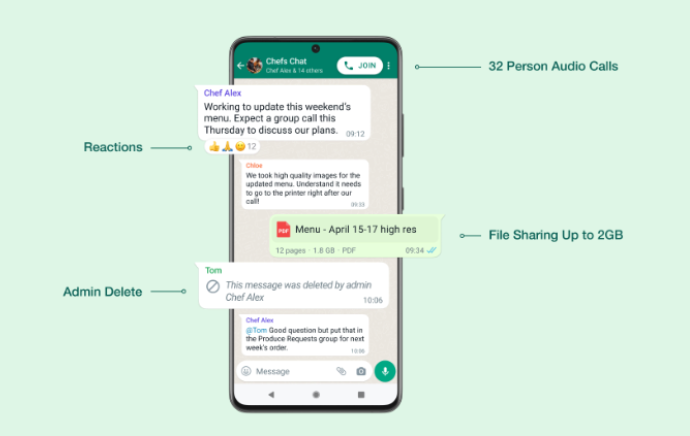
    WhatsApp users will now be able to add up to 512 people to a group. This was increased from the maximum 256 earlier fixed by the platform

    Admin Delete

    Although this may be controversial, this new feature allows group admins to remove errant or problematic messages from everyone’s chats. In cases where a group member sends an offensive message, the admin now has the power to ‘delete for everyone’.

    Increased file sharing size

    Whatsapp users will now be able to send files up to 2GB in size at once on the app, which is a massive jump from the previous limit of 100MB.

    WhatsApp Reactions

    The new reaction emojis will allow users to react with six different emojis on the platform: laughing face, red heart, surprised face, thumbs up, teary face, and hands together.

    To use the feature, just long-press on a message and choose one of the displayed emojis. Just like Instagram, users can change their reactions to a different one by long-pressing the same messages and changing the emoji or just clicking on the same one to remove it.

    WhatsApp also notes a few things about the Reaction feature: Users can only add one reaction per message, and it disappears when the messages disappear. Also, users will not be able to hide the reactions or the reaction counts. The recipients might see the reaction before you remove it or if removing it was not successful.

    Larger Voice Calls

    This feature allows a one-tap voice calling for up to 32 people with all-new design for those times when talking live is better than chatting.

    Bottomline

    These new features will, no doubt, enhance user experience on Whatsapp. That users can now send large files up to 2GB is a great improvement over the previous 100MB limit. But the 512 limit for group participants is still a drawback that will continue to push groups with larger numbers to Telegrams.

    (Naira metrics)

  • Igwesi extols Governor Ifeanyi Ugwuanyi of Enugu State on 58th birthday

    Igwesi extols Governor Ifeanyi Ugwuanyi of Enugu State on 58th birthday

    Chetanne Chinelo, Enugu

    The Registrar of Enugu State Polytechnic, Iwollo, Ugoeze Oby Igwesi, Ph.D, has congratulated Governor Ifeanyi Ugwuanyi of Enugu State on the birthday celebration to mark his 58th year on earth.

    Igwesi, in a birthday message in Enugu, recalled that in Enugu State Polytechnic, Iwollo, the Governor’s continued provision of intervention and support was responsible for the multi campuses the institution operated.

    “I wish to congratulate our Father, my brother and my Boss, His Excellency, Rt. Hon. Dr. Ifeanyi Lawrence Ugwuanyi, on his 58th birthday. You have exhibited uncommon wisdom, remarkable vision and exemplary leadership which has continued to make you a personality of importance in the leadership of the Peoples Democratic Party (PDP). You are a fantastic role model for all those seeking to understand how to make an impact with their life.

    “Your leadership has meant so much to this State because you are a man of Peace and through your thoughtful leadership, great vision and sincerity, you have had a positive impact on every aspect of our State which has made us really know that Enugu State is in the Hands of God. In the Enugu State Polytechnic, Iwollo, you have continued to provide the institution with the wherewithal and support in the already set up multi campuses of the Polytechnic in the state, thereby increasing the chances of academic pursuit for the people of Enugu state in the rural and urban areas.

    “The entire management, staff and students of Enugu State Polytechnic, Iwollo, felicitate with you and wish you greater years ahead” the Registrar, Oby Igwesi said.

  • Onyishi lauds Gburugburu at 58

    Onyishi lauds Gburugburu at 58

    Chetanne Chinelo, Enugu

    In continuation of the goodwill messages and felicitations that have followed the 58th birthday celebration of the Governor of Enugu State, Rt. Hon. Dr. Ifeanyi Lawrence Ugwuanyi, the Director of Finance and Accounts Department, Government House, Enugu, Mr. Godwin Chukwuma Onyishi has lauded the distinction and panache of the Ifeanyi Ugwuanyi administration in Enugu.

    Congratulating the Governor on his birthday celebration, Onyishi pointed out that the loud ovation and felicitation on the occasion of the Governor’s birthday by people of Enugu State revalidated the Governor’s praise name, Gburugburu.

    “Your Excellency, the loud felicitations from Ndi Enugu on the occasion of your birthday revalidates your name, Gburugburu, and the people’s belief in what you represent. You have continued to lead with distinction and panache, always putting God first.”

    Wishing him a happy easter celebration in advance, he encouraged the Governor to keep the flag flying in the remaining period of his administration.

    “I also wish you a Happy Easter celebration in advance as Christian faithfuls around the world celebrate the resurrection of our Lord and Saviour, Jesus Christ. As we reflect on the lessons the season teaches, may you find inspiration to continue to serve your people more and better. I encourage you to continue to keep the flag flying in the remaining period of your administration. Happy Birthday Your Excellency.”

  • Orba Patriotic Movement calls on Nigeria to engage Ugwuanyi, at 58th birthday

    Orba Patriotic Movement calls on Nigeria to engage Ugwuanyi, at 58th birthday

    Chetanne Chinelo, Enugu

    A political group in Enugu, Orba Patriotic Movement, has called on Nigerians to see and engage the selfless leadership of the Executive Governor of Enugu State, Rt. Hon. Dr. Ifeanyi Ugwuanyi, whom they described as their son, brother and father, who has brought peace and good governance to Enugu State.

    The group made the call in Enugu, on behalf of the Orba Udu Ancient Kingdom, on the occasion of the celebration of the 58th birthday of Governor Ifeanyi Ugwuanyi.

    In a statement sighted by our correspondent and signed by the President/National Coordinator, Orba Patriotic Movement (OPM), Ichie Engr. Onyema Odo, the group noted that “youths are empowered and infrastructures are springing up everywhere”.

    “Your Excellency, Orba Udu community is proud of you, Udenu local government appreciates you and Ndi Enugu State celebrates you for putting smiles on our faces.

    “Our prayer is that God will keep you alive and strong and Nigerians will see you and engage your selfless services for a better tomorrow.”

  • Actors Guild of Nigeria mourns ‘Natty’ of New Masquerade

    Actors Guild of Nigeria mourns ‘Natty’ of New Masquerade

    Romanus Amuta

    The Actors Guild of Nigeria is mourning late veteran actor, Romanus Amuta, popularly known as “Natty”, aged 79, who died on February 9, after battling a protracted ailment.

    Amuta became famous as Natty in the New Masquerade, a popular Nigerian sitcom that aired during the 1980s until the mid-1990s on the Nigerian Television Authority Network.

    New Masquerade, one of Nigeria’s longest running sitcoms, was aired on Tuesday nights from 8:30 p.m. t0 9:00 p.m.

    It was created and written by James Iroha who also acted in the sitcom alongside casts of late James Iroha (Gringory Akabogu), late Claude Eke(Jegede Shokoya); Chika Okpala (Chief Zebrudaya); Tony Akposheri (Zakky); Lizzy Eveome (Ovuleria); late Christy Essien-Igbokwe (Akpena); Davis Offor (Clarus); and Romanus Amuta (Natty).

    Emeka Rollas, National President of the guild, in an interview said the deceased would remain evergreen due to his contributions to the growth of the Nollywood industry.

    “This is another sad moment for Nollywood as we lost a great thespian, Romanus Amuta aka, Natty.

    “Though gone from our sight, Natty will remain evergreen in our hearts.

    “My condolences to the family, friends, fans and all grieving hearts on his demise. Rest on dear colleague,” he said.

    Romanus Amuta was also a Nollywood actor who mostly played herbalist or traditional priest, elders, or chief roles in movies.

    Amuta started his career in the media landscape and worked with the Daily Times newspaper before delving into the movie industry.

    He came into the limelight after featuring in the “New Masquerade” a highly popular Television series in the 80s.

    Some movies he featured in include “Lion Finger (2003)”, “Eagle’s Bride (2005)” and “Ijele (1999)” among others.

    (NAN)

  • Final Ofala Rites of Igwe Ozulumba to hold April 21

    Final Ofala Rites of Igwe Ozulumba to hold April 21

    The royal family of Mburubu community in Nkanu East Local Government of Enugu State has announced the burial date of the His Royal Majesty, Igwe Emmanuel Mmuonyelu Ogbuzulu Eze JP, Igwe Ozulumba 1.

    According to information made available to Pacesetter on Sunday, January 23 from Prince Lawrence Ozoemena Ezeh, the Igwe will begin his final journey on April 21, 2022.

    He will be buried according to the rites and customs of Mburubu people in the community.

    Igwe Ozulumba died at the age of 94.

    More details later…

  • Universal Healthcare Coverage: Do our communities and their Leaders have any role?

    Universal Healthcare Coverage: Do our communities and their Leaders have any role?

    Universal Healthcare Coverage: Do our communities and their Leaders have any role?

    By Dr. Ochie, Casmir N

    To build a life, a community and an economy, a good health provides the foundation, and the greatest wealth, they say, is health. The relationship between wealth and health can be likened to that between a vehicle and the driver.

    Globally, December 12 annually is recognized as International Universal Health Coverage (UHC) day. The theme for this year (2021) UHC day was ‘leave no one’s health behind; invest in health systems for all.’ To achieve this, government at the federal and state levels are primordially committed to ensuring the success and sustenance of this laudable programme. Both the government and the governed have significant roles in this regard. The Enugu State Agency for Universal Health Coverage has been doing enormous work in this respect, presently, sensitizing and mobilizing the people concerning UHC. This opportunity must be fully utilized. In a 2017 report on UHC, the World Health Organization (WHO) and the World Bank concluded that over half of the world’s population lacks access to basic health services and that over 100 million people are forced into poverty annually because of health expenses, including the cost of transportation, other tangible and intangible costs, the cost (in terms of time, effort and money) of reaching distant facilities. Globally the issue of UHC has occupied the public health media space, being recognized as means of achieving the health-related SDG, and most countries including Nigeria have since filed into the programme

    Universal Health Coverage (UHC) is a concept referring to the ability of all individuals and communities to access quality health care without suffering undue financial hardships. Financial risk protection for healthcare access and use of services remains a major issue especially among the rural dwellers, the pregnant women, the under-5, the elderly, the poorest, thus creating both socioeconomic and geographic inequity. The concept of UHC takes care of the geographical accessibility of the healthcare services, financial affordability, and patient and provider acceptability of healthcare services hence eliminating or reducing inequity. Universal Health Coverage (UHC) is increasingly recognized as the best way to achieve the Sustainable Development Goals targets on health. The success of UHC is closely linked to an effective and well-functioning primary health care (PHC) system. (WHO, 2017). The PHC system is centred around individuals and communities. This means that the UHC is also linked to the community. A community is a group of people living in the same geographical area or having common characteristics such as backgrounds, ethnicity, education, experiences, language and other social themes. Furthermore, Communities can be “groups of families, individuals and other types of networks and social circles that provide support and are often the unit on which health activities are organized and focused. These days, e-communities like WhatsApp groups, telegrams etc exist and the same benefits can also be secured here. It has been shown that community members and community-based organizations can be effective at identifying health priorities/needs, addressing health concerns, managing financial and personal processes at the local level, and evaluating health systems and holding them accountable and responsible.

    The government at both the federal and state have made smart investments in the health system to ensure the sustainability of UHC. The federal government of Nigeria has set aside part of the consolidated fund for this via Basic Health Care Provision Fund (BHCPF) and Enugu state government, through Health equity fund. The onus is now on the individuals and communities to avail themselves of this inevitable opportunity and queue into the programme. The individuals are expected to enrol and utilize the healthcare services. This has started in so many parts of this country including Enugu state. The state government has been enrolling beneficiaries across all the LGAs to ensure the smooth running of the programme and testimonies abound. Policies and actions to improve primary health care must regard community members as more than just passive recipients of health care. Instead, they should partake in the leadership with a substantive role in planning, decision-making, implementation and evaluation.

    The communities and their leaders hence have crucial roles to play to ensure their community members actively participate in this programme and derive the benefits. These leaders will include the President Generals (PG) of the towns, the councillors, the traditional rulers and significant others. There should also be equitable and meaningful inclusion of the faith actors and the religious leaders. These are opinion leaders who can influence other people.

    The community members should be involved in the implementation, utilisation, and impact evaluation of the UHC. The community members should exhibit a high level of understanding of UHC and its modus operandi. The community leaders should also sensitise and mobilise them on the program and its benefits and ensure adequate enrolment.

    Most of our people especially the rural dwellers are underserved health-wise because they are geographically or socially disadvantaged and they still constitute a significant population proportion. Incidentally, this even predisposes the rural dwellers to an increased (more) risk of disease outbreak when compared to urban dwellers.

    Now, the 2022 general election is fast approaching with associated massive electioneering campaigns when our politicians campaign in poetry and later govern in prose. Can the communities place a high premium on UHC to these politicians to enable them heavily invest in this regard by negotiating to increase the population of the enrollees and broaden the range of services? The community leaders as well as the community philanthropists can also take up this challenge.

    Various public health terms have been used to describe diverse ways a community partakes in health activities. They include Community engagement, community involvement, community participation, community mobilization and community empowerment etc. It is also a fact that UHC cannot be achieved without the substantial contribution of communities. Similarly, the individuals and communities which are the most important stakeholders in the health system – must be enabled to demand a healthcare system that is responsive to their needs and concerns and that works collaboratively to improve their health and well-being. This is service demand creation.

    Consequently, policies and actions for improving primary health care must regard community members as more than just passive recipients of health care. Instead, they should be seen as leaders who have a substantive role from the beginning of planning to decision-making, implementation, evaluation and evidence-based iterative learning.

    Community members and organizations can have active roles in providing services, promoting healthy behaviour and linking people to care. The way individuals are selected for the ward enrolment committees may have implications for its representativeness and for the community’s willingness to accept their decisions. So caution should be observed at this level.

    The extent to which communities are included, and play a leading role, in progress towards UHC can be political so that the community stakeholders should be up and doing. Community involvement in primary health care is essential for achieving UHC because, in practice, primary health care begins in the household and community.

    Finally, our people need to be carried along by the government in a way that permits them to fully understand what solutions are being proposed and what these solutions mean for them as citizens in tackling their perceived and felt needs.  When communities do not understand the system and their rights within it, accountability suffers because they do not know what and whom to hold accountable. Therefore, the role of the community and its leaders in UHC remains enormous to ensure the success and sustainability of the UHC.

    DR OCHIE CASMIR N

    Consultant Public/Community Health Physician

    University of Nigeria Teaching Hospital (UNTH)

    Ituku-Ozalla Enugu.


  • Opinion: Right to Life

    Opinion: Right to Life

    Opinion: Right to Life

    By Sandra Ojobo

    This is actually more difficult than I thought it’d be. The question that has been ringing in my head for over a week now has been, “How best can I convey, or rather, pass, my message across in such a way that a layman would boldly beat his chest and feel proud that he now knows the law? (Not that it’d, or should, prompt him to carry on the duties of a legal practitioner because that would earn him some jail time for impersonating a lawyer, and he’d definitely swear for me).

    Let us begin by informing him of his rights as a human being as contained in Chapter IV of the 1999 Constitution of the Federal Republic of Nigeria (as amended). He has the right to life as the most basic of all rights on the basis of his being a human. From the Bible, to the Natural Theory of law, to the United Nations Charter, the African Charter on Human and Peoples’ Rights, they all preach one message: that human life is sacred and should be treated as such.

    By virtue of section 33(1) of the Constitution, this right ought to not be taken away or violated except in execution of a court order in respect of a criminal offence of which he has been found guilty in Nigeria. The implication of this section is that the life of a human being should be held in utmost regard as being sacred and as such, should not be taken away except by an order of court. If this is the case, why, then are there series of killings and deaths unaccounted for? Why are there several reports of killings and it seems like nothing is being done to seek justice for the dead? We hear on several news outlets how a truck would fall on a vehicle, how tankers explode in busy areas of the road. We hear how the wickedness of a woman led to the eventual death of her househelp or stepchild. We hear how humans use their fellow humans for ritual purposes after kidnapping them or luring them to their lairs with fake job offers. We hear, too, how bosses use their secretaries or apprentices to level up. All of these are usual occurrences, but how then am I supposed to explain the fact that parents use their children for rituals, and even friends?

    Do the deaths of these victims have remedies under the law? How are their families supposed to have any sort of consolation? Section 33(2) of the Constitution provides the exceptions under which a person shall not be regarded as having been deprived of his life. The circumstances include, a) the defence of any person from unlawful violence or for the defence of property; b) to effect a lawful arrest or to prevent the escape of a person lawfully detained; or c) for the purpose of suppressing a riot, insurrection or mutiny.

    The simple meaning of the above provision is that a person can be said to not have willfully killed another if he did so in self defence- for example, Mr. A’s house was broken into in the middle of the night by some hoodlums. If in the course of the struggle, Mr. A kills any of them, he would not be guilty of murder. (Now, this does not mean, in any way, that we should always try our best to kill people who break into our homes. Trust me, you wouldn’t want to get blood on your hands for whatsoever reason, it is really not a pleasant memory). On the question of the remedies available to the victims, their families, and the society at large, section 319(1) of the Criminal Code provides that any person guilty of murder shall be sentenced to death. This means that the victim, through his family or dependents, can institute an action against the perpetrator. This was not the case before though, because the dependents of the victim or deceased could not institute any action in court for the enforcement of the deceased’s right. The coming into force of the 2009 Fundamental Rights Enforcement Procedure Rules changed the narrative and made it possible that the enforcement of a victim’s right could be done when the right has been violated, when it is being violated, and when it is likely to be violated. Such action can also be instituted at the instance of the Attorney-General of the State or Federation.

    I really hope I did not sound glum at any point though, because that was not a part of the plan. The plan was to let people become aware of their right to life and how protected it is under the law, because, as the saying goes, “Justice for one, is justice for all”. I would end here, for now with the paraphrased words of a renowned Justice of the Supreme Court of Nigeria, that “justice is not a one-way traffic neither is it a two-way traffic. Justice is a three-way traffic; justice for the victim whose blood cries for vengeance, justice for the family of the victim who would have to live without him, and lastly, justice for the society.”

    It is a part of the Nigerian dream that lives would always be accounted for and protected under the Nigerian legal system such that our faith in our laws would be restored.

  • NKANU TODAY: Ịkpa Ngịga

    NKANU TODAY: Ịkpa Ngịga

    Ịkpa Ngịga

    It was Monday, December 20, and the morning was cold, gripped by the talons of the harmattan wind, giving that typical “Christmas is in the air” feeling.

    Getting set, our destination was somewhere in Okunano (Awkunanaw), Nkanu West LG of Enugu State. Heading to Akegbe Ugwu, Okunano’s eldest, the road was so free that one would think it was 25th morning.

    Ọzọ Mkpunadinabia welcomed us to his home, as we prepped to tell, in pictures, the story of Ngiga making.

    Ngiga is made with tiny iron, knitted in a wide gappy and netty form, primarily for roasting and preserving meat or fish. The human mind has always been innovative and full of craft. Back in the days even before the idea of a refrigerator came to William craftin order to use it for a long time. This was the need that gave birth to what we have as ngiga today. Little wonder the Igbo talk about “anu kporo nko na-eju onu”, the dry meat that fills the mouth. This Igbo saying can hardly come to light without the help of ngiga that gets the meat dry and keeps it so.

    Craft making has always been a thing the African people are known for, from art to tools making, why we haven’t worked hard to bring modernity to it, and blow it into an amazing form still awaits an answer.

    But Ozo is not discouraged, for him, most people still prefer to use the ngiga to roast and preserve their meat or fish. He makes a living from it, for himself and his family, which says a lot about its increasing local demand.

    Ozo also knits local music tools for the local music like the ogene music, okanga, Igede, and other Igbo masquarede dance musics.

    If you are wondering how to get the local dry meat that fills the mouth, Ozo Mkpunadinabia would be glad to show you the path to it, any time.

    Ozo Mkpunadinabia

    Ngiga maker

    08103841721

  • Yam and Chicken Porridge

    Yam and Chicken Porridge

    By Chef Enna

    Just like every other food, yam is one food which can be cooked differently. It is super amazing that one food staple can be prepared deliciously in different ways. Yam is one food that I love so much and do not know why. When eating out, I always pick yam first, then go for any other food when it is not available. Also, among my food stuffs, yam is always the first to finish, LoL. My best food is pounded yam and vegetable soup with a lot of protein (meat, fish etc) in it. It is super delicious that I use it to treat myself most times.

    I am not writing about pounded yam and vegetable soup sha. I am writing about yam and chicken porridge. Yum right? The inspiration for this is the yam and chicken pepper soup that is usually cooked for lactating mothers in our Igbo society. I have never really asked why the yam and chicken pepper soup is given to lactating mothers, but if you have any idea, I would love to know. The yam pepper soup is best also for people feeling under the weather. With the way the weather is presently, people coming down with cold, catarrh or one illness or the other, it’ll help boost one’s immune system. With the blend of spices ranging from fresh ginger, garlic, pepper, uziza leaves etc, it will surely help to an extent. The yam pepper soup is best served hot. It is a delectable meal and the variant is yam and chicken porridge. While the yam and chicken pepper soup is prepared with “uda” seeds, the porridge is without it. Another difference between the yam pepper soup and the yam and chicken porridge is that the yam pepper soup has more liquid content so that you can chew and drink at the same time, while the yam and chicken porridge is thicker and not watery at all.

    This yam and chicken porridge is just like the regular yam porridge but with really soft chicken and without palm oil. When cooking, it could either become yam pepper soup or porridge by the quantity of water added. When you want to prepare the yam and chicken porridge, it is best to start with a certain amount of water (depending on the quantity of your yam and chicken) and then add ware later if necessary. This is one delectable meal to try if you are bored of your regular meals. Food is meant to be experimented with, that is why you see different recipes coming up always. If you’re looking for something different to try this festive season, you should try this yam and chicken porridge. It can be cooked with either utazi leaves (the bitter one) or uziza leaves (the slightly peppery one) in small quantities. Both leaves when used differently give different taste to your food. That is, the yam and chicken porridge taste different when utazi leaves are used and it also tastes different when uziza leaves are used. Both are tasty but then it’s your choice on which leaves to use.

    Here is a step by step method on how I prepare this yam and chicken porridge;

    The spices/ingredients I use are fresh ginger and garlic, Cameroon pepper/fresh pepper, onions, knorr cubes, salt, curry powder, thyme, yam, chicken and uziza leaves, when the food is ready. The measurement of these spices is as the Spirit leads (lol) and also the quantity being cooked. And while cooking you can add a little bit of more pepper or salt to your taste.

    ~Firstly, you mix washed Chicken with the spices and parboil on low heat.

    ~Next you add the cut and washed pieces of yam and stir with the parboiled chicken. It is best to cut the yam into smaller pieces so it can cook perfectly with the chicken.

    ~Add water enough to cook both yam and chicken.

    ~Allow to cook till yam is soft.

    ~Once the yam is done, you add the leaves (you could use uziza or utazi leaves) and stir and it is ready.

    This is best served with a very chilled drink, so you have hot food and chilled drink (hahahaha). This meal is quite easy to prepare and I bet you’re going to love it and even make it your regular meal (winks).

    To see a video on how I prepared mine, you can check it out on Instagram @thecravefactory.ng. When you prepare yours, I would love to hear your reviews and see your pictures and videos, so, you can send pictures and videos to me via Instagram @thecravefactory.ng.

    Regards,

    Chef Enna.

  • Enugu: Nkerefi agog as Mike Ogbuekwe hosts them to New Year Banquet with gifts

    Enugu: Nkerefi agog as Mike Ogbuekwe hosts them to New Year Banquet with gifts

    A man who calls his kinsmen to a feast does not do so to save them from starving. They all have food in their own homes. When we gather together in the moonlight village ground, it is not because of the moon. Every man can see it in his own compound. We come together because it is good for kinsmen to come together – Chinua Achebe.


    Hon. Mike Ogbuekwe is a well bred and cultured Nkerefi man who understands the beauty and value of appreciating and promoting communal spirit and togetherness among his people. His overwhelming emotion to his people is humility, love and support. His noble gesture to celebrate the stakeholders of Ndi Nkerefi who has contributed immensely to the growth of Nkerefi land is a loud testament of his deep understanding of the cultural norms of Ndi Nkerefi which honours and appreciates love, togetherness, philanthropism and respect for one another. He is a man who believes that in a community every man should find a reflection of his own soul in the mirror of each man soul, that will make the community values and norms to be cherished and respected. This is based on his philosophical disposition on communal life which is founded on the sober acknowledgement that communal life should not be a zero-sum game, in which some lose in order for others to gain but one in which one interest should not be separated from that of his neighbour, it is either we all loose or we gain!

    It is as a result of this coupled with his magnanimous nature as a community man that he did not only recognize the essence of appreciating the AKU RU ULO philosophy which is being practiced by some illustrious sons and daughters of Igbo land but also deemed it fit to celebrate the new year with giveaways to his people so as to enthrone and sustain the rich cultural norm of love sharing in Nkerefi land. This gesture can only come from an altrustic and compassionate Nkerefi man who is naturally a philanthropist and a great lover of his people.

    Engr Ogbuekwe, who has worked as a specialist Engineer in the USA and trained in the UK and France, understands the longing for home that most Ndi Igbo in diaspora have, is working to keep them connected to the homeland.

    It is based on this philosophy that on the 4th of January, 2021, Hon. Engr. Mike Ogbuekwe, the SPA on Agriculture to the Governor of Enugu State Rt. Hon. Dr. Ifeanyi Ugwuanyi and the Chinyelugo of OMASI celebrated the new year with his people as he gathered Stakeholders, men, women and children to his country home to celebrate the new year with them.


    It is a good thing to celebrate and honour people with gifts of love, but a better thing to provide it in a merry atmosphere and best in a musical language that is natural and indigenous to all and sundry.

    Hon. Ogbuekwe displayed all these character as he shared swanky package of giveaways, gave sumptuous meal to wine and dine and provided indigenous cultural music by Ukpaka, John Obasi and Okolobia Igbo to entertain his guest with the epic cultural melodies of the musical cultural heritage that Ndi Nkerefi is known for. The event was stately and splendiferous as magnificent canopies dotted with kaleidoscope of brilliant colour caught the eye of many. The event decorators gave their job a taste of professionalism. Infact, conviviality, impressive, excellence, uniqueness and colourful defined the event venue of the new year celebration.

    The high point of the event was the gifting of bags of rice to women from over 20 Villages of Nkerefi land to celebrate the new year and there profound display of gratitude to Hon. Mike Ogbuekwe for his magnanimity and gift of charity to them.

    In his Speech, the Organizer of the event, The Hon. Mike, SPA to the Governor on Agriculture extolled His Excellency, Rt. Hon. Dr. Ifeanyi Ugwuanyi for providing an enabling environment for peace to reign in Enugu State and commended him for extending his inclusive governance scepter to Ndi Nkerefi which enabled the appointment of several Nkerefi Sons to serve in his government. He also appreciated his people for their unflinching support and promised to always work for the betterment of Nkerefi land.

    Others who spoke at the event are: HRH lgwe Luke Ogbuta Okorie, Eze Anyanecheoha 1 of Nkerefi. In his words, He eulogized and the Organizer as a worthy son of Nkerefi land and commended him for deeming it necessary to remember his primary constituency with such swanky package of gift items to merry, dine and wine in the new year.

    HRH. Igwe Sunday Onyekwere, Eze Chichiri Na Ohuani Amofu while speaking also extolled the magnanimous gesture of Hon. Mike Ogbuekwe for making the new year celebration a lively and colourful one for his people

    Elder Dr. GOC Ajah, Executive Chairman, STVSMB in his appreciative speech commended His Excellency, Rt. Hon. Dr. Ifeanyi Ugwuanyi for his pragmatic and inclusive leadership in Enugu State and also praised the organized for extending largesse to the people of Nkerefi land admist the prevailing economic hardship in the country.

    Some other dignitaries that attended the event include;

    Hon. Prince Jim Chinonso Dubem, PG Nkerefi Development Union (NDU).

    Hon. Engr. Ndubuisi Ani, PG, Ishienu Amofu Autonomous Community.

    Hon. Felix Nweze, PG, Ohuani Amofu Nkerefi Autonomous Community.

    Hon. Monday Diamond Ani, Special Assistant on Culture and Tourism to the Governor.

    Hon. James Orji, Administrator, Nkanu South Development Center and Secretary, NDU.

    Chief John Njoku, Ide Na Nkerefi.

    Chief. Christian Ogbonna (Christag).

    Chief Chijioke Odi (Chi Motors).

    Chief James Dubem, Enyi Na Nkerefi.

    Hon. C.O Edeh (Bond), Former Administrator, Nkanu South Development Center.

    Hon. S.I Mbah, Former Administrator, Nkanu South Development Centre.

    Hon. Augustine Onuoha (Oil Minister).

    Chief Sam Nwaba, Onowu, Ohuani Autonomous Community.

    Chief Jude Akpulu, VP, Ohuani Autonomous Community.

    Hon. Augustine Aniobi, Chairman, Obuno Village.

    Evangelist Benjamin Anyim, Former Member, Enugu State Pilgrimage Board.

    Hon. David C. Ani, Technical Assistant to the Governor.

    Hon. Innocent Edeh, Supervisor on Education Nkanu East.

    Chief Cletus Nwanzi.

    Hon. Simeon Ede.

    Igwe Moon.

    Hon. Jacob Offia Ani, Chairman, PDP Ward 1.

    Hon. Edwin Anyim, Chairman, PDP Ward 2.

    Others include;

    Amb. Gabriel U. Odi, Hon. Ifeanyi Aniwogbu, Pastor Felix Orji, Hon. Sunday Ogbu, Chief Commander among others.

    Hon. Mike Ogbuekwe with this noble gesture has come to reiterate the word of Cezar Chavez “We cannot seek achievement for ourselves and forget about progress and prosperity of our community. Our ambitions must be broad enough to include the aspirantions and needs of others, for their own sakes and for our own”.

    Onye di ka Hon. Mike Ogbuekwe à kona kwa Ndi Nkerefi!
  • Nigeria’s rising cancer burden

    Nigeria’s rising cancer burden


    Sub-Saharan Africa suffers from a large and growing cancer burden. In sub-Saharan Africa, there are 626,400 new cancer cases each year and 447,700 cancer deaths. It is estimated that cancer incidence in Sub-Saharan Africa will rise by 85% in the next fifteen years due to population ageing.


    Each year, cancer claims the lives of 72,000 Nigerians, with an estimated 102,000 new cases diagnosed. The most common types of cancer in Nigeria are breast and cervical cancer, accounting for ~50.3% of all cancer cases. It is concerning that Nigeria has a higher cancer mortality rate (i.e., higher mortality incidence ratio) than most other nations. For instance, whilst 19% of all breast cancer cases in the United States result in mortality, this ratio is 51% in Nigeria. Furthermore, cancer in Nigeria is characterised by late diagnosis, limited treatment options, and poor treatment outcomes. Access to treatment is delayed in 80-90% of patients, resulting in late stages of cancer at the time of presentation to a hospital.


    The lack of well-coordinated national screening programmes has played a crucial role in most cancer patients’ late presentation. To enhance the acceptance of screening services in the short term, the government at all levels must coordinate existing screening programmes run by various groups. In the long run, all levels of government should integrate routine cancer screening into existing health services.


    In addition to the high cancer death rate, the availability and quality of cancer data for Nigeria are poor. The Globocan (a global cancer research centre) data estimation system gives Nigeria a low grade for mortality and incidence data availability. The country’s cancer-reduction policy must be overhauled in light of this appalling reality.


    The absence of enabling laws in Nigeria that lower Nigerians’ exposure to carcinogens, such as cigarette usage, alcohol use, food labelling, mandated vaccination, and expiration dates, has dramatically raised the number of cancer cases in the country. In the fight against cancer, laws increasing knowledge of these prevalent carcinogens would be crucial. There is a need for reasonable regulation, higher taxation on tobacco and alcoholic beverages, and improved awareness.


    Cancer is treated with a multimodal strategy that includes surgery, chemotherapy, radiotherapy, nuclear medicine, and palliative care. The lack of a well-structured board at comprehensive cancer care centres in the country impacts the quality of care provided to cancer patients. Nigeria has only two comprehensive cancer care centres, one private and the other public. These comprehensive cancer care centres are expected to provide pathological, molecular, and imaging diagnostics and one or more of the following cancer treatment options: surgery, chemotherapy, radiotherapy, and nuclear medicine. There is too much pressure on these two centres.


    Most of the time, these centres are unusable due to malfunctioning machines, thereby compromising Nigerians’ timely access to treatment. Other variables related to service availability have a detrimental impact on cancer control, exacerbated by the lack of coordination of operations in the curative care space. Cancer control in Nigeria is further compounded by widespread poverty, a lack of treatment centres, the high cost of cancer therapy, and limited health insurance services, resulting in low enrolment in the system. Implementing effective coordination mechanisms will help improve cancer control and treatment in the country.


    Advocacy and social mobilisation are two other effective strategies for reducing cancer incidence in Nigeria. The ground is ripe for immediate action and advocacy for change through various forms of persuasive communication to create an environment conducive to improving cancer awareness, encouraging early presentation, reducing barriers to cancer control, and developing a comprehensive cancer advocacy plan. The increased use and reach of social media, existing mass media networks, and the expanding number of corporate organisations would strengthen advocacy to reduce the cancer burden in the country.


    Nigeria can benefit from existing community health workers in a large-scale national cancer awareness campaign. Such campaigns will serve as a vehicle for identifying and addressing harmful behaviours and cultural attitudes to reduce the negative influence on our society. To mobilise the entire community in a sustained fight against cancer, a precise advocacy strategy for comprehensive cancer control would involve decision-makers, influential leaders and groups, and the general public.


    Cancer control sensitisation activities are currently very low or non-existent at all levels of government in Nigeria. Although human resources are scarce for cancer advocacy, existing structures such as primary health care systems (PHCs), community-based groups, and health workers can help. Deploying the necessary tools and strategies is essential as Nigeria aims to reduce its cancer burden.


    Source: www.punchng.com