
Category: Lifestyle

  • Pepper Soup 

    Pepper Soup 

    It is the holidays and Christmas is my favorite holiday of each year. Christmas is usually the time to spend time with family, both nuclear and the extended family. The Igbos for instance, travel to their villages to be with their extended family. People also use the opportunity to visit people that they have not seen in a while. People get to travel to places to be with their loved ones. Christmas is the time for premium enjoyment. There is usually an abundance of everything to eat. There is a lot because you cook for your family, people coming to visit also come bearing gifts which most times are things to eat.

    Growing up, one of the dishes we had on Christmas day was pepper soup with assorted meat and very cold Fanta (I really do love Fanta). The first time I heard of pepper soup as a child was at an end of the year party. I wondered how it will be. I have had other soups – egusi, nsala, vegetable etc, and I loved all of them so I was looking forward to eating it. I even had an imagination in my head of how it will look and taste too. Due to the fact that they called it “pepper soup”, I was expecting something thick just like other soups. It was served as an appetizer. When I tasted it, the pepper was “peppering”. It was HOT (the pepper in it and the temperature as well). Then there were assorted meats in it. As a child, I was just used to eating beef, chicken, fish, goat, kpomo and the part of cow called “towel” or “afo anu” in Igbo. Seeing some other unfamiliar parts made the soup not interesting to eat you know. But I ate the ones I was familiar with and left the others. I cannot remember what I thought of it then. But as time went on, I continued to eat it and I enjoyed it. My brothers were and still are super selective with meat, so, most times they do not eat most of their meat and they give it to me. I enjoyed pepper soup and still do.

    Pepper soup can be served as an appetizer. It is a really light food, but it is not for vegetarians because the main content of this soup is meat. Pepper soup could be made with fish (catfish to be precise), beef and its companions (popularly known as assorted), chicken, goat and any other meat of choice. Simply put, pepper soup is you eating meat with its broth, but then some leaves are added to give it a unique taste. It is not as if all the pepper in the world is poured into this soup. The quantity of pepper in this soup is usually moderate to hot, depending on your tolerance for pepper and sometimes it is to the discretion of the person cooking.

    Due to the hot nature of this soup, it is best prepared and served in the cold weather and also for people who might be under the weather. I mean, you will not want to have this when the weather is extremely hot. “Emene ya onwe gi”. You should not do that to yourself (lol). The taste of pepper soup is dependent on the meat used. As much as the same leaves can be used to cook them, they can never taste the same because of the different meat used. Pepper soup can never taste the same especially when different meats are used. That is to say that catfish pepper soup tastes different from goat meat pepper soup which also tastes different from cow meat pepper soup and vice versa.

    You can actually tell that you have a bowl of pepper soup in front of you by perceiving it. The aroma of pepper soup is like the aroma of meat being cooked. It has a watery scent but still flavorful at the same time due to the spices and leaves used to cook it. You can perceive the particular protein used, then the pepper and the leaves used. All these blend together to give it a unique aroma and taste as well.

    Let us cook goat meat pepper soup because goat meat is the protein I prefer the most for pepper soup. You’ll need;

    • Goat meat
    • Big sized onion
    • Thyme
    • Fresh pepper
    • Ginger and garlic (optional and a little size)
    • Seasoning cubes (Knorr)
    • Fresh utazi and uziza leaves
    • Some salt

    First, you wash your meat and put in a bowl. I like to marinate any meat that I am going to cook, so we’ll do that with this goat meat too. Wash your onion, fresh pepper, ginger and garlic (if using), and in a blender, blend onions, pepper, thyme, ginger and garlic and seasoning cubes till smooth. Pour into the bowl with goat meat and mix together. Put in the freezer for 2 to 3 hours. After 2 to 3 hours, you bring out the meat, mix it again with a spatula and turn into a pot. Add some salt to it and put the pot on fire. The meat will be cooked on low heat for a while till it brings out its own water. At this stage, you watch it constantly so it doesn’t burn. When it has cooked with its own water for a while, you add extra water to enable the meat cook properly. The heat for cooking the meat can only be increased when the water added begins to boil and then you let the meat cook.

    While the meat is cooking, you pick a couple of utazi and uziza leaves. Wash them and cut, ready to add them to the pot when the meat is done. You have to also watch the water added to the pot so it does not dry up when the meat has not cooked properly. It is best to add water bit by bit so that it does not become too watery and affect the taste of the soup. After 40 to 60 minutes, the meat is expected to be done. You can check it by dipping a fork into one, if it comes off the fork easily, then the meat is done. Or you can just pick one and chew it to know if it is done or not. Once it is done, more pepper and seasoning cubes can be added to your taste.

    Lastly, the uziza and utazi leaves are added. Just a little bit of both and it is left to boil one last time and tadaaaaaa, your goat meat pepper soup is ready.

    You could serve this with white agidi, white rice or whatever is in your head to eat it with (nobody will judge you, lol). For me, pepper soup is best eaten alone with a bottle of any cold drink of your choice. ENJOY!

    I will love to hear from you when you cook this soup and what you think about it. You can kindly send an email to enaamobi98@gmail.com or send a DM on Instagram @thecravefactory.ng. See ya!

    Regards,

    Chef Enna.
  • NKANU TODAY: Ịkụnkwụ

    NKANU TODAY: Ịkụnkwụ

    By Chetanne Chinelo 

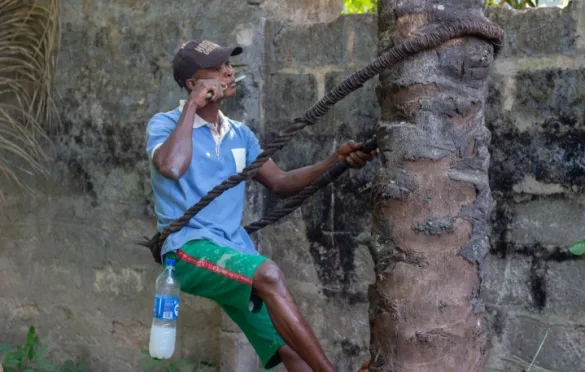
    Our call for the 2022 Christmas edition of Nkanu Today column was at Obeagu, Awkunanaw, in Enugu South Local Government Area of Enugu State.

    Pacesetter’s guest was a palm wine tapper, Chinwendu Eze, a young man whom we guess is in his mid or late thirties. We captured the entire process of Ịkụnkwụ (palm wine tapping) from palm trees. He had a little explanation to make.

    “I tap my palm trees thrice a day; mornings, afternoons and evenings.

    “To get palm wine from the tree, you cut the palm frond (igu) in a certain way to reveal the mmumu and leave it for 24 hours before positioning a gallon that will hold the palm wine. The first set of the fresh palm wine that drops into the gallon turns out so sweet but after two days, the rest of the palm wine will not be as sweet as the first set, it will be normal. Usually the fresh, sweet ones are diluted with normal palm wines to control the sweetness, or sometimes I leave it to ferment.

    “The mmumu dies after a while. The harmattan period reduces the flow of the palm wine. During the heat period, the palm wine flows heavily.

    “Some trees have up to 3 to 4 mmumu. While one dies off, the others grow back. The mmumu needs to be cut down early enough, if it stays unnoticed by a tapper for a while, it will be unable to produce palm wine, then we’ll have to wait till it grows back. It has a lifecycle of about two weeks if the palm tree is at its best condition. When it dies after two weeks, it begins to grow back. If it doesn’t, then we look for other palm trees to tap from”.

    Palm wine tapper’s contact: 07018017444

  • Queen Christiana Ego Igwesi: Going home in a blaze of glory

    Queen Christiana Ego Igwesi: Going home in a blaze of glory


    On Wednesday, October 5, 2022, an Amazon and matriarch of the Igwesi royal family of Obuoffia Ancient Kingdom in Nkanu West Local Government Area of Enugu State, Her Highness, Chief Ezinne Christiana Ego Igwesi (JP), left this world after a brief illness. Though the Queen departed at the ripe age of 76 but the reality of her demise is yet to dawn on many, especially her family and numerous admirers. Lolo Igwesi breathed her last at Raymond Anikwe Memorial Hospital, Independence Layout, Enugu.

    Those familiar with her antecedents would agree that the philanthropist par excellence is going home in a blaze of glory. She came, saw and conquered.

    Shakespeare literally had people like her in mind when he clearly stated in his novel, Julius Caesar, that: “When beggars die, there are no comets seen; the heavens themselves blaze forth the death of princes.”

    Her life was one of passion and dedication to public service, even as her preoccupation was always to touch the lives of the vulnerable and the needy.

    While active, she held different positions of trust and leadership, which included: member, Enugu State Rent Tribunal, Enugu South LGA; member, Transition Committee, Nkanu West LGA; and supervisory councillor for health, Nkanu West LGA. Also, she held positions in Umuada Igbo, National Council of Women Societies, and the Methodist Church Nigeria at various levels.

    But the ‘mother of all mothers’ has gone the way of all mortals and her funeral rites would commence on December 15 with interment to be done on Friday, December 16, as announced by the revered Igwesi Royal Family of Obuoffia Ancient Kingdom.

    This announcement was contained in a message by Chief U.S.A. Igwesi, the queen’s second son, as directed by His Royal Majesty, Eze Igwesi Obiora Igwesi, Eze-Chinawaeze III of Obuoffia Kingdom, traditional head of Obuoffia Awkunanaw and traditional ruler of Omuoha Awkunanaw, who is the first son.

    Since the sad passage of the matriarch, the royal compound of the Igwesi family has been a Mecca of some sort following condolence visits from high-profile personalities, politicians and top businessmen.

    Former member of the House of Representatives and former leader of the Enugu State House of Assembly, Chief U.S.A. Igwesi, the second son of the queen, revealed that the queen, who was a wife of the late Royal Majesty, Eze John Egbo Igwesi, Ezechinawaeze II of Obuoffia, was also the mother of the present traditional head of Obuoffia and traditional ruler of Omuoha, His Royal Majesty, Eze (Barr.) Igwesi O. Igwesi, among other surviving children and numerous grandchildren and great grandchildren.

    U.S.A. Igwesi thanked personalities, leaders, friends and well-wishers from all walks of life who visited and/or sent messages of condolence and sympathy during the trying period for the family.

    He said Lolo Nwakaego Igwesi was a great and hardworking woman, a virtuous wife to his late father and a dear mother who left no stone unturned in ensuring quality upkeep of her family.

    U.S.A. Igwesi noted that she served in various capacities, including as SPA and supervisor in Nkanu West LGA, among other important roles in the local government and beyond.

    Recalling his last encounter with his mum, he said: “On that fateful day, I came to see her at about 7am with her breakfast only to meet her stone dead and my siblings surrounding her and weeping. I couldn’t believe my eyes. It was most devastating. A number of doctors had to confirm her dead before I was convinced. After looking at her lying lifeless with all the efforts to save her life and all the capable hands that surrounded her, I concluded that life is indeed vanity.”

  • Okwudiri Ohaa @ 47: Eulogising Enugu’s Chief Fire Officer

    Okwudiri Ohaa @ 47: Eulogising Enugu’s Chief Fire Officer

    Enugu State Fire Service is, arguably, one of the greatest success stories of the Governor Ifeanyi Ugwuanyi led administration with Engr. Okwudiri Ohaa as the State Chief Fire Officer and helmsman.

    The fire service has been brought back to life, strengthened and refocused for the positive stories that abound today.

    Engr. Okwudiri Daniel Ohaa was born on 24 November, 1975 in Umueze Awkunanaw, Nkanu West Local Government of Enugu State.

    He attended Amuzu-Ukwu Community Primary School, Ibeku, Umuahia, Abia State, in then Imo State.

    After his primary education, Engr. Ohaa gained admission into the famous Holy Ghost Technical Secondary School, Olokoro Umuahia in 1986, he later completed his secondary school education at the Boys Secondary School Umueze Awkunanaw, (now…. Umueze Awkunanaw) in 1992 where he obtained his Senior Secondary School Certificate.

    He then gained admission into Enugu State University of Science and Technology (ESUT) where he studied Mechanical /production Engineering. He graduated from the University in 2000/2001 academic session with BS Engineering.

    Engr. Ohaa performed the mandatory National Youth Service from January to December, 2002 in Ogun State.

    On completion of the NYSC Programme, Engr. Ohaa was on 28th July, 2004, gainfully employed by the Enugu State Post Primary Schools Management Board (PPSMB).

    Following the need and the requirement for capable and qualified graduate engineers in the Enugu State Fire Service, Engr. Ohaa was transferred from the PPSMB to Enugu State Fire Service as a Senior Fîre Officer II on 4th October, 2005.

    Engr. Ohaa was on 1st July, 2016, appointed the Head of the State Fire Service, by His Excellency, the Executive Governor of Enugu State Rt. Hon. (Dr.) Ifeanyichukwu Lawrence Ugwuanyi. The position he still holds. While currently in office as the Head of the State Fire Service, his productiveness, innovativeness and dedication to duty has raised the State Fire Service to an enviable height of efficiency of International standard, that Enugu State Fire Service ranks as one of the best in Nigeria. This feat is made possible with the great encouragement and sponsorship of His Excellency, the Governor of Enugu State Rt. Hon. (Dr.) Ifeanyichukwu Lawrence Ugwuanyi by purchase of modern fire fighting equipment, trainings both local and international, building of additional Fire Stations across Enugu State and giving good incentives to staff of the Service .

    Professional COURSES ATTENDED:

    (i) Basic Fireman Training

    (ii) Fireman Certificate of Competency (FCC)

    (iii) Advanced Fireman Certificate of Competency (AFCC)

    (iv) Fire Safety Management and Fire Risk Assessment at Fire Service College Morton in Marsh UK.

    MEMBERSHIP OF PROFESSIONAL BODIES.

    (i) Member, Nigerian Society of Engineers (MNSE)

    (ii) Member, the Nigerian Institution of Mechanical Engineers (MNIMechE)

    (iii) member Council of Registered Engineers of Nigeria COREN.

    AWARDS:

    (i) Fellow Nigerian Society of Engineers (FNSE)

    (ii) UK Certified Fire Risk Assessor

    (iii) Professional Fellow: Institute of Corporate Administration, Abuja

    (iv) Fellow: Emergency, Crisis, Disaster, Safety, Environmental & Risk Management Institute, Lagos.

    (v) Emergency Response Ambassador: Emergency, Crisis, Disaster, Safety, Environmental & Risk Management Institute, Lagos.

    Professional Fellowship:

    (i) Nigerian Society of Engineers

    (ii) Corporate Institute of Risk & Safety Management, Lagos.

    HOBBY:

    Engr. Okwudiri Daniel Ohaa was very famous among his peers as a good footballer, earning him the nick name “Edebor” after a famous Nigerian football super star – Humphrey of the Super Eagles, was nicknamed “edebor” The nickname almost over shadow his real name as his dexterity in playing football continued increase unabated

    Engr. Ohaa is happily married and blessed with beautiful children.

  • AHỊAJIỌKỤ: Igbo New Yam Festival

    AHỊAJIỌKỤ: Igbo New Yam Festival

    …Discourse at UIU Tristate 6th Annual BBQ/New Yam Festival, Saturday. August 27, 2022, Queensbridge Park, Queens, NYC


    M.O. ENE

    PREAMBLE

    Igbo kwenu! Umu Igbo Unite, kwenu! Igbo Tri-State, kwenu, Igbo kwezuo nu!

    Thank you for inviting me back from across the Hudson River. Last April, I was here in the Big Apple. We met on Wall Street, the financial hub of the world. Shịshị, I did not see! I spoke on Ịgbankwụ, the Igbo traditional marriage. I promised you a book. I delivered. Amazon it! We gather today in Queensbridge Park for the 6th BBQ/Yam Festival of UIU: Umu Igbo Unite. Tulu nu ugo! (Congratulations!) I wish I had written a book on new yam festival. No new promises, please! This speech will be brief, by my standard, a scratch on the surface of sense, symbolism, and significance of Igbo New Yam Festival.

    INTRODUCTION

    Igbo New Yam Festival is an explicit equivalent of Easter, Labor Day, Halloween, Thanksgiving, Kwanzaa, Christmas, and New Year celebrations rolled into one. It marks the end of toiling and the beginning of harvesting—a new era, the promotion of justice, equity, peace, and progress for a more fruitful future, a celebration of our earthly existence—the living and the dead, an appreciation of ancestral supreme sacrifices, a celebration of the benevolence of Anị, the Earth deity, an immense gratitude to Eze Chiukwu Okike Abịaama, Amaamaámachaamacha, for sustenance of life.

    Though anchored on harvesting first yams, the festival commemorates the harvesting of other crops from the generosity of a good land God gave to a gifted generation. In giving thanks, the Igbo roast yam tubers—not turkeys, propitiate to ancestors and generous deities, and consume roasted yams with fresh palm oil.

    Yams can be boiled and eaten with spiced stew or salted-peppered palm oil. It can be cooked as yam porridge with dry fish and meat or sliced and fried like French fries or English chips. Top of the line is boiled yam pounded into fufu and eaten with delicious soups of assorted vegetables, fish, and meat.

    It is also common to eat roasted or boiled yams with oil-bean salad called akpaka or ụgba. The popular Igbo salad is specially prepared with spiced and simmered stockfish, okporoko, in a palm oil-potash sauce (ngụ).

    YAMS

    Yams are centuries-old plants with underground tubers and twining vines with heart-shaped leaves of predominantly green color and shades of purple. The tubers of different weights have bright-brown colors and mostly white pulp. Some varieties have yellow flesh and darker skin. Yams grow from pieces of tubers that are planted to produce shoots and die to produce much bigger tubers within four-five months.

    Yams are reportedly rich in fiber, high in potassium, manganese, copper and contain important nutrients and oxidants that support bone health, growth, metabolism, heart function, regulate blood pressure, control blood sugar, and improve reproductive functions. Humans do not eat raw yams—they are toxic; cooked, they are delicious.

    ORIGIN

    To the Igbo, yam is divine. A popular myth backs it up. As with the kolanut, this happened when human beings communicated with beings in the spiritual realm, when the space between the living and the departed was not too great. There was a vast famine in the land. A great oracle consulted the gods. It was revealed that a dude and a damsel must be sacrificed. It was done. As directed, the male body was cut into pieces and buried in many mounds of earth; the female body was subjected to the same unpleasant treatment and buried apart. Within four weeks, seven native weeks, yams spouted from the male remains, while cocoyam grew from the female flesh.

    Four months later, the land had an abundant harvest of yams and cocoyam. Famine never ravaged the Igbo country again. One version of the myth is interesting: The chief of the community (named Igbo probably for effect) sacrificed his first son (ọkpara), named Jiọkụ or Njiọkụ, and his first daughter (ada), named Ede. The flesh of Jiọkụ reproduced “ji” (yam), while Ada yielded “ede” (cocoyam). For this reason, the festival celebrates the death and resurrection of Jiọkụ and Ada.

    NOMENCLATURE

    The kolanut and yam are two common Igbo words; there are no dialectical variants—just different varieties. Interestingly, as with ascribing ‘ịwa ọjị’ and ‘ịgọ ọjị’ to kolanut communion, ‘iwa ji’ or ‘iri ji’ is not a correct designation for the yam ceremony. In using “iri ji” (literally ‘eating of yam’), one wonders why no one uses ‘ịta ọjị’ (‘eating of kolanut’)! The answer is simple: No one is compelled to eat kolanut or yam. Easting (iri) and ịwa (cutting) are phases of the ritual, a small aspect of the ceremony. ‘Ahịajiọku’ does not mean market for roasted yams! ‘Ahịa’ is also hustling. ‘Ji’ means ‘yam’ as a noun; ‘hold’ or ‘beget’ as a verb. ‘Ọkụ’ means ‘hot’ with a high tone, and ‘possession’ with a low tone. So, ‘Ahịa ji ọkụ’ also means ‘Commerce and industry beget bumper harvests.’

    Many communities use different terms. One common core is that new yam festivals are predominantly celebrated mid to end of August or early September—the so-called “August break,” when rainy season takes a breather.

    Popular terms include: Ajụ (in parts of Enugu and Ebonyi States); Ahịajiọkụ (popularized by the Ahiajoku Lecture Series instituted in 1979); Ahịanjọkụ (an obvious dialectal version that injecxts the legend of Njiọkụ and Ada); Ikeji (popular among the Aro of Imo and Abia States); Ifejiọkụ (obvious influence of Onitsha dialect); Iri ji (Ọhụrụ), popular jazzy rendition of ‘eating of (new) yams’; and Ọnwa Asatọ (‘Eighth Month’) in Nri sphere.

    Others are Oru Owere, also commemorating the founding of Owerri by Ekwem Arụugo (alias ‘Owere’) and his followers who fled their ancestral home in Uratta and arrived their present place of habitation after a treacherous exodus. Otute Inyi in Oji River, Enugu State, Afịaọlụ in Nnewi, Orureshi among the northern-neighboring Idoma, Eje among the Yoruba, Em’orho in Edo are just a few names across Nigeria.

    SIGNIFICANCE

    Yam is a mark of accomplishment: Diji  bụ ọgaranya. No other crop is so valued and ritualized. There is no ‘ezeakpụ’ (‘king of cassava’) or ‘ezeede’ (‘king of cocoyam’). The festival signifies survival; without a steady source of sustenance, many communities might as well fold and relocate.

    Yam is so significant in Igbo life it features in popular philosophical expressions of earthly existential essences. Setting priorities: Á gbara aka na-azọ ala, onye nwe ji ana-akonyue ji n’ala. Whoever regulates resources determines distribution: Oji ji, jide ede: onye ọ wanyere, o rie. Sex segregation: Á naghị enyiwe ewu n’ọba ji. The essences of diligence, humility, patience, and persistence: “Gbanụ-gbanụ kwujie ji, o tukwuru ala gwupụta ọdụ ya.” Hierarchical order: Ji anaghị esi n’ọdụ epu ome. Measure of wealth: Ụba anaghị agha ji.

    SYMBOLISM

    The new yam festival is about supreme sacrifices and about renaissance and restoration. It celebrates the living and the dead. The appearance of masquerades refers: Mmaọnwụ–the beauty of death—represents the departed. Of course, the living is mmandụ—the beauty of life. Yams are so sacred it is a sacrilege to step over them. Yams symbolize hard work and honesty. One can steal a chicken and survive the shame; stealing yams is an abomination—no matter the level of one’s pot poverty. The culprit becomes an instant outcast in days of yore, since spilling human blood is a desecration of Earth Deity.

    Yam is a symbol of sacredness used to represent faith in the supernatural. Yam embodies fertility: Just a slice of its old self is all it takes—not a seed, not a shoot, no pollination; just the body sacrificed for communities to live and thrive. Thus, yam symbolizes supreme sacrifice. This explains the presence of yams at bridewealth ceremonies before or during ịgbankwụ (weddings). Yam and cocoyam project the great sacrifice that a woman makes in leaving her home for a man’s kindred, where she will multiply herself and beget a new nation of great men and women who look different—like Jiọkụ and Ada.

    RECOMMENDATION

    As with ịgbankwụ, diaspora Igbo can force a common Igbo term for new yam festival. Ahịajiọkụ should be adopted as the generic name: a great gathering for a celebration of abundant harvests. Ahịa is not just a place for buying and selling, it is a ground of great gathering for hustles, a socializing scene, and center of cultural contacts. Thus, great masquerade festivities take place at market squares which double as town squares. You have turned Quakerbridge Park into ahịa today. Bravo!

    Secondly, we should reserve the last Saturday in August for Ahịajiọkụ festivities and the following Monday as a public holiday in predominantly Igbo societies. In America, the day will coincide with the Labor Day weekend in 2025. Whenever it does, Ahịajiọkụ should be planned as a four-day festival with lectures, picnics, ballroom dances, cultural displays, and community work.

    CONCLUSION

    Ahịajiọkụ, the New Yam Festival, must be preserved. We can now plant yams in America and not depend on imports that are expensive and often damaged on transit. Summer is getting hotter, and yams do well in bags of rich soil when watered and tended like flowers. We must do this in remembrance of the sacrifices of our ancestors and for the wellbeing of future generations.

    The festival is not just about harvesting, entertainment, and feasting, it is also about hard work, honesty humanity, and humility. Work is a cure for poverty: Ọrụ bụ ọgwụ ụkpa. During this festival, youths are taught about two things that create wealth: products and services—not prayers to sundry spirits and empty events that consume the little we have.

    Dignity of labor is the sustaining spirit of a stable society, the mantra of the moment: Produce more, consume to nourish the body, celebrate to uplift the soul, and trade to make money in a popular marketplace of goods and ideas: ahịa. Hence, the principles of Ahịajiọkụ include sustenance of life, economic growth, cultural immersion and human development.

    Again, I thank you for inviting me and for listening.

    ©MOE, 8.27.22

    @aladimma

  • 2021 Independence Edition’s Personality of the Time- Mr. Ernest Ikechukwu Ugwu

    2021 Independence Edition’s Personality of the Time- Mr. Ernest Ikechukwu Ugwu

    2021 Independence Edition’s Personality of the Time- Mr. Ernest Ikechukwu Ugwu

    Mr. Ernest Ikechukwu Ugwu is the Enugu State Chairman of the National Association of Proprietors of Private Schools (NAPPS).

    Ernest Ikechukwu Ugwu

    He is an educationist, geologist, businessman and a techie.

    He holds a Bachelor of Science Degree in Geology from the Nnamdi Azikiwe University, Awka, Anambra State.

    Mr. Ugwu is the Proprietor of Swiss Kids Academy, Enugu. He is also the CEO of Afriwice Global Limited and Instant Deposit Nigeria Limited, all in Enugu. He wasn’t born with a silver spoon. In his words “I had my primary school in a very remote village, followed by my secondary education and after that I went into the transportation business. I got an old truck, repaired it and was using the proceeds to train myself in college-two of my elder brothers gained admission and were able to go to school from the proceeds of the business.

    “I later got some buses, registered them under Peace Mass Transit as at then; I was schooling and doing all these things. In school, I went for the competition of a National Scholarship by Elf Petroleum and I won. Elf Petroleum trained me from second year to final year.

    “Graduating, my flair for business was still quite high so I ventured into ICT. In 2007 I officially took up an ICT company, Afriwise Global Ltd, which I incorporated. It grew to the point that I ventured into financial businesses, integrating IT with financial payments-Payment Service Bank and we went ahead to get a license.”

    As the Enugu State Chairman of the National Association of Proprietors of Private Schools, which is a body uniting all private schools, Ugwu has injected breaths of fresh air into the system. Recently, he purchased a Hummer Bus for the Association valued at about ten million naira, despite inheriting a lean purse of about twenty four thousand naira from the previous administration. When he assumed office, one of the challenges bedeviling private schools in Enugu state was that of multiple taxation.

    “I decided to tackle harassment of the private schools, especially tax wise, which was on the high. What the private schools usually did was just to demonstrate and write all sorts of stories against the government, but I took the matter to the government, sat them down and discussed with them. At the end of the negotiations, the 37 levies the government collected were reduced to just 7”, said Ernest Ugwu. 

    He has since introduced the training of private school teachers and private school proprietors. He was hugely instrumental in the deployment of the Enugu State students’ portal by the Enugu State Ministry of Education, a portal that has helped to effectively determine students’ promotions and arrest the proliferation of special centers. His antecedents were responsible for his appointment as member into the Enugu State Education Sector Reform Committee by the Executive Governor of Enugu State, His Excellency, Rt. Hon. Dr. Ifeanyi Ugwuanyi. He is also a member of the Enugu State Education Stakeholders Forum

    Mr. Ernest Ikechukwu Ugwu has been a crusader of Youth emancipation through business empowerment and mentorship. He has sponsored the technical training of youths of Nsukka extraction on Programming, CCTV installation, Business Management, etc. His human products have been mentored on how to understand business problems and solve them through writing. At the last count, he had mentored and settled twenty-eight youths financially and otherwise. He is the Convener of the prestigious Nsukka Youth Entrepreneurship Summit, where he hosts all Nsukka Youths and invites technocrats in different areas of life to mentor them on how they can succeed.

    Ugwu is married to a beautiful and lovely wife and has three children. He is a commanding force on everything he touches. He does everything with diligence, love, determination and an overall care for humanity. He stays true to his oath as an educationist, with dedication and defiance.

  • Encomiums pour in as former Enugu PDP guber aspirant and business mogul, Odengene, celebrates birthday

    Encomiums pour in as former Enugu PDP guber aspirant and business mogul, Odengene, celebrates birthday

    Encomiums pour in as former Enugu PDP guber aspirant and business mogul, Odengene, celebrates birthday

    Chetanne Chinelo, Enugu

    Goodwill messages, encomiums, appreciations and felicitations have continued to pour in following the birthday celebration of Capt. Evarest Nnaji, Odengene, a former aspirant of the Peoples Democratic Party, PDP, in the Enugu governorship race.

    Odengene, who enjoyed massive goodwill and followership in the build up to the primaries, especially after he single-handedly constructed a 5.4km asphalt road in Amagunze, for use by his people and 4 other connecting autonomous communities, is the Chief Executive Officer of Odengene Airshuttle Services (OAS).

    Testifying about his philanthropy, a social media user, Arthur Edeh, said “Happy Birthday to an uncommon personality, a rare gem, an entrepreneur, a business Mogul, and a gentleman par excellence.

    “Sir, you’ve by your benevolence, and sacrifices touched many lives with your wealth. And I pray, as I wish you God’s leading, guidance, protection, good health, increased measure of grace, and longevity; that God grants your earnest request in Jesus Christ’s name, Amen”

    Another user, Onah Ebuka said, “From the depths of my heart, I know you are the best leader in the world, a great mentor, and a dear boss.

    “This is a special day for me because it is also special for you. I want you to know that you are a great blessing to me.

    “Thank you for having an open door and listening ears. You are simply the best. I wish you a long and fulfilling life”.

    Chidi Wilfred said “Hurray to a rare leader on a special day like this. In marking this auspicious circle of your birthday, I am happy and greatly elated to felicitate with you on this special day of yours.

    “Enugu state has in you a son that has continuously given ndi Enugu a reason to echo ‘Glory to God’ for giving you to us. A father figure to the fatherless, humanitarian figure to the needy and succour to the less privileged.

    “Chief Capt. Evarest Nnaji (Odengene) sir, as you celebrate, I am audaciously saying hurray and praise to God who has made you who you are today”.

    Captain Evarest Edeh Nnaji (Odengene) was born on 16th August, 1962 into the family of Chief Silas Edeh Nnaji and Chief Mrs Janet Wowo-Ogo Nnaji, of the Odengene larger family clan, Isienu Amagunze, Nkanu-East Local Government Area, Enugu State.

    An Air Pilot of repute, he obtained Nigeria Air Law (NCAA), Licensed to fly in the United States of America and Nigeria. He is specially trained as a Vertical Reference and Long Line Helicopter Pilot.

    Captain Evarest Nnaji is the Managing Director/CEO of many companies such as Odengene Air Shuttle Services Limited (OAS Helicopters) Nigeria, Odengene Air Shuttle, Inc. (USA), Odengene Group of Companies Ltd, Electrostatic Laser World and OAS Offshore Logistics Ltd

    Captain Evarest is an accomplished Businessman, Aviator and Politician.

    He is the founder of Odengene Foundation, which has over the years granted and maintained scholarships for innumerable indigent students, up to the University level. The Foundation also undertakes legal services for Awaiting Trials inmates in prisons for minor offenses.

  • “Do You, Consistency Pays”- a Chat with Eru

    “Do You, Consistency Pays”- a Chat with Eru

    Eru is a music artiste based in Lagos, but from Rivers State. Eru bares her mind and thoughts about her art and music career in this chat with our correspondent, Muna.

    I know you as Eru, a music artiste, but can you tell us a little more about yourself? 

    I’m like everyone else, particularly Eru (formerly known as BeautyEru) is a lover of art, of any form.

    What made you choose music as the thing you are going to do? 

    Hmm…There’s no particular thing or event I would pin point that made me choose music. I love music, I always will and I’m doing it.

    Your music is quite unique. I mean, I love the originality and honesty in them, both in the lyrics and sound, you just made your own voice and niche, like in “Fowl Na Fowl” “Vain Glory” and “Significant Nothing”; what and who inspires your art? 

    Experience, as one distant from culture….Fowl na Fowl/Paradise is my story/experience. Sometimes these experiences (muse) aren’t mine, sometimes they’re relatively fictional but hardly farfetched.

    So, how would you describe your music journey so far, with your EP “Adiaha” out there?

    My music journey has been educative, everyday I learn.

    Where are the places that people can go to listen or download your songs?

    It’s on almost every cyber platform, links are on the site www.beautyeru.com.ng.

    How does your music promotion and support go, are you signed on any record label yet? 

    With almost everything going digital, promotion/marketing is done that way. The support has been impressive. No label, just my manager and I. We’re open to sponsorship.

    Tell us some challenges you face in your art so far.

    Challenges there would be the constant need to bring your A game, even during the bad days.

    What do you think can be done better in the industry to help young artistes like yourself grow and hit the ultimate breakthrough in their career?

    More & improved Internet access, cheaper data and a functional music/entertainment system or structure. I don’t know about any in this part of the world.

    From your experience so far, what do you say to other artistes like you out there? 

    Do you, consistency pays.

    What is the next thing we should be expecting from you, an album maybe? 

    More art…More art.

  • TOBI AMUSAN: Before her story changed in 2015

    TOBI AMUSAN: Before her story changed in 2015

    TOBI AMUSAN: Before her story changed in 2015

    Coach tells her captivating narrative as a local athlete he begged to be included in teams and the irony of Oregon where she missed World Junior Championships because of visa hitches

    Nigeria’s participation at the 2022 World Athletics Championship in Oregon, USA was made special by the outstanding performance and the iconic showing of Tobi Amusan who did not only win the 100 metres hurdles event but also created a world record with a time of 12.12s in the semi finals. She blasted that record two hours later in a wind-aided time of 12.06s.

    Amusan’s performance and another female athlete Ese Brume who picked up a silver medal in the long jump event at the championships redesigned Nigeria’s declining status among great athletics nations in the world.

    Her story with Oregon started years back, when, as a junior athlete, she was billed for the World Junior Athletics Championships but could not travel because the American Consular office in Abuja delayed the issuance of her visa.

    According to coach Solomon Aliyu, who was her coach then, “the rest of the team had travelled and her visa was still being processed. She had a visa interview on Friday and her event was on Monday. As of Friday, her visa was yet to be issued. I stayed back to wait for her because she could not travel alone as she was still a minor.

    “When at the end of Friday the passport was still not out, I decided to leave for the USA to join the rest of the team. But before I left, I advised her not to worry, that there were going to be many more championships she would attend in future because she had a very bright future.” That was how Tobi missed her first trip to Oregon.

    Incidentally, it was that same venue, where she was supposed to launch her athletics career as a junior international that the 25-year old chose to stun the athletics world and on a bigger stage.

    “When I saw her in the semi final of the World Championships when she ran the new world record of 12.12s, I said, wow. I quickly remembered that it was the same venue in 2014/2015 when she was supposed to go for the world Junior Championships held at the same Oregon which she missed. I also remembered telling her that the   America you were denied, you will get tired flying to the place. Little did I know that she would even become a resident in the US. It is very ironic that the same place and same event she missed launching her international career in the junior category became where she conquered the world in the senior category. She broke an African record in the heats, world record in semi final and finally she beat her own world record, even though they said it was wind aided.”

    The story of Oluwatobiloba Ayomide Amusan is like a script for the big screen. Born in Ijebu Ode, Ogun state 25 years ago to parents who were both teachers, she grew up under a very strict regime. Her venture into athletics was not an all smooth affair in the home front as her father didn’t sanction it. At one instance, he burnt her running kits and warned that he should never see her run again. But she found a strong ally in her mother, who saw something different in her. When she was going for an out-of-state competition, she would lie to her father that she was going for an inter-school debate.

    “My mom would cover for me that I was going for inter-school debates in Shagamu and then she would drive down there to give me my outfit,” the athlete told BBC Africa.

    In the beginning, Tobi Amusan’s coach was Ayodele Solaja, a grassroots athletics coach in Ogun state. He honed her skills in track and field, but typical of a grassroots coach, his ward was like  Jack of all trades master of none. “She was competing in the relays, 100 metres and long jump,” coach Aliyu recalled. Indeed, Amusan herself told the BBC that she began as a footballer but when her coach discovered her high work rate because she was always everywhere on the pitch during training, the coach then advised that she should take to athletics because she would be better off there. That was how she fell in the hands of coach Ayodele Solaja.

    Coach Aliyu recalled his first meeting with young Tobi.

    “My first encounter with Tobi was when she was invited to the national camp at Sapele ahead of the African Youth championships. That was 2013 or 2014.

    “We had a long camping in Sapele for both juniors and seniors. There were about 11(male and female) hurdlers in camp. We were leaving camp, at times for national competitions, then we would return after such engagements. We attended one competition in Warri. From Warri, we left for national trials in Calabar that year. I inherited Tobi with 14.60s and by the time we were done with camping in Warri and Sapele she ran 13.70s.”

    Coach Aliyu said Amusan’s progression owed largely to her commitment, dedication, discipline and being focused. “This is an athlete that will always remind her coach about training time,” Aliyu said.

    With her steady progress, she could not be ignored any longer. In 2015, she was invited again, this time, for the All Africa Games, her first at the senior level. Being a home-based athlete without much experience, Tobi was always overlooked by officials.

    Her ordeal in the Port Harcourt camp before the 2015 All Africa Games speaks volumes. Coach Aliyu narrates: “My next encounter with her again was when she was also called to camp for the 2015 All Africa Games. Before the All Africa Games camp in Port Harcourt, she came second in our national trials with 13.60s behind Lindsay Lindley, our 100mH from the US. Lindsay had a 12.90s to her credit even before the national trials and was the favourite to win the All Africa Games gold in the event.

    While in camp in Port Harcourt before the African Games, our head coach Gabriel Okon called us, all the coaches of the various disciplines. We normally have meetings intermittently but on this day we were called to discuss our athletes and their(our) medal chances before the Games.

    So, for each group of athletes, the coaches would talk about the athletes and their medal chances: gold, silver or bronze, based on their performances and the coach’s assessment. When it got to the turn of hurdles, even before I said Jack, the other coaches said Lindsay had the brightest chance for the gold medal.

    I told them if by their own assessment Lindsey would win a gold medal in that event, my own gold medalist would be Tobi Amusan. They were surprised at my assessment and asked why would I, as a coach, say an athlete with 13.60s had better chances of winning a gold medal than one with a 12.90s. I told them my assessment was based on my encounters with the two athletes. I insisted, by my own assessment, it would be Tobi for gold at the All African Games. I told them that based on what I had seen and by the level of their progress, I tipped Tobi for gold because of her progression.

    I pleaded with the team selectors to include her name in the team for the All Africa Games. One thing I asked of them was not to put any medal against her name because I didn’t want the young girl to be under any pressure. They said there was no problem. That was how they added her name as second hurdler, behind Lindsay.

    It happened that we were to go to China for the World Championships-some coaches and some selected athletes were excused from camp to attend the Senior World Athletics Championship. Tobi started nursing the feeling that if I left for China, they were going to decamp her. Her fears were genuine because some of the 4x400m hurdlers that were in camp had been decamped as they were assessed to have no medal chances.

    She feared that with my absence, it would be easier for them to drop her. I assured her that nothing like that would happen because I had gotten her name in the team already and if there was any new development, the team going to China would be in the know. But should that happen, she could reach me via WhatsApp.

    “True to her words, while we were in China she called and said she had been dropped. The list eventually got to us in China because the AFN President, Chief Solomon Ogba, was part of the trip, the secretary general, Olumide, Kayode Thomas, then a board member,Yusuf Ali and coach Gabriel Okon were all in China.

    So I quickly alerted Yusuf Ali to help me speak with the AFN president and the other board members that were present in China. I had also talked to the girl in camp that she was the only home-based hurdler I had in the camp. I said they should just trust my word and allow her to be part of the team to travel for the All Africa Games in Congo.

    So I was lucky the AFN president listened and her name was included in the final team. That was her first major international outing that changed the whole narrative and that was the platform she actually needed. It took her to the USA. I’m sure you already know the story of her performance in Congo where she won Gold at 13,15s, the same time she ran in the finals Lindsey placed third.. By that same year, she had her scholarship and in January 2016 she left for the US where she has blossomed and achieved her potential.

    Amusan was also frustrated by officials in the relays. As good as she was in the relays, she was always overlooked. At most meets, she would be ready to run but the coaches were always dropping her from the team because she was considered a risk because she was small and considered inexperienced. Coach Solomon Aliyu admitted that she is a sprinter and hurdles being her specialty was an advantage in the sprints and relays.

    He recalls: “Yes, for you to be able to run that fast over the hurdles, you must have a very good speed. In fact, most countries include hurdlers in their relay teams because if there are any good hurdlers in the team, they are always returning good times.

    We have this belief in this part of our world that you must be experienced, to be able to stand the big stage. So the relay crew then, in their own wisdom, felt she was still a novice and that she might not be able to stand up when it mattered most . They normally excuse her from the relay team even though whoever was coming to replace her would not be better than her.

    On two occasions she pleaded with me in a competition venue to say that team coaches have refused to feature her in the relay team and that she didn’t like what they were doing to her. And I would tell her Tobi, you still have a lot of years ahead of you.

    This relay you are being denied, you will be the one to choose when to run the relay when the time comes. And I think that has also manifested itself already because she was supposed to be part of the relay team in the world championships but she actually said she needed to stay fresh and fit for her main event and that contributed to her blistering form in her event.“

    (Vanguard)

  • [OPINION] G.O.C. @ 60: THE BEGINNING OF SERVICE TO HUMANITY AND GOD

    [OPINION] G.O.C. @ 60: THE BEGINNING OF SERVICE TO HUMANITY AND GOD

    By Professor Dan O. Chukwu

    In his autobiography, My Odyssey, Dr. Nnamdi Azikiwe recalls his first meeting with Dr. Kwegyir Aggrey of the Gold Coast and the impact that meeting was to have on him and Africa in the later years. According to Azikiwe, Aggrey’s sermon during that encounter was not only symbolic and suave, but it was also one which found his heart a ready soil for the dreams of a new social order in Africa in the 20th century and beyond. In the years after that memorable meeting with Aggrey, Azikiwe was to inaugurate his “Argonauts” consisting of Nigerians who sailed across the Atlantic ocean to acquire the proverbial golden fleece in the United States of America.

    The return of the “Argonauts” to Nigeria in the 1940s was probably a game changer in the course and contents of the nationalist movement on the continent of Africa – and what with their intellectual contributions to this end? The incise pen of Akweke Abyssinia Nwafor-Orizu, as made manifest in his epic, Without Bitterness: Western Nations in Post-War Africa (Creative Age, 1944) made and impressionable impact on the quest for Nigeria’s independence. For instance, the book was known to have led to the formation of the Zikist Movement, a youth vanguard of the National Council of Nigeria and the Cameroons (NCNC). Formed in 1946, the movement’s demand for the immediate restoration of Nigeria’s independence was known to have shaken the foundation of colonial rule in Nigeria.

    Also, the return of the “Argonauts” was to further give a credence to Aggrey’s prophecy and charge to Azikiwe to the effect that unless there was a reorientation of values in Africa, the continent was certainly doomed. Dr. Aggrey had in conclusion of his message to Azikiwe underlined the following immortal words: “If I, one of you, could go to the new world [USA], and make a man of myself, then you can too. May God help you, Amen.”

    The likes of Dr. Gabriel Ogbuife Chukwubuike Ajah (mni) may have undeniably been inspired by the thoughts and actions of great philosophers, nationalists and leaders of all ages – some of them western philosophers; others African thinkers such as the names mentioned in the foregoing paragraph. To Dr. Ajah, who until very recently, was the chairman, Enugu State Science, Technical and Vocational Schools Management Board, his philosophy about man and life is captured in “service to the society”.

    Born sixty years ago (precisely on 24th July, 1962) in a sleepy Umuika village of Enuogu Nkerefi, Nkanu East Local Government Area of Enugu State, Ajah had his primary education in Enuogu, Nkerefi, between 1970 and 1973; secondary education at the Colliery Comprehensive Secondary School, Ngwo (1974-1979); University of Benin, Benin City, where he studied English and Literary Studies for his Bachelors degree in English Education (1984-1986); and M.A. in English as a second language (1987-1990).

    Also, between 1995 and 2002, Dr. Ajah was at the University of Nigeria (Enugu Campus) for his Bachelor of Law (LL.B) programme; in 2016 he earned a Ph.D in Education Management from the Enugu State University of Science and Technology. Earlier in 2002, Dr. Ajah had attended the National Institute for Policy and Strategic Studies, Kuru, near Jos, for a Senior Executive Course No. 24.

    But what is the use of knowledge if not for service, especially in a knowledge-driven society like ours where Aristotle’s transcendental concept of the unmoved mover is greatly in dire need to be able to bridge the yawning gaps in human relations. We thus can evaluate Dr. Ajah’s numerous educational trainings in the light of his work experiences and contributions to the society, which include (but not invited) to the following:
    Special Assistant to the Enugu State Government (1991-1992); Director, Civil Service Commission as at 2001; Permanent Secretary, Ministry of Environment, Enugu State (2001 – 2002); Permanent Secretary, PSD, Office of the Head of Service (2002-2003); and Permanent Secretary, General Administration SSG’s Office Enugu State (2003-2004).

    Also, in 2004 Dr. Ajah served as Permanent Secretary in the State’s Ministry of Education; between 2005-2007, he was Permanent Secretary in the Enugu State Universal Basic Education Board (ENSUBEB); he later served as Permanent Secretary, Ministry of Agriculture (2008-2010); and Permanent Secretary/Chief Administrative Officer to the Governor, Governor’s Office (2011-14th May, 2015). On 15th May 2015, Dr. Ajah assumed office as the Secretary to the Enugu State Governor – a position he held with aura, tenacity of purpose and professionalism as an experienced technocrat, for four years.

    Outside government circles where, as we have recounted in the foregoing paragraphs, Dr. Ajah is known to have acquitted himself greatly, empirical evidence appears to show that he has established unbroken records in community and philanthropic services. In the sub-sector of the society, Dr. Ajah is known to have singlehanded founded the Girls Comprehensive Secondary School, Enuogu, Nkerefi. Now known as the Science Technical College, Enuogu, the school which began in 2004, has, during the past eighteen years, trained young minds for university education and technical expertise in the business world.

    Reliving his days as, what some commentators wound prefer to describe as “super-permanent secretary”, Permanent Secretary and acting Chairman, Enugu State University Basic Education Board (ENSUBEB), Dr. Ajah, who enjoys the title of the “Ambassador of the Kingdom” conferred on him in 2019 by the General Council, Assemblies of God Nigeria, quipped: “I usually thank God for every opportunity in life, especially the opportunity to have served my state (Enugu) and my community (Nkerefi) in various capacities”.

    As Permanent Secretary and Chairman of ENSUBEB, Dr. Ajah was said to have advanced the cause of revolutionising and constructing new classroom blocks in parts of Enugu States, including his community, Nkerefi. Among the schools, which benefited from the bonanza, were the Community Secondary School, Amofu; Primary School, Umuika; Community School, Enuogu; Igbokeocha Primary School, Imeoha; Igwebuike Secondary School, Imeoha; Primary School, Umunnama Etiti; and Primary School, Mgbanaocha.

    One area, among many, individuals, groups and public corporations (including government agencies) in modern African societies seem to have failed the people is in building the bond of confidence and social contract, as the French philosopher, Jean Jacques Rousseau, would advocate. The spirit of social contract presupposes that individual members of the society have agreed to surrender their natural liberty to one another, and by extension have fused individual wills into a combined general will which now becomes that of the sovereign, a true sovereign power. At this point, the sovereign power should in turn be expected to provide the basics of life to these individuals (the citizens) who have surrendered their liberty and will to him/her. The basics of life expected to be supplied to the citizens by the sovereign may include protection of lives and property; provision of social amenities like pipe-borne water, electricity, road network, education, among others. It is probably because government agencies in Nigeria have abdicated their duties that made the likes of Dr. Ajah to undertake to create job opportunities and secure employments for employable individuals of the various Nigerian communities when occasions demanded.

    A lawyer, educationist, management consultant and administrator, Dr. Gabriel Ajah appreciates the worth of skilled manpower training for societal growth and development, hence the demonstration of his benevolence in securing admissions into institutions of higher education, for potential leaders of tomorrow. Investigation shows that this is one of his areas of strength. According to him: “I always feel fulfilled each time God uses me to facilitate admission into the university, polytechnic or college of education for students X, Y or Z. This is because the challenge of tomorrow’s leadership belongs to them, and they must, therefore, be sufficiently equipped today for that challenge.”

    In thinking and writing about Dr. Gabriel Ogbuife Chukwubuikem Ajah and his contributions to the growth of human society, one factor that has remained constant is his family, comprising the wife and the children. The wife, Mrs. Anthonia U. Ajah (Nee Offiah), leading the children, has always stood supportive of Ajah’s modest achievements. In other words, as Mark Douglas would posit: “When a man has done his best, has given his all and in the process supplied the needs of his family and his society, that man has succeeded.” “Such a man,” in the words of Bishop Paul C. Nwachukwu, “is both a public and private success.” These would have perhaps been the lot of Dr. G. O. C. Ajah during the past sixty years, even as he re-dedicates his life for more quality services to man and God in the years ahead.

    One another factor that goes for Dr. Gabriel Ajah is that even though he had a humble beginning, his sense of optimism has always made him to assert that if Aggrey, Azikiwe, Nwafor-Orizu, among others, could succeed the way they did, he possesses a much brighter chance to be a success, and subsequently make others succeed, too.

    Chukwu is a professor of History at Nnamdi Azikiwe University, Awka, Nigeria.

  • Why I wore traditional worshippers’ attire to Supreme Court proceedings- Lawyer

    Why I wore traditional worshippers’ attire to Supreme Court proceedings-Lawyer

    A human rights lawyer, Malcolm Omoirhobo, on Thursday, caused a stir at the Supreme Court for wearing an African traditional worshippers’ attire to the court’s proceedings.

    Omoirhobo stated that he wore the clothing to court to exercise his fundamental human rights following a recent judgment by the Supreme Court which permits all Nigerians to express their way of worship and the use of hijab in schools and public places.

    It was reported that the Supreme Court had, on Friday, June 17, 2022, granted the use of hijab by female Muslim students in government-owned schools in Lagos.

    The Court issued its judgement following an appeal – Lagos State Govt. and Ors V. Asiyat AbdulKareem with suit number SC/910/16.

    The lawyer, who was barefooted with feathers attached to his wig, was said to have arrived at the court at about 9:05 am.

    He also wore a gourd with cowries around his neck and a red wrapper tied around his waist.

    Addressing journalists at the court, Omoirhobo expressed his gratitude to the Supreme Court for its decision on Section 38 of the 1999 Constitution (as amended), which allows for the freedom of expression of religious beliefs.

    He said, I am very grateful to the Supreme Court just last week Friday they made a very resounding decision that promotes Section 38 of the constitution. That is our right to freedom of thought, conscience, and religion.

    “That we are free to express our way of worship in our schools and in our courts. That decision was reached on Friday and that has encouraged me.

    “Because I am a traditionalist and this is the way I worship. Based on the decision of the Supreme Court this is how I will be dressing henceforth in court because I am a strong adherent to ‘Olokun’, the god of rivers.”

    Omoirhobo added that the judgement implied that every Nigerian, no matter their profession could express their religious beliefs with their mode of dressing.

    (Punch)

  • Comedian Funnybone weds lover in Enugu

    Nigerian comedian, Stanley Chibunna, popularly known as Funnybone has tied the knot with his lover in Enugu.

    The star-studded ceremony had in attendance Nollywood stars and other entertainers.

    Celebrities such as footballer Wilfred Ndidi, actor Akah Nnani, Stan Nze, and a plethora of Nigerian stars were present at the colourful traditional wedding ceremony.

    Nollywood veteran, Pete Edochie, who was also at the event, gave a special prayer for the couple during the event.

    A series of videos on Nnani’s Instagram story revealed that it ‘rained’ money as the couple hit the dance floor with their guests.

    (Punch)