Precious Nwonu, Enugu
Nigeria and India have agreed to work towards restoring bilateral trade to its previous peak of nearly $15 billion, with Indian Prime Minister Narendra Modi calling for renewed crude oil purchases from Nigeria.
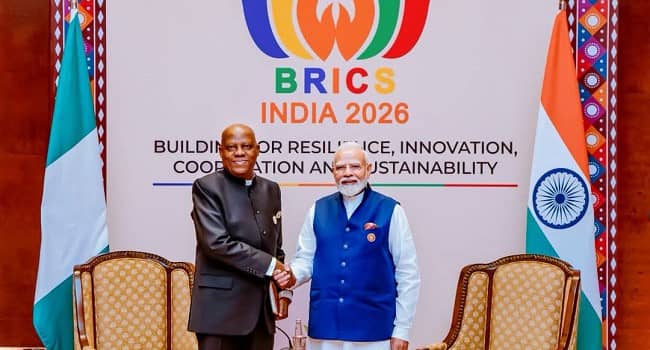
The agreement was reached during a meeting between Vice President Kashim Shettima and Modi on the sidelines of the BRICS Leaders’ Summit in New Delhi.
Bilateral trade between the two countries has declined significantly in recent years, falling from $14.95 billion in the 2021–2022 financial year to $7.13 billion in 2024–2025, largely due to a reduction in India’s crude oil purchases from Nigeria.
Trade later increased to about $9 billion in 2025–2026.
During the meeting, Modi emphasised the importance of rebuilding energy trade as part of efforts to return commercial relations between both countries to previous levels.
Shettima assured the Indian Prime Minister that President Bola Tinubu’s administration would consider India’s request for increased crude oil purchases from Nigeria.
Beyond crude oil, the Vice President stressed the need for both countries to deepen economic cooperation by moving beyond traditional commodity trade.
He said Nigeria was interested in attracting investments that would support local manufacturing, create employment opportunities and promote technology transfer, particularly for the country’s young population.
Nigeria and India also identified fintech, digital public infrastructure and the creative industry as areas for stronger collaboration.
The two countries further agreed to explore partnerships in defence technology, power generation and clean energy, while promoting investment in pharmaceuticals, healthcare and capacity development.
On the social development front, the Minister of Women Affairs, Hajiya Imaan Sulaiman-Ibrahim, said Nigeria was drawing from India’s women-led self-help group model through the Nigeria for Women Programme Scale-Up.
She said the initiative uses Women Affinity Groups to promote financial inclusion, grassroots businesses and social protection.
According to the minister, the programme forms part of Nigeria’s broader efforts to build an economy valued at $1 trillion.
Leave a Reply