Tag: tinubu

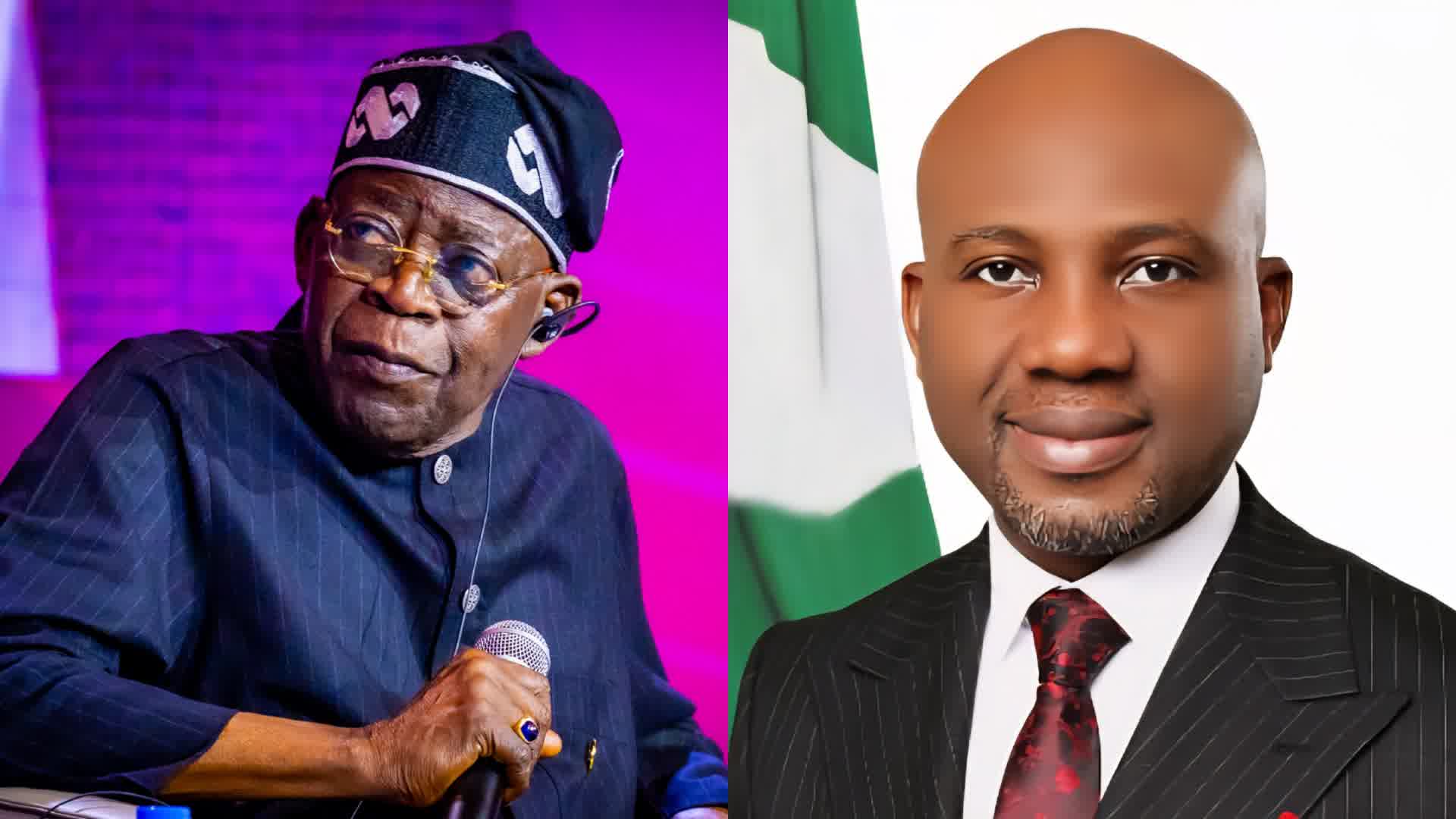
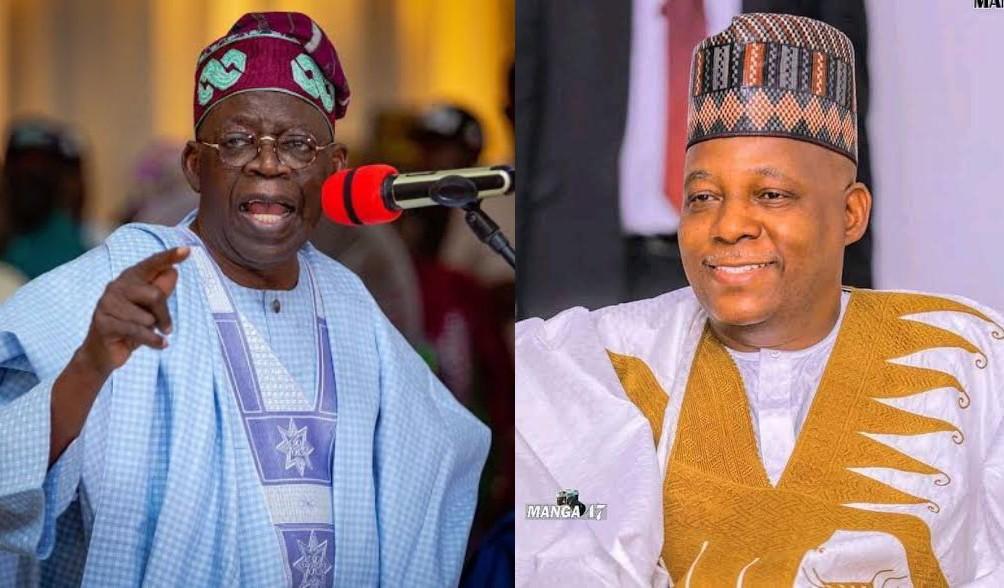
  • Tinubu Celebrates Shettima at 60, Calls Him ‘Patriot and Trusted Ally’

    Tinubu Celebrates Shettima at 60, Calls Him ‘Patriot and Trusted Ally’

    … First Lady, Remi Tinubu Celebrates Vice President, Kashim Shettima at 60

    Precious Nwonu, Enugu

    President Bola Tinubu and First Lady Oluremi Tinubu have extended warm congratulations to Vice President Kashim Shettima on the milestone occasion of his 60th birthday, hailing him as a trusted ally, true patriot, and deeply committed public servant.

    President Tinubu, in a statement issued on Tuesday ahead of the Vice President’s actual birthday on Wednesday, noted that he gladly rejoiced with Shettima’s wife, Nana, his children, extended family, and political associates during this celebration.

    “Kashim is not just a trusted ally or a valued colleague, but also a patriot whose life has been defined by service, commitment and sacrifice for worthy causes,” President Tinubu said.

    The President went on to praise Shettima’s background in banking, alongside his extensive record of service to both Borno State and the entire country.

    “Shettima’s unwavering commitment to our nation’s progress and unity is particularly worthy of mention. I commend him for his years of dedicated public service, first as Governor of Borno State and subsequently as Vice-President of the Federal Republic of Nigeria. In both capacities, Kashim has demonstrated courage, diligence, compassion and an abiding commitment to improving the lives of the people,” the President stated.

    Tinubu also highly acknowledged Shettima’s “loyalty to the All Progressives Congress (APC), support for the administration and his unwavering dedication to the success of the Renewed Hope Agenda.”

    In particular, the President lauded the Vice President’s steering of the National Economic Council, stating that Shettima has offered exceptional leadership in aligning economic policies and bridging cooperation between the Federal Government and sub-national governments.

    “His respect for constitutional governance, democratic institutions, and dialogue and consultation has helped strengthen good governance,” Tinubu added.

    Emphasising their strong bond, the President called Shettima a trusted partner, asserting that his “loyalty, wisdom and sense of duty have remained invaluable to the administration.”

    He expressed deep gratitude to the Vice President for his unwavering support in bringing the promises of the Renewed Hope Agenda to reality for Nigerians.

    “I am confident that working together, we will continue to make meaningful progress in building the Nigeria of our dreams. On behalf of the Federal Government, I again congratulate Vice President Shettima on this milestone, and I pray that Almighty Allah will continue to guide, protect, and strengthen him. May Allah grant him wisdom and good health, and bless him with many more years of purposeful service to Nigeria,” the President concluded.

    In a separate congratulatory message released on Wednesday, First Lady Oluremi Tinubu warmly joined Nana Shettima, the Vice President’s family, and well-wishers to mark the historic Diamond Jubilee.

    “On this occasion of your Diamond Jubilee, I join your wife, Her Excellency Hajia Nana Shettima, family and friends in celebrating you,” she said.

    The First Lady beautifully described the Vice President as a leader who has consistently exemplified “strength, loyalty, commitment and love for country.”

    She further celebrated his diverse professional and political milestones, referencing his past achievements as a seasoned banker, the former Governor of Borno State, and a former Senator.

    “As you attain this milestone, I pray Almighty Allah continues to bless you with divine health, peace, joy and happiness,” the First Lady concluded.
  • Presidency Reacts to Atiku’s $1.2m US Lobbying Campaign Over Tinubu Records

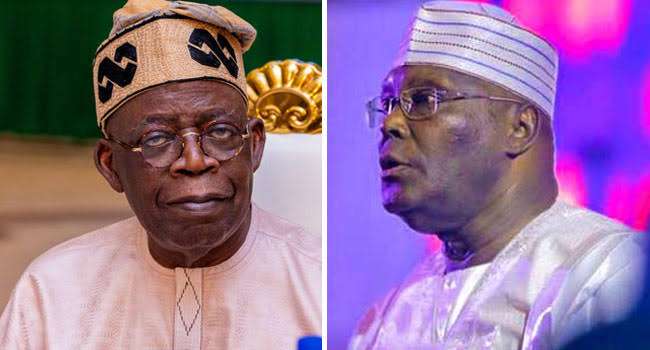
    Presidency Reacts to Atiku’s $1.2m US Lobbying Campaign Over Tinubu Records

    The Presidency has criticised a United States lobbying firm engaged by former Vice President Atiku Abubakar over its campaign for the release of records relating to President Bola Tinubu, describing the effort as a politically motivated attempt to create a crisis ahead of the 2027 elections.

    The Special Adviser to the President on Media and Public Communications, Sunday Dare, made the position known in a statement on Tuesday titled, “Speculation as Classified Information: Atiku’s $1.2 million Lobbying Gamble Exposed.”

    Dare accused the Washington-based Von Batten-Montague-York, L.C. of presenting political claims as intelligence reports and attempting to give the impression that its statements represented the position of the United States government.

    The Presidency’s reaction followed renewed activities by the lobbying firm concerning historical United States records relating to Tinubu.

    According to Dare, publicly available filings under the US Foreign Agents Registration Act showed that Atiku contracted the lobbying firm on a 12-month retainer reportedly worth $1.2m.

    He alleged that the firm’s activities were part of an attempt by the former vice president’s camp to use historical US legal records to gain political leverage ahead of the 2027 general elections.

    Dare said the reports being circulated from Washington did not constitute the official position of the US government.

    He said, “The incendiary press releases being carefully churned out from Washington are public relations propaganda sheets passed off as the view of the U.S. Government. They are not.”

    The presidential aide challenged those behind the allegations to produce what they described as classified intelligence and identify their sources.

    “Sane minds must categorically dismiss these reports as fabricated, politically motivated, and entirely unsupported by evidence. The report presents no intelligence document, no named Western official, and no evidence of any exchange involving Nigeria’s secrets or resources.

    “It is nothing more than political speculation packaged as classified information. We demand that they produce the so-called “highly classified intelligence report,” identify their unnamed sources, and provide tangible evidence for their wild allegations,” Dare said.

    He also questioned the role of the founder of the lobbying firm, Karl Von Batten, describing him as a commercial lobbyist and not an official of the US government.

    “Dr. Karl Von Batten’s comments represent solely the position of an individual associated with Atiku-linked political interests, not the U.S. government or President Trump,” he said.

    The controversy centres on historical records held by US federal agencies concerning Tinubu and a 1990s civil forfeiture case involving funds forfeited to US authorities.

    The records are also the subject of ongoing Freedom of Information Act litigation in the United States.

    PUNCH Online had reported that a Senior Advocate of Nigeria and member of Tinubu’s legal team in the United States, Wole Afolabi, defended the legal challenge against the release of portions of the records.

    Afolabi, who spoke on Channels Television’s Sunday Politics, said the US government had already released thousands of pages of records but was seeking to keep some portions redacted to protect law enforcement methods, sources and agents.

    He said Tinubu’s legal team was relying on protections available under US law and that challenging the release of the redacted portions did not amount to an attempt to conceal incriminating information.

    Afolabi said, “This matter has been going on for quite some time, as you rightly said, and the DEA and other government agencies have produced documents and made available to Mr Greenspan.

    “Now Mr Greenspan is asking that documents should be unredacted before they are handed over to him. The way the system works is this: it’s not what you want, it’s what the law stipulates.

    “So precisely what we are doing is going under the coverage of the law. It’s what the law gives us the right to do. It would amount to professional malpractice on our part if we don’t take advantage of what the law offers.”

    He also dismissed the suggestion that the US government was withholding the records specifically to protect Tinubu.

    He said, “In one of the recent filings that was made recently by the Department of Justice, it was stated in the footnote at page 24 that their concern is about the methodology by which information is gathered.

    “No mention was made of any protection being offered to President Bola Ahmed Tinubu.”

    Afolabi also argued that if US authorities had found sufficient evidence linking Tinubu to drug trafficking, he would have been indicted and prosecuted.

    Asked whether he was saying Tinubu had never taken drugs, had never been caught with heroin or had never been involved in drug trafficking, Afolabi replied, “What the evidence shows.”

    He was also questioned about the $460,000 forfeited to US authorities in the 1990s and the circumstances surrounding the civil forfeiture proceeding.

    Afolabi maintained that a civil forfeiture did not amount to a finding of criminal culpability.

    “If he was culpable, he simply would have been indicted. There’s no shortcut around it. He would have been indicted,” he said.

    The lawyer, however, declined to disclose Tinubu’s account of the matter, citing attorney-client privilege.

    “I’m acting as his lawyer, and as a lawyer, there is what you call attorney-client privilege, and it’s taken very seriously over here. One can lose one’s licence very easily.

    “Unfortunately, I can’t divulge any information that my client had disclosed to me confidentially. I’m sorry,” he said.

    Afolabi also declined to give a direct yes-or-no answer when asked whether Tinubu had ever been investigated by the FBI or the Drug Enforcement Administration.

    He explained that law enforcement agencies could investigate individuals without such investigations establishing criminal culpability.

    “Anyone can be a subject of investigation. That’s just how it goes. I mean, there’s a presumption of innocence,” he said.

    The lawyer argued that the mere presence of a person’s name in law enforcement records should not automatically be interpreted as evidence of criminal wrongdoing.

    Afolabi further defended Tinubu’s legal team’s reliance on privacy protections in challenging the release of some of the records.

    He compared the situation with US President Donald Trump’s efforts to prevent the release of some of his academic records, arguing that public office holders do not automatically lose their legal rights to privacy.

    The lawyer said, “Everybody takes advantage of it. Everybody. If the law offers you protection, there’s a reason why the law is there.”

    The Presidency’s statement came amid continuing debate over the release of historical US law enforcement records relating to Tinubu.

    The Freedom of Information Act case remains before a US federal court, where arguments concerning the release and redaction of the records are being considered. Punch

  • President Tinubu Says Economic Reforms Moving Nigeria’s Economy to $1tn

    President Bola Ahmed Tinubu

    President Bola Tinubu on Tuesday said the economic reforms introduced by his administration have placed Nigeria on the path to achieving a $1tn economy by 2030, despite the hardship and challenges confronting Nigerians.

    Represented by the National Chairman of the All Progressives Congress, Prof. Nentawe Yilwatda, at the second edition of the Asiwaju Scorecard Series and Policy Roundtable in Abuja, Tinubu said the reforms had strengthened the foundation for economic stability, growth and prosperity.

    Tinubu commenced major economic reforms on May 29, 2023, at his inauguration, measures that were met with mixed reactions from Nigerians due to their varying impact on citizens’ livelihoods.

    However, more than three years into the administration, the Presidency has maintained that the reforms are in the best interest of the country and are delivering the desired results.

    Tinubu said the removal of fuel subsidy and reforms in the foreign exchange market, alongside increased revenue mobilisation and investments in critical infrastructure, were necessary to move the country away from years of economic uncertainty and towards sustainable growth.

    He stated, “When President Bola Ahmed Tinubu assumed office on 29 May 2023, Nigeria faced a difficult economic inheritance. We had fuel subsidy distortions, multiple exchange-rate windows, weak revenue mobilisation, foreign-exchange shortages, rising debt-service pressures and years of inadequate investment in critical infrastructure. The President understood that Nigeria could not continue on that trajectory and therefore took difficult decisions, including the removal of the fuel subsidy and the reform of the foreign-exchange market.

    “The evidence increasingly shows that the foundation is strengthening. Nigeria’s gross external reserves has risen to about $52.7 billion by August 2026. Consolidated non-oil revenue increased from approximately ₦13.63 trillion in 2023 to ₦16.4 trillion in the first two quarters of 2026, demonstrating the growing contribution of non-oil sources to government revenue. Our trade position has also improved dramatically: from a merchandise trade surplus of only about ₦44.8 billion for the whole of 2023 to approximately ₦7.54 trillion in the first quarter of 2026 alone.

    “Real GDP grew by 4.43 percent in Q2 2026, while inflation has fallen significantly from its earlier peak to about 15.4 percent. These figures do not mean that our economic challenges have disappeared, but they demonstrate that the direction of travel has changed. And let me emphasise: macroeconomic stability is not the destination; it is the foundation. The ultimate test is when stability translates into cheaper food, more jobs, affordable credit, reliable electricity and greater purchasing power for Nigerians.

    “Most Nigerians have asked, why the ambitious $1 trillion economy by Mr President? The $1 trillion economy is not merely a number, but a national mission: a Nigeria that produces more, exports more, attracts more investment, creates more jobs and gives its young people a greater stake in the future.”

    He said Nigeria’s $1tn economy ambition requires adequate infrastructure, stressing that the Renewed Hope Agenda prioritises roads, rail, ports, energy and digital connectivity.

    The President added, “Nigeria must now take full advantage of its enormous maritime opportunity by developing an integrated five-port maritime and logistics corridor. Our strategic ambition should be to develop and connect five major deep-sea ports at Lagos, Ondo, Ibom, Port Harcourt and Calabar, linking them by modern rail and road infrastructure, with the Lagos-Calabar Coastal Super Highway serving as the principal coastal road spine. But the vision does not stop at the coastline.

    “The Western Corridor will connect the maritime gateways to the interior through the Lagos–Abuja–Kaduna–Kano rail corridor, complemented by the Sokoto–Badagry Super Highway, thereby opening a direct trade route from the Atlantic coast to the markets of the Northwest and the Sahel. The Eastern Corridor will similarly connect the eastern maritime gateways through the Port Harcourt–Abuja–Kaduna–Kano rail corridor, complemented by the proposed Calabar–Maiduguri Trans-Sahara Super Highway, creating a second major east-to-north trade route.

    “In this way, Nigeria can create an integrated national transport system in which our five deep-sea ports are connected to one another, connected to our major cities and production centres, and connected ultimately to the landlocked markets of Niger, Chad, Burkina Faso, Sudan and the Central African Republic.

    “This is how Nigeria can move beyond being simply a coastal trading nation to becoming the maritime gateway and logistics hub of West and Central Africa, capturing a much larger share of the continent’s trade, logistics, manufacturing and distribution value chain.

    “That is more than transportation infrastructure, but a trade architecture. It would generate opportunities in logistics, warehousing, freight forwarding, customs, banking, insurance, manufacturing, distribution and agro-processing. It would create jobs, generate foreign exchange and strengthen Nigeria’s position as a regional commercial hub.”

    Speaking further, Tinubu said Nigeria must develop industrial parks, export-processing zones, logistics hubs, agro-processing clusters and manufacturing centres along major transport corridors.

    The President continued, “Every container through a Nigerian port is an economic opportunity. Every Nigerian agricultural product exported is an opportunity. Every factory established along a transport corridor is an opportunity. Every international company that chooses Nigeria as its African distribution base is an opportunity. That is how we grow GDP, create jobs, earn foreign exchange and build the foundation of a $1 trillion economy.

    “None of this can succeed without energy, and Nigeria has abundant gas, and the Ajaokuta-Kaduna-Kano gas pipeline (AKK Project) is strategically important in connecting gas resources to major population and industrial centres in Northern Nigeria. It is about electricity, fertiliser, manufacturing, transportation, energising homes and industrialisation.

    “We are investing in the future of our young people because they are the greatest asset of the Nigerian economy. Through NELFUND, we are expanding access to higher education so that financial circumstances do not prevent young Nigerians from acquiring the knowledge they need to succeed. We are also supporting young people in technical and vocational education through grants and skills-development opportunities, while programmes to train young Nigerians in digital technologies are equipping a new generation with the skills required for the global digital economy.

    “At the same time, through initiatives such as CREDICORP, we are expanding access to responsible credit so that workers, entrepreneurs and businesses can acquire productive assets, grow their enterprises and create jobs. This is not simply social investment; it is an investment in the productive capacity of Nigeria and in the young Nigerians who will ultimately build and drive our $1 trillion economy.”

    The President said economic growth must translate into improved living standards, stressing that the next phase of the Renewed Hope Agenda will focus on more jobs, affordable credit, lower inflation, reliable power, increased production and stronger purchasing power.

  • Tinubu to Commission Renewable Energy College Aug 4, Minister Udeh Describes Project as Strategic Investment for Energy Transition

    Tinubu to Commission Renewable Energy College Aug 4, Minister Udeh Describes Project as Strategic Investment for Energy Transition

    President Bola Ahmed Tinubu is set to commission the Energy Commission of Nigeria (ECN) Complex and Africa’s first Barefoot Renewable Energy College in Osara, Kogi State, on Tuesday, August 4, in a move aimed at advancing Nigeria’s clean energy ambitions and energy transition agenda.

    This is also as the Minister of Innovation, Science and Technology, Dr. Kingsley Tochukwu Udeh, SAN, described the project as a strategic national investment that will strengthen renewable energy development, build technical capacity, and support Nigeria’s transition to a low-carbon economy.

    According to Udeh, the ECN Complex houses the Barefoot Renewable Energy College and the Green Hydrogen Research and Demonstration Pilot Plant, both of which are designed to accelerate clean energy innovation, expand energy access, create jobs, and promote sustainable development in line with President Tinubu’s Renewed Hope Agenda.

    The minister said the Barefoot Renewable Energy College, a flagship initiative of the Energy Commission of Nigeria under the supervision of the Federal Ministry of Innovation, Science and Technology, is the first institution of its kind in Africa.

    He explained that the college will provide practical training in solar and other renewable energy technologies to Nigerians regardless of their educational background, with the aim of promoting self-reliance, entrepreneurship, employment generation, and rural development while building the skilled workforce required for the country’s expanding renewable energy sector.

    Udeh also said the Green Hydrogen Research and Demonstration Pilot Plant would support efforts to diversify Nigeria’s energy mix by testing decentralised hydrogen systems as cleaner alternatives to diesel-powered electricity generation, particularly in areas with unreliable power supply.

    He noted that the facility would also advance research, innovation, and local capacity development in hydrogen technology, positioning Nigeria to become a leading hydrogen hub in Africa.

    The minister also added that the project is expected to contribute significantly to Nigeria’s Energy Transition Plan and the country’s target of achieving net-zero carbon emissions by 2060 through the deployment of cleaner energy technologies across the industrial, transportation, and power sectors.

    The commissioning of the ECN Complex and the Barefoot Renewable Energy College underscores President Bola Ahmed Tinubu’s commitment to energy security, environmental sustainability, and the development of indigenous capacity to drive long-term economic growth, utilizing innovation, science and technology.

  • JUST-IN: Court Grants Sowore Fresh Bail at N200m

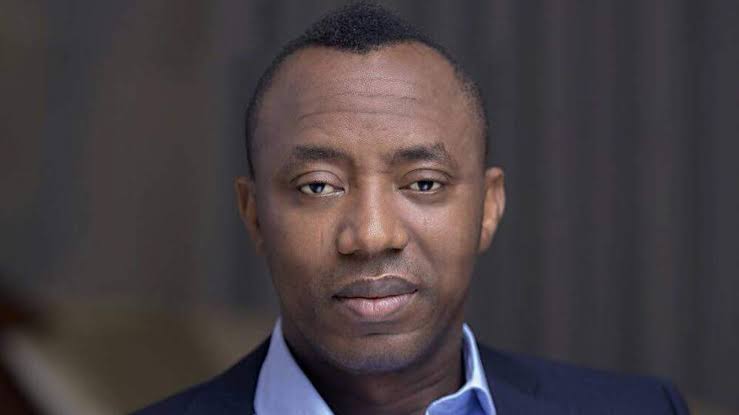
    JUST-IN: Court Grants Sowore Fresh Bail at N200m

    A Federal Judge has set aside an arrest warrant against activist and politician, Omoyele Sowore, and granted him bail after revoking an earlier one for failing to show up in his ongoing trial.

    An earlier bail granted Sowore was revoked and a warrant for his arrest ordered by the court for failing to show up for his trial on June 16.

    Sowore who is on trial for allegedly defaming Nigeria’s President Bola Tinubu was admitted to bail in the sum of 200 million naira along with two sureties. One of the sureties must be a traditional ruler from his community Kiribo, a town in the Ese-Odo Local Government Area of Ondo State, Nigeria.

    The trial judge, Mohammed Umar, ruled that the second surety must be a resident of Abuja and an owner of a landed property. The court also ordered the prosecution to verify the sureties.

    Lastly, Justice Umar ordered the defendant to deposit his passport with the court.

    The court expressed satisfaction with the defendant’s ‘readiness in the case.’ He added that Sowore did not wait till he was arrested. The judge expressed satisfaction that the defendant readily made himself available for trial.

    “He came to court to face his trial. This shows that he is set to face his trial with all seriousness.”

    On the aspect of the defendant’s passport, his counsel, Raphael Adakole, said it is presently at the United States Embassy in Lagos and would need to be there in person to get it. The lawyer thereby made an undertaking assuring that their client would be their responsibility. He assured that Sowore would be present to face trial.

    Adakole said meeting that request was crucial as it is part of the terms of bail handed down by the court.

    Following this request, the trial judge gave a ruling handing the defendant over to his legal team headed by Senior Advocate Adeyinka Fusika. The judge adjourned the case till July 6 for Sowore to open his defense.

  • Tertiary Education Fees Hike in Nigeria: Why South East Must Embrace NELFUND

    Tertiary Education Fees Hike in Nigeria: Why South East Must Embrace NELFUND

    By Sebastine Okafor, Ph.D.

    There is a recent outcry about the hike in the fees paid by most higher institutions of learning in Nigeria. The hike affects not only state-owned tertiary institutions but also federal government–owned tertiary institutions. One of the most recent increases is the 60% hike in sundry charges announced by the management of the University of Nigeria, Nsukka—an announcement that triggered public outcry. It has raised questions about the interest of national leaders in the education sector, which received less than 8% of the country’s budgetary allocation between 2022 and 2025.

    Aside from UNN, other universities and institutions of higher learning across the country, such as UNIMED, EKSU, Edo State University, LAUTECH, DUFUHS, and NDU, among others, have made both minor and major increases in tuition and sundry fees. This has generated calls for more investment in education from civil society organizations, foreign agencies, and other stakeholders. Many fear that students may lose interest in education if nothing is done to make it affordable.

    But what many forget is that the federal government, despite a less-than-enthusiastic approach to education funding, has provided a scheme that enables every Nigerian who wants to study to do so without struggling to pay school fees. Some countries, like Germany, Norway, Denmark, Austria, France, and Brazil, charge almost zero tuition, while others, like the USA, Canada, England, Australia, Switzerland, Japan, and New Zealand, charge very high fees. This does not mean that countries with free or low fees place more interest in education. Both groups provide quality education, but the challenge of affordability remains central for students in countries like Nigeria.

    In Nigeria, the administration of President Bola Ahmed Tinubu in 2024 introduced the Nigerian Education Loan Fund (NELFUND), a student loan program designed to make higher education more affordable. NELFUND was created under the Student Loan (Access to Higher Education) Act, 2024, to help students who cannot afford school fees and related costs. The program covers both tuition fees and a monthly upkeep allowance for living expenses. The loans are interest-free, meaning students only pay back the money borrowed. Repayment does not start immediately after graduation; it begins two years after completing the National Youth Service Corps (NYSC) or once graduates earn a stable income.

    Since its launch, NELFUND has grown rapidly. By late 2025, it had disbursed over ₦116 billion in loans covering both school fees and upkeep allowances to hundreds of thousands of students in public universities, polytechnics, and colleges of education across Nigeria. One of its main goals is to ensure that no Nigerian student is denied access to tertiary education because of financial constraints. Families that once struggled to pay school fees have been able to rely on the loan scheme to keep their children in school.

    Despite these advantages, many Nigerian students and parents are still not taking full advantage of NELFUND. As a program under the Federal Government of Nigeria’s Tertiary Education Support Programme (TESP), it should be welcomed by everyone, especially those whose education is at risk due to finances. The South East region is the worst affected by this lack of patronage. Recent data shows that only about 81,940 students from the South East have applied for the loan, while other regions, except the South South, had over 150,000 applicants.

    Statistically, the North West has the highest number of applicants with 353,122, followed by the North East with 298,030, the South West with 280,678, the North Central with 234,814, the South South with 113,806, and the South East with 81,940. The question many ask is whether this low patronage reflects the number of tertiary institutions in the zone or is due to a lack of interest. Nigeria’s higher education institutions are unevenly spread across the six geopolitical zones. The South West has the most institutions, totaling 141 federal and state universities, polytechnics, and colleges of education. The North West follows with 103, while the South East has the least, only 72 institutions. The North Central has 96, the North East 84, and the South South 110. Even with fewer institutions, the South East must embrace NELFUND to ensure access to higher education.

    It is important for South Eastern students to understand why NELFUND is crucial. Complaining about high fees or educational marginalization will not change the reality. The program provides a direct solution, giving students the funds needed to pay tuition and cover living expenses. By using NELFUND, students can focus on learning instead of worrying about how to pay fees. Families that once feared dropping their children from school can now plan for uninterrupted education.

    Low patronage in the South East also weakens the region’s position in national education programs. If students do not utilize NELFUND, the region continues to rely on complaints rather than practical solutions. Embracing NELFUND allows the South East to catch up with other regions in terms of access to higher education, skills acquisition, and future opportunities.

    Parents and students must act immediately. Applications are simple and can be completed online. Repayment is deferred, and there is no interest to worry about. NELFUND is not just a loan; it is a tool to empower students, reduce financial stress, and improve the quality of education in the South East.

    South Easterners should stop focusing on school fee hikes and complaints about marginalization. NELFUND provides the means to overcome these challenges, as embracing the program can enable students to complete their education without financial burdens, develop their skills, and also contribute to the growth of the region. The success of NELFUND in the South East will show that the people of the region can take advantage of government programs to improve their future, rather than waiting for external interventions or policies that may never arrive.

  • Atiku’s Back to Back Party Primaries Hits, and Misses

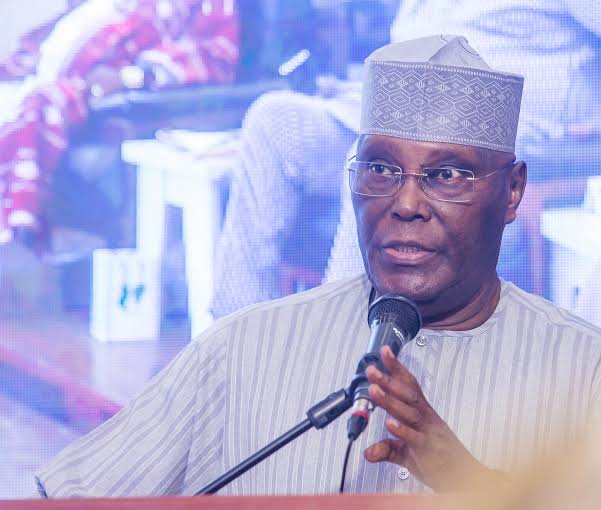
    Atiku’s Back to Back Party Primaries Hits, and Misses

    By Demola Olarewaju

    The prowess of Atiku Abubakar when it comes to party primaries was not built in a day and his recent successes at that level are built on a foundation of loss, defeat and tears.

    His entry into politics in 1991 was marked by a bitter gubernatorial ticket rivalry between him and Bala Takaya, a rivalry so fierce that both men eventually were disqualified by the IBB regime. This disqualification was alongside the likes of Sule Lamido, Yusuf Sani, Dapo Sarumi, Femi Agbalajobi, Joe Nwodo, Hyde Onuaguluchi, Sergeant Awuse and others.

    Also disqualified were 23 aspirants for the presidential ticket in that 3rd Republic and Atiku was drafted by Shehu Musa Yar’Adua to run in his stead for President.

    With the backing of the powerful Yar’Adua machinery, Atiku came third in the first round of balloting, behind MKO Abiola and Babagana Kingibe. He was then asked to step down for Abiola and become his running mate but Abiola was forced by the SDP Governors to choose Kingibe instead. Atiku lost out, Atiku campaigned hard and Atiku delivered 140k+ Adamawa votes for SDP.

    In 1999 after running successfully for Governor, he became Vice-President and then clinched the ticket of the AC in 2007 by caucus consensus.

    By 2011, Atiku was back in the PDP and ran against sitting President Goodluck Jonathan, polling 805 delegates’ votes versus Jonathan’s 2,736. Atiku lost, Atiku campaigned hard and Atiku delivered Adamawa for PDP.

    2015, Atiku found himself in APC and ran against Muhammadu Buhari and others. He came in third place with 954 delegates’ votes. Atiku lost, Atiku campaigned hard and Atiku delivered Adamawa for APC.

    2019 – Atiku won the PDP presidential primaries in Port-Harcourt. Wike had then blackmailed PDP into bringing the National Convention to PH and within 24 hours, every single presidential suite in the city had become reserved. Wike claimed they said Atiku had paid for them and that he had asked them to return the man’s deposit. Atiku won the majority delegates’ votes defeating Saraki, Tambuwal, Sule Lamido etc.

    2023 – Atiku won the PDP presidential primaries after being stepped down for by Tambuwal, much to the chagrin of Wike who has been embittered since then.

    But notice Atiku never gets bitter after any primary or general election – he stays loyal and delivers votes for the candidate who defeated him and the party that hurt him.

    And that’s one secret of how the man does it: by staying loyal to the general cause even when his interest is threatened or eliminated, Atiku has built an army of trusted political friends that span into every single state, political party or group interest.

    By always subsuming his interest to the general interest per time, Atiku maintains razorlike focus on each KPI and in the process builds allies and sets up structure from the bottom up. Atiku doesn’t focus on the presidential primaries when Ward Excos are being elected, Atiku doesn’t think of his own aspiration while the party is looking for a National HQ building: to every political activity there is a time.

    Thirdly, Atiku’s structures aren’t ever only for him – this House of Reps aspirant, that senatorial or gubernatorial hopeful – his structural interests even push down to state excos – as I found out to my own party electoral loss when I ran for Lagos State PDP Publicity Secretary. Atiku never walks alone, he always aggregates other political interests.

    These are just three reasons (observable from outside) for why he is so formidable in party primaries. Those who think it is about money can go and ask Nyesom Wike about 2019 and 2023.

    I hope other presidential aspirants can learn from Atiku on both how to win primaries and how to accept defeat gracefully.

    As long as we agree that whoever loses will still work for the greater interest against the person now in Aso Rock, as Atiku has always done: we can meet at the primaries.

  • 2026 and the Architecture of Power: Understanding The Tinubu Presidency

    2026 and the Architecture of Power: Understanding The Tinubu Presidency

    -By Abdul Mahmud

    This new year scarcely requires a seer to reveal its gravity. It stands as a decisive threshold for both Nigeria’s political class and the country itself. As the final full year before the 2027 general election, it unfolds within an atmosphere markedly defined not by open contestation but by cooptation, not by ideological opposition but by realignment, not by persuasion but by careful calibration of power. The familiar nuances of electoral politics have been subdued, replaced by a quieter, sinister and more strategic choreography in which alliances are absorbed, dissent is neutralised, and political outcomes are increasingly prefigured long before the ballot is cast. Tinubu’s Presidency has thus inaugurated a governing order that resists casual description and demands sustained, rigorous analysis. Authority has grown more personalised, institutions have been subtly but decisively reoriented, and the space of democratic life has narrowed. Power is no longer primarily fought over; it is managed, conserved, and deployed through configurations that feel increasingly distant from Nigeria’s recent political experience. What is taking shape is not simply a new leadership style, but a political condition in which the contest for power has yielded to the meticulous administration of power already secured.

    So, what’s really taking shape?

    Tinubu’s presidency marks a formative phase of governance characterised by the consolidation of authority through elite bargaining, the steady attenuation of democratic institutions, and the managed retreat of competitive politics. It does not announce itself as ideological. No manifesto declares its worldview, and no doctrine articulates its philosophical commitments. Instead, it operates as a governing illogic grounded in transactional politics, and the strategic deployment of state power in the service of endurance. Its coherence lies not in ideas but in method. At the centre of this method is elite cooptation and coordination. Power circulates within a narrow political circle where loyalty is sustained by access, protection, and reciprocal advantage. Alliances cohere less around programmes than around proximity to authority. The ruling party functions primarily as an instrument of aggregation, not as a forum for deliberation or contest. Opposition persists within formal constitutional boundaries, but its capacity to shape outcomes continues to contract. Politics increasingly resembles a closed conversation conducted beyond the reach of popular intervention. Elections still punctuate the political calendar. Ballots are cast, results announced, courts convened, and ceremonies observed. Democratic form remains intact. Democratic substance, however, undergoes a quiet but persistent erosion. Participation thins as belief in the consequences of electoral choice diminishes. Voters engage with the process less in hope than in resignation. Political competition loses its transformative promise, reduced to a symbolic presence within an already determined architecture of power. The vote comes to affirm authority more than to interrogate it.

    This configuration invites comparison with certain early authoritarian systems, not in ideology or historical circumstance, but in structural logic. In those settings, power was consolidated through the fusion of party, state, and patronage, yielding stability through alignment rather than consent. Tinubu’s presidency reflects a comparable pattern. Control advances less through open persuasion than through administrative coordination. Loyalty steadily displaces representation as the central political currency, while stability is secured through managed inclusion and calibrated exclusion. What emerges is not the silencing of politics but its careful containment, a narrowing of the space in which dissent may operate without ever quite disappearing. It is within this logic that the recently constituted high-level party committee must be understood. Comprising governors of the ruling party, members of the Federal Executive Council, and other strategically placed stakeholders, the committee is chaired by the Governor of Yobe State, Mai Mala Buni, with Muiz Banire, former Legal Adviser of the APC, serving as Member-Secretary. Its membership spans the commanding heights of political power: Senator Adamu Aliero; AbdulRahman AbdulRazaq of Kwara State, who chairs the Nigeria Governors’ Forum; Hope Uzodimma of Imo State, Chairman of the Progressive Governors’ Forum; and governors from Benue, Jigawa, Cross River, Ekiti, and Delta. It also includes Governors Uba Sani of Kaduna and Siminalayi Fubara of Rivers, senior ministers of the Tinubu administration, former governors, and key presidential aides. The committee’s composition is revealing. It gathers together not merely party functionaries, but custodians of state power, administrative reach, and regional influence, signalling an effort to synchronise authority across multiple layers of governance.

    This architecture points to a broader project: the consolidation of a pan-Tinubu suzerainty that extends beyond party boundaries while steadily hollowing out the opposition. President Tinubu’s rhetoric of accommodation and tolerance, framed as a defence of democratic resilience, sits uneasily alongside the political realities taking shape. As Oyo State Governor Seyi Makinde has suggested, the role attributed to Nyesom Wike within this order is not incidental but instrumental, working across party lines in ways that weaken and fragment the opposition, particularly the PDP. The aim is not the outright abolition of rival parties, but their domestication. Opposition is permitted to exist, but only in diminished, divided, and ultimately manageable forms. In this sense, inclusion becomes conditional, tolerance selective, and pluralism subordinated to the overriding imperative of control. What is being constructed is a political order in which unity is achieved not through persuasion or shared purpose, but through dominance carefully disguised as consensus.

    Governance within this order privileges coherence and control over pluralism and dissent. Institutions remain visible, but their autonomy steadily contracts. Courts continue to function, though within a narrowing interpretive space. Legislatures exercise oversight through accommodation and bargaining rather than confrontation. Regulatory bodies increasingly align their conduct with executive priorities. Media organisations operate under diffuse but effective pressures that shape tone, emphasis, and silence. The outward continuity of institutional life thus conceals a deeper transformation in which independence yields to accommodation and restraint is replaced by compliance. Law sits at the centre of this transformation. Legal process retains its formal authority, but its connection to justice and accountability grows attenuated. Rules are deployed less as limits on power than as instruments for preserving stability. Procedure displaces principle. Political conflict is absorbed into litigation, translated from public disagreement into technical argument. Judicial outcomes, in turn, tend to affirm the prevailing distribution of power, conferring legal legitimacy on arrangements fashioned elsewhere. In this way, law operates not as an impartial arbiter but as a governing mechanism, ordering conflict rather than resolving it. Economic governance extends this same logic into the material lives of citizens. Policies presented as reform advance largely through executive fiat, with minimal public deliberation. Hardship is framed as necessity rather than consequence, sacrifice as virtue rather than failure. Social pain is moralised as discipline, while the language of inevitability accompanies decisions that reorder livelihoods, deepen inequality, and strain communal bonds. As legal process neutralises political contestation and institutions absorb dissent, economic policy completes the circuit of control. Public consent recedes in importance, displaced by appeals to expertise, urgency, and endurance. What emerges is a political economy in which adjustment replaces accountability, and endurance stands in for consent.

    In this political atmosphere, citizenship is quietly reconfigured. Active participation gives way to managed inclusion, while political agency is reduced from the capacity to shape outcomes to the freedom to comment upon them. Protest increasingly attracts securitised responses, and dissent is recoded as disruption rather than recognised as democratic expression. The public sphere does not collapse through decree; it contracts through mood and expectation. Fear need not be declared to be effective. Caution becomes internalised. Silence acquires the character of prudence rather than resignation. This transformation proceeds without the spectacle of overt repression. No dramatic bans signal a rupture with constitutional order. No formal emergency suspends democratic norms. Instead, change unfolds cumulatively. Each adjustment appears technical, even reasonable, when taken alone. Together, they produce a political climate marked by compliance, calculation, and quiet withdrawal. Democratic life thins through attrition rather than shock. What remains is not an absence of politics, but a diminished version of it, one in which engagement is carefully weighed against consequence, and participation is increasingly symbolic.

    Opposition is also redefined under these conditions. Critics are rarely confronted head-on; they are more often absorbed into negotiation, fragmented through inducement, or marginalised by selective exclusion. Disagreement persists, but it is stripped of leverage. Public intellectuals, activists, and commentators operate within a narrowing field where critique circulates without effect. Alternative visions struggle to gain traction because power presents itself not as a contingent arrangement open to challenge, but as a settled fact to be navigated. Politics shifts from contest over direction to adjustment within constraint. Patronage functions as the stabilising mechanism of this order. Access to state resources becomes the primary currency of loyalty. Appointments reward alignment, contracts reinforce networks, and economic opportunity increasingly follows political obedience. Dependency and compliance intersect, recasting the state from guarantor of collective welfare into distributor of selective benefit. As perceptions of fairness decline, public trust erodes. The language of corruption loses its moral urgency, reframed as an unavoidable feature of governance rather than an ethical failure demanding redress. Against this backdrop, the idea of reform assumes strategic importance. Reform rhetoric provides the moral cover through which consolidation is presented as progress. Structural adjustment is dressed in the language of modernisation; disruption is recast as courage. Resistance to reform is portrayed as nostalgia, sentimentality, or irresponsibility. In this way, critique is neutralised not by rebuttal but by delegitimation. Power is framed as necessity rather than choice, endurance as virtue rather than submission. The effect is not merely to govern policy outcomes, but to shape the terms on which political judgment itself is made.

    This condition shapes the national mood as Nigeria approaches 2026. Political expectation declines, cynicism spreads, and withdrawal often replaces engagement. Survival displaces aspiration. Younger generations encounter politics as a closed system rather than an open field, and hope shifts from public institutions to private strategies. Migration, informal economies, and personal networks emerge as alternative pathways to security. The danger lies not only in democratic erosion, but in habituation: as citizens adjust to limited agency, the possibility of recovery diminishes. Democratic capacity weakens through disuse, and memory of contest fades. Power consolidates not merely through control, but through the quiet acceptance of constraint. Naming this phase of governance as a distinct moment in Nigeria’s democratic trajectory performs both analytic and political work. It resists the personalisation of critique, framing Tinubu’s presidency as a system of governance rather than a reflection of temperament. It signals temporality, marking a phase rather than an immutable fate. Such naming preserves space for reflection, intervention, and alternative futures.

    The New Year is here. The architecture of power established during this formative period will shape what is possible. Whether this governing illogic hardens into permanence or encounters disruption will depend upon forces both within and beyond the state. That inquiry belongs to the next part of this essay, which turns to the prospects for politics and democracy under conditions shaped by consolidation, fatigue, and quiet resistance. For now, Tinubu’s presidency stands as a defining moment in Nigeria’s democratic journey: a moment of form without substance, of power without persuasion, and of consequences whose reverberations will extend far into 2027.

    Happy New Year. 

  • Open Letter To Mr. President: Reassessing Police Deployment To VIPs For Improved National Security

    Open Letter To Mr. President: Reassessing Police Deployment To VIPs For Improved National Security

    By Dr. John Egbo

    Decreasing the number of police officers assigned to VIPs in Nigeria is a more appropriate and timely response than withdrawing the entire police officers assigned to the VIPs in this worsening insecurity across the country. The police force is overstretched, and redeploying some officers from excessive VIP protection duties back to public safety functions is essential for restoring confidence in national security. Decreasing the number of officers assigned to VIPs is a better security measure than total withdrawal of police officers from the VIPs.

    Importantly, the proposed reduction does not eliminate police protection for VIPs but strengthens police manpower for public protection and response to crime in progress incidents. It aims to ensure that assigned officers also serve as patrol personnel wherever VIPs travel to. In many cases, as VIP convoys travel through the country, the police officers accompanying them have deterred criminal elements—bandits and armed robbers, who often withdraw when confronted with an armed police escort. This has occurred repeatedly, even in areas where nearby police stations were unable to respond quickly.

    The fundamental role of the police remains: to protect and serve both the VIPs and general public. VIPs—especially national leaders, ministers, and influential citizens—are often prime targets for criminals, whether due to envy, political motives, or financial gain. As the saying goes, uneasy lies the head that wears the crown. Therefore, completely withdrawing all police officers from VIPs would be counterproductive and would expose them to greater danger than the average citizen.

    What the Inspector General of Police should prioritize is a strategic reduction, not an elimination of officers attached to VIPs and to sensitive establishments such as vulnerable businesses or schools. This approach frees up manpower for public patrols, highway security, and community policing initiatives, without placing VIPs at an unacceptable risk.

    As a retired Deputy Sheriff in the United States and a security consultant, I can affirm that crime control is most effective when resources are deployed based on threat assessment and environmental realities. Many parts of Nigeria are now serious crime hotspots, and policing strategies must adapt accordingly. Withdrawing every officer from VIP protection would only shift vulnerability, not solve the larger problem.

    In addition, elected officials—particularly members of the National Assembly and Ministers—should be directed to spend more time in their home constituencies and communities, accompanied by reduced and more efficient police security teams. Politics, like crime, is fundamentally local. Their presence at home strengthens governance, improves community relations, and supports grassroots policing.

    The President’s directive to recruit additional police officers is timely and long overdue. However, Nigeria must jealously guard the recruitment process. Criminal infiltration—whether by bandits, terrorists, or their sympathizers—poses a major internal threat to police effectiveness. Poorly vetted recruits can undermine operations, leak sensitive information, or sabotage crime-fighting efforts, placing both citizens and officers in danger.

    Nigeria needs a police force that is professional, properly vetted, and optimally deployed. Reducing excessive VIP protection details and strengthening public security roles is not just a policy adjustment—it is a necessary step toward restoring safety and order for all Nigerians.

    VIPs moving with a reduced number of police officers serve as crime deterrent along their routes.

    Dr. John Egbo is a United States retired Deputy Sheriff and Consultant on Security Matters. Jnegbo1@gmail.com

  • Burying Buhari – By M.O Ene

    Burying Buhari – By M.O Ene


    Humans are made up of body and soul. The body is of the earth. The soul is divine. The body dies. The soul lives. The body is buried to dissipate the distress. The soul is a spirit; no one knows better. Faith enters the equation: Don’t speak ill of the dead. The death of one diminishes humanity. Such cultural mumbo-jumbo emissions help to heal the heart of the grieving.

    I understand not speaking ill of the dead. It is of no use. The deceased has lost the physical ability to counter. Yet, the memories of life cannot be swept away. Interestingly, the speed with which we forget the dear departed is alarming. Lucky are those of whom the living still recall just months after they leave the scene. Therefore, the focus is on learning the lessons of the life lived—not rehashing rabidly the actions of the deceased.

    So let it be with Muhammadu Buhari.

    It is not easy to recall the good deeds that Buhari did with the great opportunities he had. As a military muscleman, his laudable ‘war against indiscipline’ turned into draconian decrees, including ludicrous long jail terms for political prisoners, muzzling of mainstream media, and shocking retroactive public execution of petty drug dealers!

    On his second coming, Buhari dashed the hopes of Nigerians by unleashing more corruption, bandits, and terrorist herdsmen with AK-47. He visited his signature violence of dogs and baboons on EndSARS protesters. He was particularly harsh on the Southeast, “the dot” in his warped ethnic estimation, which is to be visited with threats of another genocide. When censored for the vile statement, he banned Twitter (now X). Not even on his way out would Buhari forgive Nnamdi Kanu, Sunday Adeniyi Adeyemo (Igboho), and El Zakzaky, the Shi’a Muslim cleric. On the other hand, he treated the butchering Boko Haram terrorists with mittens!

    Buhari died peacefully in London, where he had spent many moons receiving good medical attention. His wife, who had been living in Dubai, reportedly relayed a plea for forgiveness. Fair enough: forgiven, not forgotten. Meanwhile, MNK (whom courts in Kenya and Nigeria have freed) languishes in jail because Buhari would not forgive a simple juvenile insult. What will it take for men to accept mistakes and make amends while the good gods guarantee life! I hope that Yakubu Gowon is listening and learning, not adding more insults of lies to injuries he caused and failed to heal.

    When the present emotions ebb, Nigerians must rise against medical tourism. It is ridiculous that Nigeria cannot set up topnotch medical facilities to treat its top executives. Putting Nigerian leaders at the mercy of foreign pharmacological firms is a screaming shame and a stupid security risk. Ironically, Nigerian medicos who offer commendable care abroad can offer better care in Nigeria.

    President Ahmed Bola Tinubu should establish decent hospitals at which prominent politicians get great care and die peacefully when the time comes—as it will come inevitably. We had two former heads of state in London, possibly getting care from exiled Nigerian doctors they could not keep in the country. The cost of retrieving the remains of Buhari and transporting people to and from the UK is enough to equip a set-aside standard clinic in Abuja, FCT.

    Before he jets out to France again, President Tinubu must learn the lasting lessons of the current bala-blu (hullabaloo) and think of legacy, a bequest for the memory of ex-President Muhammadu Buhari.


    #moe, 7.15.25

  • Tinubu and The Bad Roads Not Taken

    Tinubu and The Bad Roads Not Taken

    -By Abdul Mahmud

    “I couldn’t reach Yelawata in Benue State due to bad roads”, said President Bola Ahmed Tinubu. This sentence captures the spirit of Tinubu’s presidency. Aloof. Detached. Cold. Inconsiderate. Leadership without compassion. Governance without sacrifice. Authority without empathy. How did Mandela once describe compassion? He said, “Our human compassion binds us the one to the other, not in pity or patronisingly, but as human beings who have learnt how to turn our common suffering into hope for the future.” In those words lie the moral clarity of leadership: to feel with others, and to act in ways that dignify their pain. But in the hour when the people of Benue cried out beneath the weight of their grief, when blood soaked their soil and hope withered on parched lips, President Tinubu neither spoke with the tenderness the moment demanded nor did he offer comfort. Instead, he stood, quartered only to the state-organised gyre, where falcons heeded the call of the lying falconer while unburdened by the anguish of the listeners, unmoved by the cries circling beneath his silence.

    I return to the scene of the crime. Yelawata, in Benue State, is soaked in blood. Again. Victims of another attack. Not the first in the state. Sadly, not likely the last. Men butchered. Women slaughtered. Children silenced by bullets and machetes. Bodies burnt. Farmers buried in shallow graves. A people under siege, paying with their lives for living on ancestral land. And the President? He dilly-dallied like Nero until he was forced out of Aso Rock. When he eventually turned up in Benue State, he didn’t go to Yelawata.

    Why? The roads were bad.

    That excuse tells us everything. It tells us Tinubu doesn’t see governance as a sacrifice. It tells us he sees power as comfort, not service. That he is more concerned with personal convenience than national grief. That to him, bad roads are a reason not to visit, not a call to action. The road to Yelwata was too rough for his usual long motorcade. But is the road to governance not paved with sacrifice? A president should go where pain is deepest. He should stand with the broken. Weep with the grieving. Reassure the fearful. But Tinubu stayed away.  He dispatched men like Sunday Dare and Bayo Onanuga; envoys who, upon arrival, shielded their nostrils with cupped palms, as though the stench of death and despair in Yelawata were too profane for their privileged lungs. They came not to mourn, but to manage optics; not to grieve with the grieving, but to distance themselves from the human wreckage their master could not bear to face. He sent words instead of presence. He chose distance over duty.

    What is the worth of a ruler who cannot be troubled by the suffering of his people? Presidents do not have the luxury of comfort. They are servants, not absolute monarchs. They must lead from the front, even through valleys of blood. When George W. Bush visited Ground Zero after 9/11, he climbed the rubble. When Barack Obama went to Newtown after the school shooting, he wept with the parents. When Nelson Mandela walked into the ruins of apartheid violence, he held grieving mothers and swore it would never happen again.

    Tinubu avoided Yelawata. Then insulted the people. He claimed the killings were reprisal attacks. Without evidence. Without tact. Without truth. He invariably blamed the victims. He called them the culprits. He rewrote a genocide into justification. And when he finally arrived Makurdi, it was under pressure. Nigerians had cried. Protested. Shamed him into action. So, he adjusted his diary.

    That adjustment came too late. In Makurdi, school children were drenched by rain, lined up to wave flags at a president who couldn’t be bothered to dry their tears. In front of the Tor Tiv, the King of the Tiv, Tinubu’s lies crumbled. The monarch told him to his face: “These are not reprisals. They are genocidal. They aim to wipe out our people.” It was a moment of truth. The kind only kings and corpses can speak. Tinubu had no answer. After the Royal smack-down, he chose not to make it to Yelawata. He contrived an excuse: the roads were not motorable. A helicopter couldn’t be arranged. A convoy couldn’t roll. A man who uses presidential jets to vacation in France; and who is billed for luxurious holidays in the sunshine of Saint Lucia couldn’t find a way to reach grieving Nigerians at home.

    Now, the question many are eager to ask: What does it cost to show empathy? What does it take to be present in pain? In Tinubu’s case, apparently too much. This presidency has reduced governance to showmanship. It is all optics, no substance. Press releases instead of policies. Travel photographs instead of action. Ceremonies instead of compassion. Tinubu has become a distant figure. A president of Abuja, not of Nigeria. He rules from marble offices, not the muddy fields of the countryside. From Lagos business tables, not farming communities in Benue. He governs through statements, not presence. Through silence, not sympathy. The tragedy of this moment isn’t just the deaths in Yelawata. It is the erosion of leadership. It is about a man who sees the office of president as the crowning of a personal ambition, not a platform for national healing. A man who imagines governance is a reward, not a responsibility. This needs to be put out more plainly: this is not leadership. This is negligence. Tinubu’s refusal to visit the scene of the carnage, his false statements about the cause and his delay in responding to the tragedy that befell our country all points to a leader who doesn’t feel the country’s pain. One who doesn’t carry the emotional weight of his office.

    What happened in Benue is part of a pattern.

    Tinubu’s second year in office has been marked by detachment. Nigerians groan under inflation. Food is unaffordable. Electricity is a myth. Fuel prices break the backs of ordinary citizens. Unlike the back David Diop so powerfully evoked in his acclaimed poem, Africa, unbent, “that never breaks under the weight of humiliation”. The backs of ordinary citizens stoop beneath the burden of betrayal. Yet the president travels. Dines. Celebrates. Appoints cronies. Signs inflated budgets. Adds more burden to weary citizens. There is no compassion in his policies. No empathy in his speeches. No connection in his actions. A caring ruler would reduce his convoys. Tinubu expanded them. A president with empathy would cut down waste. Tinubu has increased waste. A ruler in tune with citizens would share in their sufferings. Tinubu asks them to “tighten belts” while he loosens his.

    To govern a country requires moral courage. Tinubu’s response to national pain is indifference. His answer to cries is silence. His reaction to mass murder is a shrug. Then, where lies the heart of his rulership? Not in Benue. Not in Zamfara. Not in Plateau. Not in the IDP camps. Not in the shanties. Not in the markets. The heart of this government beats only for the rich, the powerful, and his coterie of handlers. For friends in Lagos. For loyalists in government houses. For image-makers. Not for the rest of us.

    The presidency should be the conscience of the nation. Under Tinubu, it has become a billboard. A brand. A throne without soul. It is not just his failure to visit Yelawata that is tragic. It is the symbolism of it. It tells the story of a man who doesn’t understand the weight of grief. Who doesn’t see the power of presence. Who thinks governance is about roads, not relationships. Even if the roads were bad, there were other options. Helicopters. Courage. Love. Anything but absence. But he chose to stay away, which speaks volumes. It says, “You are on your own”, O-YO! “You are not worth the trouble.” It says, “Your pain is inconvenient.” It says, “I’ll mourn you from a distance.” A president who cannot brave bad roads for his people cannot lead them through harder paths. But, here is the deeper tragedy: the road to Yelawata isn’t the only one Tinubu refused to travel. He has refused the road of humility. Of compassion. Of moral leadership. He has chosen another path; the road of entitlement, indulgence, and imperial comfort.

    Our country is ruled by a man who cannot be disturbed. But, our country is disturbing. It cries out from every state. It begs for presence. For proximity. For a ruler who shows up. In person. Not by proxy. Until that happens, we will continue to drift.

    Governance is not about the ease of travel. It is about the urgency of compassion. It is not about what is motorable. It is about what is moral. Tinubu failed this test. In the hour of grief, he was absent. In the moment of truth, he deflected. In the face of pain, he excused. He cannot build our country from behind the presidential walls. He must descend his Olympian height. Step into our blood-soaked earth. Walk with the wounded. Cry with the survivors. Stand with the forgotten.

    Or step aside. Our country deserves more. Being the president shouldn’t be taken as a title, with all the pomp to boot. It is a task. It is not the celebration of personal ambition. It is the surrender of comfort for the sake of others. It is not about dodging bad roads. It is about building better ones and still traveling the worst ones when duty calls. Until Tinubu understands this, he will remain a stranger to his office. A visitor in his own country. A ruler, not a leader.

    While he pretends that the tragedy in Benue is “an internecine clash of neighbours”, to quote my friend, Josephine Akioyamen, the people of Benue must dig in to defend themselves against the rampaging Fulani conquistadors, Yelawata will remember his indifference. Just as our country remembers. The world will not forget.

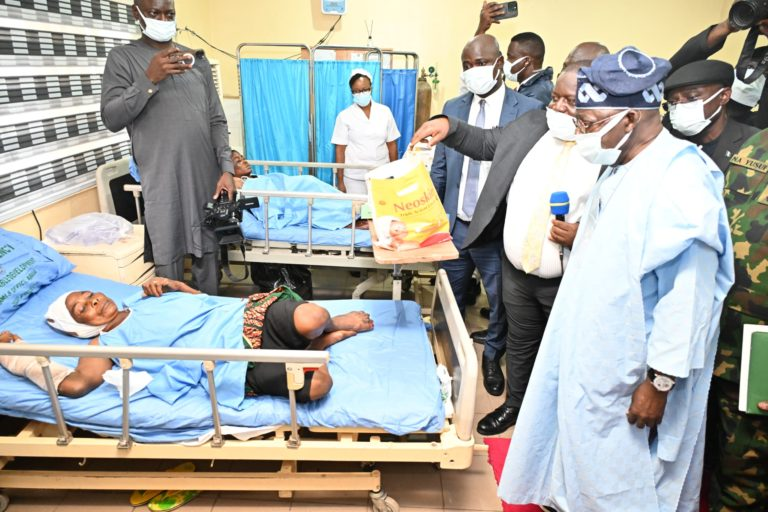
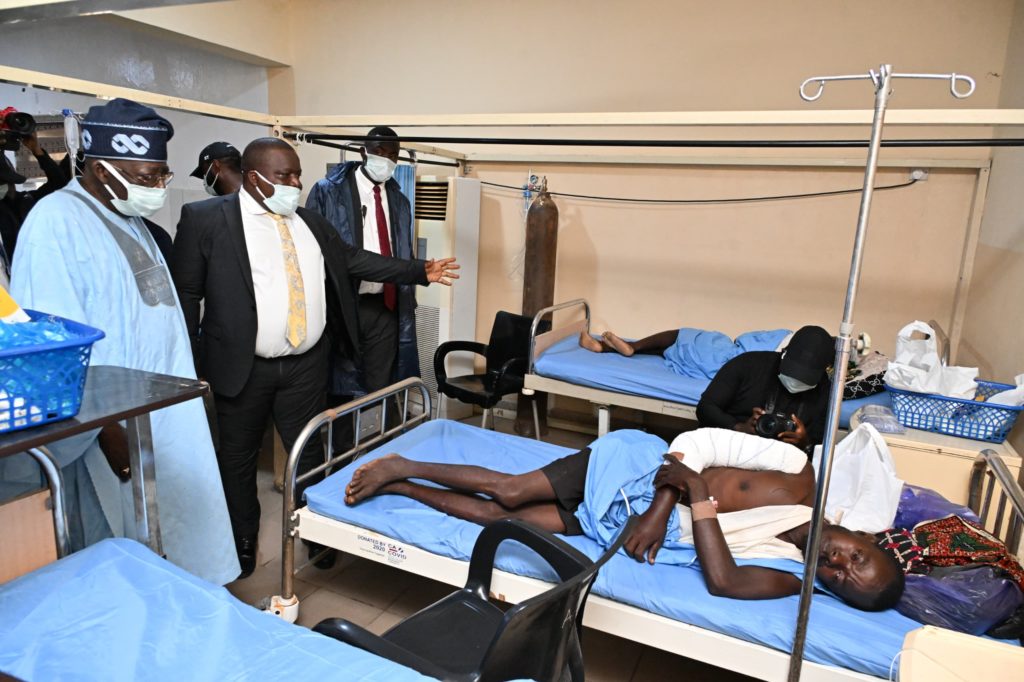
  • Benue Killings: Tinubu Visits Victims of Yelewata Attack at Teaching Hospital

    Benue Killings: Tinubu Visits Victims of Yelewata Attack at Teaching Hospital

    President Bola Tinubu has visited surviving victims of last Friday’s brutal attack in Yelewata community in the Guma Local Government Area of Benue State.

    Tinubu visited the North-Central state following the attack which left over 59 people dead and several others injured.

    The President went straight to the hospital after arriving at the Tactical Air Command, Nigerian Air Force Base, Makurdi, at about 12:58 pm on Wednesday.

    He later left the hospital for the new Banquet Hall of the Benue State Government House where he is expected to meet with major stakeholders in the state in view of the violent attacks that have led to the loss of lives.

    Tinubu is expected to meet with families of victims, displaced and injured persons, and community leaders directly impacted by the violence.

    The meeting with the stakeholders is part of a broader effort to find a lasting solution to the crisis that has affected parts of the state, especially rural communities.

    Expected at the meeting are key national and state-level figures, including the state governor, Hyacinth Alia; governors from across the country, particularly from the North-Central states; the National Security Adviser (NSA), Nuhu Ribadu, Secretary to the Government of the Federation (SGF), George Akume.

    Also expected to attend are service chiefs, key members of the National Assembly, leaders of the ruling All Progressives Congress (APC), and other prominent individuals, especially those representing affected communities in Benue.

    The state government declared a public holiday for the visit. Channels TV 

    See more photos from the hospital visit below: