Tag: nnamdi kanu

  • Israeli Lawmaker Urges UN to Pursue Nnamdi Kanu’s Release

    Israeli Lawmaker Urges UN to Pursue Nnamdi Kanu’s Release

    Precious Nwonu, Enugu

    An Israeli lawmaker, Afef Abbed, has called on the United Nations to revisit its 2022 opinion on the detention of the leader of the Indigenous People of Biafra, Nnamdi Kanu, and press for the implementation of its recommendations.

    Abbed, a member of Israel’s Knesset, made the call in a letter dated September 1, 2026, addressed to the UN Secretary-General, the UN High Commissioner for Human Rights and the Chair-Rapporteur of the UN Working Group on Arbitrary Detention.

    He urged the UN to review the implementation of Opinion No. 25/2022 concerning Kanu and seek an official update from the Nigerian government on measures taken in response to the Working Group’s findings.

    The UN Working Group on Arbitrary Detention adopted Opinion No. 25/2022 in 2022 after examining circumstances surrounding Kanu’s arrest in Kenya and his subsequent transfer to Nigeria. The opinion is officially recorded as A/HRC/WGAD/2022/25.

    The Working Group concluded in the opinion that Kanu’s deprivation of liberty was arbitrary and called on the governments of Nigeria and Kenya to take steps to remedy his situation without delay. It recommended his release, compensation and other forms of reparation in accordance with international law.

    Abbed said the UN should continue monitoring the matter and encourage dialogue with the Nigerian government to ensure that proceedings involving Kanu comply with applicable international human rights standards and Nigeria’s obligations under the International Covenant on Civil and Political Rights.

    He said the subsequent legal developments in Nigeria had not removed the need to consider the concerns raised in the Working Group’s 2022 opinion.

    Kanu was convicted by the Federal High Court in Abuja in November 2025 on seven terrorism-related counts and sentenced to life imprisonment on several of the counts, alongside additional prison terms on others.

    Abbed said Kanu’s conviction and sentence made it more important for relevant international mechanisms to examine whether the recommendations contained in the UN Working Group’s opinion had been implemented.

    He also referred to legal proceedings concerning Kanu’s detention and transfer to Nigeria, arguing that they had raised questions about his fundamental rights and due process.

    The Israeli lawmaker further expressed appreciation for what he described as the “professional and independent work” of the UN Working Group in examining Kanu’s case.

    Abbed also referenced concerns raised over Kanu’s health and alleged inadequate access to medical care, saying such allegations involving the health and fundamental rights of a detainee should receive attention from relevant international human rights mechanisms.

    His intervention comes amid continued calls from some individuals and groups for a review of Kanu’s case and his release.

  • Nnamdi Kanu’s Case, The Nigerian State, And The Rule Of Law: Jurisdiction, Rendition, And The Politics Of Prosecution

    Nnamdi Kanu’s Case, The Nigerian State, And The Rule Of Law: Jurisdiction, Rendition, And The Politics Of Prosecution

    By Dr. Brian Vincent Ikejiaku

    Introduction

    The prosecution of Mazi Nnamdi Kanu, leader of the Indigenous People of Biafra (IPOB), remains one of the most complex intersections of law, politics, and international relations in contemporary Nigeria. His trial – originating from alleged acts of terrorism, secessionist agitation, and unlawful broadcasting – has become a crucible for testing Nigeria’s constitutional order, its commitment to the rule of law, and its approach to managing deep ethno-political divisions.

    Beyond its domestic significance, the case engages fundamental questions of jurisdiction, extraterritoriality, and international due process: whether a State may lawfully prosecute a person abducted from a foreign country without formal extradition, and whether prosecutions under repealed statutes remain valid under new laws with saving clauses.

    The issues raised mirror global tensions between State sovereignty and individual rights, resonating with precedents from the United States, United Kingdom, and India – all jurisdictions that have grappled with terrorism, unlawful rendition, and the reach of domestic law beyond borders.

    1. Background: Timeline of Acts, Arrests, and Legal Context

    Nnamdi Kanu’s legal odyssey began in October 2015, when he was first arrested and charged under the Terrorism (Prevention) (Amendment) Act 2013 and the Criminal Code Act. The counts included managing an unlawful society, importing radio transmitters, and committing acts amounting to treasonable felony.

    He was granted bail in 2017 but fled the country after a military operation at his residence in Abia State, later resurfacing abroad to continue his pro-Biafra broadcasts.

    In June 2021, Kanu was apprehended in Kenya and returned to Nigeria under circumstances widely described as extraordinary rendition – that is, an abduction and forcible return without following extradition procedures prescribed under the Extradition Act, Cap E25 LFN 2004.

    In May 2022, while his case was pending, Nigeria enacted the Terrorism (Prevention and Prohibition) Act 2022 (TPPA 2022), repealing the earlier 2011 and 2013 Acts. The new law introduced broader definitions of terrorism and explicit extraterritorial jurisdiction under Section 2(1)(c), covering acts committed abroad that threaten Nigeria’s security.

    The repeal raised a constitutional question: could Kanu’s ongoing trial, framed under the repealed 2013 law, validly continue under the new statute?

    2. The Legal Framework: Repeal, Savings Clauses, and Jurisdiction

    The TPPA 2022 addresses transitional issues in Sections 97 and 98, which expressly save ongoing prosecutions and subsisting charges under the repealed Acts. Section 98(3) provides that:

    “Any proceeding, prosecution, sentence, judgment, charge or cause of action pending or existing immediately before the commencement of this Act under any of the repealed Acts may be continued or commenced … as if this Act had not been made.”

    Thus, as of the repeal date – 12 May 2022 – Kanu’s prosecution was a “pending proceeding” within the meaning of the savings clause. The Federal High Court therefore retained jurisdiction to continue his trial, notwithstanding the repeal.

    This mechanism echoes Section 6 of Nigeria’s Interpretation Act, Cap I23 LFN 2004, which presumes that repeal of a statute does not extinguish rights, liabilities, or proceedings existing under it unless the repealing law expressly provides otherwise.

    3. Jurisdictional Challenges and Extraterritorial Reach

    Kanu’s defence team has repeatedly argued that some alleged offences – particularly the radio broadcasts advocating Biafra – occurred outside Nigeria’s territory, thereby stripping Nigerian courts of jurisdiction.

    However, both the repealed 2013 Act and the 2022 TPPA confer extraterritorial jurisdiction over terrorism offences. Section 2(1)(c) of the TPPA 2022 states that an offence may be tried in Nigeria where it is “committed partly in and partly outside Nigeria,” or where the offender is a Nigerian citizen abroad, or the act is directed at Nigerian interests.

    Under this provision, the Federal High Court may exercise jurisdiction over Kanu’s broadcasts – even those transmitted from the United Kingdom or Kenya – since the alleged intent was to incite violence within Nigeria.

    This model reflects global counter-terrorism statutes. The UK’s Terrorism Act 2006, the U.S. Patriot Act 2001, and India’s Unlawful Activities (Prevention) Act 1967 all recognise extraterritorial competence for offences threatening national security.

    4. The Extraordinary Rendition Controversy

    The more profound constitutional issue, however, arises from how Kanu was brought to Nigeria. He was not extradited under treaty procedures but allegedly abducted by Nigerian agents from Kenya – a method known as extraordinary rendition.

    Under Nigerian law, the Extradition Act requires a formal request, judicial hearing, and surrender order by the requested state. None of these steps occurred. Internationally, such conduct may breach the UN Charter (sovereignty of Kenya), the African Charter on Human and Peoples’ Rights (Article 12 on liberty and movement), and customary international law.

    The defence therefore contended that this unlawful rendition deprived the Federal High Court of jurisdiction to try him.

    5. Judicial Responses: The 2022 Court of Appeal Decision

    In October 2022, the Court of Appeal (CA/ABJ/CR/625/2022) agreed, holding that:

    “The extraordinary rendition of the appellant from Kenya to Nigeria is a gross violation of international law and the procedure under the Extradition Act … The trial court therefore lacks jurisdiction to continue his trial.”

    The court struck out the remaining counts and ordered Kanu’s release, declaring that the Federal Government could not “benefit from its own wrong.”

    That judgment marked a rare victory for procedural human rights in Nigeria’s anti-terrorism jurisprudence.

    6. The Supreme Court Reversal (December 2023)

    The Supreme Court of Nigeria (SC/CR/1361/2022) reversed that decision in December 2023, holding that although Kanu’s rendition was “unlawful and condemnable,” it did not oust the jurisdiction of the Federal High Court.

    The Court adopted the Ker–Frisbie doctrine, a principle from U.S. law (Ker v. Illinois (1886); Frisbie v. Collins (1952)) holding that the manner of a defendant’s capture does not preclude trial once he is physically before the court.

    By this reasoning, the illegality of rendition is a diplomatic or political issue, not a bar to criminal prosecution. The Supreme Court thus reinstated the trial, remitting it to the Federal High Court for continuation.

    7. The Nigerian Rule of Law Dilemma

    This ruling underscores a recurring tension in Nigeria’s legal order: the struggle to balance state security against constitutional due process.

    While the Court was doctrinally correct within common-law tradition, many critics argue it reflects an executive-centric conception of justice – one that prioritises state control over individual rights.

    The judiciary’s endorsement of Ker–Frisbie suggests that, in Nigeria, ends may justify means when national security is invoked. Yet this stance risks undermining public confidence in due process and further eroding the credibility of Nigeria’s human-rights commitments under the African Charter.

    8. Comparative Perspectives in Brief

    a) United States

    The Ker–Frisbie principle originates from U.S. jurisprudence. In Ker v. Illinois (1886) 119 U.S. 436, the Supreme Court held that a defendant abducted from Peru could still be tried in Illinois. Similarly, in Frisbie v. Collins (1952) 342 U.S. 519, the Court ruled that “due process of law is satisfied when one present in court is convicted of crime after being fairly apprised of the charges.”

    However, in later cases like United States v. Toscanino (1974) 500 F.2d 267, some U.S. appellate courts suggested that extreme governmental misconduct (e.g., torture) could deprive courts of jurisdiction. The standard remains narrow but shows a recognition of limits.

    b) United Kingdom

    In contrast, UK courts have increasingly emphasised procedural propriety. In Bennett v. Horseferry Road Magistrates’ Court, Ex p Bennett [1994] 1 AC 42, the House of Lords held that English courts could stay proceedings if the accused was brought by “a deliberate abuse of process,” such as illegal rendition.

    This approach aligns more closely with rule-of-law ideals, suggesting that unlawful conduct by the state can contaminate a prosecution.

    c) India

    India’s Supreme Court in D.K. Basu v. State of West Bengal (1997) 1 SCC 416 and Abu Salem v. Union of India (2011) emphasised that while extradition irregularities may not automatically vitiate trial, they can justify diplomatic intervention or limited judicial relief.

    India thus sits between the U.S. and U.K. positions – recognising jurisdiction but condemning state misconduct.

    d) Nigeria’s Position

    Nigeria’s Supreme Court has now aligned squarely with the U.S. model, privileging jurisdictional continuity over the integrity of extradition procedures. While doctrinally defensible, it reveals a security-state bias that risks normalising executive lawlessness in future cases.

    9. Repeal, Continuity, and the Saving Clause Debate

    A second strand of argument in Kanu’s case concerns charging under a repealed statute. Defence lawyers contend that since the Terrorism (Prevention) (Amendment) Act 2013 was repealed by the 2022 Act, prosecution under the old law is void.

    However, Sections 97–98 of the new Act create a robust saving clause preserving “ongoing cases in the courts.” This mirrors common-law interpretive presumptions (as codified in Section 6 of the Interpretation Act) that repeal does not extinguish vested proceedings unless the new statute clearly says so.

    Therefore, as long as the alleged offences occurred before May 2022 and prosecution was pending at repeal, the Federal High Court’s jurisdiction survives.

    This approach is consistent with decisions like A.G. Federation v. A.G. Abia State (2002) 6 NWLR (Pt. 764) 542, which affirmed that courts may not “breathe life into dead statutes” absent a saving clause – but where such a clause exists, it operates by legislative intent, not judicial invention.

    10. The Political Dimensions

    a) Ethno-Political Context

    Kanu’s prosecution is inseparable from Nigeria’s fragile federal structure and the enduring grievances of the South-East. IPOB’s agitation for self-determination echoes the historic Biafran secession (1967–1970), and Kanu’s popularity among Igbo youth reflects disillusionment with federal governance, economic exclusion, and militarised policing.

    Thus, the case is not merely about terrorism; it is a political crisis refracted through criminal law.

    b) Security vs. Legitimacy

    By insisting on prosecution despite procedural controversy, the Federal Government seeks to demonstrate state strength. Yet each procedural breach – unlawful rendition, indefinite detention, disregard of bail – undermines the very legitimacy the government seeks to assert.

    The politics of fear and selective justice risk transforming Kanu from an agitator into a symbol of resistance.

    c) International Implications

    Kanu holds dual Nigerian British citizenship, and the United Kingdom’s muted response to his rendition raised questions about the limits of consular protection when national security is invoked.

    Kenya’s government faced domestic backlash for alleged complicity in his transfer, highlighting how counter-terrorism cooperation in Africa can blur into violations of sovereignty and human rights.

    11. The Broader Rule of Law Question

    The essence of the matter lies in Nigeria’s constitutional self-image. The Supreme Court’s reliance on Ker–Frisbie may be doctrinally orthodox, but it also signals that executive illegality is tolerable if politically expedient.

    This risks eroding the constitutional guarantees of fair hearing (Section 36) and liberty (Section 35) of the 1999 Constitution, and Nigeria’s obligations under the African Charter on Human and Peoples’ Rights (domesticated by Cap A9 LFN 2004).

    A state cannot credibly claim to fight terrorism while disregarding the rule of law. The jurisprudence emerging from Kanu’s case will therefore shape not only Nigeria’s counter-terrorism regime but its broader constitutional morality.

    12. Table Illustration of Lessons from Comparative Jurisdictions

    Jurisdiction Approach to Unlawful Rendition Effect on Jurisdiction
    U.S. Ker “Frisbie: manner of arrest irrelevant    Trial proceeds
    U.K. Bennett doctrine: abuse of process may bar trial   Court may stay  proceedings
    India Mixed: jurisdiction continues but state censured   Limited relief, no dismissal
    Nigeria Aligns with U.S.; rendition condemned but jurisdiction retained   Trial proceeds under savings clause

    This comparative lens reveals a philosophical divide: whether law or sovereign power ultimately anchors justice. The UK model prioritises legality; the U.S. (and now Nigeria) prioritise prosecution.

    13) Political Reconciliation or Perpetual (Legal) Prosecution – ‘Similar Cases’?

    The persistence of Kanu’s detention despite multiple judicial orders for his release reflects the politicisation of justice. The government’s reliance on prolonged trial and national-security rhetoric has polarised public opinion, reinforcing narratives of marginalisation in the South-East.

    For sustainable peace, Nigeria may need to combine judicial accountability with political dialogue – a model seen in India’s handling of regional separatist movements, where amnesty and negotiation have at times been used in place of prolonged prosecution. This consideration is particularly relevant in light of the recent release of Sunday Adeniyi Adeyemo (aka Sunday Igboho) – another separatist figure (a Yoruba self-determination activist pushing for an independent ‘Yoruba Nation’ in Southwest Nigeria’) – and the President’s recent grant of amnesty to various offenders in Nigeria.

    Even though the cases of Nnamdi Kanu and Sunday are legally different in many ways and took place in different countries, they are both prominent regional agitators, representing two major ethnic groups (Igbo and Yoruba), and involved in separatist or self-determination rhetoric. Because of this, the different outcomes naturally cause comparisons.

    The contrasting cases of Nnamdi Kanu and Sunday Igboho highlight important legal and political tensions within the Nigeria’s federalism and democratic practice. Legally, Kanu’s prolonged detention and trial on charges including treasonable felony, alongside the government’s controversial handling of his extradition, raise questions about due process and the limits of federal power in confronting separatist movements. In contrast, Igboho’s release after detention in Benin Republic and the absence of ongoing prosecution in Nigeria illustrate a more restrained or inconsistent legal response to similar self-determination agitation. Politically, these divergent outcomes fuel perceptions of unequal treatment among ethnic groups, deepening debates about fairness, inclusivity, and trust in the Nigeria federation. They also expose the fragility of democratic governance when security concerns overshadow constitutional safeguard and when political considerations appear to influence the enforcement of law. Together, the two cases reveal how Nigeria’s multiethnic federal democracy continues to struggle with balancing national unity, regional grievances, and the rule of law.

    Conclusion

    Nnamdi Kanu’s case is a mirror held up to the Nigerian State: it reflects the contradictions between law and power, unity and federalism, nationalism and dissent. Legally, the 2022 Terrorism (Prevention and Prohibition) Act provides a saving clause validating ongoing prosecutions, and the Supreme Court has affirmed jurisdiction despite the illegality of rendition.

    Politically, however, the case exposes the fragility of Nigeria’s rule of law and the enduring mistrust between state and citizen. The government’s victory in court may prove Pyrrhic if it deepens alienation and delegitimises judicial institutions.

    In the end, the most important verdict will not be judicial but historical: whether Nigeria chooses to be a state governed by law, or a state that governs through law.

    Dr. Brian Vincent Ikejiaku Writes From The United Kingdom.

  • IPOB distances self from Biafra Govt in Exile, insists Simon Ekpa not its member

    IPOB distances self from Biafra Govt in Exile, insists Simon Ekpa not its member

    Igbo separatist group, Indigenous People of Biafra (IPOB), has distanced itself from the recent declaration of a Biafran Government in Exile by leader of breakaway IPOB-Auto-Pilot group, Simon Ekpa, saying the government in exile does not have the blessings of its leader, Nnamdi Kanu.

    IPOB in a statement issued by its spokesman, Emma Powerful, on Sunday night, said it was appalled with the declaration by Ekpa who had since been expelled from the group.

    The group said the online inauguration of autopilot group called Biafra Government in Exile and their Liberation Army was the handiwork of “double agents sponsored by Nigerian government to ridicule IPOB, which has failed on arrival.”

    Powerful stated that though IPOB has consistently dissociated from the autopilot groups, “the agent provocateurs keep associating their criminal activities and actions to IPOB, Eastern Security Network (ESN) and Nnamdi Kanu, because they were sent to distract and deter our movement. But we have defeated them and will always defeat them, as well as their sponsors.”

    “We are alerting the international community, the Nigerian media and the general public to note that IPOB and Kanu are not part of these antics and games coming from Federal Government with the so-called Biafra Government in Exile and their Liberation Army.

    “At no time in this struggle has Kanu or IPOB’s leadership declared armed struggle or formed a Biafra army. What IPOB formed and inaugurated was armed vigilantes called ESN.

    “Autopilot has no business with ESN, though they have been using ESN’s name to defraud people.

    “Therefore, autopilot and its so-called Biafra Government in Exile with their Liberation Army are not part of IPOB or ESN, nor do they have any link or association with our leader Kanu.

    “We are making this public statement so that United Nations (UN) and other interested groups will take note so as not to link IPOB with autopilot and their foolishness. IPOB is wiser than they think.

    “IPOB is a peaceful and legally registered organisation in many countries of the world seeking independence from the Nigerian state.

    “On the other hand, the so-called Biafra Government in Exile is a factional member of autopilot. None of them is an IPOB member,” the statement reads.

    (Ripples)

  • Court approves Kanu’s request for access to doctors, medical records

    Court approves Kanu’s request for access to doctors, medical records

    The Abuja division of the Federal High Court has granted an application by the detained leader of the Indigenous People of Biafra (IPOB), Nnamdi Kanu, to apply for an order of mandamus compelling the Department of State Service (DSS) to allow him to have unhindered access to his medical doctors.

    In his suit marked FHC/ABJ/CS/ 2341/2022, Kanu said he would need his doctors to conduct an independent examination to ascertain his state of health.

    The ex parte application among others sought an order granting him leave to, “apply for judicial review in the form of an order of mandamus, compelling the Respondents to allow him unhindered access to his medical doctors to enable them to conduct an independent examination of his present deteriorating health condition, as earlier ordered by the Federal High Court, Abuja, Coram, Hon. Justice BFM Nyako, on the 21st day of October 2021; and as required by the express provisions of section 7 of the Anti-Torture Act, 2017.”

    In addition, he sought “an order of this Honourable Court granting leave to the Applicant to apply for judicial review in the form of an order of mandamus, compelling the Respondents to avail the Applicant with all his medical records, from the 29th day of June 2021, till date.”

    Justice Binta Nyako had after hearing from Kanu’s legal team headed by Prof. Mike Ozekhome, SAN, with Sir Ifeanyi Ejiofor, granted the application.

    While adjourning the matter till February 21, the court, directed Kanu’s legal team to serve all the relevant processes on both the DSS and its Director General, who were cited as 1st and 2nd Respondents in the matter.

    Kanu listed some of the records he would require from the DSS, including; his admission records, medical and clinical notes, nursing notes, observation charts and documentation during treatment or stay-in-hospital, laboratory test results, pharmaceutical records, radiological scans, images and reports, blood transfusion records, physiotherapy and rehabilitative treatment records, clinical findings, as well as diagnosis and treatment prescribed records.

    He noted that trial Justice Nyako had on October 21, 2021, ordered that he should be allowed access to three persons of his choice, including his medical doctors.

    Kanu argued that section 7 of the Anti-Torture Act, 2017, provided that a person arrested, detained or undergoing, custodial investigation, shall have the right to demand a physical and psychological examination by an independent and competent doctor of his own choice after interrogation, which shall be conducted outside the influence of the police or security forces.

    “The Respondents have repeatedly denied the Applicant access to medical doctors of his choice to independently examine him, contrary to the order of the court made on the 21st October 2021; and the express provisions of Section 7 of the Anti-Torture Act, 2017,” he added.

    In a verifying affidavit that was deposed to by one Chimmuanya Emenari, Kanu told the court that prior to the time he was arrested abducted in Kenya and extra-ordinarily rendered back to Nigeria, he visited a Specialist Cardiologist every week for medical examination and treatment.

    “Medical Reports containing the medical history of the Applicant as was issued by medical specialists managing the Applicant before his abduction in Kenya and extraordinary rendition to Nigeria are hereby attached and variously marked as Exhibits MNK 3, MNK 4 and MNK 5.

    “That notwithstanding the fact that the Applicant has been discharged by the appellate court and his further detention prohibited, the Applicant is still being held in solitary confinement in the custody of the Respondents, where he is exposed to daily mental and psychological torture and degradation of his human person.

    (Sun)

  • Court adjourns Kanu’s trial indefinitely

    Court adjourns Kanu’s trial indefinitely

    The Abuja division of the Federal High Court has pronounced an indefinite adjournment in the trial of the detained leader of the Indigenous People of Biafra, IPOB, Nnamdi Kanu.

    The adjournment made by Justice Binta Nyako is to await the decision of the Supreme Court on appeals that were lodged by both the Federal Government and Kanu’s defence team.

    Whereas FG is challenging the Court of Appeal judgement that quashed the 15-count terrorism charge it entered against Kanu, on the other hand, the defendant, approached the apex court to query the legality of the appellate court’s decision to stay the execution of the order for his release from detention.

    The Director of Public Prosecution, Mr. M.B. Abubakar, who appeared for the government, did not oppose application by Kanu’s lead counsel, Chief Mike Ozekhome, SAN, for the case to be adjourned to await Supreme Court’s decision.

    Ozekhome however noted that his client was yet to be served with a copy of the fresh charge FG filed against him, saying his team only heard about it from the social media.

    (Sun)

  • Nnamdi Kanu: FG should avoid consequences of disobeying UN -Lawyers

    Nnamdi Kanu: FG should avoid consequences of disobeying UN -Lawyers

    Three lawyers, Chiefs Clifford Okoye, Maurice Efobi, and Sam Chukwukelu, have warned the Federal Government against the consequences of disobeying the recent United Nations, UN’s demand to release the leader of the Indigenous People of Biafra, IPoB, Mazi Nnamdi Kanu, from detention.

    UN had recently demanded that Kanu be released from detention unconditionally as, according to the world body, Kanu is only seeking an independence of his Biafran people and, as such, his action has not yet warranted such unlawful detention

    However, the Federal Government is yet to heed the UN’s demand, as Kanu is still languishing inside the Directorate of State Services, DSS, custody, even as the government has never made any categorical affirmative or non-affirmative statement to that effect.

    But Okoye, Efobi and Chukwukelu, who spoke to newsmen on the development, said the Nigerian government should not dismiss the UN’s statement with ignominy the same way they disobey or disregard orders from Nigerian courts and go scot-free

    Specifically, Okoye who was a one-time Chairman of the Nigerian Bar Association, NBA, Aguata branch in Anambra State, declared: “I want to thank the UN for lending its voice to Nigeria’s internal affairs as a member nation under it and Nigeria should be a country where freedom of speech and expression are observed.

    “Kanu is entitled to bail because treason is not a capital offence that will attract death by hanging. I recall the attack in Kanu’s home in Afaraukwu Ibeku, Umuahia, Abia State, by the military.

    “Although that UN declaration is only persuasive and not compulsive, being that global strong voice, has a method of enforcing their actions against any deviant nation under it”, Okoye stated

    According to Efobi who was also a former Chairman of NBA, Idemili branch, Nigeria subscribed to the league of nations and we are bound to follow any decision taken by the UN. Therefore, we have no other option than to obey the umbrella body.

    ” The court has ruled that Kanu did not jump bail because his house was invaded and he had to flee to save his life. The court has equally ruled that his fundamental rights were infringed upon. So, he should be released unconditionally or else the UN has several sanctions to impose on Nigeria “.

    Chukwukelu, also a Chairman emeritus of the Idemili branch of NBA, said the court which refused to grant Kanu bail recently, should have considered the fact that if Kanu had not escaped alive when the military invaded his house, he would have probably been dead by now and if he had died, he wouldn’t have been alive today to face trial because it is only the living that can face trial and not a dead person.”

    (Vanguard)

  • UN tells Nigeria to unconditionally release, compensate Nnamdi Kanu, gives Nigeria 6 months to comply

    UN tells Nigeria to unconditionally release, compensate Nnamdi Kanu, gives Nigeria 6 months to comply

    The United Nations, UN Human Rights Council Working Group on Arbitrary Detention, has indicted both Nigeria and Kenya Governments for the arrest and extraordinary rendition, torture and continued detention of the Leader of the Indigenous People of Biafra, IPOB, Mazi Nnamdi Kanu, without due process.

    UN therefore, asked Nigerian Government to, “immediate release Kanu unconditionally” and pay him adequate compensations for the arbitrary violation of his fundamental human rights.

    It also recommended that Government officials responsible for the torture meted to the IPOB Leader be investigated and punished.

    The UN body further directed Nigeria to report back within six months of the transmission of its opinions on Kanu’s matter, steps taken to comply with all the recommendations thereof.

    It referred the case of Kanu’s torture to Special Rapporteur on torture and other cruel, inhuman or degrading treatment or punishment for further consideration

    The UN Working Group also threatened to take further action to ensure the recommendations are complied with, noting that both Nigeria and Kenya are signatories to the Convention and should comply.

    The 16-page report dated July 20, 2022 was adopted on April 4 by the Working Group on Arbitrary Detention at its 93rd session, held between March 30 – April 8, 2022.

    The unedited version of the document sighted by Vanguard, was marked: “Opinion No. 25/2022 concerning Mr. Nwannekaenyi Nnamdi Kenny Okwu-Kanu (Nigeria and Kenya).”

    The Working Group on Arbitrary Detention was established in resolution 1991/42 of the UN Commission on Human Rights.

    In accordance with its methods of work, the Working Group, on December 30, 2021, transmitted to the Nigeria and Kenya Governments, a communication concerning Mr. Nwannekaenyi Nnamdi Kenny Okwu-Kanu.

    According to the report, Nigeria replied to the communication on 25 January 2022 while the Government of Kenya did not reply.

    Both countries are parties to the International Covenant on Civil and Political Rights.

    The Working Group said in the report that Kanu was a victim of State persecution as Nigeria failed to provide convincing explanations with proof that he is guilty of treason and other criminal allegations levelled against him.

    “Noting the failure of the Government to explain what actions of Mr. Kanu amounted to such criminal acts and how, and observing the lack of any evidence that any of his actions may in fact amount to such crimes, the Working Group concludes that Mr. Kanu is in fact being persecuted for the peaceful exercise of his rights, most notably his freedom of opinion and expression.

    “In the present case, the Government of Nigeria has presented no exceptions permitted under article 19 (3) of the Covenant nor is there any evidence to suggest that Mr. Kanu’s exercise of his right to freedom of opinion and expression was anything but peaceful.

    “In fact, the Government has chosen not to provide any explanation for the arrest, detention and subsequent proceedings against Mr. Kanu. In these circumstances, the Working Group concludes that Mr. Kanu’s detention is thus arbitrary under category II”, UN Working Group said.

    The Working Group also said there was no evidence that International laws were observed in the arrest and rendition of Kanu from Kenya.

    The 16-page dossier read in part: “In the present case, Mr. Kanu was not furnished with an arrest warrant by Nigerian authorities nor was he promptly informed of the grounds for his arrest in Nigeria.

    “Consequently, the Working Group finds that Mr. Kanu’s continued deprivation of liberty violates his rights under articles 3 and 9 of the Universal Declaration of Human Rights, article 9 of the Covenant, and principles 2, 4, and 10 of the Body of Principles and constitutes arbitrary detention under category I.

    “Turning to the uncontested allegations that following his rendition to Nigeria, Mr. Kanu remained in pre-trial detention with his trial having been scheduled to commence in January 2022, the Working Group recalls that it is a well-established norm of international law that pre-trial detention should be the exception rather than the rule, and should be ordered for the shortest time possible. Put differently, liberty is recognised under article 9 (3) of the Covenant as the core consideration with detention merely as an exception.

    “Therefore, detention pending trial must be based on an individualised determination that it is reasonable and necessary for such purposes as to prevent flight, interference with evidence or the recurrence of crime. Such determination was not carried out in the present case, in violation of Mr. Kanu’s rights under article 9 (3) of the Covenant.

    “Further, in accordance with article 9 (3) of the Covenant, an arrested person is to be brought before a judge within 48 hours.27 This was not satisfied in the case of Mr. Kanu and the Working Group therefore finds a violation of articles 3 and 9 of the Universal Declaration of Human Rights, article 9 (3) of the Covenant and principles 11, 37 and 38 of the Body of principles.

    “Furthermore, in order to establish that a detention is indeed legal, anyone detained has the right to challenge the legality of his or her detention before a court, as guaranteed by article 9 (4) of the Covenant. The Working Group wishes to recall that according to the UN Basic Principles and Guidelines on Remedies and Procedures on the Rights of Anyone Deprived of their Liberty to Bring Proceedings before a Court, the right to challenge the lawfulness of detention before a court is a self-standing human right, which is essential to preserve legality in a democratic society.

    “This right, which is in fact a peremptory norm of international law, applies to all forms of deprivation of liberty, 29 to all situations of deprivation of liberty, including not only to detention for purposes of criminal proceedings but also to situations of detention under administrative and other fields of law, including military detention, security detention, detention under counter-terrorism measures.

    “Moreover, it also applies irrespective of the place of detention or the legal terminology used in the legislation. Any form of deprivation of liberty on any ground must be subject to effective oversight and control by the judiciary. This was also denied to Mr. Kanu, thus, violating his right under article 9 (4) of the Covenant.

    “Finally, turning to Mr. Kanu’s pre-trial detention in Nigeria, the Working Group recalls that according to international human rights law, in particular article 9 (3) of the Covenant, any person detained while awaiting trial is entitled to trial within a reasonable time, or otherwise shall be released. Article 14 (3) (c) of the Covenant also guarantees the right of anyone charged with a criminal offence to be tried without undue delay. In the absence of a substantive response from the Government of Nigeria, the Working Group finds no legitimate grounds for the delays in the trials against Mr. Kanu.

    “Consequently, the Working Group finds that the Government of Nigeria failed to establish a legal basis for the detention of Mr. Kanu. His detention is thus arbitrary under category I.”

    The UN Working Group said that both the Nigerian and Kenyan Governments should take responsibility for Kanu’s rights violations.

    “The Working Group wishes once again to underscore the collusion between the Governments of Kenya and Nigeria in the rendition of Mr. Kanu and reiterates that both Governments bear joint responsibility for any violations of Mr. Kanu’s rights in Kenya and Nigeria.

    “The Working Group has already established in its discussion of the detention of Mr. Kanu in Kenya that he was arrested and detained due to the peaceful exercise of his rights (see paras 52-54 above). The Working Group notes that the source has argued the same in relation to Mr. Kanu’s arrest, detention and trial proceedings in Nigeria. Notably, the government of Nigeria has chosen not to address the substance of these allegations.

    “The Working Group notes that it is not contested that Mr. Kanu is accused of the crime of conspiracy to commit a treasonable felony through an agreement with others to be broadcast from London, in view of the establishment of a Biafran sovereignty. The source notes that, while treason consists of “levying war” against Nigeria under Nigerian law, the Federal Government of Nigeria does not allege any action implicating Mr. Kanu in the contemplation, planning, or incitement of war against Nigeria. The source argues that Mr. Kanu was in fact advocating for a peaceful referendum for the establishment of a Biafran Sovereignty, in conformity with international and other relevant laws.

    “The Working Group recalls that freedom of opinion and expression, as expressed in article 19 of the Covenant, is an indispensable condition for the full development of the person. It is essential for any society and constitutes the foundation stone for every free and democratic society. It also recalls that freedom of expression includes the right to seek, receive and impart information and ideas of all kinds, regardless of frontiers, and that this right includes the expression and receipt of communications of every form of idea and opinion capable of transmission to others, including political opinions.

    “Similarly, in Resolution 12/16, the Human Rights Council called on States to refrain from imposing restrictions which are not consistent with article 19 (3), including on the discussion of government policies and political debate; reporting on human rights; engaging in peaceful demonstrations or political activities, including for peace or democracy; and expression of opinion and dissent, religion or belief.”

    The UN Working Group further said that the Nigeria Government could not disprove claims by Kanu that he was denied effective lagal representation including access to his US lawyer.

    “The source has submitted, and the Government did not address, that Mr. Kanu was denied effective legal representation. The Working Group considers legal representation as being a core facet of the right to a fair trial. Legal assistance should be available at all stages of criminal proceedings, namely, pre-trial, trial, and appellate stages, to ensure compliance with fair trial guarantees. Any denial of access to lawyers substantially undermines and compromises an accused individual’s capacity to defend him or herself in any judicial proceedings.

    “As the Working Group has stated in principle 9 and guideline 8 of its Basic Principles, persons deprived of their liberty have the right to legal assistance by counsel of their choice, at any time during their detention, including immediately after the moment of apprehension, and must be promptly informed of this right upon apprehension. Access to legal counsel should not be unlawfully or unreasonably restricted.

    “Article 14 (3) (b) of the Covenant entitles defendants to adequate time and facilities for the preparation of their defence and to communicate with counsel of their own choosing. Defendants must have access to documents and other evidence, including “all materials that the prosecution plans to offer in court against the accused or that could assist the defence.

    “Recalling general comment No. 32, a detainee has the right to have “prompt access” to legal counsel, meaning that a lawyer must be able to have private communications and meetings with the detainee and be able to attend all the investigations without interference or restrictions. A detainee also ought to have access to “effective counsel.”

    “All of this was denied to Mr. Kanu. In the Working Group’s view, by failing to allow Mr. Kanu to be represented by lawyers of his choice, including an international counsel, the Government denied Mr. Kanu’s right to legal assistance at all times, which is inherent in the right to liberty and security of the person as well as the right to a fair and public hearing by a competent, independent and impartial tribunal established by law, in accordance with articles 3, 9, 10 and 11 (1) of the Universal Declaration of Human Rights, article 14 of the Covenant, articles 37 (b) and (d) and 40 (2) (b) (ii) and principles 15, 17 and 18 of the Body of Principles and principles 1, 5, 7, 8, 21 and 22 of the Basic Principles on the Role of Lawyers.

    “The Working Group is also disturbed by the source’s report of the treatment of Mr. Kanus’s lawyers and recalls its jurisprudence highlighting that such treatment of lawyers is entirely unacceptable and violates articles 10 and 11 of the Universal Declaration of Human Rights as well as article 14 (3) (b) of the Covenant.41 It is the legal and positive duty of the State to protect everyone on its territory or under its jurisdiction against any human rights violation and to provide remedy whenever a violation still occurs.

    “The Working Group also considers that Mr. Kanu’s presumption of innocence was

    violated as the Department surrounded the court complex with an array of armed forces,

    creating an atmosphere of intimidation and danger (see para. 9), a submission which the

    Government has chosen not to contest. The Working Group recalls that defendants should

    not be presented to the court in a manner indicating that they may be dangerous criminals, as this also undermines the presumption of innocence.The Working Group finds a breach of article 14 (2) of the Covenant.

    “Further, according to the source and uncontested by the Government, following his

    rendition to Nigeria, Mr. Kanu was detained in solitary confinement within the headquarters

    of the Department in Abuja, Nigeria. He is reportedly currently still held in a very small cell where he is exposed to daily psychological and mental torture without access to other inmates or any other person except for the Department officers. Mr. Kanu is also allegedly denied access to reading or writing materials and has been refused access to professional medical care despite a serious heart ailment.

    “The source reports that Mr. Kanu’s life is in jeopardy and that he suffers from a medical condition occasioned by gradual depletion of potassium in his system, which has defied any medical solution given to him within the Department facilities.

    “The Working Group is seriously concerned about the treatment to which Mr. Kanu

    has been subjected. Especially noting its finding that Mr. Kanu was subjected to

    extraordinary rendition as well as his treatment prior to that, the Working Group considers it unlikely that Mr. Kanu would have been able to effectively assist with and participate in his own defence during the proceedings against him, and that such treatment roceedings against him, rendering them inherently unfair and unjust, in violation of article 14 of the Covenant. For all the reasons above, the Working Group finds that the fair trial rights and procedural guarantees of Mr. Kanu under the Universal Declaration of Human Rights, the Covenant and other relevant human rights standards, were not observed and that such violations are of such gravity as to render Mr. Kanu’s detention arbitrary under category III.”

    The UN Working Group said Nigeria also failed to disprove that Kanu was a victim of political persecution.

    “Mr. Kanu is an activist and the leader of the organisation Indigenous People of Biafra,

    which he founded in 2012. The source alleges that the Government of Nigeria is targeting

    Mr. Kanu due to his political expression, in particular, due to his membership in a group

    politically opposed to the Nigerian Government on the question of Biafra, his widely published criticism of the Government, and his work with and advocacy for the Indigenous People of Biafra. The Government has chosen not to address these allegations.

    “The Working Group finds that Mr. Kanu has indeed been targeted by the Government

    as a human rights defender on account of his freedom of opinion and expression as well as

    his position regarding the sovereignty of Biafra. As Mr. Kanu has been targeted on account of his activism in galvanising momentum for a referendum on the sovereignty of Biafra, the Working Group considers that his detention violates articles 2 and 7 of the Universal Declaration of Human Rights and articles 2 (1) and 26 of the Covenant, and is arbitrary under category V.

    Concluding remarks: “The Working Group wishes to record its very serious concern for the well-being of

    Mr. Kanu, who, according to the source and uncontested by the Government of Nigeria,

    remains in solitary confinement since his arbitrary detention in Nigeria on 29 June 2021. He has been denied medical treatment and medication for his heart condition. The Working Group recalls that prolonged solitary confinement in excess of 15 consecutive days is prohibited under rules 43(1)(b) and 44 of the Mandela Rules.

    “The Working Group is also obliged to remind the Government of Nigeria that in accordance with article 10 of the

    Covenant, all persons deprived of their liberty must be treated with humanity and with respect to the inherent dignity of the human person and that denial of medical assistance constitutes a violation of the Nelson Mandela Rules, rules 24, 25, 27 and 30 in particular.

    ” According to the source, throughout Mr. Kanu’s detention in Kenya and transfer to

    Nigeria, no family members knew about his location or could access him, and Mr. Kanu was not permitted to contact his family during this detention. These allegations have not been contested by either Governments. The Working Group stresses that, under international human rights law, all detained and imprisoned individuals have the right to communicate and be visited by their families.

    “The right to receive visits applies to all detainees, “regardless of the offence of which they are suspected or accused.” Under Principle 19 of the Body of Principles, this right could be subject only to conditions and restrictions that are appropriate to a legitimate aim. Neither Governments have argued that the restrictions placed on Mr. Kanu’s contact with his family conformed with this requirement. As a result, the Working Group finds that the restrictions placed on Mr. Kanu’s contact with his family violated his right to contact with the outside world under rules 43 (3) and 58 (1) of the Nelson Mandela Rules and principles 15 and 19 of the Body of Principles.

    “Noting the treatment to which Mr. Kanu has been subjected at the hands of both

    Kenyan and Nigerian authorities as well as his continued solitary confinement, the Working

    Group refers this case to the Special Rapporteur on torture and other cruel, inhuman or degrading treatment or punishment for further consideration.

    “The Working Group also wishes to reemphasize its very serious concern over the

    apparent collusion between the Governments of Kenya and Nigeria in this case and reiterates its findings that both Governments are jointly responsible for the violations of Mr. Kanu’s rights in both jurisdictions. The present Opinion concerns solely the treatment and rights of Mr. Kanu and is sposition

    “In the light of the foregoing, the Working Group renders the following opinion:

    In relation to Kenya and Nigeria.

    The deprivation of liberty of Nwannekaenyi Nnamdi Kenny Okwu-Kanu, being in

    contravention of articles 2, 3, 6, 7, 8, 9, 10, 11 and 19 of the Universal Declaration of

    Human Rights and articles 2, 9, 13, 14, 16, 19 and 26 of the International Covenant

    on Civil and Political Rights, is arbitrary and falls within Categories I, II, III and V.

    “The Working Group requests the Governments of Kenya and Nigeria to take the steps necessary to remedy the situation of Mr. Kanu without delay and bring it into conformity with the relevant international norms, including those set out in the Universal Declaration of Human Rights and the International Covenant on Civil and Political Rights.

    ” The Working Group considers that, taking into account all the circumstances of the

    case, the appropriate remedy would be for the Government of Nigeria to release Mr. Kanu

    immediately and for both Governments to accord him an enforceable right to compensation and other reparations, in accordance with international law.

    ” In the current context of the global coronavirus disease (COVID-19) pandemic and the threat that it poses in places of detention, the Working Group calls upon the Government of Nigeria to take urgent action to ensure the immediate unconditional release of Mr. Kanu.

    ” The Working Group urges the two Governments to ensure a full and independent

    investigation of the circumstances surrounding the arbitrary deprivation of liberty of Mr. Kanu and to take appropriate measures against those responsible for the violation of hisrights.

    ” In accordance with paragraph 33 (a) of its methods of work, the Working Group refers

    the present case to the Special Rapporteur on torture and other cruel, inhuman or degrading treatment or punishment, for appropriate action.

    “The Working Group requests the Governments to disseminate the present opinion through all available means and as widely as possible.

    Follow-up procedure:

    “In accordance with paragraph 20 of its methods of work, the Working Group requests

    the source and the Governments to provide it with information on action taken in follow-up

    to the recommendations made in the present opinion, including: (a) Whether Mr. Kanu has been released and, if so, on what date;

    (b) Whether compensation or other reparations have been made to Mr. Kanu;

    (c) Whether an investigation has been conducted into the violation of Mr. Kanu

    rights and, if so, the outcome of the investigation; (d) Whether any legislative amendments or changes in practice have been made to harmonize the laws and practices of Kenya and Nigeria with its international obligations in line with the present opinion;

    (e) Whether any other action has been taken to implement the present opinion.

    “The Government is invited to inform the Working Group of any difficulties it may

    have encountered in implementing the recommendations made in the present opinion and whether further technical assistance is required, for example through a visit by the Working Group.

    “The Working Group requests the source and the Government to provide the abovementioned information within six months of the date of transmission of the present opinion.

    “However, the Working Group reserves the right to take its own action in follow-up to the

    opinion if new concerns in relation to the case are brought to its attention. Such action would enable the Working Group to inform the Human Rights Council of progress made in

    implementing its recommendations, as well as any failure to take action.

    ” The Working Group recalls that the Human Rights Council has encouraged all States

    to cooperate with the Working Group and has requested them to take account of its views

    and, where necessary, to take appropriate steps to remedy the situation of persons arbitrarily deprived of their liberty, and to inform the Working Group of the steps they have taken”

    Victory for freedom fighters – Kanu’s family

    Meanwhile, Kanu’s family has expressed delight over the UN recommendations, describing the report as victory for freedom fighters.

    Kanu’s younger brother, Prince Emmanuel Kanu, who conveyed the position of the family in an exclusive interview with Vanguard, said that Nigeria must comply with the UN recommendations.

    “In as much as they are lawless, they must obey. After now they must still face the music because Internationally they must be held accountable.”

    (Vanguard)
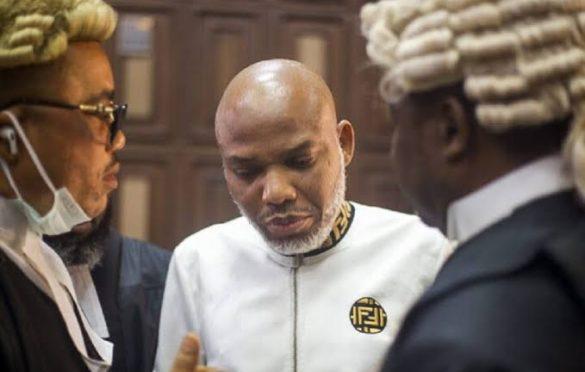
  • Release IPOB leader, Nnamdi Kanu, now, Ortom charges FG

    Release IPOB leader, Nnamdi Kanu, now, Ortom charges FG

    Benue State Governor, Samuel Ortom, has urged the Federal Government to release without delay, the detained leader of the Indigenous People of Biafra (IPOB), Nnamdi Kanu.

    He said Kanu’s release would allow the peace process in the country to be taken seriously.

    He stated this when he received in audience, the American veterans of Igbo origin in Washington DC, US.

    He said Kanu’s case was a socio-political challenge that must be dealt with politically.

    In a statement by his Senior Special Assistant on Diaspora Affairs, Rev. Peter Ichull, in Washington D.C, Ortom said even members of Boko Haram who posed greater threat to the country’s unity were freed, resettled and some integrated into the armed forces.

    He said the South East must be given a sense of belonging to erase the impression that a section of the country East must be given a sense of belonging to erase the impression that a section of the country was persecuted.

    The Benue governor, however, enjoined the Igbo veterans in the United States to believe in one Nigeria, even as he said no country is without its challenges.

    He called on the veterans to support the peace efforts in the South East so that both their communities and investments would experience sustainable growth and prosperity.

    He told the group that power shift to the South East is possible if people of the region were united. He thanked the group for appreciating his modest contributions to national discourses, but challenged South-Eastern Nigerians living abroad that charity begins at home, saying ‘there is nowhere better than home but only peace and security can guarantee the success of your investments back home.’

    President of the group, Dr. Sylvester Onyia, praised Ortom for his fearlessness position on Nigeria’s ills, saying that only such a stand from leaders could build bridges of understanding and give hope to despairing Nigerians abroad that one Nigeria is possible.

  • Breaking News: Court dismisses Nnamdi Kanu’s fresh application for bail

    Breaking News: Court dismisses Nnamdi Kanu’s fresh application for bail

    Breaking News: Court dismisses Nnamdi Kanu’s fresh application for bail

    ABUJA–The Federal High Court sitting in Abuja, on Tuesday, dismissed a fresh application the detained leader of the Indigenous People of Biafra, IPOB, Nnamdi Kanu, filed to be released on bail, pending the determination of the treasonable felony charge the Federal Government preferred against him.

    Kanu, who is currently facing a seven-count charge, had in the application he filed through his team of lawyers led by Chief Mike Ozekhome, SAN, equally challenged the revocation of the bail the court earlier granted to him.

    He specifically urged the court to set aside the order it made on March 28, 2019, which not only issued a bench warrant for his arrest, but also gave FG the nod to try him in absentia.

    The IPOB leader told the court that contrary to FG’s allegation that he jumped bail, he said that he fled for his life after his home town at Afaraukwu Ibeku in Umuahia, Abia State, was invaded by soldiers, which he said led to the death of 28 persons.

    Contending that he was denied fair hearing before his bail was revoked, Kanu, attached eight exhibits that included photographs, as well as an affidavit he deposed to from Isreal after he fled from the country.

    Meanwhile, dismissing the bail request on Tuesday, trial Justice Binta Nyako, said she was not satisfied with the reason the IPOB leader gave for his failure to appear in court for continuation of his trial.

    The trial judge noted that from records of the court, Kanu, was represented by his lawyer on the day his bail was revoked, likewise his sureties.

    “In fact, the sureties told the court that they did not know the whereabout of the Defendant and even applied to be discharged from the matter.

    “Therefore, the Defendant was not denied fair hearing”.

    Besides, Justice Nyako held that though a court could vacate a previous order when confronted with a cogent and verifiable reason, “in the instant case, I have not been given any, neither have I been given any reason to set-aside the order.

    “The present application amounts to an abuse of court process for attempting to relitigate an issue already decided by the court.

    “If the Defendant is dissatisfief, he has the Appeal Court to go to.

    “This application is accordingly dismissed”, Justice Nyako held.

    It will be recalled that the court had also on March 18, declined to release the embattled IPOB leader on bail.

    The court maintained that Kanu must explain the reason why he breached the previous bail that was given to him, before he could enjoy another favourable discretion from it.

    “Until the issue of the absence of the defendant for his trial, with all the bail conditions breached, is determined, the instant application of the defendant for bail will at best be premature and it is refused.

    “However, the defendant is at liberty to re-file the application”, Justice Nyako added.

    (Vanguard)

  • Buhari rules out bail option for Kanu

    Buhari rules out bail option for Kanu

    The President, Major General Muhammadu Buhari (retd.), on Thursday, ruled out bail for the detained leader of the proscribed Indigenous People of Biafra, Nnamdi Kanu.

    He said Kanu, who is currently on trial, was being given every opportunity under the law “to justify all the uncomplimentary things said against Nigeria while he was in Britain.”

    This was as he reiterated his commitment to leave office for the next administration in May 2023.

    According to a statement by his Special Adviser on Media and Publicity, Femi Adesina, the President said this at a bilateral meeting with the British Prime Minister, Boris Johnson, on the margins of the 26th Commonwealth Heads of Government Meeting in Kigali, Rwanda.

    The statement was titled ‘Another term for me? No! The first person who tried it didn’t end very well.’

    On notions that Kanu was not allowed to see his lawyers privately, the President said the detained separatist is being given every opportunity under the law “to justify all the uncomplimentary things he said against Nigeria while he was in Britain.

    “He felt very safe in Britain and said awful things against Nigeria. We eventually got him when he stepped out of the United Kingdom, and we sent him to court. Let him defend all that he said there.”

    He said considering Kanu’s jumping of bail earlier, the Federal Government may not consider granting him such a privilege anymore.

    Buhari said, “His (Kanu’s) lawyers have access to him. Remember he jumped bail before, how are we sure he won’t do it again if he’s admitted to bail?”

    On the keenness expressed by the PM to help Nigeria in the area of security, the President said helping to stabilise Libya could be an initial good step, as the fall of Muammar Gaddafi after 42 years in power unleashed his armed guards on countries in the Sahel, “and they are causing havoc everywhere, as the only thing they know how to do is to shoot guns.”

    On the Boko Haram insurgency, Buhari said there is a serious effort to educate the people on the fact that only an unserious person could kill innocent people, “and say Allah Akbar (God is Great). God is justice. You can’t take innocent souls, and ascribe it to God. The education process is working and the people now understand Boko Haram as anti-God, and not about religion.”

    On his part, the British PM, obviously not quite familiar with the maximum two-term limit, asked if Buhari would run for office again.

    “Another term for me? No! The first person who tried it didn’t end very well,” Buhari said amidst general laughter.

    PM Johnson said he was delighted about the good news on trade between the two countries, adding that the UK was further reducing tariffs on some goods going to Nigeria.

    He described the relationship between the countries as “very strong attachment,” adding, “I just want to be sure that we are doing enough. It’s a massive partnership for us and we need to capitalise on it.”

    Johnson offered condolences on some recent attacks in Nigeria, particularly on churches.

  • Nigeria wants to imprison Kanu without trial, US lawyer writes Ohanaeze

    Nigeria wants to imprison Kanu without trial, US lawyer writes Ohanaeze

    Bruce Fein, the United States-based lawyer of the leader of the Indigenous Peoples of Biafra, Nnamdi Kanu, has written to the Ohanaeze Ndigbo.

    He warned the group not to sit on the legal fence, noting that Nigeria plans to imprison Kanu indefinitely without trial.

    In the letter, Bruce Fein of Bruce Fein Law Firms, Washington DC exposed alleged plans by the Federal Government to imprison Nnamdi Kanu indefinitely without a trial praying for either for his death.

    Governor Mai Mala Buni Welcomes Governor Ben Ayade To APC From PDP, After DefectionSo This Happened (135) reviews kidnap of UniAbuja workers, man who sleeps with corpses, otherBaba Ijesha’s Alleged Crime Bailable But We Are Awaiting Legal Advice – Lagos CPLeah Sharibu’s Mother Shares Trauma, Grief Of Living With Daughter’s Absence

    “It has become obvious beyond a reasonable doubt that the Fulani zealots have no incriminating evidence against him. They aim to imprison Nnamdi Kanu indefinitely without a trial praying for either for his death or handing his fraudulent prosecution to the next administration and wash their hand like Pontius Pilate,” part of the read.

    Part of the letter read, “For nearly a year, Nnamdi Kanu has been punished by indefinite detention in solitary confinement and denied access to needed nutrition, medical care, and counsel of choice in violation of international human rights law and the Nigerian Constitution. (The Fulani government notoriously honors the Constitution in the breach rather than in the observance). Nnamdi Kanu has also been denied his rights to a public, prompt, and fair trial before an impartial judge.

    “The Fulani have amended the charges against Nnamdi Kanu three times. They remain infinitely vague. They trespass on the universally recognized international law right of every people to self-determination exalted in Article 1 of the International Covenant on Civil and Political Rights and Article 3 of United Nations General Assembly Resolution 61/295, Declaration on the Rights of Indigenous Peoples (2007). Notwithstanding armies of lawyers and investigators, the Fulani remain unprepared for trial after the elapse of more than 11 months since Nnamdi Kanu’s detention in Abuja. There still is no trial date.”

    Fein, who is Nnamdi Kanu’s international lawyer and spokesperson further warned Ohanaeze, “Face up to your legal and moral responsibilities as professed Biafran leaders. Do not show your heels when danger appears.

    “To whom much is given, much will be required. Luke 12:48. All that is necessary for the triumph of evil is for good men and women to do nothing.

    “Nnamdi Kanu is one of you – born on the same soil, raised on the same food, buoyed by the same music and dances, and nurtured by the same culture, inspired by the same flag. He has risked that last full measure of devotion (including dodging bullets of would-be assassins) to deliver the Biafran people from the cruel oppressions and genocide of the Fulani-controlled Government of Nigeria like Moses and Pharaoh in the Old Testament.”

    Fein said the prosecution climbed to a new level of farce on May 25, 2022, adding, “A bail hearing had been set by Justice Binta Nyako for May 26. Bail has been denied on the preposterous theory that Nnamdi Kanu previously jumped bail in September 2017 when he barely escaped an assassination attempt by exercising his unalienable right to self-preservation when Nigerian security forces riddled his residence with bullets murdering many others. An Abia High Court has awarded Nnamdi Kanu 5 billion naira for that flagrant and notorious violation of fundamental rights.

    “The day before the bail hearing, Justice Nyako announced through the court Registrar that she had become “indisposed” and had adjourned the case another month to June 28, 2022. Couldn’t the Justice concoct a better excuse, like affliction with Covid? “Indisposed” means a mild illness that passes in days. A more likely explanation is that Attorney General Abubakar Malami, acting on the instructions of President Muhammadu Buhari, ordered Nyako to again postpone the proceedings because the prosecution has no case.

    “Depend upon it. Without public denunciation of Nnamdi Kanu’s continued political persecution thundering like a hammer on an anvil demanding his release and a dismissal of the manufactured charges with prejudice, the June 28 bail hearing will also be postponed ad infinitum. Nnamdi Kanu’s cruel punishment without trial will persist in notorious violation of the Nigerian Constitution and international law.

    “You collectively, have a legal and moral duty to speak out publicly against this travesty of justice that daily inflicts great misery on the Biafran people. Do not become traitors to the noble cause. Risk a tiny fraction of what Nnamdi Kanu has risked to regain Biafran sovereignty. It was stolen by the British over a century ago and the Fulani have refused to restore it by resorting to genocide.

    “Silence is not acceptable. Neutrality between the firefighter and the fire is not an option. You cannot escape the judgment of history. Show you are made of sterner stuff than quislings.”

    Recall that last June, Nnamdi Kanu was kidnapped, tortured for several days, and extraordinarily renditioned from Nairobi to Abuja in a criminal conspiracy between Nigeria and Kenya.

    Fein advised, “The conspiracy was part of an ongoing Nigerian genocide of Biafrans prohibited by the Genocide Convention. The aim is to exterminate them through killings, rape, plunder, starvation, theft of real and personapersonal property, and a collective denial of livelihood.”

    (Punch)

  • Drama as Nigerian govt withdraws newly amended charges against Kanu

    Drama as Nigerian govt withdraws newly amended charges against Kanu

    The Federal Government has withdrawn the newly amended six-count treasonable felony charges against the leader of the proscribed Indigenous People of Biafra (IPOB), Nnamdi Kanu.

    Ahead of a ruling on Kanu’s bail application on Wednesday, the federal government had filed an amended six-count charge against the Biafran agitator before Justice Binta Nyako of the Federal High Court in Abuja.

    But while denying Kanu bail due to an earlier breach of his former bail conditions which saw him jumping bail and fleeing the country, Justice Nyako, however, berated the prosecution for filing the amended charges just hours before the ruling.

    The judge said she was not aware of the amended charges until she got to the court in the morning and according to her, the prosecution could not dump the new amended charges on the court on the morning of the hearing.

    Justice Nyako, while dismissing the new charges, asked the government lawyers to withdraw it and if need be, apply for a fresh filing at a later date.

    She further implored the parties to allow the case to proceed to trial to enable the charges to be determined for speedy dispensation of justice.

    (Ripples)