Tag: election

  • 2027: Turaki Urges Nigerians To Reject Vote-Buying, Choose Leaders On Merit

    2027: Turaki Urges Nigerians To Reject Vote-Buying, Choose Leaders On Merit

    Precious Nwonu, Enugu

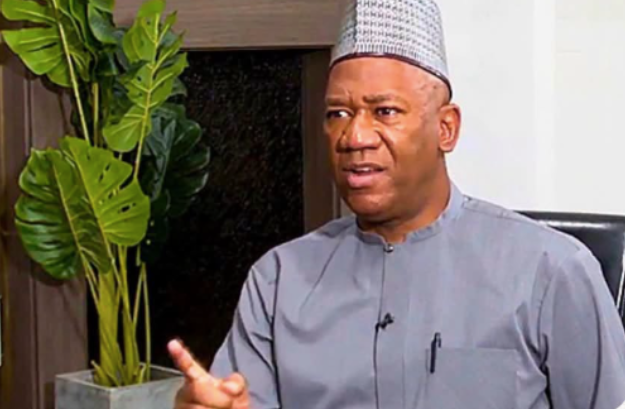
    A factional chairman of the Peoples Democratic Party, Kabiru Turaki, has urged Nigerians to reject vote-buying and assess candidates based on their ability to provide quality representation ahead of the 2027 general elections.

    Turaki made the call on Monday at the second Bala Abdulkadir Mohammed Colloquium held in Bauchi to mark the 68th birthday of Governor Bala Mohammed.

    He particularly appealed to young Nigerians to become more involved in politics and governance instead of waiting to be described as “leaders of tomorrow.”

    Turaki warned voters against exchanging their votes for money, rice, spaghetti or other material inducements, arguing that such practices could weaken citizens’ ability to demand accountability from elected officials.

    “We must not vote in exchange for spaghetti, rice, money or any other inducements. We must vote according to the capacity of the candidates to offer quality representation and contribute to national development,” he said.

    He said the quality of leadership produced by the electoral process was partly determined by the choices made by voters, adding that citizens who refused to participate in elections could also contribute to the emergence of poor leadership.

    Turaki urged youths to take an active role in political processes and decision-making, rather than being treated merely as campaign supporters or election-day voters.

    “We must stop saying that youths are the leaders of tomorrow; when will that tomorrow come?” he asked, stressing that young people should be involved in decisions concerning the country’s future.

    The PDP factional leader also expressed concern about the quality of legislative representation in the country.

    He argued that attention should not only be placed on the number of laws passed by the National Assembly but on whether such legislation addresses challenges confronting Nigerians, including hunger, unemployment, poverty and insecurity.

    According to him, effective legislation should improve citizens’ living conditions and address the country’s fundamental problems.

    Turaki also disagreed with comments by former Labour Party vice-presidential candidate, Datti Baba-Ahmed, who had earlier criticised what he described as growing executive influence over the Senate.

    Baba-Ahmed, in his keynote address at the event, argued that repeated interference by the executive had weakened the independence and vibrancy of the Senate. He also questioned whether lawmakers were primarily representing the executive or the citizens who elected them.

    He called for a legislature that would be more willing to defend citizens’ rights and assert its constitutional independence.

    Responding, Turaki said the focus should be on electing legislators capable of producing quality laws that respond to the needs of Nigerians.

    He argued that Nigeria had experienced differences in the quality of legislative representation over time and said understanding past and present developments was important to improving the country’s democratic future.

    Turaki said a strong legislature was necessary for effective checks and balances and called on Nigerians to take greater responsibility for the political process.

    The event brought together political figures and other stakeholders to discuss Nigeria’s democratic development and the role of institutions ahead of the 2027 elections.

  • INEC Warns Nigerians Against Fake Voter Registration Website

    INEC Warns Nigerians Against Fake Voter Registration Website

    Precious Nwonu, Enugu

    The Independent National Electoral Commission has warned Nigerians against a fraudulent website falsely claiming that the commission has reopened nationwide voter registration ahead of the 2027 general elections.

    INEC said the fake platform was advertising a purported registration window from September 28 to October 27, 2026, and had no affiliation with the electoral body.

    The commission, in a public notice, urged Nigerians not to click on the website or submit personal information, photographs or documents through it, warning that such details could be harvested and misused by fraudsters.

    According to INEC, the website falsely presents itself as a platform for a “Final Phase of Nationwide Online Voter Card Registration” and claims to offer services including updating voter information, transferring voters to different polling units and replacing lost or damaged Permanent Voter Cards.

    The electoral body stressed that the nationwide Continuous Voter Registration exercise ended on July 26, 2026, and that there is currently no new nationwide online registration exercise.

    INEC had earlier reaffirmed that the July 26 deadline would not be extended, urging eligible Nigerians to complete their registration or update their voter information before the close of the exercise.

    The commission’s official voter registration portal also currently states that the Continuous Voter Registration exercise has ended, while allowing registered voters to check their voter status and PVC collection information.

    The warning comes as political activities intensify ahead of the 2027 general elections. INEC’s revised timetable provides for the publication of the official register of voters on December 15, 2026, while the presidential and National Assembly elections are scheduled for January 16, 2027.

    The commission advised Nigerians to be cautious of websites and social media posts that claim to offer voter registration or PVC-related services outside its officially announced processes.

    INEC urged members of the public to verify election-related information through its official website, verified social media accounts and other recognised communication channels before providing personal information.

    The commission also provided its Citizens Contact Centre for enquiries and complaints, urging Nigerians to report suspicious electoral information through its established channels.

    INEC said vigilance was particularly important as the country approaches the 2027 elections, warning that fraudulent platforms could not only mislead eligible voters but also expose sensitive personal information to criminal elements.

  • Wike Rejects Uzodimma’s Reported Senate Presidency Ambition

    Wike Rejects Uzodimma’s Reported Senate Presidency Ambition

    Precious Nwonu, Enugu

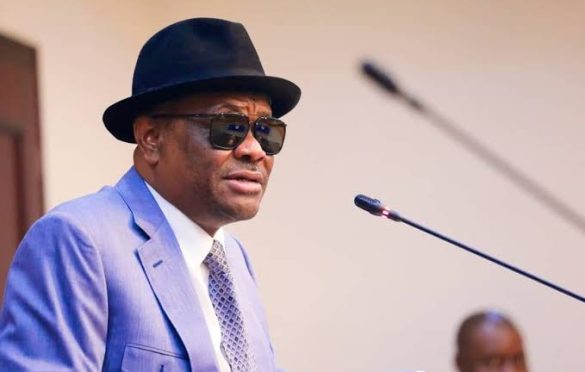
    Minister of the Federal Capital Territory, Nyesom Wike, has said he will not support Imo State Governor Hope Uzodimma’s reported ambition to become President of the Senate after the 2027 general elections.

    Wike made the declaration on Monday during an appearance on TVC’s Journalists’ Hangout, amid an escalating disagreement between him and some governors of the All Progressives Congress over political arrangements ahead of the 2027 elections.

    The FCT minister also alleged that Uzodimma was seeking to influence the emergence of senators and members of the House of Representatives who could support his reported bid to lead the Senate.

    According to Wike, some APC governors were attempting to determine which lawmakers would emerge from the 2027 elections, a move he linked to the reported Senate presidency ambition.

    “He wants to run for Senate president, and what he does is to say to his colleagues, let us be the ones, governors, to produce the senators and members of the House of Representatives,” Wike said.

    Wike further alleged that some politicians who were denied tickets during the APC nomination process had moved to other political platforms to contest the 2027 elections.

    He argued that lawmakers who emerged through alternative platforms would not necessarily be obliged to support Uzodimma’s reported ambition.

    The disagreement is unfolding amid tensions over Wike’s Rainbow Coalition, a cross-party political arrangement he has been promoting ahead of the 2027 elections.

    Uzodimma, who chairs the Progressive Governors Forum, has been among the APC governors opposing political arrangements that they believe could affect the party’s candidates or its electoral interests.

    The Progressive Governors Forum recently said it would not support alliances or political arrangements capable of undermining President Bola Tinubu’s re-election bid or the APC’s candidates in the 2027 elections.

    Wike, however, has maintained that his Rainbow Coalition is not an APC structure and has argued that political parties should remain free to field candidates for legislative and governorship elections while the coalition works to support Tinubu’s presidential bid.

    His latest comments have brought the reported Senate presidency ambition of Uzodimma into the wider political dispute, although the eventual leadership of the Senate after the 2027 elections will depend on the composition of the National Assembly and the subsequent choice of senators.

    Uzodimma has not, in the reports reviewed, publicly confirmed that he will contest for the Senate or formally declared a bid to become Senate President.

  • PDP Defends Wike, Accuses APC Governors of Fear of 2027 Contest

    PDP Defends Wike, Accuses APC Governors of Fear of 2027 Contest

    The Peoples Democratic Party has defended the Minister of the Federal Capital Territory, Nyesom Wike, following the rejection of his political support for President Bola Tinubu by the All Progressives Congress Governors’ Forum.

    The PDP said Wike remained a major political force whose support could contribute significantly to Tinubu’s re-election bid, insisting that the minister had the constitutional right to decide whom he would support politically.

    The party stated this in a press release issued on Tuesday and signed by its National Publicity Secretary, Jungudo Haruna Mohammed.

    The statement followed the position of the APC governors that their members would not participate in, support or endorse any political arrangement capable of undermining the APC or its candidates ahead of the 2027 general elections.

    The PDP argued that Wike was not the problem of the APC governors, but that their concerns were rooted in their governance records and fear of facing strong opposition candidates at the polls.

    “The APC Governors’ Forum should understand that Wike is not their problem; their problem is their poor governance and failure to meet the expectations of their people,” the party said.

    According to the PDP, Wike’s support for Tinubu did not amount to an endorsement of the APC or require him to abandon his membership and political relationships within the PDP.

    It said the minister, who is serving in the APC-led Federal Government, could legitimately support Tinubu while retaining his political identity.

    The opposition party accused the APC governors of initially misinterpreting Wike’s support for Tinubu as support for the ruling party.

    “The APC governors had initially misconceived Wike’s support for President Bola Ahmed Tinubu as an endorsement of the APC. They are now beginning to realise that supporting the President does not mean abandoning the PDP or surrendering the political space to the APC,” the statement said.

    The PDP also rejected what it described as the governors’ attempt to prevent Wike from supporting or fielding candidates capable of challenging APC candidates in the 2027 elections.

    It argued that political parties had the right to field candidates for elective positions and that voters should be allowed to determine the outcome.

    “Elections are contests, and every political party has the democratic right to present candidates before the electorate,” the party said.

    The PDP further claimed that the APC governors’ position reflected anxiety over the prospect of facing strong PDP candidates in the next general elections.

    It maintained that the PDP had stabilised and was preparing candidates across elective positions who could challenge APC incumbents and their preferred candidates.

    The party questioned why governors who were confident in their records would be concerned about opposition candidates contesting against them.

    “If they have truly performed and retained the confidence of their people, they should welcome a contest and allow the electorate to decide,” the PDP said.

    The party also highlighted Wike’s political record as a former governor of Rivers State and his performance as FCT minister, describing him as a political organiser and mobiliser whose influence could not simply be ignored.

    It argued that rejecting Wike’s support would be counterproductive for anyone seeking Tinubu’s victory in 2027.

    “It is therefore politically irrational for anyone claiming to support the President to reject a political leader of Wike’s stature and the votes and mobilisation capacity he can bring to the President’s campaign,” the statement said.

    The PDP questioned whether the APC governors were more interested in securing their own political victories than ensuring Tinubu’s re-election.

    “A governor who truly wants the President to win should welcome every credible political force capable of contributing to that victory,” it said.

    The party urged the governors to focus on governance, accountability and their performance in office instead of attempting to determine whom Wike should support politically.

    It also challenged them to account for resources accruing to their states through the Federation Account Allocation Committee and ensure that local governments receive funds due to them.

    Describing Wike as an “asset” to Tinubu’s political project, the PDP said his political influence and mobilisation capacity could contribute to the President’s electoral prospects.

    It, however, maintained that the ultimate decision would rest with voters in 2027.

    “At the appropriate time, Nigerians will decide with their votes. Those who have performed will present their records, while those who have failed will face the judgment of the electorate,” the party said.

    The PDP said it would not be intimidated into withdrawing from the electoral contest, adding that it would field candidates and campaign for an alternative ahead of the 2027 elections.

    “The message to the APC Governors’ Forum is simple: Chief Barrister Nyesom Wike is a force to reckon with, not a force to reject,” the party said.

    It added, “The PDP will not be intimidated into abandoning the electoral field. We will field credible candidates, mobilise Nigerians and offer the electorate a genuine alternative come 2027.”

  • ADC Condemns Kaduna Attack, Warns Against Political Violence Ahead of 2027

    ADC Condemns Kaduna Attack, Warns Against Political Violence Ahead of 2027

    Precious Nwonu, Enugu

    The African Democratic Congress has condemned an alleged attack on its members in Kaduna State, warning that the use of violence and thuggery in political activities could escalate ahead of the 2027 elections.

    The party said the incident was an unacceptable development, particularly as political activities for the 2027 elections were beginning to gather momentum.

    In a statement issued by its National Publicity Secretary, Bolaji Abdullahi, the ADC warned political actors against introducing violence into the electoral process.

    Abdullahi said no political party should assume that it had exclusive control over non-state-sponsored violence, warning that the consequences could become difficult to contain once violence was normalised as a tool of political competition.

    “Let nobody mistake our commitment to peaceful democratic participation for weakness. No political party has a monopoly on non-state sanctioned violence. Once violence becomes an accepted instrument of political competition, nobody can predict where it ends,” he said.

    The party called on security agencies to investigate the incident and ensure that those responsible, including anyone who may have sponsored or organised the attack, were identified and prosecuted.

    ADC also expressed solidarity with its Kaduna governorship candidate, Isa Ashiru, and other party members affected by the incident.

    The party urged the Kaduna State Government to take steps to guarantee the safety of opposition parties and their members across the state.

    Abdullahi insisted that the alleged attack would not prevent the party from participating in political activities across Kaduna.

    “Kaduna belongs to its people, not to any party. If anyone believes intimidation will frighten the ADC off the political field, they have badly miscalculated,” he said.

    “We will not be intimidated. We will organise, we will campaign, and we will compete in every part of Kaduna State. The 2027 elections must be decided by ideas competing at the ballot box, not by thugs and bruises,” he added.

    The ADC urged political stakeholders and security agencies to ensure that the 2027 electoral process remained peaceful and focused on issues and competing policy ideas rather than violence and intimidation.

  • Kwankwaso Urges Atiku to Quit 2027 Presidential Race

    Kwankwaso Urges Atiku to Quit 2027 Presidential Race

    Precious Nwonu, Enugu

    Vice-presidential candidate of the Nigeria Democratic Congress, Rabiu Kwankwaso, has urged former Vice-President Atiku Abubakar to withdraw from the 2027 presidential race.

    Kwankwaso, who is the running mate to NDC presidential candidate Peter Obi, made the appeal on Monday while speaking at his Abuja residence during a meeting with members of the Fulani Farmers Association.

    Speaking in Hausa, the former Kano State governor appealed to the group to advise Atiku, citing his age and health.

    “Go to the Wazirin of Adamawa’s house and tell him in Fulani that he needs to focus on his traditional title of Wazirin, given his age and health,” he said.

    Kwankwaso also promised that he and Obi would take care of Atiku if they emerge victorious in the 2027 election.

    “If Allah grants us success, we will take good care of him, especially since you all come from Adamawa. An apology should be offered to him,” he added.

    Atiku emerged as the African Democratic Congress presidential candidate in May 2026, setting the stage for another presidential contest.

    His emergence marked his latest attempt at securing Nigeria’s presidency after first contesting for the position in 1993.

    The former Vice-President was the Peoples Democratic Party presidential candidate in the 2019 election, where he lost to then-incumbent President Muhammadu Buhari.

    Speaking after his emergence as the ADC candidate, Atiku pledged to focus on national unity, security, economic development, education and greater devolution of resources and powers to Nigeria’s federating units.

    “This time around is different; our journey will not end at the poll; we will get to work and rescue Nigeria. I invite every Nigerian to join me in this mission to save our dear country,” he said.

    Atiku also promised to pursue a liberal economy with lower taxes for small businesses and low-income earners if elected president.

    “I have never been this optimistic, and with your support and God’s grace, we will get to the promised land,” he said.

  • 2027: Datti Baba-Ahmed Says Obi, Atiku, Others Can’t Fix Nigeria

    2027: Datti Baba-Ahmed Says Obi, Atiku, Others Can’t Fix Nigeria

    … Atiku: Tinubu subsidises friends, IOCs, won’t do same for poor Nigerians


    A vocal member of the opposition in Nigeria, Datti Baba-Ahmed, at the weekend said none of the politicians challenging President Bola Tinubu in the 2027 presidential election, including his erstwhile political ally, Peter Obi, and ex-Vice President, Atiku Abubakar, has the capacity to improve or change Nigeria.

    Baba-Ahmed, who was Obi’s running mate in the 2023 presidential election, disclosed that he had warned Obi against joining the African Democratic Congress (ADC), but the former Anambra State governor ignored his advice and subsequently moved away from what he described as his political “comfort zone”.

    The comments by Baba-Ahmed came as the the presidential candidate of the ADC in next year’s election, Atiku, yesterday accused Tinubu of subsidising his friends and the International Oil Companies (IOCs) but won’t do the same for poor and struggling Nigerians.

    But speaking on the MIC ON Podcast, hosted by Seun Okinbaloye, Baba-Ahmed said his political differences with Obi became more pronounced after the latter ignored his warning ahead of his move to the ADC.

    He said he personally approached Obi at the Yar’Adua Centre to express his reservations about the proposed defection, stressing that he had told him the ADC was not suitable for his political ambitions.

    “When he was going to join ADC, I had to go to Yar’Adua Centre ahead of him, so I called him aside. They were worried. Why is Datti calling Peter Obi aside and talking to him? And I told him, ‘This is the last time I’m coming to this place. I gave him my reasons. This is not a place for you.’ Was I wrong? I was proven right,” he said.

    According to Baba-Ahmed, Obi’s eventual departure from the ADC vindicated his earlier position, noting that he had predicted that the former governor would not remain in the party. “Within four months, Peter Obi left ADC,” he said.

    Baba-Ahmed also explained that Obi’s decision to move outside the political position he had advised him to maintain made it difficult for him to continue influencing his former running mate’s political choices.

    “Peter Obi moved out of his comfort zone against my advice. Beyond that point, I could no longer help him,” he said.

    The former federal lawmaker, who subsequently left the Labour Party for the Peoples Redemption Party (PRP) said he was also uncomfortable with what he described as contradictions in Obi’s political positions.

    “Now, I don’t like people who contradict themselves, and I don’t want to go into criticising again the politics of Atiku because that’s not what I’m about,” he said.

    On the 2027 presidential contest, Baba-Ahmed said Tinubu should prepare to leave office but should not hand over power to any of the politicians currently challenging him because, in his view, none of them had the capacity to improve the country.

    “I will simply advise uncle (Tinubu) to please prepare to hand over and move away, but not to the people contesting against him because none of them will improve Nigeria,” he said.

    Specifically, asked if he was referring to all the opposition politicians seeking to replace Tinubu, Baba-Ahmed replied: “None of that part. Tinubu should leave the stage. All those people contesting against him, too, they were all in bed together at some point or another.”

    When the interviewer particularly asked whether that included Obi, Baba-Ahmed responded: “Including Peter Obi, I’m sorry to say.”

    He argued that Obi had previously belonged to the Peoples Democratic Party (PDP), which was the ruling party at the time, questioning how politicians with such political histories could convincingly present themselves as agents of a new Nigeria. “Tell me one politician who has never been in a ruling party. Tell me,” he said.

    However, when reminded that he had also been involved in politics and had served in the National Assembly, Baba-Ahmed distinguished his political history from those of the politicians he was criticising.

    “I have never been in a ruling party. While I was in the CPC, CPC was the leading opposition party, even above ANPP then. When they merged with APC and came to power, you have my letter of resignation from the then APC because, even though I was, because I have never had a card, a membership card of APC. Never. I never had a membership card of APC,” he said.

    However, Baba-Ahmed maintained that his criticism was not simply about party membership but about the political history of the leading figures seeking to challenge Tinubu in 2027.

    Obi and Baba-Ahmed contested the 2023 presidential election on the Labour Party platform and finished third behind Tinubu of the All Progressives Congress (APC) and Atiku of the PDP.

    Atiku Accuses Tinubu of Discriminatory Subsidy Approval 

    Meanwhile, former Vice President and presidential candidate of the ADC, Atiku, yesterday accused  Tinubu of subsidising his friends and the International Oil Companies (IOCs) but won’t do the same for poor and struggling Nigerians.

    He also accused Tinubu of wrecking Nigerians’ purchasing power, emptying household pockets and pushing businesses to the brink through economic policies that have made virtually everything more expensive while leaving ordinary citizens with less money to survive.

    In a statement issued by his Senior Special Assistant on Public Communication, Phrank Shaibu, Atiku said Tinubu can no longer hide behind impressive economic figures announced from Abuja when Nigerians are living with the painful consequences of his decisions.

    He said Tinubu removed fuel subsidy from the people, presided over soaring fuel, transport and food costs, and is now attacking a ‘production subsidy’ proposal designed to reduce that burden and return money to Nigerians’ pockets.

    Atiku said the position being canvassed by the Crude Oil Refinery Owners Association of Nigeria (CORAN) for support for domestic refining, alongside President Donald Trump’s intervention to strengthen petroleum production and refining in the United States, further exposes the weakness of Tinubu’s argument against targeted support for Nigerian production.

    “Tinubu did not inherit this cost-of-living crisis from Nigerians. His policies created and deepened it. He took away relief from the people, made fuel, food, transport and basic survival more expensive, and now wants Nigerians to applaud statistics while their pockets are empty.

    “Recent reports that a significant share of the short-term assets of some of Nigeria’s biggest companies is now trapped in unpaid customer bills tell the same story: companies may record sales, but customers increasingly cannot pay because Tinubu’s economy has drained their purchasing power.

    “Take a woman selling frozen food in Kubwa. She pays more to transport her goods, more to power her freezer and more to restock. Her customers are poorer, so they buy less or ask for credit. Soon she cannot restock, her supplier is owed, and Tinubu’s economic pain spreads through the entire chain,” he stated.

    He stressed that Nigerians know the prices they come against daily, with fertiliser moving from about N9,000 to around N50,000; petrol from about N199 to around N1,400 per litre; cement from roughly N4,000 to around N13,500; and the dollar from around N450 to about N1,400.

    “And after all this pain, what has the ordinary Nigerian received? No reliable electricity. Loan for a degree. No security. No N-Power. Food is expensive. Transport is expensive. Life itself has become expensive. What exactly are Tinubu’s defenders defending?

    “This is why my Production Subsidy is about putting money back into people’s pockets. Support what we produce and refine here, increase supply, monitor the price and make sure Nigerians feel the benefit at the pump,” he argued.

    According to him, the point CORAN is making is that there’s a need to support domestic production, stressing that America understands the importance of supporting strategic energy production.

    “Yet Tinubu attacks relief for ordinary Nigerians while his government understands perfectly well how to grant waivers, incentives and concessions to multinational oil companies and businesses close to his administration.

    “So why does intervention suddenly become bad economics when ordinary Nigerians are meant to benefit?

    “Nigerians have now seen what Tinubu’s economics means in their daily lives: higher fuel prices, higher food prices, higher transport costs, weaker businesses and emptier pockets. They do not need another lecture on patience. They need relief.

    “The choice before Nigeria is therefore clear: continue with an economy that takes more from the people, or build one that puts money back in their pockets. Support production. Refine in Nigeria. Create Nigerian jobs. Lower the cost of living,” he added.

    The former VP urged Nigerians to reject a government that has made life harder and embrace a plan that makes life affordable again.

    “Enough of empty pockets. Enough of endless hardship. Nigeria must produce more, Nigerians must pay less, and families must have money left to live. Tinubu made life expensive. Atiku will make life affordable again,” Atiku maintained. This Day Live


  • Wike: EFCC Probe Doesn’t Bar Anyone From Campaigning

    Wike: EFCC Probe Doesn’t Bar Anyone From Campaigning

    …APC campaign council spokesperson Kemi Asekun-Shittu says it is unjust to stall Edu’s life or career while the investigation is ongoing

    Precious Nwonu, Enugu

    The Minister of the Federal Capital Territory (FCT), Nyesom Wike, has strongly defended the inclusion of individuals under Economic and Financial Crimes Commission (EFCC) investigation within political campaign teams, asserting that a security probe does not legally stop anyone from canvassing for votes.

    Speaking during a live media parley aired on Channels Television, the former Rivers State Governor criticized what he described as a double standard from the press and public regarding the scrutiny applied to political campaigns. He pointed out the irony that an individual under investigation but not yet charged in court is often heavily scrutinized for campaigning, while others with active cases are permitted to run for the highest offices.

    “You (media) were asking the moral justification of putting someone who has an EFCC case to be in a campaign council. And I was just watching the lady. The lady doesn’t even know what to say,” Wike observed. “Now, somebody cannot be in a campaign to canvass for votes for a particular person, but somebody who has an EFCC case can contest an election and win an election?”

    Wike further noted that Nigerian political history is filled with instances where individuals facing severe criminal allegations successfully ran for office. “This person had an EFCC case in court, charged to court. He contested an election and became a Governor,” Wike said, choosing not to mention specific names.

    Expanding his argument to show the limits of political advocacy, Wike stated that even incarcerated individuals possess the ability to influence voters. “Listen. Even a prisoner… maybe they have somebody in prison. I go and visit the person. The person can tell me, ‘My brother, I want you to support so-and-so candidate.’ A prisoner has canvassed for vote.”

    He also referenced an unnamed individual previously accused of participating in a coup plot who still engaged in political campaigning. “I was watching, when Channels, when Sunrise, who came up to say, ‘Ah, how can somebody who’s being looked for as a coup plotter is now canvassing for votes for so-and-so government?’ Somebody EFCC is looking for is now canvassing for votes for so-and-so person. But… a party, or a candidate cannot, simply because EFCC is investigating the person, cannot be a member of the campaign council to campaign for votes.”

    Wike’s comments come on the heels of intense public controversy surrounding the inclusion of the suspended Minister of Humanitarian Affairs and Poverty Alleviation, Betta Edu, in President Bola Tinubu’s 2027 presidential re-election campaign structure. Edu was named the Director of Women Mobilisation for the All Progressives Congress (APC) Presidential Campaign Council.

    Edu was suspended by President Tinubu in January 2024 following sweeping allegations of financial impropriety and was subsequently questioned by the EFCC. To date, she has not been publicly or legally declared guilty of any crime.

    Defending the decision on Channels Television’s Morning Brief, APC campaign council spokesperson Kemi Asekun-Shittu argued that it is unjust to stall Edu’s life or career while the investigation remains pending.

    “I’d like to say that for Betta Edu, for example, she has not been found guilty. And it will be unfair to ask that she leaves her life or refuses to live her life until the EFCC declares her. We believe that there is very likely the issue that she may not be found guilty,” Asekun-Shittu stated. “But besides that, we also know that with politics, every Nigerian is allowed to be a politician if they choose to. And we do not believe that we should then hold her life still or keep her stagnant until the case is decided. It’s been almost two years of that case. She does deserve an opportunity to present herself again for the party.”

    Asekun-Shittu concluded by emphasizing that campaign committee selections are strictly internal party affairs, meaning the APC retains the right to choose its workers. However, she noted that the current directory is not final and remains subject to future reviews.

  • How Enugu PDP is Gaining Strength Through Edeoga’s Return

    How Enugu PDP is Gaining Strength Through Edeoga’s Return

    By Sebastine Chukwuebuka Okafor

    When the former Gubernatorial candidate of the Labour Party, Barr. Jonathan Chijioke Edeoga left the Labour party to rejoin the Peoples Democratic Party, PDP, a lot were said about such move both from his supporters, close allies, political foes, opposition party leaders and their members amongst others.

    In all these postulations, analysis and questions, one crucial aspect was whether it was a right or wrong move and also whether he actually defected with anybody. There were lots of write-ups saying that he was alone and thus, does not have any political will to effect changes in the PDP. The people making these comments are neither PDP members nor leaders of the party but people who are political bats with no place to lay hands on.

    Immediately Edeoga defected from the Labour Party, he collapsed the party and exposed their weaknesses. He delivered Enugu State House of Assembly to PDP and ensured that their majority numbers increased. First, his State House of Assembly member, Hon. Eberechi Ezeh joined him together with the State House of Assembly candidates of the party in Nkanu West Local Government Area, Awgu North and South, Aninri, as well as Hon. Engr. George Ugwu from Ugwogo Nike who was the former spokesman of the LP’s gubernatorial campaign. He then went to Enugu North Senatorial Zone being his stronghold and annihilated the party with the defection of Hon. Dennis Agbo, the federal lawmaker representing Igboeze North and Udenu Federal Constituency who entered with his teaming grassroots supporters, same with his colleague, Hon. Mark Chidi Obetta, who represents Nsukka – Igboeze South Federal Constituency. He also followed that up with the defection of Hon. Emeka Mamah, Hon. Malachy Okey Onyechi, Nsukka West State Assembly member, Hon  Titus Odoh amongst others.

    Recall that prior to Edeoga’s defection, the APC was very confident of receiving the entrants of these people to an extent that the chairman of their Governors Forum, Chief Hope Uzodimma, announced that they were joining the party in a few weeks time. So, as soon as all these defections from LP to PDP started to happen, it became clearer to other objective members of the party to look for a better platform and they began to join APC, because of some reasons best known to them. This leaves Labour Party with only 3 State House of Assembly members and 2 Senators who are, arguably, not also recognized by the party in both the state and national level, which has left them to be in motion waiting for a coalition that may never take place. It is very clear they will either join PDP or APC because the LP has made them persona non grata to the party.

    Whether you are reading this objectively or with sentiments, Edeoga’s defection has eliminated the Labour Party in Enugu State, creating a political vacuum that the PDP quickly filled with strategic placements and strengthened structures. His tactical maneuver not only destabilized the LP but also sent a strong message to both his supporters and critics that politics is not driven by empty propaganda but by calculated moves and influence. Those who doubted his capacity have been left speechless, while those who stayed close are already reaping the dividends of alignment with a reinvigorated PDP.

    One thing that cannot be denied is that Barr. Edeoga understands the political terrain of Enugu State more than many of his peers. His movement was not one born out of desperation, but a well-thought-out plan to reposition his people and allies in the centre of decision-making. The LP, once seen as a third force, is now left fragmented, disoriented, and directionless. While some of its vocal social media handlers still try to give the illusion of relevance, the ground reality paints a picture of a party that is gasping for breath. It has no viable structure, no rallying point, and certainly no leadership cohesion.

    Moreover, the ripples of Edeoga’s defection did not only resonate in Enugu North but across the entire political spectrum of the state. Even in places like Enugu East and Enugu West Senatorial Zones, Labour Party’s influence has fizzled out with most of their local leaders either defecting silently or sitting idle without clear directives. The PDP, on the other hand, has seized this opportunity to consolidate its grassroots strength, making sure that the gap left behind by the LP is sealed with responsive and strategic mobilization. If elections were held today, it is not hard to predict that Labour Party would not only perform poorly but might struggle to field serious candidates in many localities.

    However, the party is still a better option in the state than APC if it can reorganize itself and settle its internal crisis because those defecting to APC are largely driven by personal interests, opportunism, and the illusion of federal alignment rather than genuine ideological commitment. Many of these defectors have no grassroots followership and are merely seeking political survival. If the Labour Party can rise from its current disarray, rebuild its structures, reconnect with the masses that once gave it overwhelming support, and present credible candidates, it stands a chance of reclaiming its lost ground.

    What the party needs now is a sincere, selfless, and strategic leadership, a leadership that will move beyond social media noise and engage the real voters on the streets, in the markets, in the churches, and in the villages. The energy of the Obidient movement that once shook the foundations of the old order in Enugu State is not dead; it is simply dormant and disillusioned. With proper reorientation, reconciliation, and grassroots engagement, the Labour Party can revive its vision and reassert itself as the true alternative voice in the state’s political discourse. The journey may be tough, but it is far from impossible.

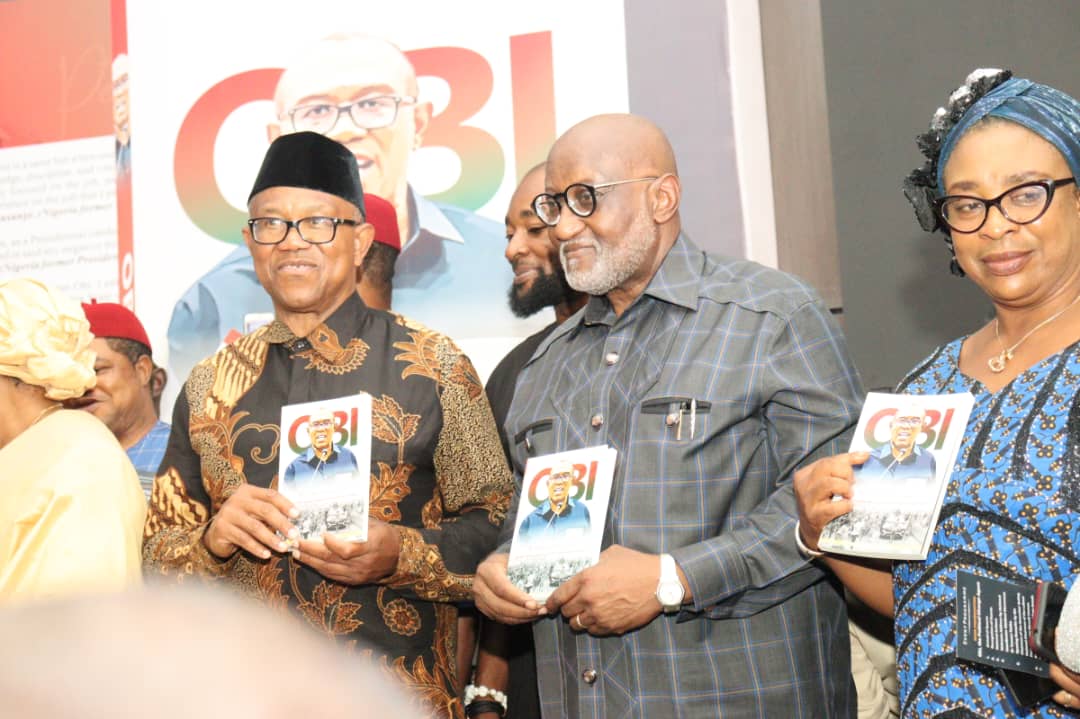
  • Obi: The Political Change Agent – Book Review By Oseloka Obaze

    Obi: The Political Change Agent – Book Review By Oseloka Obaze

    Obi: The Political Change Agent

    The story of the man who changed the face of electioneering in Nigeria

    ***********

    A Review by Mr Oseloka H. Obaze

    At the NAF Center Kado, Abuja FCT, Monday 10th June, 2025

    [Protocols]

    As conventional wisdom admonish us, “never judge a book by its cover.” But we are also told that “There is no friend as loyal as a book.” My favorite quote on books is the one by Jeanette Winterson, which says “Books and doors are the same thing. You open them, and you go through into another world.”  I sincerely hope that today we will present a book, which will serve as an open door to closed minds.

    By June 2025 – a span of three years from May 2022 – when Peter Obi became the presidential candidate of the Labour Party, no less than fifteen books have been published on his foray into Nigeria’s political space. Many observers consider that three-year span as a redefining era in Nigeria’s electioneering and partisan politics.

    The book being presented today, Obi: The Political Change Agent -The story of the man, who changed the face of electioneering in Nigeria, is yet another brick in the wall of a fast growing historical record on Peter Obi’s brand of politics.

    As the book’s title suggests, Peter Obi is by every adjectival qualification, a political change agent in Nigerian politics.  He is also an adroit competitor, in a marathon race that is far from over. So this literary work is about Peter Obi; but in the context of Nigeria, it is about the unheralded rise of Obidient Movement phenomenon between 2022 and now.  It is also about an unfinished business of nation-building, and renewal, and ultimately, a preface to the inevitability of a New Nigeria.

    The core value and potency of this book, is that is written from an insider’s perspective. Ike Abonyi, my friend and the author, has done a yeoman’s job. With a keen sense and eyes for details, he has done what adroit researchers and veteran journalists do best; render credible account of seminal events without embellishments.

    If per chance, you do not intend to read this book immediately, I will advise you to read the foreword by my brother, Dele Farotimi, in order to get the gist of this work.  Characteristically, Mr. Farotimi did a positively magisterial job, with some four hundred insightful words. He concluded with his non-hesitant recommendation of the book, “to scholars of Nigerian politics, elections and society.”

    According to Farotimi, “Obi represents an anomaly in Nigeria’s political landscape; a politician who genuinely desires to work for the betterment of society…Peter Obi is a politician unlike any other in Nigeria.  Ike Abonyi’s work looked at the campaign and organic growth of the Obidient Movement and how Peter Obi’s candidacy has rewritten the manual for future aspirants to public office.”  To that very candid summation, I will only add that any book about an enigmatic personality or an icon is worth reading and owing.

    For the sake of brevity and convenience, I am minded to dispense with the formality of the book’s nomenclature, before delving further into its substance and flourish.

    The book, Obi: the Political Change Agent consists of 252-pages, and twenty-six stand-alone compact chapters. Each chapter, adapted from original real-time op-eds and essays, details Peter Obi’s odyssey from the juncture when he ventured into Nigeria’s political setting, through his uncharted trajectory to becoming the Labour Party 2023 presidential candidate on 30th May, 2022 and thereafter.

    I’ve only offered a synopsis of the structure of the book, to get the full gist or chapter-by-chapter narration, please purchase a copy of the book. Now to the historical flourish of the work.


    ***********

    Chapter 1 is essentially a backdrop, and the condensed story of Nigeria’s return to participatory democracy, from 1999 to date.

    Chapter 2, x-rays the man Peter Obi, and captures his essence and bonafides via his abridged official biography.

    Chapter 3 is revelatory. It documents that fortuitous but life-changing encounter that took Obi into politics. It narrates how Peter Obi’s encounter with Professor Donald Jacob, the Dean of the Kellogg School of Management in the USA, altered his views on politics. Ultimately, the unforeseen outcome of that six-week executive course was his decision to go into politics. It’s a thought-provoking story.

    Chapters 4 and 5 encapsulate the Ojukwu and APGA factors; as well the Anambra governance revolution. Obi’s and sojourn in Anambra was not without its vagaries, but would have been utterly impossible without the overwhelming influence of the iconic Igbo leader, Chukwuemeka Odumegwu-Ojukwu, who was the leader of the All Progressives Grand Alliance (APGA).

    Chapter 6 and 7 surveys Obi’s Journey to the center and Obi’s political dalliance with the PDP.  This chapter speaks to Obi’s political movement from the state to the federal level after his successful tenure as Governor of Anambra State. The narration segues into the political leap that made him the running mate to Atiku Abubakar in the 2019 presidential election.

    Chapter 8 and 9 is a periscope of how Obi’s 2023 Presidential Journey begins and landed him in the Labour Party. It chronicles Obi’s encounter with the vicissitudes of Nigeria’s rotational national politics, unkept promises and his eventual divorce from PDP. The factors at play were mot mere imponderables as much as they were a manifestation of human foibles, political machinations and shortsightedness.

    Chapter 10 is about the birthing of the Obidient Movement. The chapter chronicles the emergence of the Obidient Movement in the nation’s political trajectory and how it impacted greatly on the polity during the 2023 electioneering.

    Chapters 11 narrate the already well-documented 2023 election intrigues by the INEC and the ultimate Judiciary ambush. This is one of the longest chapters in the book for obvious reasons; it captured all the election intrigues, the preparations from voter registration to election proper and the post-election drama.

    Chapter 12 is about ‘The Media and the Obi’s Politics.’ This chapter captures media involvement in Obi’s Presidential ambition and how the social and mainstream media played some significant roles in Obi’s politics. Some believed that Obi was a media hype that would fade away with time. They were wrong.

    Chapter 13, narrate the well-known folktale of Peter Obi’s “Madman” friend, affirming ultimately, that ‘all politics is local’. During his Presidential campaigns, Peter Obi frequently recalled how in his quest for adaptive leadership, he opened himself to learning from everybody. In that context, he often recalled how during his tenure as Governor of Anambra State, he got one of the best advices that helped him tackle very naughty security issues from a “madman.” The author corroborates the seemingly bizarre story, by seeking and finding the “madman.”

    Chapter 14 captioned ‘Anatomizing The Peter Obi Character’ offers an insight into varying perceptions of Peter Obi’s persona; Such perceptions are mixed and complex. Some people saw Obi is a stingy and difficult man to deal with, but to others, he is the prudent man, who detests corruption and extravagant living. To some, he was a quiet philanthropist. This chapter looks at his personality from these contrasting and eclectic perspectives.

    Chapter 15 is the author’s published rendition of Obi’s experience during his brief sojourn in PDP. He facetiously asked: “Obi in PDP; was a Celibate in the Whorehouse?” He surmised how Obi’s clean character and credentials meant nothing to some of the PDP leaders who were bent on frustrating him. This narration validates Obi’s frequently uttered contention that any foray into Nigerian politics was an entanglement with “pimps and prostitutes, not priests and nuns.”

    Chapter 16 and 17 titled ‘A Political Phenomenon Called Peter Obi,” is also another published op-ed by the author capturing the enigma in Peter Obi’s politics. The chapter segues to an analysis of ‘LP’s Obi and the Involuntary Campaigners.’ This article talks about how Obi campaigners emerged involuntarily after hearing his disarming messages on how to create a new Nigeria, with his “Go and verify” and “consumption to production” and “a New Nigeria is Possible” Mantras.

    Chapter 18 & 19 are respectively titled “How Obi-phobics Chased the Wind” and “As Campaigns Flag off, it’s Obi…kererenke.”  These chapter mirrors and juxtaposes the twin developments of dislike and, like, hate and love, ignominy and fervor Obi candidacy elicited nationally. It synoptically captures the futility of the quest by Obi’s political traducers, who embarked on a massive search for something negative about him, but failed woefully. On the flip side was the fervent mob like national support during the same period as Obi’s campaign flagged off, to endless chants of ‘Obi…kererenke’. Rather than the unfolding of scandals, that zeal would eventually transform into the electrifying campaign mood that was replete with various campaign songs and slogans that dominated the political space.

    Chapter 20: captioned “OBI’s quest for Justice and Repetition of History,” recalls how Obi has always been treated unjustly since he entered politics and how he has continued to seek Justice undauntedly via legal redress.

    Chapter 21 tackles the very sensitive issue of ethnified politics and the costs and challenges of being Igbo impacted Obi’s and candidacy. It further explores how that negative narrative was used derogatorily to douse Obi’s potentials.

    Chapter 22 highlights the use of political trolling and fake news to demarket Obi. One such instance was the allegation that as governor, “Obi demolished Mosques.” This chapter captures endless calumny, some blatantly religious against Peter Obi during the campaigns. But as it turned out he actually built a mosque and had fantastic relationships with Muslims in his state during and after leaving office.

    Chapter 23 captioned “Peter Obi, the Opposition’s Talking Drum,” documents Obi’s involuntary post-election role after being manipulated out of the presidency in the 2023 polls.  The intention, as the author averred was to frustrate Obi and force him to quit the political stage. Instead, Obi chose to keep playing a proactive role from the opposition desk, becoming as it were the opposition’s vanguard. It was not to be an easy task; but Obi has remained undaunted.

    Chapter 24 is captioned “Can the Labour Party Go Far Without the Obidients?” The chapter grapples with the evidential hesitance of the Labour Party leadership to fully embrace the efforts of the Obidients Movement by bringing its structure in its fold. It wonders what will become of the Labour Party without the Obidient Movement and Peter Obi and his numerous supporters. The answer as the famous song says: ‘Is blowing in the wind.”

    Chapter 25 is titled “In Whose Interest Is Soyinka’s Obidient-Phobia?” Nigeria’s literature icon, Nobel laureate Professor Wole Soyinka, known for his progressive position on issues, has strangely been at the forefront in the campaign against Peter Obi and the Obidients. This chapter examines what may have caused his shocking position and volte face.

    Chapter 26: “Obi on Marble” is a glossary of some of the many quotable quotes of Peter Obi. Most of these became the political refrain for his legion of followers. Their inclusion aligns well with historical records, for which the book is meat to amplify.

    ***********

    If this book offers one unique essence, it is that in politics and governance, we must continue to use history in our decision making. The utility of history remains ever pertinent. As such, any book such as this, which offers a glimpse into history in the making, ultimately adds value to our politics, our history and our decision-making processes.

    In the 25 years of uninterrupted democracy in Nigeria, six consecutive presidential elections were held in 1999, 2003, 2007, 2011, 2015, and 2023. The 2023 elections perhaps, stand out the most. It was a redefining moment. Like most presidential elections –except that of 2015 – the 2023 elections ended up in litigation and was eventually decided; by the Supreme Court.

    In 2023, Nigerian youths, were sufficiently incentivized to play a role in politics. Peter Obi was the catalyst to that foray. It was he who instigated, exhorted and encouraged Nigeria youths to “take back their country”. Even though the outcome of the 2023 election fell far short of expectations in reflecting the desire of Nigeria voters, the unprecedented landmark electoral awareness remains memorable.  This huge change in our electioneering mindset and modalities will forever be attributable to one political character; Mr Peter Obi the former Governor of Anambra State, and the 2023 Presidential flag bearer of the Labour Party.

    Unwittingly, Obi’s unheralded presidential candidacy –in and by itself, an instrument of soft power- gave Nigeria’s electioneering process a new image, impetus and colouration; focusing as it were on issues designed to turn the country away from her dysfunctional economic fixation of “consumption” and channel that inclination to “production.”

    His issues-based campaign had focused on poverty alleviation, economic growth, job creation, educational reform, efficient healthcare delivery, and anti-corruption mode and mindset. His advocacy for broad policy shifts, enjoyed unprecedented support from many discerning minds and gained significant support among young Nigerians, who saw him as a fresh face and an alternative to the traditional selfish and corrupt political elite. Indeed, Obi even made cutting cost of governance sexy and attractive.

    But trying to dislodge the entrenched system was never going to be a walk in the park. Peter Obi was aware of this and so too, were his followers. Thus Obi faced stiff competition from established political parties, candidates, and critics, who initially took him for granted and questioned his ability to win a national election. Indeed, a ranking politician had characterized Peter Obi and the Obidients as largely “effervescent” – a phenomena that would blow away with time. He was wrong. He had since changed his mind and said so publicly.

    Despite the challenges he encountered, Obi’s candidacy generated significant interest and enthusiasm, particularly among Nigerians seeking real change. And despite the fervour and commitment, the eventual outcome of the 2023 presidential elections was not what Nigerians hoped for; but the outcome was also not totality unexpected.  Like most of the prior presidential elections, the Courts would eventually decide who became president, regardless of public opinion and the electoral evidence presented.  This proved the cliché that “the law is an ass.”

    As the author rightly surmised, the political fervour ignited by Obi is still flaming. Nigerian youths appear through Obi’s prompting to have discovered their potential and are not letting go. Consequently, Nigerian youths are now at the center of a struggle to reset Nigeria under the Obidient Movement that has become the platform for the inevitable discovery of a New Nigeria.

    ‘Obi: The Political Change Agent’ the story of the man who changed the face of electioneering in Nigeria, is politically enriching as it captures the historical background of our democratic struggle and offers various insightful perspectives on the different administrations since 1999. This work is a well-researched by an experienced journalist who has been part of Nigeria’s political trajectories. The book captures profusely our contemporary political journey for 25 years with all its vagaries, upheavals and proclivities.

    Written in very easy-to-read prose and elegant language, I find this book very enriching for any inquisitive mind; and for anyone who desires to know more about Nigeria’s uninterrupted two and half decades of the democratic journey. It offers unvarnished insight into how the issues-driven campaign messages by Peter Obi helped to revolutionize and compel Nigerian youths to discover themselves and prepare for the inevitable and proactive role they must play in nation-building. For Nigerian youth’s Peter Obi’s “take back your country” was not just a slogan, it was a clarion call that resonates till this day.

    Political campaign books are usually about train wrecks and triumphs. Most are about introspection and retrospective reconstructing of issues that mattered or played out. Obi: The Political Change Agent is none of these. It is straightforward recording of events as they happened.

    Oftentimes, political campaign books, historical books and memoirs are richer because they include or reveal snippets of undisclosed confidential discussions or events. From my vantage point as a 2023 presidential campaign insider; perhaps two yet undocumented remarks relative to the 2023 elections remain vital.  While visiting Kaduna on 17th October 2022, Sheik Ahmed Abubakar Gumi told Peter Obi, “Even if you don’t win, beyond the 2023 elections don’t let the Movement you have started to end”(p237). I believe Gumi was speaking of the Obidient Movement. He may be clairvoyant.

    The second was what President Muhammadu Buhari told Peter Obi on 22 October 2022: “From what I read in the newspapers, Nigerians, especially the Nigerian media like you. You may not win this particular election, but age is on your side. I tried four times before I finally won.”  I’m certain both messages have stayed with Peter Obi. Both, I believe, will instinctively undergird the inevitability of a New Nigeria that is Possible.

    If this book has any shortcoming, it is not out of dereliction or inattention. Besides the protagonist, the book does not hap on the role of other key campaign dramatis persona. It does not for instance delve deeply into how the choice of Labour Party over the Social Democratic Party was made, or how the Vice-Presidential Candidate was selected over the other possible and probable candidates.

    Finally, I recommend this book for academic work, politics, and leisure reading; and to political party managers. This book will be an integral part of any serious library and an invaluable reference material for anyone sufficiently passionate about political and governance reforms Nigeria.

    I thank you all for your kind attention.
  • 2027 and the Opposition’s Test

    2027 and the Opposition’s Test

    By Abdul Mahmud 

    A few days ago, opposition leaders gathered in Abuja. They called it a national political summit. Their mission was clear: to take back political power in 2027. In speeches laced with urgency and ambition, they signaled the start of a political war to win the hearts of the electorates. At the heart of this new resolve is the burning question: can the opposition really defeat Bola Tinubu’s ruling APC? On the surface, the resolve looks like a noble dream, and the mere push of love for power. But, dreams alone don’t win elections; or as my friend, Ayisha Osori, puts it more poignantly in her book, ‘Love Does Not Win Elections’. Power doesn’t fall into laps. It is taken through strategy, sacrifices, and unity. The opposition coalition must face the uncomfortable truths. They must ask themselves: are we truly ready? Or we are merely taking the citizens who are desperate to escape Tinubu’s nightmare for the ride?

    Right now, the opposition space is fragmented. The PDP, the biggest opposition party, is a shadow of its former self. Its governors bicker in public. Others inside it wear the party’s colours on their sleeves, yet their hearts beat the drums of power inside the ruling party where their personal selfish interests whisper louder than party loyalty and allegiance. Its presidential candidate in the 2023 election appears not to have a foothold on the party. The Labour Party, once the surprise of the last election, is struggling with identity and cohesion. Peter Obi remains popular, but his party lacks depth. Enter Sowore who has consistently presented himself as an insurgent at the gates of neoliberal power; and whose party, the African Action Congress, AAC , conflates radical struggles with petit bourgeois liberalism, and with ill-fitting rhetoric. In seeking to marry the fire of radicalism with bourgeois politics, Sowore mistakes the fact that he is operating within a bourgeois neoliberal political order for a radical political environment, with the presence of revolutionary conditions. He has to operate inside the coalition, posing an objective modernity that is rooted in emancipatory politics or what the British sociologist, Anthony Giddens, describes as “engagements concerned with the liberation from inequality”. Though, internal rifts and ego battles often threaten to reduce opposition coalition to a personal cult rather than a national political force organising for power, how the opposition coalition deals with the rifts over personal ambitions matters in aggregating unity within itself.

    There is a fundamental truth that I must lay bare here – one so central that it ought to serve as the rallying cry for all aggrieved citizens: that within the opposition coalition lies the last viable platform upon which their collective aspirations can be realised. It is not merely a political alignment, but a covenant of common purpose, the big tent under which the dispossessed, the disillusioned, and the determined can find both voice and vision. The orchestrated gale of defections, engineered from the commanding heights of power in our country, has done more than disrupt party lines; it has helped drain the political swamp, clarifying the landscape into a vivid binary: on one side, those content to watch the nation stagger deeper into the mire of misery and ruin; on the other, those resolved to staunch the bleeding and set the republic on the path of recovery and rebirth. This is no longer a matter of mere politics; it is a moral referendum. A battle between light and darkness, justice and impunity, hope and despair. The choice is stark, and the hour is upon us. I am in that hour and have chosen to be on the side of the opposition coalition.

    But, there is this familiar story worth retelling here that the opposition coalition can learn from elsewhere. One that mirrors the fate of Cambodia’s now-defunct opposition. In Cambodia, the ruling Cambodian People’s Party, CPP, led by Hun Sen, waged a quiet and effective war of attrition. It didn’t need to defeat the Cambodia National Rescue Party (CNRP) at the polls. It simply dismantled it. First, by using the courts to de-legitimise it. Then by orchestrating defections and stripping the party of its core. In 2017, the CNRP was dissolved by the Supreme Court. By then, its leaders were in exile or in prison. The party was gone. And so was any real challenge to Hun Sen’s rule. The opposition faces a similar threat. A sinister ministerial order to ‘close the shop’ dangles like a noose around the neck of the PDP, whose national secretariat in Abuja now sits under lock and key – sealed off for alleged non-payment of ground rent. Yet, beneath this ministerial veil of legalism lies the darker pretext: a crude attempt to slam-dunk the party out of existence, not through the ballot, but through the backdoor of state power wielded as vendetta. Also, APC is slowly drawing away influential voices. Defections are gathering momentum. Every defection erodes credibility. It tells voters that the opposition cannot protect or reward loyalty. And as it stands, neither PDP nor Labour has a coherent strategy to prevent further haemorrhage.

    But, defections are just one part of the challenge. The larger problem lies in the opposition’s inability to define itself. What does it stand for? Why should our citizens trust it? Removing Tinubu is not a vision. Citizens want to know what comes after. They want to know how the opposition coalition will end hunger, grow jobs, rebuild institutions, secure lives and secure their country. It is this clarity that is still missing. Though it isn’t late yet to pose and give clarity to all of this.

    The contrast with Senegal is instructive. In 2024, the Senegalese opposition did what many believed was impossible. It defeated the ruling elite and produced the country’s youngest president. This wasn’t luck. It was the result of years of tireless grassroots organising, unity, and ideological clarity. Even when their main figure, Ousmane Sonko, was jailed, the movement endured. The opposition didn’t collapse under pressure. Instead, it grew stronger. It didn’t focus on personalities. It focused on change. That discipline, that resilience, is what turned a protest movement into a governing force. The opposition coalition and its supporters and promoters continue to make elections about individuals. The Atiku-Obi rift cost the opposition dearly in 2023. Instead of presenting a united front, they split the base. Kwankwaso’s ambitions added another fracture. The APC didn’t win because it was popular. It won because the division allowed it to work and game the electoral process in a fraudulent way.

    And now, with 2027 on the horizon, that same lack of coordination is creeping back in. The Abuja summit was the first step. I welcome it, warts and all. But, walking the talk becomes cheap, a mirage, when unity of purpose is absent. Walking the talk begins with shared sacrifices. Someone must be willing to step aside. As Ousmane Sonko did in Senegal last year. Someone must lead the charge. As Diomaye Faye did. Others must fall in line. That’s the nature of coalition politics.

    Coalitions aren’t new to Africa. In Ghana, the National Democratic Congress has built enduring strength through consistent messaging and grassroots work. In Kenya, Raila Odinga’s ability to unify various political camps, despite internal contradictions, shows that coalition-building can deliver momentum. Our opposition coalition leaders must stop seeing each other as rivals and start behaving like allies. They need a memoranda of understandings. On consensus. On ambition. Not the ones signed in hotels but those signed in action. The practical roadmaps with timelines, benchmarks, and compromises. The opposition coalition must also overcome another major weakness: its detachment from the masses. Our citizens want change, but they don’t want elite quarrels. They want food, security, dignity, and a country that works for all. The Senegalese opposition understood this. They mobilised students, unions, and rural farmers. They protested. They forced the state to listen. The opposition coalition is still too focused on media sound bites and elite meetings.

    There’s also a lesson from the Philippines. Rodrigo Duterte didn’t come from the traditional elite. He spoke plainly. He sounded like the people. He wasn’t polished, but he was relatable. That authenticity gave him power. Behind him was a campaign machine that knew how to touch nerves. His supporters built online armies. They controlled narratives. They sold hope. He defeated an entrenched political dynasty because he knew how to connect with ordinary people. The opposition coalition should pay close attention. In 2023, the opposition tasted the power of social media. But it wasn’t enough. Opposition coalition doesn’t win elections alone online. It wins them in the cities, towns, villages, and hamlets. It wins them by convincing the citizens and build the coalition of the aggrieved around them. It wins them by building trust, one handshake with the citizens at a time. And it must organise, not just mobilise. Mobilisation is what serious opposition coalition does before elections. Organisation is what it builds between elections. The opposition coalition needs ward structures, data, election monitors, logistics hubs. It needs to recruit and train volunteers. It needs to know every local issue, every polling unit, and every INEC officer to deliver the message: rig and die. It doesn’t win elections by outrage; it wins by converting citizens’ outrage into protective bulwarks against rigging. It wins by planning.

    Time is not on the side of the opposition coalition. The APC has the tools of incumbency. It will play the ethnic card. Tinubu will argue that it’s still the South’s turn. The opposition must be ready to counter that narrative with a national message. It must present a pan-Nigerian ticket that appeals across the north and the south, across religion, across class. It must also confront the demons within. Ego, ethnicity, and ambition are the three poisons destroying the opposition. Too many leaders think they are saviours. They are unwilling to compromise. They want to lead, even if it means losing. That mindset must change. Politics is not about personal fulfilment. It’s about service. Those who cannot accept this should step aside.

    Ambition will also be a test, with eyes are on 2027. Atiku may run again. Obi is interested. Kwankwaso wants relevance. But there is only one ticket. Unless these men can sit together, agree on terms, and stick with them, the ruling party will coast to victory again. More importantly, the opposition coalition must also take defections seriously. Loyalty must be rewarded. Structures must be protected. There should be clear rules. Crossing to the ruling party shouldn’t be treated as a mere political mischief. It should be political treason. Voters must be made to see defectors as traitors, not heroes. That requires narrative control. It requires discipline. It requires a clear sense of identity.

    And that leads to the final point: the battle of stories. Every election is a contest of narratives. The opposition coalition must invest in storytelling. They must define the 2027 election before APC does. They must control the message. Not just in English, but in Hausa, Yoruba, Igbo, and Pidgin. They must craft a story of hope and urgency. A story that says: 2027 is about saving our country. They must tell this story in markets, at bus stops, on radio, on TikTok, Twitter, Instagram and Facebook. They must reach the old and the young. They must inspire, but also instruct. They must be clear about what they will do differently. And they must say it often.

    History shows that opposition coalitions don’t win by accident. They win because they plan, they unite, they learn. Cambodia shows what happens when an opposition coalition doesn’t protect its base. Senegal shows what’s possible when it does. The Philippines shows how one man with a message can change the game. The opposition coalition still has time. But not much. If it starts now, I mean truly starts now, it can build something powerful. If not, the summit in Abuja will be just another jamboree. And 2027 will be a repeat of 2023- with stolen ballots and all that jazz.

    Our citizens are waiting, watchful, weary, but not without hope. The youths, disillusioned by empty rhetoric, now demand substance and not slogans. The old, mindful of the hourglass, yearn to walk hand-in-hand with the young, to pass on a country that works to the next generation before the final summons of death arrives. In this twilight of despair and flickers of hope, the opposition coalition stands at the cusp of possibility. It can give shape to these longings, give breath to a new covenant.

    I believe it, with the quiet urgency of faith.

  • The Next Election, Not the Next Generation

    The Next Election, Not the Next Generation

    -By Abdul Mahmud

    Obasanjo has a singular talent for driving the blade deep into our country’s conscience. No former president wields words like him: pointed, layered, unflinching. To him, no subject is sacred. No figure, too revered. He dissects them all with the precision of a surgeon and the courage of a prophet. His commentary is never casual; it is always an incision that reveals the rot beneath. And yet, therein lies the paradox. For every truth he unveils, a shadow of himself appears silent and self-incriminating. His insights often sting not because they are false, but because they echo with the ghosts of his own complicity. Obasanjo holds up the mirror to our country, but his reflection too stands in the frame.

    Last week, the media echoed Obasanjo’s voice far and wide: “Those in power today are only concerned about the next election, not the next generation.” A simple sentence. Yet, it struck like thunder. It wasn’t just a criticism. It was a verdict. A stinging indictment of the smallness that defines our politics. In those few words, he laid bare the rot at the heart of our leadership. He revealed the depth of a crisis that our country has long normalised. While his words are the stones thrown at glasshouses, or made for applause or headlines, they are a wake-up call. A rough shaking from the dream of indifference. A call to reckon with who rulers of our country are becoming and what our country may soon lose if the rulers continue this way. He forces rulers to look beyond manifestos and microphones. To face the hollow out bottom of our national purpose. His voice, like a prophet’s, disturbs. And rightly so.

    Today, in our country, leadership has drifted far from its noble roots. It is no longer a call to serve, it has become the crab-like scramble for political survival. Tenure has replaced transformation. Power, not purpose, drives the engine of governance. Those who rule do so with eyes fixed on the next election, not the next generation. They govern with fear, not foresight; with calculation, not conviction. The idea of legacy has been replaced by the hunger for control. There is no dream, only strategy. No roadmap, only insidious ambition. Our rulers no longer plant trees whose shades they may never sit under. They build nothing that outlives them. And so, the future stands abandoned like a child waiting at a door that may never open. They govern to stay in power.

    Chinua Achebe captured it perfectly in his book, The Trouble with Nigeria. He said: “The trouble with Nigeria is simply and squarely a failure of leadership.” Achebe’s words still ring true today. He saw through the façade long before the problems became this glaring. And, sadly, it seems like the situation has only gotten worse. The evidence is everywhere. Our schools are failing. Our hospitals, once mocked as mere consulting clinics, have now deteriorated into silent mortuaries – places where hope goes to die and the living fear to enter. The roads are full of potholes. Our youth are lost to hopelessness. And yet, our rulers are blind to these problems. The future of the next generation is compromised, and our rulers seem unfazed. They do not see the consequences of their failures.

    Why?

    Because they do not govern for the future.

    They govern for now. They do not care about legacy. They care only about tenure, elections, and power. They are too busy securing the next election to consider the next generation. This is why our policies are chaotic. They are short-sighted. Projects are started, only to be abandoned halfway. Behold the obsession with flyovers and the concrete madness that has gripped our governors, who mistake slabs and steel for progress, while the people beg for schools, hospitals, and clean water! Economic plans are announced, only to be forgotten. Education is neglected. Health care is ignored. Every promise made seems to fade away in the face of politics as usual.

    Our rulers do not plan for long-term prosperity. They want quick wins. They want to win the next election, not create lasting change. There is no grand vision, no blueprint for the future. All they see is the next vote, not the next generation. Take the education sector. It is broken. Teachers are underpaid. Schools are dilapidated. Classrooms are overcrowded. Students sit on floors. And they respond with empty promises. Meanwhile, the children of our rulers are sent abroad for better education. The system is rigged. The brightest minds are denied access to quality education, while mediocrity thrives. Health care is worse. Public hospitals are gone. They are underfunded, understaffed, and ill-equipped. Citizens die from preventable diseases because the system is broken. Yet, our rulers fly abroad for medical treatment. They neglect the very sector that could save lives. The hypocrisy is staggering.

    Security is another crisis. Bandits run rampant in the north. Terrorists control vast swathes of land. Kidnappers strike at will. The government’s response is slow, ineffective, and often political. The lives of ordinary citizens are sacrificed. The military is overstretched, fighting with outdated equipment. Yet, the government keeps increasing the defense budget. The country is on the brink, but no one seems to care. And what about democracy? It is in name only. Political parties are no more than patronage networks. Primaries are auctions. Candidates are chosen by godfathers, not the people. The electorate is sidelined. Citizens are ignored. Democracy has become a tool for self-interest, not service. Democracy has been emptied of its noble promise. It no longer serves the people; it serves the powerful. What was once a sacred covenant between the rulers and the citizens has become a ladder for personal gains. The Harvard scholars, Ziblatt and Levitsky were right in their book, How Democracies Die, that democracies rarely collapse with a bang; they erode slowly, as norms decay, institutions weaken, and those in power substitute the public good with private ambition. Our country is living that slow death. The guardrails meant to protect our republic have been kicked aside by those meant to uphold them. Citizens’ voices are drowned out by money and power.

    What future do our rulers offer the next generation? A country where mediocrity reigns? A country where merit is irrelevant? A country where the brightest minds leave, and the dullest stay behind? The future is bleak. But it doesn’t have to be this way.

    Obasanjo’s words are not new. They capture a pattern of failure. Our country has repeatedly stumbled over the same obstacles. Short-term thinking. Selfish politics. The same mistakes keep being made, and the people keep suffering. The Second Republic collapsed under the weight of selfish politics. Shagari’s government offered little reform. Babangida promised economic liberalisation but delivered economic disaster. Abacha’s rule was a period of looting and repression. Obasanjo’s second coming was marked by the failed attempt at a third term. Jonathan’s years were marked by wasted opportunities. Buhari’s tenure was marked by stagnation and inefficiency. Tinubu’s government is already failing disastrously.

    Each government has failed to deliver meaningful change. None has left a legacy worth remembering. All promised change, but none provided it. The same story repeats itself over and over. The citizens suffer, but the rulers remain unscathed. The long arc of history shows us the cost of ignoring the future. Countries that fail to plan, fail to survive. Rome fell not just because of the invasion of barbarians, but because of internal decay. The Ottoman Empire disintegrated because its leaders ignored the signs of decline. Mobutu’s Congo is a cautionary tale of mismanagement and corruption.

    But all is not lost. There is hope.

    Countries rise from the ashes of their mistakes. Rwanda, after its genocide, focused on rebuilding with a clear vision. Singapore, once poor and underdeveloped, invested in human capital and infrastructure. Leadership and vision made the difference. These countries did not dwell on the past. They focused on the future. They planned for the long term. Our country can rise too. But not with the current rulers. Our country needs a change. Our country needs leaders who care about more than just elections. Our country needs leaders who care about the future. Leaders who will leave a legacy for the next generation. Our country needs the politics of purpose, not of power.

    Our citizens must rise. They must demand better leadership. They must question the rulers. They must reject those who only care about power and self-interest. They must demand leaders who are willing to serve, not to rule. They must insist on transparency and accountability. They must reject tribalism and nepotism. Our citizens must abandon the politics of sentiment and begin to measure leadership by the weight of service, not the size of slogans. In a country scarred by broken promises, citizens can no longer afford to gamble their future on charisma without character. The ballot must become a moral instrument, wielded in favour of those whose hands bear the calluses of real work – men and women who have served not themselves, but the people; who have shown, in quiet diligence, a commitment to public good over private gains.

    Citizens must look beyond the billboards and the roadside crowds, and ask harder questions: Who has stood with them when the cameras weren’t rolling? Who has delivered when there were no political points to score? Leadership must be rooted in history, in evidence, in a lived ethic of care. It is time citizens voted not for those who promise paradise, but for those who have exalted them, built schools, reformed the system, or shielded the weak from the blows of the harsh state. Only then can democracy serve the living, and not just the powerful.

    A new political culture is needed. One that values service over self-interest. One that prioritises the future over the present. Every leader must be asked: What will you leave behind? It is not enough to simply win elections. Leadership is about building the country and the people, not just securing power. Mandela understood this. Lee Kuan Yew understood this. Kagame’s Rwanda shows that, even after great tragedy, countries can rebuild. Vision is essential. And leadership is key. Our country is a giant. But it is a sleeping giant. It is time to awaken her.

    If our rulers will not think of the next generation, the next generation must think of how to replace them. The citizens must rise. They must take charge of their future. History will remember not only the failure of leaders, but the courage of citizens who refused to surrender their fate to mediocrity. When those entrusted with our country’s future chose ambition over vision, it was the citizens who rose, not with arms, but with resolve; not with bitterness, but with purpose. Surely, history will record this for posterity: when the custodians of power abandoned their posts, active citizens stepped forward to reclaim the dreams of our country. They choose legacy over fleeting victory, substance over spectacle. They gave history something worthy to record.

    Obasanjo is right. Achebe was right. Now, it is the citizens’ turn to act right.

    History and the future wait for no man – including woman.