Tag: 2023 election

  • Obi: The Political Change Agent – Book Review By Oseloka Obaze

    Obi: The Political Change Agent – Book Review By Oseloka Obaze

    Obi: The Political Change Agent

    The story of the man who changed the face of electioneering in Nigeria

    ***********

    A Review by Mr Oseloka H. Obaze

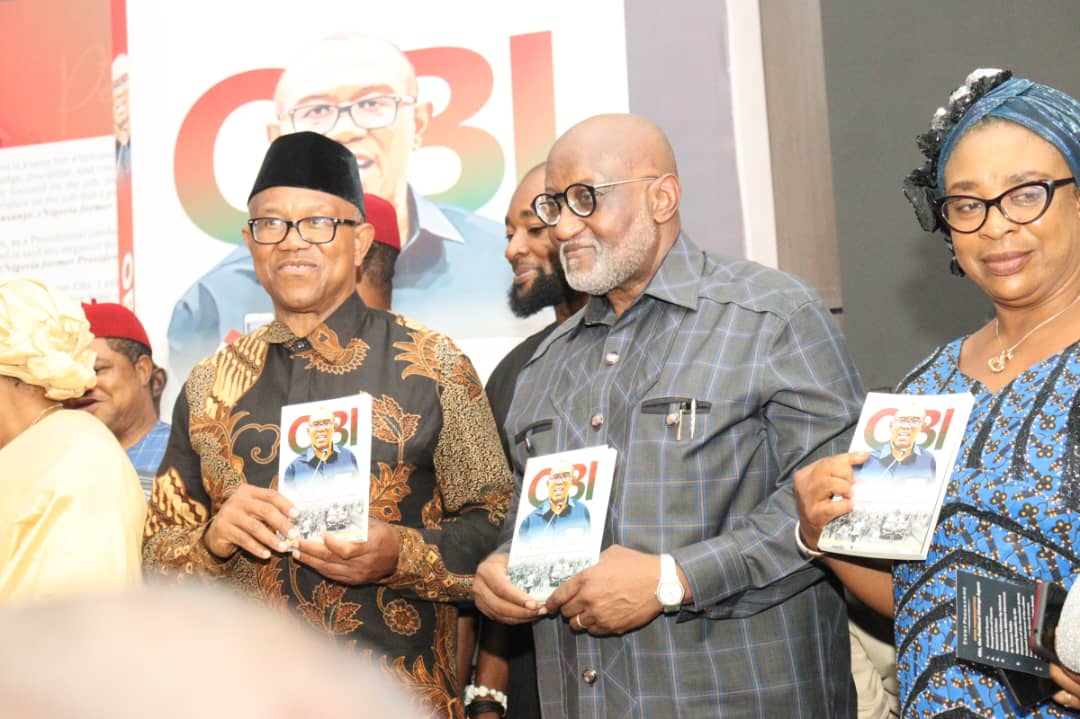
    At the NAF Center Kado, Abuja FCT, Monday 10th June, 2025

    [Protocols]

    As conventional wisdom admonish us, “never judge a book by its cover.” But we are also told that “There is no friend as loyal as a book.” My favorite quote on books is the one by Jeanette Winterson, which says “Books and doors are the same thing. You open them, and you go through into another world.”  I sincerely hope that today we will present a book, which will serve as an open door to closed minds.

    By June 2025 – a span of three years from May 2022 – when Peter Obi became the presidential candidate of the Labour Party, no less than fifteen books have been published on his foray into Nigeria’s political space. Many observers consider that three-year span as a redefining era in Nigeria’s electioneering and partisan politics.

    The book being presented today, Obi: The Political Change Agent -The story of the man, who changed the face of electioneering in Nigeria, is yet another brick in the wall of a fast growing historical record on Peter Obi’s brand of politics.

    As the book’s title suggests, Peter Obi is by every adjectival qualification, a political change agent in Nigerian politics.  He is also an adroit competitor, in a marathon race that is far from over. So this literary work is about Peter Obi; but in the context of Nigeria, it is about the unheralded rise of Obidient Movement phenomenon between 2022 and now.  It is also about an unfinished business of nation-building, and renewal, and ultimately, a preface to the inevitability of a New Nigeria.

    The core value and potency of this book, is that is written from an insider’s perspective. Ike Abonyi, my friend and the author, has done a yeoman’s job. With a keen sense and eyes for details, he has done what adroit researchers and veteran journalists do best; render credible account of seminal events without embellishments.

    If per chance, you do not intend to read this book immediately, I will advise you to read the foreword by my brother, Dele Farotimi, in order to get the gist of this work.  Characteristically, Mr. Farotimi did a positively magisterial job, with some four hundred insightful words. He concluded with his non-hesitant recommendation of the book, “to scholars of Nigerian politics, elections and society.”

    According to Farotimi, “Obi represents an anomaly in Nigeria’s political landscape; a politician who genuinely desires to work for the betterment of society…Peter Obi is a politician unlike any other in Nigeria.  Ike Abonyi’s work looked at the campaign and organic growth of the Obidient Movement and how Peter Obi’s candidacy has rewritten the manual for future aspirants to public office.”  To that very candid summation, I will only add that any book about an enigmatic personality or an icon is worth reading and owing.

    For the sake of brevity and convenience, I am minded to dispense with the formality of the book’s nomenclature, before delving further into its substance and flourish.

    The book, Obi: the Political Change Agent consists of 252-pages, and twenty-six stand-alone compact chapters. Each chapter, adapted from original real-time op-eds and essays, details Peter Obi’s odyssey from the juncture when he ventured into Nigeria’s political setting, through his uncharted trajectory to becoming the Labour Party 2023 presidential candidate on 30th May, 2022 and thereafter.

    I’ve only offered a synopsis of the structure of the book, to get the full gist or chapter-by-chapter narration, please purchase a copy of the book. Now to the historical flourish of the work.


    ***********

    Chapter 1 is essentially a backdrop, and the condensed story of Nigeria’s return to participatory democracy, from 1999 to date.

    Chapter 2, x-rays the man Peter Obi, and captures his essence and bonafides via his abridged official biography.

    Chapter 3 is revelatory. It documents that fortuitous but life-changing encounter that took Obi into politics. It narrates how Peter Obi’s encounter with Professor Donald Jacob, the Dean of the Kellogg School of Management in the USA, altered his views on politics. Ultimately, the unforeseen outcome of that six-week executive course was his decision to go into politics. It’s a thought-provoking story.

    Chapters 4 and 5 encapsulate the Ojukwu and APGA factors; as well the Anambra governance revolution. Obi’s and sojourn in Anambra was not without its vagaries, but would have been utterly impossible without the overwhelming influence of the iconic Igbo leader, Chukwuemeka Odumegwu-Ojukwu, who was the leader of the All Progressives Grand Alliance (APGA).

    Chapter 6 and 7 surveys Obi’s Journey to the center and Obi’s political dalliance with the PDP.  This chapter speaks to Obi’s political movement from the state to the federal level after his successful tenure as Governor of Anambra State. The narration segues into the political leap that made him the running mate to Atiku Abubakar in the 2019 presidential election.

    Chapter 8 and 9 is a periscope of how Obi’s 2023 Presidential Journey begins and landed him in the Labour Party. It chronicles Obi’s encounter with the vicissitudes of Nigeria’s rotational national politics, unkept promises and his eventual divorce from PDP. The factors at play were mot mere imponderables as much as they were a manifestation of human foibles, political machinations and shortsightedness.

    Chapter 10 is about the birthing of the Obidient Movement. The chapter chronicles the emergence of the Obidient Movement in the nation’s political trajectory and how it impacted greatly on the polity during the 2023 electioneering.

    Chapters 11 narrate the already well-documented 2023 election intrigues by the INEC and the ultimate Judiciary ambush. This is one of the longest chapters in the book for obvious reasons; it captured all the election intrigues, the preparations from voter registration to election proper and the post-election drama.

    Chapter 12 is about ‘The Media and the Obi’s Politics.’ This chapter captures media involvement in Obi’s Presidential ambition and how the social and mainstream media played some significant roles in Obi’s politics. Some believed that Obi was a media hype that would fade away with time. They were wrong.

    Chapter 13, narrate the well-known folktale of Peter Obi’s “Madman” friend, affirming ultimately, that ‘all politics is local’. During his Presidential campaigns, Peter Obi frequently recalled how in his quest for adaptive leadership, he opened himself to learning from everybody. In that context, he often recalled how during his tenure as Governor of Anambra State, he got one of the best advices that helped him tackle very naughty security issues from a “madman.” The author corroborates the seemingly bizarre story, by seeking and finding the “madman.”

    Chapter 14 captioned ‘Anatomizing The Peter Obi Character’ offers an insight into varying perceptions of Peter Obi’s persona; Such perceptions are mixed and complex. Some people saw Obi is a stingy and difficult man to deal with, but to others, he is the prudent man, who detests corruption and extravagant living. To some, he was a quiet philanthropist. This chapter looks at his personality from these contrasting and eclectic perspectives.

    Chapter 15 is the author’s published rendition of Obi’s experience during his brief sojourn in PDP. He facetiously asked: “Obi in PDP; was a Celibate in the Whorehouse?” He surmised how Obi’s clean character and credentials meant nothing to some of the PDP leaders who were bent on frustrating him. This narration validates Obi’s frequently uttered contention that any foray into Nigerian politics was an entanglement with “pimps and prostitutes, not priests and nuns.”

    Chapter 16 and 17 titled ‘A Political Phenomenon Called Peter Obi,” is also another published op-ed by the author capturing the enigma in Peter Obi’s politics. The chapter segues to an analysis of ‘LP’s Obi and the Involuntary Campaigners.’ This article talks about how Obi campaigners emerged involuntarily after hearing his disarming messages on how to create a new Nigeria, with his “Go and verify” and “consumption to production” and “a New Nigeria is Possible” Mantras.

    Chapter 18 & 19 are respectively titled “How Obi-phobics Chased the Wind” and “As Campaigns Flag off, it’s Obi…kererenke.”  These chapter mirrors and juxtaposes the twin developments of dislike and, like, hate and love, ignominy and fervor Obi candidacy elicited nationally. It synoptically captures the futility of the quest by Obi’s political traducers, who embarked on a massive search for something negative about him, but failed woefully. On the flip side was the fervent mob like national support during the same period as Obi’s campaign flagged off, to endless chants of ‘Obi…kererenke’. Rather than the unfolding of scandals, that zeal would eventually transform into the electrifying campaign mood that was replete with various campaign songs and slogans that dominated the political space.

    Chapter 20: captioned “OBI’s quest for Justice and Repetition of History,” recalls how Obi has always been treated unjustly since he entered politics and how he has continued to seek Justice undauntedly via legal redress.

    Chapter 21 tackles the very sensitive issue of ethnified politics and the costs and challenges of being Igbo impacted Obi’s and candidacy. It further explores how that negative narrative was used derogatorily to douse Obi’s potentials.

    Chapter 22 highlights the use of political trolling and fake news to demarket Obi. One such instance was the allegation that as governor, “Obi demolished Mosques.” This chapter captures endless calumny, some blatantly religious against Peter Obi during the campaigns. But as it turned out he actually built a mosque and had fantastic relationships with Muslims in his state during and after leaving office.

    Chapter 23 captioned “Peter Obi, the Opposition’s Talking Drum,” documents Obi’s involuntary post-election role after being manipulated out of the presidency in the 2023 polls.  The intention, as the author averred was to frustrate Obi and force him to quit the political stage. Instead, Obi chose to keep playing a proactive role from the opposition desk, becoming as it were the opposition’s vanguard. It was not to be an easy task; but Obi has remained undaunted.

    Chapter 24 is captioned “Can the Labour Party Go Far Without the Obidients?” The chapter grapples with the evidential hesitance of the Labour Party leadership to fully embrace the efforts of the Obidients Movement by bringing its structure in its fold. It wonders what will become of the Labour Party without the Obidient Movement and Peter Obi and his numerous supporters. The answer as the famous song says: ‘Is blowing in the wind.”

    Chapter 25 is titled “In Whose Interest Is Soyinka’s Obidient-Phobia?” Nigeria’s literature icon, Nobel laureate Professor Wole Soyinka, known for his progressive position on issues, has strangely been at the forefront in the campaign against Peter Obi and the Obidients. This chapter examines what may have caused his shocking position and volte face.

    Chapter 26: “Obi on Marble” is a glossary of some of the many quotable quotes of Peter Obi. Most of these became the political refrain for his legion of followers. Their inclusion aligns well with historical records, for which the book is meat to amplify.

    ***********

    If this book offers one unique essence, it is that in politics and governance, we must continue to use history in our decision making. The utility of history remains ever pertinent. As such, any book such as this, which offers a glimpse into history in the making, ultimately adds value to our politics, our history and our decision-making processes.

    In the 25 years of uninterrupted democracy in Nigeria, six consecutive presidential elections were held in 1999, 2003, 2007, 2011, 2015, and 2023. The 2023 elections perhaps, stand out the most. It was a redefining moment. Like most presidential elections –except that of 2015 – the 2023 elections ended up in litigation and was eventually decided; by the Supreme Court.

    In 2023, Nigerian youths, were sufficiently incentivized to play a role in politics. Peter Obi was the catalyst to that foray. It was he who instigated, exhorted and encouraged Nigeria youths to “take back their country”. Even though the outcome of the 2023 election fell far short of expectations in reflecting the desire of Nigeria voters, the unprecedented landmark electoral awareness remains memorable.  This huge change in our electioneering mindset and modalities will forever be attributable to one political character; Mr Peter Obi the former Governor of Anambra State, and the 2023 Presidential flag bearer of the Labour Party.

    Unwittingly, Obi’s unheralded presidential candidacy –in and by itself, an instrument of soft power- gave Nigeria’s electioneering process a new image, impetus and colouration; focusing as it were on issues designed to turn the country away from her dysfunctional economic fixation of “consumption” and channel that inclination to “production.”

    His issues-based campaign had focused on poverty alleviation, economic growth, job creation, educational reform, efficient healthcare delivery, and anti-corruption mode and mindset. His advocacy for broad policy shifts, enjoyed unprecedented support from many discerning minds and gained significant support among young Nigerians, who saw him as a fresh face and an alternative to the traditional selfish and corrupt political elite. Indeed, Obi even made cutting cost of governance sexy and attractive.

    But trying to dislodge the entrenched system was never going to be a walk in the park. Peter Obi was aware of this and so too, were his followers. Thus Obi faced stiff competition from established political parties, candidates, and critics, who initially took him for granted and questioned his ability to win a national election. Indeed, a ranking politician had characterized Peter Obi and the Obidients as largely “effervescent” – a phenomena that would blow away with time. He was wrong. He had since changed his mind and said so publicly.

    Despite the challenges he encountered, Obi’s candidacy generated significant interest and enthusiasm, particularly among Nigerians seeking real change. And despite the fervour and commitment, the eventual outcome of the 2023 presidential elections was not what Nigerians hoped for; but the outcome was also not totality unexpected.  Like most of the prior presidential elections, the Courts would eventually decide who became president, regardless of public opinion and the electoral evidence presented.  This proved the cliché that “the law is an ass.”

    As the author rightly surmised, the political fervour ignited by Obi is still flaming. Nigerian youths appear through Obi’s prompting to have discovered their potential and are not letting go. Consequently, Nigerian youths are now at the center of a struggle to reset Nigeria under the Obidient Movement that has become the platform for the inevitable discovery of a New Nigeria.

    ‘Obi: The Political Change Agent’ the story of the man who changed the face of electioneering in Nigeria, is politically enriching as it captures the historical background of our democratic struggle and offers various insightful perspectives on the different administrations since 1999. This work is a well-researched by an experienced journalist who has been part of Nigeria’s political trajectories. The book captures profusely our contemporary political journey for 25 years with all its vagaries, upheavals and proclivities.

    Written in very easy-to-read prose and elegant language, I find this book very enriching for any inquisitive mind; and for anyone who desires to know more about Nigeria’s uninterrupted two and half decades of the democratic journey. It offers unvarnished insight into how the issues-driven campaign messages by Peter Obi helped to revolutionize and compel Nigerian youths to discover themselves and prepare for the inevitable and proactive role they must play in nation-building. For Nigerian youth’s Peter Obi’s “take back your country” was not just a slogan, it was a clarion call that resonates till this day.

    Political campaign books are usually about train wrecks and triumphs. Most are about introspection and retrospective reconstructing of issues that mattered or played out. Obi: The Political Change Agent is none of these. It is straightforward recording of events as they happened.

    Oftentimes, political campaign books, historical books and memoirs are richer because they include or reveal snippets of undisclosed confidential discussions or events. From my vantage point as a 2023 presidential campaign insider; perhaps two yet undocumented remarks relative to the 2023 elections remain vital.  While visiting Kaduna on 17th October 2022, Sheik Ahmed Abubakar Gumi told Peter Obi, “Even if you don’t win, beyond the 2023 elections don’t let the Movement you have started to end”(p237). I believe Gumi was speaking of the Obidient Movement. He may be clairvoyant.

    The second was what President Muhammadu Buhari told Peter Obi on 22 October 2022: “From what I read in the newspapers, Nigerians, especially the Nigerian media like you. You may not win this particular election, but age is on your side. I tried four times before I finally won.”  I’m certain both messages have stayed with Peter Obi. Both, I believe, will instinctively undergird the inevitability of a New Nigeria that is Possible.

    If this book has any shortcoming, it is not out of dereliction or inattention. Besides the protagonist, the book does not hap on the role of other key campaign dramatis persona. It does not for instance delve deeply into how the choice of Labour Party over the Social Democratic Party was made, or how the Vice-Presidential Candidate was selected over the other possible and probable candidates.

    Finally, I recommend this book for academic work, politics, and leisure reading; and to political party managers. This book will be an integral part of any serious library and an invaluable reference material for anyone sufficiently passionate about political and governance reforms Nigeria.

    I thank you all for your kind attention.

  • 2023 Election: PSC declines tenure extension for retiring officers, requires their exit

    Ahead of the February 25 presidential election, the Police Service Commission (PSC) says those police officers due for retirement must exit the service.

    In a statement on Tuesday, PSC spokesman, Ikechukwu Ani, said the commission will not extend the tenures of the retiring senior police officers.

    According to him, all existing laws, the Police Act, PSC Act and the constitution of Nigeria constrain the Commission from elongating the tenure of retiring senior police officers.

    “The Commission took a decision that it will not extend the tenures of the retiring senior police officers, stressing that even when requested, it cannot do so as it is against all existing laws, Police Act, Police Service Commission Act and the Constitution of the Federal Republic of Nigeria,” Ani said.

    He assured Nigerians that there is an institutional succession plan in the Nigeria Police Force, especially with the current injection of 10,000 Constables and several other thousands of cadet Assistant Superintends of Police (ASPs) from the Police Academy every year.

    Following a management meeting on Monday, Ani stated the ongoing campaign for the extension of the tenures of some Deputy Inspectors General (DIGs), Assistant Inspectors General (AIGs), Commissioners (CPs), and other senior police officers is unnecessary.

    He described it as an affront to all existing laws in the country guiding entry and exit in the public service.

    “The Commission assured Nigerians that there will be no vacuum in the hierarchy of the Police with the touted retirement of hundreds of senior police officers.

    “It took a decision to rigidly uphold the provisions of the law which stipulates that a serving public Officer, whether in the Police or in any other government agency, must exit the service at the age of 60 or having served for a period of 35 years.

    “The Commission said it would not encourage the subversion of the laws guiding entry and exit in to the Nigeria Public Service, adding that the retiring senior Police Officers are not indispensable and that their exit would not in any way or manner affect the success of the 2023 general election,” he added.

    (Channels)

  • 2023 General Elections: PDP urges UN to guard against manipulation

    2023 General Elections: PDP urges UN to guard against manipulation

    The People’s Democratic Party (PDP) has called for the United Nations (UN) continued support of Nigeria’s electoral system and closely monitor the 2023 General Elections against any form of manipulation.

    The party’s acting Chairman, Amb Umar Damagum, made the appeal while receiving a team of Special Representatives of the United Nations (UN) Secretary-General, led by the Head of the UN Office in West Africa and the Sahel Region (UNOWAS), Ahmad Annadif, on Tuesday in Abuja.

    Damagum, the party’s Deputy National Chairman (North), said that the UN and international community placed importance on the conduct of the 2023 General Elections in Nigeria.

    He urged the UN to advise INEC to ensure that the 2023 General Elections were credible and transparent.

    “UN Development Organisation is one of the organs that ensure that things are done rightly and that is why it plays important role in the conduct of 2023 General Elections.

    “We need your support to ensure that INEC is truly an election umpire.

    “There are a lot of reforms that have taken place which will be put to test in this coming elections.

    “We hope with the signing of the new Electoral Act, those reforms will alleviate some of our fears in the coming elections,” he said.

    Damagum, who commended UN interest in the stability and development of Nigeria, said that the country could not afford any form of electoral violence.

    He expressed hope that APC would emulate PDP by accepting defeat and peacefully handover power if it did not win the 2023 General Elections.

    “We hope they will continue to see Nigeria as one of the uniting factors on the continent so that we continue to lead by example.

    “We have been doing so since the coming of democracy in 1999 and we will continue to do so.

    “We will continue to do our part as an opposition party. You also have to continue to do your part to ensure that things are done rightly.

    “You can do that in advisory form or any other form in which you have been doing it,” Damagum said.

    Also at the meeting, PDP Deputy National Chairman (South), Amb Taofeek Arapaja, urged the UN to roll out its punishment for anyone who might want to disrupt the 2023 general elections in Nigeria.

    He urged the UN to pay keen interest on issues of vote-buying and conduct of security personnel during the 2023 general elections.

    Arapaja said that the recently conducted governorship election in Ekiti State was characterised by vote-buying, adding that the people should be allowed to make a free choice in an election without any money inducement.

    “A situation where people cannot change the situation they do not like is what we do not want,” Arapaga said.

    In his remarks, the party’s National Publicity Secretary, Mr Debo Ologunagba, urged the UN to pay particular interest to the peace of Nigeria as the 2023 general elections approach.

    Ologunagba urged the UN to work with the country to ensure no electoral violence was recorded during the 2023 general elections.

    He said that with the huge population of Nigeria, any electoral violence that could lead to mass emigration of Nigerians to other West Africa and the Sahel countries would have untold effects on countries in the sub-region.

    In his remarks, Annadif said they were on an official visit to Nigeria.

    As you are all aware, Nigeria has important roles in the development and stability of the Africa and Sahel region.

    As you are aware and as we will be conducting general elections in 2023, there are security challenges in the sub-region.

    Nigeria has stability role in West Africa and Sahel region. That is why Nigeria is a concern to us.

    We have met with politicians and key actors in Nigeria. We have met with INEC and CSOs, IPAC APC, and diplomatic corps in Nigeria.

    The UN and all international communities hope and wish Nigeria conduct a credible and peaceful election that would contribute to the stability of the region.

    This is why we are doing this re-election need assessment visit to see how we can contribute to the peaceful and credible elections in Nigeria.

    (Sun)

  • 2023 Presidential Election Amidst Crippling Inflation Crisis and Devaluation of the Naira

    2023 Presidential Election Amidst Crippling Inflation Crisis and Devaluation of the Naira

    By Ikenna Igwe

    For the most part in Nigerian politics, candidates have been known to play the identity politics game, where the focus is largely on ethnic affiliation, political parties and defacement of an opponent’s name and reputation. We hardly see election candidates debate on things in the line of a sustainable economic goal.

    In July 2009, Boko Haram stared its insurgency against the Federal Republic of Nigeria and since then, the major national issue has been the case of Insecurity and rightly so, but with the dollar at 450 as at 30th May 2022, inflation eating up the value of the Naira, poverty becoming the reality of many Nigerians and essential commodities becoming even harder for the average Nigerian to get, big economic questions have been asked of the government and as the general election is approaching, the majority of the populace have tossed out party affiliation and ethnic difference. Financial experts have cited the need for diversification of the economy. As things stand currently, the GROSS DOMESTIC PRODUCT(GDP) is too low for a country of the size and population of Nigeria. Exchange rate of the dollar and other foreign currencies have made the economy more volatile and the country almost at risk of another recession.

    And If there is anything Nigerians want to understand so badly, it is why and how exactly the same amount of money tends to be able to buy less and less than it used to be able to buy just few months ago. Prices of commodities keep rising without any corresponding rise in wages or income. The process and cause as to why a currency might lose its value and purchasing power is what majority of the populace don’t understand.

    Economists and Financial analysts always focus on inflation as the major reason why a currency over time tends to lose its value and purchasing power. In this piece, we will understand the basics as regards to inflation, the causes, the control measures and its impact on the whole economy.

    UNDERSTANDING INFLATION

    Inflation is the upward movement in the average price of general goods and commodities. A rise in inflation means an increase in the overall cost of living.

    Inflation affects your ability to purchase goods and services, making them costlier over time. For example, a crate of egg sold for 900 naira in March rose in May to 1350 naira, that is essentially a 50% increase in the cost. Similar prices rose across various other commodities such as milk, bread, oil, petrol etc .This simply means that people tend to spend more to buy for less. Inflation largely occurs when an economy grows due to increased spending without any accompanying increase in the production of goods and service.

    When this happens, prices rise and the currency within the economy loses its value and when it loses worth, its exchange rate weakens when compared to other currencies. However this depends on whether other countries are inflating less than yours; this is a key point because if they are inflating faster than your country, your currency will be strengthened against theirs.

    According to STATISTA, in 2022, Nigeria’s inflation rate reached 16.1%. As at March 2022, the inflation rate in the urban area of Nigeria grew by 16.44% compared to the prior year, while the rural inflation rate experienced an increase of 15.49%.

    Experts recorded Nigeria as one of the highest inflated economies in the world in 2020 and no wonder, for a country that relies heavily on importation, the impact of the Covid-19 pandemic affected the economy harshly because exporting countries were essentially on lockdown. As the economy was in recovery against the impact of the pandemic as at the end of 2021 and the beginning of 2022, the prices of petroleum products such as diesel increased sharply. Putting into account the Russia-Ukraine war, the stability of oil prices is a long way and experts around the world are alerting the public to prepare for more heavy hit on oil price.

    IMPACT OF INFLATION ON THE ECONOMY

    Human beings tend to see everything around it in twos-either good or bad. In most cases, this is not actually the whole truth. Something can be good and only becomes bad when it is out of control. That is the case with inflation.

    Sometimes, inflation is good for the economy. Mild inflation has a healthy side effect. Once people start to expect inflation, they spend now rather than later because they know prices will be higher in the future and you know that consumer spending is what drives economic growth. In fact the federal reserve sets an inflation target, they expect a healthy core inflation rate of at least 2% every year. The Central Bank wants a little inflation which also leads consumers to believe prices will continue rising and this triggers spending.

    For consumers, inflation means filling up gas cylinders, stocking up food stuffs and bucking up the cupboard with essentials.

    For businesses, it means making CAPITAL INVESTMENT that under different circumstances might be put off until later. For some it means to buy Gold and other precious stones in order to hedge them from inflation.

    Unfortunately, the urge to spend and invest in the face of inflation tends to boost inflation, in turn creating a potentially catastrophic feedback loop. As people and businesses spend more quickly in an effort to reduce the time they hold their depreciating currency, the economy finds itself awash in cash no one particularly wants. In other words, the supply of money outstrips the demand and the purchasing power of the currency falls at an even faster rate.

    The frequency at which this is happening is what results in a case of HYPERINFLATION, which was seen in Zimbabwe [2000s], where consumers were known to be hauling around wheelbarrow loads of millions and billons of “ZIM DOLLAR” notes. That is the same with Venezuela [2010s], where thieves were practically refusing to even steal their local currency, the “BOLIVARES”, and this is essentially what brought about the destabilization of Germany in the 1920s where the inflation rate rose up to 29,525% in one month.

    As the case of inflation is growing around the world and in Nigeria more so, it is paramount that the government and other regulatory bodies in the country put in place control measures on how to curb this trend.

    CONTROL MEASURES TO CURBING INFLATION

    It is the major responsibility of the government and different financial agencies to control and regulate inflation. There are two major ways governments regulate and curb inflation in its economy.

    -Contractionary Monetary Policy: This has to be the most popular method used to control inflation. The goal of this policy is to reduce the MONEY SUPPLY within an economy by decreasing the price of government ‘TREASURY BONDS’ and increasing the ‘INTEREST RATES’. Decreasing the price placed on Treasury Bonds is meant to encourage citizens to buy government bonds which helps in reducing the money in circulation. Removing as much money from the public hands is the goal of this control measure. Increasing the interest gain on bonds is meant to encourage more investors to buy.

    These are all ways employed to essentially reduce the liquid cash in the economy. Calling in debts that are owed to government are all geared towards collecting money from the public and give to government who tries to regulate the cash flow.

    Policies that mandate banks and other financial agencies to increase its interest on loans are all engineered towards ensuring that people borrow less and spend less. As the news of increasing price of commodities have been all over the news, we have seen several countries hike their interest rates in order to curb inflation.

    The Reserve Bank of India (RBI) raised their interest rate to as high as 4.4% for the first time in two years. With US inflation at a 40 year high, the US Federal Reserve raised its interest rate up by 1% and with the rate of inflation still soaring high, further hikes are expected. The Reserve Bank of Australia (RBA) announced on 4th May, 2022, that it had lifted its cash rate to 0.35%, a move designed to combat rising inflation, which is at a 21 year high.

    According to a report from the BBC, The Bank of England warned that inflation in the UK would be over 10% by the end of the year, something not seen since 1982.

    In Nigeria, the Central Bank of Nigeria, on 24th May, 2022, jacked up the bench market interest rate to 13% from 11%, the first change in almost a year and the first hike in six years.

    CBN Governor, Godwin Emefiele, at the Monetary Policy Committee’s (MPC) 142nd meeting said that the action of increasing interest rates was geared towards taming the rising inflation rate in the country.

    -Reserve Requirement: Another effective tool used is to increase the reserve requirement on the amount of money banks are legally required to keep on hand to cover withdrawals.

    The more money banks are required to hold back, the less they have to lend consumers, which will decrease spending and by a huge margin reduce the direct impact of inflation. The CBN by regulation mandates bank to deposit up to 30% of their total capital as CASH RESERVE REQUIREMENT(CRR). Funds deposited are not accessed by the banks for loans and advances. It is noteworthy that Nigeria has the highest reserve requirement in Sub Saharan Africa. South Africa, Kenya and Ghana all have CRRs of below 10% . The CBN Governor, Godwin Emefiele, admitted that the high CRR was part of efforts to curb excess liquidity in the banking system and check inflationary pressure.

    CONCLUSION

    As the general election is fast approaching, the need for Nigerians to place issues regarding the sustainability of the economy at the forefront is so important, because we can’t get it wrong with another administration in power. Let’s do away with ethnic bias and party affiliation over everything else but rather look for competency and integrity.

    The importance of exporting more and having a larger stack in another country’s economy cannot be overemphasized because that is the most effective way to strengthen the Naira against inflation or devaluation. This is a call for the country’s central bank to enact a functioning monetary policy that will curb this growing rate of inflation.

  • Fayemi to formally declare 2023 presidential bid Wednesday

    Fayemi to formally declare 2023 presidential bid Wednesday

    The Ekiti State Governor, Kayode Fayemi, will formally declare his 2023 presidential bid on Wednesday in Abuja.

    The governor’s Chief Press Secretary, Yinka Oyebode, confirmed this in a statement on Tuesday in Ado-Ekiti.

    He said the declaration dubbed: “Unveiling My Nigeria Agenda,” will put to rest concerns about whether or not his principal will vie for President next year.

    The state’s Commissioner for Finance and Economic Development, Hon. Akin Oyebode, had earlier revealed Fayemi’s intentions in a video posted on his Twitter handle on Tuesday.

    He said: “The Nigeria of our dream is possible, a Nigeria that is the pride and joy of all, among others.”

    The development has swelled the number of presidential aspirants from the South-West vying for the All Progressives Congress (APC) ticket with Vice President Yemi Osinbajo and the party’s National Leader, Bola Ahmed Tinubu, the leading cast.

    The other presidential aspirant from the region is the former Ogun State governor, Ibikunle Amosun.

    The ruling party will hold its presidential primary on May 30.

    (Ripples)

  • 2023 Presidency: It’s shocking South West, South South aspirants in race against South East –Kalu

    Chief Whip of the Senate,  Dr. Orji Uzor Kalu, has expressed shock at the number of presidential aspirants from the South West and South South geopolitical zones when equity and justice demand they should be supporting the South East for the presidency.

    He said the right thing to do, as political parties are on the verge of picking their candidates, is for the governing All Progressives Congress (APC) and the Peoples Democratic Party (PDP) to zone their presidential tickets to the South East, which remains the only zone in the South that has not produced the president and vice president since 1999.

    In a statement entitled, 2023 Presidency: The Fairness I Know,” Kalu said although he wants to contest, he would not do so except the APC zones the ticket to South East.

    He said in the absence of zoning to South East, he would seek reelection to the Senate as “the reality is that the North is more advantageous to win elections in this democratic setting.”

    Expressing disappointment that people from South West and South South are jostling for the presidency, after their zones had produced presidents and vice presidents, Kalu said it was “embarrassing that these aspirants (APC and PDP) have no single respect and concern for the South East. I had thought they would think about the South East; I thought they would support us.”

    The former governor said if there was anything like fairness, equity and justice, “it should be the entire South pushing for a president of South East extraction. Anything less than that is ‘hypocritical, unjustifiable and inordinate.”

    He said that there was no difference between South West, South South politicians running to the Presidency at this time and northerners contesting for the position, stating: “What moral justification does a Southerner who refused to be fair to his brothers have against a Northerner running for president? It will be very insensitive, unreasonable and disrespectful for any Southern man to criticise a presidential aspirant from the North on the ground that the North has done eight years and power should return to the South.”

    He thanked elderstatemen, Pa Ayo Adebanjo, Chief Edwin Clark , Deji Adeyanju and a host of others “who have stood firm in their support for their brothers in the South East, posterity will be kind to you.”

    Kalu’s statement reads: “It’s my desire and intention to run for the Presidency of the Federal Republic of Nigeria. I am committed to this pursuit, but I can’t make an official declaration to this regard  without the full support of other regions.  Everywhere in the world, politics is situational and that of Nigeria is exceptionally situational.

    “The situation in Nigeria is that without the support of other regions, it would amount to a shadow chase for a South Easterner to be president. This is the reason I have been in the frontline of the call that the two major political parties, APC and PDP, should zone their presidential tickets to the South East as they did for the South West in 1999. In the absence of this zoning, I shall return to the Senate and stay away from the presidential contest. The reality is that the North is more advantageous to win elections in this democratic setting.

    “I am even shocked with the number of aspirants coming from the South West and the  South South . It is embarrassing that these aspirants (APC and PDP) have no single respect and concern for the South East. I had thought they would think about the South East; I thought they would support us. The amount of money being spent by these aspirants is alarming and they have forgotten that money alone cannot buy the presidency.

    “It has become a joke to an ordinary Nigerian who hears  southern commentators and aspirants rooting for a southern president on the premise of fairness, equity and justice. How can you talk about these morals when you are not even fair to your own brothers?

    “If there is anything like “fairness”, “equity” and “justice’’, it should be the entire South pushing for a president of South East extraction. Anything less than that is “hypocritical”, “unjustifiable”and “inordinate”.  Some persons are even claiming God’s anointed choice  in 2023. Unfortunately, it is not all prayers that God answers; at least not inordinate ones.

    “What moral justification does a southerner who refused to be fair to his brothers have against a northerner running for president? It will be very insensitive , unreasonable and disrespectful for any Southern man to criticize a presidential aspirant from the North on the ground that the North has done eight years and power should return to the South.

    “The South West and the South South have successfully completed their tenures as ‘President and Vice President’.They should have the courage to support their brothers from the South East. If the next president after President Muhammadu Buhari does not come from the South East , there would be nothing unfair and unjust if he/she comes from Daura.

    “This country belongs to all of us and the unity of the country should be paramount . If not for selfishness and greed, how can you say that where a president comes from does not matter simply because you don’t want to support a president of Nigeria from the South East, but turn around to clamor for a power shift to the South? How do we explain this to the younger generation?  Let the wise and courageous stay firm on their convictions and not swing on the two sides of the Atlantic .

    “If you are convinced that where a president comes from does not matter, let Nigerians not hear you clamour for power shift. Be brave to encourage everyone to run , including President Buhari’s kinsmen. But if you have conscience and believe in equality, then you should support the South East region that is yet to produce a president. That is what I consider as fairness .

    “The two regions that are yet to produce a President are South East and North East. If this means anything to Nigerians, the APC and PDP should be fair enough to prioritize these regions. If power should come to the South and not the South East or North and not the North East, the essence for which the six geopolitical zones were created is long dead.”

    (Sun)

  • We must salvage Nigeria or perish, Obi warns

    We must salvage Nigeria or perish, Obi warns

    Former Anambra State governor and 2023 Peoples Democratic Party (PPD) presidential aspirant, Peter Obi, has observed that unless critical decisions and actions are taken by Nigerians, the country is headed for a deep crisis.

    He made the observation during a meeting with Ekiti State PDP stakeholders and delegates, yesterday, in the course of his consultation processes on the need to choose the right candidate for the party.

    He noted that the economic crisis besetting Nigeria is humongous, warning that the country may go under if not properly managed and decried the high level of insecurity in the country, attributing it to the poor state of economy

    The former governor lamented the high rate of unemployment, unstable education sector and deplorable infrastructure in the country and remarked that the challenge is how to pull the country out of its current crisis. He bemoaned the high incidence of borrowing by the country, without much to show for it.

    He vowed that his commitment is to move Nigeria from a consumer society to a productive nation. The first step in this regard, he said, is to cut the cost of governance.

    Obi asked Ekiti delegates not to be swayed by material or primordial considerations at the national convention but do due diligence on those seeking their votes to know if they have the capacity and vision for the job. He warned that Nigeria would continue to lose with the present sharing culture, adding that his mission is to halt the trend.

    In his address, state Chairman of the party, Lanre Omolase, lauded Obi for the good record he set while as governor of Anambra State. He described Obi as one of the best the party can offer for the presidency.

    Earlier, the former Ekiti State governor, Ayo Fayose, had met with Obi where they discussed many challenges faPresident Muhammadu Buhari has described the explosion that rocked an illegal crude oil refinery in Abaezi forest in Ohaji-Egbema Local Government Area of Imo State as a national disaster,.

    He, therefore, directed the armed forces, security and intelligence agencies to intensify clampdown on illegal refineries following reported deaths of tens of people in the disaster.

    According to a statement by his Senior Special Assistant on Media and Publicity, Garba Shehu, Buhari said responsibility for the loss of lives and property must squarely lie with the sponsors of the illegal refinery, “who must all be caught and made to face justice.”

    Conveying his condolences and the full depth and range of the nation’s shock and trauma, to the families of the victims, the Ohaji Egbema community, and the government and people of Imo State, the president urged community leaders, the police, and the secret service not to allow occurrence of the heart-breaking incident in any part of the country again.cing the nation.

    (Sun)

  • UN expresses anxiety over preparation for 2023 election

    UN expresses anxiety over preparation for 2023 election

    The United Nations (UN) has expressed anxiety over preparations for the 2023 general elections in Nigeria.

    The worry of the world body was among the issues discussed at a meeting in Abuja, yesterday, between the delegation of the UN Electoral Needs Assessment Mission and 18 political parties under the umbrella of the Inter-Party Advisory Council (IPAC).

    Leader of the UN delegation and head of Mission, Serge Gakwandi Kubwimana, said the team was in Nigeria to interact with stakeholders and assess the level of preparation for the 2023 general election.

    This, he said, would enable the UN electoral needs mission to identify areas to provide support to Nigeria.

    Kubwimana, who drew attention to the problem of voter apathy noticed in previous elections in Nigeria, said the delegation would confer with members of the National Assembly, security agencies and the political parties on the challenges envisaged.

    He explained that the UN Electoral Needs Assessment Mission renders technical assistance by strengthening the capacity of relevant organs for the election. This is even as he said Nigeria was quite experienced in electoral matters and had introduced some reforms in the electoral process.

    Kubwimana said t the UN would always assist African countries in strengthening electoral processes in order to deepen democracy.

    “We are here as a mission in response to a request for electoral assistance by INEC chairperson and even going to governmental organisations elections being a high stake process and a matter of national sovereignty.”

    He said the team targets meeting with other key stakeholders,especially within the government, its institutions, civil society organisations and alike “to assess the overall context in which the elections will take place.

    “Again, these not are specific to Nigeria, the UN is moving close to 60 countries currently and then in doing so, so assessed the needs and the areas where the UN could best provide some type of support.”

    In its response, IPAC advocated the scrapping of state electoral commission.

    Its National Chairman, Yabaji Sani also demanded the autonomy of the 774 local governments.

    Represented by the National Secretary, Yusuf Dantalle, he said: “Primarily we are concerned with the scrapping of the State Independent Electoral Commission. So, we need you to send our message to the appropriate authority using their office to influence the lawmaking body in Nigeria to ensure we have an enabling environment for full participation of Nigerians in the electoral process. IPAC supports local government autonomy as the third tier of government closest to the people.”

    IPAC assured that the body would address the problem of voter apathy by carrying out massive sensitisation, advocacy, enlightenment and mobilisation of the electorate at grassroots level across the country.

    He called on the UN Mission to assist Nigeria in capacity building of political party leaders to equip them for transformational leadership and enhance parties’ internal recruitment process which will produce credible leaders with the people’s mandate to govern.

    IPAC said it would counter the apathy by embarking on massive sensitisation, advocacy, enlightenment and mobilisation of the electorate at grassroots level across the country.

    (Sun)

  • I’ll tackle insecurity, ailing economy if elected president – Wike

    Rivers State Governor, Nyesom Wike, has vowed to expeditiously tackle the festering security and economic challenges facing Nigeria if elected president.

    Governor Wike maintained that at this critical juncture, the country desperately requires a leader with political will and courage to decisively end the scourge of insecurity and revive the ailing economy.

    He made the pledge while addressing Peoples Democratic Party (PDP) delegations from Borno and Yobe states in Maiduguri, the Borno State capital, yesterday.

    He observed that in the past seven years, the security and economic situations in the country had deteriorated due to the incompetence of the current All Progressives Congress (APC)-led Federal Government.

    He said: “I came here today, because there is a problem, and that problem is that Nigeria is dying and we must not allow Nigeria to die. We must rescue this country. So, I came as a Nigerian, a member of the PDP, a party I have never left since 1998 till now. A party I have worked for and will continue to work for.

    “And so, I want to vie for the presidency of this country on PDP platform. I came because I feel concerned, I came because I have no other country to run to and therefore, I have come to offer myself to solve most of the problems that this APC administration could not solve.

    “Before, people used to talk about insecurity in Borno State. Today, insecurity is all over Nigeria. Hunger does not know Muslim, hunger does not know Christian. Insecurity does not known Muslim, insecurity does not know Christian. Insecurity does not know North, insecurity does not know South. You need somebody who will have the courage to fight insecurity in this country and I want to tell you, I have that courage.”

    He advised the delegates not to be deceived by those who might want to use geopolitical and religious sentiment to influence how they would vote during the PDP convention.

    According to him, the socio-economic and security challenges bedevilling the country does not exclusively affect Muslims or Christians alone.

    “Nigerians are aware that everybody is suffering. Nigerians are aware people are dying. Muslims are dying, Christians are dying. Northerners are dying, southerners are dying. We need somebody that can stop all these and that is me.”

    Governor Wike accused APC leadership of covertly scheming against his emergence as the standard bearer of the PDP.

    According to him, APC leaders were afraid that if he clinches the PDP presidential ticket, that would mark the end of their grip on power.

    The governor commended PDP leader in Borno State, Mohammed Imam, for being a steadfast and dependable political ally.

    In his welcome address, Imam said he was one of the friends who purchased the expression of intent and nomination forms for Governor Wike, because they were convinced of his capacity to lead Nigeria out of its current socio-economic predicaments.

    Imam, who spoke on behalf of PDP delegates in Borno and Yobe states, decried the nonchalance shown by the APC-led Federal Government to issues of security that have crumbled business in the two states.

    “We, in Borno and Yobe, are business people. We are bordered with three countries; Niger, Cameroon and Chad. Your excellency, our people are businessmen.

    “On a daily basis, lots of people here can attest to that, over 2,000 trucks load of goods come out from Maiduguri market, cutting (taken) across these three Trans-Sahara regions that I’ve mentioned: Maiduguri, Banki-Bama to Cameroon, Lake Chad, Niger, up to Central Africa, Libya.”

    Imam also expressed grief over the level of devastation that their communities have suffered within the period because of the unrestrained marauding Boko Haram killers.

    According to him, despite their cries, there has not been meaningful response from the Federal Government.

    He said they were now looking up to Governor Wike who is a man of vision and courage to rescue Nigeria, guarantee safety to Nigerians and improve the economy.

    “We are peasant farmers, we don’t go to farm now. Our people cannot access their farms. In the Lake Chad, we are fishermen. Forty percent of the fish consumed in Nigeria and other Sub Africa states come from Lake Chad basin.

    (Sun)

  • 2023 Presidency: Northern group seeks support for Umahi


    A group under the aegis of Northern Organisation Umahi for President has lauded the aspiration of the Ebonyi State Governor, Dave Umahi, to lead Nigeria in 2023.

    The group code named its mission ‘Rescue Nigeria’, revealed that it began its move in 2021, precisely one year ago, adding that the candidate would ensure the transformation of the country to an enviable position.

    According to a press statement issued to journalists on Thursday, by the Coordinator, Modibbo Yahaya, their candidate has displayed impeccable character, worthy of trust to pilot the affairs of the country.

    The statement partly read, “We wish to welcome all crew members on board this vessel. The name of the vessel is ‘Rescue Nigeria’. It’s flying Umahi ’23 flag. We started constructing this vessel in January 2021.

    “We wrote to His Excellency, Dave Umahi, requesting him to vie for president. However, God has answered our prayers. So we decided to flag off the journey on 20th January, 2022.

    “We started from this harbor. We will be cruising all over, until when we get to our terminal, pray Allah will answer our prayers.”

    While explaining further the reason the group settled for Umahi, Yahaya stressed that the job of the president is one meant for credible persons, which their candidate exemplified.

    “We really need your cooperation. Our flag bearer is honest, reliable, trustworthy and a true nationalist. He is not sentimental either tribal, religious or otherwise,” the statement added.


    (Punch)

  • Enugu State 2023 Election: The next Governor should be based on Competence and Capacity and not Zoning


    Enugu Chairman of the All Progressives Congress (APC), Ben Nwoye, has raised the alarm that politicians particularly from the northern senatorial district of the state, were heating up the polity of the state.


    He said the next governor of the state will not be based on zoning and sub-ethnic origin but on competence, capacity and clear-cut programme that would better the lot of the people.


    Nwoye said goings on in the state far ahead of 2023 were huge distractions to Governor Ifeanyi Ugwuanyi whose second term was yet to go half way.


    Alluding to a recent large gathering of politicians from the Enugu North senatorial district, where speakers, including Chuka Utazi, boasted that Nsukka people would retain the governorship seat in 2023 after their son, Ugwuanyi, the APC chairman said such assertion was a careless statement capable of triggering crisis in the state.


    He described the staging of open campaigns in the state in the guise of cultural symposia and mini-rallies against the Independent National Electoral Commission’s (INEC) guidelines as an aberration.


    He warned leaders from the Nsukka zone to desist from making divisive and inflammatory statements capable of defining Governor Ugwuanyi as a clannish leader and not governor to all sections of the state.


    According to him, the average Enugu indigene is worried about good governance and how to survive the hard times and not really about who becomes governor in 2023.


    Source: www.sunnewsonline.com


  • Registration of new voters begins on 28th June -INEC

    INEC promises to ensure a safe and stress-free experience for Nigerians.


    Nigeria currently has just over 84 million registered voters, but has been struggling with a voter apathy problem [Sun News]

    Nigeria currently has just over 84 million registered voters, but has been struggling with a voter apathy problem [Sun News]

    The Independent National Electoral Commission (INEC) has announced that it will recommence the continuous voter registration (CVR) exercise on June 28, 2021.


    The commission’s chairman, Prof. Mahmood Yakubu, announced the new date at a media briefing in Abuja on Thursday, April 1.


    RECOMMENDED ARTICLES

    April fools? Mercy Aigbe says she’s engaged

    Entertainment


    April fools? Mercy Aigbe says she’s engaged


    APC extends nationwide membership registration, revalidation exercise by 3 weeks

    News


    APC extends nationwide membership registration, revalidation exercise by 3 weeks


    Buhari asks Senate to confirm Justice Abdullahi as FCT Chief Judge

    News


    Buhari asks Senate to confirm Justice Abdullahi as FCT Chief Judge


    Electricity supply in Lagos has gone from bad to worse, here’s why [Pulse Explainer]

    News


    Electricity supply in Lagos has gone from bad to worse, here’s why [Pulse Explainer]


    The nationwide exercise will be carried out for over a year until September 2022, just months before the 2023 general elections.


    Yakubu encouraged Nigerians that have turned 18 years old as of June 28 to turn out for the exercise and register to vote.


    Other categories of Nigerians to benefit from the exercise include registered voters who wish to change their voting locations due to relocation, and those who have damaged or lost their permanent voter card (PVC).


    Registered voters who have experienced previous accreditation issues, or want to correct their information, such as misspellings or dates of birth, are also encouraged to take advantage of the CVR.


    The exercise will be temporarily paused in Anambra State in August ahead of its off-cycle November 6 governorship election.


    Yakubu promised that INEC will ensure a safe and stress-free experience for registrants, especially with aid from improved technology.


    He noted that the commission will migrate from the old Direct Data Capture Machine (DDCM), used for the past 10 years, to the new INEC Voter Enrolment Device (IVED), which is based on an android tablet.


    Nigeria currently has just over 84 million registered voters, but has been struggling with a voter apathy problem.


    Only 34.75% of voters participated in the 2019 presidential election, and voter turnout as low as 3% has been recorded in legislative bye-elections conducted over the past few months.


    Attempts to pass an Electoral Amendment Bill to improve the dire situation has made little progress under the current government.


    Source: www.pulse.ng