Category: News

This is an optional category description

  • EFCC Arrests Five Katsina Internal Revenue Officials for Alleged N1.3billion Fraud

    EFCC Arrests Five Katsina Internal Revenue Officials for Alleged N1.3billion Fraud

    Operatives of the Kano Zonal Command of the Economic and Financial Crimes Commission, EFCC,   have arrested five officials of the Katsina State Board of Internal Revenue over alleged diversion of N1,294,337,676.53 (One Billion, Two Hundred and Ninety Four Million, Three Hundred and Thirty Seven Thousand, Six Hundred and Seventy Six Naira, Fifty Three Kobo) belonging to the Katsina State Government.

    The suspects are, Rabiu Abdullahi, Sanusi Mohammed Yaro, Ibrahim M. Kofar Soro,  Ibrahim Aliyu and Nura Lawal Kofar Sauri.

    They were arrested following a petition from the Katsina state government alleging that the suspects colluded and diverted the sum  of N1,294,337,676.53 accruing to the state from the World Health Organization, Medicins Sans Frontiers, Alliance for International Medical Action, ALIMA.

    Preliminary investigation by the Commission showed that Rabiu Abdullahi, a former Director of Collections of the Board and current Permanent Secretary of the Board authorized the opening of l a bank account in the name of ”BOIRS” at Sterling bank where he allegedly designated Sanusi Mohammed Yaro, Director of Revenue Account and Ibrahim M. Kofar Soro as sole signatories to the account. Subsequently, the account became the primary channel through which all the funds  were allegedly funneled to the main beneficiary NADIKKO General Suppliers, a company owned and controlled by Nura Lawal Kofar Sauri,  an Assistant Director of Career Skills/Staff Welfare of the Board.

    Investigation further revealed that Nura Lawal and his company  ”NADIKKO” became the principal conduits used to launder the stolen funds. These laundered funds were traced to the various bank accounts of the suspects.

    The suspects are currently being detained at the Kano Zonal Command of the EFCC.

    They will be charged to court upon conclusion of investigations.

  • Appeal Court president cautions judges on conflicting judgements

    Appeal Court president cautions judges on conflicting judgements

    The President of the Court of Appeal, Hon. Justice Monica Dongban-Mensem, has cautioned judges of courts with coordinate jurisdiction against delivering conflicting judgments.

    Justice Dongban-Mensem issued the warning during the commencement of the special sitting of the Court of Appeal in Enugu.

    She emphasized the importance of the rigorous conference process, where justices deliberate collectively on cases, noting that this practice will be strictly upheld under the leadership of the Chief Justice of Nigeria, Hon. Justice Kudirat Kekere-Ekun.

    “This approach guarantees consistency in our rulings, strengthening public trust in the judiciary,” she stated.

    She also urged legal practitioners to familiarize themselves with the Court of Appeal’s rules to ensure efficient court proceedings.

    The special sitting, presided over by Justice Dongban-Mensem, involved 15 justices from various divisions of the Court of Appeal, organized into different panels.

    These panels sat from January 6 to January 10, 2025, to hear and conclude 80 appeal cases in the Enugu Division, ensuring the swift dispensation of justice.

    Declaring the court open for the year, Justice Dongban-Mensem welcomed legal professionals and stakeholders, reflecting on her personal connection to Enugu, where she had previously served in 2003 and between 2019 and 2020.

    Justice Mensem emphasized the significance of the special sittings, noting that their purpose is to alleviate the court’s heavy case load and ensure the quick resolution of pending appeals.

    “Having served here, I am well aware of the workload in this division, and I understand the pivotal role that Enugu State plays as a commercial centre.

    “These sittings are designed to ensure timely hearings, bringing justice closer home for businesses and individuals,” she explained.

    During the five-day special sitting, 80 appeals were scheduled for hearing and determination.

    Justice Dongban-Mensem encouraged lawyers and litigants to take full advantage of the opportunity to achieve prompt resolutions.

    Commissioner hails appellate court’s commitment to improved justice delivery

    The Enugu State Attorney General and Commissioner for Justice, Dr. Kingsley Udeh, commended the Court of Appeal for its commitment to improving the state’s justice system.

    The Attorney General highlighted the positive outcomes of the special sittings to include the resumption of Monday court sittings after a four-year suspension due to security concerns, the decongestion of the court’s docket and the establishment of more legal precedents that will enrich Nigerian jurisprudence.

    He noted that the decongestion of the court’s docket will accelerate the resolution of long-pending legal matters.

    Udeh stated that the special sitting would not only expedite justice but will ensure its swift and transparent delivery, noting that justice delayed is justice denied.

    He acknowledged that the numerous judicial decisions that will be made during the special sittings will serve as key resources for lawyers pursuing the rank of Senior Advocate of Nigeria.

    Both Hon. Justice Dongban-Mensem and Dr. Kingsley Udeh, expressed optimism that the special sittings would set a positive precedent for the year, strengthening the justice system and promoting unity within Nigeria’s legal community. Nation

  • Police Commission Okays Dismissal of 2 Senior Officers, Demotes 6

    Police Commission Okays Dismissal of 2 Senior Officers, Demotes 6

    The Police Service Commission has approved the dismissal and prosecution of two Assistant Superintendents of Police (ASP) for misconduct, dishonesty, corruption, sabotage and acts unbecoming of public Officers.

    The Commission also approved the reduction in ranks of six other Officers on related offences. The Officers include two Superintendents of Police reduced to the rank of Deputy Superintendents, one Deputy Superintendent reduced to the rank of Assistant Superintendent and three Assistant Superintendents now Inspectors.

    These decisions were highpoints of the concluding stages of the Commission’s 2nd Plenary Meeting which held at its Corporate Headquarters in Jabi, Abuja.

    The Commission also approved a punishment of severe Reprimand on ten senior Police Officers found guilty of unauthorised disclosure of official secret, dishonesty, sabotage and conduct unbecoming of senior Police Officers.

    Another nine senior officers were given punishment of Reprimand while a Deputy Commissioner of Police was found not guilty and exonerated. A letter of warning was served on an Assistant Superintendent of Police.

    The Commission had earlier treated recommendations on Police Promotions and promoted several senior Police Officers.

    These include eleven Commissioners of Police to the next rank of Assistant Inspectors General of Police; 16 Deputy Commissioners of Police to Commissioners; 21 Assistant Commissioners to Deputy Commissioners; 57 Chief Superintendents to Assistant Commissioners and 1348 Superintendents to Chief Superintendents which included Obi-Ejoh Nnamdi Patrick, former Commander Anti Narcotics section, FCT Command, now serving at Kaduna Command and Milicent Amadi, Officer in Charge of Surveillance, State CID Ebonyi state Command.

    Others were 876 Deputy Superintendents promoted to Superintendents and which also included the Police Public Relations Officer, PPRO for Enugu State Command, Daniel Ndukwe.

    Chairman of the Commission, DIG Hashimu Argungu rtd, mni, says the Commission will ensure that Nigeria’s Police Officers must be disciplined to effectively carry out their constitutional responsibility of enforcing the law and protecting lives and property.

    DIG Argungu noted that the Commission will accord Pending Disciplinary Matters (PDM) the required attention so that no Police Officer is unduly stagnated.

    The decisions have since been conveyed to the Inspector General of Police for implementation in a letter signed by Secretary to the Commission, Chief Onyemuche Nnamani.

  • SERAP drags FG, Govs to ECOWAS Court over alleged misuse of Cybercrimes Act

    SERAP drags FG, Govs to ECOWAS Court over alleged misuse of Cybercrimes Act

    Socio-Economic Rights and Accountability Project (SERAP) has filed a lawsuit against the government of President Bola Tinubu and Nigeria’s 36 governors over “The repressive use of the Cybercrimes (Amendment) Act 2024 to criminalize legitimate expression and violate the human rights of Nigerians, including activists, journalists, bloggers and social media users.”

    The ECOWAS Court had in its judgment dated 25 March, 2022 “Ordered Nigerian authorities to stop using section 24 of the Cybercrime Act 2015 to prosecute anyone on the grounds of insulting or stalking public officials online.”

    The Court declared section 24 as “Arbitrary, vague and repressive” and ordered Nigerian authorities “to repeal it in conformity with the country’s human rights obligations.” But while the Cybercrime (Amendment) Act 2024 has repealed section 24, it has not cured the arbitrary, vague and repressive nature of the provisions.

    In the suit no: ECW/CCJ/APP/03/2025 filed last week before the ECOWAS Community Court of Justice in Abuja, SERAP is challenging “The legality and compatibility of the provisions of the Cybercrime (Prohibition, Prevention, etc.) (Amendment) Act 2024 with the rights to freedom of expression and information.”

    SERAP said, “The provisions of the Cybercrimes (Amendment) Act 2024 have opened the door to criminalizing legitimate expression and punishing activists, journalists, bloggers and social media users.”

    According to SERAP, “What constitutes ‘causing a breakdown of law and order’ in section 24(1)(b) of the amended legislation is unclear and undefined, threatening to punish peaceful and legitimate expression and opening the provisions up to abuse.”

    SERAP also said, “Rather than using the amended legislation to make cyberspace and its users safer, Nigerian authorities are routinely weaponizing it to curb Nigerians’ human rights and media freedom.”

    SERAP is arguing that, “The Cybercrime (Amendment) Act 2024, in addition to its arbitrary, vague and repressive section 24 provisions, broadly defines ‘cyberstalking’ in section 58 as ‘a course of conduct, directed at a specific person that would cause a reasonable person to feel fear.’”

    SERAP is also arguing that, “The provisions of the Cybercrimes (Amendment) Act 2024 represents a harshly punitive attempt to address the problems relating to stalking and harassment and fails to provide sufficient safeguards against misuse, particularly for peaceful and legitimate exercise of human rights.”

    SERAP is arguing that, “The use of section 24 of the Cybercrime (Amendment) Act 2024 to harass those who are deemed critical of the government directly threatens the staff, members and supporters of SERAP, particularly given the nature of the organization’s advocacy for human rights.”

    The suit filed on behalf of SERAP by its lawyers, Kolawole Oluwadare, Mrs Adelanke Aremo and Andrew Nwankwo, read in part: “The amended legislation is abused to threaten and stifle people’s human rights and livelihoods.”

    “The vague, arbitrary, and repressive provisions on ‘cyberstalking’ in section 24 of the Cybercrime (Amendment) Act 2024 are routinely abused to suppress factual reports by activists, journalists, bloggers and social media users, thereby leaving a chilling effect on human rights and media freedom.”

    “Nigerian authorities not only have a negative obligation to abstain from unduly interfering with human rights and media freedom but also have a positive obligation to facilitate and protect these rights.”

    “Freedom of expression is a fundamental human right and full enjoyment of this right is central to achieving individual freedom and to developing democracy. It is not only the cornerstone of democracy, but indispensable to a thriving civil society.”

    “Whether labelled as cyberstalking, criminal defamation, seditious libel of government officials or false news, the provisions of section 24 of the Cybercrime (Amendment) Act 2024 disproportionately penalize the accused and inevitably limits protected public discussion and debate on matters of legitimate public concern.”

    “The ECOWAS Court had on 25 March 2022 ruled that section 24 of the Cybercrime Act 2015 is arbitrary, vague and repressive and therefore, is in contravention of Article 9 of the African Charter on Human and Peoples’ Rights and Article 19 of the International Covenant on Civil and Political Rights.

    “The Court also ordered the Federal Republic of Nigeria to amend Section 24 of the Cybercrime (Prohibition, Prevention, etc.) Act, 2015 in accordance with its obligations under Article 1 of the African Charter on Human and Peoples’ Rights.

    “The National Assembly amended section 4 and other provisions of the Cybercrime 2015 in 2024 but the new Cybercrime (Amendment) Act, 2024 still criminalizes ‘cyberstalking’. The provisions remain vague, arbitrary, and frequently misused by Nigerian authorities to crackdown on human rights.

    “Since the amendment of the Cybercrime Act in 2024, Nigerian authorities at all levels have consistently used the provisions of the Cybercrime Act to harass, intimidate, arbitrarily arrest and detain and unfairly prosecute users of social media, activists, journalists, and bloggers solely for the peaceful exercise of their rights.

    “Stories published online have been deemed ‘offensive’, ‘obstructive’, ‘insulting’ or ‘annoying’ with actionable consequences under provisions of section 24 of the Cybercrime (Amendment) Act 2024 even when the stories are true and factual.

    “According to the 2023 and 2024 Freedom House Reports on Nigeria, internet freedom of expression declined due to an unprecedented pattern of arbitrary arrests and detention of bloggers after the enactment of the Cybercrime (Amendment) Act 2024.

    “There are several reports on the recent abusive use of the arbitrary, vague and repressive provisions of section 24 of the Cybercrimes (Amendment) Act 2024.

    “For example, the police filed ‘cybercrime charges’ against activist Dele Farotimi under the arbitrary, vague and repressive provisions of the Cybercrimes (Amendment) Act 2024.

    “Journalist Agba Jalingo of the Cross River Watch Newspaper was charged with ‘cyberstalking’ over a report that a relative of a former governor of Cross River State had engaged someone to sit for law exams on her behalf.

    “Chioma Okoli was arrested following her comment on Facebook complaining about the sugar content of Nagiko tomato mix. Funke Adeoye was also reportedly summoned by the police for alleged cyberbullying due to a statement she shared on her X account.

    “The Nigeria police also reportedly re-arraigned four bloggers on fresh charges of alleged cyberstalking. The police also arrested ‘a famous singer’ for alleged cyberstalking and harassing Benin Crown Prince.’

    “The provisions of the amended legislation are inconsistent with international human rights law, which requires any regulation of freedom of expression to be necessary for a legitimate purpose and to be strictly proportionate to that end.

    SERAP is therefore asking the ECOWAS Court of Justice for the following reliefs:

    For a declaration that the provisions of section 24 of the Cybercrime (Prohibition Prevention, ETC) (Amendment) Act 2024 are unlawful, inconsistent and incompatible with Article 9 of the African Charter on Human and Peoples’ Rights and Article 19 of International Covenant on Civil and Political Rights.

    That the actions of the Defendant and its law enforcement agencies in arbitrarily applying and enforcing section 24 of the Cybercrime (Prohibition, Prevention, ETC) (Amendment) Act 2024 to harass, intimidate, arrest, detain, unfairly prosecute and imprison journalists, bloggers, social media users, and other Nigerians threaten and/or violate the rights to freedom of expression, information, opinion, privacy and media freedom, guaranteed under the African Charter on Human and Peoples’ Rights, and the International Covenant on Civil and Political Rights.

    An order directing the Defendant to immediately repeal and/or amend section 24 of the Cybercrime (Prohibition, Prevention, ETC) (Amendment) Act 2024 in line with Nigeria’s obligations under Article 1 of the African Charter on Human and Peoples’ Rights and other relevant human rights treaties.

    No date has been fixed for the hearing of the suit. Daily Trust
  • Tinubu Bans LGBTQ+ Activities, Cross-Dressing in Revised Military Conduct Rules 

    Tinubu Bans LGBTQ+ Activities, Cross-Dressing in Revised Military Conduct Rules 

    The federal government has prohibited personnel of the Nigerian military from engaging in homosexuality, bestiality, cross-dressing, and other behaviours that contravene the revised Harmonised Armed Forces Terms and Conditions of Service (HAFCTCS).

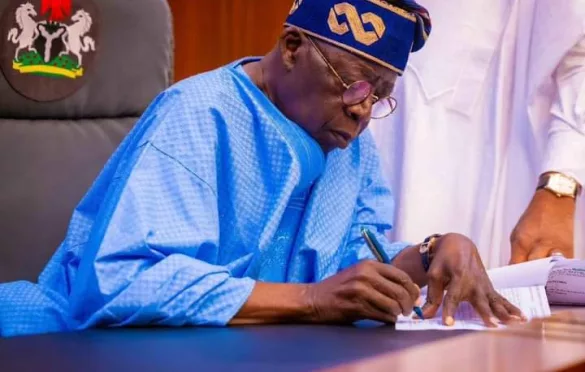
    The revised Harmonised Armed Forces Terms and Conditions of Service (HAFCTCS) 2024, which was signed by President Bola Tinubu on December 16, 2024, also prohibited personnel from body piercing, tattooing, drunkenness, disorderly conduct, and other forms of public misconduct.

    The prohibitions were aimed at reinforcing discipline within the military.

    According to HAFCTCS, “An officer must not engage in homosexuality, lesbianism, and bestiality. He/she is not to belong to, or engage in activities of the Lesbian, Gay, Bisexual, Transgender, Queer or Questioning, Intersex, Asexual or Agender, Two-Spirit (LGBTQIA2S+) group and cross-dressing, amongst others.”

    Military personnel were also forbidden from entering into amorous relationships with subordinates or their spouses.

    The legal instrument specifically highlighted the importance of maintaining professional boundaries.

    “An officer shall not engage in any amorous relationship with any soldier, rating, airman, airwoman, or their spouses,” part of the revised terms and condition of service stated.

    It added that other key regulations included the obligation for personnel to fulfill financial obligations such as vehicle licensing and insurance on time, stressing that failure to do so would be considered a serious offence, as was the issuance of dud cheques.

    The revised terms also banned officers from joining secret societies or political parties.

    “An officer shall not hold membership of any secret society or political party. He shall not participate, in any way, in activities concerned with such societies or parties even in observatory capacities,” it further outlined.

    Military personnel were equally restricted from engaging in private businesses or misusing government property for personal gain.

    The document further warned that actions that bring discredit to the armed forces would not be tolerated. Arise News

  • TCN dismisses news of grid collapse

    TCN dismisses news of grid collapse

    The Transmission Company of Nigeria (TCN) on Saturday attributed the power fluctuations experienced in parts of the country to line tripping, dispelling rumors of a national grid collapse.

    In a statement released by the TCN spokesperson, Ndidi Mbah, the company clarified that the national grid remained stable and operational throughout the day.

    The disruption was traced to the tripping of the Osogbo-Ihovbor and Benin-Omotosho transmission lines, which significantly impacted power supply to the Lagos axis.

    Mbah explained that the Osogbo-Ihovbor line tripped at approximately 1:41 PM, leading to a cascading effect that caused the Benin-Omotosho line to trip as well. This situation disrupted operations at major power generation facilities, including Egbin, Olorunsogo, Omotosho, Geregu, and Paras power stations.

    “It is important to clarify that at about 13:00 hrs today, just before the tripping, total generation on the grid was 4,335.63 MW. After the tripping, however, generation dropped to 2,573.23 MW, showing clearly that the grid did not experience a collapse,” she stated.

    News continues after this ad

    At the time of the tripping, total grid generation was recorded at 4,335.63 MW. The incident caused a significant drop in power generation, bringing it down to 2,573.23 MW. Mbah emphasized, however, that this did not constitute a grid collapse, as power was quickly restored to most affected areas.

    As of Saturday evening, the affected power stations had resumed operations, with only the Benin-Omotosho 330kV transmission line awaiting full restoration. Mbah assured that TCN’s technical teams were actively working to resolve the issue and restore supply.

    “Earlier today, at about 13:41 hrs, the Osogbo-Ihovbor line tripped, followed by the tripping of the Benin-Omotosho line. These consequently affected bulk supply only on the Lagos axis,” she said.

    Mbah reiterated TCN’s commitment to strengthening the national transmission grid to minimize such disruptions. She emphasized the importance of ongoing investments in infrastructure upgrades and preventive measures to ensure stable power delivery across the country.

    On Saturday, some news platform [not Nairametrics] reported that the power outage experienced in some parts of the country was due to the collapse of the national grid.

    “Transmission Company of Nigeria, TCN, hereby states that the nation’s grid did not experience any collapse today, contrary to the widely published misinformation in the media,” the statement reads.

    The power sector in Nigeria continues to face significant challenges, including aging infrastructure and limited generation capacity. Transmission lines, which serve as the backbone of the country’s power delivery system, are often strained, leading to occasional disruptions.

    TCN has been actively pursuing grid expansion projects aimed at increasing transmission capacity and enhancing system resilience. These projects are part of a broader effort to meet the growing demand for electricity in the country. Nairametrics

  • FBN Shareholders say Requisitioned Extraordinary General to Oust Otedola Unnecessary

    FBN Shareholders say Requisitioned Extraordinary General to Oust Otedola Unnecessary

    The ongoing debate among some shareholders of FBN Holdings Plc over the proposed N350bn private placement has raised questions about corporate governance and transparency.

    However, some shareholders have defended the ongoing reforms under the leadership of the Chairman of FBN Holdings, Femi Otedola, dismissing calls for an extraordinary general meeting as unnecessary.

    According to PUNCH, Matthew Akinlade, the immediate past president of the Noble Shareholders Solidarity Association, described some Ashareholders’ protests as driven by external interests.

    He argued that the moves made by Otedola were in the best interest of the bank. “For me, I believe some of these shareholders protesting are being used, and, unfortunately, people are willing to be manipulated. Otedola has been driving positive changes within FBN Holdings, and this is a bank that, in the past, paid peanuts as dividends. Now, with the bank’s improved performance, the situation is different,” Akinlade stated.

    While Akinlade fully supported Otedola’s leadership, he questioned the preferred method of capital raising, calling for an inclusive process.

    “Private placement should not be the first option. A public offer or rights issue would be more equitable, giving every shareholder an opportunity to invest. While I understand the need for raising funds, the board must ensure that the process is inclusive and transparent,” Akinlade argued.

    The National Coordinator of the Pragmatic Shareholders Association of Nigeria, Bisi Bakare, also weighed in, defending the private placement as long as it adhered to legal and regulatory guidelines.

    “When I look at this issue of private placement, I do not see why there is such a fuss. If you have your money and the process is legal, then why not? The key question should be whether the source of funds is legitimate. If the Securities and Exchange Commission and Central Bank of Nigeria approve it, then there’s no issue,” Bakare said.

    Additionally, Boniface Okezie, the National Coordinator of the Progressive Shareholders Association of Nigeria, echoed similar sentiments but raised concerns regarding transparency and the potential abuse of corporate governance.

    “If the private placement was part of the agenda approved during the last Annual General Meeting, then there is nothing fundamentally wrong. The board promised to raise capital through the market, and they are simply following through,” Okezie stated.

    However, Okezie stressed the need for transparency, warning against the risk of the private placement being directed towards a select few.

    “If this private placement is targeted at one individual or a small group, it could lead to an abuse of corporate governance, which would raise red flags with the Central Bank of Nigeria. Corporate governance is critical, and the CBN, as the regulator, must verify the process and ensure everything is above board,” he added.

    Okezie noted that the private placement was aligned with the resolutions passed during the last AGM.

    Okezie urged the Central Bank of Nigeria to provide clarity on the issue to maintain transparency and reassure stakeholders.

    “If the private placement was indeed part of the AGM resolutions, there’s no justification for this controversy. The CBN, as the regulator, must clarify the situation for transparency and stakeholder confidence,” he concluded.

    In a statement filed by the company secretary, Adewale Arogundade, on the Nigeria Exchange Limited on Thursday, FBN Holdings assured stakeholders the ongoing developments would not impact its operations. The company emphasised that all businesses under its umbrella continue to provide uninterrupted services to customers.

    The company also reassured investors, shareholders, and the public that it is taking measures to protect the interests of FBN Holdings and its subsidiaries. According to the statement, the group’s performance has continued to improve, resulting in a higher market capitalization. FBN Holdings is also on track to surpass the regulatory minimum capital requirements well before the deadline.

    Arogundade added that the company remains committed to corporate governance, assuring that management and its subsidiaries are operating with the highest levels of transparency and accountability.

    FBN Holdings Plc has opened a rights issue, offering 5.983 billion ordinary shares at 50k each to existing shareholders at N25 per share, in a bid to raise additional capital totalling N150 billion. Punch

  • Nasarawa Judicial Commission Demotes Magistrate over Role in Chioma Okoli vs Erisco Foods Legal Battle

    Nasarawa Judicial Commission Demotes Magistrate over Role in Chioma Okoli vs Erisco Foods Legal Battle

    Magistrate Emmanuel Jatau has been demoted for breaching legal boundaries in a case involving Erisco Foods and Chioma Okoli.

    The Nasarawa State Judicial Commission demoted a chief magistrate, Emmanuel Jatau, over misconduct in the case involving Chioma Okoli and the Nigeria Police Force (NPF).

    The judicial commission demoted Jatau from chief magistrate II to senior magistrate.

    The decision of the commission was contained in a letter dated January 6, 2025, and addressed to Inibehe Effiong, Okoli’s counsel.

    The letter was signed by the Secretary of the commission, Yahaya Shafa.

    The letter addressed to the human rights activist, reads: “Consequently, I have been directed by the Hon. Chief Judge of Nasarawa State and Chairman, Judicial Service Commission to write and inform you that Hon. Emmanuel A. Jatau has been demoted by a grade level lower than his current grade level, that is, from Chief Magistrate II on GL 15 to Senior Magistrate I on GL 14 and stripped of his magisterial duties,” the commission said.

    On September 17, 2023, Okoli made a post on Facebook stating that she tasted Nagiko Tomato Mix, one of the tomato paste variants of Erisco Foods Limited and found it sugary.

    Erisco Foods Limited had described her claim as untrue and unfounded.

    Days after the Facebook comment, Okoli was arrested by the police following a petition by the President and CEO of the company, Eric Umeofia.

    Her arrest sparked outrage on social media as many Nigerians called for her release.

    The police had obtained an arrest warrant and remand order from a magistrate court in Masaka, Nasarawa, to that effect.

    Okoli was later arraigned at the Federal High Court in Abuja where she pleaded not guilty to the two counts of conspiracy and cyberstalking.

    She was initially remanded at the Suleja Correctional Centre but later got bail.

    Amid the legal battle, she suffered a miscarriage.

    Displeased with the remand order, Effiong petitioned the Nasarawa State Judicial Commission.

    In the petition, Effiong argued that it is “brazen” for the magistrate to issue arrest and remand warrants against his client, who is not residing in Nasarawa and has never visited the state.

    The lawyer also stated that the alleged offences were not committed in Nasarawa State.

    “We submit respectfully that a Magistrate Court has no jurisdiction to make any order or issue any warrant whatsoever (whether for search, arrest or demand) for the allegations levied against the Defendant which border on offences allegedly committed under the Cybercrimes (Prohibition, Prevention, etc.) Act, 2015.

    “This is simply because cybercrime is not only a federal offence, it is one that the law creating the offence has donated exclusive jurisdiction to the Federal High Court not only for the trial of alleged offenders but also for pre-trial investigative actions.

    “We respectfully seek your Lordship’s intervention to investigate and appropriately sanction the assumed Magistrate (Hon. EA Jatau) on his/her involvement in this messy desecration of the judicial process and also invite any other official found culpable for necessary sanction.” Arise News

  • Ohanaeze Elects Senator Azuta-Mbata New President General

    Ohanaeze Elects Senator Azuta-Mbata New President General

    …Gov Mbah Harps on Igbo Unity, Collective Interest 

    Apex Igbo sociocultural organization Ohanaeze Ndigbo Worldwide has elected the former member representing Rivers East senatorial district, Senator John Azuta-Mbata as the new president-general of the organisation.

    Azuta-Mbata hails from Obio Akpor local government area of Rivers, whose turn it is to occupy the PG position of Ohanaeze Ndigbo. He will be succeeding Fidelis Ozichukwu Chukwu, whose tenure has ended.

    The election, held on Friday, January 10, 2025 at the old government lodge Enugu, Enugu State, saw the new executive members emerging through a consensus.

    Ohanaeze: Gov Mbah Harps on Igbo Unity, Collective Interest

    Governor of Enugu State, Dr. Peter Mbah, stressed the need for a strong and united front by Ndigbo, urging all to put the Igbo interest above narrow interests and partisan politics.

    Mbah noted that the socio-political circumstances that gave birth to the pan-Igbo body remained relevant in present-day Nigeria as they were in the 1970s.

    He extolled the leadership pedigrees of Igbo leaders such as Dr. Michael Okpara, whom he said demonstrated how so much could be achieved when patriotism, altruism, and sense of brotherhood are at the core of leadership.

    “We may be gathered here for the crucial task of electing members into the National Executive Committee of Ohanaeze Ndigbo Worldwide, but this epic event yet offers a room for introspection, regarding the noble vision that inspired our forebears towards its founding.

    “The ties that bind us run deep and transcend geographical boundaries, for we are bound by a common history and cultural heritage. Our forebears clearly understood this. They understood, as well, that unity is a formidable force.

    “From the Igbo Federal Union to the Igbo State Union and the Igbo Forum that would later become Ohanaeze Ndigbo in 1979, the motivation had always been the desire to forge unity and deep brotherhood amongst the Igbo.

    “For them, the collective interest was all that mattered; not narrow interest shaped by party affiliation and boundary lines.

    “Ohanaeze Ndigbo represents the soul of our people, and is firmly anchored on the conviction that we are stronger together. That soul of the people is our unifying force.

    “The socio-political circumstances that gave birth to Ohanaeze Ndigbo are as relevant today as they were in the 1970s. So, we’d never needed this group more than we do today.

    “Our founders and forebears were great men and women ahead of their time. They left for us a glimpse of how much that can be achieved when fostering brotherhood is the defining essence of leadership.

    “The Premiers of the old Eastern Region, who governed from here, left indelible imprints visible in Enugu as much as in towns like Port Harcourt, Abakaliki, Owerri, Aba, Onitsha, Umuahia, etc.

    “That is the definition of statesmanship. Our forebears were statesmen, who appreciated the expediency of rising above partisan politics when the call of unity beckoned.

    We will certainly achieve far more when we fully embrace the value of speaking as a collective voice – not as lone, discordant voices,” he stated.

    The election process was conducted via voice voting, and alongside Azuta-Mbata, 15 other individuals were elected to various executive positions within the organisation.

    As a former senator, Azuta-Mbata brings a wealth of experience to his new role, having served as a senator for the Rivers East constituency from 1999 to 2007.

    In his acceptance speech, Sen. Azuta-Mbata expressed gratitude to the delegates for their trust and support, promising to work towards uniting the Igbo people and addressing pressing issues.

    A former deputy governor of Anambra State, Chief Emeka Sibeudu, was elected as the new Secretary-General.

    In the election, Governors Hope Uzodimma of Imo State, Alex Otti of Abia State, Chukwuma Soludo of Anambra State and Peter Mbah of Enugu State, were present during the election that saw eminent Igbo personalities present.

  • Court of Appeal reverses ruling nullifying Sanusi’s appointment as Emir, orders rehearing of case

    Court of Appeal reverses ruling nullifying Sanusi’s appointment as Emir, orders rehearing of case

    THE Court of Appeal has set aside the ruling of the Federal High Court, Kano, that nullified the appointment of Sanusi Lamido Sanusi as the 16th Emir of Kano.

    The Federal High Court had on Thursday, June 20, 2024, reinstated deposed Ado it Bayero as the emir, consequently annulling the state government’s reinstatement of Sanusi Lamido Sanusi as the emir.

    The court abrogated the Kano State Emirate Law 2024, which dissolved the five Emirates in the state.

    It also dismissed the state government’s repeal of the Kano Emirates Council Law, which the state had used to sack Sanusi and install Bayero as emir.

    The judge, Abdullahi Muhammad Liman, in his ruling, ordered all parties involved in the case to maintain the status quo.

    A kingmaker in the defunct Kano Emirate, Aminu Babba Danagundi, also known as the Sarkin Dawaki Babba, through his attorney, Chikaosolu Ojukwu (SAN), had sued the Governor Abba Yusuf-led government to contest the new law’s validity and requested that the court void it.

    Sanusi’s reinstatement threw the state into confusion as the dethroned Emir Bayero refused to relinquish his office.

    But in a judgment read by Gabriel Omoniyi Kolawole on Friday, January 10, a three-member panel of the Court of Appeal, Kano, held that the order nullifying the steps taken by the Kano State Government pursuant to the 2024 Emirates Council Law was made by Liman without jurisdiction.

    The appellate court ruled that the fundamental rights enforcement suit filed by an aggrieved kingmaker—Aminu Babba Dan Agundi—on which basis Liman issued the June 20 order, was not only invalid but the court lacked the jurisdiction to hear the matter.

    Meanwhile, in another ruling, the Court of Appeal, Abuja Division, on Friday, January 10, ordered a fresh hearing into the Kano Emirate impasse.

    The court, headed by Mohammed Mustapha, ruled that Bayero was not given a fair chance to present his case.

    The court criticised the Kano High Court for not following proper procedures, including failing to notify Bayero of the hearing, and emphasised the importance of ensuring all parties have an equal opportunity to be heard.

    The three-member panel of the court upheld the appeal on the issue of fair hearing, citing that the lower court should have notified the appellant and allowed them to get new legal representation after their lawyer withdrew.

    The Court of Appeal ordered the case to be sent back to the Kano State High Court’s chief judge to be reassigned to a different judge for a speedy decision. 

    The emirship tussle in Kano has persisted for months since the government abolished the five emirates in the state.

    While Bayero refused to relinquish his office and has occupied the mini palace in the Nasarawa area of Kano City, Sanusi has been in charge of the main palace. ICIR

  • Police arrest 29-year-old man for allegedly killing mother for rituals in Cross River 

    Police arrest 29-year-old man for allegedly killing mother for rituals in Cross River 

    The police in Cross River Statehave arrested a 29-year-old man for allegedly killing his mother for ritual purposes.

    Irene Ugbo, the police spokesperson in Cross River, confirmed the suspect’s arrest and detention to reporters on Friday in Calabar.

    Mrs Ugbo, a superintendent of police, did not, however, provide details.

    The News Agency of Nigeria (NAN) reports that the incident occurred on 25 December 2024 in Batriko, Eastern Boki Local Government Area of the state.

    A source told NAN that the suspect was arrested on Friday by a combined police and security team from the Obudu council area.

    The suspect allegedly shaved his dead mother and packed up the hair before dumping the corpse in a well in Obudu Local Government Area, while security operatives had been tracking him since the incident occurred.

    The source said that the suspect, arrested alongside a native doctor, would be brought to the police headquarters, Calabar, for further investigation.

    The source told NAN that he was arrested at the shrine of the native doctor with a bag containing his late mother’s shaved hair.

    “As I speak with you, the suspect and the native doctor are presently cooling off at the Obudu Divisional Police Headquarters,” said the source.

  • Tinubu To Depart Nigeria To Attend Sustainability Summit In Abu Dhabi 

    Tinubu To Depart Nigeria To Attend Sustainability Summit In Abu Dhabi 

    President Bola Ahmed Tinubu will depart Abuja on Saturday, January 11, to participate in the 2025 edition of Abu Dhabi Sustainability Week (ADSW 2025), a statement by Bayo Onanuga, Special Adviser to the President on Information & Strategy, has revealed.

    His Highness Sheikh Mohamed bin Zayed Al Nahyan, President of the United Arab Emirates, invited President Tinubu to attend the Summit, which will take place in the emirate from January 12 to 18.

    The Summit will bring together global leaders to accelerate sustainable development and advance socioeconomic progress.

    The event, ‘The Nexus of Next; Supercharging Sustainable Progress,’ will enable policymakers, business, and civil society leaders to explore pathways to fast-track the transformation to a sustainable economy and evolve a new era of prosperity for all.

    ADSW, a testament to the power of collaboration, has been held annually for over 15 years. It provides a global platform to foster multi-stakeholder cooperation in addressing global challenges and accelerating growth.

    It has birthed high-value agreements and strategic partnerships between governments, industry leaders, and clean energy pioneers worldwide, driving impactful alliances and advancing the sustainability agenda worldwide.

    At the event, President Tinubu will stress his administration’s reforms, including those related to energy sufficiency, transportation, public health, and economic development.

    The Nigerian leader and his entourage will also meet with the emirate’s leadership to discuss issues of interest affecting the two nations.

    The Minister of Foreign Affairs, Ambassador Yusuf Tuggar, and other senior government officials will accompany the President. Tinubu will return to Nigeria on Thursday, January 16.