Category: News

This is an optional category description

  • Suspected Herders Kill 7 Traders in Benue 

    Suspected Herders Kill 7 Traders in Benue 

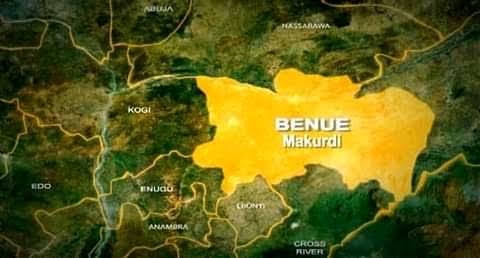
    Armed bandits believed to be herders have attacked Yanriwa Market in Kwande local government area of Benue State, killing five traders and injuring seven others.

    A resident of the community, Lawrence Akerigba who disclosed this to our correspondent on telephone, explained that the heavily armed gunmen invaded the market about 3pm when traders were transacting business.

    Akerigba said the gunmen were shooting sporadically at anyone in sight leading to the killing of the five persons.

    He lamented that the federal government reneged on its promise to deploy additional security operatives to the communities following the 2024 Christmas day attack where over 20 farmers were killed.

    This he said was promised by the government to the affected communities to enable displaced farmers to go back to their ancestral homes.

    “Up till now, nothing of that nature has been done. Government has abandoned us to our fate.

    “The attack by the herdsmen happened around 3pm in Liev 1 at Usambe in Ikyurav ya,” the distraught resident lamented.

    According to him, there is a market in the mountainous area called Yariwa which is patronized by the people of Ikyurav and Turan communities.

    He explained that the herdsmen have blocked the Anwase road, where the Christmas attack and killings took place, “as I am talking to you, that road is no longer passable.”

    He added that the people of the area have charted another route to Anwase, and taking refuge in Ikyurav, where they establish a market to enable farmers bring their produce once in a week for sale.

    “However, the joy of selling turns bloody when the herdsmen invaded the market while people were buying and selling and started shooting at the people.

    “Five persons were killed on the spot and 7 others sustained injuries and were taken to the hospital. Some other people are still missing and the search is still ongoing,” Akerigba said.

    He added that most schools, churches and markets in the area have been shut due to the herdsmen activities.

    “The security men on the ground are trying so much to prevent the attacks, but because they are few in number, their efforts are not much felt.”

    He called on the government to deploy more security “to enable our children and farmers to resume school and farm”, even as he said all the schools in the five council wards affected by the crisis have been shut down. Leadership

  • Akanu Ibiam International Airport to be reopened April 28

    Akanu Ibiam International Airport to be reopened April 28

    The Federal Airports Authority of Nigeria (FAAN), has announced the reopening of Akanu Ibiam International Airport, Enugu, on Monday, April 28, 2025.

    In a press release dated 26th April, 2025, FAAN’s Director of Public Affairs & Consumer Protection, Obiageli Orah, said the re-opening followed the completion of emergency runway repairs of the airport.

    According to Orah, the runway is certified suitable for landings and takeoffs by the agency’s engineers.

    The full statement reads:

    The Federal Government of Nigeria has announced that Akanu Ibiam International Airport in Enugu, Enugu State, will reopen for flight operations on Monday, 28th April 2025, following the completion of emergency runway repairs.

    On April 18th, 2025, the Federal Airports Authority of Nigeria (FAAN) announced that due to a sudden and significant rupture in the asphalt surface at a critical section of the runway, the runway would be shut down for emergency repairs. The work was scheduled to begin on April 22nd and conclude before reopening on May 6th, 2025. However, rehabilitation works on the runway have been completed, and the runway is cleared for landings and takeoffs by the engineers working with FAAN.

    FAAN appreciates all airport users and stakeholders for their understanding and cooperation during this time. The Authority sincerely apologises for the inconvenience but assures the public that all actions were taken in the interest of safety.

    FAAN-Safe Skies, Secure Airports, Seamless Travel.

    Mrs Obiageli Orah

    Director, Public Affairs and Consumer Protection.

  • Pope Francis laid to rest as about 250,000 mourners pay final respects at Vatican funeral

    Pope Francis has been laid to rest in Rome following solemn, hours-long funeral rites at St Peter’s Square in the Vatican, bringing to a close his sometimes turbulent 12-year leadership of the world’s 1.4 billion Catholics.

    The Argentinian pontiff, who died earlier this week from a stroke and cardiac arrest at the age of 88, was buried on Saturday at the Basilica of St Mary Major in the Italian capital.

    As sunny skies greeted crowds of well-wishers in Rome, tens of thousands packed the square to attend the ceremony, officiated by Cardinal Giovanni Battista Re, with many queueing from the early hours outside the square.

    Security around the Vatican was unprecedented, with Italian authorities deploying more than 2,500 police officers and 1,500 soldiers, closing the airspace above Vatican City, and stationing a torpedo ship off the coast, Italian media reported.

    Vatican Pope
    Pallbearers carry the coffin of Pope Francis during his funeral at the Vatican [Gregorio Borgia/AP]

    Applause and cheers rang out as Francis’s wooden coffin, inlaid with a large cross, was carried by 14 white-gloved pallbearers through the main doors of St Peter’s Basilica to the outdoor funeral service.

    Among the mourners were royals and global leaders, including United States President Donald Trump, who had frequently clashed with Francis over their sharply contrasting views on immigration.

    French President Emmanuel Macron, United Nations Secretary-General Antonio Guterres, European Union leaders, the United Kingdom’s Prince William, and members of the Spanish royal family were also in attendance.

    Ukrainian President Volodymyr Zelenskyy, who had initially said he could not attend due to new Russian attacks, was present after all. According to reports, he held a meeting with Trump before the ceremony – their first face-to-face encounter since a heated Oval Office clash in February.

    Former US President Joe Biden also attended, alongside other world leaders including Argentina’s President Javier Milei, Brazil’s President Luiz Inacio Lula da Silva, and Lebanon’s General Joseph Aoun.

    ‘A pope among the people’

    As world leaders watched from the sidelines, Cardinal Giovanni Battista Re delivered a moving funeral homily, describing Francis as a relentless advocate for peace and human dignity.

    “Faced with the raging wars of recent years, with their inhuman horrors and countless deaths and destruction, Pope Francis incessantly raised his voice imploring peace and calling for reason and honest negotiation to find possible solutions,” Battista Re said.

    He also praised Francis’s landmark papal letter on climate change and highlighted his many visits to places like Lampedusa and Lesbos, where the pope met migrants and refugees in detention camps.

    “His gestures and exhortations in favour of refugees and displaced people are countless,” Battista Re told the crowd.

    He eulogised Francis as “a pope among the people, with an open heart towards everyone”, known for his informal, spontaneous style and his ability to reach “the least among us”.

    A humble final resting place

    Reporting from the Vatican, Al Jazeera’s Jonah Hull called it an “utterly beautiful service” that was “very well received by the enormous crowd”, noting how spontaneous applause broke out during the historic moment.

    Following the service, Francis’s coffin made a 4km (2.5-mile) journey through the centre of Rome. According to the Vatican, 150,00 lined up the route of the motorcade to watch the pope’s motorcade.

    His burial at St Mary Major Basilica – rather than St Peter’s – was a deeply personal decision made by Francis himself in his last will, Hull reported.

    “It has a deep personal significance to Pope Francis and the Jesuit faith, which he was part of,” Hull said.

    Earlier this week, more than 250,000 people stood in line – some for hours – to pay their final respects while Francis’s body lay in state at St Peter’s Basilica. The Vatican kept its doors open overnight to accommodate the crowds.

    His final resting place, a plain tomb in a historic Roman church that has not held papal remains in centuries, reflects the humility and independence that defined Francis’s papacy.

    After the funeral, a group of 40 people – including migrants, homeless individuals, prisoners, and transgender people – greeted the late pope’s coffin with white roses on the steps of St Mary Major Basilica. Al Jazeera

  • Crowds gather for Pope Francis’ funeral Mass at the Vatican

    Throngs of mourners are gathering in Vatican City and lining the streets of Rome on Saturday to give a final send-off to Pope Francis, who will be remembered as a champion of migrants and the poor, and for his efforts to reshape the Catholic Church.

    His funeral Mass is being held on the steps of St. Peter’s Basilica, one of the Catholic Church’s most important sites, with more than 50 world leaders and 11 reigning monarchs in attendance. They are expected to include US President Donald Trump, Argentine President Javier Milei, Italian Prime Minister Giorgia Meloni and Philippine President Ferdinand Marcos Jr., head of the largest Catholic nation in Asia.

    The Vatican has prepared for as many as 250,000 people to flock to St. Peter’s Square and one million more to line the 6-kilometer (3.7-mile) procession route from Vatican City through Rome to the Basilica di Santa Maria Maggiore, in hopes of seeing the pope’s modest coffin as it travels to his final resting place.

    Many more of world’s 1.4 billion Catholics will watch the funeral for the first Latin American pope on TV.

    Pope Francis died at the age of 88 after suffering a stroke on Easter Monday, just one day after he appeared in the same square to offer a blessing to the faithful at the high point of the Christian calendar.

    In the days that followed, about 250,000 mourners came to pay their final respects as his body lay in state inside St. Peter’s Basilica. His coffin was officially sealed on Friday night in a liturgical rite led by the Cardinal Camerlengo Kevin Farrell, the acting head of the church.

    As daylight gleams off the massive travertine columns of St. Peter’s Square on Saturday morning, the funeral Mass will open with the chant, sung in Latin: “Eternal rest grant unto him, O Lord, and let perpetual light shine upon him.”

    A Bible reading will be given in English, and a “Prayer of the Faithful” will be offered up in multiple other languages, including French, Arabic, Portuguese, Polish, German and for the first time, Mandarin, fitting for a pope who sought to reach out to followers in all parts of the globe.

    In keeping with tradition, the Mass will include a homily and communion and end with a final commendation and farewell. Francis approved the order of the day for Saturday back in June 2024.

    But other elements of the day will be pared back, as Francis had sought to “simplify and adapt” proceedings, so that the papal funeral is “that of a pastor and disciple of Christ, and not of a powerful person in this world,” according to Vatican officials.

    Francis, who chose his name in honor of St. Francis of Assisi, with his commitment to poverty, peace and nature, also wanted to reflect his own dedication to the homeless and disadvantaged in the day’s events.

    He believed “the poor have a privileged place in the heart of God,” a Holy See statement said. “For this reason, a group of poor and needy people will be present on the steps leading to the papal Basilica di Santa Maria Maggiore to pay their last respects to Pope Francis before the burial of his coffin.”

    They will be the last members of the public to see his wooden coffin, after it’s driven slowly through the streets of Rome – past tourist highlights like the Piazza Venezia and the ancient Colosseum – in his final procession.

    Francis will become the first pope in more than three centuries to be buried at Santa Maria Maggiore, with the interment taking place away from the public eye.

    He was a pope of many firsts – the first Latin American pontiff, the first of the Jesuit order and the first modern-day pope born outside of Europe.

    Elected in 2013 as an outsider candidate from Argentina, Francis went on to usher in progressive reforms, including the promotion of women’s roles in the church.

    But his 12-year leadership was not without criticism. He took some important steps to address the Catholic Church’s clerical sexual abuse scandals, but campaigners and survivors say there is still much more to do.

    Divisions within the Church over same-sex relationships also persisted throughout his papacy. When asked about his position on sexual orientation, the pope famously said, “Who am I to judge?” but also reaffirmed the Church’s position that homosexuality is considered sinful.

    And his record was disparaged by some of the more conservative cardinals and members of the Church.

    Francis issued a rebuke of the Trump administration’s immigration policy earlier this year, and criticized Vice President JD Vance’s use of theology to defend its approach. Vance was one of the last people to meet with the pope, in a brief encounter on Easter Sunday.

    The next pope will be chosen by cardinals from around the world in conclave, a closed-door process that may see a battle play out between those who want to continue Pope Francis’ progressive path and those who want to reverse it.

    Catholics throughout the world have differing opinions, but many believers gathered in Vatican City this week told CNN that they are proud of Francis’ record.

    “He made some good changes in the Church. I think the Church is now more open,” said Laura Grund, from Leipzig, Germany, who was among the last people to see the late pope lying in state. “He opened many doors.”

    “He was a very simple man, who loved other people,” said Sister Luisa, a nun from Munich. “We feel very blessed, but also deep sorrow.” CNN

  • FCCPC’s $220m Fine Against Meta Upheld by Tribunal 

    FCCPC’s $220m Fine Against Meta Upheld by Tribunal 

    The Competition and Consumer Protection Tribunal has upheld the $220 million fine imposed on Meta Platforms Incorporated by the Federal Competition and Consumer Protection Commission (FCCPC).

    In a statement on Friday, the FCCPC’s Director for Corporate Affairs, Ondaje Ijagwu, announced that the tribunal also awarded the commission $35,000 to cover the investigation costs.

    Ijagwu noted that the Tribunal specifically determined that the Commission complied with prevailing laws, discharged its mandate, and exercised its powers within the confines of the 1999 Constitution (as amended).

    He added that the Tribunal ruled that the multiple actions by WhatsApp and Meta, for which the Commission made findings of violations, were correctly identified, and that the Commission did not err in making those findings.

    The tribunal’s three-member panel was led by Honorable Thomas Okosun.

    WhatsApp and Meta’s legal team was led by Gbolahan Elias (SAN) while the FCCPC’s legal team was led by Mr. Babatunde Irukera. Both teams had made their final arguments on behalf of their respective clients on January 28, 2025.

    The FCCPC had on July on July 19, 2024, issued a Final Order imposing a $220 million administrative penalty after concluding that the companies engaged in discriminatory and exploitative practices against Nigerian consumers.

    The Commission said it started an investigation into the alleged unethical practice by Meta in 2020.

    The case arose from a 38-month joint investigation initiated by the FCCPC and the Nigeria Data Protection Commission (NDPC) into the conduct, privacy practices, and consumer data policies of Meta Platforms and WhatsApp.

    Dissatisfied with the Order last year, Meta and WhatsApp appealed to the Tribunal, challenging both the legal basis and the findings of the Commission.

    While ruling on Meta’s appeal, the Tribunal also validated the Commission’s investigative procedures and processes.

    The Tribunal resolved Issues 1 to 7 largely in favour of the FCCPC, dismissing the appellants’ objections to the Commission’s findings, orders, and legal competence.

    One of the central issues (Issue 3), which alleged a breach of fair hearing, was decided in favour of the Commission, with the Tribunal affirming that the FCCPC fully discharged its quasi-judicial responsibilities by affording the appellants ample opportunity to respond. The Tribunal found no violation of constitutional due process.

    On Issue 4, which questioned the Commission’s powers in matters of data protection and privacy, the Tribunal held that the FCCPC acted within its statutory mandate, reaffirming its authority under Section 104 of the FCCPA to regulate competition and consumer protection even in regulated industries.

    On Issue 5, which challenged the Commission’s findings regarding Meta’s privacy policies, the tribunal also resolved in the FCCPC’s favour. The Tribunal found no error in the Commission’s conclusions and held that the privacy policy in question did, in fact, offend Nigerian law.

    While Issue 7 was largely resolved in favour of the Commission, the Tribunal set aside Order 7 of the Commission’s Final Order, stating that it lacked a sufficient legal basis.

    While expressing delight at the landmark judgement, FCCPC Executive Vice Chairman/CEO, Tunji Bello, thanked the Commission’s legal team for their exceptional diligence and forensic skills in assembling evidence and marshalling their argument.

    He restated FCCPC’s unwavering commitment to not only championing the rights of Nigerian consumers but also ensuring fair business practices in the country in accordance with FCCPA (2018) and consistent with the Renewed Hope Agenda of President Bola Ahmed Tinubu. Channels TV

  • Tinubu sends Akpabio-led Nigerian delegation to Pope Francis’ funeral in Vatican City

    Tinubu sends Akpabio-led Nigerian delegation to Pope Francis’ funeral in Vatican City

    President Bola Tinubu has sent a high-powered delegation to Vatican City to attend the funeral of His Holiness Pope Francis, scheduled for today. Leading the five-member Nigerian delegation is Senate President Godswill Akpabio.

    According to a statement by Special Adviser on Information and Strategy, Bayo Onanuga, the delegation also includes Minister of State for Foreign Affairs, Bianca Odumegwu Ojukwu; Archbishop Lucius Iwejuru Ugorji, President of the Catholic Bishops Conference of Nigeria; Archbishop Matthew Hassan Kukah of Sokoto Diocese; and Archbishop Ignatius Ayua Kaigama of Abuja Diocese.

    Pope Francis, leader of the Roman Catholic Church, passed away on Monday, April 21, at the age of 88, just a day after celebrating Easter Sunday at the Vatican. His funeral will be held at St. Peter’s Square, with thousands of mourners and over 170 international delegations expected to attend.

    In a condolence message, President Tinubu described the late pontiff as “a humble servant of God, a tireless champion of the poor, and a guiding light for millions.” He added, “Pope Francis’s death, coming just after the celebration of Christ’s resurrection, is a sacred return to his Maker at a time of renewed hope for Christians worldwide.”

    The Nigerian delegation will formally deliver a letter of sympathy and condolences from President Tinubu to the acting Head of the Vatican.

    The Pope’s body lies in state at St. Peter’s Basilica, where thousands have paid their respects, with the funeral mass set to begin at 10 a.m. local time on Saturday. Following the funeral, Pope Francis will be interred at Rome’s papal basilica of Santa Maria Maggiore, a place he personally chose as his final resting place.

  • Pope Francis’ funeral date announced by Vatican as first images of his body released

    Pope Francis‘ funeral has been scheduled for 10 a.m. local time (4 a.m. Eastern) on Saturday in front of St. Peter’s Basilica, the Vatican announced Tuesday, following a meeting of the College of Cardinals at the Catholic Church’s city-state headquarters in the heart of Rome. The coffin carrying the pope, who died Monday morning after suffering a stroke and heart failure at the age of 88, will be brought in a procession Wednesday morning, accompanied by cardinals, to the basilica from his residence at Casa Santa Marta, where he died.

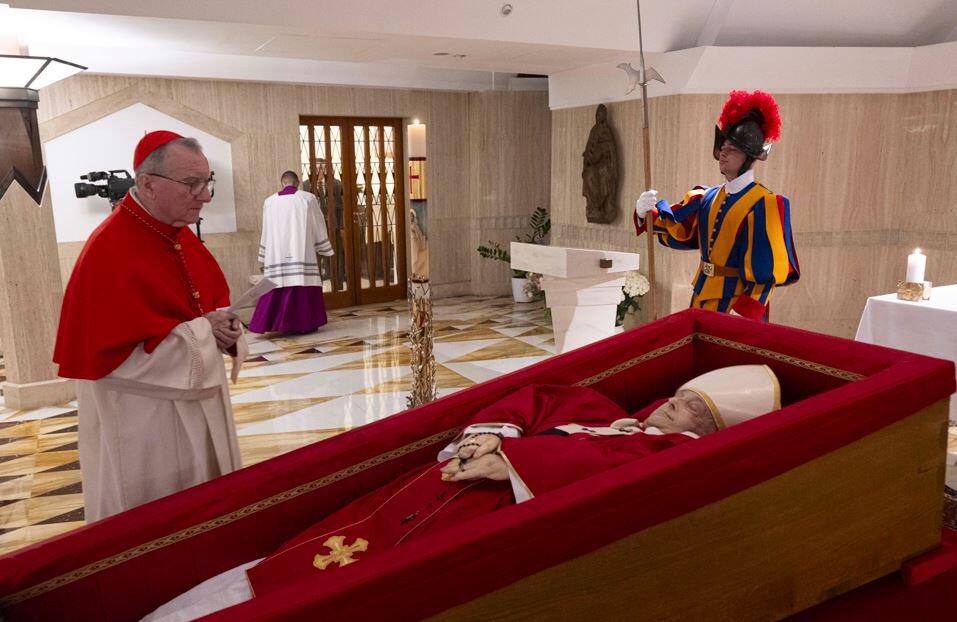
    The pope’s body was placed in his coffin in the chapel of the Santa Marta residence on Monday. On Tuesday, the Vatican released the first photos and video of Francis since his death, showing him in the wooden coffin wearing a red robe with the papal mitre on his head and a rosary intertwined in his hands.

    pope-francis-coffin-santa-marta-cu.jpg
    Pope Francis’ body is seen in a coffin in the chapel of the Santa Marta residence at the Vatican, where the late pontiff resided and then died at the age of 88, on April 21, 2025. HANDOUT/VATICAN NEWS SERVICE

    The images showed cardinals and other church officials performing what the Vatican said was the formal Confirmation of the Pope’s Death and praying over his body.

    CBS News correspondent Seth Doane said the intimate service at the Santa Marta hotel gave senior clergy and Vatican insiders a private chance to pay their respects to Francis. The Vatican’s ornately attired Swiss Guards were, as ever, standing at attention by the pope’s side.

    Church officials also shared some details about the pope’s final hours, describing “a discreet death, almost sudden, without long suffering or public alarm.”

    The interim administrator of the Vatican, Cardinal Kevin Farrell, an Irish-American who will play a major role in the funeral and subsequent events in the coming weeks, will preside over the procession and the ritual transfer of the pope’s body to St. Peter’s Basilica.

    The pontiff will lie in state ahead of his funeral at the basilica from Wednesday morning, the Vatican said. The funeral Mass will be celebrated three days later by the dean of the College of Cardinals, Giovanni Battista Re. The papal funeral is broken down into three separate phases, or “stations.” They are the preparation of the body, the viewing of the body, and then the burial.

    Who will come to Pope Francis’ funeral?

    The funeral at St. Peter’s Basilica on Saturday will draw “Patriarchs, Cardinals, Archbishops, Bishops, and priests from across the globe,” the Vatican said. It will also be attended by a number of world leaders and other dignitaries.

    President Trump said Monday that he and first lady Melania would attend, as did Ukrainian President Volodymyr Zelensky and France’s Emmanuel Macron. Italian Prime Minister Giorgia Meloni was to attend, along with a number of other European heads of state, including U.K. Prime Minister Keir Starmer and Germany’s outgoing Chancellor Olaf Scholz.

    Among the first royals to confirm they will attend the funeral were King Philippe and Queen Mathilde of Belgium. The country’s official Belga News agency confirmed that they would attend, noting the royal couple’ social media post on Monday in which they honored Francis as, “a great man, close to the most vulnerable and concerned with the problems of the world.”

    King Felipe VI and Queen Letizia of Spain were also planning to be at the funeral, the French news agency AFP said Tuesday, citing the royal palace in Madrid.

    Kensington Palace said Tuesday that William, the Prince of Wales and heir to the British throne, would attend the pope’s funeral on behalf of the U.K. royals, representing his father King Charles III. Charles, along with Queen Camilla, met with Francis at the Vatican less than two weeks before the pontiff died.

    Russia’s President Vladimir Putin, who is currently the subject of an International Criminal Court arrest warrant over war crimes allegedly committed during his country’s ongoing invasion of Ukraine, will not attend the pope’s funeral, the Kremlin’s chief spokesman said Tuesday.

    “No. The president has no such plans,” spokesman Dmitry Peskov told reporters when asked about Francis’ funeral. The ICC warrant severely limits Putin’s ability to travel internationally, as any nation that’s a signatory to the U.N. court’s founding charter is legally obligated to arrest him if he enters its territory.

    The Reuters news agency said Brazil’s President Luis Inacio da Silva and European Commission President Ursula von der Leyen had also confirmed that they would attend the funeral. President Javier Milei of Argentina, where Francis was born in 1936, would also be at the funeral, according to his office.

    China’s government indicated Tuesday that no decisions had been made regarding which officials might attend the service at the Vatican.

    What happens after Pope Francis’ funeral?

    After the funeral Mass at St. Peter’s, Pope Francis’ coffin will be taken to the Basilica of St. Mary Major in Rome, where he will be entombed. The pope chose to be buried at the smaller basilica, which is about four miles away, outside the Vatican walls. He prayed at St. Mary’s often, before and after international trips during his 12-year pontificate.

    Between 15 and 20 days after the pope’s death, the Cardinal Electors will gather at the Vatican and seal themselves off from the world behind the doors of the Sistine Chapel for the papal conclave, the centuries-old process of choosing the next pope. Only cardinals under the age of 80 — currently a group of about 135 — are eligible to vote in a conclave.

    The meeting of the cardinals on Tuesday was the first in what will be a series of gatherings culminating with the conclave. John Allen, editor of the Catholic news website “Crux,” told CBS News that the cardinals who were already at the Vatican to attend Tuesday’s meeting would soon be joined by others from around the world.

    “The really important part of these meetings begin when cardinals begin giving programmatic talks about where they believe the church stands… and what the profile of the man is needed to carry it forward,” Allen told CBS News about the process leading up to the conclave.

    “Let’s be clear: These are not the Iowa Caucuses. Nobody’s going to be standing up, barnstorming on behalf of their preferred candidate,” he said, adding that one can, however, “read between the lines” of the addresses delivered by the cardinals “to figure out, ‘he’s probably talking about cardinal so-and-so, or he may be talking against cardinal, so-in-so… so this is as close to political sausage grinding as we’re going to get in the process electing the next pope.”

    For the actual conclave, the cardinals will cast ballots inside the Sistine Chapel, out of public view, for their choice to lead the church, repeating the process until a candidate emerges with a two-thirds-plus-one majority. The paper ballots are burned after each round of voting, sending up black smoke to signal no choice has been reached yet, and finally white smoke to reveal that a new pope has been selected. CBS News

  • House of Reps Presents N18m Cheque to Victims of Enugu Tanker Explosion

    House of Reps Presents N18m Cheque to Victims of Enugu Tanker Explosion

    …As Mbah extols Speaker Abbas for compassionate leadership style

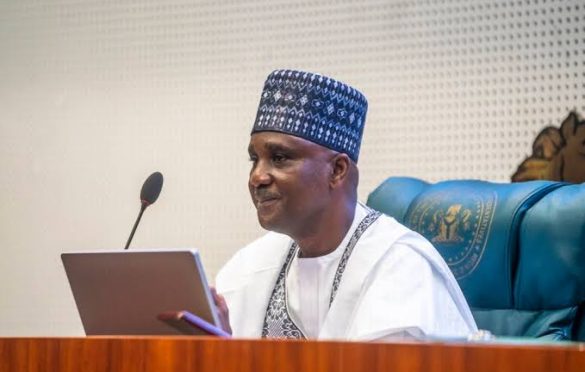
    The Speaker, House of Representatives, Hon. Tajudeen Abbas, Tuesday, presented a cheque for N18 million to the Enugu State Government as support to the victims of the January 25 petrol tanker explosion at Ugwu Onyeama on the Enugu-Onitsha Expressway, which claimed several lives.

    The Speaker described the incident as a huge loss, not only to the Government and people of Enugu State, but also the nation as a whole, noting that the support was in keeping with the tradition of the House of Representatives to ensure that governments and people of Nigeria do not stand alone in the face of such challenges.

    Abbas, who was represented by the Hon. Nnolim Nnaji-led Enugu State Caucus in the Green Chamber, which also had Hon. Matins Oke, Hon. Dennis Agbo, Hon. Mark Obetta, Hon. Anayo Onwuegbu, and Hon. Chimaobi Atu on its delegation, commended Mbah for his sterling leadership of the state and the prompt effort to comfort the families who lost their loved ones and support the injured.

    “On behalf of the Speaker of the House of Representatives, we commiserate with the Government and people of Enugu state over the tanker incident at Ugwu Onyeama. We acknowledge that you have done a lot to support both the injured and those who lost their loved ones.

    “So, this is a cheque for N18 million to assist the state to further ameliorate their losses and challenges occasioned by the incident. The Speaker sends his heartfelt condolences, once again. And you can continue to count on the support of the Speaker and the House,” Hon. Nnaji stated.

    Reacting, Governor Mbah thanked the Speaker and the Enugu State Caucus of the House of Representatives for the show of concern, assuring that the donation would go straight to the purpose for which it was made.

    “On behalf of the Government and people of Enugu State, I express profound gratitude and deep appreciation for this wonderful gesture. I recall that when the Ugwu Onyeama incident occurred, taking the lives of several of our loved ones, the Speaker called and assured that he was with us in prayers.

    “Today, he has also shown us that he is not only with us in prayers, but also materially. He has equally come to mourn with us. This cheque for N18 million will go a long way in cushioning the effect of the incident on those affected and their families.

    “Rest assured that as a government, we will ensure that this gets to them in a transparent, accountable, and just manner,” he stated.

  • ‘He was full of humanity,’ Gov Mbah Mourns Pope Francis

    …Consoles the Catholic faithful

    Governor of Enugu State, Dr. Peter Mbah, has joined the rest of the world in mourning the Catholic Pontiff and sovereign of the Vatican City, Pope Francis.

    Mbah described the late Pontiff as a man full of humanity, a reformer, and humble leader.

    In a statement he personally signed on Monday, the governor also described the Pope’s demise as a heavy loss, not only to the Catholic Church, but equally to the entire world.

    “His Holiness, Pope Francis, was full of humanity and lived as an epitome of meekness. A highly spiritual Pontiff, he chose a modest life over the glamour and privileges intrinsic in the papacy.

    “The first Jesuit Pope championed a number of liberal reforms, including the review of the Vatican constitution that accorded the lay Catholic and women a foothold on the central administration of the Mother Church

    “Importantly, His Holiness will be remembered for the promotion of global peace, one of his most outstanding legacies being the ‘Document on Human Fraternity for World Peace and Living Together,’ which he co-signed with the Grand Imam of Al-Azhar, Sheikh Ahmed el-Tayeb, on February 4, 2019.

    “Therefore, I am of the strong belief that a peaceful resolution of the raging conflicts around the world will stand as the greatest monument in honour of the Holy Father.

    “On behalf of the Government and good people of Enugu State, l join the over 1.4 billion members of the Catholic Church across the world to mourn His Holiness and pray for the peaceful repose of his kind soul.”

  • Tinubu returns to Nigeria

    Tinubu returns to Nigeria

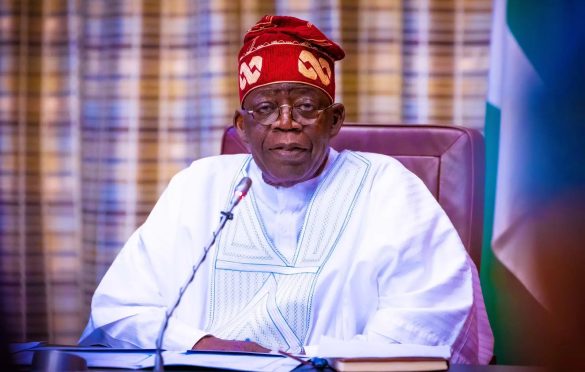
    President Bola Tinubu, on Monday night returned to Abuja after over two weeks working visit to Europe.

    President Tinubu, whose aircraft touched down at the Presidential Wing of the Nnamdi Azikiwe International Airport, Abuja, at 9:50pm, was received by senior officials of his administration.

    Recall that Tinubu departed Nigeria on Wednesday, April 2, and had spent some time in Paris, the capital of France, before heading to London.

    While in Europe, he maintained constant communication with key government officials, overseeing critical national matters, including directives to security chiefs to address emerging threats in some parts of the country.

    While in Paris, President Tinubu held a high-level meeting with the United States Department of State’s Senior Advisor for Africa, Mr. Massad Boulos.

    His discussions with the US official, it was gathered, focused on deepening bilateral collaboration aimed at enhancing regional security and promoting sustainable economic development across Africa.

    A key aspect of the talks included joint efforts to advance lasting peace in the eastern Democratic Republic of Congo (DRC), with emphasis on multilateral cooperation and the role of regional stakeholders.

    The meeting underscored Nigeria’s ongoing engagement with international partners in addressing complex security and development challenges across Africa.

    Among those who received the President on arrival were the Secretary to the Government of the Federation, SGF, Senator George Akume; Chief of Staff to the President, Rt. Hon. Femi Gbajabiamila; the National Security Adviser, NSA, Mallam Nuhu Ribadu; Minister of Budget and Economic Planning, Atiku Bagudu; and the Minister of the Federal Capital Territory, FCT, Nyesom Wike.

  • What comes now after the death of Pope Francis?

    Pope Francis has died at the age of 88, after 12 years as spiritual leader of the Roman Catholic Church.

    His death has triggered a mourning period which involves centuries-old rites.

    It has also set into motion the process for electing a new pontiff. A conclave can be expected to be held between 15 and 20 days after Francis’s death.

    This is what we can expect now.

    What happens immediately after the Pope dies?

    The official duties are carried out by the Pope’s camerlengo or chamberlain, currently Irish-American Cardinal Kevin Farrell.

    He is the one who officially confirms the death, with a doctor and death certificate. No autopsy is performed.

    The Vatican said on Easter Monday, hours after announcing his death, that Francis’s body would be laid in a coffin in a chapel at his Saint Martha residence at 20:00 local time (18:00 GMT). Farrell would preside over those rites, the Vatican said.

    It will also fall upon the camerlengo to lock and seal the Pope’s personal residence.

    Francis had not taken up apartments in the grand Apostolic Palace but smaller quarters in the form of a suite in the Vatican’s Saint Martha guesthouse.

    Farrell also has the responsibility to destroy the Pope’s ring and lead seal, which is used to authenticate official documents, so they cannot be used by anyone else.

    He and a team of three assisting cardinals will then set out the mourning schedule for Pope Francis – including the date of the funeral and burial.

    The period of mourning rites typically lasts nine days, and church rules say those events should begin between the fourth and sixth day after the Pope’s death.

    Farrell and his team will also decide when the Pope’s body will be moved into St Peter’s Basilica before burial so the public can pay their respects. On Monday afternoon, the Vatican said this transfer could happen as early as Wednesday morning but that cardinals would decide on Tuesday.

    What can we expect of the funeral?

    Pope Francis shunned much of the Church’s pomp and ceremony – so in keeping with that style he requested his body not be put on a raised platform, the traditional catafalque, in the middle of St Peter’s Basilica for public viewing.

    Instead the faithful coming to mourn will simply be able to look upon his body inside his coffin which will have the lid removed.

    His funeral, according to Church custom, should typically be held within four to six days after his death, with the funeral mass taking place in St Peter’s Square.

    Papal funerals have traditionally been elaborate affairs, but Pope Francis acted last year to simplify his arrangements.

    He will be the first Pope in more than a century not to be buried in the Vatican, in the crypt of St Peter’s Basilica – opting instead to be laid to rest in Rome’s Basilica of St Mary Major, near his favourite icon of the Madonna.

    Francis also requested to be buried in a simple wooden casket – unlike his predecessors who were buried in the traditional three nesting coffins made of cypress, lead and oak.

    How is a new Pope chosen?

    Pope Francis’s death sets into motion the political process for the Church to select a new leader.

    Cardinals from around the world will descend on the Vatican for the election, known as a conclave.

    Traditionally, the 15-day mourning period is observed before the conclave begins. However Francis’s predecessor Benedict changed the rules in 2013 to allow it to begin earlier if the cardinals wished. The vote typically takes place 15-20 days after the Pope’s death.

    The new Pope is voted on by the College of Cardinals – a group of the Church’s most senior officials, who are all men, all appointed by the Pope and who are usually all ordained bishops.

    There are currently 252 Catholic cardinals, but only 135 are eligible to cast ballots as those over the age of 80 can take part in debate but cannot vote.

    Meanwhile, between the Pope’s death and the election of his successor, the College of Cardinals governs the Church.

    They run the day-to-day business of the church but have limited power as much of the Church’s central administration stops work and typically, Vatican department heads resign from their positions until they are confirmed or replaced by the new Pope.

    How does the conclave run?

    The voting cardinals are locked into a period of pontiff selection where they are cut off from communication with the outside world – denied phones, the internet and newspapers – while in discussions and lobbying among themselves to decide the Church’s new leader.

    The conclave, or election, is held in strict secrecy inside the Sistine Chapel, famously painted by Michelangelo.

    A majority of two thirds plus one of the gathering is needed to agree on a new Pope, so multiple rounds of voting are often needed to get a result. After the first day, a secret ballot takes place twice a day and the process can often stretch to several days.

    In previous centuries, voting has gone on for weeks or months. Some cardinals have even died during conclaves.

    To the outside world, the only clue as to how it is progressing is the smoke that emerges from the chapel’s chimney, the product of the cardinals’ ballot papers being burned.

    Black smoke signals failure. White smoke means a new Pope has been chosen.

    How is the decision about the new Pope made public?

    After the white smoke goes up, the new Pope normally appears within an hour on the balcony overlooking St Peter’s Square.

    The senior cardinal participating in the conclave will announce the decision with the words “Habemus Papam” – Latin for “we have a Pope”.

    He will then introduce the new Pope by his chosen papal name, which may or may not be his original given name.

    For example, Pope Francis was born Jorge Mario Bergoglio, but he chose a different name for his papacy in honour of St Francis of Assisi.

    Who can become the Pope?

    In theory, any Roman Catholic man who has been baptised can be considered for election to become Pope.

    In practice, however, the cardinals prefer to select one of their own.

    In 2013, the Argentine-born Francis became the first pontiff to hail from South America – a region that accounts for around 28% of the world’s Catholics – and the southern hemisphere.

    Historical precedent suggests the cardinals are far more likely to pick a European – and especially an Italian. Of the 266 popes chosen to date, 217 have been from Italy.

    Several Vatican analysts have suggested it is possible Francis’s successor could come from outside Europe – not least because the late Pope appointed more than 140 cardinals from beyond the continent during his tenure.

    What does the Pope do?

    The Pope is the head of the Catholic Church. Roman Catholics believe he represents a direct line back to Jesus Christ. He is considered a living successor to St Peter, who was chief among Christ’s initial disciples, the Apostles.

    That gives him full and unhindered power over the entire Catholic Church and makes him an important source of authority for the world’s roughly 1.4 billion Catholics.

    While many Catholics often consult the Bible for guidance, they can also turn to the teachings of the Pope, which govern the Church’s beliefs and practices.

    About half of all Christians worldwide are Roman Catholics. Other denominations, including Protestants and Orthodox Christians, do not recognise the Pope’s authority.

    The Pope lives in Vatican City, the smallest independent state in the world. It is surrounded by the Italian capital, Rome.

    The Pope does not receive a salary, but all his travel costs and living expenses are paid for by the Vatican. BBC

  • Pope Francis dies at 88, Vatican says 

    Pope Francis, a voice for the poor who overcame fierce resistance to reshape the Catholic Church, has died at 88, the Vatican has announced.

    The pope’s death was announced on Monday morning by Cardinal Kevin Farrell, the Vatican camerlengo.

    “Dear brothers and sisters, with deep sorrow I must announce the death of our Holy Father Francis,” a statement from the camerlengo said.

    “At 7:35 this morning the Bishop of Rome, Francis, returned to the house of the Father. His whole life was dedicated to the service of the Lord and His Church.”

    Farrell continued, “He taught us to live the values of the Gospel with fidelity, courage and universal love, especially in favour of the poorest and most marginalized.”

    “With immense gratitude for his example as a true disciple of the Lord Jesus, we commend the soul of Pope Francis to the infinite merciful love of the Triune God,” the statement concluded.

    The announcement would have come as a shock to many, coming less than a day after the pope made a high-profile appearance in public.

    While he did not appear as engaged as usual on Sunday, he still managed to address a huge crowd of worshippers.

    Francis gave the traditional Easter blessing from the balcony of St. Peter’s Basilica in the Vatican, in what marked his highest-profile appearance yet since being discharged from hospital.

    Just before that, he held a brief meeting with US Vice President JD Vance.

    The death of Francis, who became the first Latin American pontiff in 2013 and was one of the oldest popes in the church’s history, came weeks after he was discharged from a Rome hospital having battled a life-threatening case of pneumonia in both lungs.

    His medical team said his condition had stabilized, allowing for him to continue his convalescence at his Casa Santa Marta residence back at the Vatican.

    Two weeks after leaving hospital, he delighted the faithful by making a surprise appearance at St. Peter’s Square.

    He has made a number of appearances since then, including spending 30 minutes at a prison in Rome on Thursday and a visit to St. Peter’s Basilica on Saturday evening.

    His death will open a debate about the future direction of the Catholic Church, with cardinals from across the globe expected to gather in Rome in the coming days to mourn the pontiff and then elect his successor.

    An outsider figure and the first non-European pontiff in nearly 1,300 years, Francis championed the poor, migrants and the environment, but divisions over same-sex relationships and how to tackle abuse scandals within the church persisted throughout his pontificate.

    The pope’s tireless advocacy for migrants saw him sharply criticize US President Donald Trump’s immigration deportation policies in the months before his death. Francis, whose pontificate was a counterweight to the rise of nationalist populism, often found himself under fire from powerful conservative Catholic forces in the US. CNN