Category: World News

  • Turkey agrees to Sweden’s NATO membership

    Turkey agrees to Sweden’s NATO membership

    A SUMMIT OF NATO leaders in Vilnius, Lithuania’s capital, opened in dramatic fashion on July 10th. On the eve of the gathering, which begins formally on July 11th, Turkey lifted its hold on Sweden’s application to join the alliance. It means that Sweden is likely to become the 32nd member of NATO, essentially turning the Baltic Sea into a NATO lake and potentially ending a saga that has dragged on for more than a year.

    NATO officials warn that Swedish membership is not a done deal. A similar eve-of-summit agreement in Madrid last year proved less of a breakthrough than it seemed at the time. But Jens Stoltenberg, NATO’s secretary-general, tweeted that Recep Tayyip Erdogan, Turkey’s president, had agreed to forward Sweden’s bid to Turkey’s parliament “ASAP” and to “ensure ratification”. The news came shortly after a meeting between Mr Stoltenberg, Mr Erdogan and Ulf Kristersson, Sweden’s prime minister, which itself capped off weeks of intensive diplomacy between the three sides.

    A NATO statement published on July 10th indicated that Sweden had promised further measures against Kurdish movements that Turkey regards as terrorists and that the alliance had agreed to establish a new post, “Special Co-ordinator for Counter-Terrorism”, reflecting Turkey’s priorities. Bloomberg, a news outlet, reported that the European Union had also agreed concessions over a customs union and visa-free travel.

    It is not clear whether Joe Biden, America’s president, also offered inducements: Mr Erdogan was widely believed to have been using his hold on Sweden’s application as leverage to secure the purchase of F-16 fighter jets from America. Mr Biden did not mention the issue in a short statement welcoming the news, but Turkey’s state-run Anadolu news agency said that America’s State Department had supported the provision of the jets.

    If Mr Erdogan follows through on his promise, it is a triumph for Mr Stoltenberg, who has been accused by some allies of having been overly indulgent towards Mr Erdogan. Mr Stoltenberg, the alliance’s secretary-general since 2014, had been due to retire in October 2022 to take over Norway’s central bank. His term was extended by a year after Russia’s invasion. Allies have been struggling to agree on a replacement. Debates over succession “overshadowed” a NATO summit in Strasbourg in 2009, recalls Jamie Shea, a former NATO official, holding up proceedings by hours. Vilnius has been spared that fate: on July 4th Mr Stoltenberg’s term was prudently extended by another year.

    The relief over Sweden’s progress will be short-lived. The thorniest challenge at the summit is how to handle Ukraine’s bid for NATO membership. In 2008, at a summit in Bucharest, the allies agreed that Ukraine and Georgia “will become members of NATO”, but did not say how or when. Many now believe that was the worst of all worlds: a red rag to Russia, without any benefit to Ukraine.

    Ukraine and even its most hawkish allies agree that membership is a question for the future. “We understand that we cannot be a member of NATO during the war,” acknowledged Volodymyr Zelensky, Ukraine’s president, last month, “but we need to be sure that after the war we will be.” A French official says that there are now “intense discussions among allies on the conditions” that would apply to Ukraine’s bid.

    Britain, France, Poland and other eastern allies want Ukraine fast-tracked after the war, much like Finland, which in April entered NATO less than a year after formally applying, compared with the eight years it took Montenegro. “We need something much more substantial and we need a path towards membership,” said Mr Macron in May. America and Germany are more cautious. “I don’t think [Ukraine is] ready for membership in NATO,” said Joe Biden, America’s president, on July 9th. “There’s other qualifications that need to be met, including democratisation and some of those issues.”

    America and Ukraine seem to be talking past one another, suggests Eric Ciaramella of the Carnegie Endowment, a think-tank in Washington. Ukraine sees the question of nato membership in symbolic terms, he suggests, as a signal to Russia. America takes a legalistic approach. “There is a very serious concern about advancing the language in a way that we have no clear path to…make good on that promise,” says Mr Ciaramella. Some European officials also suggest that the promise of nato membership should be withheld for now, because it might be needed as a sweetener for Ukraine in any future deal involving territorial concessions.

    That will disappoint Ukraine. The consolation prize in Vilnius is likely to be a separate document agreed by a smaller coalition of countries on the margin of the summit, pledging long-term military aid. The aim will be to signal to Russia that the flow of arms from allies to Ukraine is locked in for years to come, and insulated from the vagaries of national politics—including the possible re-election of Donald Trump next year. Individual countries will then publish details of their specific commitments.

    A fourth question at Vilnius concerns major changes taking place in NATO’s defence posture. Leaders will approve the alliance’s first comprehensive defence plans since the cold war, spanning 4,000 pages of text, including three regional plans covering the north, central and southern parts of Europe. Though Turkey had held up approval, the issue was resolved on July 10th. The plans set tougher expectations for how individual allies organise, train, exercise and equip their national forces. But there is still a political debate over the best way to arrange military forces in Europe for the purposes of deterrence.

    America, Britain, Canada and Germany have positioned relatively modest battlegroups on Polish and Baltic soil, with the intention of reinforcing them quickly in a crisis. The Baltic states retort that Russia’s invasion of Ukraine, however botched, swallowed an Estonia-sized swathe of territory within weeks, and that war crimes occurred during even brief periods of occupation. They accordingly favour larger peacetime garrisons, and a strategy of forward defence. In recent weeks Germany has indicated that it is willing to upgrade its presence in Lithuania from a battalion of around 1,000 troops to a brigade of 4,000 or so.

    Yet there are also doubts over the wisdom of concentrating forces in the east. “Very generally, in military terms you want flexibility,” warned Admiral Rob Bauer, the chair of NATO’s military committee, “I would be cautious to have all the forces fixed along the eastern flank, because we do not know where the enemy will come.” Keeping stockpiles within range of Russian rocketry presents other problems, he noted. “If you have huge dumps of ammunition, they are vulnerable as well.”

    In private, even Baltic officers have misgivings. “I am not a great fan of more NATO boots on the ground in the Baltics,” says an Estonian field commander. “There is no point talking about additional brigades.” Instead, he emphasises long-range strike weapons. “What we really need is a capacity for targeted effect against critical nodes in the Russian system.”

    Ultimately, making the new plans reality will require a substantial increase in defence investment. In 2014 allies agreed that they would aim to spend 2% of GDP annually on defence by 2024. Most will miss the target. Some want to raise it regardless. “It is important to recognise that 2% should be a floor rather than a ceiling,” notes Camille Grand, an assistant secretary-general at NATO until last year.

    Others are sceptical that such levels of spending can be sustained. “That’s a discussion that largely ignores the realities of how hard it’s going to be to maintain that defence spending and…the threat perception of Russia in some western European states in particular,” says Sophia Besch, also of Carnegie. Even NATO’s newest ally-in-waiting, Sweden, is not due to meet the 2% target until 2026, following years of under-spending. The effects of electroshock therapy do not last for ever.

    The Economist

  • Ukraine, Russia Accuse Each Other of Planned Attack on Europe’s Biggest Nuclear Plant

    Ukraine, Russia Accuse Each Other of Planned Attack on Europe’s Biggest Nuclear Plant

    Ukraine and Russia accused each other Wednesday of planning to attack one of the world’s largest nuclear power plants, but neither side provided evidence to support their claims of an imminent threat to the facility in southeastern Ukraine that is occupied by Russian troops.

    The Zaporizhzhia Nuclear Power Plant has been a focus of fear since Moscow’s forces took control of it early in the war. Ever since then, Moscow and Kyiv have traded blame for shelling the facility and accused each other of nuclear terrorism.

    Regular power outages resulting from shelling made it impossible to operate the plant safely, and its six reactors have been shut down to minimize the threat of a disaster.

    Over the last year, the U.N.’s atomic watchdog repeatedly expressed alarm over the possibility of a radiation catastrophe like the one at Chernobyl after a reactor exploded in 1986.

    Ukraine has alleged more recently that Moscow might try to cause a deliberate leak in an attempt to derail Kyiv’s ongoing counteroffensive in the surrounding Zaporizhzhia region. Ukrainian authorities accused Russia of blowing up a dam in southern Ukraine last month with a similar aim, while Moscow blamed Ukraine for its destruction.

    Citing the latest intelligence reports, Ukrainian President Volodymyr Zelenskyy alleged Tuesday night that Russian troops had placed “objects resembling explosives” on top of several of the plant’s power units to “simulate” an attack from outside.

    “Their detonation should not damage power units but may create a picture of shelling from Ukraine,” according to a statement from the general staff of Ukraine’s armed forces.

    The Associated Press reviewed high-resolution satellite imagery of the plant taken Monday and Wednesday. The photos showed no visible changes to the roofs of the six concrete containment domes covering the reactors at the plant, or nearby buildings.

    The International Atomic Energy Agency has officials stationed at the Russian-held plant, which is still run by a Ukrainian staff that oversees crucial cooling systems and other safety features.

    Arise News

  • Grandmother of teen killed by police calls for calm, as France prepares for sixth night of violence amid Macron meeting with top ministers

    Grandmother of teen killed by police calls for calm, as France prepares for sixth night of violence amid Macron meeting with top ministers

    The grandmother of the 17-year-old boy who was fatally shot by a police officer in a Paris suburb has called for an end to the violence that erupted in the aftermath of his death, as French authorities gear up for a sixth night of rioting.

    Victim Nahel Merzouk’s grandmother appealed to protesters on Sunday, telling CNN’s affiliate BFMTV: “They should not damage the schools, not break the buses, it was the moms who take the buses.”

    “I’m tired,” the grandmother, identified by BMFTV as Nadia, said, adding that Nahel’s mother, “doesn’t have a life anymore.”

    Meanwhile, security forces will again have more than 45,000 police and gendarmes deployed across France on Sunday night following the violent public unrest, the government said.

    Many of the people detained since the protests began on Tuesday are minors, Interior Minister Gérald Darmanin said Saturday, adding that the average age of the more than 2,000 detainees is 17 years old.

    The situation across France so far on Sunday has been less tense than Saturday, with only sporadic protests reported, but the violence normally kicks off after sunset, according to CNN producers in France.

    French President Emmanuel Macron will meet the country’s prime minister, interior minister and justice minister at 7 p.m. local time (1 p.m. ET) to take an update on the latest on the nationwide protests, the Elysee Palace said in a statement.

    ‘Assassination attempt’

    Early Sunday morning, the mayor of a Paris suburb said his home was attacked, calling it “an assassination attempt” on his family.

    “At 1:30 a.m., while I was at the city hall like the past three nights, individuals rammed their car upon my residence before setting fire to it to burn my house, inside which my wife and my two young children slept,” said mayor Vincent Jeanbrun of L’Haÿ-les-Roses, a commune in the southern suburbs of Paris, in a statement.

    “While trying to protect the children and escape the attackers, my wife and one of my children were injured.”

    Jeanbrun said that he had “no words strong enough to describe his emotion towards the horror of this night” and thanked police and rescue services for their help.

    The Créteil prosecutor’s office has classified the incident as an “attempted murder,” prosecutor Stéphane Hardouin told reporters Sunday.

    Firefighters and french police operate during clashes between protesters and police, after the death of Nahel, a 17-year-old teenager killed by a French police officer during a traffic stop, in Nanterre, Paris suburb, France, June 28, 2023.

    Hardouin said the initial findings of a police investigation suggest that a flaming car “was launched to burn down the pavilion,” entering Jeanbrun’s property at around 1:30am local time.

    “Hitting a low wall, the vehicle stopped… before it could reach the veranda of the house. Only the front gate was hit, along with the family’s vehicle,” the prosecutor said in a news conference outside the mayor’s home.

    He said the mayor’s wife and two children, aged 5 and 7, fled through the back garden. While running away, the mayor’s wife hurt her shin which “appears to be broken,” according to the prosecutor.

    Hardouin also said forensic police have found a fire accelerant in a bottle of Coke. He didn’t specify which substance the accelerant was.

    “Every effort will be made to find the perpetrators and bring them to justice,” the prosecutor concluded.

    France has been rocked by a wave of protests following the death of Nahel, a 17-year-old of Algerian descent who was shot by a police officer in Nanterre earlier in the week and whose funeral took place on Saturday at a mosque in the Paris suburb amid a heavy security presence.

    The youth’s death has reignited a debate on policing in France’s marginalized communities and raised questions over whether race was a factor in his death.

    A GoFundMe page in support of the family of the police officer accused of fatally shooting the teenager had reached almost €650,000 ($710,000) on Sunday afternoon.

    The page was started by a far-right TV pundit and claims the policeman “only did his job and is now paying a hard price for it.”

    The officer has been charged with voluntary homicide and placed in preliminary detention, the prosecutor of Nanterre said earlier in the week.

    In comparison, another crowdfunding page in support of Nahel’s mother had raised over €97,000 ($105,000) at the time of writing. The page reads Nahel “leaves behind a mother torn apart by the loss of her only son. She needs our support to face the long trials that lie ahead.”

    Hundreds detained

    While the French government has deployed security forces and riot police across the country, the unrest continued with another night of protests on Saturday.

    More than 700 people were detained across France overnight, according to a provisional tally from the Interior Ministry.

    The statement added 45 police officers and gendarmes had been injured overnight, while 74 buildings including 26 police and gendarmes stations were damaged and 577 vehicles set on fire.

    The previous night, more than 1,300 people were detained and 2,560 fires reported on public roads.

    Meanwhile, China has warned its citizens in France to remain vigilant after a bus carrying a Chinese tour group in the southern city of Marseille had its windows smashed, resulting in multiple minor injuries, the country’s foreign ministry said in a statement Sunday.

    China’s Consulate General in Marseille has lodged an official complaint and urged French authorities to ensure the safety of Chinese citizens and property amid the unrest.

    The ministry did not say when the incident took place or how many people were injured. It said all the tourists on the group have since left France.

    CNN

  • In blow to Sunak, UK court rules Rwanda deportation plan unlawful

    In blow to Sunak, UK court rules Rwanda deportation plan unlawful

    A British court has ruled that the government’s controversial plan to deport asylum seekers to Rwanda is unlawful as the African nation cannot be considered a safe third country.

    An activist blocking a road leading away from the Colnbrook Immigration Removal Centre
    Several charities and human rights groups have criticised the plan to deport asylum seekers to Rwanda [File: Henry Nicholls/Reuters]

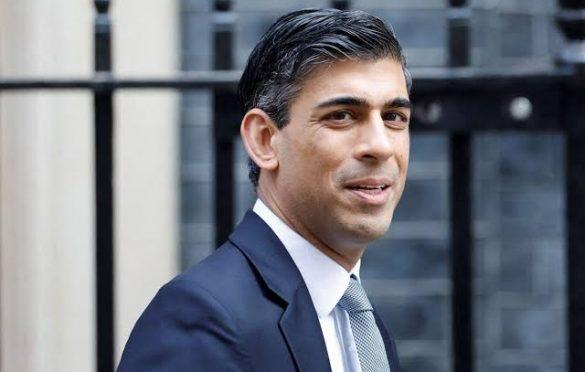
    In a major setback for Prime Minister Rishi Sunak, who has pledged to deter people from arriving across the Channel in small boats, three Court of Appeal judges on Thursday said the “removal of asylum seekers to Rwanda” would be “unlawful”.

    “The deficiencies in the asylum system in Rwanda are such that there are substantial grounds for believing that there is a real risk that persons sent to Rwanda will be returned to their home countries where they face persecution or other inhumane treatment,” judge Ian Burnett said, but added that he, himself, disagreed with the other two judges on this point.

    The United Kingdom government has been planning to deport asylum seekers to the East African country as part of a 120 million pound ($148m) deal to deter people from crossing the English Channel from France in small boats.

    Asylum Aid director Alison Pickup said many of her clients were breathing a sigh of relief.

    “Some of them have experienced torture, they’ve had very traumatic journeys, and have been waiting for over a year to find out if they will be able to make a case in the UK – or if they will be sent to Rwanda, a country they know nothing about,” Pickup told Al Jazeera.

    She added that the ruling will “hopefully give them that reassurance of safety”.

    The government has said it will appeal against the decision.

    The Rwandan government said that while the matter was one for the British courts, it took exception to the judges’ conclusions.

    “Rwanda is one of the safest countries in the world and we have been recognised by the UNHCR and other international institutions for our exemplary treatment of refugees,” said government spokesperson Yolande Makolo.

    Sunak under pressure

    As well as fighting against criticism from his own right-wing party and the public on migrant and refugee arrivals, Sunak is dealing with stubbornly high inflation and a cost-of-living crisis.

    Sunak made “stop the boats” one of his priorities and hopes a fall in arrivals might help his Conservative Party pull off a win at the next national election.

    The Rwanda plan was announced in April last year, but the first deportation flight was blocked by the European Court of Human Rights (ECHR), which imposed an injunction preventing any deportations until the conclusion of legal action in Britain.

    In December, the High Court ruled the policy was lawful, but that decision was challenged by asylum seekers from several countries, along with human rights organisations, who blasted the plan as “cruel”, “inhumane” and “neo-colonial”.

    Home Secretary Suella Braverman in April said Rwanda was a safe country for the resettlement of asylum seekers but declined to set any deadline for the first deportations there.

    The government has put forward a series of bills aimed at curbing migration that have been strongly criticised by civil society.

    In March, it proposed a contentious new law that would allow authorities to deport people arriving on its shores via small boats across the English Channel that divides the island from France.

    Several charities and human rights groups criticised the plan – known as the Illegal Migration Bill – saying it criminalises the efforts of thousands of genuine refugees.

    More than 45,000 people entered by crossing the channel in 2022, according to government figures – a jump of more than 17,000 from the previous year’s record.

    Aljazeera

  • 150 arrested in second night of French protests after 17-year-old shot dead by police

    150 arrested in second night of French protests after 17-year-old shot dead by police

    Police stations, town halls and schools were set alight across France on Wednesday, the second night of protests following the fatal police shooting of a teenage boy that was captured on video.

    Second night of rioting in Nanterre between young people and the police following the death of a 17-year-old following a roadside check, in Nanterre on the night of 28 June 2023 to 29 June 2023. Wednesday’s unrest saw 150 people arrested. It followed a chaotic night Tuesday during which 24 police officers were injured and 40 cars burned in several Paris suburbs, French authorities claimed, prompting them to deploy 2,000 extra police officers in anticipation of a second night of demonstrations.

    Government officials were quick to condemn Wednesday’s destructive unrest. President Emmanuel Macron said the violence was “unjustifiable” – the same word he used to describe the killing of the young boy named Naël – while Interior Minister Gerald Darmanin called it “intolerable.”

    The violent scenes that played out two nights in a row have raised concerns that Naël’s death could lead to a level of unrest and rioting not seen since 2005, when the deaths of two teenage boys hiding from police sparked three weeks of rioting and prompted the government to call a state of emergency.

    The video has sparked a similar level of shock and anger across France, touching a particular nerve among young men and women of color who feel that they have been discriminated against by police. A 2017 study by the Rights Defenders, an independent human rights watchdog in France, found that young men perceived to be Black or Arab were 20 times more likely to be stopped by police than their peers.

    Many of these individuals are simply “tired,” journalist and racial equality activist Rokhaya Diallo told CNN.

    “People know and have been speaking about police brutality and have not been heard,” she said.

    Authorities appear to be bracing for a third night of violence. Darmanin said that 40,000 officers would be mobilized Thursday night – including 5,000 in Paris – to quell further unrest.

    All government ministers have been asked to postpone non-urgent travel and remain in Paris due to the protests, a government source told CNN on Thursday. The source spoke on the condition of anonymity citing French professional norms.

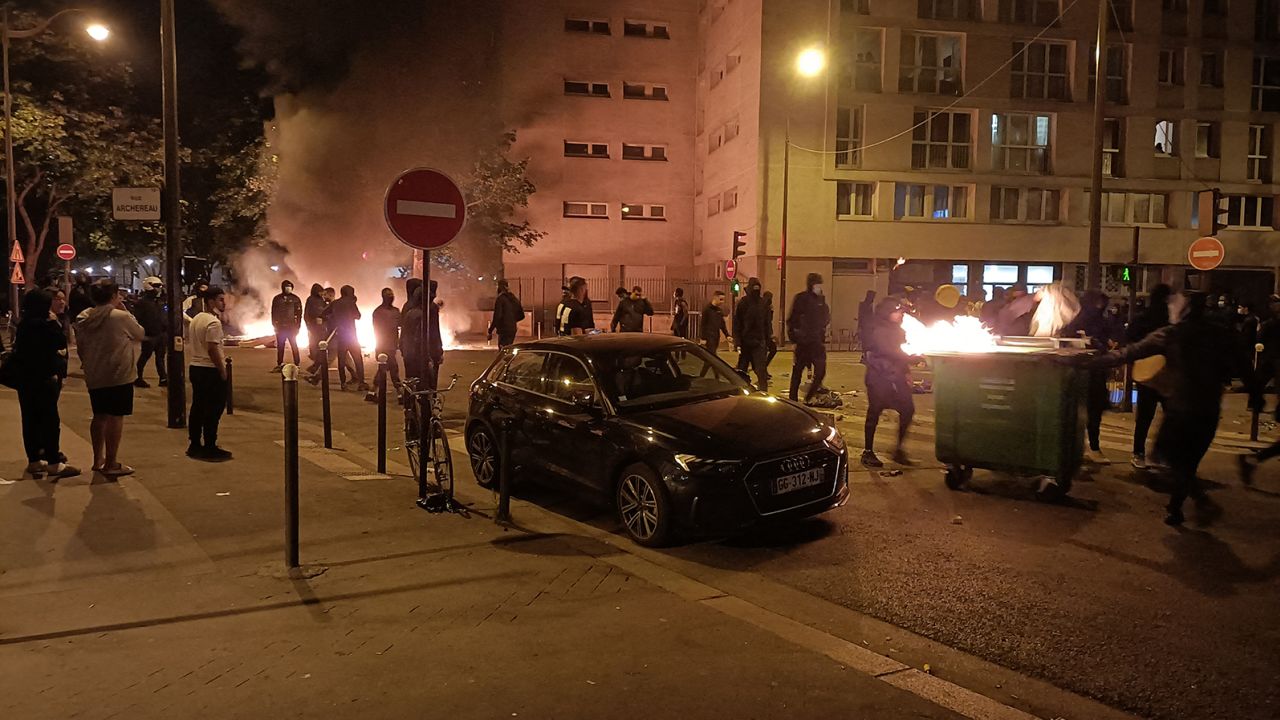
    Protesters burn garbage bins and block a street during a protest in Paris on June 29.
    Protesters burn garbage bins and block a street during a protest in Paris on June 29. Fiachra GIBBONS/AFP/Getty Images

    Video of the shooting in the Paris suburb of Nanterre surfaced on social media shortly after the incident took place Tuesday morning. The clip shows two police officers standing on the driver’s side of a yellow Mercedes AMG, one near the door and another near the left front fender. As the car attempts to drive away, one officer is seen firing his sidearm.

    The bullet that hit Naël pierced his arm and chest. After fleeing the scene, the car crashed into a stationary object at a nearby plaza. The 17-year-old victim was later pronounced dead and the officer who allegedly shot him was placed in custody. The teen was in the car with two others at the time of the incident. One passenger in the vehicle was taken into custody and later released, while another, who is believed to have fled the scene, is missing, authorities said.

    The local Nanterre prosecutor, Pascal Prache, said Thursday that the officers testified both drew their weapons and pointed them at the driver to dissuade him from restarting the engine. The officer who fired his weapon said, according to the prosecutor, that he was scared the boy would run someone over with the car. However, Prache said it is believed the officer accused of shooting and killing Naël may have acted illegally in doing so. The officer has since been put under provisional detention for voluntary homicide.

    Prache said that Naël had been known to authorities for a previous “breach of rules,” but it is not clear what law or orders that pertains to. The teen was expected to appear before a juvenile court in September.

    Protesters in Nanterre, west of Paris, on June 28.
    Protesters in Nanterre, west of Paris, on June 28. Geoffroy Van Der Hasselt/AFP/Getty Images

    Macron and other government officials, including Prime Minister Elisabeth Borne, have called for patience to allow the criminal justice system to run its course.

    “We need calm for justice to carry out its work,” Macron said Wednesday. “We can’t allow the situation to worsen.”

    Rallying public support and goodwill, however, is likely to be difficult for Macron’s government given how much political capital it spent in the first half of 2023 pushing through unpopular pension reforms, which sparked months of mostly peaceful mass protests.

    Acknowledging the government’s massive unpopularity, Macron gave himself 100 days to heal and unite the country. That deadline is up on July 14, France’s national day.

    Addressing allegations of institutional racism in France is particularly challenging given the country’s unique brand of secularism, which seeks toensure equalityfor all by removing markers of difference, rendering all citizens French first. In practice, however, the vigorous adherence to French Republicanism often prevents the government from doing anything that would appear to differentiate French citizens on the basis of race, including collecting statistics.

    Racial and religious data, where available, typically comes from private institutions, and extra care is typically taken by politicians to avoid circumscribing racial motives to state institutions.

    “On a general level, people tend to think there is no racism in France. And it’s one of the reasons people are so angry, because they feel and experience racism on a daily basis,” said Diallo, the anti-racism activist. “Despite that, they still face institutions, public discourse, and media which still say that there is no racism and that the race debate does not belong in France. And that’s the reason people are so angry and so outraged.”

    Government officials have so far not broached questions of racism in the police. Leaders of opposition left-wing parties have focused their criticisms on police violence rather than racism. Government spokesman Olivier Veran told CNN affiliate BFMTV that anger against the state itself, however, is unjustified.

    “It is not the republic that killed this young man,” Veran said. “It is one man who must be judged if the justice system deems it necessary.”

    CNN

  • Prigozhin says he is turning his forces around amid claims of deal brokered by President Lukashenko of Belarus

    Prigozhin says he is turning his forces around amid claims of deal brokered by President Lukashenko of Belarus

    Wagner boss Yevgeny Prigozhin published a new audio recording Saturday claiming he was turning his forces around from a march toward Moscow.

    Wagner chief Yevgeny Prigozhin speaks in this screengrab from a video released on June 24.
    Wagner chief Yevgeny Prigozhin speaks in this screengrab from a video released on June 24. Press service of “Concord”/Handout/Reuters

    “We turning our columns around and going back in the other direction toward our field camps, in accordance with the plan,” he said in a message on Telegram.

    The announcement comes as the Belarusian government claimed President Alexander Lukashenko had reached a deal with Wagner boss to halt the march of his forces on Moscow.

    “This morning, Russian President Vladimir Putin briefed his Belarusian counterpart on the situation in southern Russia with the private military company Wagner,” the statement said. “The heads of state agreed on joint actions.
    “As a follow-up to the agreements, the President of Belarus, having being additionally informed on the situation through his own channels, and in agreement with the President of Russia, held talks with the head of Wagner PMC Yevgeny Prigozhin,” the statement continued. “Yevgeny Prigozhin accepted the proposal of the President of Belarus Alexander Lukashenko to stop the movement of armed persons of the Wagner company on the territory of Russia and take further steps to de-escalate tensions.”

    CNN has reached to Prigozhin’s office for comment.

  • Trump indicted by Florida grand jury in classified documents probe

    Trump indicted by Florida grand jury in classified documents probe

    Former President Donald Trump and Trump aide, Walt Nauta, have been indicted in the special counsel’s classified documents probe.

    Trump is facing a charge under the Espionage Act, his attorney Jim Trusty said on CNN Thursday, as well as charges of obstruction of justice, destruction or falsification of records, conspiracy and false statements. Details from the indictment have not yet been made public.

    The former president is expected to appear in a Miami courthouse on Tuesday afternoon. Read more about why the case will unfold in Florida.

    Here are the latest developments on Friday:

    • Trump aide indicted: Walt Nauta, an aide to Trump, was also indicted in special counsel Jack Smith’s investigation into the mishandling of classified documents, according to one source familiar with the matter. Nauta’s involvement in moving boxes of classified material at Trump’s Florida resort had been the subject of scrutiny by investigators. Nauta, with the help of a maintenance worker at Mar-a-Lago, moved the boxes before the FBI executed a search warrant on the Palm Beach property last August.
    • The investigation: Special counsel Jack Smith has been investigating Trump’s handling of national security records at his Mar-a-Lago resort and elsewhere. His team is trying to determine if Trump or his aides committed crimes by keeping the documents after his presidency. Those were sensitive government documents that Trump had no legal right to hold on to, prosecutors have said in court filings.
    • Admission on tape: Trump acknowledged on tape in a 2021 meeting that he had retained “secret” military information that he had not declassified, according to a transcript of the audio recording obtained by CNN. “As president, I could have declassified, but now I can’t,” Trump says, according to the transcript. Publicly, Trump has claimed that all the documents he brought with him to his Florida residence are declassified.
    • Legal team changes: Trump announced on Truth Social that he will be represented by Todd Blanche, a defense lawyer he hired in April after being indicted in Manhattan. Trump is also planning to add another Florida-based attorney to the case, sources familiar with his thinking said. This is a major change to his legal team. His attorneys Jim Trusty and John Rowley said they will no longer represent Trump on either the federal indictment case or the January 6 investigation.
    • The judge: Federal District Judge Aileen Cannon, who Trump appointed, has been initially assigned to oversee the federal criminal case in Miami, two sources familiar with the matter tell CNN. If she remains on the case she would have wide latitude to control timing and evidence in the case and be able to vet the Justice Department’s legal theory. Cannon emerged in the public spotlight last year when she oversaw court proceedings related to the FBI’s search of Trump’s Mar-a-Lago estate in Florida.
    • Security preparations: Federal and local law enforcement officials are working on a plan to deliver Trump to the Miami federal courthouse where he will be formally placed under arrest and processed, according to law enforcement officials briefed on the discussions. Officials from various agencies, including the Department of Homeland Security, are meeting in Miami to discuss security preparations.

    CNN

  • Trump’s Vice President, Pence, announces 2024 presidential campaign

    Former Vice President Mike Pence announced Wednesday he’s running for the 2024 Republican presidential nomination as he delivered his toughest takedown to date of primary rival and former boss Donald Trump, who he said “should never” be president again for his actions in the aftermath of the 2020 election.

    At his formal campaign kickoff in Ankeny, Iowa, Pence recalled how Trump had asked him to block the certification of Joe Biden’s 2020 election win as Pence presided over Congress on January 6, 2021.

    “The American people deserve to know, on that day, President Trump also demanded I choose between him and the Constitution. Now voters will be faced with the same choice. I chose the Constitution, and I always will,” Pence said to applause from the crowd at Des Moines Area Community College.

    “I believe that anyone who puts themselves over the Constitution should never be president of the United States. And anyone who asks someone else to put them over the Constitution should never be president of the United States again,” the former vice president said of his onetime boss, currently the front-runner for the 2024 GOP nomination.

    At a CNN town hall later in the day in Des Moines, Pence repeated his criticism of his former boss, but on the subject of Trump’s alleged mishandling of classified documents, he said it would “be terribly divisive to the country” if the former president were to be indicted by federal investigators over his actions and a possible obstruction of justice.

    “This kind of action by the Department of Justice I think would only fuel further division in the country,” Pence told CNN’s Dana Bash, before adding later, “I hope the DOJ thinks better of it and resolves these issues without an indictment.”

    CNN reported Wednesday that the DOJ recently informed Trump’s legal team that the former president is a target in the special counsel investigation into his possible mishandling of classified documents, according to sources familiar with the matter, a sign that prosecutors may be moving closer to indicting him.

    A growing field

    Pence – who’s been polling in the single digits – joins a growing field of Republican hopefuls, which so far has been dominated by Trump and Florida Gov. Ron DeSantis. Former South Carolina Gov. Nikki Haley, who served as ambassador to the United Nations, is the other former member of the Trump administration running against the former president. Former New Jersey Gov. Chris Christie, a onetime Trump ally who helped him prepare for the 2020 presidential debates, announced his candidacy Tuesday with a sharp anti-Trump message.

    Pence’s team views the early-voting state of Iowa as vital to his chances of securing the nomination.

    In his remarks in Ankeny that ran a little over half an hour Wednesday, Pence, who had been a loyal second-in-command to Trump prior to January 6, maintained that he was “incredibly proud” of the Trump-Pence administration’s “accomplishments,” before explaining why he was challenging his onetime ticket mate.

    “The former president continues to insist that I had the right to overturn the election. President Trump was wrong then, and he is wrong now. I will always believe, by God’s grace, I did my duty on that day, I kept my oath, to ensure the peaceful transfer of power under the Constitution and the laws of this country,” he said.

    “I stand before you today as a candidate for president to say to the Republican Party, the Republican Party must be the party of the Constitution of the United States,” he said.

    A Reagan Republican

    Pence, who filed his candidacy with the Federal Election Commission on Monday, released a launch video earlier Wednesday, in which he cast himself as a Reagan Republican seeking to return America to conservative principles.

    In the video – which makes no mention of Trump and features no images of the former president – Pence argues that “different times call for different leadership” and that the nation needs a leader “that will appeal, as Lincoln said, to the better angels of our nature.”

    “We can bring this country back. We can defend our nation and secure our border. We could revive our economy, and put our nation back on a path to a balanced budget, defend our liberties and give America a new beginning for life,” the former vice president says.

    An evangelical Christian, Pence was picked to be Trump’s running mate in the 2016 election in hopes of bolstering his standing among Christian conservatives. While “vice president” is his most known title, Pence is seeking to reintroduce himself to voters as a conservative who served as an Indiana governor and congressman before hitching his career to Trump.

    In speeches, Pence has argued for fiscal responsibility, including calling for reforms to entitlement programs, a renewal of American energy, support for Ukraine against Russia’s unprovoked invasion, restrictions on abortion and a return to social conservative principles.

    He hit several of those themes in his remarks in Ankeny on Wednesday.

    Pence accused Trump and other Republican candidates of “retreating” from their abortion stances.

    “The sanctity of life has been our party’s calling for half a century – long before Donald Trump was ever a part of it. Now he treats it as an inconvenience, even blaming election losses on overturning Roe v. Wade,” he said.

    Trump earlier this year had argued that it “wasn’t my fault” that Republicans “didn’t live up to expectations” in the 2022 midterms, saying that the “abortion issue” had been poorly handled by many GOP lawmakers, especially those who insisted that the procedure should be barred with no exceptions in the case or rape, incest or life of the mother, which he said “lost large numbers of voters.”

    On Wednesday, Pence also slammed Trump for referring to Russian President Vladimir Putin as a “genius” for his invasion of Ukraine, and – without mentioning DeSantis by name – he criticized the Florida governor for suggesting that the war was a “territorial dispute.”

    “We must resist the politics of personality and the siren song of populism,” Pence said. “We must stand firm on a traditional Republican agenda of a strong national defense, fiscal responsibility and traditional values that lead us to victory in the past and will lead us to victory again.”

    Pence vowed to set the nation back “on a path to a balanced budget” and ramp up domestic American energy. He also promised that he would appoint federal judges who will uphold the Second Amendment and “stand for the sanctity of human life.”

    Following his campaign announcement, Pence told Fox News he would “absolutely support” the GOP presidential nominee when asked if he’d commit to the Republican National Committee’s debate requirement for candidates to sign a pledge “agreeing to support the eventual party nominee.”

    “I will absolutely support the Republican nominee for president in 2024, especially if it’s me,” Pence said.

    Pence repeated that pledge at the CNN town hall later Wednesday. Pressed on how he could make that commitment while also saying that Trump should not be president, Pence replied, “Because I don’t think Donald Trump is going to be the nominee.”

    Pence plans to campaign heavily in Iowa, hitting all 99 counties, as his team sees a path for him to secure the GOP nomination by winning over conservative evangelical Christians in the state who have soured on Trump. Later in the week, Pence heads to New Hampshire, which holds the first-in-the-nation GOP primary.

    “Evangelicals are very wide open in Iowa, and beyond Iowa, in looking for the candidate who they want to support,” Bob Vander Plaats, the influential president of The Family Leader, a conservative Iowa group, told CNN in a recent interview.

    Vander Plaats, who has not yet endorsed in the primary but has known Pence personally for years, said Iowans have received the former vice president “exceptionally well” during his visits to the state ahead of his formal announcement.

    In breaking with Trump, however, Pence may have alienated some of Trump’s most loyal supporters. Though other Republicans have applauded him for his actions on January 6.

    “I think every candidate is going to have their hill to climb or hurdle to cross. And that probably is going to be Mike Pence’s,” Vander Plaats said, when asked if Pence’s standing among GOP voters angry over his actions on January 6 would complicate his path to the nomination.

    CNN

  • 2 Dead in Shooting After High School Graduation Ceremony in Virginia Capital

    2 Dead in Shooting After High School Graduation Ceremony in Virginia Capital

    Seven people were shot, two fatally, when gunfire rang out Tuesday outside a downtown theater in Richmond, Virginia, where a high school graduation ceremony had just ended, causing hundreds of attendees to flee in panic, weep and clutch their children, authorities and witnesses said.

    A 19-year-old suspect tried to escape on foot but was arrested and will be charged with two counts of second-degree murder, Interim Richmond Police Chief Rick Edwards said during a nighttime news conference at which he confirmed the two fatalities.

    Five others were wounded by the gunfire outside the state capital’s city-owned Altria Theater, which is across the street from a large, grassy park and in the middle of the Virginia Commonwealth University campus. At least 12 others were injured or treated for anxiety due to the mayhem, according to police.

    “As they heard the gunfire, it was obviously chaos,” Edwards said. “We had hundreds of people in Monroe Park, so people scattered. It was very chaotic at the scene.”

    Edwards said one of the people who was killed was an 18-year-old male student who had just graduated, while the other was a 36-year-old man who was there for the graduation. Their names were not released, but police believe the suspect, who was not immediately identified, knew at least one of the victims.

    “This should have been a safe space. People should have felt safe at a graduation,” Edwards said.

    “It’s just incredibly tragic that someone decided to bring a gun to this incident and rain terror on our community.”

    Six people were brought to VCU Medical Center and their conditions ranged from serious to critical late Tuesday, VCU Health System spokesperson Mary Kate Brogan said.

    Multiple handguns were recovered. Police initially said two suspects were detained, but Edwards said later that they determined one of them was not involved.

    Richmond Mayor Levar Stoney vowed to ensure anyone responsible faces justice.

    “This should not be happening anywhere,” Stoney said.

    Officers inside the theater, where the graduation ceremony for Huguenot High School had been taking place, heard gunfire around 5:15 p.m. and radioed to police stationed outside, who found multiple victims, Edwards said.

    School board member Jonathan Young told Richmond TV station WWBT that graduates and other attendees were leaving the building when they heard about 20 gunshots in rapid succession.

    “That prompted, as you would expect, hundreds of persons in an effort to flee the gunfire to return to the building,” Young said.

    “It materialized in a stampede,” he said.

    Two people were treated for falls; one juvenile was struck by a car and sustained injuries that were not life-threatening; and nine people were treated at the scene for minor injuries or anxiety, according to police spokeswoman Tracy Walker.

    Richmond Public Schools Superintendent Jason Kamras said the new graduates were outside taking photos with families and friends when the shooting broke out.

    “I don’t have any more words on this,” Kamras said. “I’m just tired of seeing people get shot, our kids get shot. And I beg of the entire community to stop, to just stop.”

    As he heard the gunshots and then sirens, neighbor John Willard, 69, stepped onto the balcony of his 18th-floor apartment. Below, he saw students fleeing in their graduation outfits and parents hugging children.

    “There was one poor woman in front of the apartment block next to ours who was wailing and crying,” Willard said, adding that the scene left him deeply saddened.

    Edythe Payne was helping her daughter sell flowers outside the theater to students as they left the ceremony. She told the Richmond Times-Dispatch that the shooting caused a panic on nearby Main Street, which was packed with people at the time.

    “I felt bad because some elderly people were at the graduation and they got knocked down to the ground,” Payne said.

    The school district said a different graduation scheduled for later Tuesday had been canceled “out of an abundance of caution” and schools would be closed Wednesday.

    The mass shooting, the latest in a nation increasingly accustomed to them, prompted calls for reform.

    “The gun violence epidemic is a public health crisis that we must address,” U.S. Rep. Jennifer McClellan, a Democrat whose district includes Richmond, said in a statement. “We cannot continue to live in fear. We must address the root causes of gun violence and pass common sense gun safety policies that protect our communities.”

    Republican Lt. Gov. Winsome Earle-Sears, an ardent gun-rights advocate, said in remarks to news outlets near the scene that the problem lies not with guns but with criminals.

    “We have to figure out what’s going on in our communities,” she said.

    (AP)

  • Oil prices rise after U.S. debt deal, all eyes on OPEC meeting

    Oil prices rise after U.S. debt deal, all eyes on OPEC meeting

    Oil prices rose on Friday after a U.S. debt ceiling deal averted a default in the world’s biggest oil consumer, while attention turned to a meeting of OPEC ministers and their allies at the weekend.

    Brent crude futures rose 77 cents, or 1% to $75.05 a barrel by 0806 GMT, while U.S. West Texas Intermediate crude (WTI) was up 69 cents, or 1%, at $70.79. Both contracts were headed for their first weekly loss in three weeks.

    Markets were reassured by a bipartisan deal to suspend the limit on the U.S. government’s $31.4 billion debt ceiling, which staved off a sovereign default that would have rocked global financial markets.

    Earlier signals of a potential pause in rate hikes by the Federal Reserve also provided support to oil prices, not least by weighing on the U.S. dollar , making oil cheaper for holders of other currencies.

    Investor attention is now fixed on the June 4 meeting of the Organization of the Petroleum Exporting Countries and allies including Russia, collectively called OPEC+.

    OPEC+ in April announced a surprise cut of 1.16 million barrels per day in April, but the gains from that move have since been retraced and prices are below pre-cut levels.

    But signals on any fresh cut have been varied, with Reuters reporting and bank analysts indicating that further output cuts are unlikely.

    On the demand side, the U.S. Institute for Supply Management (ISM) said its manufacturing PMI fell to 46.9 last month, the seventh-straight month that the PMI stayed below 50, indicating a contraction in activity.

    Manufacturing data out of China painted a mixed picture. Thursday’s better-than-expected Caixin/S&P Global China manufacturing PMI contrasted with the previous day’s official government data that reported factory activity in May had contracted to the lowest level in five months.

    Reuters

  • Erdogan wins Turkish election, extending rule to third decade

    Erdogan wins Turkish election, extending rule to third decade

    President Recep Tayyip Erdogan has won Turkey’s presidential election, defeating opposition leader Kemal Kilicdaroglu in Sunday’s runoff vote and stretching his rule into a third decade.

    With 99.43% of the votes counted, preliminary official results announced by Turkey’s Supreme Election Council (YSK) on Sunday showed Erdogan winning with 52.14% of the votes. Kilicdaroglu received 47.86%.

    Speaking to thousands of his supporters outside the presidential complex in Ankara, Erdogan said that now was the time to “put aside all the debates and conflicts regarding the election period and unite around our national goals and dreams.”

    “We are not the only winners, the winner is Turkey. The winner is all parts of our society, our democracy is the winner,” Erdogan said.

    Erdogan said among the government’s main priorities would be fighting inflation and healing the wounds from a catastrophic earthquake on February 6 which claimed more than 50,000 lives in Turkey and neighboring Syria.

    Speaking at his party headquarters in the capital Ankara, Kilicdaroglu said he would continue to fight until there is “real democracy” in Turkey.

    “This was the most unfair election period in our history… We did not bow down to the climate of fear,” he said. “In this election, the will of the people to change an authoritarian government became clear despite all the pressures.”

    Kilicdaroglu said what “truly makes me sad is the hard days ahead for our country.”

    Foreign leaders including those of Russia, Qatar, Libya, Algeria, Hungary, Iran and the Palestinian Authority were among the first to congratulate Erdogan.

    In remarks published on the Kremlin’s website, Russian President Vladimir Putin said the election provided “clear evidence of the Turkish people’s support” for Erdogan’s efforts “to strengthen state sovereignty and pursue an independent foreign policy.”

    US President Joe Biden also congratulated Erdogan, tweeting that he looked forward to working together “as NATO allies” on “bilateral issues and shared global challenges.”

    Erdogan’s supporters gathered In Istanbul’s Taksim Square, chanting his name and “God is great.”

    Hundreds gathered outside the Istanbul headquarters of the ruling Justice and Development (AK) Party after preliminary results showed Erdogan in the lead. Some came with children while others waved flags, honked car horns and set off flares and fireworks.

    Speaking outside party headquarters amid the celebrations, Erdogan supporter Denel Anart said: “I hope he lives forever.”

    “He is my father, grandfather, uncle. He is my everything,” Anart said.

    Sehat Pak said Muslims should rejoice following Erdogan’s victory.

    Others struck a more religious note.

    “Muslims should rejoice. The whole world will know Muslims more,” said Sehat Pak, 33. “The Islamic world should rejoice.”

    But Mehmet Karli, adviser to Kilicdaroglu, called Erdogan’s election win a “pyrrhic victory” accusing the president of fueling tensions during the election.

    “It does appear that President Erdogan has won these elections. But it would be a mistake to call this a victory. Perhaps a pyrrhic victory is a better term to describe this situation,” Karli said.

    Erdogan’s victory over Kilicdaroglu, a 74-year-old bureaucrat and leader of the left-leaning CHP, leaves Turkey a deeply divided nation.

    “This is not a crushing defeat for those who wanted change,” Asli Aydintasbas, a visiting fellow at Brookings Institution, told CNN’s Becky Anderson. “We are once again looking at a divided country … both camps want entirely different things for Turkey.”

    In the first round of voting on May 14, Erdogan secured a nearly five-point lead over Kilicdaroglu but fell short of the 50% threshold needed to win.

    The president’s parliamentary bloc won a majority of seats in the parliamentary race on the same day.

    Electoral authorities said earlier that voting was passing “without any issues.”

    Last week, third-place candidate Sinan Ogan, who won 5% of the first-round vote, publicly endorsed Erdogan, further boosting the strongman leader’s chances of winning Sunday’s second and final presidential round.

    Many polls had incorrectly predicted that Kilicdaroglu would lead in the May 14 vote, which saw a high turnout of nearly 90% across the country.

    Six opposition groups had formed an unprecedented unified bloc behind Kilicdaroglu to try to wrest power from Erdogan.

    The opposition had described the election as a last stand for Turkish democracy, accusing Erdogan of hollowing out the country’s democratic institutions during his 20-year rule, eroding the power of the judiciary and repressing dissent.

    Erdogan also faces headwinds from a floundering economy and a shambolic initial response to the February earthquake.

    The government acknowledged its “mistakes” in its rescue operation and apologized to the public.

    Erdogan’s critics also spotlighted loose construction standards presided over by the ruling AK party, which turbocharged a construction boom since the early 2000s, and exacerbated the death toll. They also argued that the earthquake response underscored Erdogan’s alleged hollowing out of government entities in his bid to consolidate power.

    The country’s financial crisis – which saw the currency plummet and prices soar – is also partially blamed on Erdogan’s policies. The president suppressed interest rates leaving inflation unfettered, critics argued.

    Erdogan won the first round but fell short of the margin needed to avoid a runoff.

    In an interview with CNN’s Anderson last week, Erdogan vowed to double down on his unorthodox economic policies, arguing that interest rates and inflation were “positively correlated.”

    He also hailed his relationship with Russia’s President Putin as “special” and said he would continue to block Sweden’s access to NATO, despite Western criticism that he was obstructing a unified front against Moscow’s invasion of Ukraine.

    Erdogan, who controls the second-largest army in NATO, accused Sweden of harboring Kurdish terror groups and has preconditioned Stockholm’s accession on the extradition of wanted individuals. Sweden has refused Turkey’s repeated requests to extradite individuals Ankara describes as terrorists, arguing that the issue can only be decided by Swedish courts.

    Sweden’s Prime Minister Ulf Kristersson congratulated Erdogan for his victory. “Our common security is a future priority,” he tweeted.

    Since Russia launched its invasion of Ukraine in February 2022, the Turkish strongman has emerged as a key power broker, adopting a crucial balancing act between the two sides, widely known as “pro-Ukrainian neutrality.”

    He helped broker a key agreement known as the Black Sea Grain Corridor Initiative that unlocked millions of tons of wheat caught up in Russia’s invasion of Ukraine, averting a global hunger crisis. The agreement was extended for another two months last Wednesday, one day before it was set to expire.

    In a statement on Twitter, Ukrainian President Volodymyr Zelensky congratulated Erdogan for his victory.

    “We count on the further strengthening of the strategic partnership for the benefit of our countries, as well as the strengthening of cooperation for the security and stability of Europe,” Zelensky said.

    CNN

  • Turkey faces momentous runoff election after Erdogan fails to win outright

    Turkey faces momentous runoff election after Erdogan fails to win outright

    Turkey is braced for a bruising runoff election after longtime leader President Recep Tayyip Erdogan was forced into a second round with only a narrow lead over his rival, Kemal Kilicdaroglu.

    Neither candidate achieved the required 50% to take the presidency outright, but Kilicdaroglu now faces a tough battle to win the second round after Erdogan performed better than some opinion polls had suggested.

    The incomplete results for both frontrunners remained just below the threshold 50% mark after 99% of ballot boxes were opened, according to Turkey’s Supreme Election Council. So far, Erdogan has 49.40% of the vote, Kilicdaroglu gained 44.96% and the third candidate, Sinan Ogan, earned 5.2%, the head of the council Ahmed Yener said.

    With the final count underway, the electorate will turn to a second round of voting that could extend Erdogan’s 20-year grip on power, or set the stage for a change in political direction.

    Each candidate looked to re-energize voters once results began to surface in the early hours of Monday, in remarks that framed their contrastingly conservative and secular approaches to power.

    Erdogan said he was “already ahead” of his “closest rival.”

    “We are already ahead of our closest rival by 2.6 million votes. We expect this figure to increase with official results,” he commented.

    He added that his camp does not know yet “if the presidential election is over in the first round,” but said, “We believe we will finish this round with over 50% of the votes.”

    The leader of the ruling Justice and Development (AK) Party received a litany of criticism in the months preceding the election, fielding accusations of negligence following the deadly February 6 earthquake, and overseeing an unorthodox fiscal policy that has plunged the nation into a cost of living crisis.

    His decision to maintain close relations with Russia amid the Kremlin’s war in Ukraine has also caused friction with NATO allies, after he blocked requests for Finland and Sweden’s accession to the transatlantic military alliance. He campaigned on a manifesto championing the stability of his long rule, independent foreign policy and lowering the retirement age.

    Kilicdaroglu, who represents an election coalition of six opposition parties, has promised an overhaul of Erdogan’s Islamist-leaning policies in favor of a political slogan based on secularism and fixing Turkey’s economic woes.

    He welcomed the prospect of a runoff vote and said his party would triumph, after accusing Erdogan’s AK Party of demanding recounts and delaying results in opposition strongholds, including in Ankara and Istanbul.

    “If our nation says second round, we gladly accept it. We will absolutely win this election in the second round. Everyone will see that,” Kilicdaroglu said, of the runoff.

    Deciding factor

    Supporters for both candidates claimed momentum was on the side of their candidate, but the final results of the runoff could be determined by a key third component.

    Ogan, the 55-year-old far-right candidate, has enough support from the first round to swing the vote in either Erdogan or Kilicdaroglu’s favor, depending on whom he chooses to endorse.

    “There will be another difficult 15 days ahead,” Ogan said on Sunday at a press briefing in Ankara.

    “We will do our best to make this process a good one for our nation and our country. At this time, we are not saying that we will support one party or the other.”

    CNN