Category: Agriculture

  • FG Launches Space–Powered Agricultural Innovation Project for Food Security

    FG Launches Space–Powered Agricultural Innovation Project for Food Security

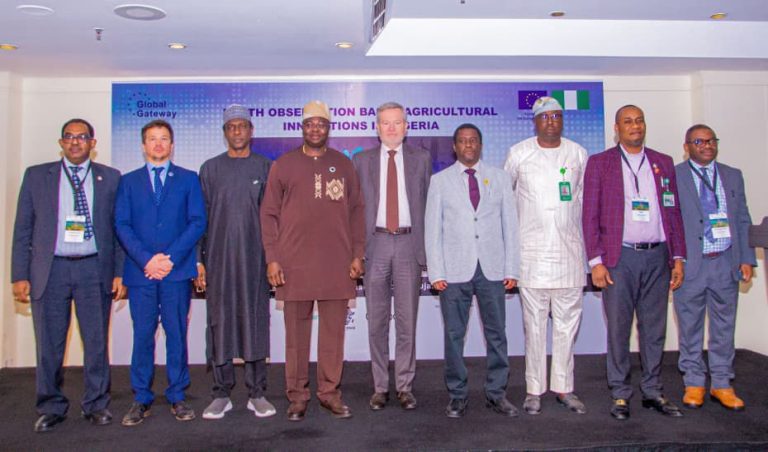
    In a major stride towards agricultural transformation and national development, the Honourable Minister of Innovation, Science and Technology, Dr. Kingsley Udeh, SAN, has emphasized the need for the deployment of space based capabilities in order to guarantee food sufficiency in the country.

    He made the statement while delivering a keynote address at the launch of the Earth Observation-based Agricultural Innovations Project held at the Transcorp Hilton Hotel in Abuja.

    The Minister, who was represented by the Permanent Secretary of the Ministry, Dr. Muktar Yawale, described the initiative as timely and transformative, noting that it provides a strategic platform for revolutionizing Nigeria’s agricultural sector.

    While commending the National Space Research and Development Agency, NASRDA, for its leadership and commitment to deploying space based solutions for Nigeria’s socioeconomic development, the Minister added that the project aligns with the Renewed Hope Agenda of President Bola Ahmed Tinubu, particularly in advancing agricultural development.

    Dr. Udeh noted that the integration of satellite-based data and geospatial intelligence will enable effective monitoring of crop performance and support precision farming practices.

    According to the Minister, such innovations are critical to achieving national priorities, improving productivity, and ensuring sustainable agricultural growth.

    In his address, the Honourable Minister of Agriculture and Food Security, Senator Abubakar Kyari, CON, described the initiative as a vital pillar of the Renewed Hope mandate, marking a transition from traditional farming methods to a modern, data-driven agricultural framework.

    Senator Kyari who was represented by the Director of Agricultural Land and Climate Change Management Services, Mr. Olanipekun Oshadiya, stated that integrating advanced technology into Nigeria’s agricultural system will ensure a more resilient, competitive, and scientifically driven sector.

    Also speaking, the European Union Ambassador to Nigeria, His Excellency Gautier Mignot, noted that the project not only strengthens the partnership between Nigeria and the European Union but also serves as a platform for improving the livelihoods of Nigerians.

    He explained that the initiative is part of the EU Global Gateway Strategy, which prioritizes the modernization of agricultural practices.

    In his welcome address, the Director General and Chief Executive of NASRDA, Dr. Matthew Adepoju, described the project as a strategic intervention aimed at bridging the gap between uncertainty and informed decision-making in the agricultural sector.

    He emphasized that access to accurate, timely, and reliable data is essential for improving productivity and achieving food security, adding that the initiative will provide stakeholders with actionable insights for effective planning and resource management.

    Dr. Adepoju further reaffirmed NASRDA’s commitment to advancing the application of space science and technology as a key driver of national development.

    He stated that the Agency will continue to leverage innovation, research, and strategic partnerships to deliver practical solutions that address real-world challenges, particularly in agriculture, climate monitoring, and sustainable development.

    Providing technical insight into the project, the Director of Strategic Space Applications at NASRDA, Dr. Godstime James, explained that the use of satellite imagery, remote sensing, and geospatial analytics will enable near real-time monitoring of agricultural systems.

    According to him, the technology will support vegetation assessment, land use and land cover analysis, and yield prediction, thereby enhancing planning and decision-making processes.

    The project, funded by the European Union and implemented by the European Space Agency in collaboration with NASRDA, represents a significant milestone in Nigeria’s efforts to build a technologically driven and sustainable agricultural sector.

  • Over 60,000 Farmers to Benefit from Free Fertilizer, Farm Inputs as Gov Mbah Flags Off Distribution

    Over 60,000 Farmers to Benefit from Free Fertilizer, Farm Inputs as Gov Mbah Flags Off Distribution

    …Mbah has increased functional tractors in Enugu from less than 5 to hundreds in 2 years – Farmers Union chair

    Over 60,000 farmers across Enugu State are set to benefit from a new round of free fertilizer and agro-inputs distribution as Enugu State Governor, Dr. Peter Mbah, weekend, flagged off the exercise on Saturday.

    The event, attended by thousands of farmers and stakeholders at Okpara Square, was described as another bold step towards food security, poverty eradication, rural prosperity, and the transformation of farming into profitable venture in the state.

    Governor Mbah, who recalled that his administration distributed 12,000 bags of fertilizer alongside power tillers, seedlings, cassava stems, and herbicides at no cost to farmers last year, said the 2024 intervention had led to bumper harvests and reduced food prices across the state.

    “Therefore, it gives me great joy to be here today to flag-off the distribution of over 40,000 bags of free fertilizers and other agro inputs. Our farmers are the backbone of our communities – the hands that till the soil and bring food to our tables. Without you, there is no sustenance, no prosperity, and no growth,” he said.

    The governor announced that 200-hectare Farm Estates were being established in each of the 260 political wards in the state, complete with irrigation systems, warehouses, tractor sheds, and power supply.

    He revealed that 102 tractors had already been delivered, another 98 on the way, while 800 more would soon be assembled at the tractor plant nearing completion in the state capital.

    “Farming is big business. That is why we are upgrading the Enugu State Polytechnic, Iwollo, into a University of Agriculture to train the next generation of agricultural scientists, entrepreneurs, and innovators,” Mbah added.

    He also reaffirmed ongoing efforts to establish Agro-Industrial Processing Zones and Agricultural Transformation Centres across the three senatorial zones.

    The governor stressed that the free inputs would go directly to registered farmers in the state’s database without middlemen.

    “There is no red tape. The only pre-condition is to be a registered farmer. Currently, we have over 60,000 farmers in our database,” he said.

    In his remarks, the Commissioner for Agriculture and Agro-Industrialization, Hon. Patrick Uburu, praised the governor for inspiring what he called “an agricultural revolution in the state,”noting that long-abandoned assets such as Enugu United Palm Products, Adarice Irrigation Scheme, Ojor and Mgbagbu Owa irrigation projects, and Sunrise Flour Mill had been revitalised under the Mbah administration.

    Uburu highlighted new initiatives under the governor, including the Enugu State Livestock Productivity Centre, a Cocoa Development Initiative targeting 3,000 hectares by 2027, greenhouse farming with 2,000 greenhouses by 2026, and export warehouses for cashew processing.

    He further commended the governor’s approval of crop insurance premiums to protect farmers against climate shocks and pests.

    “Today’s event signifies a new chapter; an affirmation that the Governor is fully committed to transforming our rural communities into vibrant centers of economic growth and prosperity. The sense of pride I derive as Commissioner is immeasurable. It is all thanks to His Excellency, Dr. Peter Ndubuisi Mbah – a man for whom there are no impossibilities,” Uburu said.

    The Chairman of the All Farmers Association of Nigeria (AFAN), Enugu chapter, Mr. Romanus Eze, also lauded the governor for fulfilling his promises to farmers, even as he recalled that Enugu once had fewer than five functional tractors, but now had over 200, with a tractor assembly plant already set up in the state.

    “The governor has not only given us inputs, he has brought mechanisation to our doorsteps. He promised 1,000 tractors, and today we are seeing them. The Farm Estates that are coming up in every ward, the new seed laboratory, and the support from traditional rulers for land access are transforming agriculture into real business,” Eze said.

    Similarly, the Chairman of Enugu North Local Government Area, Dr Ibenaku Onoh, described Mbah as “a governor, who does the big things as well as the small things,” stressing that the distribution of inputs in every ward reflected inclusive governance.

    “What you are doing is to move Enugu from a state of consumption to a state of production. In agriculture, transport, water, and other sectors, you are doing wonders. The people are happy, and we promise to continue protecting your mandate,” he said.

    The ceremony ended with the symbolic distribution of fertilizers to farmer cooperatives from the 17 local government areas, which stakeholders described as “a giant leap towards food security and sustainable rural development.”

  • Mbah Flags-off Revitalisation of N100bn Deal Enugu United Palm Products Ltd

    Mbah Flags-off Revitalisation of N100bn Deal Enugu United Palm Products Ltd

    …Says it’s triumph of vision over cynicism

    Governor of Enugu State, Dr. Peter Mbah, Thursday, performed the formal flag-off of the revitalisation of the Enugu United Palm Products Limited, EUPPL.

    The flag-off, which took place at Ibite-Olo, Ezeagu LGA of the state, was sequel to the N100bn deal between the Enugu State Government and Pragmatic Palms Limited, PPL, in May this year.

    At the event during which he equally performed the groundbreaking for the staff quarters at the plantation, Mbah thanked the people of the state for believing in his vision and determination to revive and convert the state’s moribund assets to productive assets.

    “For me, this flag-off is a triumph of vision over cynicism. Recall that a few months ago, when we announced an investment of N100bn in partnership with Pragmatic Palms Limited, the news was greeted with a lot of cynicism and doubt. We had a lot of naysayers and critics, who ascribed all sorts of things to this humongous investment. But as you have seen, we were absolutely clear as to what we wanted to achieve and accomplish for our people in Enugu State.

    “So, what this groundbreaking ceremony represents for us is a new lease of life for Pragmatic Palm Product Limited. It also shows that we are getting closer to our dream to transform Enugu State as a premier destination for investment, industry, tourism, business and living.

    “Therefore, I want to use this opportunity to reassure the management and executive of PPL of our commitment to supporting every step of this investment,” he said.

    Speaking, the Managing Director/CEO of Pragmatic Palms Limited (PPL), Prof. George Nwangwu, rolled out a five-year aggressive plan to reposition EUPPL as one of the leading integrated oil palm establishments in Nigeria, playing in the upstream, midstream, and downstream sectors.

    He added that the firm would create 3,500 direct and indirect jobs.

    In the upstream, he said that with only 40 per cent of the 6,700 hectres of land planted so far, EUPPL would embark on aggressive planting of the unplanted lands, increasing the planted area to at least 20,000 hectres in five years.

    In the midstream, Prof. Nwangwu said, “We will set up world-class oil mills across the three locations as well as increasing the oil production capacity over time.

    “We will also set up and improve our refining capacity to produce crude palm oil, palm kernel oil, olein, stearin, biodiesel, as well as refined, bleached, and deodorised oil.

    “In the downstream, we plan to have a share of the retail market by setting up the largest network of agents to aggregate fresh fruit bunches from around our catchment area.”

    In her remarks, the Commissioner for Trade, Investment and Industry, Adaora Chukwu, recalled that EUPPL, originally established by the government of the defunct East Central State in 1970 on 6,700 hectares traversing Ibite-Olo in Ezeagu LGA, Ugwuoba in Oji River LGA, and Umulokpa in Uzo-Uwani LGA, though initially viable, was crippled by mismanagement, obsolete equipment, and limited market access.

    She, however, said that the N100bn joint venture sealed between the state government and Pragmatic Palm Limited in which the state provides the land/plantations, while PPL provides finance for 60 per cent of the transaction, would see to the turnaround of the company to the immense benefit of the state through job creation, economic diversification, infrastructural development, revenue generation, technology development, innovation, among others.

    The Commissioner for Agriculture and Agro-Industrialisation, Patrick Ubru, said the partnership between the Enugu State Government and PPL towards the revitalisation of EUPPL was very strategic to the overall vision of the Mbah administration for the agriculture sector.

    Meanwhile, the host communities, lauded Governor Mbah for reviving the EUPPL after over 40 years of dormancy and ruin, with a businessman and community leader from Olo, Johnmary Anagolu, pledging a donation of N50m to support the administration’s infrastructural development in the area.

  • Enugu targets N100bn livestock production, processing potential, as state welcomes first veterinary hospital

    Enugu targets N100bn livestock production, processing potential, as state welcomes first veterinary hospital

    Governor Peter Mbah of Enugu State has disclosed that the administration has set a target of over ₦100 billion from livestock production and processing.

    The move, he said, would boost the economy, scale up the capacity of farmers in animal husbandry, and strengthen value chain across the spectrum of agricultural sector in the state.

    The governor stated this while receiving a delegation from the Livestock Productivity and Resilience Support Project (L-PRES) led by the National Project Coordinator, Sanusi Abubakar, who were in Enugu for the flag-off of the first Regional Enugu Model Veterinary Hospital in Enugu on Monday.

    He expressed excitement
    that the veterinary hospital was coming at a time the state was focused on scaling up meat and dairy production that would serve the state and beyond.

    Mbah further stressed that the recent Enugu State Ranch Management Agency Law was conceived to unlock economic opportunities for the state, create employment opportunities in the livestock space and contribute to the growth of the Gross Domestic Product from $4.4 billion to $30 billion.

    “We saw that we needed to start putting in a robust policy or a legal framework that can support these policies. We are aware that Enugu has a market size of over ₦100 billion, and we are quite ambitious in the growth projection of our GDP,” he noted.

    While underscoring all the frameworks that the administration had put in place to unlock the economic potential in the sector, the governor maintained that the state had enough capacity to produce enough “meat and dairy products for export, which would require skills in processing and packaging.”

    He called on investors to seize the opportunities in the new ranch law, the veterinary hospital and the robust partnership between the state and the L-PRES to invest in the state, assuring sustained security of lives, property and investments.

    Speaking earlier, the L-PRES coordinator, Abubakar, informed the governor that they visited to inspect the site and flag off the construction of the hospital.

    According to him, the hospital, on completion, would, among others, carry out disease surveillance, maintain a healthy animal husbandry, conduct disease eradication services as well as vaccination of animals.

  • Tinubu approves 150-day duty-free window for importation of maize, rice, wheat

    Tinubu approves 150-day duty-free window for importation of maize, rice, wheat

    The federal government has approved a 150-day duty-free window to allow the importation of maize, husked brown rice and wheat as part of measures to combat rising food inflation in the country.

    The Minister of Agriculture and Food Security, Sen. Abubakar Kyari disclosed this in a press statement as part of the implementation of the Presidential Accelerated and Stabilisation Advancement Plan (ASAP).

    According to the report, the federal government hopes to quell the food security problem in the next 180 days through the granting of 150days import window for certain food commodities, while the federal government will import 250,000 metric tonnes of wheat and maize to fill the depleted strategic grain reserve.

    Furthermore, the federal government will engage stakeholders to get a Guaranteed Minimum Price (GMP) for commodities, ramp up production especially among small holder farmers in the 2024/2025 farming season, promotion of production of fortified food commodities and others.

    It stated, “The EMT has been meeting day and night working out the best modalities to achieve the best results for Nigerians. To ameliorate food inflation in the country caused by affordability and exacerbated by availability, the government has taken a raft of measures to be implemented over the next 180 days:”

    1. “A 150-Day Duty Free Import Window for Food Commodities
    2. suspension of duties, tariffs and taxes for the importation of certain food commodities (through land and sea borders)
    3. these commodities include Maize, Husked Brown Rice, Wheat and Cowpeas
    4. under this arrangement, imported food commodities will be subjected to a Recommended Retail Price (RRP).
    • In addition to the importation by private sector, Federal Government will import 250,000MT of Wheat and 250,000MT of Maize. The imported food commodities in their semi processed state will target supplies to the small-scale processors and millers across the country.
    • Engage relevant stakeholders to set a Guaranteed Minimum Price (GMP) and mop up surplus assorted food commodities to restock the National Strategic Food Reserve.
    • Continuous ramp-up production for the 2024/2025 farming cycle.”

    The Minister of Agriculture also noted that the Ministry in the next 14days will collaborate Presidential Food Systems Coordinating Unit and the Economic Management Team (EMT) to finalise the implementation frame work for the policy initiatives.

    The approval to grant food imports contrasts the Presidency’s earlier position on food import where it stated that Nigeria should grow what it eats stating it has the potential to feed itself and export.

    Nairametrics earlier reported that the federal government is looking into temporary importation of food items to stem the rising tide of food prices in the country.

    Nigeria is battling one of the worst food crises in a generation as food inflation in May 2024 crossed 40%. Data from the NBS reveals that staple food prices like rice, maize, wheat, bread, beans and others have risen by over 100% on average in the last one year.

    Projections of international development organisations like the World Bank, FAO, World Food Program (WFP) and others states that around 32 million Nigerians will face severe hunger in 2024 over the current food crisis.

    Nairametrics

  • ONE YEAR IN OFFICE OF GOV. PETER MBAH: Xraying Mbah’s Strides in the Agricultural Sector – A Chat with Patrick Ubru, Enugu State Commissioner for Agriculture and Agro-Industrialization

    ONE YEAR IN OFFICE OF GOV. PETER MBAH: Xraying Mbah’s Strides in the Agricultural Sector – A Chat with Patrick Ubru, Enugu State Commissioner for Agriculture and Agro-Industrialization

    Patrick Nwabueze Ubru is the Enugu State Commissioner for Agriculture and Agro-Industrialization. With his professional career as a banker spanning close to 14 years, Ubru was Head of Public Sector at First Bank of Nigeria, coordinating activities for the expansion of Agriculture. He was also the Pioneer Manager of the Nsukka branch of NIRSAL, an agency of the CBN, with interventions in the agricultural sector. He is an agricultural consultant and a fish farmer. In this interview with Pacesetter, Ubru lets us in to the achievements of Gov. Peter Mbah in the agricultural sector in the first year of his administration. Dateline: May 22, 2024.

    Give us a Food Map of Enugu State

    Enugu State is blessed with abundant resources, land, water and climate. Enugu State has the richest soil in Nigeria. Majorly, we grow cassava. We have been adjudged the largest producer of cassava in the country. We grow Maize, Sorghum, Rice, Groundnut, Tomatoes, Ose Nsukka (Yellow pepper), Yam, Cocoa, Oil Palms, Sesame, different fruits too. As a matter of fact, we produce rice in large quantities better than any other state in the Southeast. Little wonder that on December 8, 2023, we unveiled ‘Enugu Rice’ to support our farmers to stop transporting our rice paddy to other states. So, we take pride to say that we’re the largest rice producers in the country. Anyone can challenge us on that. There’s no crop that can’t grow in Enugu. Enugu State is also the highest producer of cashew. Apart from the state owned cashew plantations, there are pockets of cashew plantations owned by individuals and communities in the state.

    Since you assumed office, what interventions have you provided to the agricultural sector?

    We have done quite a lot of interventions in the agricultural sector, most importantly for our smallholder farmers. We understood that for us to scale up our production, we will need to get into dry season farming as is obtainable in the North. So, we introduced dry season farming and in doing that, we decided to train our farmers. We took rice as an example because we found out that within the Owo, Idodo, Amankanu and Ubahu axes, those places are rice belts but our small scale farmers farming there did not have the modern knowledge on how to grow rice and optimize their potentials. So, we instituted a team to teach them this and it’s still ongoing. Besides that, we have also provided solar water pumping machines for them to aid the dry season farming. If you go to Nenwe, Oduma, you will see our smallholder farmers enjoying such facilities. Leveraging on the strengthened relationship we enjoy with the Federal Ministry of Agriculture and Food Security, we have also distributed seedlings, fertilizers to our farmers. Soon, we will be distributing rice seeds to over 1,200 farmers in Adani.

    Let us in on Agricultural programs currently ongoing or in the pipeline.

    There are a lot of programs. I want to emphasize that the state is keen on expanding its agricultural production capacity. Currently, we cultivate on 111,000 hectares of land but the state has made a bold commitment on adding 300,000 hectares to our agricultural space. Why do we want to do that? The state has a policy of encouraging large scale farming. In the month of March, we signed an agreement with a private investor to cultivate 15,000 hectares of land in Ikem, Isiuzo and work has commenced. He will be cultivating cassava, maize, rice, soybeans, etc.

    You asked about initiatives. We have this cassava to bioethanol value chain development where we undertake an end to end approach on cassava development, from the seed multiplication to planting to harvesting to processing to different byproducts of cassava, up to bioethanol refining. The guarantee is that any cassava cultivated in Enugu state must be off taken one hundred percent. Another initiative is the Special Agro-Processing Zones (SAPZ) which the Governor of Enugu State has also assured Ndi Enugu will be established in the three senatorial districts of the state. The pilot SAPZ is already coming up in Owo. We have done the feasibility study and environmental impact analysis for the take-off of the pilot SAPZ, sponsored by Africa Development Bank, other private investors and the state government. It’s a whole lot of thing that the state government is doing. Yet another initiative is the Green Smart School where we’re developing smart farms so that we can teach our children, at a tender age, to embrace agriculture. In 260 Green Smart Schools, we will be having 260 smart farms. There’s still the ‘Food For All’ initiative but it’s still in the pipes. So, there are lots of initiatives by the state government.

    Are the Green Smart Schools different from the Smart Schools the governor is constructing in every ward of the state?

    No, they are not different. I’m trying to tell you that we are incorporating smart farms as a part of the smart school. If you go to Owo, the smart farm is under construction and will be ready by next week. We will be training the school children on Poultry, Piggery, Fish Farming, etc. There will also be a greenhouse and an agro forest. We will be using organic materials to grow crops. It’s going to be an integrated farm where there will be zero waste because the waste of one aspect will be converted for use in another aspect.

    What exactly are the Special Agro-Processing Zones? What difference will they make?

    It is basically bringing a processing cluster close to where the agricultural produce is cultivated in abundance. The agro processing zone will have an industrial aspect where our produce will be processed, packaged and ready for export. SAPZ is a huge employment opportunity for Enugu people. It will employ not just those in the primary production but also those who are engaged in the secondary production, which is the value addition and those in the tertiary production which involves packaging, logistics and the rest. It is a holistic approach to lifting the people of Enugu out of poverty. The pilot processing zone is to be located in Owo. We have carried out the feasibility study and we believe that before the first quarter of 2025, that zone would have started. Apart from the African Development Bank, the state government is also approaching private investors.

    Your Ministry seems pivotal to the governor’s plan of growing the state’s economy from $4.4bn to $30bn, a projection some believe is impossible.

    Agriculture all over the world is the surviving strategy of every nation. It is the mainstay of any economy. Agriculture employs over 70% of the population, maybe basically for subsistence farming. Our governor has promised to cause a rebirth in Agriculture through the introduction of technology to appreciate the yield beyond subsistence farming. In the process of expanding production, more jobs will be created. Beyond this, our governor has said we are going to add value to our crops. This is going to the secondary and tertiary aspects of agriculture which will involve processing, packaging and export of our agricultural products to consumers in other states and countries. So, the governor is visionary, he knows what he is doing and it’s not lost on him that agriculture is the main driver of the economy.

    One of the greatest challenge to farming is insecurity. In practical terms, what is being done to arrest this so that food insecurity doesn’t become a thing in the state?

    Our governor does not joke with security. Let me give you an instance. If you go to Isiuzo, the Ikem-Nkwo axis to Odenigbo, down to the boundary of Enugu and Benue states, suspected Fulani herdsmen had chased the indigenes of the community away but if you get there today, because that is where the Enugu State Produce City, the first of its kind, will be, you will find out that the government has established a military base there. If you also go to Uzo-Uwani where you also hear about issues between communities and herdsmen, the kind of security presence there is incredible. Naval officers are occupying Uzo-Uwani because they are building their naval base, school and hospital in Ogurugu. Intentionally, the governor asked them to move in to Adarice to provide security for the rice farmers. So, the governor is not joking with security at all. Besides these, we are also in talks with the Nigerian Security and Civil Defence Corps, NSCDC, to activate the Agro-Rangers which was established in the Buhari administration. Our farmers are encouraged to go back to their farms.

    Between February 2023 & February 2024, food inflation stood at 30.07% nationally. In Enugu, what’s being done to increase the purchasing power of the people?

    Once money is chasing few goods, there’s always inflation. Food inflation may also have been caused by what is known as cost-push inflation because there are a lot of things that go into production of food. You talk about the transportation of the produce from the farm down to the market. It’s a factor. Come to Enugu state, when you see a government that has gone head on to provide infrastructures like roads, to ease the transportation of food produced to the market, it will more than reduce the cost of food. When you see a governor who’s interested in providing good health facilities to enable even farmers take good care of their health and not lose some days due to sickness, it will help to reduce food inflation. When you see a government that is interested in educating the citizens, inclusive of farmers, to have more knowledge in producing more food, because if we expand our production base, definitely it will knock down the cost of food items. When you see a government encouraging everybody and every household in Enugu state to plant something even behind their compound, it will more than reduce the cost of food. So, a government that has a strategy, supporting its farmers, will reduce the cost of food. Once we produce what we eat here we, becoming self-sufficient, definitely the cost of food items will come down. Once you arrest the price of food items, you arrest the price of other things needed to aid life.

    Are there agricultural taxes presently collected?

    Obviously, there should be agricultural taxes collected for instance, for veterinary services. Veterinary services are not in the primary production line. These taxes are however very friendly, not painful, because agriculture is a sector every government wants to support and subsidize, to be able to extend help to farmers.

    Are there agricultural produce from the state that have hit the markets nationwide?

    Of course. For instance, our rice, our cassava are in the market. As I speak to you, we export cassava chips outside Nigeria. We also get demand from Lagos to buy our cassava chips. We also have El-shaddai Foods producing sorghum flour. These things are in the market. Our honey is one of the best of its kind and it’s in the market. Our cashew, yellow pepper, palm and so many others

  • Enugu targets lead in cashew production in Nigeria, flags off 2024 cashew season

    Enugu targets lead in cashew production in Nigeria, flags off 2024 cashew season

    Governor of Enugu State, Dr Peter Mbah, has flagged off the 2024 National Cashew Day and Cashew Season, assuring boost in the industry in order to make the state the hub of cashew production in Nigeria.

    The Governor, who was represented by the Commissioner for Agriculture and Agro-Industrialization, Hon Patrick Ubru, officially flagged-off the 2024 cashew trading season at an event organised by the National Cashew Association of Nigeria (NCAN), in Enugu, on Wednesday, stressing that Enugu State is known as a land for cashew production in the country.

    Speaking on the theme, “Transforming Nigeria cashew industry through Technology, Innovation and Inclusive policies”, Governor Mbah commended the leadership of NCAN for choosing Enugu State for this year’s event noting that the state has played a central role in the production of cashew in Nigeria over the years.

    He recounted how the national production of cashew went down from splendour in the early 1960s to a distant 14th position on the rung of the ladder, far behind neighbours like Cote D’Ivoire, Benin and Mali.

    Mbah said that agriculture is expected to play a significant part of driving private sector investment due to the endowment of arable lands, favourable climate patterns and also agriculture being a natural occupation of most of majority of the people in the state making cashew one of the focal crops along side cassava, rice, oil palm and variety of spices.

    He expressed hope that the event would provide key stakeholders in the industry an opportunity to engage in some deep thinking about strategies required to reignite the dynamism of the industry as quickly as possible.

    Mbah reassured of his commitment to continue to work closely with partners and stakeholders such as NCAN and others in making cashew one of the leading foreign exchange earners for the country and a veritable source of livelihood for the state.

    Earlier, in a key note address presented by the Speaker of the House of Representatives, Rt Hon. Tajudeen Abbas who was represented by the Chairman, House Committee on Agriculture, Dr Adeyemi Akinyemi, commended the governor for enacting policies since assumption of office which directed at the revamping of agriculture and making Enugu a productive state.

    According to the Speaker, Nigeria currently ranks 6th largest producer of cashew, with an annual production of 120,000 tonnes and a trade value of ₦24 billion.

    He stated that the market projection for 2030 by the Nigerian Export Promotion Council is that Nigeria will reach 300,000 metric tonnes of cashew production, solidifying the country’s place on the global stage with rapid growth in cashew kernel exports, predominantly to the USA. These, he said, were accomplished despite the traditional farming methods, insisting on possibilities of remarkable improvement through innovative technology backed up by legislation that safeguards the sector.

    The President, National Cashew Association of Nigeria, Dr Ojo Joseph Ajanaku, who gave an overview of the history and roles of the Association said its vision is to make the country’s cashew industry the most reliable and credible supplier and exporter of high quality cashew products in a sustainable manner.

    He said that Enugu was choosen because of the large cashew production commenced under under the Micheal Okpara administration in the defunct Eastern Region, adding that although the purpose then was primarily targeted at erosion control, unlike now that it has become of high economic value.

    The high point of the event was when Governor Mbah was presented the Best Achiever Award in recognition of his contributions towards agricultural development, food security, and economic advancement by the Speaker of the House of Representatives. ‎

    Also in attendance were the representative of the Governor of Abia State, representative of the Federal Minister of Agriculture and Food Security, representative of the Minister of Industry, Trade and Investment, Commissioner of Agriculture Edo State, donor partners such as GIZ and NEXIM.

  • Enugu Gov’t intensifies cassava production, as Uzo-Uwani targets 500 hectares of cassava farm

    Enugu Gov’t intensifies cassava production, as Uzo-Uwani targets 500 hectares of cassava farm

    In its effort to boost food security, create jobs, and grow the state’s gross domestic product (GDP), the Enugu State government has intensified cassava production by targeting over 500 hectares of farmland in Uzo-Uwani Local Government Area of the state.

    Recall that the state governor, Dr Peter Mbah had announced his administration’s collaboration with the Federal Ministry of Finance, together with Bio-source Technology Limited, a private sector firm, to establish bioethanol plants at Affa and Egede communities in Udi Local Government Area of the state.

    The Enugu State Commissioner for Agriculture and Agro-industrialization, Mr Patrick Ubru, who was accompanied by the Chairman of Uzo-Uwani local Government Area, Mr. Celestine Chukwudi Nnadozie, during an inspection tour of the cassava farmlands in Umulokpa, Uzo Uwani LGA, on Tuesday, restated the resolve of the Peter Mbah administration to create jobs, eradicate hunger, and reduce the poverty headcount index in the state to zero by 2031.

    Stressing that cassava has about 34 products and over 200 by-products that could be used by different industries, especially the pharmaceuticals, he assured that the government had concluded plans to boost cassava to bioethanol value chain development in the state.

    “I am happy with what I have seen here today. I thank the people of Uzo Uwani for joining the state in Governor Peter Mbah’s determination to implement cassava to bioethanol value chain development in the state. Governor Mbah is relentless on this, and he is ready to get every facility put in place to actualize the project.

    “It is not only that we want to ensure food security in Enugu State, we also want to industrialize, harvest, process and package our products, and export them overseas to boost our economy”.

    Ubru noted that the three local governments of Nkanu East, Uzo-Uwani, and Aninri represented each of the three senatorial districts of the state in the pilot scheme, expressing the hope that it would be extended to the others.

    Also speaking, the Chairman of Uzo-Uwani Local Government Area lauded Governor Mbah’s commitment to revive agriculture in the state, assuring the council’s readiness to support the government actualize its objectives.

    Nnadozie said Uzo-Uwani was targeting over 500 hectares of cassava farmlands, adding that 200 hectares had already been cultivated in communities such as Umulokpa, Ukpata and Uvuru, while Nimbo and Abbi were willing to assist towards meeting the 500 hectares target.

    He reiterated that Uzo-Uwani was blessed with fertile lands for different crops, saying the soya beans that were intercropped with the cassava in the area were doing very well.

    The Supervisor for Agriculture in Uzo-Uwani, Chika Aruma, and the Head of Agriculture Department, Dr. Anya Donatus who spoke on behalf of the people, thanked the governor for finding Uzo-Uwani worthy to benefit from the project, saying it would not only keep the youths busy and assist in crime reduction, but would equally pave way for development in the area.

  • Enugu Commissioner for Agriculture, Ubru inspects Special Agro Processing Zone in Nkanu East

    Enugu Commissioner for Agriculture, Ubru inspects Special Agro Processing Zone in Nkanu East

    …meets with land donors

    Enugu State Commissioner for Agriculture and Agro-Industrialisation, Patrick Ubru, according to a report made available to Pacesetter, on Thursday, inspected the Special Agro Processing Zone in Owo, Nkanu East Local Government Area.

    The land, which is over 500 hectares, was donated by the people of Owo community to serve as a processing zone for the entire Enugu East senatorial zone.

    The Commissioner and officials of the ministry, accompanied by the Chairman of Nkanu East Local Government, Hon. Okechukwu Sydney Edeh, during a brief stopover at the palace of the traditional ruler of Mbulu Owo, Igwe Okeke Arum, met with the village heads who expressed their readiness to give the state government maximum support on the project.

    The council chairman, while introducing the visitors to the people of Owo, expressed joy over the interest and cooperation shown by them by donating the large expanse of land for agricultural purpose, saying it was in line with Governor Mbah’s promise to make Enugu the number one exporter of agricultural produce in the country.

    Speaking, the Commissioner gave details of how the lands would be utilized, reminding them of the benefits they would get from citing the project in the area, while commending them for their support in ensuring that the governor succeeded in his stated desire for food security and eradication of hunger in the state.

    “I want to assure the people of Owo, Nkanu East and Enugu East zone in general that this project will create numerous employment opportunities for the people and equally develop the area,” the commissioner assured.

    Also speaking, an agricultural expert, Prof. Nnaemeka Chukwuone of the University of Nigeria Nsukka, who was among the team led by the Commissioner, said they were in the host community to help the state in conducting environmental and social impact assessments to ensure there would be no negative environmental impact of the project on the people.

    According to him, it was necessary to conduct feasibility and envionmental studies to ascertain the profits expected to be made and recommend measures to avoid environmental depletion.

    Speaking for the host community, Igwe Okeke Arum lauded the state government for its readiness to embark on extensive agricultural revolution targeted at increasing the gross domestic product (GDP) of the state, assuring of their eagerness to provide more lands if need be.

    “The people of Owo are happy and we are yearning for more projects like this to come to our land because it will bring in development and create employment for our people,” Igwe Arum said.

  • Enugu: Hope for dry season farming following built Dam, as Agric Commissioner, others tour Adarice

    Enugu: Hope for dry season farming following built Dam, as Agric Commissioner, others tour Adarice

    The Enugu State Commissioner for Agriculture, Patrick Ubru, today, Tuesday led a delegation from the Federal Government and the Enugu Ministry of Agriculture to Adarice Farm in Uzo-Uwani Local Government Area of Enugu State, to inspect projects and interact with farmers.

    The delegation, which comprises the Chairman, House Committee on Agriculture and member representing Nsukka East in the Enugu State House of Assembly, Hon. Ejike Eze, Special Adviser to the governor of Enugu State on Donor Relations, Dubem Onyia (jnr), Zonal Program Coordinator, Agricultural Transformation Agenda Support Programme (ATASP 1), Egba Romanus, Enugu-born investor and agriculturist, Alhaji Sani Friday Nnaji, Project Manager, Diyoke Consultant Ltd, Engr. Sunday Okonkwo, among others, inspected some completed and ongoing projects in Adarice Farm, viz. Northern Zone, Eastern Zone and Adarice World Bank Zone.

    Leading the delegation round the different zones, the Project Manager, Diyoke Consultant Limited, Engr. Sunday Okonkwo introduced the newly built Obinna Bridge, which was a federal government sponsored project through ATASP-1, irrigation facilities which will be supplying water to all the farms during dry season and other successful projects executed by the ATASP through his company.

    Mr. Okonkwo reiterated that all the earth works which needed to be done on all the roads in the site have been done, maintaining that there is need for the other contractor, Anbeez Construction Company which stopped the tarring of the major link roads as a result of the then collapsed Adarice Bridge, to complete the work since the bridge has been rebuilt.

    “This Obinna Bridge is the major entrance way to Adarice Farm, it was rebuilt by the ATASP-1. We also have a dam somewhere up there which may be 10 kilometers away from this Northern Zone. From the dam, you will get the primary canal which supplies water to the secondary and then to the distributory canal (tertiary) which now supplies directly to the farms. With this in place, farmers can start their dry season farming by this upcoming dry season,” Okonkwo said.

    Lending voice, the Zonal Program Coordinator, Egba Romanus stated that the earth work into Village One and Village Two where some of the farmers are living that should be done by ATASP-2 would soon start.

    The Zonal Program Coordinator while on a visit to the Adani Ricemill with the Commissioner and his team, assured the traders at the Ricemill that the issue of flooding being experienced in the environment of the newly built market would soon be solved to enable them utilize the place.

    “This market was built to ensure comfort for the Adani Rice traders, and their business. The market is already completed, we shall sand-fill the environment and make sure that the traders do not experience any discomfort during their trade,” ATASP-1 Zonal Program Coordinator assured.

    The Commissioner while expressing happiness over the numbers of successful works done in Adarice Farm and Ricemill thanked the ATASP-1 coordinator and his team members for their good works, reminding the farmers that the intention of Governor Mbah’s administration is to unlock the rural areas through numerous agricultural programmes, provision of access roads and other agricultural facilities, educating the farmers on modern agro developments, ensuring that farming in Enugu becomes completely tech-driven, among others.

    “The Gpvernor and ATASP are serious in making sure that their mission in agriculture is realized. According to the Governor of Enugu State, Dr. Peter Mbah, his administration is business unusual. We are in a new era where the governor will be delighted to see the rural areas unlocked through agricultural revolution. Uzo-Uwani is well known for agriculture and I am very sure that we can feed the entire state. We are ready for any kind of farming you can think of, and we equally have investors who are also interested. Here with us is Alhaji Sani Nnaji, a top agricultural investor and we also have Chairman, Committee on Agriculture from the Enugu State House of Assembly, Hon. Ejike Eze. This is to tell you that we are here for a serious business,” the commissioner stated.

    He further urged the farmers to ensure that their accurate data is being sent to the Ministry of Agriculture to enable the ministry communicate with them whenever there is any intervention programme from the state government, reiterating that the government of Peter Mbah is out to give farmers all the needed assistance that will enable them thrive.

    While taking a tour from Adarice Farm down to Adani Ricemill where he had met with the leadership of the Adani Rice Producers and Marketers Association who expressed their happiness on the projects being executed by the federal government through its ATASP -1 programme, the Commissioner applauded the Zonal Coordinator of ATASP -1, Egba Romanus for a job well done in the newly built Adani Ricemill, and requested that the traders should immediately relocate to the new Ricemill once the environment has been sand-filled to avoid the flood which the marketers complained was the reason for not using the newly built market.

    Ezea Cyprain, Bernard Idu, Diugwu Christian, among others who spoke on behalf of the farmers and traders expressed their readiness to cooperate with the state government to enable the mission and visions of the Governor in making sure that Enugu becomes the number one exporter of agricultural produce would be achieved.

  • Farmer/Herder Clashes: Tinubu Okays Establishment of Presidential Committee to Bolster Livestock, Dairy Industries

    Farmer/Herder Clashes: Tinubu Okays Establishment of Presidential Committee to Bolster Livestock, Dairy Industries

    President Bola Tinubu has approved the establishment of a Presidential Committee dedicated to the reform of the livestock industry and the provision of long-term solutions to recurring clashes between herders and farmers in the country.

    The President announced the establishment of the Committee on Thursday in Abuja, following the submission of a report from the National Conference on Livestock Reforms and Mitigation of Associated Conflicts in Nigeria.

    The Conference was convened by the former Executive Governor of Kano State and Chairman of All Progressives’ Congress (APC), Dr. Umar Abdullahi Ganduje.

    The President explained that the Committee is expected to collaborate with the Federal Ministry of Agriculture and Food Security, and propose recommendations aimed at fostering a peaceful co-existence between herders and farmers while ensuring the security and economic well-being of all Nigerians.

    “The Federal Government is fully prepared to cover the cost of acquiring the land. These opportunities will provide gainful employment for our veterinary doctors, while opening doors for the private sector as the provision of new educational opportunities for herders’ and their children emerge. Medical facilities will be established. This is a life-changing opportunity that we have.

    “Imagine us producing enough milk for our school children. Imagine us becoming net exporters of cheese and yoghurt. Imagine us producing the skin massively with a major Nigerian leather industry. Imagine us providing cold storage facilities and employment across the nation. These things are possible in front of us,” the President charged.

    President Tinubu commended Ganduje for assembling the best minds and experts to find solutions to the perennial issues between pastoralists and farmers.

    He also praised the committee members for their diligent work in examining the complex issues related to livestock management, land use, and security.

    “Out of every tragedy, if you are careful, you will see an opportunity. We have faced this conflict for some time. We know it is a homegrown problem. It is very hard for people to stay away from their traditional, old ways.

    “I tried in 2018 to bring about a solution to this problem, but it proved elusive. But I’ve been told not to ever give up and today I believe the solution is here,” the President stated, referring to the committee report, which contains several recommendations.

    “It is not the fault of herders and farmers that this crisis has persisted. It is the fault of the leadership who failed to find immediate solutions to solve their problems. Leadership is about thinking and doing,” he said.

    In his remarks, Ganduje recalled that during his tenure as the Governor of Kano State, he had hosted the National Conference as part of a deliberate effort to promote the modernization of livestock production, while strengthening the capacity of local authorities to manage relationships and amicably resolve conflicts between herders and farmers.

    He noted that Kano had remained one of the most peaceful states in the country throughout his eight years in office.

    “Mr. President, I am convinced that the Report submitted here today has the antidote to the problems of the livestock industry. It addresses the key reforms and presents various development options required for the sustainable development of the sector.

    “The implementation of the proposals will enhance productivity, improve livelihoods, promote environmental conservation, address substantial causes of conflicts between farmers and pastoralists, and help in reducing the cost of importation for animal products like milk and beef,” the Convener noted.

    Chief Ajuri Ngelale

    Special Adviser to the President
    (Media & Publicity)
    September 14, 2023

  • Enugu gov’t plans 100,000 hectares of cassava plantations for export, as FG calls for collaboration on agriculture

    Enugu gov’t plans 100,000 hectares of cassava plantations for export, as FG calls for collaboration on agriculture

    The Enugu State Government says it plans to earmark over 100,000 hectares of land to boost cassava production for export, even as the Federal Government has expressed its desire to collaborate with the state government on agriculture.

    This was disclosed by the state governor, Dr. Peter Mbah during a courtesy visit to his office by a delegation of the Federal Ministry of Finance, Budget and National Planning led by the Permanent Secretary, Nebeolisa Anako, Tuesday.

    While noting that his administration had already identified agriculture as one of the productivity sectors that would drive development and growth in the state, the governor said cassava production would go beyond consumption to export.

    He said that the value chain that would generate revenue for the people such as cassava flour, cassava cake, cassava chips, among others, would be created from cassava production.

    “This project is in sync with our developmental plan. We’ve identified agriculture as one of the productivity sectors.

    “Enugu has arable land that yields five times more than other states. We will be working with you closely in this regard and we’re ready to provide you all the things you need to start the pilot project in our state,” the governor added.

    Speaking earlier on, the Permanent Secretary expressed delight at the warmth reception by the state, saying the high delegation from the ministry comprised a multi-sectorial team members eager to chart the way forward for the development of the country’s economy.

    He recalled that the Federal Executive Council had earlier given approval for a pilot project on cassava production to commence in the South East zone, adding that they were ready to collaborate with the state government, including their universities, to grow the economy.

    According to him, the project would be starting with sensitisation programme on biosphere, cassava, and palm production.

    Mr. Nebeolisa also disclosed that the project would grow the economy, attract massive employments, and engage the youth.

    He added that the federal government would be making grants available to Enugu farmers in respect of the project.