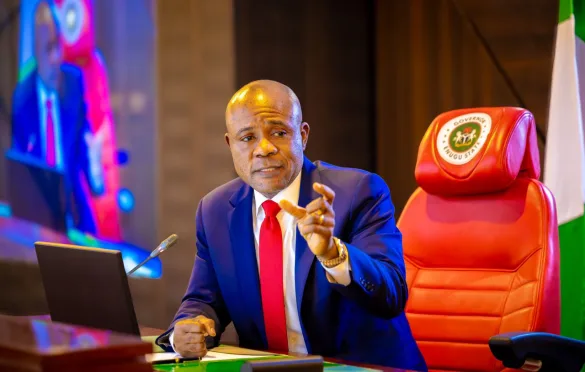
Enugu State has emerged as Nigeria’s fastest-improving state, while Abia ranked third in the 2026 Phillips Consulting State Performance Momentum Index, an assessment that measures how rapidly states are improving relative to the national average.
The report released by Phillips Consulting awarded Enugu a momentum score of +1.15, the highest among the 33 states assessed, placing it ahead of Jigawa (+0.77) in second place and Abia (+0.67) in third.
The Momentum Index measures the extent of progress recorded by each state during the review period rather than absolute performance. Positive scores indicate above-average improvement, while negative scores reflect slower-than-average progress.
Other states that recorded positive momentum include Osun (+0.65), Kano (+0.46), Gombe (+0.39), Akwa Ibom (+0.33), Sokoto (+0.27), Borno (+0.26), Ogun (+0.24), Ekiti (+0.19), Kogi (+0.15), Kwara (+0.08), Kaduna (+0.01) and Adamawa (+0.01).
At the lower end of the rankings, Edo posted the weakest momentum score of -0.79, followed by Imo (-0.72), Katsina (-0.66), Benue (-0.49), Ondo (-0.43), Ebonyi (-0.32), Oyo (-0.26), Kebbi (-0.25), Delta (-0.24), Anambra (-0.19), Nasarawa (-0.17), Taraba (-0.14), Bayelsa (-0.10), Cross River (-0.09), Lagos (-0.08), Plateau (-0.07), Bauchi (-0.05) and Niger (-0.03).
According to the report, Enugu’s emergence as the country’s strongest-performing state reflects deliberate governance, strong fiscal discipline and sustained implementation of reforms, while the South-East recorded the strongest regional momentum among Nigeria’s six geopolitical zones.
Phillips Consulting noted that Enugu’s performance demonstrates how purposeful leadership and disciplined execution of public policies can translate into measurable development outcomes within a relatively short period. It also highlighted the state’s progress in governance effectiveness, institutional reforms and implementation capacity.
The report came as state governments continue to benefit from higher revenues following recent economic reforms. It noted that federal allocations to states increased by 118 per cent between 2022 and 2025, driven by stronger Federation Account receipts.
Despite the revenue growth, the report observed that many states have struggled to translate increased public spending into improved living standards, with average citizen satisfaction with public services standing at 2.90 out of five, below the benchmark score of 3.0.
“Spending is a number. Progress is an outcome,” the report stated, arguing that governance quality, rather than the size of government revenues, determines development outcomes.
In a statement, Abia State Commissioner for Information, Prince Okey Kanu, described the state’s third-place ranking as evidence that the reforms of Governor Alex Otti’s administration were yielding measurable and nationally recognised results.
He attributed the state’s performance to strategic investments in infrastructure, education, healthcare, digital innovation, security, agriculture, public sector reforms and economic development.
According to him, road reconstruction, the establishment of Smart Schools, governance and revenue reforms, industrial revival, youth empowerment and investment promotion have all contributed to the state’s improvement.
“The recognition by Phillips Consulting serves as an independent validation of Abia’s reform journey and further strengthens the state’s position as one of Nigeria’s emerging models of transformational governance and inclusive development,” the statement said.
The report also highlighted notable sectoral performances across the country. Abia received the highest ratings for security and public transport, Gombe topped roads and healthcare quality, Sokoto ranked highest for education affordability and perceptions of public sector honesty, Kano led in economic opportunity, while Kogi recorded the best performance in access to clean water.
On fiscal indicators, Lagos remained Nigeria’s most fiscally self-reliant state, generating internally generated revenue equivalent to 369 per cent of its federal allocation and recording the country’s highest internally generated revenue per capita. Jigawa recorded the lowest debt burden per resident, while Enugu posted the fastest annual revenue growth.
Phillips Consulting explained that Rivers State and the Federal Capital Territory were excluded from the rankings because they had not published audited 2024 financial accounts by the report’s cut-off date, while Yobe and Zamfara were not fully ranked due to insufficient survey responses.
The firm said the exclusions were necessary to preserve the integrity of the index, which places greater emphasis on audited financial data than public perception.
Leave a Reply