Tag: senate

  • Akpabio Opposes Suicide Decriminalisation As Senate Bill Passes Second Reading

    Akpabio Opposes Suicide Decriminalisation As Senate Bill Passes Second Reading

    Precious Nwonu, Enugu

    The Senate has advanced a bill seeking to decriminalise attempted suicide in Nigeria and establish a national suicide prevention framework, despite opposition from Senate President Godswill Akpabio, who insists that offenders should continue to face imprisonment.

    The bill, sponsored by Senator Asuquo Ekpenyong, representing Cross River South, seeks to replace criminal punishment for attempted suicide with a health-focused approach that prioritises treatment, rehabilitation and support for survivors.

    Presenting the proposal, Ekpenyong said Nigeria’s existing laws contained a contradiction, as the National Mental Health Act recognises attempted suicide as a psychiatric emergency requiring care, while Section 327 of the Criminal Code and Section 231 of the Penal Code criminalise the act.

    He argued that criminalising suicide attempts discourages people experiencing psychological distress from seeking help and often forces families to conceal such incidents.

    The senator also warned that the threat of prosecution could worsen the situation by making vulnerable individuals afraid to seek medical attention after surviving an attempt.

    “At the heart of this bill is a simple question: when a Nigerian survives a suicide attempt, should the first response of the state be prosecution or protection?” he asked.

    The proposed legislation provides for mandatory assessment, referral, treatment and follow-up support for survivors instead of imprisonment.

    It also seeks to introduce crisis helplines, train police officers, teachers and healthcare workers to respond to suicide risks, promote public awareness and establish a national data system to support prevention efforts.

    However, Akpabio opposed removing criminal penalties, arguing that decriminalisation could encourage attempted suicide.

    “If you attempt suicide, make sure you die. Anyone who attempts and fails will go to jail,” the Senate President said.

    Akpabio also noted that the issue involved provisions in both the Criminal Code and the Penal Code, stressing the need to involve state legislatures during a public hearing to prevent legal conflicts.

    Despite the disagreement, the bill passed its second reading and was referred to the Senate Committees on Judiciary and Health for further legislative consideration and a public hearing.

    The proposed law will undergo further scrutiny before the Senate decides on its next legislative steps.

  • 2027: Senate Rules Out Electoral Act Review Before General Elections

    2027: Senate Rules Out Electoral Act Review Before General Elections

    Precious Nwonu, Enugu

    The Senate has ruled out any fresh amendment of the Electoral Act 2026 before the 2027 general elections, saying changes to the legislation at this stage could disrupt preparations for the polls

    The Chairman of the Senate Committee on Media and Public Affairs, Senator Yemi Adaramodu, disclosed this in an interview with Saturday PUNCH, explaining that the National Assembly would only consider reviewing the law after the elections if the need arose.

    His position follows a Supreme Court judgment that restored provisions of the Electoral Act governing political party membership registers and methods of selecting candidates for elections.

    The apex court overturned an earlier ruling by the Court of Appeal, which had declared Sections 77(5), 77(6), 77(7) and 84(2) of the Electoral Act 2026 unconstitutional.

    The Court of Appeal had delivered its ruling following a suit by the Zenith Labour Party, which challenged the requirements as an interference with the internal administration of political parties.

    However, the Supreme Court, in a unanimous decision by a seven-member panel, reinstated the provisions and set aside the appellate court’s decision nullifying parts of the Independent National Electoral Commission’s timetable for the 2027 elections.

    Reacting to calls for a possible review of the legislation, Adaramodu said the National Assembly had completed the lawmaking process and the Act had received presidential assent.

    He maintained that the law was intended to guide the 2027 elections and should not be altered while political parties were already preparing their candidates for the polls.

    According to him, reopening the legislation could create uncertainty for parties that had relied on its provisions in their electoral preparations.

    Adaramodu said individuals or groups seeking changes could submit petitions to the Senate, but stressed that the National Assembly had no immediate plans to amend the law.

    The Supreme Court judgment has renewed attention on compliance with the restored provisions, particularly the requirements governing party membership records and candidate nominations.

    Sections 77(5), 77(6) and 77(7) restrict participation in party primaries, congresses and conventions to members whose names appear on membership registers submitted to INEC.

    Section 84(2) provides for direct primaries and consensus as methods through which political parties can nominate candidates for elections.

    The provisions are expected to remain part of the legal framework guiding political parties as preparations continue for the 2027 general elections.

  • Senate Extends 2025 Capital Budget Implementation To December 31

    Senate Extends 2025 Capital Budget Implementation To December 31

    Precious Nwonu, Enugu

    The Senate has extended the implementation period of the capital component of the 2025 Appropriation Act by another three months, moving the deadline from September 30 to December 31, 2026.

    The extension was approved on Tuesday after lawmakers passed a bill sponsored by the Senate Leader, Opeyemi Bamidele, representing Ekiti Central, following clause-by-clause consideration.

    The legislation seeks to give Ministries, Departments and Agencies additional time to complete ongoing capital projects and utilise funds appropriated for them.

    Moving the bill, Bamidele said the extension was necessary because the implementation of several capital projects under the 2025 budget had not reached the desired level despite the release of funds to the relevant MDAs.

    He said extending the deadline would allow the government to complete funded capital and other critical national projects already underway.

    The latest decision represents another extension of the lifespan of the 2025 capital budget. The implementation period had earlier been extended from its original deadline to June 30, 2026, and was subsequently moved to September 30.

    The new extension means funds under the capital component of the 2025 Appropriation Act can continue to be implemented until December 31, 2026, subject to the required presidential assent.

    The decision comes despite earlier commitments by the Federal Government to end overlapping budget cycles.

    President Bola Tinubu had pledged during the presentation of the 2026 Appropriation Bill that his administration would move away from multiple overlapping budget cycles and operate within a single revenue cycle.

    However, previous extensions of the 2025 budget were justified on the grounds that additional time was required to complete ongoing projects and ensure that appropriated funds were effectively utilised.

    The Senate approved the latest extension as the National Assembly resumed plenary on Tuesday after an extended recess.

    The National Assembly had postponed its resumption from September 15 to September 29 to allow rehabilitation work in the legislative chambers to be completed.

    With the passage of the amendment bill, the 2025 capital budget will remain open for implementation for three months beyond the September 30 deadline.

  • House of Reps adopts direct and indirect primaries


    The House of Representatives, yesterday, settled for the version of the recommitted Electoral Amendment Bill passed by the Senate last week, after its initial position not to cave in.

    In the passed amendment, yesterday, provisions which clearly defined the mode of primaries for political parties were stated.

    President Buhari, had rejected the Electoral Act Amendment Bill last December, because the National Assembly made direct primary, the only mode of nominating candidates for elective positions.

    The re-amendment was sequel to a motion on “rescission on clause 84 of the Electoral Act No. 26 2010 (Amendment) Bill, 2022 and Committal to the Committee of the Whole” sponsored by Senate Leader, Yahaya Abdullahi.

    Senate President, Ahmad Lawan, after the amendment to the Electoral Bill by the Committee of the Whole, said the re-amendment was done to harmonise its position with that of the House of Representatives.

    He added that the amendment accommodates clearly defined provisions for the mode of primaries by political parties.

    Lawan expressed optimism that the bill would be signed into law when transmitted by the National Assembly to President Buhari for his assent.

    He warned that political parties that fail or refuse to abide by the provisions on the mode of primaries, would miss out on the opportunity to participate during elections.

    “On the mode of conducting primaries by parties to produce candidates, we have concluded our task on the amendment to the Electoral Act No. 6 2010 Bill. You would recall that the Senate and the House passed the Electoral Act amendment Bill with slight difference. While the House passed the mode of primaries to be direct and indirect only, the Senate passed the mode of primaries to be direct, indirect and consensus. What we have done is to give very clear and sufficient definition to each mode of primaries.

    “The direct primaries is well define on how it will be conducted; ditto the indirect primaries. And for the consensus, the two chambers have produced in this Bill, very clear definition of how a consensus candidate would emerge. Therefore, we are very glad that we have been able to achieve this consensus between the two chambers to arrive at this harmonised version, and we are also very optimistic that Mr. President will sign the bill.”

    Speaker Femi Gbajabiamila at the resumption of plenary, yesterday, said it was imperative for the House, to also include consensus, as a means of nominating candidates in the Electoral Act Amendment Bill, so as to avoid the chambers going for conferencing over the proposed legislation.


    (Sun)

  • Senate disapproves FG’s plans to borrow $200m for mosquito nets


    The Senate Committee on Local and Foreign Loans on Tuesday kicked against the proposal by the Federal Ministry of Health to borrow $200m  under the Malaria Programme to buy mosquito nets in the 2022 budget.


    The committee’s condemnation was in response to the Ministry of Health’s submission about its intention to borrow the amount for purchase of mosquito nets for 13 vulnerable states.


    The Permanent Secretary in the Ministry, Mahmuda Mamman had justified the proposal before the panel.


    He said, “The loan if approved by the National Assembly and accessed, will be used to medically fight malaria in the 13 orphan states which cover 208 local government Councils and 3, 536 primary health care centres”


    Angered by his submission, Senator Ibrahim Oloriegbe and other senators present descended heavily on the Permanent Secretary and the Executive Secretary, National Primary Health Care Development Agency, Dr.Faisal Shuaib.


    Oloriegbe wondered why N450m was budgeted for Malaria treatment in the proposed 2022 budget and yet, plans being made to borrow $200m for the same purpose.


    He said, “This is unacceptable. We should be able to put our feet down when dealing with these donor agencies or creditors  as regards loans to be taken and what it should be expended on.”


    “Don’t we have local manufacturers of mosquitoes nets and malaria drugs in Nigeria to patronise with the loan even if approved.


    “This is a clear case of money and jobs for the boys by creditors luring you for loans and railroading you on what it should be spent on.


    “Washington or whatever creditor offering the loan, should stop giving us money with one hand and taking it back with another hand through railroaded spending,”  he said.


    Other members of the committee like Senators Adelere Oriolowo (APC Osun West), Abba Moro (PDP Benue South) and other, also blamed the Ministry for coming up with such idea.


    The N450m already budgeted for fighting the scourge in the alleged vulnerable areas, according to them, was enough.


    They angrily asked the permanent Secretary to explain how the idea was arrived at and how it will be implemented.


    The Permanent Secretary in his response said subsidiary arrangement had been made with all the states involved through required signing of agreement.


    In his further clarification, the Executive Director, National Primary Heal Care Development Agency, NPHCDA, Dr. Faisal Shuaib noted that the $200m was for importation and local production of mosquito nets.


    The panel however demanded the total needs of the agency to ascertain if there was need for borrowing.


    Source: www.punchng.com

  • Senate gives INEC green light to transmit election results electronically in the conduct of 2023 elections


    Applause and knocks have greeted the decision of the Senate to give the Independent National Electronic Commission the green light to transmit results of elections electronically in the conduct of the 2023 general elections and the adoption of direct primaries method.


    Those who hailed the lawmakers included the Inter-Party Advisory Council (IPAC), Alaigbo Development Foundation (ADF), Ebonyi Professionals Forum (EPF), Governor of Rivers State, Nyesom Ezenwo Wike, former vice president, Atiku Abubakar, former Senate deputy president, Ike Ekweremadu, former deputy governor of the Central Bank of Nigeria (CBN), Kingsley Moghalu and The upper legislative chamber had reconsidered its earlier position and gave the Independent National Electoral Commission (INEC) the nod to determine the mode to transmit election results: either electronically or manually.

    It also reversed its earlier position and approved that all political parties must use the direct primary mode in picking candidates. This, however, drew the ire of the Peoples Democratic Party (PDP), the Coalition of United Political Parties (CUPP) and Governor Wike.


    In its earlier amendment passed in July, Senate had approved both direct and indirect methods.


    The landmark moves came barely 24 hours after Senate President, Ahmad Lawan and Speaker of the House of Representatives, Femi Gbajabiamila, met with President Muhammadu Buhari at the Villa on Monday.


    The decision of the Senate, followed the re-committal of some clauses of the Electoral Act 2010 to the Committee of the Whole.


    In July, the Senate, rejected its committee’s report, which had approved electronic transmission of results by INEC. The House of Representatives, however, approved it.


    The Senate, said: “After critical examination of the Bill by the Senate Committee on INEC, some fundamental issues which require fresh legislative action on clauses 43, 52, 63 and 87, were observed.”


    “Desirous of the need to address the observations by the committee and make necessary amendments, and relying on Order 1(b) and 53(6) of the Senate Standing Order, accordingly resolves to rescind its decision on the affected clauses of the Bill as passed and re-commit same to the Committee of the Whole for consideration and passage,” Senate Leader, Yahaya Abdullahi stated while moving the motion.


    The Senate, had in July, while rejecting the position of its Committee on INEC, opted for a position, which was outrightly rejected by Nigerians.


    The senate approved four clauses in the electoral act amendment bill. Part of the clause amended, read: “Subject to section 63 of this Bill, voting at an election and transmission of results under this Bill shall be in accordance with the procedure determined by the Commission (INEC), which may include electronic voting.


    “A political party seeking to nominate candidates for elections under this Bill shall hold direct primaries for aspirants to all elective positions, which shall be monitored by the Commission.”


    Daily Sun had reported that plans were underway to force direct method of conducting primary elections on political parties.


    Governor Wike said the resolution of the National Assembly joint committee to allow the electoral umpire transmit election results electronically is a good development for Nigeria and democracy.


    “I think it is a good news to hear that the Joint Committee of the House of Representatives and the Senate agreed for INEC to transmit result electronically. That is a good news to hear. Like I have always said, what is important now is what do people want. The moment you do what the people want you’ll see happiness everywhere.”


    The governor, who has been a proponent of transparent electoral system, observed that many nations have moved beyond manual result declaration and Nigeria cannot afford in the 21st century to be left behind.


    On the amendment of the Electoral Act, Governor Wike stated that the issue of direct or indirect primaries should be the exclusive decision of the political parties in the country.


    Governor Wike insisted that National Assembly prescribing how political parties conduct their primaries is tantamount to interference in the internal politics of the parties.


    IPAC also believe that electronic transmission of results would go a long way in deepening the nation’s political process critical for inclusive, free, fair, credible, transparent and generally acceptable elections.


    National Publicity Secretary, IPAC, Ambassador Agbo Major, in a statement released said: “Reversing itself is a giant step forward in making Nigeria a great arsenal of democracy in Africa. Manipulation of election results, ballot box snatching, violence, vote buying and selling are the bane of the nation’s electoral process.


    Former VP Atiku, in a statement by his media office, yesterday, said the harmonisation of positions between the parliament and the electoral body was an indication that the country’s democracy is growing.


    He also commended individuals and groups, especially the various pro-democracy advocacy groups that participated in the public discourse on the controversial issue.


    “By this outcome, I am convinced that public institutions in Nigeria will continue to play their roles as guardians of public policy.”


    Spokesman of ADF, Abia Onyike and National Secretary of Ebonyi Professionals, Ugochukwu Hanks-Ezekiel, described it as a progressive move indicative that power belongs to the people. They said it would go a long way to guarantee free and fair elections in Nigeria.


    On the issue of direct primaries, Onyike said: “It is equally a welcome development because the members of political parties would have a say in who their candidates for elections should be. The power is being removed from few delegates who can be easily bought over by money bags.”


    For Hanks-Ezekiel, it is a sign of the people’s power to stand together. He also noted that direct primaries would end Godfatherism in the nation’s polity.


    Ekweremadu said the Senate’s action justified his assurances to Nigerians in July that all hope was not lost for electronic transmission of 2023 election results despite the initial setback.


    In a statement by his media aide, Uche Anichukwu, Ekweremadu said: “I want to specially commend the Senate for setting aside narrow partisan interests to correct the mistake of July 15, 2021 by reversing itself on the issue of electronic transmission of election results.


    “This clause, though not originally part of the Bill, was introduced by the Joint National Assembly Committee on the Independent National Electoral Commission, which I am part of, to save the nation the troubles of ballot box snatching, electoral violence, and manipulations that happen between the polling booth and collation centres. Although I was representing Nigeria at an international parliamentary session in Montenegro and therefore unavoidably absent during the passage of the Bill in July, I had assured Nigerians that we would work with the progressives across party lines to dialogue with our colleagues and other critical stakeholders to ensure that electronic transmission of results was restored in the Bill. It is, therefore, heart-warming that my confidence in the capacity of my colleagues to dialogue  and rise above narrow partisan interest on this matter was not misplaced.”


    Source: www.sunnewsonline.com
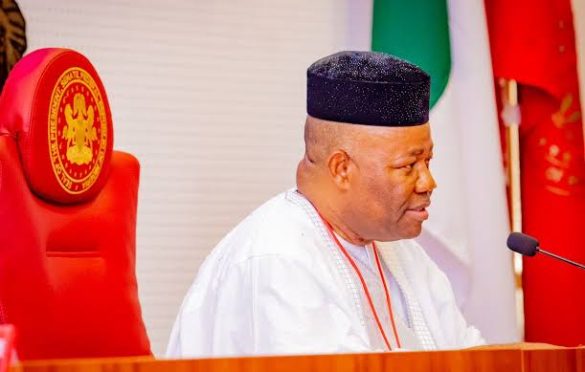
  • Senate confirms NURC board members and scrapes Department of Petroleum Resources.

    The Senate on Wednesday confirmed the appointment of board members of the Nigerian Upstream Regulatory Commission.


    The confirmation of the nominees followed the consideration of a report by the Senate Committee on Petroleum Resources.


    The new agency has automatically replaced the Department of Petroleum Resources because the commission would take over its responsibilities.

    The nominees confirmed include Isa  Modibbo – Chairman; Gbenga Komolafe – Chief Executive; Hassan Gambo – Executive Commissioner, Finance and Accounts; and Rose Ndong – Executive Commissioner, Exploration and Acreage Management.


    Chairman of the Committee on Petroleum Resources (Upstream), Senator Albert Akpan, in his presentation, said that the nominees demonstrated sufficient knowledge of the workings of the petroleum industry, especially the upstream petroleum sector, as well as the economics of petroleum exploration and production.


    He added that the appointments of the nominees satisfy the requirements of Sections 11 and 18 (1-5) of the Petroleum Industry Act, 2021.


    According to the lawmaker, “there are no adverse reports against the nominees as record checks and other forms of investigations by security agencies did not reveal any negative trace against them.”


    Akpan stated that the Committee was satisfied about the qualifications, experience, suitability, competence and integrity of the nominees to assume the position of Chairman, Chief Executive and Executive Commissioners of the Nigerian Upstream Regulatory Commission.


    The Senate President, Ahmad Lawan, said the establishment of the Nigerian Upstream Regulatory Commission would provide a foundation for the stabilisation of the petroleum industry in Nigeria.


    He also said the confirmation of the NURC board has automatically led to the scrapping of the Department of Petroleum Resources as the new commission will take over its responsibilities.


    He said, “The Regulatory Commission has the enormous and huge responsibility of setting and establishing the Commission as provided in the Petroleum Industry Act.


    “They have the unenviable responsibility of ensuring that they commit themselves and work hard to provide the solid and stable foundation for that matter, that they don’t waste any time because time is of essence.


    “The implication of the approval of board members for the commission is that the Department of Petroleum Resources has ceased to exist.”


    “The Petroleum Industry will go through a reform process and the process has already started.


    “This Commission is one of the huge arms of those reforms that will stabilize the petroleum industry in Nigeria.


    “While the Senate confirms them, we expect nothing less than commitment and patriotism on their side.


    “The Senate wishes them the best and a very fruitful tenure as they take their offices.


    “We expect that the other regulatory authority for downstream and midstream will also be confirmed as soon as possible, so they also start their work immediately.”


    Source: www.punchng.com

  • Senate passes second bill on empowerment of Rural Dwellers


    The Senate on Wednesday passed for second reading, a bill seeking to empower poor Nigerians in rural areas with guaranteed income and jobs that would provide 100 days of paid work per year.


    Tagged, ‘The Rural Employment Guarantee Bill, 2021, the proposed legislation was sponsored by Senator Mohammed Sani Musa (APC, Niger East).

    Musa explained that the bill among others, seeks to provide livelihood security in rural communities by providing at least one hundred days of guaranteed wage employment in every financial year to every household whose adult member volunteer do do skilled manual work.


    He said the bill when passed into law would empower rural poor through the processes of a rights-based law.


    He said it would ensure a strong social safety net for vulnerable groups, strengthen the natural resource base of rural livelihood and and serve as a model of governance reform anchored on the principles of transparency and grass root democracy.


    He added that the National Rural Employment Guarantee bill aims to reduce poverty by providing extra work for those who need it, while also providing empowerment and insurance when other sources of work dry up.


    Citing the Poor Employment Act of 1817 in Britain, and the New Deal Programs in the United States in the 1930s, Musa explained that the piece of legislation was similarly intended to be an intervention that makes government an employer of last resort.


    He noted that the Ministry of Agriculture and Rural Development would monitor the implementation of the scheme in association with state governments.


    Contributing to the debate, Senator Smart Adeyemi (Kogi West), threw his weight behind the passage of the bill into law.


    He said, having agencies backed by law to oversee the implementation of such schemes for the poor would ensure that they are not abused.


    He said, “In our nation today, Mr. President, most of these palliatives that the present government has put in place has been abused, because you have a situation where names are duplicated.


    “It is even difficult for you to know those who are benefiting.


    “The bill my brother is seeking, is for us to have a formal agency for social security that will take care of all employment problems and even health problems of people who are not gainfully employed. It must be holistic.


    Read Also

    New Senate bill eliminates investment barriers in power sector

    Senate bill seeking stiffer punishment for kidnapping passes second reading

    15-year jail: National Assembly members will pay ransom if kidnapped —Falana

    “This bill is good, the intention is good, but I think this bill must go further to make it a holistic solution to the problem of unemployment in our nation, so that it is not abused, and so that in every local government in Nigeria, you have an agency in charge that will take care of unemployment of our people.


    “In having the law, we must also have the punitive measures in place for those who would abuse it, so that people will know that this bill is intended to alleviate the suffering of people, and by extension, Mr. President, guarantee security of our nation.


    “Most of the people who are into crime today, is out of frustration of unemployment. We have a large number of people who are unemployed.


    “Today, we have up to two hundred universities and polytechnics producing graduates.


    “So, I think we must advise our government. Progressive as this government is to palliatives, let us formalize these palliative measures by having a social security agency in every local government of Nigeria, and let us put a law in place to make sure that nobody abuses it.”


    The Senate President, Ahmad Lawan, referred the bill to the Committee on Agriculture and Rural Development for further work after passing second reading.


    The Committee which is chaired by Senator Abdullahi Adamu was given four weeks to report back to the Senate.


    In a related development, the Smallholder Farmers (Protection) Bill 2021, also scaled second reading on Wednesday.


    The bill sponsored by Senator Muhammad Enagi Bima (Niger South) was also referred by the Senate President to the Committee on Agriculture and Rural Development.


    Also, the Petroleum Industry Act (Amendment) Bill, 2021; Chartered Institute of Electrical and Electronic Engineering of Nigeria (Establishment) Bill, 2021; and Federal College of Agriculture, Shani (Establishment) Bill, 2021, passed second reading during plenary.


    While the Petroleum Industry Act (Amendment) bill 2021, was referred to the Joint Committees on Petroleum (Upstream); Petroleum (Downstream); and Oil and Gas, the other two were referred to the Committees on Establishment and Public Service; and Tertiary Institutions and TETFUND for further imputs, respectively.


    The Committees were all given four weeks to turn in their reports to the chamber in plenary


    Source: www.sunnewsonline.com

  • A financially sinking nation: Senate approves Buharis $8.3bn loan Amidst other foreign debts

    Senate, yesterday, approved President Muhammadu Buhari’s request for ongoing external loans to the tune of $8,325,526,537 and €490,000,000 under the 2018-2020 External Borrowing (Rolling) Plan.

    The approval followed the consideration of a report on the 2018 to 2020 External Borrowing (Rolling) Plan by the Committee on Local and Foreign Debt.


    Chairman of the Committee, Clifford Ordia, in his presentation, said the panel noted with utmost importance, the genuine and very serious concerns of Nigerians about the level and sustainability/serviceability of the country’s borrowings in the last decade.


    According to the lawmaker, “our (Nigeria’s) debt service figures constitute a huge drain on our revenue to the extent that it account for over 30 percent of our expenditure in the annual budget.”


    He said due to the shortfall in the country’s annual revenues in relation to the need for rapid infrastructure and human capital development, “we have had to pass deficit budget every year, requiring us to borrow to finance the deficit in our budget.”


    Ordia said out of the total borrowing request of $36,837,281,256 contained in the re-forwarded request of Mr. President, $26,154,536,533 is for funds proposed to be borrowed from various financial institutions from the Peoples Republic of China.


    He said the proposed projects in the ministries of Transportation, FCT, Aviation, Works and Housing, Agriculture and Water Resources and some commissions, such as National Universities Commission, North East Development Commission and the National Identity Management Commission, are mostly ongoing projects and programmes in respect of which external borrowed funds have been spent in the past, including loans.


    “These projects have a great multiplier effect on stimulating economic growth through infrastructure development, job creation and poverty alleviation, stimulation of commercial and engineering activities and the consequent tax revenues payable to government as a result of these productive activi ties,” Ordia said.


    Source: www.sunnewsonline.com

  • Senate minority Leader Kicks as Buhari pitches Onochie to be Screen for National Commissioner

    The Senate on Wednesday referred the name of the Special Assistant to the President on Social Media, Mrs. Lauretta Onochie, to its Committee on the Independent National Electoral Commission (INEC) for screening as a National Commissioner of the commission representing Delta State.


    This happened about eight months after President Muhammdu Buhari had forwarded Onochie’s name and five other nominees to the Senate for confirmation.


    Onochie’s nomination had generated controversy with critical stakeholders arguing that her choice was not in order in view of her alleged “artisanship and identification” with the ruling All Progressives Congress (APC).


    Other nominees also referred to the Committee on INEC include Prof. Mohammed Sani representing Katsina; Prof. Kunle Cornelius Ajayi (Ekiti), Seidu Babura Ahmed (Jigawa), Prof. Sani Mohammad Adam (Northcentral) and Dr. Baba Bila (Northeast).


    Read Also; Furore as Buhari nominates aide Lauretta Onochie as INEC commissioner

    President Buhari had, in his letter of nomination read by Senate President Ahmad Lawan, said the appointments were pursuant to Paragraph 14 of Part 1F of the First Schedule of the 1999 Constitution (as amended).


    President Buhari’s letter of nomination, dated October 12, 2020, was read by Senate President Ahmad Lawan on October 13, 2020, making it exactly eight months before the nominees were officially referred to the relevant committee for further legislative work.


    Senate Minority Leader Enyinnaya Abaribe (Abia South), in seconding the motion, said he was surprised that Onochie’s name resurfaced after the matter had been dealt with.


    He said: “In seconding this motion, let me point out that our people say that it is not when we have passed the evil forest that the demon will still catch us.


    “Mr. (Senate) President, we had dealt with the matter of the nomination of Lauretta Onochie. So, we feel surprised that the same name has resurfaced, no longer as a National Commissioner but now as a Delta State commissioner.


    ADVERTISEMENT

    “Mr. President, reluctantly, I second the motion that these nominations be referred to the relevant committee for action, and we shall meet in Philippi.”


    Before referring the nominees to the Senate Committee on INEC, Senate President Ahmad Lawan reacted to the comment made by Abaribe.


    Lawan said: “Thank you very much Minority Leader. But before I put the question, let me clarify an issue.


    “The nominees are not State Resident Electoral Commissioners (RECs). They are National Commissioners, and there was no change of request. I think we need to clear the air on that.”


    Chairman of the Senate Committee on Media and Public Affairs, Surajudeen Ajibola Basiru, urged those who considered that Onochie is not qualified to be appointed as a National Commissioner for the INEC to petition the committee with proofs.


    Source: www.thenationonlineng.net

  • EFCC: Senate get sued to stop Bawa’s confirmation

    The new Chairman-designate of the Economic and Financial Crimes Commission, Abdulrasheed Bawa, who is expected to face Senate screening soon, is beset by a legal hurdle following a controversy surrounding his rank, Saturday PUNCH has learnt.

    It was learnt that a lawyer, Osuagwu Ugochukwu, has filed a suit before the Federal High Court in Abuja seeking to stop the Senate confirmation of the chairman-designate.


    The court document marked FHC/ABJ/CS/196/2021 was received at the Office of the Senate President on Thursday, according to an acknowledgement copy obtained by our correspondent on Friday.


    It was learnt that the leadership of the Senate, the Presidency and the Office of the Attorney General of the Federation were holding talks as to how to address the issue in order to avoid a repeat of the last screening exercise where the then nominee, Ibrahim Magu, was rejected twice by the Senate.


    Bawa is also believed to be a kinsman of the AGF, Abubakar Malami (SAN). Malami played a major role in the removal of Magu and reportedly recommended Bawa’s appointment to the President, Major General Muhammadu Buhari (retd.).


    The new nominee, who is a member of the pioneer Course 1 of the EFCC Cadet Officers, is a Level 13 officer. However, the EFCC Act states that in appointing a chairman of the commission, such an appointee must be at least an Assistant Commissioner of Police or equivalent.


    The EFCC Act, however, may not have envisaged that a member of the core staff of the EFCC would become chairman and does not state what the equivalent of an Assistant Commissioner of Police would be in the EFCC cadre.


    Bawa, who joined the EFCC in 2005, has been in service for 15 years and is believed to be a seasoned detective. However, there has been controversy over what the equivalent of a Level 13 officer in the EFCC would be in the police.


    In the originating summons filed by Ugochukwu, it was argued that Section 2 of the EFCC Act states that the EFCC shall have a chairman who shall be the chief executive and accounting officer of the commission; be a serving or retired member of any government security or law enforcement agency “not below the rank of Assistant Commissioner of Police or equivalent;   and possess not less than 15 years cognate experience.”


    Ugochukwu asked the court to determine whether a Level 13 officer is the equivalent of an ACP.


    The plaintiff subsequently sought two reliefs, including “a declaration that the 2nd defendant (Bawa), who is a Grade Level 13 public service officer and not an Assistant Commissioner of Police or its equivalent is not qualified to be the chairman of the EFCC” and “an order of perpetual injunction restraining the first defendant (Senate) from confirming the appointment of the second defendant (Bawa) as chairman of the EFCC.”


    Meanwhile, the Centre for Anti-Corruption and Open Leadership has written a letter to the Senate asking the upper legislative chamber not to confirm Bawa as the EFCC chairman.


    This is according to a letter titled ‘Don’t Confirm Abdulrasheed Bawa’s Appointment as EFCC Chair until He Clears His Name of Corruption Allegation; Appeal to the Nigerian Senate,’ which was signed by the Executive Director of CACOL, Debo Adeniran.


    CACOL said Bawa was alleged to have diverted 224 forfeited trucks while he was the Port Harcourt zonal head of the commission and is also rumoured to be a cousin of the AGF.


    The group further argued that Bawa is not up to the level of an ACP and is thus not qualified to be chairman of the EFCC.


    “The EFCC law is an Act of the National Assembly, hence the Senate must not overrule itself by breaching a critical provision in the appointment of EFCC Chairman.


    “It is against this background that CACOL is appealing to the Senate to please take the pains to dig deep into Mr Abdulrasheed Bawa’s record of overall performance, as well as that of corruption allegations levelled against him.


    “Howbeit, if the rumour making waves in some quarters, which has also been confirmed by some sections of the media, is anything to go by, we would say Nigerians’ hope for a corruption-free society has been dashed with the nomination of Mr Abdulrasheed Bawa as the chairman of the EFCC,” the letter read.


    Bawa, who was accused of diverting recovered assets, was, however, absolved of any wrongdoing by the EFCC in a statement sign ed by its spokesman, Mr Wilson Uwujaren, on Tuesday.


    Source: www.punchng.com

  • Senate in chaos as Petroleum ministry spends N98.4m on flyers and leaflets


    The Senate Public Account Committee has described as unacceptable the payment of N98.4m by the Petroleum Resources Ministry for the printing of leaflets.

    The flyers, according to the 2015 Auditor-General for the Federation’s report, was meant to create awareness campaign for the Petroleum Industrial Bill.


    The report, currently being scrutinised by the National Assembly, also stated that the fund was released without due process.


    The Chairman of the Senate panel, Senator Matthew Urhoghide, also faulted the payment of N39m was into the accounts of two persons for the purpose of monitoring the ministry’s project within the Federal Capital Territory.


    The AuGF query on the matter read in part, “Contrary to the procurement process, an entry in the cash book for the sum of N98.4m was made in favour of a company for printing of leaflets for awareness campaign programme for the Petroleum Industry Bill.


    “There was no formal award of contract and it was also observed that the approval for the payment was via memo presented by the Director (Press) to the Ministerial Tender Board meeting of 9th and 11th October, 2013.


    “The permanent secretary had been requested to take procedural disciplinary measures against the erring officers in line with provisions of extant regulation.”


    However, the ministry in its written response to the query explained that massive publicity needed to be created, hence the awareness campaign programme.


    The response read, “Adequate publicity was made: M/S Dangrace and Partners Limited were selected based on proven capabilities and competence.


    “It should be stated that veritable costing proposals were submitted and approved before the authorisation for the award and production of Petroleum Industry Bill leaflets.


    “The (Media) Department complied with necessary rule and procedure.”

    Also, the AuGF in another query, faulted the payment of N39.7m into the bank accounts of two officers for the purpose of monitoring the ministry’s projects located within Abuja.

    The query said contrary to the e-payment policy of the Federal Government, the total sum of N39.7m was paid to 178 staff of the ministry for project monitoring and evaluation in 2014.

    Not satisfied with the ministry’s explanation, the Senate panel directed the officers involved to return the mo ney to the federation account.


    Source: www.punchng.com