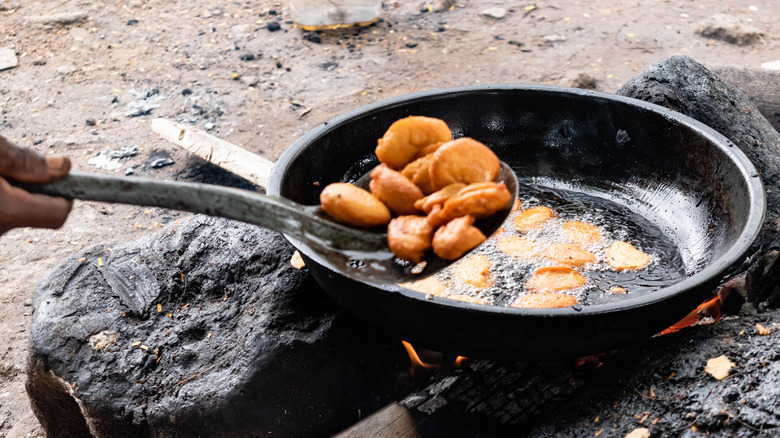
Nkechi Okonkwo has been awake since 3:45 in the morning. By the time most of Oshodi is still arguing with its alarm clock, she has soaked beans, queued at the neighbourhood mill, lit her coal pot, and begun producing one of the most economically efficient food products in Nigeria.
An akara ball costs between one hundred and five hundred Naira. It requires no supply chain from Rotterdam or The Strait of Hormuz. It requires beans, palm oil, a frying pan, and a 3:45am discipline that would make most MBA students reconsider their choices. Nkechi does not have an MBA. She has a waiting list.
On the last Wednesday in late June 2026, First Lady Oluremi Tinubu addressed State House correspondents after the Renewed Hope Initiative’s second-quarter meeting with wives of state governors. She encouraged Nigerians, particularly women, to start selling akara, roasted corn, and kuli-kuli, noting that these businesses require little capital.
A video surfaced online by Friday. By Saturday, the country had started approximately one million satirical akara businesses on social media. The debate that followed was heated, widespread, and largely missed the actual economics. This article attempts to recover them.
Nigeria’s informal economy, of which the akara stall is one of the recognisable faces, is not just peripheral to the national economy. It is the national economy. The International Labour Organisation’s 2024 Nigeria policy brief places the informal sector’s share of total employment at 92.3%. Among women specifically, the figure is 96% compared with 88.7% of men. World Economics estimates Nigeria’s informal economy at about 57.2% of GDP, using its own methodology.
According to SMEDAN, Nigeria has approximately 40 million micro, small, and medium enterprises. The dismissal of the akara economy as beneath serious policy attention is not sophistication. It is innumeracy. The First Lady was not advising Nigerians to embrace poverty. She was describing the sector that employs nine in ten working Nigerians and produces more than half of national output. The satire got ahead of the statistics.
The economics of a ₦50,000 capital injection into a micro-enterprise are more consequential than the mockery suggested. The switch from charcoal to a 3kg gas cylinder costs below ₦5,000 per refill but yields faster output, lower fuel cost per unit, and a cleaner product over the course of a month’s trading.
The akara seller who cannot afford the upfront cylinder deposit stays on coal, paying more per unit of heat and producing less per hour. Working capital also unlocks bulk purchasing: the seller with ₦50,000 buys beans wholesale at discounts of up to 20% versus the retail prices she pays on a daily cash cycle. These are not marginal gains. They compound into the difference between subsistence and modest accumulation. Not all fingers are equal, but a hand needs all of them. The akara economy needs its fingers to have working capital, and the formal system has been largely unwilling to provide it.
The First Lady’s remarks were correct in substance and poorly timed in context, and the honest analysis requires holding both judgements simultaneously. She was right that starting a food micro-enterprise requires little capital and can generate sustainable income. Come to think of it, most Nigerians are already active participants in the country’s largest informal financial institution: the Extended Family.
Its lending policy is simple with no collateral, no interest, no repayment schedule, and no realistic expectation of ever seeing your money again. The Bank of Mum, Dad, Uncle, Auntie, Brother, and Cousin dispenses perpetual grants with remarkable consistency and rarely asks for repayment. This is a visible thing needing no microscope. She was right that grants are a more appropriate instrument than loans for the lowest-income tier of the MSME base, as an annualised interest rate on loan of up to 60%, aside from other hidden fees, for a seller on a daily cash cycle, transfers income to the bank rather than capitalising the enterprise.
What the video could not carry was the distinction between akara as an entry point into accumulation and akara as the ceiling of national aspiration. If a child washes his hands clean, he will eat with elders. The graduate mechanical engineer who cannot find work commensurate with her training has washed her hands. The table is not yet set. Telling her the frying pan is available was heard as a dismissal of her preparation rather than a bridge to opportunity. That is not what I think the First Lady meant. It is what the timeline heard. The two things can be true simultaneously.
The scale problem that the debate missed is the most consequential number in this story. Of Nigeria’s 40 million MSMEs, only 4% have access to formal bank credit, per PwC’s MSME Survey 2024. SMEDAN’s 500,000 active loan beneficiaries represent 1.25% of the MSME base. The World Bank’s FINCLUDE programme, approved in December 2025 with $500 million in capitalisation, targets 250,000 additional MSMEs a combination of commercial banks, microfinance institutions, fintech lenders, and credit guarantee mechanisms, bringing the potential formal reach to roughly 750,000 enterprises out of 40 million, less than 2%.
The federal government’s N1 billion MSME grant disbursed in April 2026 is correct in instrument and wholly insufficient in size. The Moniepoint Informal Economy Report 2025 found that 51% of informal businesses have never taken a formal loan and do not intend to, up from 30% the year before. The informal economy has not refused capital. It has concluded that capital has refused it, through interest rates, collateral requirements, credit bureau conditions, and processing timelines that have nothing to do with the economics of an akara stall and everything to do with a system designed for a different kind of borrower.
Unfortunately, an idle hand is the devil’s workshop. Perhaps the greatest tragedy is not the unemployment itself, but where that unemployment leads. An idle labour market has become a waiting room for criminal enterprise. This is why employment policy is also security policy.
Every new factory, every thriving SME, every apprenticeship, every digital skills programme, and every successful farm enterprise does more than increase GDP by competing directly with criminal organisations for the time, talent, and aspirations of Nigeria’s youth. The safest communities are often those that provide the greatest opportunities for legitimate work.
Four interventions and a rhetoric question are immediately available. First, the World Bank’s FINCLUDE programme must be implemented at speed and expanded in scope. Its December 2025 approval targets 250,000 MSMEs over several years. The sector’s 57.2% of GDP share warrants a target of 2.5 million over the same period. The difference is between a pilot and a policy.
Second, SMEDAN’s zero-interest N500 million revolving fund and single-digit loan facility are correctly designed instruments at wholly insufficient scale. N500 million distributed across 40 million enterprises is N12,500 each if all were reached, which they are not. The fund needs to be fifty times larger to be proportionate to the growing sector it is supposed to serve.
Third, the movable collateral registry under Nigeria’s Secured Transactions in Movable Assets Act must be operationalised at the micro-enterprise level, allowing businesses to borrow against inventory, receivables, and equipment rather than land certificates most informal operators will never hold. Fourth, grants rather than loans are the correct instrument for the smallest enterprises: a N50,000 grant combined with basic business training can move an akara operation from coal pot to gas stove, from retail to wholesale sourcing, from one shift to two, from one employee to three. That is infrastructure investment in the sector that employs 92.3% of the workforce.
Finally, let’s face it: is it not high time we established a dedicated government ministry fashioned after South Africa’s Department of Small Business Development (DSBD) explicitly focused on the providing funding and business toolkits to informal entrepreneurs and traders?
The scenario projections in this article show the scale of what is at stake. Scaling formal capital access from 1.25% of MSMEs today to 18% by 2030, through expanded grants, single-digit rate loans, and collateral reform, could move more than 6 million additional micro-enterprises toward the small enterprise tier. The status quo trajectory delivers approximately 1.8% by 2030, a marginal improvement while the coal pots stay on and the wholesale discounts remain uncollected.
Nkechi Okonkwo does not need a debate. She needs a gas cylinder, at least N50,000 in working capital, a city council that does not confiscate her table every other Thursday, and a government that counts her in the programmes it announces rather than only in the statistics it publishes about sectors it does not fund.
The First Lady was right that the akara economy is real, accessible, and important. The government’s job now is to match the scale of the advice to the scale of the sector. 92.3% of the workforce cannot be served by programmes that reach 1.25% of enterprises. The akara is frying. The policy is not.
Akinola Morakinyo (Ph.D) writes on MINT economies from the Department of Economics, Finance & Quantitative Analysis, Kennesaw State University, GA, USA.
Originally Published on Nairametrics.com