Tag: President Bola Tinubu

  • Amend NYSC: Make Every Graduate a Soldier of the Republic

    Amend NYSC: Make Every Graduate a Soldier of the Republic

    By SNC Nwagu, Esq.

    “We cannot keep sending graduates into a security environment the 1973 law never imagined. Let us train them first.”

    President Bola Tinubu is right to appeal for the repeal of the extant NYSC laws. The National Youth Service Corps Act, Cap N4 LFN 2004, was designed for unity in 1973. In 2026, it is now a security risk, a fiscal burden, and a political frustration.

    A corper is kidnapped on the Enugu–Port Harcourt Expressway. Another is posted as a “tea boy” at his Place of Primary Assignment (PPA) and spends twelve months counting days. Parents lobby, stipends drain the budget, and the original objective of national cohesion is lost.

    We must not scrap service. We must redesign it for Nigeria’s security, political, and fiscal realities.

    The Problem: One Size, High Risk

    The current model posts untrained graduates across Nigeria without regard to risk, skill, or order. That made sense when the threat was only disunity. Today the threats are banditry, kidnapping, cultism, and unemployment.

    We are asking civilians to represent Nigeria, but we are not giving them the discipline, protection, or purpose to do so.

    The Southern Record: This is not Hypothetical

    The danger is not rhetorical. It is documented, recent, and concentrated on the very corridor this article opened with:

    • July 2025 — Gunmen blocked the Ezinnachi/Okigwe axis of the Enugu–Port Harcourt Expressway, shooting and abducting an unspecified number of passengers in broad daylight (Vanguard, TV360, July 9, 2025).
    • January 2025 — About 35 passengers, including NYSC members and four soldiers, were abducted along the Enugu–Nsukka Road at Enugu-Ezike. One corps member’s family was asked for ₦20 million in ransom within 24 hours of her abduction (SaharaReporters, January 14, 2025).
    • October 2024 — An NYSC member was kidnapped along the Elele/Omerelu axis of the Port Harcourt–Owerri Expressway; a separate corps member was robbed at gunpoint in Gokana LGA, Rivers State, before police arrested the suspects (Punch, October 23, 2024).
    • November 2025 — Public anxiety over the Aba–Port Harcourt road grew strong enough that NYSC had to publicly address fears about it, even while disowning a viral document on the subject — itself a sign of how widely the route is feared (Africa Check, November 28, 2025).
    • 2023–2025 — An investigation by the Foundation for Investigative Journalism found kidnappers extracted more than ₦46 million in ransom from corps members’ families nationwide over this period (FIJ, March 2025).

    This is the texture of the risk a Nsukka graduate, an Akwa Ibom graduate, or a Rivers State graduate faces simply travelling to camp or to a PPA. It is precisely the kind of exposure a trained, escorted, military-integrated service year would remove.

    The Solution: The 12-Month National Service and Defence Pattern

    Nigeria should amend the Act to create one mandatory service pattern for all graduates. Borrow the best from Israel’s universal service and America’s structured civilian-military models, but tailor it to us.

    Phase 1: Six Months Full Military Training (Months 1–6)

    Every corps member shall undergo basic military training. On enrollment, each will choose an arm: Army, Navy, or Air Force, like all other ranks and files.

    Training will cover drill, first aid, disaster response, weapons handling, civic duties, and national orientation.

    The result: every graduate becomes a trained National Service Reservist — a soldier of the Republic who can be called out only for national emergencies, disasters, or internal security support, as approved by the President and the National Assembly.

    Phase 2: Six Months Military Base Deployment (Months 7–12)

    After training, corps members are deployed to military formations and bases nationwide. Duties will focus on discipline, hierarchy, logistics, medical outreach, engineering, ICT, teaching in barracks schools, and civil-military relations.

    The result: real orientation in order and service. No more idle postings. No more “posting lottery.”

    Phase 3: Option to Enlist (After Month 12)

    Any corps member who wishes can enlist into the chosen service arm with accelerated entry and credit for the one year served. Those who opt out are discharged with a National Service Certificate, a stipend, and a Skills Transition Voucher for civilian enterprise or further study.

    Why This Saves Nigeria

    • Security: We stop exposing untrained youths to high-risk LGAs. Instead, we build a national pool of disciplined reservists for emergencies.
    • Fiscal: One unified training and deployment removes duplication between NYSC camps, PPA bureaucracy, and ad hoc security costs.
    • Employment: It creates a direct pipeline into the Armed Forces for willing youths, and a skills voucher for others. Service becomes a bridge to work, not a gap year.
    • Discipline: Military order will cure absenteeism, truancy, and the collapse of service ethics. Hierarchy teaches responsibility.

    The Amendment We Need

    Local Reality: A graduate from Nsukka will not fear posting to Uzo-Uwani because he is trained, insured, and under military command, not alone in an unknown village.

    The National Assembly should repeal Sections 2–4 of the NYSC Act and substitute a new framework:

    • One Service Track: 12 months — military training plus base deployment for all.
    • Choice of Arm: Army, Navy, or Air Force at enrollment.
    • Reservist Status: Legal backing for emergency call-out only.
    • Exit with Value: Certificate + Skills Voucher, and a clear path to enlistment.

    Proposed Amendment Clauses to the NYSC Act

    Clause 1 — Repeal and Replace: Repeal Sections 2, 3, and 4. Enact: “There shall be a National Service and Defence Corps of twelve months’ duration for all eligible Nigerian graduates.”

    Clause 2 — Two Phases: “Every person liable to service shall undergo six months’ basic military training in the Army, Navy, or Air Force as elected, and six months’ deployment to military formations and attached units.”

    Clause 3 — Reservist Status: “Service under this Act confers the status of National Service Reservist. The President may, with the approval of the National Assembly, call out reservists during a national emergency, disaster, or internal security support operation.”

    Clause 4 — Exit and Value: “On completion, a corps member may elect to enlist in the Armed Forces with accelerated entry and one year’s service credit, or be discharged with a National Service Certificate and a Skills Transition Voucher redeemable for education or enterprise.”

    Israel makes service universal but safe and skills-based. America makes it voluntary but structured and valued. Nigeria can make it mandatory, disciplined, and purposeful.

    The Standard

    A Nigerian graduate should serve Nigeria, not fear it. A parent should release a child for service without prayer as the only plan. A nation under pressure should have trained, orderly youths to call upon.

    Mr. President, distinguished lawmakers: repeal without replacement is a mistake. Retention without reform is cruelty.

    Amend the NYSC Act now. Make every graduate a soldier of the Republic in discipline, a builder of the Republic in service.

    Conclusion

    Repeal without a plan is danger. Retention without reform is cruelty.

    Let the National Assembly act now. Train our graduates. Value their service. Make every Nigerian youth a soldier of the Republic in discipline, and a builder of the Republic in peace.

    Sidebar: Understanding “PPA Culture”

    PPA stands for Place of Primary Assignment — the school, hospital, ministry, bank, or private firm where a corps member is posted to “serve” for the eleven months after orientation camp.

    PPA culture is the way that system actually works on the ground, not how the Act intends it:

    • Tea Boy/Girl Posting: Most corpers end up doing clerical work — photocopying, record keeping, or simply sitting idle because the PPA has no real task for them. Little skill is gained.
    • Absenteeism is normal: Many corpers are “ghost corpers.” They pay the PPA to sign their monthly clearance without showing up. The PPA agrees because it doesn’t need them anyway.
    • Lobbying and connection: Posting is not by skill or need; it is by who you know. Abuja, Lagos banks, or “safe” ministries go to connected people. Rural schools and PHCs are left for others.
    • No supervision: NYSC, the PPA, and the corper all operate separately. No one tracks impact, so eleven months can pass with zero national value added.
    • Risk and waste: Corpers are posted far from home, often to a place with no accommodation or security plan, to do nothing useful — the very frustration parents and corpers complain about.

    SNC Nwagu, Esq. is a policy and leadership consultant based in Enugu. Email: lordsnc@hotmail.com | Tel: +2348082609026
  • Shettima’s Passive Presence in Discussions About His Own Political Future

    Shettima’s Passive Presence in Discussions About His Own Political Future

    -By Abdul Mahmud

    Fresh political whispers drifting through news salons and media columns suggest that President Bola Ahmed Tinubu is quietly weighing alternative running mates ahead of the 2027 presidential election. The names most frequently mentioned are not obscure. They are prominent northern Christian figures with national visibility and symbolic weight.

    Former Speaker of the House of Representatives, Yakubu Dogara; Defence Minister, General Christopher Musa. Plateau State Governor, Caleb Mutfwang. And the Catholic Bishop of Sokoto, Matthew Hassan Kukah. The whispers share a common thread. They frame the alleged weighing of alternatives as part of a larger political calculation around religious and regional balance after the controversial Muslim-Muslim ticket of 2023. They also point to an inner circle that appears to be thinking ahead, testing options, and perhaps sending signals without formally committing to any course of action.

    The first sign came when campaign posters bearing President Tinubu’s image began appearing across the streets of Abuja, conspicuously without any trace of Shettima. Amid the whispers stands Vice President Kashim Shettima, elected on the same ticket as Tinubu, serving a mandate that runs concurrently with the President’s, and who, by constitutional logic and political convention, ought to be presumed the natural running mate in 2027 unless compelling reasons suggest otherwise.

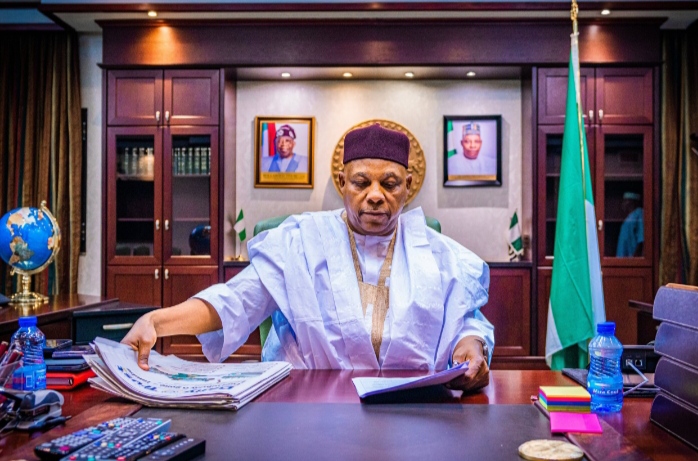
    VP Kashim Shettima

    What makes the current moment intriguing is not simply that names are being mentioned. Politics thrives on rumours after all. What shocks observers of the polity is the manner in which the Vice President appears reduced to a passive presence in discussions about his own political future. At one moment, he is treated as an afterthought; and at another moment, as a loyal functionary dispatched on errands while others debate whether he remains relevant to the project he helped midwife. The image calls to mind Oblomov in Ivan Goncharov’s novel, Oblomov. A character defined by inertia and resignation. A man whose life unfolds around him while he lies still, allowing others to decide what becomes of his estate, his relationships, and his destiny. When Shettima is not rendered invisible in elite conversations, he is portrayed as a man running presidential errands but without real agency. Flying out to represent the President. Receiving delegations. Offering dutiful loyalty, while the central question of his political fate hangs unresolved, sometimes discussed in rooms he has just exited and sometimes in rooms he may never enter.

    The irony is sharp. Shettima is not a novice. He is a former governor, and a seasoned party man. He was not selected in 2023 as a brooch fastened to presidential clothing or an ornamental addition. He was chosen despite strong objections from many quarters, including religious leaders and civil society voices who warned against the dangers of the same-faith ticket in a deeply plural country. Those warnings did not dissipate after the election. They lingered. They hardened into criticisms that have followed the administration. International partners, including voices from the United States, have made careful but pointed remarks about inclusion and representation. At home, the perception that Christian constituencies, especially in the North, felt alienated continued to shadow the government. The renewed circulation of alternative running mates must be read against this background. It signals an attempt to correct a political imbalance that many believe cost the ruling party moral capital. By floating respected northern Christian figures, Tinubu’s presidency appears eager to reassure sceptical audiences that lessons have been learned and that the future will look different. Still, the so-called attempt at weighing alternatives raises serious questions about political ethics and loyalty. What does it say about the stability of presidential and vice presidential partnerships when a sitting vice president is treated as expendable barely midway into the first term in office? What message does it send to party loyalists who defended the 2023 ticket at great personal cost? And what precedent does it set for the future?

    The Constitution grants the President wide latitude in selecting a running mate. That power is not in dispute. Political wisdom, however, demands more than constitutional permissibility. It requires sensitivity to process, respect for incumbents, and an understanding of how power is perceived as much as how it is exercised. There is also a deeper institutional issue at play. The office of the Vice President in Nigeria has long suffered from ambiguity. Its occupant is either overly powerful, a spare tyre that is painfully useless, or surplus to requirements. Rarely is there a stable middle ground defined by clear responsibilities and mutual respect.

    From Obasanjo’s frosty relationship with Atiku Abubakar to Buhari’s cautious sidelining of Professor Osinbajo, history offers little comfort. Shettima’s predicament fits neatly into this pattern. He is visible but constrained. Present but peripheral. Trusted enough to represent the President abroad, but seemingly not trusted enough to be shielded from speculation about his replacement. The mention of figures like Dogara, Mutfwang, Musa, and Kukah adds further layers to the conversation. Dogara brings legislative gravitas and a record of defying party lines on principle. Mutfwang represents a Christian minority state scarred by violence and neglect. Musa embodies military professionalism at a time of persistent insecurity. Kukah symbolises a strain of moral authority whose polish has worn thin, weakened by his muddled interventions on claims of Christian genocide in Nigeria. Each name appeals to a different constituency. Each underscores what the current ticket lacks in the eyes of critics.

    What remains missing is an honest conversation about governance performance. Electoral arithmetic alone cannot substitute for accountability. If the administration believes that changing the face of the ticket will cure deeper discontent, it risks mistaking symptoms for causes. Nigerians are burdened by inflation, insecurity, and a sense of economic drift. No vice presidential reshuffle can obscure these realities. For Shettima himself, the moment demands clarity and resolve. Silence can be dignified, but prolonged silence in the face of open speculation risks being read as acquiescence. Political survival in Nigeria rarely rewards quiet endurance and favours strategic assertion. More’s the pity for a Vice President who finds his future debated as an abstraction rather than being confronted as a political fact. More’s the pity for a power order that normalises such uncertainty at the heart of presidential power. And more’s the pity for a country whose politics revolves around personalities and permutations rather than the hard work of governance.

    Whether these discussions are trial balloons or serious plans, they reveal an administration already looking beyond its present mandate. That alone should give pause. Power is most effective when it is anchored in purpose, not perpetually distracted by succession. But do Tinubu and his goons care?

  • Senate screens Tinubu’s nominees for RSIEC, other agencies

    Senate screens Tinubu’s nominees for RSIEC, other agencies

    The 17 candidates nominated by President Bola Tinubu to oversee the affairs of Rivers State Independent Electoral Commission, Rivers State Civil Service Commission and Rivers State Local Government Service Commission have officially declared their assets before the Code of Conduct Bureau.

    The assets declaration came on the heel of security clearance by the Department of State Services and the Nigerian Police.

    The Leader of the Senate, Senator Opeyemi Bamidele, disclosed this during the screening exercise by the Senate ad hoc committee to oversee the activities of the Rivers Sole Administrator, Vice Adm Ibok-Ete Ibas (retd).

    The development comes barely one week after President Tinubu transmitted the names of nominees to the Senate for confirmation.

    The five nominees for the Rivers State Civil Service Commission are Dr Barikor Baribuma (Chairman), Lot Egopija, Ms Maeve Ere-Bestman, Mrs Joy Obiaju and Mrs Charity Lloyd Harry.

    Rivers State Electoral Commission has seven nominees – Dr Michael Ekpai Odey (Chairman), Mr Lezaasi Torbira, Prof Arthur Nwafor, Prof Godfrey Mbudiogha, Prof Joyce Akaniwor, Dr (Mrs) Olive A. Bruce and Prof Chidi Halliday.

    The category of Rivers State Local Government Service Commission also has seven appointees namely Israel N. Amadi (Chairman), Linus Nwandem, Lady Christabel George-Didia, Dr Tonye Willie Pepple, Richard Ewoh, Rear Admiral Emmanuel Ofik (retd) and Sammy Apiafi.

    The 17 nominees were all presented before the Senate committee by the Special Adviser to the President on Senate Matters, Basheer Lado, who divided them into three categories.

    The nominees for the Rivers State Primary Health Care Management Board are expected to take place on Wednesday at the Senate. Punch

  • Elite War Renewed

    Elite War Renewed

    -By Abdul Mahmud

    The war among Nigeria’s political elite has been renewed. It is not a war for ideas, nor one fought over the soul of our country. Rather, it is a petty battle over ego, and personalised struggle for who becomes the capo di tutti capi- the boss of bosses – of the State. It is also about control of access, of appointments, and the primitive accumulation and the appropriation of state resources, as it is about enthroning political narratives. As old alliances crumble and new rivalries emerge, what becomes clear is that our most powerful politicians are less interested in governance and more interested in the politics of dominance.

    This war is not new. It has been fought before. Repeatedly. And among the same political class that switches parties with ease, trades insults with flair, and builds loyalty around personalities rather than principles. What is new, however, is the sheer frequency of the war and the utter contempt they now display for even the pretence of ideological disagreement.

    Take Nyesom Wike and Rotimi Amaechi. Former friends and allies. Both from the same Ikwerre ethnic stock. Their villages, only separated by the brackish ponds that dot the landscape. They have become each other’s fiercest adversaries. Their dispute is now the stuff of public spectacle. What started as a political disagreement has festered into a deeply personal war. They call each other names in the press. They challenge each other’s legacies. They deploy proxies in the media and in government. Yet, behind the noise lies a more sobering reality: this fight is not about the people of Rivers State. It is not about policy. It is about power. It is about who controls the political structure of the state, who gets to anoint successors, and who determines “who gets what, when and how”, to quote the eminent scholar, Harold Lasswell, who framed politics as some primitive accumulation many aeons ago. A few weeks ago, the Wike-Amaechi feud resurfaced in the media. Unlike 2017, when their convoys clashed on the streets of Port Harcourt, this time the battle was fought with words, not fists. No bullets. Just barbs. It began with Amaechi’s declaration: “We’re all hungry. All of us. If you’re not hungry, I am.” Wike fired back. He accused Amaechi of mocking the sufferings of Nigerians. “He never spoke of hunger while he was minister. Two years after leaving the office, he suddenly discovers it. That’s not a concern. That’s hunger for power”. Then came the sting: “You’re insulting Nigerians by trivialising poverty. The only hunger you feel is from being out of power.” Amaechi’s reply was curt: “I don’t want to join issues with children”. In a theatrical twist, Wike took to the streets of Abuja, flanked by schoolchildren who cheered his public works- mocking, perhaps, the maturity of his rival, Amaechi. The Wike-Amaechi war exemplifies how elite disagreements in our country are rarely about governance. They are about the erosion of trust among powerful individuals who once traded favours, shared secrets, and benefitted from a common network. When those relationships sour, they do not simply walk away, they destroy each other in the open, using the levers of government and the media as weapons. Nonetheless, this must be said: there are no victors in this warfare, only theatrical performers draped in borrowed comical robes, stumbling through farce like Clarus and Gringory of yesteryear. Their antics, though staged with the pomp of statesmen, draw laughter laced with pity. For while they clown, the public bears the quiet shame of being forced to watch, knowing the jest is at their own expense.

    A similar war broke out in Edo State a few years ago. Adams Oshiomhole and Godwin Obaseki were once political allies. Oshiomhole handpicked Obaseki as his successor, branding him a technocrat who could consolidate the achievements of his administration. But within one term, their relationship deteriorated. Obaseki began to assert independence. Oshiomhole, accustomed to loyalty, felt betrayed. The fallout culminated in a fierce political battle in 2020 that saw Obaseki defect from the All Progressives Congress (APC) to the Peoples Democratic Party (PDP), securing a second term against his former benefactor’s wishes.  Last year, their hostilities were renewed. The two men backed opposing candidates for the 2024 Edo governorship election. Their political machinery, once united, operated as different war theatres, with a verbal arsenal deployed without caution. As usual, there were little public discourses about what these candidates stood for. The election, like the war between Oshiomhole and Obaseki, became a proxy battle over egos and retribution, not vision or policy.

    Even in Lagos, the epicentre of elite political engineering, cracks have shown up themselves. At the recent commissioning of the Lagos-Calabar coastal highway, President Bola Tinubu, the dominant political godfather of Lagos, snubbed his longtime ally and protégé, Governor Babajide Sanwo-Olu. What might have appeared to the casual observer as a momentary oversight was, to insiders, a clear signal that the relationship between godfather and godson had gone south. Sanwo-Olu extended his hand; Tinubu ignored it. In our country’s politics, these gestures are never accidental. They are loaded with meaning. It was a cold public humiliation disguised as protocol. The reasons for the cold remain the subject of intense speculation. Some say it’s about Tinubu’s future political calculations. Others hint at unresolved tensions over the management and deployment of power. Whatever the reason, it underscores a pattern: political relationships in our country are rarely stable. They are transactional, conditional, and expendable. Only a few days ago, newspapers reported that Tinubu had forgiven Sanwo-olu for his sins. What were his sins in the first place? Nobody knows.

    They are not alone in this theatre of elite war. I invite the reader to turn their gaze to Benue State, where Senator George Akume and Governor Hyacinth Alia are entrenched in a slow-burning war of attrition. Each maneuvering for dominance over the soul of the state. To the south, in Akwa Ibom, the echoes of past battles between Udom Emmanuel and Godswill Akpabio still linger. The current governor, Umo Eno, finds himself delicately poised between these two warring combatants. In a bid to survive the infernal tides, he has publicly aligned with the ruling party at the centre, while seeking sanctuary from political crossfires and shielding himself from the sharp edge of internal vendettas. And in Delta State, a cold war simmers just beneath the surface. There, former Governor Ifeanyi Okowa, incumbent Sheriff Oborevwori, and political godfather James Ibori circle each other in a triangular standoff. The smiles are strained, the handshakes stiff. Hostilities remain veiled for now. But like the harmattan bushfires, all it takes is a single spark.

    These elite wars come at a steep cost. Governance is abandoned or hijacked. Institutions become politicised. Political parties become war camps. State resources are diverted to settle loyalists or fund propaganda. Worse, the people are dragged into disputes they barely understand. They are recruited as foot soldiers in wars that are never about them in the first place. But, at the heart of these elite war is the fundamental problem: the absence of ideological core to the politics of our country’s political elite. Unlike countries where political parties reflect social or economic philosophies, our country’s political parties are mere platforms for personal ambitions. They are vehicles for power, not values. Politicians decamp from one party to another not because of policy disagreements, but because their interests are no longer served where they are. This ideological emptiness is why elite war so often turns violent, personal, and protracted. There is no higher cause to appeal to. No shared philosophy to fall back on. Once trust breaks down, all that remains is the raw, naked struggle for power. The elite war is also sustained by the absence of consequences. In countries with strong institutions, political disagreements are managed through the formal mechanisms of debates and caucuses. In our country where state institutions are weak and compromised, the institutions are thrust into the heart of the war. The elite manipulate them at will, so when they fall out, there are no impartial referees but only loyal judges, partisan security agencies, and pliant lawmakers that play the roles of the palace jesters, group thinkers and echo chambers’ inhabitants.

    The media are not spared. Far from standing above the fray as impartial observers, many have been drawn into the swirl of the elite war. Rather than offering sober analysis and critical scrutiny, they are conscripted as foot soldiers in the war of powerful men. Journalists become partisans, trading objectivity for allegiance. Editorials, once sacred spaces of reasoned reflections, are auctioned to the highest bidder. The press, meant to be the fourth estate in a democracy, becomes the bugle in the battlefield of ambition, echoing the voices of its paymasters. In the process, public trust withers. Journalism, whose noble duty is to shine light on power, becomes not only compromised, co-opted, and complicit; but a shadow of itself.

    The political, governance and public arenas become chaotic and lawless.

    What, then, is the way forward?

    Our country needs a new elite consensus. A shift to issue-based politics. A commitment to governance that outlives personal loyalty. This cannot happen overnight, but it must begin. The country is in crisis on multiple fronts- economic collapse, insecurity, unemployment, mass migration. These problems require political maturity, not endless elite wars. More importantly, our citizens must also resist being drawn into elite wars. They must ask harder questions. Whose interest does the wars serve? What values are at stake? What does this mean for service delivery? They must stop romanticising political gladiators and combatants of needless wars. The tendency to see powerful men as saviours, even after repeated betrayal, emboldens the culture of impunity. Politicians must be judged by what they deliver, not whom they fight.

    Ultimately, elite wars are not harmless rivalries. They deepen polarisation. They stall progress. They distract from urgent reforms. They are the symptoms of a broken political culture that prioritises loyalty over legacy, revenge over reconciliation. The renewed war among our country’s elite is not just a political drama. It is a warning sign. A sign that our democracy remains fragile. That the politics of the strongman still prevails. That until values replace vengeance at the centre of our political life, our country will continue to be governed not by principles, but by grudges.

    Those who still have ears, hear. And let them not only hear, but understand. For in the rising din of political vanity and elite wars, truth speaks in whispers. Wisdom calls from the margins. The times are urgent, the stakes high. Silence is no longer innocence. In a country where power drowns out reason, and noises pass for leadership, discernment becomes a civic duty. Let the discerning rise above the clatter, and let our citizens remember: the future belongs not to those who shout the loudest, but to those who listen, truly listen to the heartbeats of our country in distress.

    Those who have ears, hear! Now.

  • JUST-IN: Ezeh-Led Enugu APC Youths Call For Dialogue, Reject Protest, Say One Year Insufficient To Judge President Tinubu 

    JUST-IN: Ezeh-Led Enugu APC Youths Call For Dialogue, Reject Protest, Say One Year Insufficient To Judge President Tinubu 

    Chetanne Chinelo, Enugu

    Sequel to plans to commence the nationwide protests against hardship and hunger in Nigeria tomorrow, the leadership of the Youth wing of the Enugu State chapter of the All Progressives Congress, APC, led by Hon. Chidiebere Ezeh have called on young Nigerians to shelve the idea of protests and embrace dialogue. 

    The youth wing arrived at this decision after an emergency meeting of the members drawn from the seventeen local government areas of the state, held on Tuesday, July 30, 2024, at the state party office in GRA, Enugu. 

    Hon Chidiebere Ezeh
    Leadership of the Youth wing of Enugu APC led by Hon. Chidiebere Ezeh (Middle)

    Speaking with newsmen, Ezeh, who was a former Nkanu West local government council chairmanship candidate of the APC, dissociated the youth wing of the party from the proposed national protest and demonstration, declaring that the protest will not solve any problem rather, “it will impoverish the ordinary people”.

    Mr. Ezeh noted that although the nation was battling a struggling economy, the situation could be salvaged with engagements and dialogue, explaining that President Tinubu has shown the will to steer the fortunes of the nation for good in one year. 

    In his words: “It is obvious that Nigerians are facing a lot of hardship presently which Enugu State is not excluded from. We agree with the fact that things are not easy, but we believe that you don’t solve such issues with violence. There are ways of settling issues rather than violence or protest.

    “Therefore, all the Youth Leaders present today now agree that we will embark on consultation and dialogue with the Federal government rather than going for protest. We have agreed that we will not go on protest because one year is not enough for Mr. President to fix the Nigerian economy.

    “We have expressed our grievances to the Federal government on issues and challenges bothering the youth constituency and other segments of the society in Enugu state and Nigeria as a whole.

    “We just had a meeting with various groups. Since the government has promised to progressively address some of our grievances, we are saying no protest in Enugu State especially now the President has granted Local Government Autonomy which will bring the government closer to the people especially the rural dwellers”. 

    Ezeh reiterated their unalloyed loyalty to the Leadership of President Bola Ahmed Tinubu and its Renewed Hope Agenda, and that of Chief Uche Nnaji Nwakibie, the Honourable Minister of Innovation, Science and Technology.

    Hon Chidiebere Ezeh
    A collage of the Minister of Innovation, Science and Technology, Chief Uche Nnaji Nwakibie and Hon. Chidiebere Ezeh, Leader, Enugu APC Youth wing

    Present at the meeting were the State Deputy Youth Leader, Hon. John Nebo among other youth leaders from the 3 Senatorial zones and 17 Local Government Areas of the State.

    Earlier, the Deputy Governorship candidate of the party in the 2023 general elections, Barr. George Ogara met with the Enugu APC Youth wing.