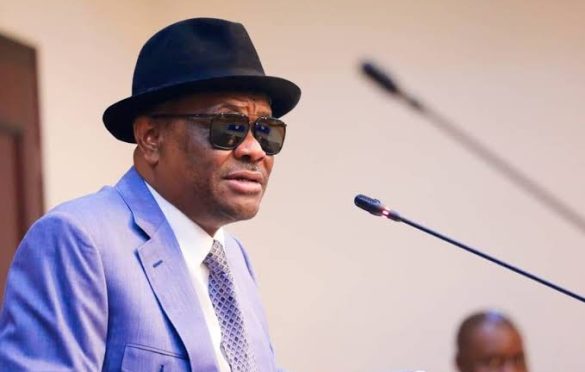
Two wrongs never make a right. When two people stridently but wrongly assert their rights over an issue, something is systemically wrong. That was the circumstance surrounding the recent Wike-Yerima standoff that has become the greatest content asset for social media lampooners. But this is a very serious matter relating to military-civilian relations in Nigeria. For starters, Wike and Yerima took the already fraught military-civilian relations to a whole new subterranean level.
One of the greatest ills bedeviling good governance in Nigeria is the use of the military for purely civilian police duties in a democracy. Soldiers by orientation are not good policemen. It’s not their orientation. It is not their training. As such they should not be. Yet, because of the military’s long sojourn in Nigeria’s leadership politics, certain traits imbued on the psyche of Nigerians continue to reflect the negative influence of military anti-politics.
The recent shameful public altercation between Nyesom Wike, the Abuja FCT Minister and a young naval officer, Lt. AM Yerima, speaks to and epitomizes the prevailing crises of our national clash of values and lack of respect for constituted authority. Those, who like Wike, who occupy high public offices, have unwittingly contributed to the crisis, often by their conduct and their utterances. Some may say minister Wike deserved his comeuppance. That’s debatable. But a minister berating a uniformed military officer, as “a fool” and a “small boy,” lends credence to how deep-seated the crisis has become. It speaks also to the dearth of patriotism in Nigeria.
The now viral altercation presented a Catch-22 situation. Heads both parties lose; tails, both parties lose. Both Wike and Lt. Yerima, represent by their official positions, constituted authority. Yet, they both cancelled each other’s prerogative, and shamelessly so. Today, political leaders take full delight in legitimizing the militarization of our politics. They have police and military officers guarding them and standing or sitting behind them at public events. Our civilian leaders all covet having ADCs; a purely military culture. Incidentally, had officer Yerima been assigned as part of the Minister Wike’s security detail, -such assignments which happen frequently- he would have executed Wike’s orders the very way he executed the orders of his principal; reportedly a retired three-star military officer. That’s the irony that was lost on Wike, and his cloistered civilian mindset. It’s worth recalling that in July 2020, Gov. Wike used his security details to rescue embattled former NDDC managing director Joy Nnuieh from a supposed house confinement. If the truth be told; soldiers are meant to obey the last command. They follow orders. Moreover, due process in enforcing a purely civic matter, required modalities other than the one deploy routinely by the FCT Minister.
Here is the sad paradox of that altercation. In a democracy, the military is statutorily supposed to be subservient to civilian authority. That respect derives operationally, from the commander-in-chief to his alter egos. It matters little, if the official is elected or appointed. Then again, in the order of protocol and official precedence, a minister ranks about the same as a military general. Interestingly, well before Wike became the FCT minister, four of his predecessors as ministers of the FCT, were soldiers; Gen. Mamman Jiya Vatsa, AVM Hamza Abdullahi, Gen. Gado Nasko and Gen. Jeremaih Timbut Useni. Now, would young Lt. Yerima, have responded the same way to them in a similar circumstance? I think not. What this says is that our military has this mindset that every non-military Nigerian, no matter how highly placed, is a “bloody civilian.” Someone forgot to remind Wike of that reality. Just as someone forget to tell him that he was not a judge, a sheriff or a bailiff.
Relatedly, an incident that happened in the late 1980s that is worth recalling, illustrates how our values and respect for constituted authority has been egregiously eroded. During President Ibrahim Babangida’s rule, late Ambassador George Dove-Edwin, one of Nigeria’s most astute and highly respected diplomats, was the High Commissioner in London. Prior to that assignment he had served as Permanent Secretary in the Foreign Ministry. At that time, late AVM Hamza Abdullahi, an air force general, was the FCT Minister, a member of the ruling military council and as a very close ally of President Babangida, belonged to his close-knit kitchen cabinet.
AVM Abdullahi had travelled to Germany and was returning to Nigeria via London. The High Commission was duly informed of his transit so as to facilitate his transfer after his short layover in London. When High Commissioner Dove Edwin was informed that the FCT Minister would be passing through, he had indicated that he intended to personally go to the airport, and await the Minister’s arrival at the Heathrow Airport protocol lounge. His plan to spend the transit time with the minister was not out of obligation, but as a matter of courtesy and diligence.
On the appointed day, several hours before Dove-Edwin was to go to the airport, he was summoned to Foreign and Commonwealth Office (FCO) at Whitehall. Realizing that he might not make it to the airport on time, Dove-Edwin dispatched his Deputy Chief of Protocol to the airport to receive the minister and hold fort until he arrived, just in case he was delayed. He went a step further. He sent a personal handwritten note to the FCT Minister explaining his predicament. The Deputy-Chief of Protocol received Minister Abdullahi, handed over the High Commissioner’s personal note, and reassured him that the High Commissioner would definitely arrive before his departure for Nigeria. AVM Abdullahi was visibly displeased; and made that known in very clear terms.
When Amb. Dove-Edwin eventually arrived, and was already tendering his apologies as he entered the Protocol Lounge, an irate Minister Abdullahi publicly berated him, using expletives, despite the presence of other high ranking foreign dignitaries in the Lounge. His grouse; he did not understand what was so important at the Foreign Office to warrant the High Commissioner not being on hand to receive him. His ultimate faux pas was when he said; “We sent you here at great expense to serve us.” It was not clear if the “us” was Nigeria, or Nigeria’s top military brass. A totally stunned Dove-Edwin, though a civilian, stood erect, almost at attention, looked straight at the Minister, and said, “Honourable Minister, your language is most unbecoming and unacceptable. Have a good afternoon.” He turned around and left.
The postscript to that saga is that Amb. Dove-Edwin reported the incidence in a dispatch to the Minister of Foreign Affairs, with copy to the Chief of General Staff (CGS). One point vehemently made in the demarche, was that traditionally, Ambassadors when at post, were only obligated to be present at the airport, when the Head of State, his Deputy or the Foreign Minister visited. Any such presence, for other senior government officials, was simply, a matter of courtesy- a privilege, not a right. The upshot is that Dove-Edwin was never queried and never sanctioned, even as some might have deemed his conduct insubordination. The flip side is that the Minister’s conduct reflected a clash of values that also ridiculed constituted authority: his, and that of the High Commissioner. In Nigeria, military-civilian relations are complex and fraught with imponderables. Even when soldiers retire from active duty, and don agbada or kaftan mufti, most generally treat civilians with visible disdain, whenever there is a civil disagreement. Officer Yerima exemplified that mindset. Also, in Nigeria, soldiers don’t submit to civilian police authority. That’s a fact.
The interface between Minister Wike and Lt. Yerima would have ended well, if Wike instead of publicly berating the officer had simply and civilly asked to speak to his principal or commanding officer. That could have been done, without acrimony. No one appointed the FCT minister a law enforcement police officer or bailiff. Wike should have also recognized and respected the officer’s obligation to carry out his orders by a constituted authority. A proper and courteous interface would have also affirmed the Minister’s legitimate position and authority as someone, who was also carrying out his statutory duties at the behest of the commander-in-chief, without the engagement becoming vexatious.
The Wike-Yerima face off, is a daily occurrence in Nigeria. What happens at military checkpoints across Nigeria is even more appalling. The only difference is that this incident involved a well known public official, whom most Nigerians already consider obtuse and very controversial. But it was not just Wike that the soldier disrespected; it was the commander-in-chief, who appointed him and the senate that confirmed him. Likewise, it was not only Yerima that Wike called a “small boy” and “a fool”. Indeed, it was the entire armed forces of the Federal Republic of Nigeria that Wike abused. Admittedly, Lt. Yerima did professionally well, not to be provoked by the abuses and name calling. Two wrongs never make a right.
Even though it is well and good that Lt. Yerima stood his grounds, some of his military superiors know too well that his conduct, despite being polite to Wike, perceptibly did not enhance military-civilian relations. Often, perception is worse than reality. The messaging was visibly conflictual and condescending. If a junior officer can publicly do that to a serving minister, what then, can they do to the common man? And on the flip side, can a junior civil servant do same to a serving or retired military general without agonizing reprisals? I think not! Beyond right and wrong, the Wike-Yerima episode raises more questions than answers. One can only hope that this saga will prompt the urgent rethink and redress of deploying military officers to enforce law and order tasks that are within the statutory remit of the Nigerian police.
———-
Obaze is MD/CEO, Selonnes Consult – a policy, governance and management consulting firm in Awka.