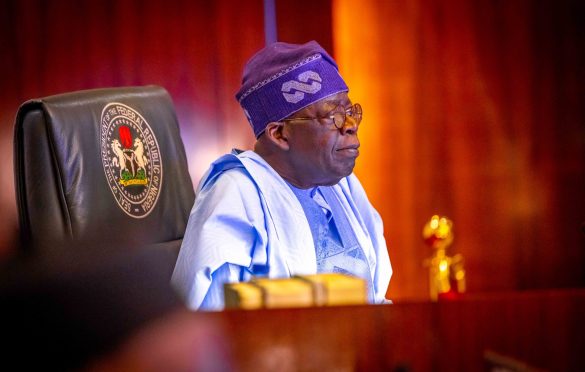
President Bola Tinubu has asked the House of Representatives to approve external loans worth $20.52bn and €1.045bn to fund infrastructure and development projects under the Federal Government’s 2026–2027 Supplementary External Borrowing Rolling Plan.
The request was presented to lawmakers on Wednesday through a letter read by the Speaker of the House, Tajudeen Abbas, during plenary.
In the letter, Tinubu urged the House to fast-track consideration of the proposal, saying the funds would support programmes in agriculture, healthcare, education, water supply, security, employment and other critical sectors.
The President listed the proposed facilities as $20,517,755,901 and €1,045,083,643, with a detailed breakdown attached to the request for legislative review.
He explained that the proposed borrowing was necessary to support his administration’s reform agenda, stimulate economic growth and address the country’s infrastructure funding gap.
According to Tinubu, the projects were selected after technical and economic assessments, with consideration given to their potential contributions to national development.
He said the initiatives were expected to create jobs, improve skills acquisition, encourage entrepreneurship, reduce poverty and strengthen food security.
Tinubu added that most of the projects would be implemented across Nigeria’s 36 states and the Federal Capital Territory.
He argued that the country’s infrastructure needs, particularly in power, transportation and healthcare, required substantial investment beyond what the government could adequately provide from available resources.
The President maintained that responsible external borrowing would help bridge the funding gap, while stressing the importance of timely disbursement and effective execution of the proposed projects.
Following the presentation, the House referred the request to a joint committee on Aids, Loans and Debt Management and Appropriations, chaired by Abubakar Nalaraba, for further consideration.
The committees are expected to examine the proposed facilities, including their terms, intended purposes and potential effects on public finances, before submitting their findings to the House.
The loan request comes amid ongoing discussions about Nigeria’s need to fund major development projects while managing its public debt obligations.
The proposed facilities will require legislative approval before the Federal Government can proceed with the borrowing covered by the request.
Africa’s mounting debt crisis reveals a troubling paradox: a continent rich in natural wealth yet burdened by rising liabilities, infrastructure gaps, persistent poverty, and weak institutions. From Ghana’s prolonged debt distress to Nigeria’s liabilities consuming 75% of revenue alongside $24.14 billion in external borrowing—the pattern is clear: borrowing without transformation. In contrast, Rwanda has deployed debt more strategically, echoing Asian success stories like South Korea, Singapore, and China, where disciplined investment turned liabilities into engines of growth. Although Rwanda’s debt-to-GDP ratio surged from 20% in 2010 to over 80% in 2025 triggering a Fitch downgrade its borrowings have been capitalized into infrastructure, health, and technology, anchored by long-term planning and relatively strong governance. The contrast is stark: while African giants struggle with rising debt and limited returns, Rwanda and Asia demonstrate that, under the right conditions, debt can drive growth. The central question for Africa is no longer whether to borrow, but why decades of borrowing have failed to deliver sustained prosperity and what lessons can be drawn to rewrite the continent’s debt path in line with productivity.
2.0 Public Debt vs Growth Productivity: Africa vs Asia
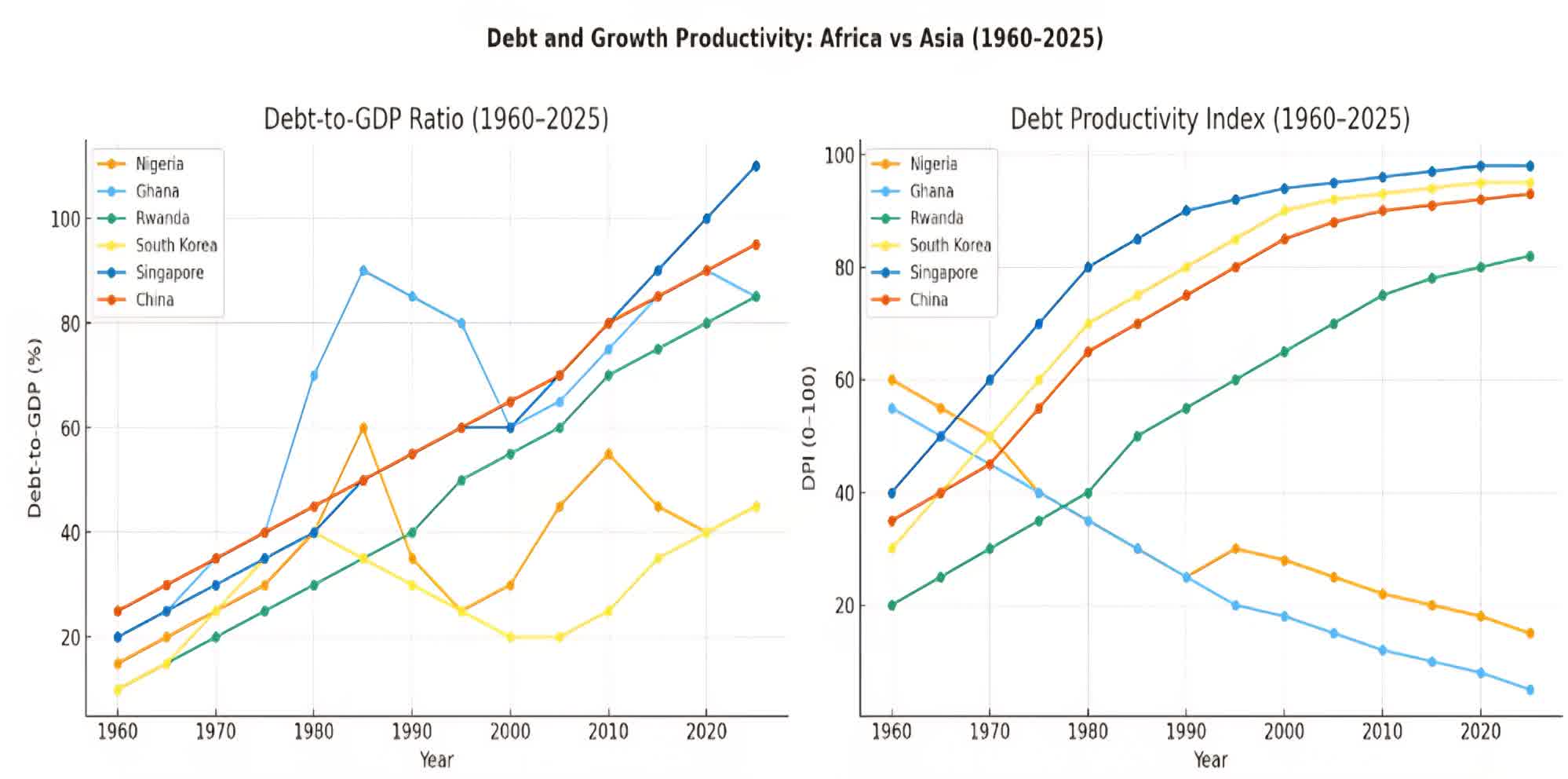
The “Debt Productivity Index” (DPI), an analytical construct using debt-to-GDP and GDP per capita growth, captures the correlation between debt and productivity.
Nigeria’s debt-to-GDP ratio rose from 39.1% in 1989 to 56.6% in 1990, then declined to 39.4% in Q1 2025 after GDP rebasing. Yet Nigeria’s DPI has steadily declined, mirroring Ghana’s trajectory despite Ghana’s debt-to-GDP peaking above 80% in the mid-2010s and again in 2023–2024. Rwanda’s debt-to-GDP rose from 20% in 2010 to over 80% in 2025, but its DPI shows a corresponding positive increase. This mirrors patterns in South Korea, Singapore, and China. For example, South Korea’s debt-to-GDP is forecast to reach 53.6% by 2028, China’s to 110% by 2029, and Singapore’s to 175% in 2025. These countries demonstrate that rising debt, when tied to productivity, can yield transformative outcomes.
3.0 Africa’s Debt Landscape
Over the past 15 years, Africa’s debt has surged. The Sub-Saharan Africa median debt-to-GDP ratio reached 60% in 2025—double the 30% recorded in 2010. Nigeria’s 2025 ratio of 45% sits below the continental average, while Ghana’s exceeds 80%. Sudan remains in chronic debt distress, unable to regain international creditworthiness.
Africa’s debt structure is increasingly dependent on external borrowing—Eurobonds and bilateral loans from China. Domestic debt markets remain shallow, constrained by weak savings and fragile financial systems. Global shocks, commodity price volatility, and interest rate hikes have pushed many African countries into unsustainable debt service positions.
4.0 The Debt Paradox in Africa: Rwanda as an Outlier
Africa’s paradox is multifaceted: resource-rich yet fiscally distressed, attracting financial inflows but suffering from debt overhang. The continent faces power shortages, food insecurity, and illicit financial flows exceeding $89 billion annually. Debt servicing diverts funds from health, education, and infrastructure, undermining human capital and deterring investment.
Rwanda stands apart. Its long-term plans such as Vision 2050 focus on productivity-enhancing investments in transport, ICT, and health. Stronger governance and alignment with donors and multilaterals rationalize its debt-to-GDP climb to over 80% in 2025. While not risk-free, Rwanda’s debt strategy shows that high debt can support transformation if well managed.
5.0 Africa vs Asia: What Went Wrong?
Asian economies once faced similar savings gaps. South Korea’s economic miracle was driven by heavy borrowing tied to industrial policy, mass education, and export-oriented manufacturing. Singapore’s borrowing between 1970 and 1990 funded world-class infrastructure and human capital. China’s 1978 reforms leveraged debt to finance infrastructure and technology, lifting over 800 million people out of poverty. The common thread: long-term planning, institutional discipline, and strategic use of debt for development. In contrast, African borrowing has often been reactive, fragmented, consumption-driven, and applied to politically motivated projects rather than productivity multipliers. Weak institutions and corruption crowd out fiscal space, trapping governments in cycles of refinancing without growth.
6.0 Lessons for Nigeria and Africa
To escape perpetual fiscal fragility, Africa must go beyond debt restructuring. Key reforms include:
•Fiscal discipline and transparency: Align debt with credible development strategies and national priorities.
•Domestic revenue mobilization: Tax reforms must reduce dependence on borrowing. In Nigeria, scepticism around the 2025 tax reforms fuels non-compliance, highlighting the need for public trust. This is because trust in governance is critical to long-term fiscal sustainability.
•Growth-enhancing investment: Debt must fund projects tied to measurable growth multipliers and long-term planning.
•Institutional strengthening: Democratic institutions must be fortified to eliminate inefficiencies and inconsistent borrowing.
•Governance and accountability: Prevent misuse of debt and ensure high returns on public investment.
•Strategic deployment: Debt must be a deliberate development tool—not a reactive deficit plug.
Unproductive debt must not define Africa’s destiny. Rwanda, South Korea, Singapore, and China show that debt, when anchored in discipline, vision, and strong institutions, can fuel transformation. For Nigeria and its peers, the debt paradox is not just fiscal, it is systemic. The task is clear: close governance and strategy gaps, turn liabilities into productivity, inclusive growth and lasting prosperity.
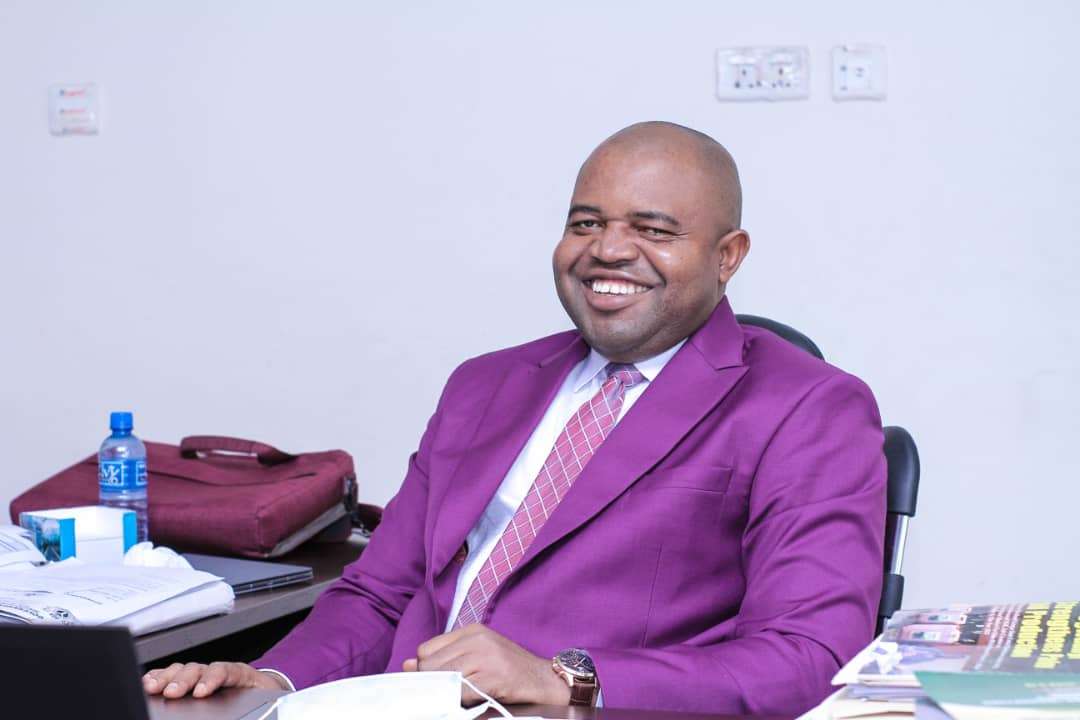
David Okelue Ugwunta, PhD
Dr. Okelue David Ugwunta is a Nigerian University Lecturer and an Economic Planning Specialist.