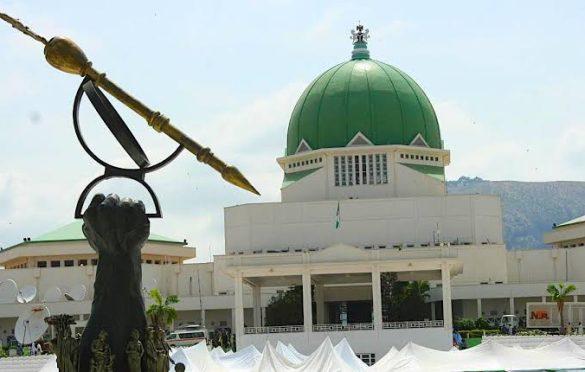
Some Nigerians have expressed concerns that the National Assembly’s latest amendment to the Electoral Act, 2022, to allow statutory delegates – all those elected – to participate and vote in the conventions, congresses or meetings of political parties, saying it was designed to boost the chances of the Senate President, Ahmad Lawan, who recently joined the 2023 presidential race under the All Progressives Congress (APC).
This is just as the decision of the Court of Appeal yesterday which set aside the judgment of a Federal High Court, Umuahia, Abia State which voided the provision of Section 84(12) of the Electoral Act 2022, has continued to generate mixed reactions in the polity as well as among senior lawyers.
THISDAY gathered that the aim of the fresh amendment to the Electoral Act which received accelerated passage at both chambers of the National Assembly, was to increase the chances of Lawan in the party’s presidential primaries and subsequently in the presidential elections.
“What the National Assembly is trying to do is to back Lawan with the huge number of statutory delegates of past and present legislators that the amendment would be allowed to attend such conventions and congresses. They are in the region of almost 4,000, who are expected to support Ahmad Lawan. So, that is why they are trying to amend the law again to suit their own selfish purposes and calculations. But will President Buhari sign it? That is what everyone is asking,” a source who pleaded to remain anonymous stated.
Analysts easily point to what happened to the previous electoral bill where they reached an understanding with the president to amend after signing the amended Electoral Act only for the lawmakers to renege. .
Those identified as ‘statutory delegates’ include the President, Vice President, Members of the National Assembly, Governors and their deputies, Members of the State Houses of Assembly, Chairmen of Councils, Councillors, National Working Committee of political parties, amongst others. Meanwhile, some senior lawyers who spoke on yesterday’s appellate court ruling noted that with the judgment, political appointees are free to participate in the congresses and conventions of their political parties without having to resign their appointments 30 days to such congresses and conventions.
However, others disagreed, claiming that with the setting aside of the judgment which had ordered the striking down of the section of the electoral act, the section subsists until set aside.
Justice Evelyn Anyadike of the Federal High Court, Umuahia had in a judgment delivered on March 18, 2022, held that the said Section 84 (12) which barred political appointees from participating in the congresses and conventions of their political parties except they resign their appointments 30 days to the period was unconstitutional.
The lower court had predicated its decision on the fact that the constitution had already stipulated the criteria for the qualification and disqualification of persons seeking election into public offices, adding that the provisions of the amended electoral act runs contrary to the provisions and as such must be struck down.
However, not pleased with the decision, the People’s Democratic Party had approached the court to set aside the judgment of the lower court on the grounds that it erred in law when it entertained a suit wherein it lacked the legal authority to do so because the plaintiff was not qualified to institute the legal action.
However, delivering judgment on the appeal yesterday, the appellate court held that the lower court lacked the jurisdiction to entertain the suit and subsequently voided the judgment of Justice Anyadike.
The judgment was in the appeal marked: CA/OW/87/2022 and had Nduka Edede and the Attorney General of the Federation as respondents.
In a unanimous decision, the three-member panel of the appellate court presided by Justice Hamma Barka held that the Federal High Court, Umuahia, had no jurisdiction to have entertained the case in the first case because the plaintiff, Edede, did not have the legal authority to initiate the suit.
According to the panel the plaintiff failed to establish any cause of action to have warranted his approaching the court on the issue because he did not establish that he was directly affected by the provision.
The Court of Appeal subsequently struck out the suit marked: FHC/UM/CS/26/2022 which Edede had filed before the Umuahia court.
In reaching the decision that plaintiff lacked locus, the court held that he failed, “to show that he is that political office holder who is affected by the vexed section.
” Curiously, none of the numerous office holders, to which the section of the Electoral Act is targeted has shown interest in the matter.
“I agree with the appellant that from the 1st respondent affidavit in support of the originating summons, no discernable personal interest to the 1st respondent has been shown to exist.
“To that end, I am in full agreement that the1st respondent in the circumference, lacked the requisite locus standi to initiate the action before the lower court, and the court devoid of jurisdiction in entertaining the suit/action.
“The aggregate of all I have been saying is that owing to the fact that the 1st respondent lacked the locus standi to sue, and there being no right of action in his favour, the lower court had no jurisdiction to entertain the suit and thereby laboured in vain. The resultant effect is that the action before the lower court is liable to be struck out and is accordingly struck out.
“Consequently, we would proceed to examine issues two and three which forms the fulcrum before the trial court generating the instant appeal and issues two and three being interwoven and related, the issues would be considered at the same time.”
According to the justices, the nullification of the judgment of the lower court ought to have ordinarily settled this instant appeal, “But, we are very conscious of the fact that the decision of this court may not be the final decision on the issue, this being a penultimate court.”
The panel acknowledged that there are divergent views on what they should do in the circumstance, “having arrived at the decision that the lower court lacked the necessary jurisdiction to entertain the action, in the first leg.”
While they submitted that there was the need and duty to avail the apex court a view on the matter being agitated, the panel subsequently delved into the merit of the suit and held that the said Section 84 (12) was unconstitutional because it breaches Section 42 (1)(a) of the Constitution by denying a class of Nigerian citizens their right to participate in an election.
“The provision of Section 84(12) of the Electoral Act 2022 specifically targets political appointees and disqualified them from being voting delegates or from being voted for at convention or congress of any political party for the purpose of the nomination of candidates for any election.
“This provision does not disqualify any other class of person.
“The term community is not defined by the constitution but it is a Canon of constitutional interpretation that where words used in the Constitution are clear and unambiguous they must be given their natural meaning
“The term: community in Section 42(1)(a) of the Constitution as members of that group share the same job and therefore, the same political interest.
“Section 84(12) of the Electoral Act expressly subjects them to disabilities and restrictions from other citizens of Nigeria, other communities, political interests and political views and thereby contravenes the provision of Section 42 (1)(a) of the Constitution and thereby null and void,” he said.
Reacting to the judgment, rights activists and constitutional lawyer, Chief Mike Ozekhome, told THISDAY that, “they are just saying that because the plaintiff did not have locus standi and if a plaintiff does not have locus standi it means that the court has no jurisdiction. But on the merit of the case, they said Section 84 (12) is unconstitutional and invalid.”
Also, senior lawyer and President of the Center for Socio-Legal Studies, Professor, Yemi Akinseye-Goerge while also agreeing that Section 84 (12) of the Electoral Act, 2022, was patently unconstitutional as has now been confirmed by the Court of Appeal added, “Until the Supreme Court says otherwise, political appointees are free to participate in their party’s convention as voters or as candidates without resigning their appointments until 30 days to the general election.”
While agreeing that the law was discriminatory, the law professor argued that the National Assembly lacks powers to make any law that discriminated against any group of Nigerians “such as this provision which abridges the rights of appointees to participate fully in the primaries of their parties. No one should suffer any disability not recognised by the constitution.”
Akinseye-Goerge added that, “Qualifications for participation in elections are clearly stated in the Constitution. They cannot be modified through subordinate or inferior legislation like the Electoral Act. This is in line with a long list of authorities decided by the Supreme Court on the relationship between the Constitution and other laws.”
He, however, acknowledged that the decision of President Muhammadu Buhari and the Federal Executive Council (FEC) that they should resign is the best for the country.
“They are already distracted and can no longer give their best to the government. It is embarrassing that rather than finding solutions to the problems facing the country they are busy campaigning for votes,” he added.
Also speaking in the same vein another senior lawyer, Chief Adeniyi Akintola, SAN, commended the appellate court for delving into the merit of the appeal and reaching the decision that the said Section 84 (12) was unconstitutional.
He said, “Their lordship has done the right thing as the middle court, they have to delve into the merit of the case and they have even settled it for the High Court judges because they now know that that section is null and void,” adding that only the Supreme Court could set it aside.
According to Akintola, “for now it stands”, because once a judgment is delivered by a court of record that judgment must be enforced, as parties have no other choice on the issue but enforce it.
The senior lawyer while blaming the legislators for placing political consideration over the law stressed that any law that discriminates against citizens can hardly stand the test of time.
“A law is no law if it fails the litmus test of quality; the quality of a good law is that it must be certain, it must not be discriminatory, it must be universal because when a law is targeted at a group of people it is termed a bad law and that is exactly what has happened in respect of Section 84 (12).
“That section is unconstitutional because it deprives Nigerians of their rights”, he said, stressing that whether a governor has 400 appointees, it is left for Nigerians to decide whether they are good for political offices.
But Mr. Dayo Akinlaja, SAN on his part disagreed with the two submissions, observing that the position appears rather unclear yet.
“I just came across another story in the social media that the Court of Appeal referred the issue of the validity or otherwise of the provision to the Supreme Court for determination. On this standpoint, it is sheer wisdom for one to read the judgment of the Court of Appeal before proffering opinion on the issue.”
He said, “Nonetheless, it should be safe to say that once the Court of Appeal has held that the High Court in Umuahia had no jurisdiction to entertain the matter for want of locus standi on the part of the person who instituted the suit, it follows that the decision of the High Court is non-existent.
“As a sequel to that, whatever decision reached by the Court of Appeal would remain the correct position pending the intervention of the Supreme Court, given the opportunity.”
According to him, if the Court of Appeal held that it is invalid, that would represent the position of the law as of today.
“However, if the Court of Appeal merely referred the question of the validity or otherwise of the provision to the Supreme Court for determination, the situation would be that there is no judicial determination of the validity or otherwise of the provision yet.
“In that case, the law would remain as it is in the Electoral Act, meaning that political appointees cannot vote or be voted for during primaries”.
(thisdaylive)