Tag: Journalists

  • Media owners, journalists, stakeholders agree on 41-point code of ethics, co-regulation, Ombudsman

    Media owners, journalists, stakeholders agree on 41-point code of ethics, co-regulation, Ombudsman

    Critical stakeholders in the media industry, yesterday, agreed on a 41-point code of ethics for Nigerian journalists. They also adopted co-regulation instead of a self-regulation mechanism.

    Both measures are part of “an attempt to jumpstart a fresh attempt to put in place rules to guide professional conduct and a regulatory council to support the efforts to hold journalists accountable to their publics and deepen public trust in their work.”

    Stakeholders, who took the decisions, yesterday, at a Rountable on “Deepening Media Professionalism Through Co-Regulation,” in Lagos included the Newspapers Proprietors Association of Nigeria, NPAN; Nigerian Guild of Editors, NGE; Nigerian Union of Journalists, NUJ; Broadcasting Organisation of Nigeria, BON; Guild of Corporate Online Publishers, GOCOP; and Independent Broadcasters Association of Nigeria, IBAN.

    They were backed by veterans of the media industry such as Chairman/Publisher of Vanguard Newspapers, Mr Sam Amuka; former Ogun State Governor, Chief Olusegun Osoba; Mr Ray Ekpu; Mr. Lade Bonuola; Dr Tonnie Iredia (via Zoom); Publisher of ThisDay Newspapers, Prince Nduka Obaigbena; Publisher of The Guardian Newspapers, Mrs. Maiden Ibru; and Chairman of Daiily Trust Newspapers/President of NPAN and Nigeria Press Organisation, NPO, Malam Kabiru Yusuf.

    The event was a gathering of who is who in the media industry, in what Chief Osoba described as the best ever gathering of media gurus he has ever seen since he joined the profession in 1964.

    Also at the event were General Manager and Editor-in-Chief of Vanguard Newspapers, Mr. Gbenga Adefaye; NGE President, Mr Mustapha Isah; NUJ President, Mr. Chris Isiguzo; Editor of Vanguard Newspapers, Mr. Eze Anaba; Mr. Richard Akinola, Mr. Lanre Arogundade, Mr. Lanre Idowu, Mrs Kadaria Ahmed, Mr. Feyi Smith, and Mr. Martins Oloja among others.

    Specifically, the co-regulatory mechanism adopted will consist of members of the media, civil society and the public sector.

    If fully implemented, the co-regulatory framework will stave off strangulating government regulation and render the Nigerian Press Council, NPC, redundant, a development that made the Minister of Information and Culture, Alhaji Lai Mohammed, who was represented by Mr Francis Nwosu, NPC Executive Secretary, to plead with the media stakeholders not to kill the NPC.

    Code of conduct, ethics

    The stakeholders noted that: “The Nigerian media has a rich track record of rooting for public welfare and protecting the underdog. That tradition holds that the practice of Journalism should be socially responsive and responsible through the pursuit of a true, fair, decent, and credible account of issues in the public interest.

    “Consequently, we freely and willing subscribe to the following ethical principles as germane to the free, fair, and professional practice of journalism in Nigeria, and hold that it is the duty of every journalist to observe its provisions.”

    The provisions cover editorial independence, accuracy and fairness, access to information, privacy of individuals, bribery and corruption, public interest, protection of sources of information, plagiarism, decency, protection of children and minors, discrimination, hate speech, violence and conflict sensitivity, gender sensitivity, social responsibility, and bill of rights to cater for security and welfare of journalists.

    The ethics include allowing professional journalists to decide editorial content, and journalists must ensure that the public receive reliable, factual, accurate, balanced and fair reporting. Also, a journalist should not solicit or accept bribe, gratification, or patronage to distort, suppress, or publish information; and a journalist should refrain from using offensive, abusive, or vulgar language, as well as presenting lurid details, in words, sound, or images, of violence, sexual acts, abhorrent, or horrid scenes among others.

    The 2022 code of ethics ratified, yesterday, will replace the 1998 Code of ethics for Nigerian journalists.

    Media co-regulation, Ombudsman

    To end what was dubbed as the government’s strangulating regulation worsened by the infamous Press Council Amendment Bill (2019, which surfaced a public hearing of the Legislature on June 17, 2021, the stakeholders adopted a co-regulation, which will incorporate the public in place of self-regulation. This is expected to reduce distrust and deepen public confidence.

    According to them, one of the angst of the media against the Nigerian Press Council is the fact that a majority of its members are either appointed by the minister or the president, a situation that does not conduce for trust among media professionals.

    Thus, the media gurus adopted a two-tier system of Ombudsman mechanism: Local or Zonal Ombudsman; and Industry-wide Ombudsman.

    The organs of the Industry-wide Ombudsman are Appointment panel; Board, Complaints Committee; Independent Reviewer; and Executive Director.

    Essentially, the Ombudsman will handle complaints.

    A person may complain about any article in a newspaper or magazine published in Nigeria or broadcast on a terrestrial platform or radio and television as well as well as online (on the internet) he or she believes directly affects or involves him or her unfairly. A person may also complain about the conduct of a journalist if he or she believes that the conduct directly or involves him or her unfairly.

    Sanctions against erring newspaper, publisher, journalist

    After investigation and due actions on a complaint, “if the Ombudsman upholds the complaint, the publication concerned will be obliged to publish the decision in full, and with reasonable prominence, within seven days of the ruling being delivered to it. All NPAN members shall be obliged to publish an abstract of the ruling produced by the Ombudsman after seven days but not later than 21 days of the delivery of the ruling to the publication.

    “Where the Ombudsman determines that a particular ruling affects the fundamental rights of the parties involved or is of importance to journalism practice and/or the publishing industry, then the ruling shall be published by the publication involved and by all members of NPAN. This provision is necessary to ensure that only very important cases are published.”

    Don’t kill NPC

    Pleading for the survival of the NPC, Mr Francis Nwosu, said efforts are being made to ensure that past issues that brought the NPC and the media industry at loggerhead do not happen.

    Rather than killing the NPC, he said “we need to build strong institutions including the press”. According to him the NPC has 19 members including four each from the NGE and NUJ and two from NPAN are nominated by their various organisations and not appointed by the government or minister.

    ‘’It is good we strengthen the media industry. The NPC is not to gag the press. We have been doing good interventions to save the polity. We should not throw the baby away with the bath water. In whatever we do, let’s give the press council a chance.’’

    (Vanguard)
  • Investigation: Democracy, media practice and the future of investigative journalism in a repressed state like Nigeria

    Investigation: Democracy, media practice and the future of investigative journalism in a repressed state like Nigeria

    Investigation: Democracy, media practice and the future of investigative journalism in a repressed state like Nigeria


    Kemi Falodun on 2021/07/30


    Perhaps more than any time in history, ordinary Nigerians came to realise their political power after the 2015 elections. Social media, Twitter and Facebook, in particular, had been employed to mobilise and expand political participation to the point that an incumbent president had been voted out of office. Despite Peter Orubebe’s infamous outburst and allegations of bias by INEC, the elections stood, and there was an orderly transition.

    The result fueled expectations that politicians would become more accountable; that indeed, citizens have the power to change leaderships; that President Buhari would simply be voted out of power like his predecessor if he failed to perform. Nigeria’s crawling democracy had begun to walk.

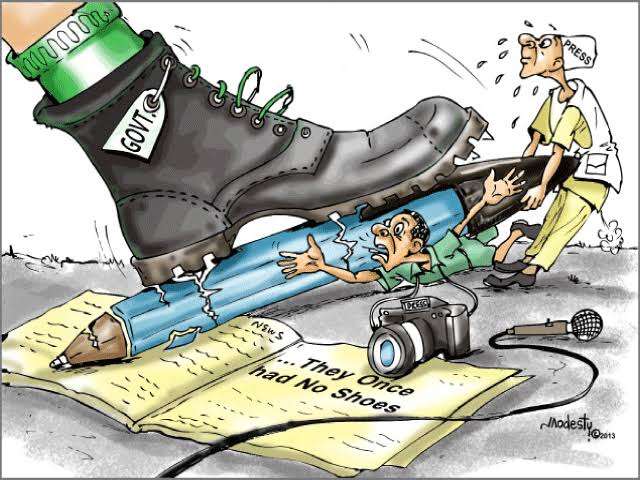
    Six years later, democratic institutions continue to retrogress under Muhammadu Buhari’s watch. With several cases of non-compliance with court order; civic spaces shrinking at an alarming rate; the NBC’s attempt to control digital media, which led to major Nigerian newspapers on July 10, to publish on their front page, in solidarity, the picture of a man with sealed mouth; and the brazen suspension of Twitter which serves as an avenue for citizens to express their displeasure and coalesce their political involvement — these raise concerns about the great lengths that this government will go to further clamp down on free press and preserve itself.

    Media repression is not alien in Nigerian’s history. From the military era, there were several cases of repression which reached a climax with the murder of Dele Giwa under the Ibrahim Babangida regime. Sanni Abacha continued the practice by throwing journalists in jail. And ever since, most political leaders have tried to undermine democracy to advance their personal agenda and retain political power.

    Like Radio Kudirat, which offered an alternative voice to the people by democratizing access to information, hence playing a key role in fighting Abacha’s autocratic regime; the internet, with its increase in usage in the past decade, is also being wielded by ordinary Nigerians to advocate and form communities. According to this Heinrich Böll report on digital rights and privacy, “at the beginning of 2001, a paltry 200 000 Nigerians used the internet. By 2020, that figure had increased to over 126 million — a factor of almost 630 – with a 61.2 percent penetration of the population.”

    In the past, few media platforms such as Tell and Newswatch, decided what filtered into the public space and their reach was limited. The advent of the internet gave rise to a new media practice. This has helped produce journalists, media platforms and activists without the gatekeeping and rigidity of traditional media. They further expand the work of truth-telling and keeping the public informed.

    Social media is part of the new media. It contributes to the sustenance of investigative journalism — an in-depth process of unraveling facts and details. The new media aids the watchdog function of investigative journalism by adding contexts and nuances to the coverage of issues. Samson Itodo, Executive Director of Yiaga Africa, says investigative journalism plays a vital role in exposing violations of human rights. “If democracy is meant to survive, if we’re going to reclaim the state from oppressors, it’s going to take investigative journalists unearthing and sharing information to empower citizens to demand accountability.”

    From the Occupy movement across the world against economic inequality and lack of democracy, to the Black Lives Movement against violence on black people, to the End SARS movement against police brutality, which flowed from the digital space to the streets — the internet, especially social media, takes power from a select few and provides more avenues for not only journalists and media houses, but also the citizens to inform, mobilise, and hold government accountable. With it, the supposed freedom inherent in democracy seems more realizable.

    With the transition to the digital, there was hope that the repressive tendencies that plagued traditional media would have less impact on the civic space. It’s now almost full circle. In January this year, two days before presidential and parliamentary elections, the Ugandan government shut down social media platforms. In Nigeria, it’s been almost two months since Twitter was suspended. (Even though, according to the Heinrich Böll report, the growth in internet usage has been economically significant). In July 2019, The Republic of Chad’s president Idriss Deby, finally lifted the sixteen-month social media ban. It was the longest social media blockage in any African country.

    Social media connects politicians directly to the people, demystifies them. Ironically, the government also tries to use the media and media people to shape the narrative they desire and further oppress the people. “In Nigeria, politics isn’t service,” Itodo adds, “politics is an investment. It’s a pathway to self-enrichment and self-aggrandizement.”

    What happens when the government seeks to completely control access to social media, this power that the people have to information, collaboration and impactful organisation?

    “War is still war, even in the digital age,” writes Kenyan writer and political analyst Nanjala Nyabola in her essay, “Governance and Public Policy in the Digital Age.” She notes that the digital space is changing the way we do politics, “and this creates a new urgency for understanding the digital ecosystem, and specifically understanding the digital rights of citizens. Who will the African citizen be in this new landscape where war is threatened on a whim and public opinion is bought at a song?”

    The media is not the only space shrinking under the leadership of President Muhammadu Buhari; the civil society is not exempt. There’s been heightened attacks targeted at civil society, from introducing legislations to sponsoring organizations that masquerade as authentic civil society groups.

    A research recently published by the Carnegie Endowment reveals that, in a bid to protect themselves from domestic pressure, politicians and top power brokers have cultivated a new generation of thriving pro-government non-governmental organisations (NGOS). Authored by Matthew T. Page, the document offers insight into the proliferation of NGOs created for praise singing of the government and opposition to civil society organisations. “Once a niche side hustle for those seeking to curry favor with the regime, running a pro-government NGO has become an increasingly lucrative means of gaining political and media influence.”

    The study finds that, “Out of 360 pro-government Nigerian NGOs identified by this research, 90 percent have started operating since President Muhammadu Buhari took office in 2015.”

    The author adds that “this correlation suggests that these groups receive high-level support and encouragement.” The document reads, “Many are controlled by a small number of individuals who have personal and ethnic connections to Nigeria’s ruling All Progressives Congress (APC).”

    Challenges of practising investigative journalism in Nigeria

    In addition to financial constraint, a major challenge pervading journalism in Nigeria, “stifled press freedom, poor remuneration, a shoddy education system that lacks the resources to produce a 21st century journalist” are some of the concerns of Damilola Banjo, a Nigerian investigative journalist. Investigative journalism demands rigour, time, access to information and resources that journalists and media outfits may not find available.

    It’s important to note that, oftentimes, traditional media and the new media do not particularly share the same challenges. “Generally, I think readers underestimate the extent to which we lack the media infrastructure for producing quality journalism in Nigeria,” says Wale Lawal, founder and Editor-in-Chief of The Republic.

    “For those publishers who would like to tell the big stories,” Lawal adds, “the high-cost, high-risk nature of such coverage in Nigeria and the lack of protective and/or supportive media infrastructure means limits to the number of journalists capable of taking on such stories. Political uncertainty in Nigeria is increasing and for many publishers that means potential restrictions to what kinds of stories you can tell.”

    What happens after the story?

    In October 2018, Kano state governor Abdullahi Ganduje was caught on camera collecting wads of dollar notes, reported to be some five million dollars. The following month, Jaa’far Jaa’far, the investigative journalist and Editor-in-Chief of Daily Nigerian, who broke the story, was sued for defamation. According to this report by Amnesty, Jafaar received several threats and had to go into hiding. On June 30, 2021, Ganduje withdrew the lawsuit.

    “It’s sad when status quo continues after you’ve risked so much to unearth corruption,” says Banjo, who has covered several investigative stories, including the corrupt system where people pay for the West African Secondary School Certificate Examination (WASSCE) and the Sex for Grades documentary. “But I’ve learnt to live with it.” After her story that uncovered the extortion of people by court clerks and prison warders, there was hardly any systematic change, despite promises by the responsible parties to take action.

    For every assignment, Banjo has several concerns such as safety and maintaining her cover. She has also come to accept her limitations as a journalist. “I can’t implement policies; it is not my job. When I do a story and show the loopholes in the system, maybe even suggest solutions, I have done my job as a member of the fourth estate. It is left to the citizens to demand change, for the civil society organisations to put pressure on the government, for the government itself to implement and enforce. I am first a journalist before any other thing. I know the lines get blurry sometimes because as a Nigerian journalist, you’re forced to be an activist, advocate, pressure group… but those aren’t really my responsibility.”

    The present administration’s attitude toward governance and democracy has shown that real transformation is beyond making attempts at changing leaderships. “The big question many of us have to face post-EndSARS is how we channel our energy towards sustainable and sustained political reform,” says Lawal. “Unlike protests, political reform is neither glamorous nor immediately gratifying. Are we really ready to do the work knowing it could take years?”

    Journalists and media houses play a pivotal role in bringing about long-lasting reforms. The manner in which media outlets are regarded as threats, so much so that security agents raid and demolish their offices, is the same way digital spaces are perceived. Perhaps there are no physical locations to destroy, but the same brazen attempts at censorship still stand.

    As more people adopt digital tools, there’s an urgent need to also adopt digital security and safety practices. Despite the attempts to distort the public’s view of facts and harm journalists, some key players are building structures to strengthen digital rights and the future of investigative journalism. One of such is Ayeta, a toolkit developed by Paradigm Initiative (PIN), with an “aim is to address the growing need to safeguard digital rights defenders, journalists, whistle blowers, and others working with sensitive information in the global South.”

    “I like to think that Nigeria has some of the best journalists in the world,” says Banjo, on her view on the future of investigative journalism in Nigeria. “People who do great journalism despite these odds. And I’m even more excited about the future of journalists coming up in the country. The younger journalists are relentless.”


    Source: www.newswirengr.com