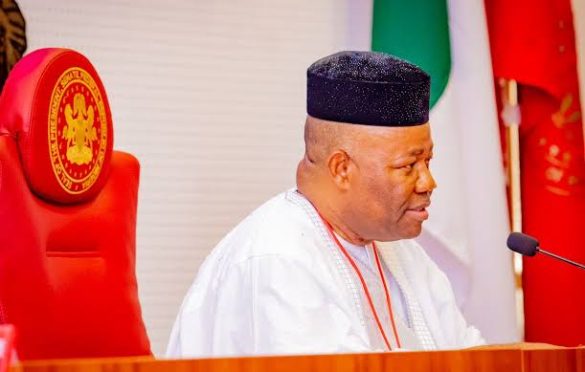
Tag: Godswill Akpabio

  • Akpabio Raises Alarm Over Private Jet Shortage Ahead Of 2027 Elections

    Akpabio Raises Alarm Over Private Jet Shortage Ahead Of 2027 Elections

    Precious Nwonu, Enugu

    Senate President Godswill Akpabio has expressed concern over the difficulty of securing private jets for political campaigns ahead of the 2027 general elections, urging the Federal Government to consider reviving a national airline.

    Akpabio made the remarks during Tuesday’s plenary session while contributing to discussions on challenges in Nigeria’s aviation industry and the difficulties faced by air travellers.

    He warned that the pressure on available aircraft could worsen during the December holiday season, noting that political campaign organisers were already struggling to hire private jets.

    “Watch December and the confusion. Even the private airlines cannot handle. Common campaigns, we cannot see even private jets to hire,” he said.

    The Senate President argued that establishing a national carrier would help strengthen Nigeria’s aviation industry and improve its participation in international air transport.

    He called for a motion to be introduced to facilitate the revival of the defunct Nigeria Airways, insisting that the country needed an airline operating under the Nigerian flag.

    Akpabio recalled that Nigeria Airways once operated about 40 aircraft, including DC-10 planes used for international routes such as Saudi Arabia.

    He questioned how the country had moved from operating such an airline to its present aviation situation.

    The Senate President spoke during deliberations on a motion sponsored by the Senate Chief Whip, Tahir Monguno, representing Borno North, on the need to review and enforce Nigeria’s Bilateral Air Services Agreement with China.

    Monguno called for measures to enable Nigerian airlines to operate direct flights to China, arguing that improved air links would reduce travel time, strengthen supply chains and expand trade between the two countries.

    He also said direct flights could help reduce foreign exchange spent on international air travel.

    Contributing to the debate, Senator Abdul Ningi, representing Bauchi Central, said Nigeria was not maximising the benefits of its relationship with China despite the country’s growing influence in the global economy.

    Following the deliberations, the Senate urged the Ministry of Aviation to renegotiate the bilateral agreement to establish direct commercial air connections between Nigeria and China.

  • Senate Declares Akpabio’s Position Secure Amid Political Attacks

    Senate Declares Akpabio’s Position Secure Amid Political Attacks

    Precious Nwonu, Enugu

    The Senate has unanimously declared that there is no vacancy in the office of its President, reaffirming its support for Godswill Akpabio amid controversy over his comments on a bill seeking to decriminalise attempted suicide.

    The resolution followed remarks by Akpabio during Thursday’s plenary, where he said his comments on the proposed legislation had been misrepresented in public discussions.

    The Senate President argued that his position on the bill should not be interpreted as hostility towards any religion, noting that his aide-de-camp of 19 years was a Muslim.

    He also maintained that terrorists had no religion and that those destabilising the country should not be associated with any faith.

    Akpabio cautioned television commentators against distorting statements made during legislative proceedings, adding that the Senate presidency had become a target of political attacks after the offices of the President and Vice-President had been settled.

    Supporting the resolution, Senator Fasuyi backed a motion moved by Senator Monguno, affirming that Akpabio remained the recognised occupant of the office.

    Senator Babangida Hussaini also expressed support for Akpabio, citing his contributions to his state and endorsing his continued leadership of the Senate.

    Hussaini, however, raised concerns about the spread of hard drugs and substance abuse, calling for measures to address the problems and prevent them from contributing to criminality, banditry and terrorism.

    The controversy followed Akpabio’s remarks during Tuesday’s debate on a bill sponsored by Senator Asuquo Ekpenyong seeking to decriminalise attempted suicide and establish a national framework for suicide prevention.

    During the debate, Akpabio was reported to have said that anyone who attempted suicide should succeed or face imprisonment, a position that drew criticism amid arguments over whether survivors should be prosecuted or receive medical attention.

    Presenting the bill, Ekpenyong argued that criminalising attempted suicide could discourage people in distress from seeking help and encourage survivors to conceal their experiences.

    He proposed replacing criminal penalties with medical assessment, treatment, referrals and continued support for survivors.

    The bill also seeks to establish coordinated suicide prevention services, including crisis helplines, referral systems and follow-up care.

    Ekpenyong maintained that people who survive suicide attempts should receive urgent clinical attention rather than face prosecution or imprisonment.

    Akpabio, however, argued during the debate that attempted suicide remained a criminal offence under the existing legal framework.

    The exchange highlighted the disagreement over how Nigeria should respond to suicide attempts, with the proposed legislation seeking to shift the emphasis from punishment to prevention, treatment and rehabilitation.

    The bill passed second reading on Tuesday and is intended to establish a coordinated framework for suicide prevention and support for people experiencing suicidal crises.

  • Akpabio Opposes Suicide Decriminalisation As Senate Bill Passes Second Reading

    Akpabio Opposes Suicide Decriminalisation As Senate Bill Passes Second Reading

    Precious Nwonu, Enugu

    The Senate has advanced a bill seeking to decriminalise attempted suicide in Nigeria and establish a national suicide prevention framework, despite opposition from Senate President Godswill Akpabio, who insists that offenders should continue to face imprisonment.

    The bill, sponsored by Senator Asuquo Ekpenyong, representing Cross River South, seeks to replace criminal punishment for attempted suicide with a health-focused approach that prioritises treatment, rehabilitation and support for survivors.

    Presenting the proposal, Ekpenyong said Nigeria’s existing laws contained a contradiction, as the National Mental Health Act recognises attempted suicide as a psychiatric emergency requiring care, while Section 327 of the Criminal Code and Section 231 of the Penal Code criminalise the act.

    He argued that criminalising suicide attempts discourages people experiencing psychological distress from seeking help and often forces families to conceal such incidents.

    The senator also warned that the threat of prosecution could worsen the situation by making vulnerable individuals afraid to seek medical attention after surviving an attempt.

    “At the heart of this bill is a simple question: when a Nigerian survives a suicide attempt, should the first response of the state be prosecution or protection?” he asked.

    The proposed legislation provides for mandatory assessment, referral, treatment and follow-up support for survivors instead of imprisonment.

    It also seeks to introduce crisis helplines, train police officers, teachers and healthcare workers to respond to suicide risks, promote public awareness and establish a national data system to support prevention efforts.

    However, Akpabio opposed removing criminal penalties, arguing that decriminalisation could encourage attempted suicide.

    “If you attempt suicide, make sure you die. Anyone who attempts and fails will go to jail,” the Senate President said.

    Akpabio also noted that the issue involved provisions in both the Criminal Code and the Penal Code, stressing the need to involve state legislatures during a public hearing to prevent legal conflicts.

    Despite the disagreement, the bill passed its second reading and was referred to the Senate Committees on Judiciary and Health for further legislative consideration and a public hearing.

    The proposed law will undergo further scrutiny before the Senate decides on its next legislative steps.