Tag: cashless policy

  • Osinbajo: Cashless Policy Will Curb Illicit Election Financing In Nigeria

    Osinbajo: Cashless Policy Will Curb Illicit Election Financing In Nigeria

    He noted that so much money can be spent without it being tracked under the current election financing system in the country.

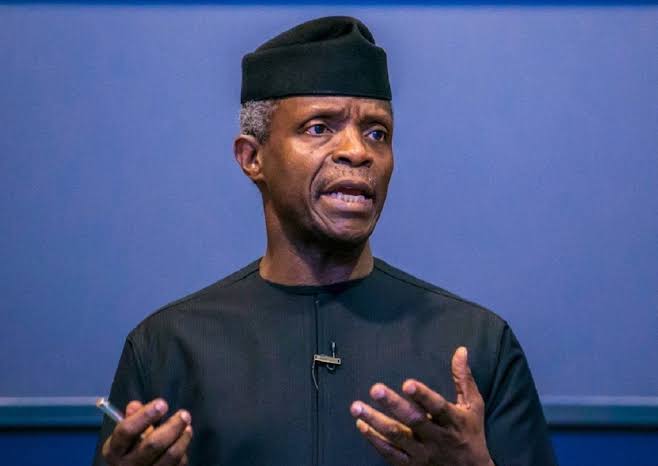
    Nigeria Vice President Yemi Osinbajo has declared that cashless monetary policy will go a long way to curb illicit election financing in the country.

    He submitted that when fully operational, the cashless policy being introduced in Nigeria can help stem the surge of illicit election financing by making it possible to track funds.

    Speaking Monday while playing host to a delegation of the European Union Election Observation Mission led by the Chief Observer, Mr. Barry Andrews, who is also a member of the European Parliament at the State House, Abuja, Osinbajo noted that so much money can be spent without it being tracked under the current election financing system in the country.

    According to him: “I think that what we should be looking at is to provide more infrastructure. The cashless thing has been really advantageous and helps with tracking. That sort of infrastructure is useful for more financial inclusion and the more financial inclusion you have, the easier it is to track.”

    While noting the serious difficulty in controlling election financing because of cash transactions, the Vice President stated that there are still infrastructure issues required to be in place to ensure an efficient cashless system in the country.

    He observed that with cash transactions, it is still difficult to seriously control election financing.

    On the issue of electoral offences, Osinbajo noted that there is the Electoral Offences Commission Bill at the National Assembly and “we hope that it will begin a new regime of dealing with electoral offences which would be helpful.”

    He emphasized that by and large, one shouldn’t expect INEC to be the investigator of electoral offences. I think that law enforcement agencies should be responsible for arresting and prosecuting offenders, State by State.

    “Electoral offences are always seen through a political prism; people will always feel that they are being prosecuted because they belong to a certain party.

    “What is more important is that we have to find a system where the police could have a special unit for offences during the course of elections. The Federal High Courts could also have a special jurisdiction to deal with offences and not extend beyond the Federal High Courts.”

    Commenting on the role of the judicial system, the Vice President noted that more attention should be paid to the monitoring of tribunals and their outcomes, calling for more scrutiny from the National Judicial Council.

    He disclosed that there were discussions in the past concerning malfeasance on the part of some judges saying those found guilty should be brought to the fore.

    His words: “There should be sanctions and that way, we would be able to clean up and correct some of the problems”.

    In his remarks, Mr Andrews mentioned that the Observer Mission would be monitoring the elections coming up next month and hope for a peaceful and fair electoral process.

    According to him, this is the seventh time the Independent National Electoral Commission is inviting the EU Mission to monitor the elections, adding that the team has been in the country since 11th January and would be here till the end of March, 2023.

    Other members of the delegation include Ambassador, EU Delegation to Nigeria and ECOWAS, Ms Samuela Isopi and Deputy Chief Observer, EU Election Observation Mission, Mr Thomas Boserup

    (Arise News)
  • FG, states, LGs to go fully cashless March 1

    FG, states, LGs to go fully cashless March 1

    Worried by the inflationary consequences of huge public sector cash withdrawals on the nation’s economy, the Nigerian Financial and Intelligence Unit (NFIU), yesterday, outlawed cash withdrawals from all government accounts effective March 1, 2023 warning that defaulters risk three-year jail term.

    The NFIU declared that such transactions would now be done electronically in line with the Central Bank of Nigeria (CBN) monetary policy.

    It said defaulters who fail to heed the cash restriction order on public accounts risks collaborative investigation by the Nigeria Financial Intelligence Unit (NFIU), Economic and Financial Crimes Commission (EFCC) and Independent Corrupt Practices Commission (ICPC).

    Director and Chief Executive Officer, NFIU, Modibbo Tukur, who confirmed the latest development at a press briefing at the Unit’s office in Abuja, said defaulters risk spending three years behind bars.

    He said “The NFIU had told banks and government agencies at all levels to go fully digital by moving online, as all transactions involving public money must be routed through the banks for the purpose of accountability and transparency.

    “This is not reversible as we are only enforcing the law. As far as we are concerned, Nigeria will become a full non-cash economy by March 1, 2023. As a consequence, any government official that withdraws even one naira cash from any public account from March 1 will be investigated and prosecuted in collaboration with relevant agencies like EFCC, ICPC and the NPF”, he said.

    Tukur clarified that under the guidelines, only the President can give a waiver for any cash above the approved daily threshold to be withdrawn for urgent or emergency reasons.

    He said despite the introduction of the cash withdrawal limits in the country, state governments withdrew a total of N701 billion cash above the N225 billion withdrawn by the Federal Government and N156 billion withdrawn by the local governments in the country, bringing total public sector cash withdrawals between 2015 to date to N1.082trillion.

    “With some states withdrawing up to N24 billion and then we also discovered that the Federal Government withdrew in cash up to N225 billion while the local governments withdrew up to N156 billion.

    “So if we are to apply the law here, all the public servants involved in these withdrawals are entitled to three years imprisonment. That’s what the law said”, he said.

    The NFIU therefore directed federal, state and local governments in the country to put necessary measures in place to ensure the smooth operationalisation of the new policy.

    He advised the different tiers of government in particular, to deploy technology and train their staff to be able to apply the new policy from the stipulated date.

    Modibbo said: “With the implementation of this guideline, Nigeria has been taken into a non-cash economy with effect from March 1, 2023.”

    Continuing, he said: “The rate of withdrawals above the threshold from public accounts has been alarming, over N701 billion has been withdrawn in cash from 2015 till date. So you are all aware of the inflation in the economy, public servants traveling, this and that, so the mark of withdrawing above the threshold is becoming very frequent.

    “For government exigencies, only the President has the power to grant any waiver to any government official considering the importance of the situation; either for national security, health, or other important reasons.”

    “From the first of March 2023, if there is any cash withdrawal, it is going to trigger off money laundering investigation in EFCC, ICPC, the Nigerian police, or all the law enforcement agencies, depending on the relevance of the withdrawal.

    “So it’s also understood, the cash in the system is limited. But with this guideline, we expect that cash withdrawal from the system will go down by about N1 trillion out of the N3 trillion cash that is in circulation on a weekly basis now.”

    In his reaction, Frank Onyebu, Chairman, MAN, Apapa Branch, said: “This measure is laudable, but I think it’s still a tall order based on so many militating factors, chief of which is infrastructural deficiency. We cannot be talking about going totally cashless when we still have problems with internet penetration”.

    Chairman, SMEs Group of the Lagos Chamber of Commerce and Industry (LCCI), Daniel Dickson-Okezie, said it was a welcome development.

    “The more cashless we go, whether at governmental, organisational or individual levels, the better for the economy and society. The issue of cashless economy was mooted for the first time during the Olusegun Obasanjo administration. The policy is acceptable because it will check crime, money laundering, corruption in government, private and public sectors. Businesses don’t thrive in a corrupt society, investors don’t want to invest in a corrupt environment and corruption affects government too. So cashless economy will tame corruption”, he said.

    He however tasked the government to follow it up by improving information technology infrastructure saying “The whole thing is based on ICT and it is important that we are able to make payments seamlessly.”

    An economist, Dr Nathan Owhor, lauded the directive by NFIU on MDAs to ensure that all receipts and payments on government transactions from March 2023 are cashless.

    “The leakage in the MDAs are huge and not good enough for the economy. The Chief Executives in the MDAs must learn how to be accountable and show greater financial discipline. Some of them who claim to have strong godfathers are actually reckless with government finances and they enjoy protection. This protection is usually sustained by huge cash rewards which is a drain on the economy.

    “The new cashless policy for the MDAs will therefore achieve four broad objectives amongst others. In the first instance, which is perhaps key, is the ability to track government receipts and payments. Secondly, it has the capacity to reduce the high level of waste and mismanagement in the MDAs. It will also build trust in the domestic economy because of the level of transparency it will engender. All of these possibilities in the final analysis will make more funds available for development projects,” he said.

    (Sun)

  • Court declares CBN cashless policy on 6 states discriminatory and unreasonable


    A Federal High Court sitting in Awka, Anambra State, and presided over by Justice N.O. Dimgba, has ruled as discriminatory the cashless policy of the Central Bank of Nigeria on six states of the federation and the Federal Capital Territory.


    The states are Anambra, Abia, Lagos, Ogun, Kano and Rivers


    This followed a suit instituted by an Anambra-based legal practitioner, Chijioke Ifediora, against the apex court, describing the policy as discriminatory and offending section 42 of the 1999 Constitution.


    Ifediora told the court, “On the January 7, 2020, I visited a branch of the Bank in Amawbia Awka, to make payments into my bank account with the sum N600,000 but I was told by a staff of the bank that I would be charged three per cent of the cash amount I had.


    “On enquiry, I was shown a Central Bank circular which was pasted across the cash machine PSM/DIR/CON/CWO/02/014 published on September 17, 2019, mandating the bank to charge three per cent for lodgement above N500,000.


    “I was prevented from making the lodgement except I paid three percent of the cash amount above N500,000. There is no constitutional foundations for such discriminatory policy neither is any statutory enabler for such biased circular.”


    The counsel for the CBN, Jackson Iragunima, in his submission, contended that the policy was not discriminatory, but for the wellbeing of the country.


    The CBN maintained that the plaintiff did not have the authority of all the citizens and corporate institutions residing in Anambra, Abia, Lagos, Ogun, Kano, Rivers and FCT to institute the action on their behalf.


    In his judgement, Justice Dimgba said, “I believe the claims in these depositions are sufficient to donate the plaintiff  not  only  with  a  locus  standi,  but  also  a reasonableness on the case which he has brought before the court.”


    Describing the policy as unreasonable, he agreed with the plaintiff that the CBN policy was discriminatory and offended section 42 of the 1999 Constitution (as amended).


    He said, “Assuming that the cashless policy is beneficial to the nation for its financial stability and growth, and inevitably demands the imposition of financial levies on banking customers as an incident of its operationalisation, why will residents in some named states suffer this disability while those in other states do not?


    “This nation, as all civilized nations of the modern era, is governed by the rule of law. The rule of law demands that government institutions, such as the defendant in this suit, should provide rational justifications for policy choices they have made and not to act arbitrarily.”


    The judge added, “This aspect of the policy imposing financial levies on lodgements/deposits, in my view, appears unreasonable. And it makes no difference if same was applied throughout the federation or limited to only the residents of a few states.”


    Source: www.punchng.com